Tag: Arniston

  • WHERE TO FISH PART 10

    WHERE TO FISH PART 10

    Exploring Agulhas’s graveyard of ships

    By Johan Smal
    [Originally published in the July 2023 issue of Ski-Boat]

    THE southern part of the meridian 20° east of Greenwich, stretching from Antarctica to the southernmost point of the African continent, makes landfall at the little town called Agulhas. Renowned for separating the great Atlantic from the Indian Ocean, this famous line of longitude cuts neatly through the heart of the notorious “Graveyard of Ships”, the fishing theatre we focus on in this article.
    The seas that pound our shores, although enchanting, are some of the most treacherous in the world. Legendary for its sudden weather changes with gale-force winds whipping up the seas, this area sees massive, fast-moving swells exceeding 10 metres. The 130-odd shipwrecks which lie scattered along the coastline, bear testimony to this phenomenon.
    And yet, these treacherous and captivating waters also provide recreation, adventure and sustenance for thousands. Famous for its annual bumper yields of yellowtail in particular, the area’s rich marine life and breathtaking sea- and landscape scenery, is appropriately considered as a place of plenty.
    The continual mixing of the icy north-flowing Benguela current up the west coast and the warm south-flowing Agulhas current hugging the east coast, generates one of the five richest marine ecosystems in the world. This Agulhas area has been synonymous with fishing for millennia, and Arniston (also named Waenhuiskrans in Afrikaans) and Struisbaai, with its quaint little harbour, are two of a few remaining line-fishing communities along the Cape’s east coast.
    From September to April, the mighty Agulhas current sweeps across the Agulhas Banks, swathing very large inshore areas with generous plankton- and baitfish-rich warm eddies. The abundance of fish species caught in the area, especially at this time, fuels the zest of fishermen even from afar.
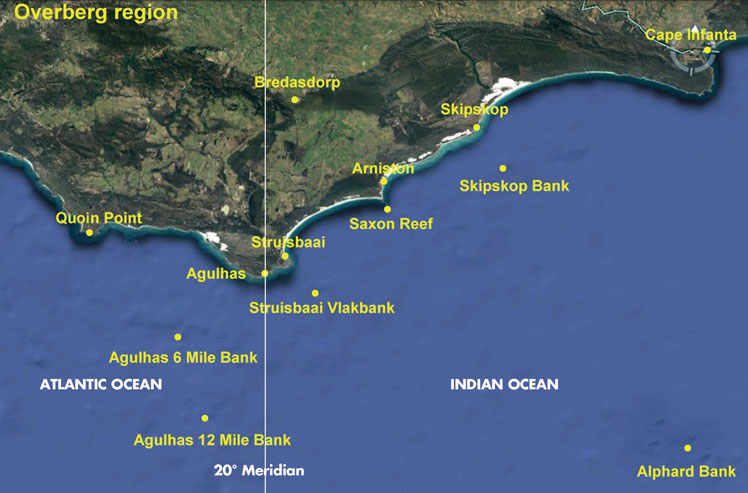
    For this article in the popular Where to Fish series, our focus area stretches from Die Dam near Quoin Point in the west, up to Cape Infanta, located at the mouth of the Breede River some 125km east along the coast. Die Dam is where Rob Naysmith finally cut his line in Part 4 of this series, “Exploring the Overberg”, in the January/February 2022 issue of SKI-BOAT.
    LAUNCHING AND TRAILERING FACILITIES
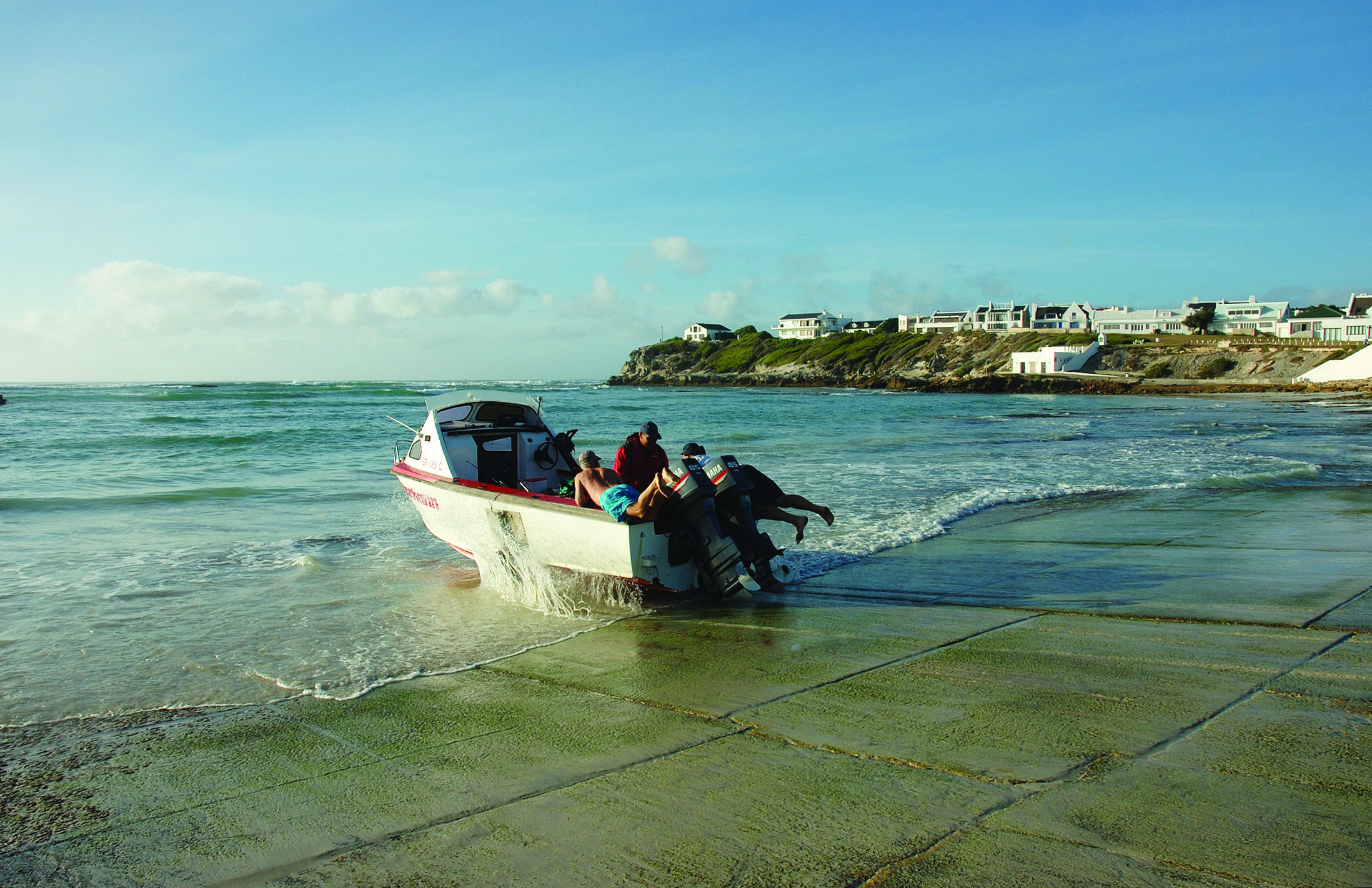
    Due to the rocky nature of the coastline, there are only two official launching facilities serving this huge fishing area. If you want to fish both the Atlantic and Indian oceans in one day, then you launch from Struisbaai harbour.
    This is the home of the Suidpunt Deep Sea Angling Club that stages the popular Two Oceans Marlin Tournament and Yellowtail Bonanza. (For further details please contact the club manageress, Marinda de Kock on 0761913744 or 2017sphk@gmail.com.)
    Struisbaai is the only conventional breakwater launching and trailering facility, and over 95% of all boat anglers fishing this huge Agulhas area launch there.
    Built in 1986 though, it was not designed to cope with as many boats in a short space of time as is experienced nowadays. On busy holidays, when over 150 craft could make use of the facility on fishable days for example, some serious logjams are caused with boats queuing far back into town. The harbour also sometimes sands up, resulting in very low water levels being encountered around the slipways during spring low tide. A three or four hour no-go safe window is usually then observed to avoid boats getting stuck on the sandbar which would cause damage to drive mechanisms, especially on the bigger craft.
    Renowned for breaking heavily at times, another risk is the very shallow bank called Borrelgat located to the port side immediately as you leave the harbour. During heavy breaking waves skippers must also take note of the risks associated with the remaining engine block of the Oriental Pioneer (S34 48 783 E20 05 295) located off Northumberland Point. The Chinese ore carrier ran aground in July 1974, and the engine block still sticks out at spring low tide.
    Launching from the Arniston harbour also needs sober, clearheaded and well-prepared skippers and crews. Running your precious ski-boat down this unique, 7° angle concrete slipway on special wheel modifications, directly into the oncoming surf, makes for exceptional challenges and exciting launches.
    Deprived of the normal thrust at your disposal due to disproportionately trimmed engines to prevent prop and drive gear damage, and even further disadvantaged by the excessive drag created by the detachable wheels fitted on the sides of the boat, one must negotiate the surf at greatly reduced speeds.
    With very little margin for error and no opportunity to turn away from oncoming waves or run to protected areas, the skipper’s timing must be impeccable. This is especially crucial during low tides when he must also negotiate the narrow six-metre wide gap between protruding rocks, which is the only passage out to sea. Fortunately, after unclipping and stowing the wheels, the last 80 metres of incoming surf can be faced at full thrust if necessary.
    THE FISHING THEATRE
    Situated entirely on top of the Agulhas Continental Shelf, although annoying to mariners around the globe due to its treacherous nature, the area offers relatively shallow fishing grounds. Referred to as some of the best fishing waters in South Africa, copious quantities of a large variety of both bank- and gamefish species are lifted from these productive waters each year.
    The area is broadly shaped like a skewed, upside-down triangle. Sited on the western extreme, we have the Brandvlei area that is popular for kob. To the south-east of that you find the Agulhas 6-Mile Bank (also called Blougansie) which is located 13km diagonally offshore and produces good yellowtail and geelbek at times.
    On its seaboard side, located 28km from the Struisbaai harbour and essentially signifying the outer range for Category C craft, is the famous Agulhas 12-Mile Bank. Having to negotiate the busy shipping lane that runs around Africa means that sometimes numerous huge cargo ships will cross your path, but it’s worth it, just go carefully. This bank boasts two very productive 30m deep pinnacles, producing vast yellowtail catches at times.
    During high summer months the areas along the 100m contour line stretching further beyond the bank, is a very popular choice for tuna, marlin, and other gamefish species.
    If you head straight into the rising sun some 6km out of the Struisbaai harbour, you’ll find the Struisbaai Vlakbank, the most popular structure where mainly yellowtail are targeted. Due to the strong flowing current, anchoring is seldom possible and catches are taken either on the troll or drift.
    Many years ago this bank was known as the seventy-four bank and yielded hundreds of tons of this fine table fare. Although seventy-four numbers have recovered remarkably further up the coast, only a few small fish have lately been reported hooked and safely released since they were fished out in the area around the mid-1950s.
    Also referred to as the Bulldog, the treacherous Saxon Reef is located further up the coast at Struispunt, only 3km west of Arniston. It is a shallow structure that runs diagonally seawards from shore and is demarcated by a 13m high solid stone beacon erected in the intertidal zone many moons ago.
    Anglers pulling trolling baits parallel to the reef and as close as possible to the structure can catch giant yellowtail and yellowfin tunny within 100 metres of the shore. Several of these trophy yellowtail specimens have brought their catchers the first prize spoils of the annual Suidpunt Yellowtail Bonanza. However, this fishing spot is jealously guarded by razor-sharp rocks cunningly concealed underneath the serene beauty of the surrounding waters, so skippers must take the utmost care and maintain vigilance while working this area.
    At the top end of the “triangle” in the eastern corner near Cape Infanta, there are also some popular fishing spots. These are fished by boats which launch in the Breede River from Witsand and then work their way down in a south-westerly direction.
    The popular Skipskop bank area located some 24km from Arniston, often yields good catches of various species, especially yellowtail, geelbek and santer. When good catches are reported in this area, it is not uncommon to experience a real traffic rush with many Struisbaai boats also joining in to get some of the bounty on offer.
    This area is located near the world famous De Hoop Nature Reserve, legendary for its countless whale sightings and considered one of the most diverse floral habitats on this planet in terms of the biota. The reserve’s offshore extension, the De Hoop Marine Protected Area (MPA), is zoned as a restricted no-take area. Conserving a vast and fascinating variety of marine life, this World Heritage Site is one of the largest marine protected areas in Africa.
    At the bottom, southernmost point of our triangular area, essentially the outer limits for Category B craft and located 65km south from Cape Infanta and 75km from Struisbaai harbour, you’ll find our own unique underwater archipelago — the Alphard Bank. Because it’s so shallow, this area has been defined as a Traffic Separation Scheme, as ruled by the International Maritime Organization.
    Due to its distance from shore and because adverse weather conditions sometimes curtail the approachability, it remains the most unspoiled and fish-rich angling destination in the Agulhas theatre. Rising to depths of between 48- and 15m, some 20 apexes above the 50m contour of the underwater islands offer excellent trolling, jigging and soak-baiting opportunities for intrepid anglers. Even Cape snoek are taken here on jigs at 60m depths.

    TARGETING AGULHAS SPECIES
    Other articles in this series have comprehensively covered all the basics required to fish off the South African coast, including general tackle and boating requirements, so I’m not going to go over those. Instead, I’ve opted to share our general local practices when launching for a day out on the deep blue.
    Obviously planning should begin with assessing reports of recent catches so you can determine what species to target, the route to take (noting the most important marks) and where to commence the first lines-down. Based on species abundance, availability, endangered status and habitat, I’ve also loosely classified the day’s intended proceeds in logical groupings, categorised under two main headings: Reef Species and Gamefish Species. These are further subdivided into species specifically targeted and bycatch.
    Although there are substantially more species found in the Agulhas areas, I’ve focused on the most important targeted and bycatch ones.
    During summer months the Agulhas hallmark, yellowtail, is always on top of the list for the day’s pickings. If they’re not available, kabeljou, geelbek, red steenbras and red stumpnose (in order of priority) tend to be the targeted fallback species. The remaining reef species, essentially caught among the targeted species and usually not purposely targeted for the day, are classified as bycatches.
    Having searched for the abovementioned target species for some hours without any reward, the crew might well be treated to a last-chance decision by an emptyhanded skipper to stop over a known spot on the way back home. These are the points that tend to yield more bycatches than targeted species.
    TARGETED REEF SPECIES
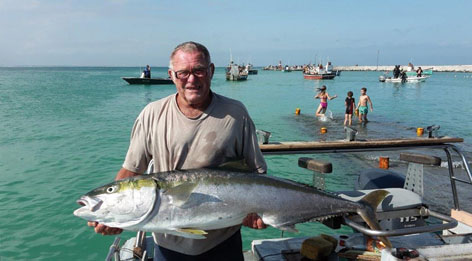
    CAPE YELLOWTAIL
    A highly nomadic species that aggregates and moves between offshore reefs.
    Main areas: 2, 3, 4, 13, 16 and 17.
    Time of year: Habitually, from September or October with huge shoals of small (2-3kg) fish massing in the area, but reluctant to go on the bite. Catches slowly improve exponentially with bigger fish (2-6kg) taken until about December. Bumper catches of shoaled fish up to 14kg are then sporadically taken for some months. A limited number of loners up to 25kg are also taken. Numbers start to dwindle again towards the end of April when catches become much scarcer. Their most productive feeding times are usually early morning and late afternoon.
    On the troll: If they are not feeding on or near the surface, try hard diving lures such as Rapalas in a mixture of sizes and colours. When the ’tail are feeding on the surface, switch to skirted lures and spinners in a mixture of sizes and colours.
    Drifting or on anchor: Jigs of various sizes and colours can be used. If you opt for bait, the best is fresh pilchard or pike, sandwiched with a piece of octopus or squid. When the ’tail are in an eating frenzy, they’ll take anything you throw at them.
    Water temperature: Over 16°C
    Size: 2 to 25kg, with the bulk of catches during high season being 4- to 13kg fish.
    (Interesting to note that juvenile amberjack have also been caught on both the Agulhas 12-Mile and Skipskop banks, with a tropical yellowtail caught from a boat anchored in the Struisbaai harbour during a marlin competition.)

    KABELJOU/KOB
    Both species are very mobile. Silver kob are mostly found on moderate and low-profile reefs in 20-120m depths, with dusky kob predominantly found in the near-shore marine environment, river mouths and estuaries. Based on the numbers taken lately, both these species are under serious pressure.
    Main areas: 1, 4, area 5 to 6, 8, 11, 13, 14, 15 and 16
    Time of year: Mostly December to June. Usually found in shoals, but individual fish are often taken amongst other species, especially geelbek shoals.
    Drifting or on anchor: Use the large baits or cut baits shown.
    Water temperature: Over 18°C
    Size: up to 45kg

    GEELBEK
    A shoaling species found over sandy and shallow rocky substrata to depths of 150m throughout their distribution.
    Main areas: 2, 3, 4, 11, 12, 13, 14, 16 and 17.
    Time of year: Mostly Nov to Apr. The geelbek is a nocturnal feeder and normally caught at night, but for daytime fishermen the best time to catch them is during morning twilight. Experience has shown that the moment the sun appears on the horizon they go off the bite … meaning that if one of the crew members “oversleeps” and launching is delayed, the whole crew might have to do without that so wanted geelbek for dinner.
    Drifting or on anchor: Use the large baits or cut baits shown.
    Water temperature: Over 18°C
    Size: Up to 12 kg.

    RED STEENBRAS
    These coppery-red fish with large canine-teeth are the largest of the seabream family and feed mainly on reef fish. The older males become more yellow in colour with black markings on the head and back.
    Main areas: 3, 4, 9, 10, 11, 13, 14, 15, 16 and 17.
    Time of year: They tend to remain in deep water during the winter months, but are caught on reefs closer to shore mainly from September to June.
    Drifting or on anchor: Use the large baits or cut baits shown. For this species the best bait is a live steentjie or one with the backbone removed and the “calling flaps” swaying enticingly in the current.”
    Water temperature: Over 14°C
    Size: Mostly young fish from 3- to 10kg but can be up to 57kg like one specimen that was caught on the Agulhas 12 Mile Bank.

    RED STUMPNOSE
    A highly resident species found on offshore reefs to depths of 150m, red stumpnose have partially lost their localised migratory patterns due to severe population depletion.
    Main areas: Found on all reef structures, but as they are seriously under pressure please think long and hard before removing them.
    Time of year: More abundant from August to May, but they are also caught during the winter months.
    Drifting or on anchor: Use the cut baits I’ve detailed. Red stumpnose are not very fussy, but a longish piece of octopus leg usually does the trick, nicely and quickly.
    Water temperature: Over 14°C
    Size: Up to 5kg.

    REEF SPECIES BYCATCH
    RED ROMAN
    Highly resident species with a small home range, less than 100m in linear extent. Of all the bycatch species it is the most prolific, being found on all reefs and caught all year round. Mostly juveniles have been caught lately, and this is yet another species under pressure.

    SANTER
    This is my favourite table fare. A nomadic species, santer move up to 10km between structures, with local movements into shallow waters following cold water upwelling events. They are caught on most reef complexes during the summer months. Some 5kg specimens have been caught, but catches are also dwindling notably lately.

    CARPENTERS
    This is a shoaling species with adult fish mostly found in further offshore water columns just above high-profile reefs from 50-200m. Juveniles are found on shallower reefs 10-40m with individuals usually caught among other species on all reef structures.

    BLACK MUSSELCRACKER
    Adults are found on high-profile inshore and offshore reefs down to 100m, with juveniles found in the rocky surf-zone and shallow subtidal reefs. Catches are also dwindling.

    YELLOWBELLY ROCKCOD
    Catches in this area are mainly juveniles which are found on most rocky reefs from the surf zone down to 200m.

    LEERVIS
    This is not a bycatch species nor specifically targeted regularly, but adults up to around 25kg are found all along the Agulhas nearshore surface waters during the summer months.
    Popping or spin-fishing whilst casting into the surf zone from a stationary boat, or trolling lures, spinners or live-bait near the surf zone are the only ways to reach them from a craft, but unfortunately have not proven to be very effective. Leervis are usually caught while feeding on shoals of spawning elf close to shore during December and January, using a live elf as bait.

    TARGETED GAMEFISH SPECIES
    MARLIN
    It’s mostly black- and striped marlin that are caught in this area, but blue marlin and the odd white marlin, as well as the odd sailfish, have been caught in the Agulhas 12-Mile bank (especially along the 100m contour), Struisbaai Vlakbank, Skipskop Bank and Alphard Bank areas. These are caught during the high summer months of January and February, using both lures and livebait, of which a yellowtail, if available, yields very good results.

    TUNA SPECIES
    Yellowfin tuna, skipjack tuna and Atlantic bonito (katonkel) are regularly caught in the Agulhas area from December to March. Use a mixture of lures, Rapalas and spinners to target them.

    GAMEFISH SPECIES BYCATCH
    Dorado are regularly caught during the high summer season, with the odd wahoo also showing its face inbetween marlin and tuna. Dorado are usually caught in the warm current further offshore.
    My thanks go to local fishermen Traill Witthuhn, Johan van der Walt and Henk Aggenbach who eagerly assisted in compiling this article. Lekker stywe lyne vir almal daar buite op die diep blou!


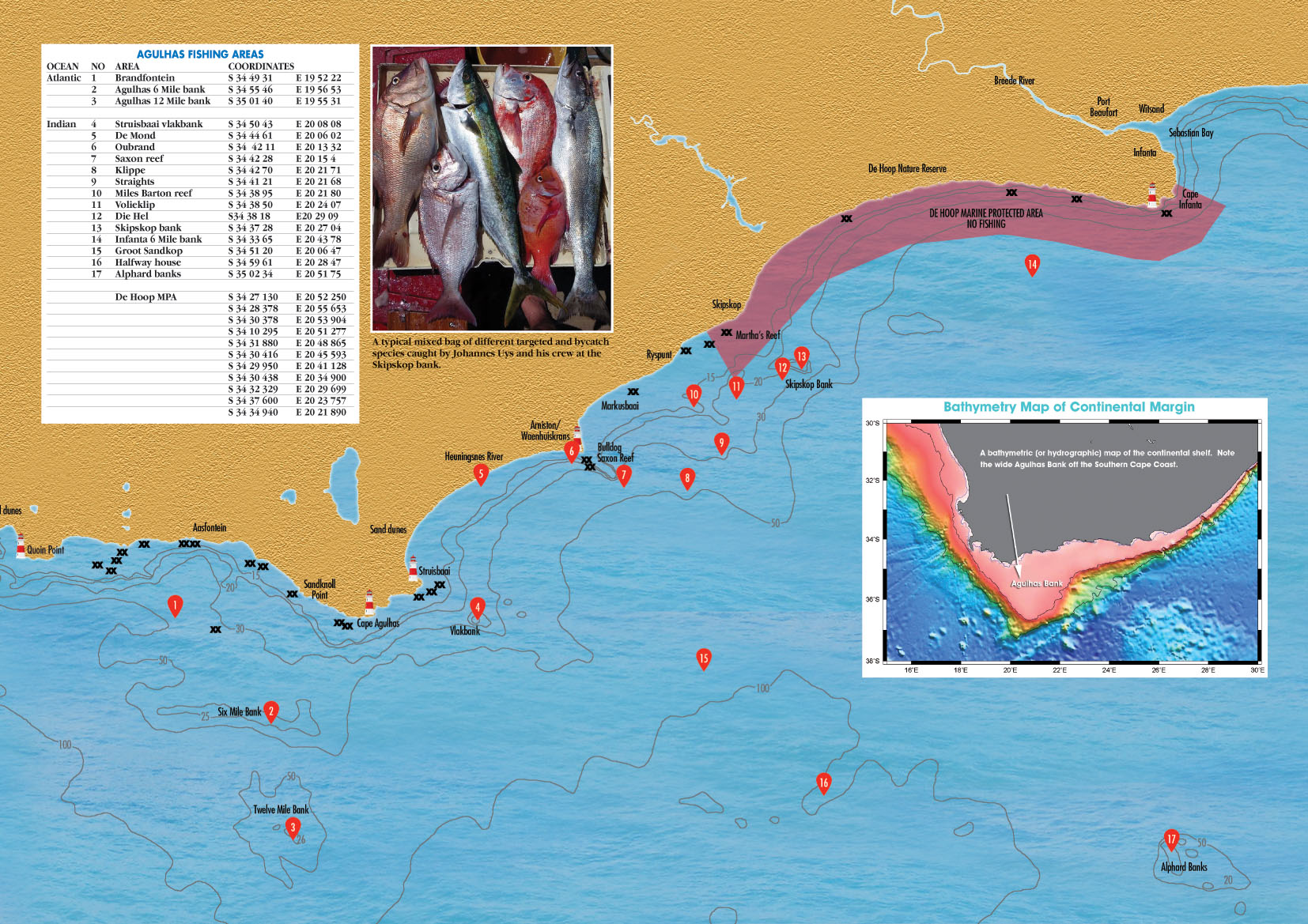
    AGULHAS FISHING AREAS
    OCEAN NO AREA COORDINATES
    Atlantic Ocean

    1 Brandfontein S 34 49 31 E 19 52 22
    2 Agulhas 6 Mile bank S 34 55 46 E 19 56 53
    3 Agulhas 12 Mile bank S 35 01 40 E 19 55 31

    Indian Ocean

    4 Struisbaai vlakbank S 34 50 43 E 20 08 08
    5 De Mond S 34 44 61 E 20 06 02
    6 Oubrand S 34 42 11 E 20 13 32
    7 Saxon reef S 34 42 28 E 20 15 4
    8 Klippe S 34 42 70 E 20 21 71
    9 Straights S 34 41 21 E 20 21 68
    10 Miles Barton reef S 34 38 95 E 20 21 80
    11 Volieklip S 34 38 50 E 20 24 07
    12 Die Hel S34 38 18 E20 29 09
    13 Skipskop bank S 34 37 28 E 20 27 04
    14 Infanta 6 Mile bank S 34 33 65 E 20 43 78
    15 Groot Sandkop S 34 51 20 E 20 06 47
    16 Halfway house S 34 59 61 E 20 28 47
    17 Alphard banks S 35 02 34 E 20 51 75

    De Hoop MPA

    S 34 27 130 E 20 52 250
    S 34 28 378 E 20 55 653
    S 34 30 378 E 20 53 904
    S 34 10 295 E 20 51 277
    S 34 31 880 E 20 48 865
    S 34 30 416 E 20 45 593
    S 34 29 950 E 20 41 128
    S 34 30 438 E 20 34 900
    S 34 32 329 E 20 29 699
    S 34 37 600 E 20 23 757
    S 34 34 940 E 20 21 890
  • HANDLINING YELLOWTAIL PART 3

    HANDLINING YELLOWTAIL PART 3

    (Originally published in the May 2019 issue of Ski-Boat magaine)

    By Johan Smal

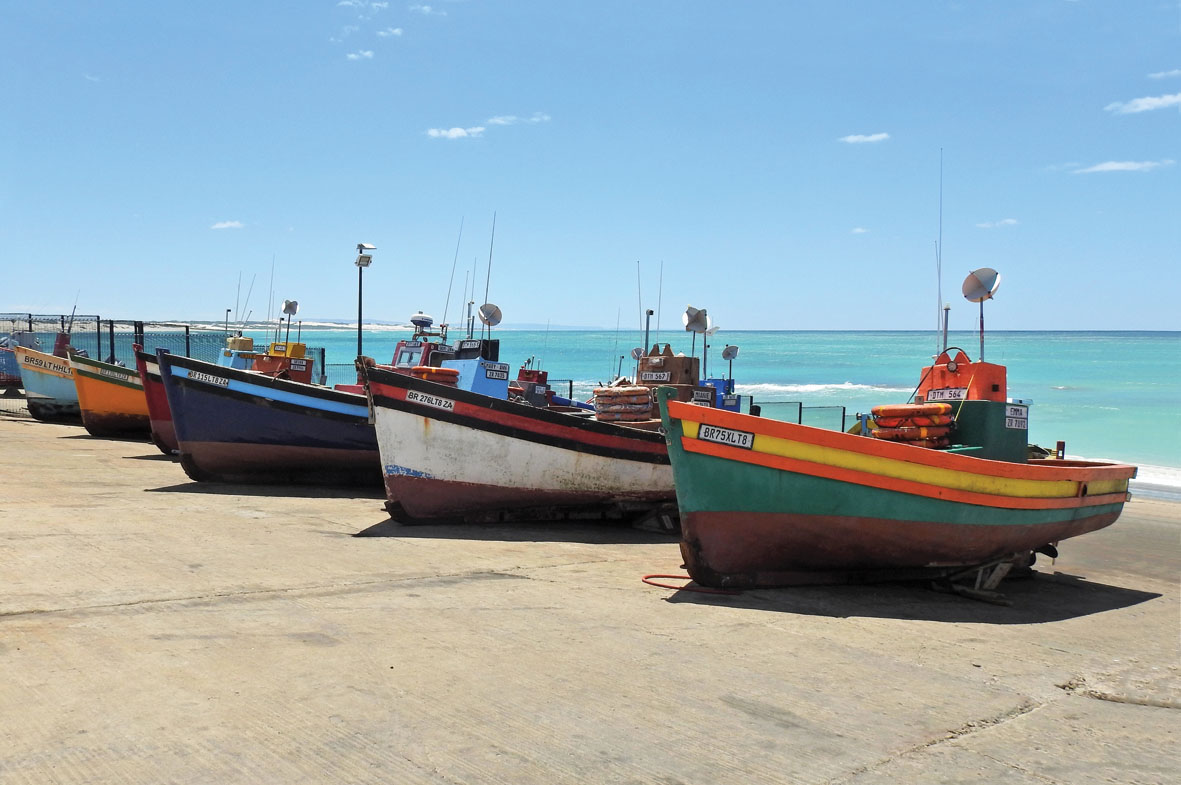
    STILL somewhat dazed, I became aware of the annoying noise from the alarm clock rapidly growing louder. Momentarily despising the piece of technology that kickstarts our daily lives, I felt the onset of that typical euphoric feeling I’ve experienced so many times before. Suddenly wide awake with waves of adrenalin surging through me, I fully comprehended these now solidly ingrained early morning sensations — yellowtail fever! Originating from the Arniston harbour a couple of hundred metres away, short commands and exciting chatter, sporadically masked by short bursts of revving diesel engines, drifted through the bedroom window.
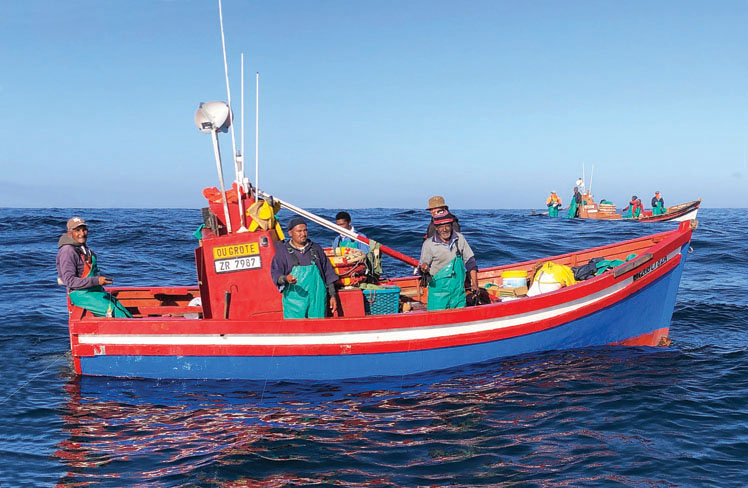
    Jumping out of bed and rushing through the usual morning routines, I reflected on the motive for my delight, simultaneously preparing myself for the exciting day which lay ahead. The last time I fished from a chukkie was way back in 1990, the very first time we came to Arniston. This time, almost 30 years on I would be joining Ou Grote’s crew handlining yellowtail the Arniston way!
    It was still pitch-dark when I arrived at the slip but the first boat had already been pushed into the surf and was disappearing into the dark beyond. Amidst excited chatter and morning greetings I passed my gear over Ou Grote’s gunnel for stowing by one of the crew members. With her engine’s test starting successfully completed, we rushed through the short prelaunch caucus. In the crisp morning air the poorly-muffled thumping sounds of the stoter’s (tractor) engine was pretty deafening. The tractor driver was busy pulling the individual boats backwards from their parking lots, spinning them around to face the ocean, and then cleverly executed some manoeuvres to position his pusher behind the chukkie for the final shove into the surf. The whole operation was amazingly slick and without incident.

    LAUNCHING OU GROTE
    When our turn came, sliding down the slip towards the water with some black smoke spewing from the pusher’s exhaust, Ou Grote’s inboard 80hp Ford engine sprang into life the very moment her bow hit the oncoming surf. With throttles wide open and reaching full speed remarkably soon, we skimmed over the well-lit surf area into the tranquil dark waters behind. In preparation for the 90 minute ride to Skipskop bank, our target area for the day, the crew bedded down into their individually allotted “laaie” (fishing holds).
    Only the skipper, who happened to be the owner as well, remained in an upright position, standing behind the wheelhouse with the tiller arm lightly squeezed between his lower legs. Seventy-two-year-old James Murtz (Lulu) has worked these waters for as long as he can remember.
    With his head neatly silhouetted against the starry expanse hanging above us, the illumination from the instrument displays and running lights created some eye-catching displays dancing all over his face. Appreciating his well-aged but serious expression I started humming, intuitively, Matt Redman’s song Ten Thousand: “And on that day when my strength is failing; the end draws near and my time has come; still my soul will sing Your praise unending; ten thousand years and then forevermore!”
    Sometime later I noted that the long awaited dawn had brightened up the eastern sky sufficiently to unveil the details of a magnificent picture unfolding before our eyes. In front of us stretched the most spectacular panoramic view imaginable — windless shades of orange skies guarding over small lazy turquoise swells blending seamlessly into the calm shiny surface of the great Indian Ocean beyond. Bounded only on the portside by a green shoreline interspersed with snowy white sand dunes, it reminded me of a rainbow; beautiful colours intentionally chosen by Him. Deeply touched by the display, the excitement I felt at being able to fulfil my long awaited wish to fight feisty yellowtail from a chukkie with a handline was simply overwhelming.
    The upside of such a long boring voyage during night-time must be the idle time which gives one a chance to muse over all sorts of things. Still watching Lulu’s face, I became acutely aware of Ou Grote’s personality. It’s a living organism, I thought! Watching the white post-scrubber exhaust fumes swirling upwards from the ocean’s surface, I realised that the smell of a diesel fuel spill, exhaust fumes and fishing bait inter alia, are very typical of these boats. I also noticed that the rhythmic hull vibrations were neatly in-sync with an atypical blend of the large propeller cutting into the water and the audible sound of the fast rotating engine intermingled with fluctuating power demands needed to ascend and descend the swells.
    Whilst quietly enjoying these stimuli, I pondered over the origin of the term chukkie. Having learned that this style of boat was originally called a chug-chuggy, my unilateral decision to call them as such for the remainder of this exercise, was driven more by sincere sentiments than any other motivation. Fortified by the fact that I was actually travelling on-board the very first GRP chug-chuggy built in Arniston, the sudden rush of pride and honour catapulted my joyous feelings to new heights.
    With Ou Grote having been built during 1975 and the rest of the fleet only a few years later, they certainly have stood the test of time and served their masters well. However, after 40 years of service in harsh conditions, often enduring the worst Neptune could throw at them, they have become completely out-dated, badly worn-out and unreliable for the task at hand. With their hulls seriously fatigued and drive-trains failing — particularly those four-decade-old engines, they are in constant need of care just to stay seaworthy and afloat. Unofficially they have been branded as a safety hazard and due to the crews’ fear of getting stuck at sea if their boat breaks down, at least two boats need to go out to sea together.
    Glancing over the serene waters surrounding us, I recalled Meirion Williams (a retired and well-known Struisbaai fisherman) once saying, Cape Agulhas waters are not the place for unsound boats, inexperienced skippers or fainthearted crews, as water conditions change very rapidly. The place is legendary for its sudden weather changes with gale-force winds whipping up the sea, generating massive, fast-moving swells exceeding ten metres. No wonder the area gained global reputation as the “Cape of Storms”.
    We have to remeber that the GRP chug-chuggy was a state of the art inshore fishing craft at the time it was first built. Furthermore, during their sea trials they were pedantically tested in hostile conditions, and the designs were enhanced and modifications done to improve general performances.
    One of the most important aspects was the flat bottom which was imperative for quick floating in shallow waters during launching and beaching, compared to the deep water mooring conditions offered in Struisbaai harbour. Their relatively short lengths and light weights again facilitate easier manoeuvrability on the slip, especially when manhandling is needed when the pusher breaks down.
    Although craft up to 50ft in length were manufactured in various locations around South Africa, only 20- and 25ft models were built and put to use in Arniston. They performed well and produced the goods. However, having reached the end of their productive shelf-lives they need to be withdrawn from service. Another major downside is that the pusher, an integral part of the safe launching procedure, is also susceptible to to very high levels of wear and tear and, if it’s not rigorously maintained, prone to long let-downs.
    When compared to the new generation powerboats which are able to travel much further distances and get their catch to the markets much faster, it’s obvious there are some downsides to the chug-chuggies. Single engine displacement-type hulls are very slow and take about three times longer to get to the fishing grounds. They also constrain the crews’ ability to quickly move between different banks in search of fish; the crews’ days become much longer. Recreational fishers flocking to the Arniston and Struisbaai banks provide additional competition, especially over weekends and holiday seasons. The Arniston fishermen are therefore in desperate need of contemporary planing-hulled boats which provide enhanced reliability, faster speeds and the ability to be trailered and towed around to other fishing grounds as needed.
    Suddenly I got distracted by a large flock of low-flying gannets heading straight towards the Skipskop Bank; that is always a very good sign! However, the sudden bout of excitement quickly dissipated as the birds suddenly chose a different heading.
    Still staring at them, I reflected on my mission of delving into the history of the Kassiesbaai fishermen who have very successfully managed to survived the more than 200 year long uphill battle they’ve been combating ever since they started fishing there. Today they are in fact facing very unsure prospects. Aside from their hardware’s deficiencies and shortcomings, the added realities of desecrated marine resources and stricter legislation are certainly driving their livelihoods to a grinding halt.
    They’ve reached a serious impasse with a future more uncertain than any challenges faced before, but their well-honed assiduousness, ingenuity and fighting spirit to stay afloat is still very much intact and vibrant. Maybe, just maybe, the Kassiesbaai fishermen might get out of their quandary, hopefully without fatal scarring.
    Some distance away from us on Ou Grote the first chug-chuggy had already reached the Skipskop Bank and was carefully probing the two most productive areas where yellowtail normally feed. With shiny spinners attached to handlines pulled behind the boats, now clearly visible in the early morning glow, I once again felt the excitement pushing into my throat. Suddenly an individual on the portside went vas, then another one. Desperate to be engaged myself and wishing that we were on one of those modern speedboats so that we coould get there without further delay, I had no option but to sit it out.
    By then Lulu, just as excited as I was, had pushed Ou Grote into overdrive. Clouds of smoke were billowing from the exhaust and, although very eager to respond, the old lady’s speed hardly increased despite the deafening sound of the tonking engine now running at full revs. Momentarily providing some consolation however, full marks and appreciation must go to this perfectly timed man/machine interface. Appreciating that we would soon be at the hotspot, some snippets on pre-colonial fishing practices flashed through my mind.

    PRE-COLONIAL FISHING RECORDS
    When Jan Van Riebeeck arrived at the Cape on 9 April 1652, his crew observed that the local Khoisan residents were expert anglers using hand held rods, nets and spears. Within a very short time they were supplying the Dutch with fish. Van Riebeeck also mentions “a troop of Caapmans that brought ten oxen laden with steenbrassems killed with assegais in False Bay.” We assume they’re talking about white steenbras. The journals in the beginning of 1653 indicated that besides fish, penguins and “duikers” (cormorants) were also harvested, salted and consumed.
    South Africa does not have any history of native boat-based harvesting of marine resources prior to the Dutch’s arrival, but since the 1600s an artisanal, boat-based small-scale fishery has emerged along the Western seaboard. This development was shaped mainly by the influences of the Malay slaves brought to the Cape, the European sailors and the local Khoisan peoples who had extensive shore-based knowledge of the coastal waters.
    The first indications of fishing as an industry came in 1655 when dried and salted harders were found to be nutritious and were used on ships as provisions for sailors. In 1657 freemen were allowed to fish with hooks but not to sell their catches, since that would distract them from agriculture. However, this decree did not prevent them from drying and selling fish to passing ships. In May 1658 this practice was prohibited and they could only sell their surplus fish to the Dutch East Indian Company. In 1708 the demand for fish had escalated so much that slaves were allowed to fish on Sundays and also sell their catches.
    With the start of British rule the export of dried and salted fish shrank but the freed Malay slaves still caught great quantities of fish. These were sold for low prices to slaves within an 80km radius of Table Bay. By 1795 all restrictions on fishing were lifted and by 1830 the statistical register indicated there were 40 boats and 200 men exclusively engaged in fishing and two boats and 12 men in whaling. (Information from Sea Fisheries of the Cape Colony by W. Wardlaw Thompson, published by Maskew Miller in 1913.)

    HANDLINING YELLOWTAIL THE ARNISTON WAY
    By the time Lulu slowed down and turned Ou Grote’s bow into the current only a short distance upstream from the pinnacle where the fish were feeding, a few boats were already fighting feisty yellowtail. Poised, standing against the gunnels, we were all more than ready to engage. Finger protection donned and hooks loaded with sandwiches of octopus leg and pike, we chucked the handlines into the dark cobalt-blue waters before Ou Grote reached the target spot.
    The fish had risen and were feeding voraciously on the surface; almost simultaneously most of us went vas, all with belligerent yellowtail. The boat’s momentum into the current, however, immediately swept all the lines astern. The ensuing entanglements created chaos, especially with the hooked yellowtail running unconstrained in all directions. We had to take some time out to untangle the lines and regroup, unfortunately wasting some valuable fishing time in the process.
    Most of the hooked fish were successfully boated and, with Ou Grote now slowly drifting with the current, lines could be cast perpendicular to her beam. With some of us working the bow area and some the aft space, hooked fish could be constrained and properly fought within their individual fighting zones. Wet, shiny, wriggling yellowtail were flying over the gunnels for a while but suddenly, as quickly as they came on the bite, the shoal sounded. All went quiet with none of the boats catching any fish. Sometime later a few fish were lifted into boats again, but the majority of the fish were gone.
    Leaving the lingering flotilla behind, various chug-chuggies withdrew to search for the shoal in the area around the pinnacle. when they didn’t find any promising signs, two boats then targeted another area some distance away but Ou Grote stayed put, patiently waiting for some action.
    The crew commenced baiting and dropping their second set of lines, the way they normally fish for yellowtail which are feeding erratically. I was carefully watching Edwin Agnew who silently stared at the shoreline some three miles away, one line dangling from his left hand while he worked the other line with his right hand in a jigging fashion. What an honour to be fishing with these legendary fishermen, I thought. I was glad that I’d had the unique experience of probing their full account and gained a much better understanding and appreciation of their livelihoods and pursuit for continued existence.
    I saw Edwin’s hand jerking as a fish unexpectedly wacked his bait. He jumped up and leaned into the gunnel, fully poised to answer the first call in a long time. I was still holding my line and hoping for some action when he slowly looked around and stared at me. No! “Nothing,” he said without even uttering a single sound; his shaking head and the disappointed frown on his face said it all.
    Suddenly all hell broke loose. Lines were ripped taught with strikes neatly executed. Arms flew in all directions, in some cases two arms in very close proximity, some belonging to the same person, actually crossing. Caught slightly offguard, my line got ripped from my hands. As it snaked over the gunnel I managed to grab it, but before I could gain full control, it almost cut right through my finger guards. A quick glance at the rest of the crew confirmed that most, if not all lines were now bringing fish towards the boat in some way or another. The dispersed boats had noted the action and were bearing down on us, their boats’ loud droning noises virtually completely muffled by our crew’s excited chatter.
    Soon this run also came to an end, with the renewed prospects of making a bumper catch tumbling into the abyss. The last hook-up for the day, however, was made by Andrew Europa. He hooked into a large yellowtail, and the way the heavy handline was stripped from his hands indicated that it was most probably one of those huge loners which habitually patrol the ocean floor.
    Skilfully applying his many years of hard-earned experience, Andrew managed to restrain the headlong run. With the wild fish making short dashes all over, vigorously shaking its head as it went, the fisherman had difficulty retrieving lost line. He then pressed the severely strained handline onto the gunnel, pulling it down onto the hull with both hands.
    The resultant friction between the wood and fishing line reduced the excessive load on the angler, allowing him some time to rest and regroup. The array of time-worn grooves cut into the top of Ou Grote’s gunnels served as ample proof that this clever strategy has been employed since the boat’s first outing, particularly when fighting large strong fish. Guarding against overstraining the line, whilst keeping pressure on the fish, Andrew was constantly strong-arming it to swim upwards and towards the boat and, most importantly, the waiting gaff.
    While I was still admiring Andrew’s adeptness at working and playing the feisty fish, the green and gold colours of the quarry rose from the depths only a short distance from the boat. Only a short piece of 120kg nylon filament separated the well-seasoned yellowtail hand-liner from the estimated 15kg yellowtail specimen on the other end, visibly straining the line.
    The fish was tired, slowly swimming in a circle just out of reach of the gaff; very tense moments indeed! Suddenly it took off again and we had to turn our heads away to avoid the huge spray of cold seawater — flapped aboard by its huge, rapidly oscillating, powerful tail — thumping us solidly in the face. All taken by surprise, we watched Andrew absorbing the strain, then clearly heard that familiar, dreaded sound, only this time with the sinker smashing hard into the hull, confirmation that this huge fish was gone. “Hook pulled,” came the final, resigned verdict.
    Yellowtail — particularly those large specimens hooked in the shallow waters of the Agulhas theatre — are notorious for these generally unexpected last strong sprints, a desperate final attempt to free themselves. As we know so well by now, some you win and some you lose!

  • HANDLINING YELLOWTAIL Part 2

    HANDLINING YELLOWTAIL Part 2

    (Originally published in the March 2019 issue of Ski-Boat magazine)

    By Johan Smal

    IN the January issue of SKI-BOAT I started talking about the chukkies of Arniston and the tough fishermen who have perfected the art of handlining for yellowtail. In part 1 we looked at some of the history of fishing and the evolution of the tools anglers use; in this issue I want to point out how the history of these craft and fishermen ties up with that of Arniston. Please note that any reference made to Agulhas in particular includes the major settlements of Bredasdorp, Agulhas, Struisbaai, Arniston and Skipskop, unless otherwise stated. Our focus, however, remains Arniston throughout.
    “Desolate to the extreme” was a rather fitting description by someone of what this particular piece of barren land had on offer many years ago. This is the very same place where the quaint little town of Arniston eventually sprouted from the ancient, windswept, lacteous-coloured sand dunes. Located 27km on an easterly heading from the southernmost tip of our continent and called Waenhuiskrans in Afrikaans, it’s the only town in South Africa officially known by two names.
    The English name, Arniston, originated from an East Indianman sailing ship christened Arniston. Under charter by the East India Company, while heading around the Cape to repatriate wounded soldiers from Ceylon on 30 May 1815, she was wrecked on this rugged shoreline during a blistering storm. The Afrikaans name, Waenhuiskrans, was in reference to the huge tidal cave which was chiselled into the sandstone cliffs by Mother Nature’s elements during ancient times. Waenhuis means wagon house, and the cave is literally large enough for an ox wagon and span of oxen to turn around in.
    Remains of stone-walled fish traps located in the inter-tidal zone and their associated shell middens, scattered around above the high-water mark and dated to be 2000 to 4000 years old, provide authenticated proof that nomadic tribes stayed in the area for millennia. From a later period evidence also indicated a more resident lifestyle, and from the 16th century onwards, further substantiation that there was some contact between the Khoisan nomads and survivors of the numerous shipwrecks dotting this treacherous stretch of coastline.
    The first reported wreckage in the area was that of the Zoetendal dating back to 1673, but these disasters must have occurred ever since the Portuguese explorers Bartolomeu Diaz and Vasco Da Gama traversed the area in the late 1400s.
    In the 17th century European settlers started to explore the Overberg, and by1708 cattle farmers had already procured grazing rights on loan farms in the area. By the time Arniston was wrecked in 1815 the nomadic tribes had already disappeared from this part of the coast and the six shipwreck survivors were taken to Cape Town by ox-wagon.
    Arniston Downs, the loan farm on which Arniston was later established, became a private property in 1838 and changed hands on a regular basis. Around 1850 the first members of the present fishing community of Arniston settled in the region. It seems they were originally from Swellendam.
    Initially fishing from shore, the fishermen migrated to inshore fishing as boat technology advanced. They went to sea from the present Roman Beach known as Oubaai and lived mostly in houses spread out in a closeby area now known as the Ou Dorp. Following an agreement in 1905 to develop a holiday village on their land, they gradually moved to the present fishing village called Kassiesbaai. The village was so-named because some of the first houses there were built from the numerous “hout kassies” (wooden cases) that washed ashore from the many vessels that crashed on the reefs. A national heritage site, this 200-year-old settlement is the oldest fishing village in South Africa.
    Arniston was declared a town in 1922 with the Fisherman’s Union, inaugurated in 1932, assuming responsibility for managing the Kassiesbaai fishing village. The two different names used for the town, became the official town names in 1981.
    Arniston, Agulhas and Struisbaai have been popular vacation and fishing destinations since the mid 1850s. As the populaces burgeoned and increasingly attracted more permanent dwellers, the towns expanded with a progressive snowballing effect. They are now bustling holiday and fishing towns, especially during the December holiday seasons.
    A famous anecdote is that Jock Dichmont (one of the previous Arniston Hotel owners) who ran the pub had two stompkop (poenskop/black musselcracker), decorated with steenbok horns, mounted on the wall. Holidaymakers, some asking very peculiar questions about this bizarre collection, were told that they were local “bokvis” which came out at night to feed amongst the dunes. Legend has it that many actually believed the story and spent many hours camping on the beach hoping to gain a glimpse of these outlandish fish.

    HEADING OUT TO SEA
    By the turn of the 20th century the local Arniston fishermen were going out to sea in small wooden rowing/sailing boats, the only means of propulsion available to them at the time. The boats were pushed over the beach by hand and launched directly into the surf from small protected bays.
    Instruments were non-existent and the men relied on their indigenous knowledge and natural instincts, using landmarks to navigate and always fishing within sight of the shoreline. As the fish were abundant and close inshore in those years, it was not necessary to go far out to sea. Once the first sail was hoisted after a day’s fishing there was usually a race back to the harbour, not just for fun, but mainly for commercial reasons. The longer you fished the greater the catch, but the first boat in had the best chance of selling its entire catch.
    Following their relocation from the Oudorp to the present Kassiesbaai, boats were launched from Arniston Bay but were still pushed over the beach by hand. However, once again mankind’s eternal need for advancement and proprietorship reigned supreme, and the construction of the Arniston slip eventually reaching completion in 1936.
    Some 40 metres long and 25 metres wide, dipping into the ocean at an angle of 7°, the slipway extends right into the surf and has no protection from any breakwater facilities. Although this presented some new challenges that had to be surmounted, handling their boats on this concrete surface became manifold easier for the fishermen. Although still manhandled, the boats could now be lifted onto steel rods and be rolled around more easily.
    Motorised handling of the boats during launching and beaching then followed — the very same system still in use today. When launching, a modified tractor is used to drag the boats down to the water’s edge and they are then pushed to a suitable depth where the skipper can safely negotiate the oncoming surf. (See Part 1 for a series of pictures of a chukkie launching during a spring low tide.) When they return to port, the boats — neither fitted with wheels to run up the slip, nor trailered — are hooked onto a permanently installed diesel-driven winch and hauled up the slipway where they are stowed safely above the high-water mark.
    Today the chukkies are still pulled around on the slipway’s concrete surface without any wheeling arrangements. Sliding on heavy steel channel irons permanently fixed to the keels, they suffer from accelerated wear and tear, especially generally impact damage resulting from all the knocks endured during these bumpy operations.
    Up to the early 1980s the lack of appropriate electrical infrastructure — indispensable for suitable refrigeration and ice production in particular — rendered the safeguarding of bait and management of daily catches absolute nightmares for the fishermen. The peak fishing season was during the hot summer months, regularly yielding bumper catches. To prevent spoiling every single catch of the day had to be dealt with sensibly and quickly; it either had to be consumed or sold, alternatively salted, dried and stowed for personal future use or sale.
    With the majority of residents being subsistence fishers at the time, the local market could not absorb much excess. Some local farmers purchased small quantities at times, mainly for consumption by themselves and their workers, but most catches had to be transported to the bigger markets at nearby settlements. Located some 95km away, Swellendam was the most popular terminus. These precious, quick-spoiling loads had to be carted on the back of open trucks and were covered with wet hessian sacks to keep them cool and moist, a practice which lasted may years. (For more details on the susceptibility of fish to spoiling see “Something Fishy — Causative factors of fish spoiling”, SKI-BOAT July/August 2017.) <https://issuu.com/sheenacarnie/docs/skiboat_201707/58>

    THE BIRTH OF GRP CHUKKIES IN AGULHAS
    Numerous chronicles documenting the history of early life in the area have been compiled and published, but these records dealt mainly with the early settlements, its people and lifestyles, as well as the area’s natural beauty and associated attractions. Not much had been documented about Agulhas’s richest attribute — the abundance of her copious fish stocks, the eventual exploitation of these and the hardware used to gather the catches. Due to the absence of written records on the subject — especially the period around the 1950s/1960s when the industry really mushroomed — one has to rely on oral records. Unfortunately very few elderly people are still available to share their life ventures, and getting accurate historical accounts remains testing.
    Sadly, nobody could confirm who coined the name “chukkie” for these boats. Different spellings have surfaced over the years, but in Arniston the boats are commonly referred to as chukkies, allegedly named after the engine’s start-up noise. Some people say, however, that they were originally called “Chug-chyggy” which again was based on the running noise of their original slow revving engines — a mere 800 to 1 200 rpm going flat-out! Locally they are also differentiated from ski-boats (habitually called speedboats or powerboats) as the “slow boats”.
    Chukkies developed from the novel wooden row/sail boats which originated in Kalk Bay as early as the 1700s. Many years later this design eventually found a foothold in Agulhas, where they were extensively used at Arniston, Skipskop and Struisbaai until around the mid 1900s. They were mostly carvel builds (hull planks laid close together on their edges) with only the odd clicker built to be found (edges of the hull planks are overlapped to form an irregular exterior).
    Due to the exceptionally rough operating conditions they were exposed to these wooden craft required a lot of maintenance. The hull planking in particularly was prone to damage with the joints having to be cleaned out, re-caulked and sealed on a regular basis, using the traditional caulking cotton rope (also known as Oakum) and red lead putty. Repairs were labour intensive and time consuming, rendering the craft unserviceable for extended periods, and obviously when there was no boat there was no income.
    With the new GRP technology progressively gaining popularity and becoming readily available over time, a practice evolved to simply apply a GRP skin over the damaged wooden planking. Proving to be a relatively quick, cheap and effective repair at the time, the practice gained acceptance rather quickly. This resulted in some wooden boats eventually sporting a complete new GRP skin, so successfully applied that the rotten planking on the inside could simply be stripped away and discarded. Further developments eventually led to the “wooden frame completely encapsulated GRP hull” builds that became very popular during later years.
    One of the high risks associated with this technological advance was a phenomenon called “fibreglass pox”. This defect was named after the multitude of surface pits in the outer gel-coat layer which resembles smallpox, and which allowed seawater to seep through small holes and caused delamination. Most of the older fibreglass boats were often not constructed in temperature controlled buildings, leading to this widespread problem. It was also caused by atmospheric moisture being trapped in the layup during construction in humid weather.
    With inshore fishing becoming a normal lifestyle for many South African’s after the Second World War, the need for more suitable, advanced and better-equipped fishing craft was pushed into an unprecedented upward spiral. The relatively new fibreglass technology which became available in South Africa around 1950, was ideally suited to build such boats. This could be done much more quickly than was possible using the more traditional methods, and in response to the growing demand various boat builders introduced this new GRP technology.
    The well-known Stompneusbaai resident, fisherman and entrepreneur, Samuel Antonie Walters, realised the immense potential of St Helena Bay’s rich seafood resources and saw that the fishermen were looking at options to upgrade their crayfish and snoek boats in particular. Together with Charles Hutchinson and Alfred Tallie (an expert Louw & Halverson boat builder fabricating wooden boats in Velddrif at the time), Samuel established the company Sachal in Vredenburg during 1965. The name Sachal was created by using the first two letters of each partner’s first name. Commencing with the construction of GRP boats straight away, they were the first to deliver these new generation chukkies to Arniston in the mid 1960s, followed by Struisbaai just a few years later.

    ENGINE-POWERED CRAFT TAKE ARNISTON BY STORM
    The first reference to a motorised vessel operating at Arniston was Koos Sparmers’ 32ft trawler Miss Arniston. She was acquired around 1927 and, believe it or not, fitted with a 9hp Thornycroft engine. She had to be anchored in Arniston Bay at sea and the catches shipped ashore by rowboats.
    Reportedly Coen Taljaart, a well-known boat owner and ostensibly the first principal fish merchant in Arniston and Agulhas at the time, was the first to install an engine into one of the Arniston rowboats during the mid-1940s. This was a 2-cylinder Scottish built 15hp Kelvin paraffin engine, distributed by Louw & Halverson at the time. Although some Lister engines also followed, the Kelvin became the engines of choice until they were replaced by the preferred 2-cylinder Ford diesel engines which became available circa 1955.
    The next major upgrade to these power sources only materialised in the late 1970s when 30hp Yanmar engines and the 80hp 4-cylinder Ford became the popular choices. After 40 years of hard labour in extremely harsh conditions, most of these engines are still tonking away today, still chasing Kassiesbaaiers’ dreams.
    Although our focus remains on Arniston, it is interesting to note that by 1960 chukkies were in fact used all over the Western Cape. Some important locations include Stillbaai, Mossel Bay, Witsand, Skipskop, Gansbaai, Hermanus, Gordon’s Bay, Strand, Kalk Bay and St Helena Bay. However, Struisbaai, Arniston and Kalk Bay are the only places where they still operate on a daily basis, weather permitting.
    Acknowledged as the first managing owner of a real commercial fishing enterprise in Struisbaai, Barend Dalhauzie was the first to build a fish-factory in Struisbaai harbour during 1960. Operating a fleet of his own boats, he also rendered a boat repair service to others. Sold to Etienne Bruwer and with Lance Steytler also playing a role in the business, Irwin & Johnson (I&J) bought the factory in 1967. Louis Knobel was transferred from Kalk Bay to manage the operation and brought the Kalk Bay-built wooden chukkie Dagbreek 1 with him.
    According to my sources, the first GRP built chukkie located in Struisbaai was Jan Weber’s Waterberg, built in 1969 by Sachal in Vredenburg. Kenny Coleman, a well-known ex-Kalk Bay fisherman, relocated to Struisbaai during the early 1970s. He used a 16ft GRP Sachal-built monohull fitted with a 20hp Yanmar outboard and an 18hp auxiliary Johnson engine. Due to the restricted deck space, load carrying capacity and fuel cost Kenny decide to upgrade and bought the GRP constructed chukkie Melody from Kenny Kingma in 1973. Operating at Kalk Bay harbour at the time, she was also built by Sachal in Vredenburg.
    During 1974 Frank Weber, an uncle of Jan Weber who owned Waterberg at the time, used Dagbreek 1’s hull (the biggest hull at the time) to shape a mould. He then built Blouberg followed by Dagbreek 2 in 1974 — the very first GRP chukkies to be constructed in Struisbaai.
    In 1979 Louis Knobel and one of his sons, Brian, also engaged in building GRP chukkies. They constructed a mould using the hull of a defunct I&J boat, but lengthened by 1.2 metres, to build Marco 2. Some eight more chukkies were built by them between 1980 and 1985, mainly for I&J. Brian then progressed further by building larger craft in Struisbaai, including some deep-sea trawlers.

    THE BIRTH OF GRP CHUKKIES BUILT IN ARNISTON
    During 1975 the treacherous Agulhas coastline claimed yet another victim. The relatively new wooden chukkie, Gansie 1, one of Coen Taljaard’s many chukkies, built by Louw & Halverson’s builder, Alfred Tallie in Veldrif, was wrecked on the reef at Struispunt. once she was salvaged Coen commissioned Jollop Murtz, one of the legendary Arniston fishermen and general boat repairer at the time, to restore her. The new GRP skin was laid over her wooden hull using lots of resin and only chopped strand fibreglass, with no gel-coat whatsoever. (Gel-coat is the material used to provide a high-quality finish on the visible surface of a fibre-reinforced composite.) Having been declared seaworthy following the acquisition of a new licence and different name, Ou Grote, she went back into service.
    Currently Arniston’s oldest lady in use, she happens to be the chosen one we’ll get to know more intimately at a later stage. This particular build marked Jollop’s first GRP build, setting him on course to become Arniston’s most celebrated boat builder. His second chukkie, Ahi, which was owned by W Fortman, was built in Struisbaai.
    Traill Witthuhn, another legendary commercial Struisbaai fisherman, relocated to Struisbaai in 1971 and started fishing with Kenny Coleman on Melody. In 1977 he decided to take the leap and build his own boat. With Jollop Murtz designated as his preferred builder, he moved a wooden hull belonging to a defunct I&J boat called Marco, to Arniston. Traill’s new boat Rusvic was layered over Marco’s wooden hull using the male moulding system.
    Marco’s 25ft long hull with its flat underside was ideally suited to facilitate shallow water floating which was essential for the launching and beaching conditions from shore at Arniston, so many GRP builds were fashioned over her shell. Also using the male moulding system, they were all constructed by Jollop Murtz, aided by his son Thomas, and most of them are still in use today.
    Samrock was one of the most celebrated wooden Arniston chukkies; she belonged to the famous Kassiesbaai brothers, Simon and Samual Marthinus.  During 1977 they decided to build their own separate boats and also commissioned Jollop for the task. Their boats, Timothy and Nicolene, are both still in service today. Samrock was subsequently sold to Eppie Newman who operated her for a few years before she was grounded and used as a mould by Jollop Murtz to build numerous more chukkies.
    One of the Marthinus brothers, 88-year-old Samual, is currently the oldest remaining Arniston fisherman and also the only one still alive who went to sea with rowing boats. Fortunately he could share his memories with me; it was indeed a real honour and privilege to be able to talk to him in person.
    In the next and final part of this series I will get into the real meat of handlining yellowtail, starting by sharing some snippets from the pre-colonial fishing practices as gleaned from Jan van Riebeeck’s journals dating back to 1653. I’ll also touch on the current quandary of the Arniston chukkie fishermen and take a closer look at one particular local chukkie. Weather permitting and fish biting, I hope to spend a day on Ou Grote handling yellowtail the Arniston chukkie way, and will report back to SKI-BOAT readers on my personal experience.

    My thanks to the following sources for the wealth of information provided:
    • Ferdie Sparmer, rightly called Arniston’s walking encyclopaedia and the original source of most records.
    • Arnistonalive.org.za.
    • Wikipedia.org
    • Kenny Coleman, Brian Knobel, Samual Marthinus, Thomas Murtz, Eppie Newman, Piet (Lulu) Swart, Frederik Walters and Traill Witthuhn.

Verified by MonsterInsights