How to handle fish safely for release
By Nikki Smit
(Originally published in the January 2026 issue of SKI-BOAT magazine)
FISHERMEN are well known for their tall stories, arms stretching as their story progresses, but with the advent of social media, these stories have moved from the mythical to the real deal, and now with the growth of AI, well, who knows where these tales of tails will end!
Every angler loves to see great fishy pics, whether it’s to capture a moment in time, a memory of an exhilarating fight, or bragging rights of a new PB. However, with these pictures comes a certain amount of responsibility.
We have all seen how pictures zoom around on social media like a hooked yellowtail heading for the bricks. Suddenly we are exposed. Anything can happen. Anyone can see it, pass it on, praise it – and throw abuse.
I refuse to be an online troll, but sometimes it’s hard not to shake one’s head at some of the pictures that are posted. Some of my pet hates are:
- Posting a photo of a dead fish lying in the sink and asking what it is!
- Posting photos of undersized fish or catches that clearly exceed the bag limit – and bragging about it!
- Holding a fish up by the gills and claiming to have safely released it!
These issues make my skin crawl, so I hope this article will help to educate anglers on better ways of doing things.
We anglers have a responsibility to learn to identify fish and to ensure that we know the size and bag limits of various species. Going fishing and not knowing these basics, is like driving and not knowing the rules of the road. If you don’t know what the fish is that you’ve caught, release it.
The ORI fish app is a wonderful tool that gives anglers all the information needed to ensure they fish responsibly, from photos of the fish for identification, to bag limits and sizes as well as a length-to-weight conversion calculator. It can be used on both Android and IOS devices, and the cost is minimal and goes to a wonderful cause.
Visit https://saambr.org.za/app-marine-fish-guide-for-southern-africa-2/ or search for “Marine Fish Guide” on your app store.

There’s also no excuse for keeping undersized fish or for taking more than your bag limit. If an undersized fish died when you caught it, throw it back so it can at least contribute to the ocean’s food chain.
Sometimes there’s nothing you can do to save a fish, but if you know in advance that you’re planning to release your catch, it needs to be handled correctly, so that it is given every possible chance of survival.
Some fish, such as Roman, don’t have a good release record, but they should still be handled carefully to give them a fighting chance.
So, what can we do to help ensure the survival of the fish we release?
REDUCE FIGHT TIME
As with human athletes, lactic acid levels accumulate in the fish’s muscles during a long fight, leading to a longer recovery time, higher mortality rates and reduced flesh quality in retained fish. To reduce the fight time, opt for a heavier line and leader, and avoid light tackle when targeting large fish.
REDUCE AIR EXPOSURE
Fish suffer from hypoxia (oxygen deprivation) from extended periods of time out of the water, which greatly increases the likelihood of death.
If you’re going to release a fish, try to keep it in the water while removing the hook. If you are unable to unhook the fish in the water or if you want to take a photograph, always work as quickly as possible and ensure that all the required tools are nearby.
A good de-hooking tool can reduce the air exposure and limit any injury to the fish.
HANDLE CAREFULLY
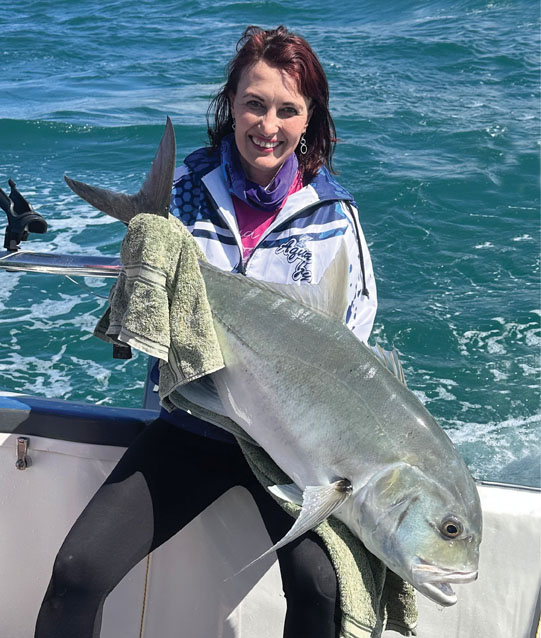
If the fish is removed from the water, use a wet cloth to pick it up. Cover its eyes with a wet cloth to protect them from bright light and to calm the fish, thus preventing injury from excessive flapping. Handling the fish with a wet cloth also protects the angler from injury caused by sharp spines and scutes. You can place the fish on the wet towel while you remove the hooks to protect it’s skin from being damaged by a hot, dry deck.
A plastic fish stretcher or a soft, knotless landing net is useful when landing a fish, although care must be taken to avoid injury to fins and tail in a landing net. Avoid getting lures or hooks tangled in a landing net, too, as this will increase the fish’s air exposure while the hooks are being untangled.
Avoid gaffing fish you plan to release, as gaff injuries and bleeding greatly reduce the chances of survival. If you absolutely must use a gaff, follow these best practice tips:
- Never gaff fish in the stomach, gills or head; rather gaff in the bottom lip.
- For sharks, skates and rays, gaff in the jaw area. If this is not an option, gaff in the muscle below the dorsal fin. Do not gaff skates or rays in the wing area as this tears easily.
- If fishing from a boat, rather use a knotless landing net or a lip-grip.
Large-mouthed or sharp-toothed species such as barracuda can be landed using a lip-grip attached to the fish’s lower jaw, but be sure to also support the fish’s weight as it is lifted from the water.
REDUCE INJURIES
Fish often suffer injuries from tackle as well as handling. These injuries, combined with the exhaustion and stress of the fight, greatly increase the likelihood of death. There are, however, ways to reduce these injuries.
Fish have a protective slime over their skin and scales that prevents bacterial and fungal infection. This layer can be damaged by excessive handling. Always keep handling to a minimum and use wet hands or a soft wet cloth when lifting fish and returning them to the water.
Fish’s gills and eyes are sensitive organs, so do not touch or damage them if you plan to release the fish. Do not hold the fish up by the gills if you want to take a photo, and do not pull it into the boat by its gills. Placing anything under the gill plates damages the plates and the gills and can cause the fish to die.
When removing hooks, do not apply pressure on the gill plate or put your fingers inside the gill plate to hold the fish. Also do not to put undue pressure on the fish’s body.
When fishing from the shore, never drag fish over the rocks or sand. This is particularly harmful to flatfish (stingrays and sand sharks) whose gills are on the underside and can be filled with sand, causing serious damage.
Do not turn stingrays upside down to remove hooks as this causes serious damage to the animal’s internal organs and may result in death.
Never drag flatfish by their spiracles (the small openings behind the eyes that are vital for breathing on the sea floor). Rather use the groove in the top lip to lift the head and gills from the sand before moving the fish.
Sharks should not be dragged by their tails or be left to lie on the sand for long periods, as their cartilaginous skeleton does not protect the internal organs from being crushed under their own body weight.
USE BARBLESS OR CIRCLE HOOKS
Barbless hooks not only reduce injury to the fish, but also substantially reduce the amount of handling required to remove the hook before returning the fish to the water.
You don’t have to buy special barbless hooks; long-nosed pliers can be used to squash the barbs, or the barbs can be filed off.
To remove a barbed hook that is well set in the lip or jaw, push the point of the hook through and flatten the barb when it protrudes. This will make removal easier and will result in less injury to the fish.
If a fish is hooked in the gills or in the throat, or if the hook is swallowed, simply cut the line as close as possible to the hook and release the fish as normal. Ideally, use circle hooks which are designed to set in the corner of the mouth, resulting in less physical damage to the fish as the hook is seldom swallowed.
When using a circle hook, simply lifting the rod while simultaneously reeling in and applying firm pressure will be sufficient to set the hook. Barbless circle hooks are ideal if you’re planning to release all fish caught.
Hooking injuries in fish are more prevalent when more than one hook is used per line. It’s also preferable to use single hooks rather than treble hooks. Removing the middle hook from a multiple hook lure can also reduce injury without affecting catch rates. Treble hooks can be replaced by inline single hooks, or one of the hook points on the treble hook can be removed using side-cutters.
Choosing the right size hook for the target species will greatly reduce the chance of deep hooking the fish.
Using artificial baits and lures is also preferable to using natural bait. For one thing, it reduces the extractive pressure on bait populations and destruction of their habitats. For most species, hard lures, spinners or plugs are less likely to result in deep hooking than soft artificial or natural baits.
ADDRESS BAROTRAUMA
Bottom-dwelling fish caught in deep water (over 20m deep) may experience barotrauma due to the decrease in water pressure and inflation of the fish’s swim bladder as it is brought to the surface.
Barotrauma is obvious if you see a fish’s inverted stomach protruding from the mouth.
Some sharp-toothed species such as santer and seventy-four, may inadvertently bite their protruding stomaches, thus self-releasing the built-up gases, and may not require intervention before release. Other species such as Roman and slinger are more susceptible to barotrauma and will float on the surface, unable to return to the deep water without assistance.
Anglers with a lot of experience may know how to vent the swim bladder using a hypodermic needle, but even though this allows the fish to return to their preferred depth in the water column, it can result in secondary infections and death, and is not the preferred method to deal with barotrauma.
The best way to release a fish with barotrauma is to use the reverse hook or downrigger method (see diagram below) or a Seaqualizer.
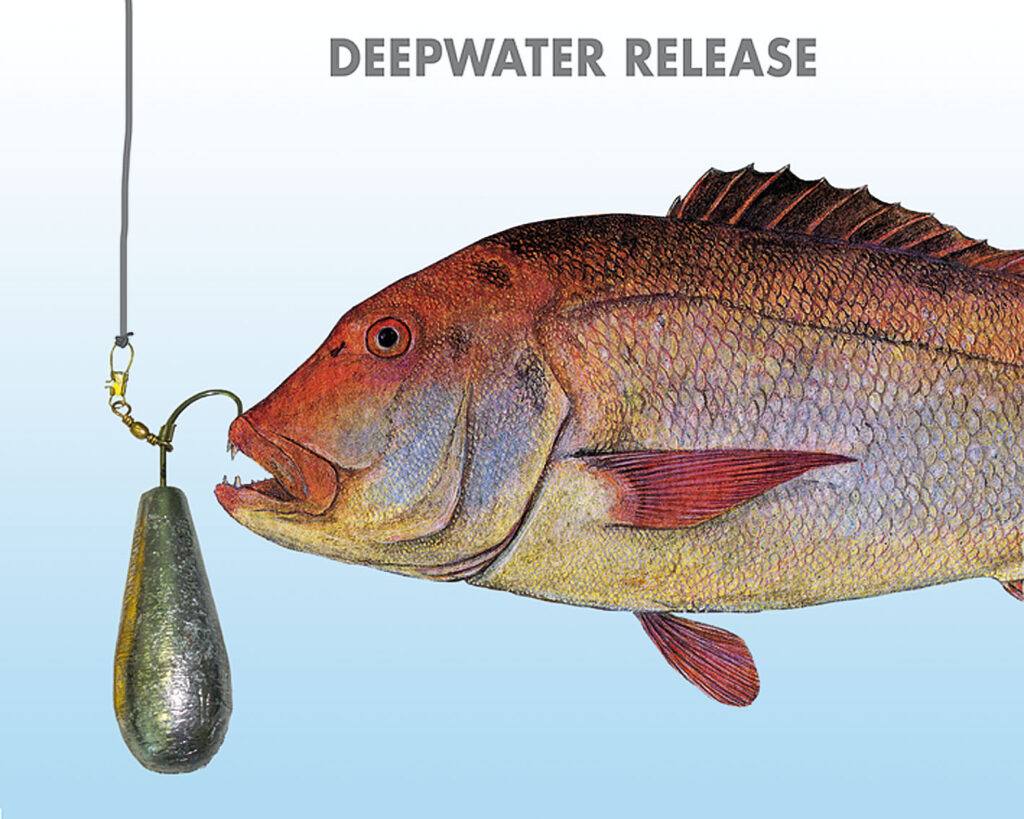
There are many home-made varieties of this, but essentially a large weight or downrigger ball heavy enough to counteract the fish’s buoyancy is tied to the eye of a large, inverted barbless hook. Heavy fishing line, long enough to reach the depth where the fish was caught, is then attached to the bend of the hook.
The hook is gently but firmly placed in the top lip of the fish with the hook pointing downwards, and the fish is released to sink to deeper water. It is important to let the fish descend as smoothly as possible, avoid jerking and pulling on the line.
If possible, try to get the fish all the way to the bottom. Once the fish has descended to the bottom, give it a little time to recover, then sharply tug the line to dislodge the hook and weight, releasing the fish.
REVIVE IF NECESSARY
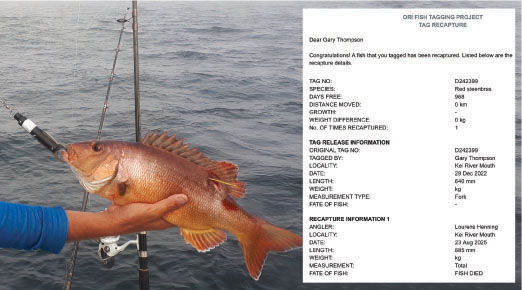
If you’ve handled a fish carefully with minimal time out the water, it should swim away strongly as soon as it is put back in the water. However, some fish may need reviving.
Hold the fish headfirst into the current. Do not move it backwards and forwards in the water or restrict the flow of water through the mouth and gills.
If the fish shows no sign of recovery, move it gently forwards through the water so that oxygenated water can flow over the gills. It may take a few minutes for the fish to recover its balance and swim away unaided.
KEEP YOUR TOOLS READY
Equipping oneself with the following items, will help ensure a fish is released as quickly as possible with the least amount of harm. These items must be kept within easy reach :
- Long-nose pliers: to remove a hook set in the jaw and to squash barbs.
- Side-cutters: to cut through line or steel trace if the hook is swallowed.
- Measuring tape: to record the length of the fish. The length can be converted to weight using an online species length/weight ratio.
- Measuring mat: to protect fish and avoid sand entering the gills on the fish’s underside while measuring. Keep it wet and cool.
- Waterproof camera: to ensure a quick release if a photograph is desired.
It is our responsibility as anglers to ensure that we are educated. For further information regarding correct handling of fish, visit ORI’s website www.oritag.org.za.
