Tag: Donavan Cole

  • Snaring Snoek

    Snaring Snoek

    Fishing clever in False Bay

    By Donavan Cole

    [Originally published in the November 2023 issue of Ski-Boat magazine]

    I DON’T think there is another species of fish in the Cape that causes as much excitement and chaos at our slipways and on the water as the Cape snoek does. On any good weather day in False Bay when the fish are around, it is not uncommon to have over 100 boats, kayaks, rubber ducks and almost anything that can float in an area the size of a few rugby fields.
    The snoek’s name comes from “zeesnoek” because the early Dutch colonists said it reminded them of the freshwater pike (or snoek) they found in the Netherlands.
    Snoek (Thyrsites atun) are encountered along the entire west coast of South Africa to Namibia and up the south/east coast as far as Port Elizabeth (Gqeberha). While we make massive catches of snoek in South Africa, we also import large quantities from New Zealand. The main reason for us importing so much of these fish is due to their consistent superior quality. In South Africa our snoek frequently go “pap” where the flesh will turn to jelly, resulting in it been inedible. The imported snoek do not have the same enzyme in their flesh that causes them to go pap.
    I know a few boat owners who don’t allow anglers to bring snoek on board because of the mess they create with their blood and scales. Snoek have tiny scales, each the size of a match-head, which they will usually shed when you lift them from the water. These scales then fly around sticking to every surface on board, including any exposed skin. Once dried, they can be near impossible to remove. Snoek fishing also results in a lot more blood flying around than other species as you break every fish’s neck after landing.

    WHEN AND WHERE
    The last two years were two of the best snoek seasons we had around False Bay in the last decade, and we can only hope the 2023 season will bring similar catches. In 2021 and 2022 the snoek arrived around Cape Point by the middle to end of September with good catches being made from September through to January. This year we caught our first snoek of the season outside Cape Point in the second week of September, and as I write we hope we’ll soon be catching them inside False Bay.
    The easiest way to find where the snoek are is to look for the commercial handline snoek fleet. These boats are not hard to spot. They are usually open center console mono-hull ski boats between 6 and 9m and fitted with the largest outboard engines the boats can handle, in order to load and push as much fish as possible. It’s not uncommon for some of these 12-man boats to load in excess of 2 000 snoek a day, which they can catch in a matter of a few hours when the larger shoals arrive and they are feeding properly.
    The main area where the snoek are encountered is in Buffels Bay, which is just inside the Cape Point. The snoek often move deep inside the bay too, with large catches being made right off Millers Point slipway when the season is in full swing. Years back we would frequently get snoek even deeper inside the bay, catching them off Simonstown, Fish Hoek and Kalk Bay.
    Outside Cape Point, the main area where the fish will be caught is on Rocky Bank, which is around five miles south-east of Cape Point. You can also find snoek around the Anvil, Bellows, South West reefs and further up the coast towards Scarborough and Slangkop Lighthouse.
    On your echo sounder snoek will show up in different ways depending on what they are doing. When they’re free swimming, you will usually find them “writing” in a closed red ball on the sounder. As soon as you stop and drop lines you should see the shoal break up and disperse all over the screen when they start feeding. (See photos alongside.)
    When the fish are busy feeding on baitfish, you will find them broken up at different depths. These shoals will usually grab a lure or bait line. There are, however, times when you will barely see them as they “write” so close to the ground that you cannot see the difference between fish and the seabed. The best way to check the different ways they will show up on your fish finder is to take note of the showings while you are catching them or while you are among boats that are catching.
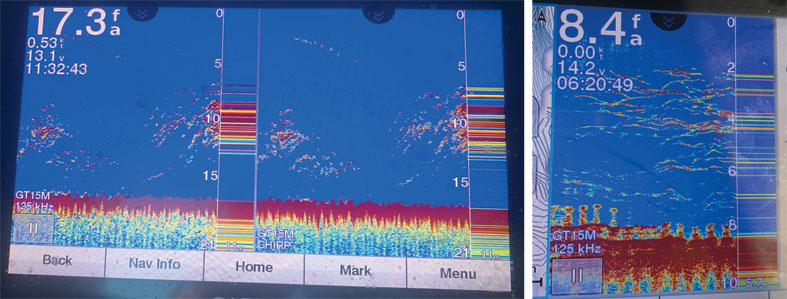
    Left: Snoek showing in a closed shoal on the echo sounder before starting to feed. Right: Shoal of snoek spread out and feeding.

    CATCHING SNOEK
    Once you arrive in the area where the commercial boats are anchored, the weather and your specific location within the fleet will affect how you catch them.
    The most common way of catching them inside False Bay will be on anchor. First find a spot where you will not hinder or obstruct other boats. You need to consider that if the wind comes up, there is a very good chance of dragging the anchor so it’s best to always try and find a spot where you can put out as much anchor rope as possible. Try not to anchor directly ahead of another boat so that you don’t run the risk of dragging onto them or catching their anchor rope with your lines.
    Once you’ve thrown anchor and it’s hooking, you need to figure out where the fish are in the water column so you can place your bait lines accordingly. Check your echo sounder to see where the fish are “writing”, and stream your lines out to reach that specific zone.
    When the fish are scattered and slow inside the bay, put bait lines out at various depths, and once you start feeling the fish in a particular spot, put the rest of the lines there.
    When snoek fishing, we will usually work in fathoms, one fathom being 1,83m. This is roughly the same as when you extend your hands as wide apart as possible while holding the line, and measure from fingertip to fingertip.
    When you see the fish markings on the echo sounder set in metres, the quickest and easiest way to calculate fathoms is to divide by two, so 20m will mean measuring off 10 outstretched arms/fathoms of line. Alternatively, you can change the measuring units on your echo sounder to fathoms, and fathom off your lines accordingly.
    I usually start by dropping a line down to the bottom with a heavy weight attached to the hook. Once it reaches the bottom, I lift it around two fathoms from the bottom. I will then set another line four fathoms from the bottom. When fishing with a hand-line it is pretty simple to set your line at a certain depth and keep it there, but it’s not as easy when using a rod and reel.
    When bait fishing with a rod and reel, I will usually “fathom” off the desired depth by pulling the line off the reel onto the deck and then pitch the bait out to settle at that depth. You might find this quite tedious, but it will make all the difference on those days when the fish are biting slower or at a specific depth.
    One way to mark your line on the reel at a specific depth where you are catching the fish is with a short piece of dental floss that you simply double and choke around the line. Then, when you want to reset your bait, simply drop the bait until you reach the dental floss marker.
    The next thing to consider is how to weigh your line down, especially when there is current in the water. Always use as little lead as possible on your bait lines so that the bait can pass through the water column, because snoek will often take the bait while it’s sinking. You can then take up the slack and set your lines at that shallower depth.
    There are, however, days when you might need a few ounces of lead to keep your bait down when the current picks up.
    I usually use a barrel or ball sinker that I have free running on the line to lay against the swivel on the hook. I often use a fluorocarbon bite trace between the main line and hook, and I like to attach the leader to the main line with a knot. You can use a swivel, but there are times when the snoek are feeding madly and will grab a swivel while you’re pulling the line in, resulting in the line being bitten off.
    Once your lines are set, you wait for the bite. The way the snoek grab the bait will depend on how they are feeding on the day. At times the line might just go tight if the snoek has the bait in its mouth and swims off. You want to strike then to set the hook.
    At other times they will bite like a smaller reef fish and then you mustn’t strike immediately. Feed the bait to the fish, and only strike when the line goes tight. If you miss the bite and you can still feel there is bait on the hook, don’t retrieve your line immediately as the fish will probably come back a second time and give you another chance.
    You can sometimes entice a second bite by pulling the bait in slowly. This is why pike is the favoured bait for snoek fishing as its nice and tough, and snoek will often return a second and third time if you miss them.
    Once you set the hook, you want to pull as hard as you can, depending on the tackle you’re using. A fast retrieve is necessary because seals are often waiting to take your fish!
    A seal will usually take the fish deep down and then come up for a breather as far from the boat as it can. If a seal does take your fish, keep as much tension as possible on the line while the seal is swimming away. Your best chance of getting your fish back is when the seal tries to throw your fish on the surface.
    Be very careful of pulling too hard when you have a snoek that’s been hooked on a spinner or lure. If the lure pulls out of the fish’s mouth while you are fighting with the seal, it will shoot back at you like a bullet.
    When fishing outside Cape Point you might find that the commercial boats are all huddled together with their engines running while they keep their boats facing into the sea and their crew work their lines and pull fish. Sometimes the skippers will just move from shoal to shoal that they find using sonars and echo sounders, and then keep the boat in the perfect position for the crew until the shoal disperses. They will then up lines and head off to find another shoal.
    When you encounter the boats fishing like this, it’s best not to get in the very middle of the mix of boats, as you are unlikely to be able to keep your boat in a fixed position between them, and run the risk of catching their lines or even colliding with one of them as you drift past.
    Rather come in on the downwind side of them. If you’re unable to remain in position, then just drift away from them and once you stop catching you can move back up and start again.
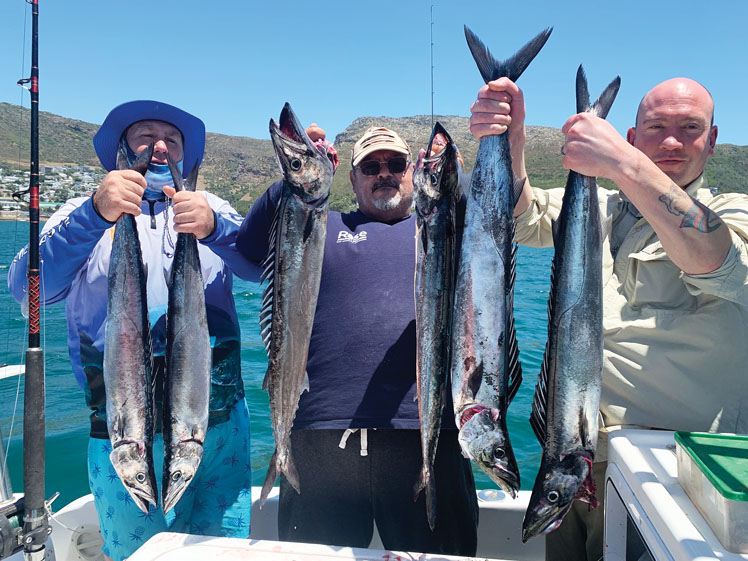
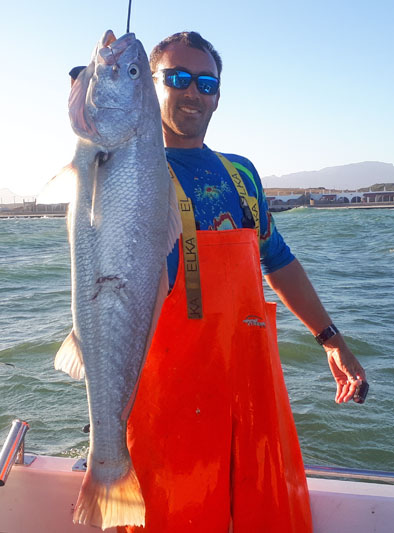
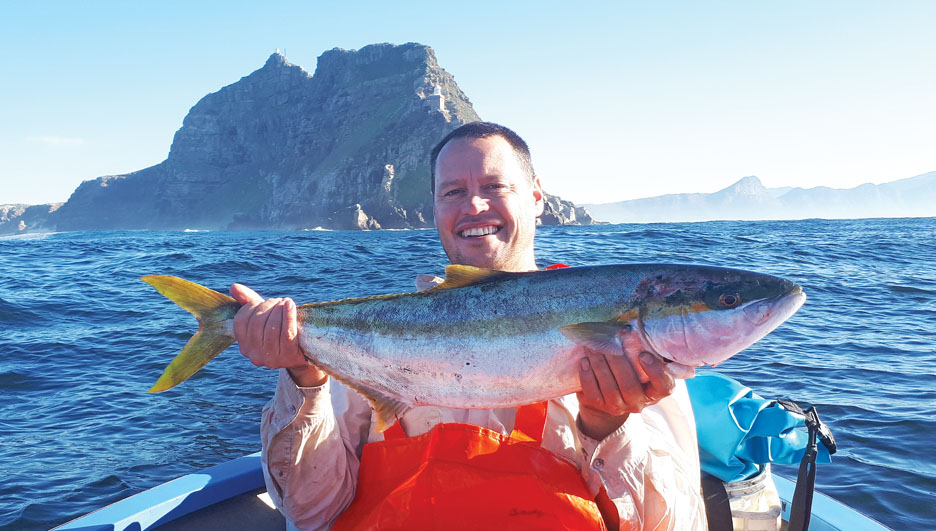
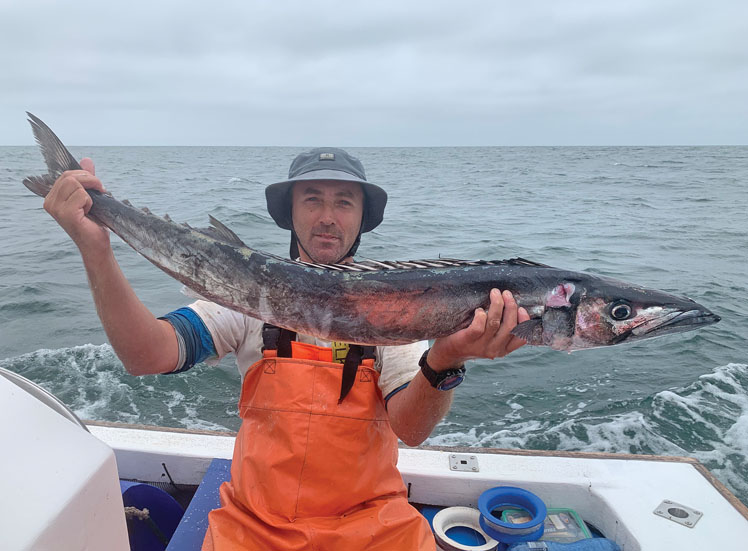
    Happy anglers show off their snoek catches wrestled from the Cape’s cold waters.

    PAP SNOEK
    The best way to ensure that a snoek does not go pap is to break its neck as soon as you bring it on board. This is done by pinning the fish down between your legs (if you are wearing oilskins), holding it behind its head with one hand and placing your other hand’s thumb in the fish’s eye and your other fingers under its mouth. You then bend the head backwards 90 degrees until you feel the neck break.
    If you’re not keen on breaking the neck like this you can use a knife to cut its throat to bleed it.
    Warm water and warm weather will usually cause a snoek to go pap very quickly, so keep the fish as cool as possible and out of direct sunlight.
    Snoek are usually “vlekked” (butterflied) by cutting them from tail to head alongside the dorsal fin. A second cut is then made to separate the backbone from one side. When folded open, it’s opened up like a butterfly, hence the term.
    When “vlekking” a snoek, you want the meat to be a nice pink colour and visibly firm. If the meat looks white then the fish is on its way to going pap. If the flesh has a jelly-like appearance it is best not to eat it, as the taste and texture would probably put you off snoek for life.
    The best way to ensure that the meat does not deteriorate any further after cutting is to lay the fish flat and throw a handful or two of coarse salt all over the flesh side. Leave the salt on for around 20 to 30 minutes and then rinse off with fresh water. Hang up for a few minutes to drip dry. This will usually firm up the meat and stop it from turning completely pap.

    FEROCIOUS FANGS
    Snoek have incredibly sharp teeth and many anglers have ended up in the emergency room to be stitched up after being bitten and losing a lot of blood. Snoek are believed to have an anticoagulant on their teeth which will stop blood from clotting, and most bites will bleed profusely.
    There is an old snoek fishermen’s tale that if you cut the eye of a snoek and rub the jelly in the cut it will stop the bleeding. I find the best thing to carry for snoek bites is a bottle of “Staaldrupples” as this will stem profuse bleeding and help blood clot.
    The snoek bite itself is not usually where the injury happens; it’s usually your reaction to being bitten and pulling your hand back that results in the worst wounds.

    TACKLE AND BAIT
    Snoek are pretty fierce predators with big mouths and razor-sharp teeth that will destroy most baits and soft lures in a single bite. The average snoek caught in the Cape is around 2- to 4kg, but it’s not uncommon to catch them up to 6kg.
    Tackle varies widely and is up to the angler. I have caught snoek on the lightest tackle while fishing inshore league on 4kg line, and on heavy 120kg hand lines. Although the thick lines don’t really give the fish a chance, it can be just as much fun as on the lighter tackle. I do, however, adjust my tackle according to the prevailing conditions, depth of water, current and how the fish are feeding.
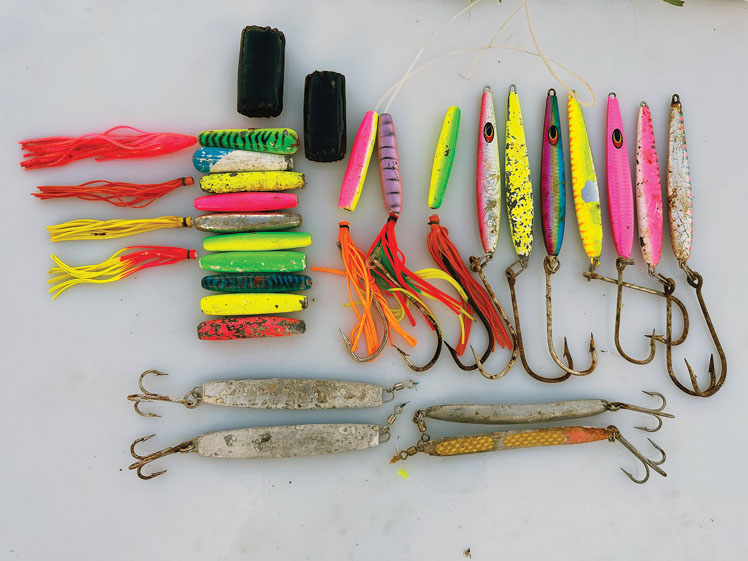
    The most common and exciting way to catch snoek will be using lures, and I am yet to find a lure that a snoek will not take when they are around in their numbers. They can, however, get quite fussy some days when they only want to take a certain colour and swim past most lures.
    You can use pretty much any spinner/jig that you would use for yellowtail. I generally advise people to use the lures that usually gather dust in the back of the cupboard, as you will probably lose a few lures every time you head out thanks to their sharp teeth. I have found that if you use a thick fluorocarbon bite trace you will end up losing a lot less tackle.
    The size/weight of the spinner/jig you use will depend on the tackle you are using. My go-to spinner is a Tin Garfish spinner that I bend slightly to give it a nice action. These spinners can be a bit heavy for the average spinning setup used by anglers in the Cape.
    The second best option for me would be an old trusty Tin Snake spinner that I also bend to give a nice action. Tin spinners work so well because teeth marks and scratches will give the spinner a nicer finish and look to a hungry snoek.
    I usually put a heavy duty 4/0 or 5/0 treble hook on these spinners. The main reason for using heavy-duty hooks is so you can use pliers to remove the hook from the snoek’s mouth and keep your fingers well clear of those razor sharp teeth.
    If you choose to catch snoek “commercial style” with a handline you can opt to use a traditional “dollie” and “bokstang”. This consists of a shiny/coloured barrel lead between 3- and 5oz, and a brightly coloured skirt made from rubber inner tubes or gloves cut into strips. The most common colour is red. These days you can pick from an array of colours and use either a single 11- or 12/0 hook.
    In years gone by snoek fishermen didn’t have all these options and they would simply use a lead barrel that was scratched using the back of a knife, and a piece of dried shark skin that was then cut into strips to make a skirt. This is known as a snoek lead.
    The easiest option to use on a hand-line is a snoek spinner. You will find these in every possible colour combination under the sun with an 11- or 12/0 hook attached by means of an oval clip. When fishing with a handline you will get less bite offs if you use a spinner than when the line is attached directly to the hook as it is on a snoek lead. On a spinner the line is above the lure, meaning it’s further away from those sharp teeth. Snoek spinners are also easier and quicker to change than a snoek lead.
    When casting or throwing out your lure, throw it as far as you can from the boat. Let the lure sink through the water with the line under tension as opposed to just dropping the lure down next to the boat. Let the lure free-fall down, as the snoek will very often grab a lure while it’s sinking. If the line is slack, it will usually swallow the lure and swim off, and when the line tightens you will get bitten off.
    Bait fishing for snoek can be a lot of fun, but can also be extremely frustrating when the snoek are not taking the bait properly. When they are shy, you will often pull in your bait to find teeth marks all over the bait where the fish has simply “tasted” it.
    Just like lure fishing, choice of tackle and hooks will vary from angler to angler. The most common hook to use is a 10- to 12/0 with a swivel attached to the eye. The big hooks help reduce the chance of getting bitten off, but you need a bit of force to set these thick gauge hooks into a snoek’s mouth.
    When fishing with lighter tackle, I usually opt for a thin gauge 8- to 10/0 circle hook. Using these circle hooks will usually result in far fewer bite offs than when using a similar size J hook. I have also found that I get far fewer bites when using a wire trace, so I usually use a thick fluorocarbon bite trace.
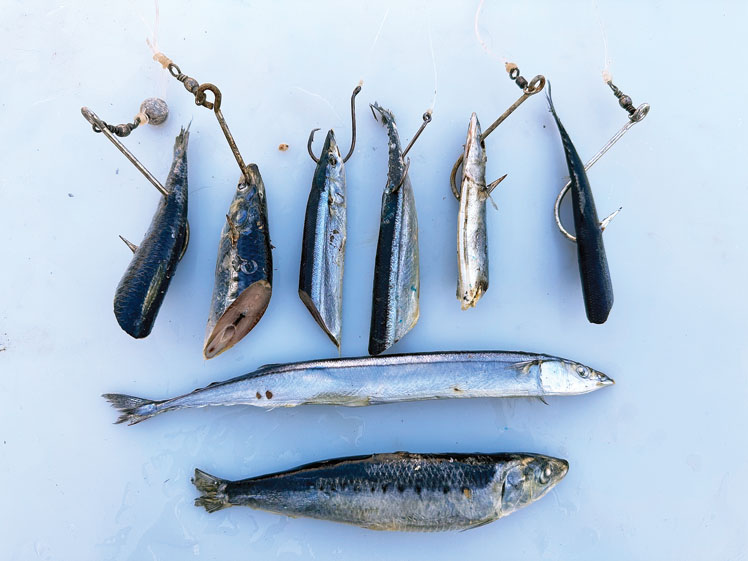
    Most fish baits will work but imported pike is by far the first choice for most fishermen. Unfortunately it’s not always easy to get and is very expensive. You will usually only be able to buy pike in 10kg boxes. The most cost-effective approach is to buy one box, drop the frozen box on the ground a few times to break the fish apart, then re-pack them in smaller packs while still frozen. You can then remove the bait from your cooler as needed.
    Once you defrost pike it won’t re-freeze well, so I usually refreeze any unused defrosted bait and then use it as chum on the next trip.
    Another way to chum is to use the stomach contents of the snoek that you have already caught. Hang the snoek over the side of the boat while holding the base of the tail. Use your other hand to rub the belly from the tail side towards the head, and you will push out the stomach contents.
    If you do decide to use a handline, make sure you have “vingerlappies” on your index/pulling fingers. These are rubber or neoprene tubes made to slip over the finger to stop you from getting cut when pulling the lines. It also provides extra grip when pulling.
    Snoek can also be caught on trolled lures, but will not often take on a surface lure, so if you want to catch them on troll rather opt for a deep diving lipped lure. Trolling is also a great way to find a shoal of snoek to then cast spinners at or throw bait lines on.
    If you hook up while trolling, don’t stop the boat immediately. Troll on for another short while and this will usually result in the rest of your lures hooking up, as snoek are a shoaling species.
    Watch your echo sounder while pulling in the snoek you have hooked up. If you ran into a shoal, then you should see plenty signs of them all over the echo sounder screen. If this is the case, then clear the lines and drop a spinner or jig and you should hook up pretty quickly.
    You should also carry a bolt cutter on board when snoek fishing and ensure it can cut through any hook in your tackle box. I have seen more hooks in people’s hands and bodies from catching snoek than any other species, because snoek mouths have a terrible habit of tearing, and when you lift the fish from the water, the lure then comes straight back at you.

    SIZE AND BAG LIMITS
    The current SADSAA All Tackle snoek record is 8,4kg (caught off Hout Bay in June 1974 by G. Sandell), but I have often seen snoek over 9kg caught on commercial boats around Cape Town.
    The IGFA All Tackle World Record is 7,67kg (caught in Chile in March 2017).
    The bag limit for snoek is ten per person per day with a minimum size of 60cm.
    If you’re keen to join us for a day’s fishing in False Bay to target snoek, or would like updated info and catch reports, then visit <www.oceanlifecharters.co.za>.
  • VARIETY CLOSE TO HOME

    VARIETY CLOSE TO HOME

    By Donavan Cole
    [Originally published in the November 2020 issue of SKI-BOAT magazine]

    FALSE Bay offers some really good reef fishing that many overlook as most boat anglers are usually chasing after the larger inshore and offshore pelagic species. The best part about targeting the smaller reef species is that you usually don’t have to travel very far from the launch site so these spots are accessible for most craft, and you will rarely return empty handed when reef fishing inshore.

    TARGET SPECIES
    False Bay reefs offer a wide range of species and it is not uncommon to catch more than ten different species of fish and small sharks in a day. The variety of species will, however, reduce as you go deeper, with more variety being found in water shallower than 30m. This is also the case as you move westwards out of the bay, because the water gets colder up the west coast. When you’re fishing west of the SW reefs outside the bay you will mostly only catch hottentot.
    The cold Atlantic Ocean is believed to meet the warm Indian Ocean at Cape Agulhas (southernmost tip of Africa) you will, however, find far more evidence of these two currents actually meeting at Cape Point if you look at the fish species caught in False Bay. We have many species that are commonly caught in False Bay and up the east coast into KZN, and most of these species will very rarely be caught west of Cape Point.

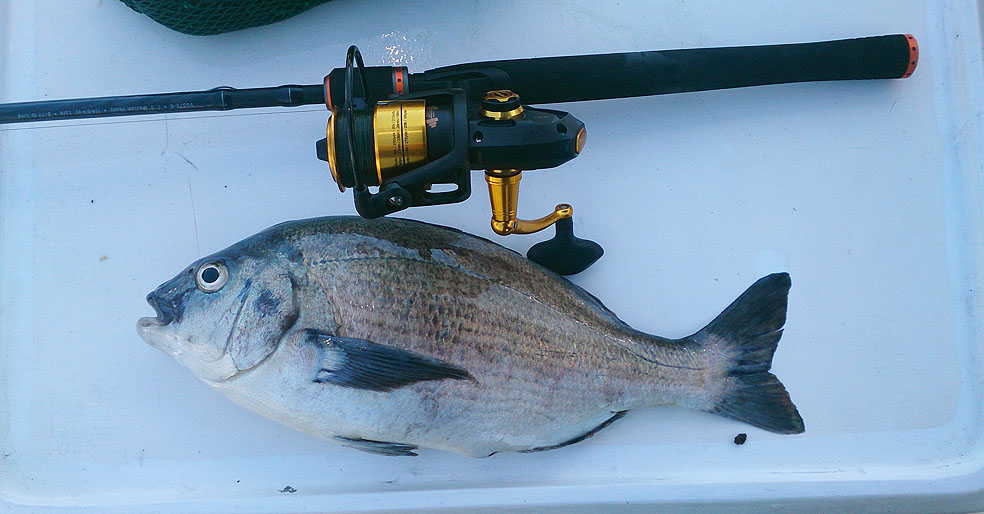
    ABOVE: A lovely hottentot caught on a light spinning reel setup.

    The most common species caught in False Bay is hottentot, also known as Cape- or black bream. You will find them close inshore between the kelp and out as deep as 100m outside the bay. You will generally find that the deeper you go the bigger the fish get, but large specimens can be caught in the shallows if your bait isn’t devoured too quickly by the small fish.
    Hottentot can also be like chameleons that change colour slightly according to their habitats. The fish you catch close to or in the kelp will most often be a dark brown colour, and as you move into deeper water they get lighter in colour. When catching them down off the sandy areas between Strandfontein and Macassar you’ll find they are a silver colour. I personally prefer to eat hottentot caught away from the kelp beds, as I think they taste better; those caught around the kelp beds apparently have a stronger taste due to the iodine in the kelp that they often feed on.
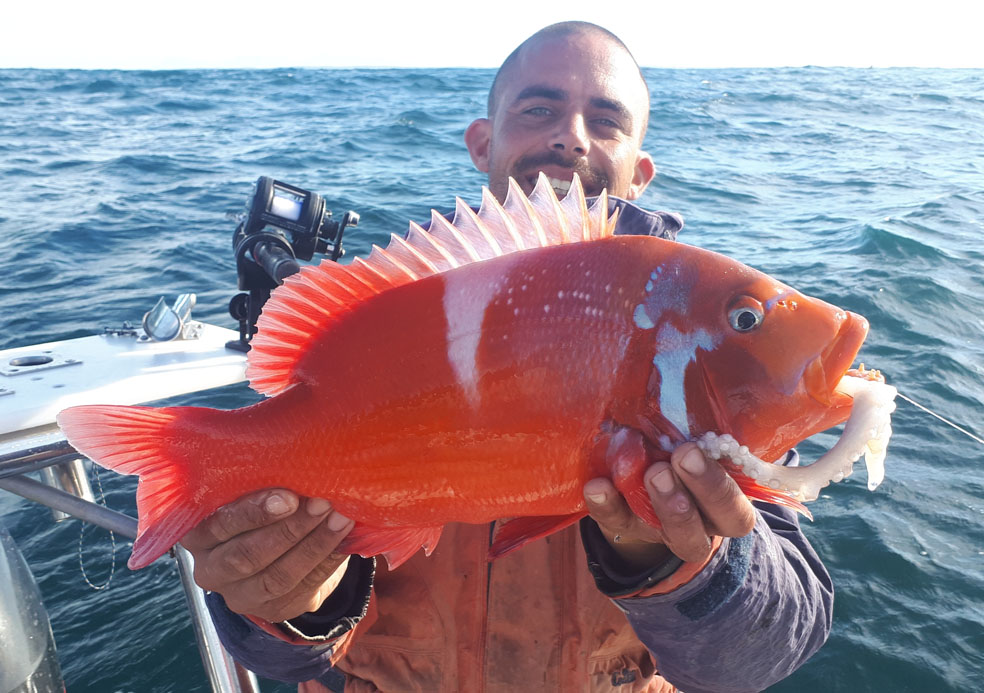
    Red roman are probably the most heavily targeted reef fish inside the bay. These beautiful, slow-growing red fish are the most aggressive feeders on reefs around the bay and you will quite often find that when you drop a bait they will are one of the first fish to grab your bait, rushing in and chasing away other smaller fish.
    I try to release most of the roman I catch around the bay and have tagged and released more than 300 in the last couple of years. A few of the tagged fish have been recaptured a year or two after being released while fishing on the very same reefs where they were originally tagged and released. This proves that these fish do not move around much, staying on a specific reef for great lengths of time.
    These fish are very aggressive feeders, so you will quite often hook them in their throats or deeper. If this happens it’s usually best to cut the line as close to the hook as possible and leave it to rust out rather than trying to pull or rip it out as the fish will most probably die after release in that case. Be very careful when handling a red roman as they have razor sharp gill plates; I have received a few nasty cuts while handling them.
    When considering whether to release or keep a nice big roman, please remember that a specimen of 45cm and upwards is 20 or more years of age.

    ABOVE: Ryan Cole with a red steenbras which was tagged and released.

    Red steenbras were once very common in the bay and some massive fish were landed in the early 1900s. They were, however, fished to near extinction and for many years you would rarely see any caught in the bay. Over the last few years there has, however, been a massive increase in juveniles caught all over the bay. Most are around 30- to 40cm in length, with the odd larger one coming out. I would like to appeal to all anglers to please handle these fish with care when landing them and try to return them to the water as quickly as possible. With any luck we could see the larger specimens also returning to the bay like in the good old days.
    You will quite often find that fish caught on the inshore reefs will carry some parasitic lice on the side of their heads and inside their mouths. While this puts many people off, it does not affect the quality or taste of the flesh. If I’m going to release fish that have these lice I will usually remove the lice before releasing the fish.
    When targeting reef fish in deeper water (30m-plus) you will usually find that the fish will embolize (suffer barotrauma) while being pulled up from the depths. This is due to the big pressure change from the bottom to the surface. When releasing these fish you will usually find that they battle to get down due to their expanded swim bladders and float away to be eaten by birds or seals. A way to minimise this is to pull the fish up as slowly as possible. You can also make up a simple weighted release tool using a biggish upside down hook with a clipped off point and a squashed barb. The line is attached to the bend of the hook and you hook the fish lightly in the lower jaw. You then send the fish down, keeping slight tension on the line, and when you recover the hook it will usually pull easily from the fish’s mouth, releasing the fish to swim off. I usually use a device called a SeaQualizer which clips on the fish’s lip; the clip is then set to open at a desired depth using a built in hydrostatic release.
    Please keep an eye out for tagged fish, and if you catch one please note the length, tag number and location where it was caught, and email that info to ORI <oritag@ori.org.za>. If you release the fish again please do so with the tag in place. Most anglers won’t carry a pen or pencil to write down the tag details, so the easiest thing to do then is to take a quick photo of the tag number.

    TACKLE
    When reef fishing, the bottom will generally be very rocky and foul which results in you hooking up to the seabed frequently; with lighter gear you tend to snap off very easily. I usually opt to fish with stronger braid which allows me to have a direct feel of any bites and great fun when pulling the fish in as I can feel every head shake and pull because there is little or no stretch in the braid.
    I generally use a standard “Paternoster rig” when bottomfishing, with three-way swivels to separate the hook and sinker traces. (See photo alongside.) I will usually fish a double rig with two hooks above each other. The hook traces are around 30cm long, with the sinker trace slightly longer so that when I’m fishing flat on the bottom my hook stays off a bit to minimise snagging and lost tackle.
    My hook and sinker traces will be of a lighter breaking strain than the main line so that when the hook or sinker trace snags up on the seabed I can just break off the trace instead of losing everything. When I’m fishing close to the kelp beds in shallow water I will make up a drift trace with a small swivel to allow it to sink slowly.
    I prefer to use “J” type hooks when reef fishing as I like to feel the bite and strike the fish as opposed to using circle hooks where you let the fish hook itself. I use 1/0 to 3/0 size hooks as smaller hooks will result in me hooking most of the smaller fish that come to nibble on the bait and missing out when a bigger fish comes along. I do, however, use circle hooks when targeting red roman as I release most of them. The circle hooks usually hook in the corner of the mouth and can then be removed quickly for the fish to be released with minimal damage, unlike the J hooks which often hook in their throats.
    Sinker size depends on tackle, depth of water and current. When fishing inshore in shallower water (under 20m) you will rarely need to fish heavier than 1- to 2oz. When fishing deeper, especially outside the bay, you might encounter some strong currents and need to fish much heavier. This is when braid will outperform mono filament as the thinner braid will create far less resistance in the current, meaning you can use lighter sinkers.
    I generally fish with a spinning reel setup loaded with 20 lb to 30 lb braid. When fishing close inshore a lighter rod can be used, but when you’re fishing deeper waters that require a bigger sinker a heavier rod is used.

    BAITS
    When reef fishing around False Bay almost any baits can be used, but I prefer to use the tougher baits like octopus and squid/chokka as there are loads of small nibblers that will tear most soft baits apart in seconds. Another favourite bait is white mussel which is really soft when fresh. I will usually defrost my white mussels a day or two before going fishing and then salt them heavily with coarse salt and leave in a strainer overnight; this will remove most of the moisture and the mussel meat will toughen up nicely.
    When using softer baits like sardine or red bait, I’ll put a thin strip of chokka on the hook first and then have the softer bait on the outside which will usually attract the fish. As it breaks up you will be left with the firmer chokka that will be chewed on until a bigger fish comes along.
    When it comes to using fish as bait I like to use pike instead of sardine as the tough skin on the pike keeps it on the hook a bit longer. The pike is also pretty oily which usually gets a lot of action. The pike can be filleted then cut into pieces or chopped into blocks. In the summer months mackerel is often caught in the bay, and if they’re frozen properly these make excellent bait as the skin and meat is quite firm and I don’t know of any fish that will swim past a strip of mackerel.
    I don’t usually chum while reef fishing as the chum will drift away in the current, and by the time it reaches the seabed it will be a way off from the boat where the baits are. You can, however, drop a weighted bait bag down to the bottom to attract the fish into the area where the lines are.
    A few anglers have shifted from using conventional baited hooks to artificial lures for reef fish with great success and most reef species can easily be enticed to grab a lure. Micro jigs have been proven to work for many of the reef fish encountered in and around False Bay.
    I’ve had great success using micro jigs on the bottom of a baited trace as a weight instead of a conventional sinker. On many occasions the fish have gone for the jig instead of taking the baited hooks just above. I think that the jig action from the moving boat will also attract fish quicker than a bait that’s just hanging there, but I often end up losing more tackle due to the hooks on the jig snagging the bottom which can become very costly.

    WHERE AND WHEN TO FIND THEM
    Reef and rocky bottom are found throughout False Bay and fish are found from the edge of the kelp line right out to a few miles off the coast. The most productive areas are, however, towards Cape Point where the largest variety of species and rockier grounds are found.
    When fishing close inshore it’s always worthwhile noting what the coastline contours looks like; that will give you a good indication of what the bottom is like. Deeper, rockier ground under the surface is usually found off steep cliffs, while softer, flatter grounds lead off beach stretches.
    The beach stretch between Muizenberg and Macassar is a perfect example of an area where the sandy bottom and shallow waters extend quite far out. Quite often the water a mile off the coast will be as shallow as 6m compared to the steep coast line around Cape Point where the seabed is mostly rocky and the water drops off past 30m very close in.
    Venture a bit further out for some very nice reef fishing around Whittle Rock/Bell buoy which is around four miles east of Miller’s Point out into the middle of False Bay, otherwise try Rocky Banks which is around five miles off Cape Point. Both these areas can quite easily be found on a nautical chart or on a plotter, and once you’re in the vicinity you will not have any problem finding fishing areas using a echo sounder.
    Don’t discount the sandy stretch between Muizenberg and Macassar, though, because there are plenty of spots to catch reef fish around there. Those reefs are usually small and not always easy to find, but you may be very well rewarded if you ride around a bit watching your echo sounder.
    One way to find some productive areas is to get a paper nautical chart for the bay and plot GPS positions of pinnacles or steep changes in depth contours. You should also be able to see these pinnacles and contour lines on your plotter fishing chart. You can also draw your own contour lines on some of the newer echo sounder/plotter electronic units using pre-installed software. I use Quickdraw™ Contours on my Garmin echo sounder/plotter. By drawing your own contours you can get a nice idea of the seabed structure and if you cross reference this with what fish you see on the echo sounder you can get a good idea of the best areas to fish.
    Reef fish around the bay usually bite in most water temps and wind conditions although there is usually far less action and fewer bites when the water drops below 13°C. There are, however, times when there is a rapid drop in water temp from day to day and the fish will go off the bite completely while they acclimatise.
    At other times the water is warm and we see plenty of fish on the echo sounder but get no bites. This might be because there is a thermocline (large temperature difference between the surface and bottom). A way to check this is to feel your sinker when you pull your line in; you’ll be able to tell if the water is abnormally cold as the bottom temp will transfer into the lead.
    I usually mark fishing spots on my plotter when I see nice structure, pinnacles, drop offs or fish markings on the seabed. Most of the spots around Cape Point and further out I have found and marked while trolling around for yellowtail. If I see any interesting structure or pinnacles I will usually mark them and come back and fish them at a later stage. You can usually tell when you are passing over rocky/reef areas as the thickness of the seabed reading on your echo sounder screen will increase as the bottom gets “harder”; when moving onto softer sand or shell the seabed image will be thinner.
    Once you find “the spot” head up into the wind and throw anchor, then come back slowly until you are on top of the spot you intend to fish. When fishing around the point or outside the bay always keep an eye on the swell as an anchor that is thrown too short could result in your bow being pulled under when a big set of waves come through as they peak over a reef or pinnacle.
    Once the anchor is hooked and lines are dropped you should get bites pretty soon if you have positioned the boat correctly. If you don’t get any bites then let out more anchor rope while watching your echo sounder to see if you come onto the fish. If you’re still not getting bites then it’s best to pick up the anchor and try again. When we’re reef fishing we won’t usually lie and wait for the fish to arrive as most of the reef fish will hang around a specific spot, and if you are not on top of it then you are wasting your time.
    If you manage to get onto the spot and start catching fish then you will usually find that the fish go off the bite or slow down after a while. When that happens I pick up my anchor and look for another spot.
    I usually use a grapnel anchor with a shorter length of chain when reef fishing as you generally don’t have a problem getting your anchor to hold, and if your chain is too long you run the risk of the chain hooking up which will often result in a lost anchor.
    Alternatively on calm, windless days you can drift instead of throwing anchor. This can be quite productive as you can drift across a reef and cover a lot more ground, especially where you have small pinnacles and drop offs that can be hard to anchor on exactly. Unfortunately you lose far more tackle when drifting as your line gets dragged along the seabed; this method is also not practical when you’re fishing in deeper water because even with a very slow drift you will need to keep on paying out line to keep your bait close to the seabed where the fish usually are.
    I usually drop my bait down to the seabed, and once the sinker hits the bottom I will take up the slack and try to keep my bait as close to the bottom as possible. I generally don’t strike when I feel the first bites but wait for a proper take or the biggest bites; this way you don’t end up hooking the smaller fish before something bigger comes along.
    Seals can be quite a nuisance when reef fishing in False Bay, especially when you are boat alone. A seal will sometimes hang around the boat taking almost every fish you hook! If this is the case then it is best to pick up and run to another area as the seal will usually hang around the boat until it has eaten its fill.

    FISHING RESTRICTIONS
    Please check the most recent marine recreational angling regulations for size and bag limits for the various reef species. Also ensure that you know details of the Marine Protected Areas that are off limits to fishing. MPAs are put in place around important reef areas which populate the outlying areas with fish, ensuring that we will still be able to catch reef fish in the future.
    The most important MPAs to note in this area are listed below, and they are visible on most plotter maps.
    • Boulders Restricted zone: in the area between the eastern end of Simonstown harbour and Oatlands extending out around Roman Rock Lighthouse.
    • Castle Rock Restricted Zone: between beacon VB1 at Miller’s Point just south of the Cape Boat and Ski-boat Clubhouse and beacon VB2 at Partridge Point extending one nautical mile seawards.
    • Paulsberg Restricted Zone: between Smitwinkel Point and Venus Pool, extending one nautical mile seawards.
    Remember: Limit your catch; don’t catch your limit.

  • GETTING INKED

    GETTING INKED

    By Donavan Cole

    [Originally published in the September 2020 issue of Ski-Boat magazine]

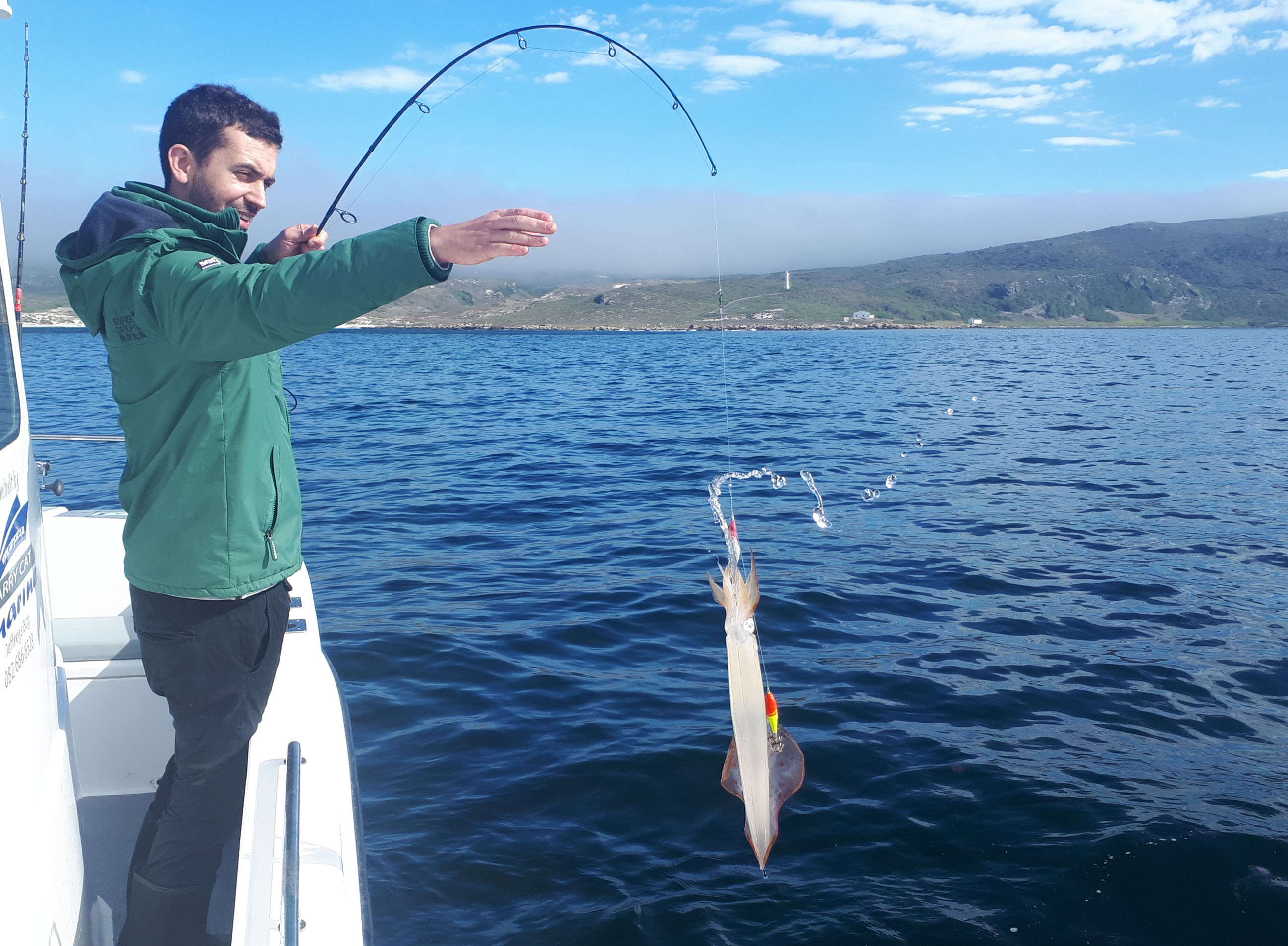
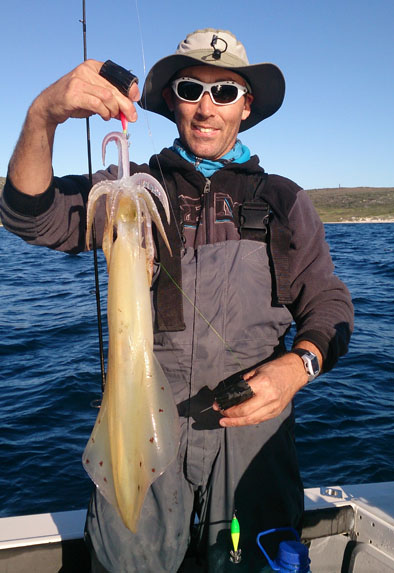
    SQUID must be my — and many other False Bay fishermen’s — favourite species to target! Not only are they fun to catch, but they are also delicious to eat and one of the best baits to use. I can’t think of a single species of fish we catch in False Bay that would not eat a chokka bait.
    Our False Bay squid (Loligo reynaudii) are usually called chokka/tjokka by fishermen (this name originated with the old Kalk Bay handline fishermen) but they’re generally called calamari when prepared as a meal.
    South African-caught chokka is one of the tastiest squid caught anywhere in the world and demand a massive price overseas. There is a large commercial handline squid fishery off Port Elizabeth and Jeffreys Bay where they catching the same species as we catch in False Bay, and most of it is exported. Most of the time when you order calamari locally at a fish-and-chip shop or restaurant you will be eating a cheaper imported trawler-caught squid. It is softer but not as tasty as our local species.
    The imported squid is also sometimes used by local fishermen as bait, but there is no comparison between the two; our local squid will out-catch the imported squid every time, and many anglers refer to our local chokka as “white gold”.
    Chokka fishing can be quite a messy affair, though, as a mix of water and slimy black ink will be flying around when the chokka are lifted from the water, so its always best to wear clothing that you don’t mind getting stained black.

    WHEN AND WHERE
    Chokka are commonly caught along the South African coast from False Bay to Port Alfred, but I am going to discuss fishing for them around False Bay.
    Chokka can be caught pretty much everywhere around the bay, but the best areas are where there’s a softer sandy or shale bottom. The most commonly fished areas are in Buffels Bay towards Cape Point and the area from Simonstown to Muizenberg. The area off the Bull Nose (Simonstown Naval Harbour) is a favourite spot as it can usually be fished in most weather conditions and is easily accessible by pretty much anything that floats. Craft fishing here usually launch off Long Beach opposite the Simonstown train station.
    I’ve found that chokka can be caught right through the year in Buffels Bay and I’ve had some of my best catches in the middle of winter. Simonstown area is usually different, though; the best times there will usually be during the summer months from October to May. The 2020 season, however, proved to be very different and good catches were being made there most days in the middle of winter.
    Chokka can usually be caught when water temperatures are from 14°C upwards. They will however go off the bite pretty quickly when you have a very rapid drop in temperature and when a big swell and strong sea are running.
    Along the Simonstown to Muizenberg stretch chokka can be caught anywhere from close inshore to more than 20m of water. In Buffels Bay we will generally fish in water from 15m to as deep as 45m, but usually find the bigger squid in the deeper water. When fishing in Buffels we will usually fish in line with the big white Diaz Cross on the top of the hill above Buffels Bay slipway.
    I will usually start looking from a depth of around 20m and watch my echo sounder while heading straight out to sea. I’ll check to see where the best markings of chokka are and then either start drifting from there or throw anchor depending on the prevailing wind conditions.
    Drifting will usually result in the best catches as you will move around covering more ground. You do, however, end up losing more jigs when drifting if they snag on the bottom and it can also be quite challenging keeping your jigs down near the bottom when the wind picks up. Your best times of the day will always be early morning and late afternoon.
    I prefer to go and anchor or drift on my own, but some days you need to anchor between all the other boats catching because seals can be quite a nuisance. Some days you will lose almost every single chokka that you hook to them, and when you’re situated between all the other boats the seal will eventually move from boat to boat until it has eaten its fill!
    Our chokka generally live a maximum of 18 to 24 months and the average size caught will be between 10cm and 30cm mantle length (measured from the tip of the body to the base of the body where the head enters). Larger specimens of up to 50cm can sometimes be caught.
    When Cape snoek are being caught in Buffels Bay you might want to think twice about fishing for chokka, as snoek love going for chokka jigs and most of the time you will go tight and get bitten off immediately by their razor sharp teeth. I’ve gone as far as trying a wire trace and didn’t lose any jigs, but the chokka would not come near the jigs with the wire traces. These days we don’t encounter snoek as often as in the past, but we often catch other species like gurnards, mackerel, maasbankers and octopus on the squid jigs.
    It’s best to wash the boat as you are catching, because the black ink will leave stains all over. The best thing to use for removing the marks that won’t come off is a bathroom mould cleaner, and for the really stubborn stains you can use diluted pool chlorine.

    TACKLE
    For squid fishing I will generally not fish with under 20 lb line/braid as you run the risk of losing your expensive jigs if you’re fishing too light and you snag the bottom or a seal takes your catch.
    I like to fish with a spinning/grinder reel in the 2 500 to 3 500 size loaded with braid. In my experience you will feel far more “bites” and catch far more when using braid than monofilament line. You will, however, lose a lot more chokka without that stretch in the line for a bit of extra give when they jet backwards. I like to use a softer rod that can handle a 1- to 2 oz jig; if the rod is too stiff then you wont feel a lot of the “bites”.
    When it comes to jigs it’s a case of the more expensive the jig, the better the catches. You will find jigs in every colour under the sun and with different textures, but my favourite colours are pink, blue, white, green and chartreuse/ yellow. Most days they will work but you will find days when you will end up catching most on one specific jig while others get very little interest. I frequently fish before sunrise and after sunset so I always look for jigs that have some sort of glow-in-the-dark colouring on them as these will get far more action in the dark.
    I mostly fish two jigs on a thin fluorocarbon trace with a lead jig (1- to 2 oz depending on depth of water and current) at the bottom and a “floater” (shrimp like floating jig) just above. I drop the jigs down to the bottom and then lift them around 30cm from the bottom and wait for the bite. When the chokka are feeding off the bottom then I’ll use a single floater type jig with a small peanut-size ball sinker and cast it out and let it sink down and work it up slowly.
    At times you will have a lot of fine weed and sea grass on the seabed when fishing in Simonstown, and if your jigs touch the bottom they will get fouled up. A way to prevent this is, when you drop down the first time, lift the jigs off the bottom and then set the line in the line clip on the side of the spool (on a spinning/grinder type reel) so that when you drop down again the jigs don’t touch the bottom because the line stops at the line clip.

    THE BITE
    When catching squid there are so many different “bites”, but usually if you feel any movement or bumps on the line that will be a squid taking the jig. The most common “bite” to recognise is where the line will go slightly slack and then heavier than normal and you are usually hooked up. There is no need to strike, you simply start reeling and try not to stop reeling. Don’t pump the rod up and down as the slightest bit of slack in the line will result in you losing your catch.
    There are also times when you will lose the squid while reeling in and end up finding a single tentacle on the jig hooks; this is usually the case if you’re reeling them in too fast. This also happens frequently when you’re using braided fishing line which has no stretch or give when the squid jets backwards against the jig.
    I find the easiest way to feel for chokka is to hold the rod and lift the tip every now and then and you will have a good feel for the weight of the jig, so that when you lift the tip of the rod and feel extra weight you then keep the tip raised and start reeling in and you should be hooked up.

    CATCH RESTRICTIONS
    In addition to a Post Office-issued Recreational Fishing Permit you will also require a molluscs fishing permit (number 9) to legally catch squid. There is no legal size limit and you have a daily bag limit of 20 squid per person. Currently there is a closed season for catching squid from 12h00 noon on 19 October to 12h00 noon on 30 November of any year (as per the Marine Recreational Activity Information Brochure). Please check your most recent regulations as this could change.
    Happy squidding.

  • KOB IN THE CAPE

    KOB IN THE CAPE

    [Originally published in the March 2020 issue of SKI-BOAT magazine]

    By Donavan Cole

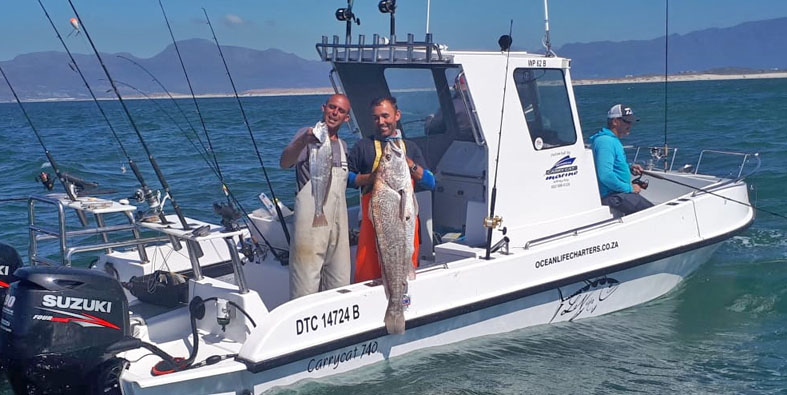
    KOB is probably my very favorite species to catch in the bay even though I will often return mombak. I still ask myself why I bother when I come back empty-handed, but those trips when we find the fish after the persistence makes it all worthwhile. What I love most about catching them is that when a fish take the bait you never know if it’s a 1kg or a 20kg specimen.
    The kob caught in the bay are often undersize (under 50cm) and most of the time you will throw back ten undersize fish for every one that is above the legal size limit of 50cm, but then you’ll find quite a few fish between 3kg and 12kg. Bigger fish are not uncommon, but around 20kg is the biggest that you will encounter.

    WHEN AND WHERE
    I will mainly be discussing fishing the areas accessible when launching from the western side of False Bay at Simonstown or Millers Point.
    In False Bay kob are predominately caught during the summer months, with catches starting around early October when the south-easterly winds start blowing and warming up the water in the bay. These winds will also start churning up the water creating the milky brown “kob water” that is seen inshore along the stretch between Muizenberg and Gordon’s Bay.
    A change of wind direction will, however, change conditions pretty quickly. When the wind swings more to the east this “kob water” will be pushed from Muizenberg towards Kalk Bay, and if it really blows then that water can sometimes move as far west as Simonstown. During these easterly blows you can almost be sure that kob will be off Fish Hoek and Kalk Bay and it will be worth having a look in these areas before running further down to Strandfontein.
    The opposite can be said about southerly and south-westerly wind days, as this will usually clean up the water along this stretch very quickly.
    The main reason that kob are found in this brown water is that this nutrient rich water will usually attract the bait fish that the kob feed on, unlike most species kob are known to be very good hunters in dirty water, these strong winds will also create a lot of wave action which will highly oxygenate the water, and the fish will in turn feed a lot more actively in these oxygen enriched waters.
    I will usually plan my trip according to the predicted weather reports. If the wind is due to drop in the afternoon or early evening then I’ll run down around 3pm and, depending on what the catches are like, run back home around 10pm. Otherwise if the wind is predicted to drop during the night then I’ll launch a couple of hours before sunrise and fish well into the day. I’ve found that the best catches come an hour or two either side of sunset and sunrise. There are, however, times when conditions are good in the evening and the fish are biting nicely and I’ll stay out all night and then get to fish sunset and sunrise. I’ve also had many times where we’ve gone down in near perfect conditions and caught very little, then boats go down the next evening in less than ideal conditions and catch plenty of fish, so there are no hard and fast rules here.
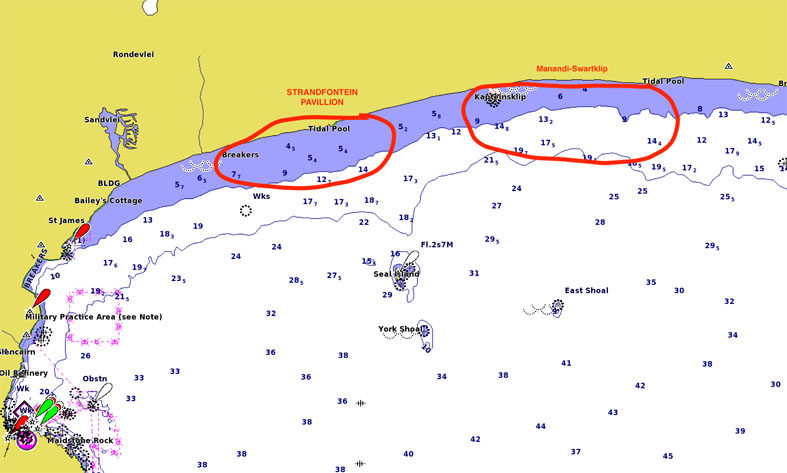
    I’ll usually start off running down to Strandfontein Pavilion and, if the swell and wind allow, I’ll try to get in as shallow as possible behind the tidal pool wall. If the swell does not allow then I will start looking from the edge of the surf line and work my way out to around 15m deep water. If conditions are not great there or if good catches are reported further down, then I will run down towards Kapteins Klip/ Manadi and work on towards Swartklip. I don’t have specific “numbers”, positions or spots that I run to and anchor on; I just head for these general areas and then use my echo sounder to find where the fish are.
    When you’re fishing the early season from October to November you need to be especially careful at night because during these months there is an increase in the number of whales in the bay, especially in the shallows. Keep a good lookout and run as slowly as possible.
    During the summer months the south-easterly winds can blow for days on end, driving everyone mad. As I write this we are in the middle of a ten day blow. When that happens I watch the weather predictions waiting for when the wind moderates, and take any gap I can get. Ideally you want the south-easter to drop off completely and then swing to the north-west. This change in direction will usually result in the best conditions, and the north-westerly, being offshore, will blow the sea flat enough so that you can get into the shallow waters that are usually in the surf zone during south easterly (onshore) winds.
    I also keep a eye on the swell; ideally you want it to be under 2m so that you can get into the best areas. If the swell is over 2m then I will start looking in the deeper water, but if the swell starts pushing towards 3m I’d rather just stay home.
    One funny thing about kob fishing is that when we’re out we are usually trying to get as close inshore as possible and at the same time the rock and surf anglers are trying to get as far out as possible. These days we will often see bait boats and drones taking baits out from the beach and dropping them close to us.
    When looking for kob I have a few indicators I look at. Watercolor plays the biggest part in selecting the area to fish. I always start out looking for the brown dirty water that’s a result of the strong south-easter, but don’t lose hope if you arrive in the area and the water is clean as this is usually when the kob will start feeding after dark.
    Kob can be very frustrating fish to catch, especially when you are among other boats. There are times when you will be so close to another boat that you can talk to one another, and you will watch them catch fish after fish after fish while you don’t get a thing. Then there are times where you will have guys on the top current side of the boat catching plenty of fish while the guys under current on the same boat will be catching absolutely nothing.
    The best position to fish from will always be the stern of the boat as the swell, wind and current will come from different directions and the boat will swing from side to side while on anchor. If space does not allow you to fish from the stern then always try to fish on the top current side which should keep your lines away from the keel and engines.

    TACTICS
    When fishing in shallow water — 5m and shallower — always first stop on the outside for a while and watch the sets of waves coming through so you can get a good idea of where the waves are breaking. That way you don’t end up anchoring in what you thought was flat water and then get into trouble when a set comes through. Also be mindful of what the tides are doing and watch your echo sounder, especially over spring tides as you might anchor in water that is perfectly safe at first and later you have breaking waves around you as the tide drops and water gets shallower.
    Once you have assessed the area then move in closer, watching your echo sounder. Kob can usually be seen on the echo and if they’re feeding then it won’t take long after anchoring to get them to take baits. Once you find the fish on the echo then move up ahead of them, into the wind and drop your anchor as quietly as possible. I like to lower the anchor hand over hand as quietly as possible. I also have a specific anchor set up to use in the shallow water — a grapnel with a very short, heavy chain because a long, thin chain has a tendency to get completely stuck in the rocky ground as you swing side to side. The longer chain also makes a lot more noise on the reef as it snatches up and down. I also like to have a short rope attached to the crown of my anchor with a small buoy on the end so that if the anchor or chain gets snagged and I’m unable to recover the conventional way, I can pick up the buoy and pull the anchor up inverted.
    Don’t forget to always put your engines in gear while on anchor, especially when there is a strong current, because when they’re in neutral the propellers will spin in the moving current and any lines close by will be snagged and wrapped up.

    TACKLE
    When fishing for kob I will usually opt for heavier tackle — 10kg line upwards — because of how rough the ground can get. When you hook bigger fish in the shallows they will usually run off to the nearest rocks or reef and you generally don’t stand a chance on light tackle. We also find that when the conditions are favourable there will be a good few boats all anchored in close proximity to one another and with lighter tackle the fish often run around your own anchor or another boat’s anchor or their lines and get cut off. I also prefer to use heavier tackle because we frequently hook big sharks and rays and end up spending ages trying to land these fish on light tackle, unsure if it’s a big kob and wasting the best fishing times.
    Having said that, when the kob are very shy you will get a lot more bites using light tackle, so it’s always worth a try when conditions are good and you’re not getting any action on the heavier tackle.
    I prefer to use circle hooks as they generally hook fish in the corner of the mouth and not deeper, so fish that you want to release have a greater chance of survival. I have also found that I get snagged less often on the bottom when I’m using circle hooks, especially when fishing with drift lines. I will usually use a 3/0 to 9/0 depending on the brand and size of fish around.
    Before circle hooks became so popular I would mostly use Kendal Round hooks and, depending on the size of fish around, use between a 6/0 and 9/0. I also never use wire traces, so when the elf are around I also get fewer bite offs because of the circles.
    I will usually fish a drift line (un-weighted) by attaching a swivel to the end of the main line and then use a fluorocarbon trace of around 50cm between the swivel and the hook. Depending on the depth of water and how strong the current is, I will add a small ball or barrel sinker (seldom bigger than 1 oz) to the trace by sliding it on the main line against the swivel.
    I like to fish drift lines using a multiplier reel loaded with monofilament line rather than using a spinning/ grinder reel loaded with braid. When casting light drift baits out repeatedly with braid you get a lot of wind knots and tangles, and they’re usually impossible to get undone in the dark. With multipliers as you can also put the rod in a rod holder and set the ratchet and wait for it to tell you there is a fish on. You really need a ratchet when you’re fishing in the dark. Another trick is to use a small light stick attached to the tip of your rod with a thin cable tie and you can then keep a good eye on what your rod is doing in the dark.
    I also use a second rod rigged up with a trace similar to what rock and surf fishermen use — attach a 3-way swivel to the end of the main line with a hook trace of around 30cm on one side and a slightly longer sinker trace on the other end. I will use 1- to 3 oz sinkers depending on the depth of the water, and smaller hooks around 3/0 size as there is always a good chance of catching white stumpnose and other smaller species on this setup. This line will be dropped straight down next to the boat, and when it hits the bottom I’ll just take up the slack and wait for the bite.
    In some spots where the bottom is very foul I will only fish “up and down” with the last mentioned trace as a drift line will usually get stuck as soon as it hits the bottom, and fishing the up and down method will allow you to fish with far less tackle loss.

    BAIT FISHING
    The main baits I use for kob are squid/ chokka and sardine, and I will always try to start a kob trip by catching a few fresh squid off Simonstown or Fish Hoek on our way down to the fishing grounds. I remove the head of the squid and open the squid, cutting it into long thin strips and threading one or two on the hook, leaving a long tail depending on the size hooks. The sardine will be cut into blocks and I’ll add a piece with the chokka. I don’t ever use bait cotton when fishing from the boat. Never throw that squid head away, because it’s probably the best part of the squid and you can use it guts and all; no kob could ever swim past that. A fresh elf fillet is also very hard to beat.
    Livebait can also be very productive, and there will quite often be small maasbankers and streepies/karanteen under the boat that can be easily caught with sabikis or small baited hooks. At times there will also be masses of mullet on the surface around the boat in the shallows, so carry a throw net on board for those times.
    Kob can be caught on most baits when they’re feeding properly, and I have caught many kob on white mussel and red bait while fishing for reef fish.
    Lures are not commonly used to target kob in False Bay, but I believe that if we tried harder we would have good results as we have caught a few fish on spinners while throwing them for elf. This previous season I managed to land a fish of 19kg on a jig, and on that particular morning I caught a good few small kob and geelbek on the same jig.
    I believe that paddle tails are used quite successfully by rock and surf guys off the Strand reefs. I have tried them on a few occasions off the boat but usually lost interest after losing one or two to the foul bottom, even when rigged weedless.

    SIZE AND BAG LIMITS
    In False Bay/Cape Town we follow different bag limits/restrictions on kob to anglers on the east coast and up into KZN as we mostly catch silver kob while further up the coast their main catch is dusky kob, especially inshore and in estuaries east of Agulhas.
    In the Cape the bag limit is five kob per person per day with a minimum size of 50cm. Please also remember that the bag limit is what you may have in your possession at any one time, so if you spend the night at sea fishing over two days that does not mean that you are permitted to keep two days’ quota.
    I try to tag and release as often as possible and have tagged more than 300 kob over the last few years. The tag recapture rates are unfortunately quite low, but in this past year two fish that I tagged off Strandfontein were recaptured on the west coast between Melkbos and Gaanzekraal. This has surprised many other anglers as most fishermen believed that the west coast and east coast kob were different stocks with Cape Point being that imaginary border. One of the most interesting kob recaptures I’ve had was a fish I tagged and released off Melkbos on the west coast and which was recaptured by a commercial boat fishing off Stillbaai more than 600km away.

    FISHING ETIQUETTE
    When conditions are good, especially over weekends, you’ll find a good few boats out there. Just be mindful that in very shallow waters you can quickly scare fish away with too much noise, so try your best to move into the area as slowly as possible. When you’re approaching other boats try not to pass too close across their sterns as that is where the lines will usually be out; rather pass around their bow and watch out for anchor ropes. The same goes for when you’re anchoring — rather anchor next to another boat (not too close) instead of directly behind them because any big fish will usually run down with the current at first and the other boat then has a very good chance of losing their fish around your anchor rope if you’re anchored behind them.

    BELIEFS AND THEORIES
    One of my theories that many other regular kob fishermen in our area agree with, is that when we’re fishing from a catamaran in the very shallow water we catch a lot less fish than when fishing from a monohull, especially in a choppy sea. This is due to the tunnel slap as the wave action pushes through the tunnel of a cat creating a slapping noise which I’m pretty sure can be felt and/or heard by the fish.
    Another theory is that you should not use bright lights while night fishing. Most of the old kob fishermen will never switch on any deck lights or shine any torches in the water as they believe it spooks the fish. I’ve fished on some boats in the past where you would almost be thrashed for shining a torch anywhere near the water.
    Please note that I am by no means an authority on catching kob in False Bay and after catching these fish for more than 25 years I am still learning new things every time I go to sea. What I will say, though, is that persistence pays off with these fish more than anything else.

    If you’re keen to join us for a day’s fishing in False Bay to target kob or if you would like some updated info and catch reports then contact Donavan via <www.oceanlifecharters.co.za>.

  • ON THE TRAIL OF TAIL

    ON THE TRAIL OF TAIL

    (Originally published in the January 2020 issue of Ski-Boat)
    By Donavan Cole

    IF you ask any Cape Town angler they will all agree that yellowtail fishing around Cape Point can be some of the most exciting or most frustrating fishing you’ll ever encounter. One day you will have them eating out of your hand and the next you will be pulling your hair out while they swim around any and every lure you present to them. However, the days when they do bite make all the mombak (no fish) days worthwhile!
    The average size of yellowtail encountered around False Bay is usually between 2- and 5kg; bigger fish up to 12kg are not uncommon, though, and a few specimens up to 20kg have been caught over the years. I have not landed one over 12kg despite fishing around the bay for more than 20 years, but I have had many big fish reef or run me off over the years.

    WHEN AND WHERE TO CATCH
    Around False Bay the yellowtail generally prefer warmer water of 15°C and upwards, but there are times when the fish can be caught in water as cold as 13°C. The fish will usually go off the bite with a sudden drop in water temp, but if there is a gradual drop in temperature over a few days then they can be caught in these colder waters.
    The colour of the water is also a big factor and we will usually find that the best catches will be made when it’s clean and blue. Catches will decline from little to nothing as the water turns green and then to dirty brown.
    A westerly wind is the favoured wind for catching them around the point as it will usually warm the water and make it nice and blue. During these times there is also a very good chance of encountering yellowfin tuna which usually results in the unsuspecting angler getting a hiding and a story of the big one that got away. I have, however, seen many large yellowfin landed on yellowtail tackle, so it doesn’t have to end badly.
    Having said all that, though, yellowtail fishing is still unpredictable. There are times when we will have perfect conditions with no baitfish around and not a sign of a yellowtail, and other days when the conditions will be terrible with large areas of baitfish and we will make good catches. Nothing is written in stone, so any day out there when the weather allows is worth a look.
    There are a few areas around Cape point where we regularly get good catches:
    • South west reefs a mile or two south west of Cape Point. The fish are usually caught on the edge of the kelp line.
    • Bellows Rock — an exposed rock around two miles south of Cape point, with deep water all around.
    • The Anvil — around a mile to the east of Cape Point. It’s a very shallow pinnacle that usually breaks when the swell picks up.
    • Rocky Bank — a large rocky area around five miles south east of Cape Point.
    The strong south easterly wind that usually prevails over the summer months will cool the waters around Cape Point and make the water rather dirty, but at the same time it will warm up the water inside the bay. We will then go and look for the ’tail inside the point, from under the lighthouse all along the kelp beds past Rooikrantz and into Buffels Bay. You generally don’t find massive concentrations of birds inside the point like you do on the outside, so keep a good eye out for one or two sterretjies and if you find them feeding you will be sure to get a yellowtail under them. If that doesn’t work your best bet is to troll lures.
    The strong SE winds will also push the fish deep inside the bay and catches can be made from Simonstown, Glencairn, Fish Hoek Bay and towards Muizenberg. The fish are quite skittish in these areas, though, and they can be very hard to catch, especially since they are not found under feeding birds like they are around Cape Point.
    This wind unfortunately pushes the shoals very close inshore along this stretch where the beach seine net fishermen will catch countless tons with their nets that are rowed out at Long Beach (Simonstown), Fish Hoek, Muizenberg and Strandfontein. As destructive as this method of fishing might appear, it has been going on for more than 100 years and little has changed since then with regard to their gear and methods used.
    Earlier is usually better when targeting yellowtail, and our day will start with us getting to Cape Point at sunrise. We will then have a look for birds actively feeding on the surface as an indication of where the fish are.
    The best birds to look for are terns or “sterretjies” — Afrikaans name comes from the way they look like twinking stars when they are seen hovering over baitfish with their rapidly flapping wings. When you find them feeding this is usually a good indication that the yellowtail are feeding underneath. Your best bet would then be to approach these birds and, depending on your favoured method of targeting them, get a lure in as quickly as possible.
    There are times when these birds will feed over splashing yellowtail for ages, and other times you will be running around between groups of birds as they drop down to feed for mere seconds and then frustratingly fly off again. Other times there will be a mass of terns, gannets, cormorants and gulls feeding on masses of bait as far as the eye can see.
    These feeding birds will usually disperse mid morning and the fish will go off the bite. When that happens tactics change and you need to use your echo sounder to find the schools, stop on them and try dropping your spinners or jigs down to where they are.

    SPINNING
    Spinning is by far the most exciting way to catch yellowtail as the chase and hookup is quite visual and there are many times when the whole school will chase after your lure just to have one of them grab it right at your feet.
    When you’re casting at surface feeding fish it’s always best not to cast into them if possible, but rather cast over the school and then pull your lure straight through the frenzy.
    Before spinning reels became so durable and popular the spinning setup of choice would be a Shimano Speedmaster or Daiwa SL50 Multiplier loaded with monofilament on a Purglas Tiger Special rod. It was quite challenging casting these multipliers when the fish were splashing on the surface as the excitement would usually result in a massive overwind. Those setups are also not ideal for casting small lighter lures.
    These days most guys are using grinders/spinning reels from 2500 to 8000 sizes loaded with braid, meaning they can fish with much thinner lines than before and not run the risk of overwinds. The smaller/lighter lures can thus be thrown much further with pin point accuracy.
    There is a wide range of rods out there and guys will use anything from 5ft to 10ft rods depending on reels and lures to be cast. Using the smallest, lightest setup will usually result in the most action and fun, but it can be impractical as you often need to bully the fish away from the reef and kelp, and then there are the seals that want to take your fish. My setup of choice is a Shimano Stradic 5000 or 6000 loaded with 30 or 50 lb braid on a 10ft Exage rod.

    CASTING LURES
    Anglers use a wide variety of spinners and surface lures in different sizes, but the lure that most closely mimics what the fish are feeding on naturally will always get the most action.
    When the fish are very fussy we shake out a few fish’s stomach contents and, depending on what we find, we will change lures accordingly.
    On days when they’re feeding on large sardines you can catch them on most lures, but on days when they’re feeding on tiny lantern fish or maasbankers you will need to throw the smallest lure your tackle can handle. There are, however, days when you will find the fish feeding ferociously on the surface and you change to every single lure you have in your box only to find they will take one specific lure and nothing else.
    Plastic surface poppers/plugs will also get a lot of action when targeting surface feeding fish. You get them in a wide range of sizes, shapes and colours, but my favourite is white or green in a long thin shape.

    TROLLING
    Trolling is the favoured method for targeting yellowtail around Cape Point as you’re able to cover a lot of ground. This method is usually most successful when there is not much bird action around and you rely on getting blind strikes.
    We generally troll multiple lures and a mix of deep diving lipped-lures and surface running squids and jet heads, at speeds between 5- and 6.5 knots. I like to run the deep divers on the port and starboard quarters and have them swimming just on the edge of the prop wash. My squids will run in the wake and I’ll run them in a V-formation with the shortest lines just outside the propeller wash and the longer lines out at around 20m.
    I usually run deep divers when the fish are not feeding hungrily as they are often the first lures to get a strike. When the fish really start biting I will remove these lures and just run surface lures as the lipped lures often don’t play well with other lures, resulting in tangles.
    You also can’t troll these treble-hooked lures through the kelp for obvious reasons.
    Treble-hook lures are generally pretty dangerous and many anglers have had to head home early with a treble embedded in their hands or legs. Handling a lively yellowtail with trebles swinging around from its mouth is an accident waiting to happen
    Over the last few years seals have become more and more of a nuisance and some days we will not be able to get a single yellowtail out as the seals follow the boat around like puppies and pounce on every fish that is hooked. This results in a lot of lost fish as well as lost and/or damaged tackle.
    To get around this problem we sometimes run bungees (a length of surgical rubber attached to a trace and lure) and short sticks similar to what the commercial boats use. This may seem unsportsmanlike for a recreational fisherman, but some days this is the only way that we can land a fish quick enough so that the seals don’t take them. We pull these heavy lines in by hand and lift the fish over the side without gaffing them.

    BAIT FISHING
    Catching yellowtail on bait is not a common practice among recreational fishermen around the Point, but the commercial boats use bait very successfully when the shoals move deeper beyond their trolled lures. The favoured bait for them is squid/chokka, while commercial linefish boats do very well using pike cut into blocks.
    The setup for bait fishing is pretty straightforward; I usually use a 9/0 hook on a trace around 1m long with a small power swivel between the leader and hook trace. When there is a bit of current we add a small sinker accordingly, but you want to fish with as little weight as possible so that the bait drifts slowly through the water column.
    The bite can be anything from a mad rush as the yellowtail swallows the bait, to a slight bite that you might think is a small reef fish.
    I also like to fish with a float, and I make the trace as long as possible to be cast with a large float which will keep it on the surface. It can be pretty exciting watching and waiting for the float to be pulled under when the yellowtail takes the bait which is quite reminiscent of my experiences catching mullet as a kid.

    FISHING ETIQUETTE
    Yellowtail fever can run pretty high when the fish are around, especially when there are birds all over and fish splashing under them. It is not uncommon to have more than 50 craft from kayaks and small rubber ducks to large commercial linefish boats in a small area all trying to get a piece of the action.
    Tension can run pretty high during these times and you need to keep a good eye out for collisions as you will have some boats trolling and others drifting and spinning. Common sense quite often does not prevail and you will find guys trolling over each other’s lines or charging right through shoals of fish.
    The commercial linefish boats will usually be catching fish on the “steam”, meaning they will be trolling a bunch of lines and when they get into a school of feeding fish they will do donuts on the school, hauling the fish in while the boat is travelling at trolling speeds. This is quite something to behold, but it is best to give these guys a wide berth as their movements can be quite erratic and if you have a run in with their heavy tackle you will usually lose whatever lures you have entangled with them, not to mention the verbal abuse that will follow. They are also trying their best to make a living from what they catch, so it is always best to try and give them space to work.
    When you’re trolling inside Cape Point take a wide berth around Rooikrantz ledges and Bortjiesdrif ledges as there will usually be guys spinning off the rocks. This is one of the few places around Cape Town where yellowtail can be caught from the shore, and as boat fishermen we have more than enough water to fish in without hindering these shore fishermen.
    When you encounter commercials on anchor or drifting and catching fish on bait it is best to not troll too close to them, especially across their sterns, as their bait lines will usually be drifting behind them in the current. If you’re going to anchor near them it’s also best not to anchor directly behind them.
    Happy fishing!

    If you’re keen to target yellowtail around Cape Point then contact Donavan on <fishing@oceanlife
    charters.co.za>, phone 082 443 0476 or visit <www.oceanlifecharters.co.za>.
Verified by MonsterInsights