Tag: F16

  • F16 — A 4,95m

    F16 — A 4,95m

    Tested by Erwin Bursik (SKI-BOAT November/December 2004)
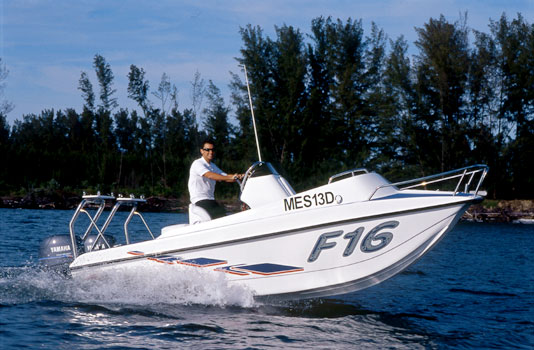
    PETER Motzouris lives boats. If he’s not designing and building new models to add to his range of offshore craft, he is upgrading existing models to ensure they look and behave like current generation craft should.

    To keep Peter on his toes, his son Dustin has been working closely with him this year. Dustin, who achieved world champion status during the nine years he raced jet skis professionally in the USA and Japan, was born into a boating world, achieved fame in it, and now he intends making his mark at Z-Craft. In fact, Dustin has become so involved with the F16 both in design and manufacture that it has become his baby. And a damn fine craft it has turned out to be too!

    GENERAL IMPRESSIONS
    As usual, Peter kept me informed throughout the gestation period of the F16, but I only first set eyes on her at the recent National Boat Show, held in Johannesburg in August.

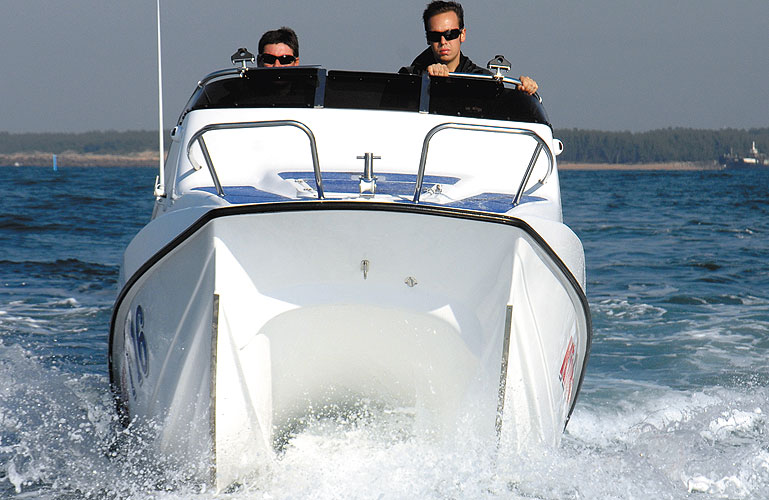
    There she lay amongst dozens of other craft, and although dwarfed by some much larger craft, she stood proud, with the Z-Craft lineage coming through strongly in her lines and layout. She also boasted a very striking, sporty look that I have since discovered is Dustin’s influence.

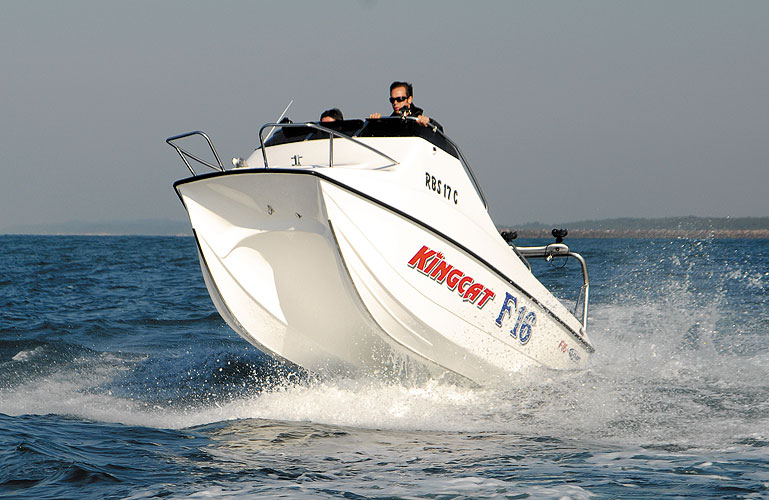
    This craft, categorised by Peter as an entry-level craft to the world of offshore boating, has ended up much more than that and will prove to be a mean fishing machine in her size range.

    CONDITIONS FOR TEST
    Spring had sprung …. or had it? Waiting for a window of good weather — or at least sunshine — took seven days, with howling south-westerlies and snow everywhere from ’Maritzburg to the mountains, not to mention dark, rain-filled clouds over the coast. I sat glued to in an endeavour to find a gap in the long term forecast.

    It’s a brilliant website, with both radar and satellite images that virtually update as one is looking at it. And I found a gap in the weather! I raced to Richards Bay and found bright sunshine, but with a strong westerly land breeze over a choppy, mushy sea over a huge swell. For a small craft, conditions like these would be a baptism of fire.
    LAUNCHING AND TRAILERING
    Peter and Dustin decided that the F16, whilst being “entry-level” — a description determined by price alone — had to be a real ski-boat. She had to be a craft that newcomers to the game and first-time boat owners could not only be proud of, but could also fish from practically and safely if caught in a big sea.

    What’s more, the trailer also had to be right, built strong enough with tough suspension and good brakes to ensure that it would survive many trips into Moçambique. “I don’t want a newie to the sport to learn the hard way,” said Peter, so he built the trailer good and solid. When I watched the rig being towed at good speed behind Dustin’s 4×4 on the way back from Richards Bay to Z-Craft in Empangeni, she appeared to tow perfectly.

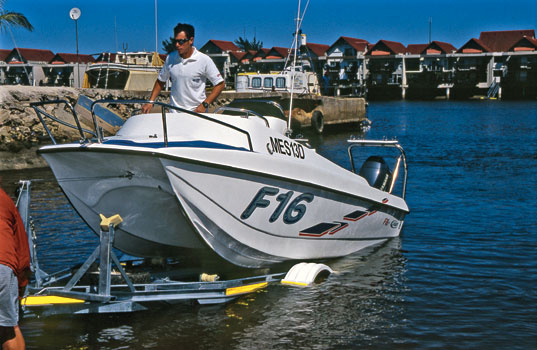
    Further proof of the quality and good design of this trailer was obvious when launching and retrieving the F16 at the Richards Bay slipway. It was as easy as it gets. Peter has built enough launching rigs to know what a trailer is required to do on the beach, and I have no doubt this rig will perform just as beautifully there too.

    MOTORS AND CONTROLS
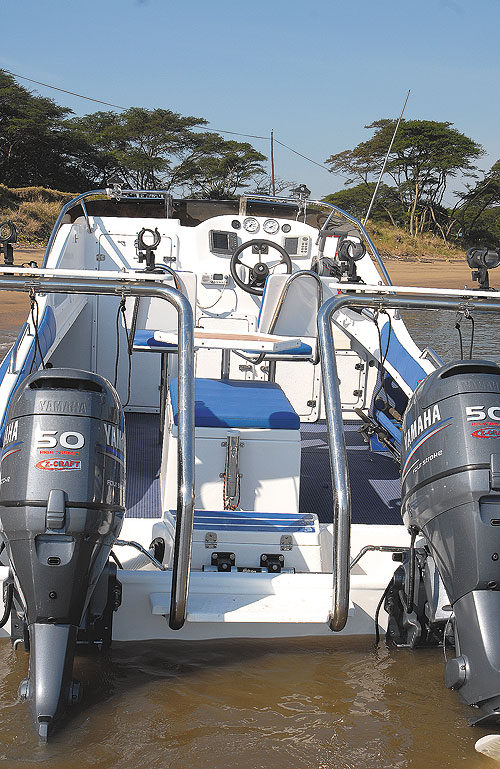
    Peter had fitted a pair of 50hp Yamaha 4-stroke motors to the F16 for the show, because that’s what he had in stock, but these are hardly entry-level motors. According to Peter, the craft is actually designed to take 40hp or 50hp Yamaha 2-stroke motors.

    Not only would the 2-stroke models be a lot lighter and cost a lot less, but they would also provide a little bit more torque during out-the-hole take-off, especially if the craft needed to perform on one motor only.
    It was, however, a treat to play with the Yamaha 4-stroke motors as it gave me a chance to feel how well these motors ran and performed. True to Yamaha’s word, they were quiet, started instantly and had very smooth acceleration throughout the power curve with both motors running in tandem. 

    Yamaha controls had also been fitted, and the standard control box that hasn’t changed in years worked well, though one was smooth and even, while the other was a little stiff and needed adjustment. The steering — both mechanically and position-wise — was perfect. 

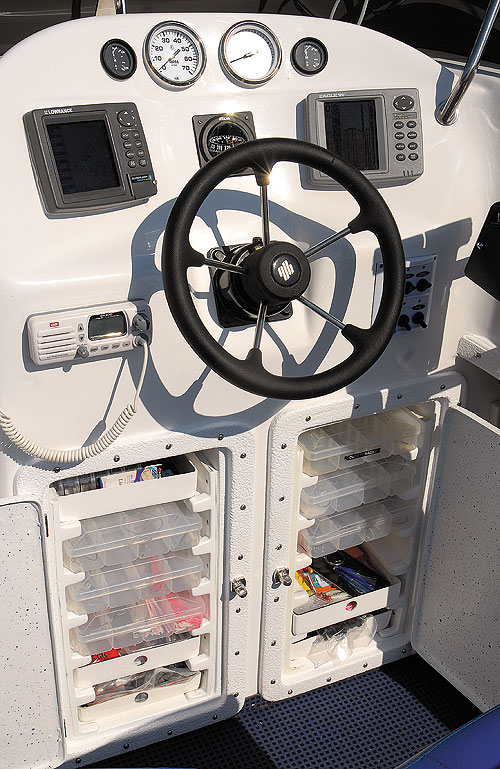
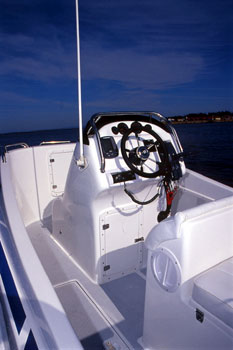
    For a craft of this size, the centre console helm station was both comfortable and visually pleasing. It offers an aft bum seat for calm weather operation and has sufficient support for one to brace oneself and get protection when standing in the really heavy stuff. The steering and throttle controls are well positioned, and the instrumentation is clearly visible.

    HANDLING
    Almost every time I exit Richards Bay harbour, the current and churn created where bay meets ocean has a radical effect on the craft’s hull.
    As I was running the F16 through a particularly churned up harbour entrance and this small craft was being affected by these currents, I battled to gain a proper impression of the craft’s performance. It was only when I got at least a kilometre out to sea that a fairly consistent sea action began to prevail and I could relax and start to feel the craft.
    The hull design of the F16 originates from the Invader 16, a craft that was both highly successful and very popular in the 1980s and 1990s. Peter has heightened the tunnel to reduce hydraulic action. Then he softened the chine which has the effect of making entry softer, thus making for a much softer ride.

    As I know the Invader 16 extremely well, I was very keen to see how the theory relating to these changes would translate into the F16’s eventual performance at sea. And, yes, the Motzourises have got it right, but I will expand on these aspects later.

    In the “getting to know you” stage of my time on the F16, I set course up the coast, not too far off from the backline. I chose this because the westerly/land breeze was really blowing hard. Additionally, the chop it produced got bigger and bigger the further out one ventured. This was especially so where it mixed with the chopped sea and big swell the strong westerly has blown up during the preceding 48 hours.
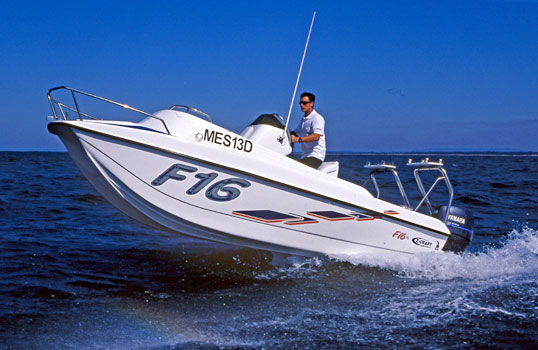
    Sitting at just under 4 000 rpm, we made excellent progress up the coast with the side sea not affecting the craft’s lateral stability all that much and, above all, keeping the wind-driven spray off us.

    It was during this run that I was able to get Dustin to move from his comfortable seat — located in the front of the console — to stand next to me. In this way I’d be able to find the craft’s “sweet spot” by moving him forward and aft.

    The change in the F16’s ride was immediately evident, and the best position turned out to be with him standing on the starboard side right next to me. This exercise helped me prove that the F16 is indeed softer, with little or no hydraulic thumping in the tunnel. Indeed, she seemed to track a lot more evenly than the Invader 16. The only time I experienced thumping in the tunnel was when I deliberately tried to bring it on by going into a big chop head-on and at excessive speed. 
    Again, taking overall size into consideration, I swung to starboard and ran with the wind, across the south-westerly sea to deep water, to see how she would handle the rougher conditions.

    The conditions out deep were, in my opinion, marginally fishable — if you’re competition fishing for wealth rather than pleasure — and the F16 was put through a range of speeds from lure pulling to slow troll on one motor, as well as drifting. 

    I was very happy with the way this relatively small craft performed in all these tests, without becoming uncomfortable or, above all, wet. Yes, the odd bit of wind spray was experienced, but then I was daring her to wet me. Indeed, I certainly could have fished in a manner which would have kept me bone dry.

    On the drift I found her stable, with no water washing over the false transom, even when Dustin and I moved far aft, bearing in mind the extra weight of the 4-stroke motors.

    The way in which the two of us walked around the deck as if fighting a double-up on ’cuda proved just how much practical deck space there is on this craft. Even for a big guy like me, passing the centre console from stern to bow was easy, without having to worry about falling overboard or clutching onto grab rails with one hand to make the pass.
    Running back towards Richards Bay with the wind on the starboard bow quarter and the sea and swell on the opposite quarter made for an interesting ride. We threw lots of spray aft, yet were able to push very fast speeds without being uncomfortable.

    With the big swells on the transom — and even though the wind was head on — she held her line well with no tendency to yaw in the steep sea.
    Once we were almost in the back line I put her through simulated surf conditions. She turns extremely lightly, with no sign of cavitation, and was very quick out of the hole. Interestingly, I found turning her a lot easier using hard to starboard than to port, which is my natural preference, being right-handed, and also turning with the prop rotation instead of against it.

    On one motor she was sluggish. I believe I would have got better performance out of her with one 40hp 2-stroke motor. It will be interesting to gauge this aspect of her performance when the first F16 powered by twin 40hp Yamaha 2-strokes gets into the water.
    DECK LAYOUT
    Saying that she’s styled as an entry-level craft is, to me, a misnomer, as this suggests that she’s simple and basic. The F16 is way beyond that. Not only has the F16 got all the same styling, finishes and fittings, hatch consoles, cupboards and stainless-steel accessories as the bigger craft in the Z-Craft stable, but they’re also of the same quality.

    Dustin has, however, redesigned aspects of the top deck moulding that, in essence, simplify the construction while still incorporating virtually all of the niceties we expect on a craft of this size. He has also refined certain aspects of the craft’s finishes that reduce maintenance in the long term and thus keep the boat looking good for longer. Who says we old dogs can’t learn from what is done overseas and from the younger generation?

    In having a simplified deck layout, the F16 maximises the deck area — as I stated in detail earlier — yet still has the necessary hatches both above deck and below, as well as under the gunnels, to store everything one needs to take when fishing offshore. 

    The fish hatch, which can double as a livebait hatch, is of adequate size for any recreational gamefish angler.

    The aft seat and the very comfortable forward seat (with backrest incorporated in the helm console) are both well upholstered and provide practical seating for the crew, while the skipper has his bum rest to be satisfied with.

    The substantial transom roll bars not only provide a useful rod holder support, but also provide support and protection to an angler working the rods at the aft of the craft, especially in rough water.
    FINISH
    Dustin explained to me that being around boats in Florida for the last few years has made him very conscious of quality and finish. In his own words, Dustin is “fastidious about finish”, and it is his goal to push Z-Craft’s already very good finishes to an even higher level.

    To underline his claims he showed me other Z-Craft boats ready to be delivered, and I can certainly see what he’s aiming for. If the F16 is anything to go by, then it certainly appears he is getting his way at Z-Craft.

    The F16 not only looks very good, but some of the new ideas ensure the craft will stay looking good even if cleaning and maintenance are not of the highest order.

    This craft is not carpeted, but the non-slip deck covering and gel-like finish on the interior sides of the craft make it look good and ensure that it is easy to keep clean. “I don’t need to carpet it,” Dustin said. “I am proud of my deck and gunnel finishes.”

    CONCLUSION
    The F16 performs very well. This, combined with her good looks and superior finish, make her an ideal craft for those who are new to the sport, as well as for the flyfishing fraternity. Besides these user-groups, she would also prove ideal for the father-and-son team who want a craft that is easy to use for light tackle gamefishing, and anyone looking for a smaller boat that can easily be towed to the destination of choice.
  • F16

    F16

    Tested by Erwin Bursik (SKI-BOAT November/December 2009)

    AT A GLANCE
    Length: 4.95m
    Beam: 2.2m
    Draft: 300mm
    Approx weight: 460kg
    Fuel capacity: 100 litres
    Rated max hp: 2 x 70hp
    Rated min hp: 2 x 40hp
    Power as tested: 2 x 50hp Yamaha four-stroke trim-and-tilt motors

    SOME men are never happy! And that is the case with Peter Motzouris, MD of Z-Craft. I don’t mean that in the “jolly” sense of the word, but rather that he’s never entirely satisfied with the design and building of the Z-Craft range of boats.
    “You bleated about wanting an F16 with a forward console, so now you had better come to Richards Bay and test it,” was the message I heard upon answering a phone call early one morning a few weeks ago.
    True to form, Peter had redesigned the popular F16 centre console ski-boat that came onto the market in late 2004, and has radically changed the top deck moulding to produce the new F16 forward console.
    I could have asked him why it took so long, but feared the answer. He was bound to come out with something like, “I’ve only got two hands — and look at the new Kingcats I’ve made over the last few years.” Indeed, he has revolutionised Z-Craft’s boats in recent years.

    GENERAL IMPRESSION
    And there she was, proudly displayed at the water’s edge at Richards Bay Ski-Boat Club, looking quite a bit bigger than I had imagined. She was also very striking, with the strong forward design typical of most of Z-Craft’s range of offshore craft. The racy lines of the centre console version have given way to the more traditional Z-Craft looks — looks that really appeal to me, as I unashamedly prefer the forward console configuration in offshore craft.
    Clambering aboard I was immediately taken with her overall layout. That first impression gathered in a few seconds told me, “Yes, I like it,” and after spending a good few hours on her out at sea off Richards Bay, like had turned to love.

    CONDITIONS
    For once Z-Craft and I experienced sea conditions that not only allowed this craft to show off her capabilities, but were also pleasant enough for me to enjoy the ride without having to fight the sea all morning. The southwesterly had all but died, but its effect on swell in that area, which generally moves in to the coast from the northeast, was to put a fair chop on the water. This chop got progressively worse as the wind swung around and started puffing from the northeast.
    Those kind of conditions allow one to properly assess a craft’s performance and seakeeping ability, as well as simulate the sort of conditions that those of us who regularly fish this part of the coast know so well. This knowledge enabled me to truly appreciate the F16 FC and rate her performance in a sea that could be classed as “great fishing conditions”.

    LAUNCHING AND TRAILERING
    Gone are the days when Z-Craft outsourced its trailers and I had to review the trailer as well as the craft. These days Peter builds all his trailers inhouse to a standard design that has been perfected over years. This design has been proven by many, many Z-Craft owners who traditionally launch their craft from the beach and tow their rigs on the tortuous Moçambique roads.
    Having recently followed Peter on the way through Swaziland and Moçambique en route to Guinjata, I had ample time to watch the performance of the trailer on the road at good speeds. Possibly more importantly, I could also watch how the craft on sat the trailer. 
    Minimal flexing of the trailer bed is essential so as not to transfer that flexing through to the hull of the craft. It’s all in the suspension, and experience has proved that the Z-Craft trailers do their job effectively, without putting strain on the craft they are supporting.
    Backing boats into the water via a good slipway has become a non-exercise. It’s just too easy, as we experienced while putting the F16 FC into the water off Richards Bay. What’s more, using the drive-on method of reloading makes this side of boating a pleasure too.

    MOTORS AND CONTROLS
    Yamaha and Z-Craft have become synonymous over the many, many years that Peter has been a “Yammie” agent. It was no surprise, then, that twin Yamaha 50hp 4-stroke trim-and-tilt motors had been used to power the new F16 FC. 
    It was interesting to compare these new generation Yamaha motors and the way they powered this craft to what I remembered of the performance of the F16 CC with the same size motors five years ago. Even with the larger forward console and the additional wind resistance, I was pleasantly surprised at the performance these two motors permitted the craft to achieve. 
    One has to also take into account that with the forward console the human “cargo”, and therefore weight, is moved a long way forward when compared to the centre console version. That means that some of the power is required to sustain her attacking profile, that is slightly bow-up, instead of using 100% of the power to push the craft forward. No matter what I tried in an effort to justify use of bigger motors, I eventually had to concede that the twin 50hp Yamaha 4-strokes were ideal for the F16 forward console boat.
    Throughout these exhaustive trials not only did the steering system and throttle/gear controls operate smoothly, but they also felt perfectly positioned for the skipper to operate.

    HANDLING
    In my mind, the perception of how a craft performs comes but a few minutes after I’ve had her under my control. What takes time, and a lot of time, is trying to confirm or reject that initial impression. 
    Taking the controls of the F16 forward console put me in a good mood straight away, and the moment I got her up onto the plane I remember thinking, “Peter, I told you so.” Just as I’d thought, the F16 worked well in a forward console model. 
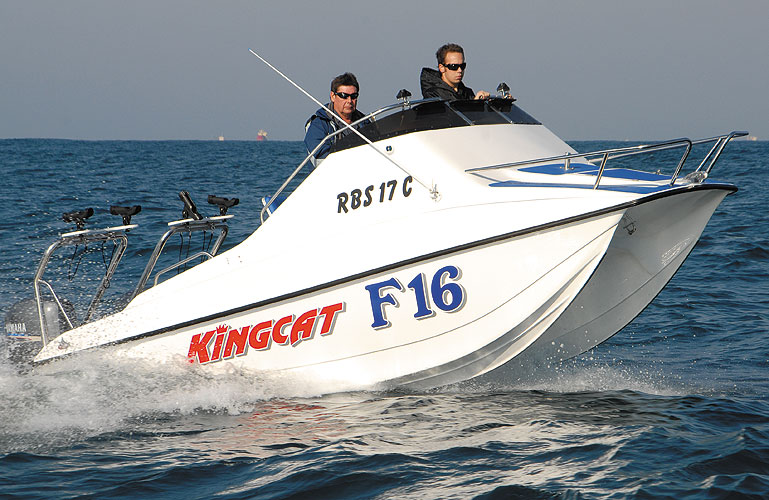
    As she got onto the plane I could feel her hull separating from the water as her shoulders reached their designed planing stance. As the wetted areas of her sponsons decreased, her speed-over-water (SOW) climbed quickly. Like most of Peter’s craft, especially the Kingcats, the hulls like to ride bow-proud and plane on that attack angle without much bow-up- or down trim.
    Trim is always important when one gets out to sea, as it’s usually necessary to adjust the craft’s ride to the sea conditions, but in the flat water of Richards Bay harbour, her designed ride was perfect. Naturally I tried trimming her, but reverted back to the design stance almost straight away, as this was undoubtedly her best ride. The only trim I then used was laterally to compensate for motor torque and crew positioning.
    Standing at her controls with Danie Goosen from Z-Craft alongside me, I felt the weight distribution was ideal, and because I did not need to use any of the motors’ thrust to hold her bow up, this energy could be more productively used for forward propulsion. I proved this once and for all when I eventually took the F16 FC out to sea and moved north towards Dawson’s to get out of the bay water which, in my opinion, has a negative effect on any boat’s performance.
    Having set a course to the north, I set her speed at 20 knots SOG, relaxed and gave her her head. It was then that I could really feel the way this hull reacted to whatever the sea was putting in our path.
    First and foremost, I felt the ride on the F16 FC was substantially different to that of F16 CC. The racy feel of a low trajectory at speed, hugging the water’s surface, was gone, and there was a more sedate feel as the water’s action seemed to manifest itself behind where we were standing, thus giving a softer ride. In addition, from this higher forward position I felt I could not only see better, but could also judge the sea conditions more accurately to achieve the comfort I was looking for on the long ride north.
    Even though we did not have excessive wind chop, there was enough to establish her performance both directly into the sea, and running with the wind and swell, especially just prior to returning to the harbour when the northeasterly started to blow. I enjoyed her ride and her reaction to trim, especially when running with the sea. I was able to hold her stance and maintain an even SOW during the return run.
    Where the swell was peaking a little more, just behind the backline, I was able to seriously test her surf work ability. I raced down the front of a swell and swung her round at speed to face the swell, before thrusting her out of the hole to climb over it, get onto the plane and back out to sea. I experienced no cavitation and it was extremely easy to pull her out of the turn.
    Danie and I trolled a lot for snoek — after all, you have to have some fun while “working” — and through out the hour or so we trolled both at Rapala speed and slower, she behaved well, giving a comfortable and very stable ride even though we caught no snoek.

    LAYOUT
    Peter builds a great boat and he is proud of that. He makes no excuses for the fact that everything has to be just right, even if it costs a little more. The thought and detail he has put into the F16 FC are exemplary. 
    As eager as he was to explain every facet of the layout, I was equally keen to appreciate the finishing on this craft. Attention to detail and quality of the hardware fitted certainly makes the end product more practical and adds extensively to its overall appearance.
    In the F16 FC the helm station is substantial for a craft of this size. Not only does it provide the skipper with a lot of protection, but it also allows for a neat and spacious layout for the array of electronics and instrumentation. The site of the steering wheel and its positioning relative to the side-mounted controls make skippering her a pleasure, whether one is standing at the wheel when heading at speed to the fishing grounds or sitting during the long hours of trolling.
    The deck layout on the F16 FC follows the standard and style of most of the Z-Craft ski-boat range, a layout that has proven practical for game- and bottomfishing. However, in addition to the centre coffin hatch and the two longitudinal below-deck fish hatches, this craft has a solid transom that incorporates the motor wells and transom step. 
    As an extra, a deck table has been mounted on a gooseneck stand that allows it to be manoeuvred over the forward portion of the coffin hatch. Its raised outer rim will help prevent any thing placed on this table from sliding off. As a tackle, drinks/food or even a bait preparation table, I think it will be most useful.
    Another nicety which Peter has incorporated onto the inner gunnels of the F16 is an upholstered inside gunnel cushion which looks and feels good.

    FINISH
    I don’t know whether it’s a sign of the high quality that consumers are demanding nowadays, or the natural progression towards perfection, but I have noticed a dramatic improvement in both the superficial finishes of most of the new offshore craft and, more importantly, the quality of the hardware that supports the finishes that first catch your eye. 
    The F16 FC is a great example of this. Not only are its fibreglassed hull and top deck beautifully moulded and solid to the feel, but it is also finished off with extras such as immaculate stainless-steel work which is very solid in construction, neatly fitted and polished to perfection.
    She’s definitely a craft that will not only catch the eye of an avid ski-boater, but will also hold his attention for a longer and more admiring look.

    CONCLUSION
    I am very chuffed that Peter has produced the F16 forward console. Indeed, the craft’s basic hull which performed very well in the centre console version now has the space, comfort and increased fishability that the forward console layout offers the offshore angler. 
    She’s certainly a craft we will see a lot more of, especially amongst those who enjoy the wonderful fishing on offer off the Moçambique coast.

Verified by MonsterInsights