Tag: fishing tactics

  • DREAMS COME TRUE ON YOUR DOORSTEP

    DREAMS COME TRUE ON YOUR DOORSTEP

    Tigerfishing at Lake Jozini

    By Philip van Wyk, Tiger Hunter Tours and Safaris

    [Originally published in the May 2022 issue of SKI-BOAT magazine]

    WHENEVER one thinks of tigerfishing, our minds seem to almost automatically drift to some remote wilderness in Africa where you have to battle your way through hippo pods and crocodiles to get to the best fishing waters. And then — as the sun sets romantically in a blaze of orange, with the call of a fish eagle in the background — you’ll be standing there fighting this behemoth of a tigerfish. A true angler’s paradise.
    For many anglers this experience remains something that they can only dream about. Travelling to some of the African countries has become a logistical nightmare and costs have shot up, making it next to impossible for the average angler to experience the true fight of Africa’s river monster.
    The thing is, there is actually no need to leave South Africa to catch tigerfish; you can experience first-hand what it feels like to be fighting with a river monster right here!
    Pongolapoort dam, better known as Lake Jozini, is the southernmost point in Africa where tigerfish are naturally found. The lake sprawls across Maputaland in northern KwaZulu-Natal, nestled between the Obombo and Lebombo mountain ranges. Built in 1972, the dam was to be used as a holding reservoir for water desperately needed to irrigate the surrounding areas. As this is the only lake in South Africa where tigerfish naturally occur, it’s a popular destination for angling enthusiasts in search of the ultimate freshwater fishing experience.
    Today the lake is surrounded by game reserves teeming with wildlife on the shores of the lake, making it a spectacular place not just for the fishing, but also for water-based game viewing and birding. There are regular sightings of buffalo, elephant, rhino, waterbuck, tsesebe, wildebeest, giraffe, zebra, kudu, bushbuck, duiker, nyala, impala, warthog and even the occasional sighting of leopard which roam the Lebombo mountains. Over 350 species of birds have been recorded in the area.
    If you have to compare the quality and quantity of fish in Jozini to other places such as the Zambezi, I would personally say that it is up there with some of the best destinations.
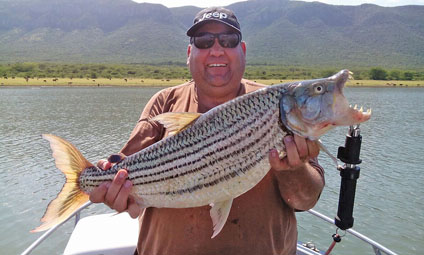
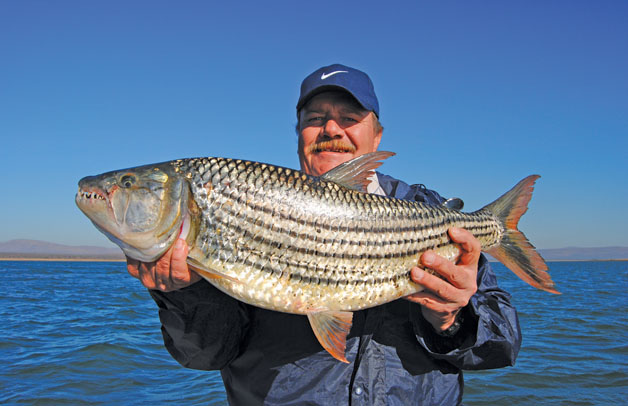
    At Jozini the average size fish are 5- to 6 lb (around 2.5kg) and we have regular catches of fish over 10 lb (4.5kg). With the dam record standing at just over 21 lb (9.5kg), it’s fair to say that there are some real trophy fish in this lake.
    Lake Jozini has an amazing climate with warm to extremely hot weather all year round. Winter temperatures average 25°C and summer 35°C, making it ideal to target tigerfish all year round. Unlike other destinations where the fishing is limited depending on rainfall and water colour, Jozini always has a pocket of clean water somewhere.
    I have found that if you are after quality fish then the winter months from mid-March to end of August are the best. However, if you are after quantity rather than quality, then the summer months are best, and you can sometimes catch up to 30 fish in a two-hour session.
    Methods of tigerfishing vary all over southern Africa, with each place having its own best method. These methods range from flyfishing, spinning and trolling with lures and spoons, to dead bait and livebait fishing with fillets and live tilapia/bream.
    Fishing successfully for tigerfish on Jozini requires a lot of local knowledge and patience, as techniques used in other areas of Africa don’t necessarily work here.
    On Jozini we prefer to use livebait as the main option, but this means that you will need to have some patience out there. We also use other methods such as spinning and trolling, but find these are more effective in the warmer months when the fish are more active on the surface.
    One must remember that the tigerfish at Jozini are very different to those in other areas in Africa, and prefer open water to structure. They do congregate around structures, but unlike bass you don’t find them within these structures.
    Here we often see anglers sitting at these structures for a short time and then moving off, which does not work at Jozini. Here patience is the key; we often sit for hours in one spot before considering moving.
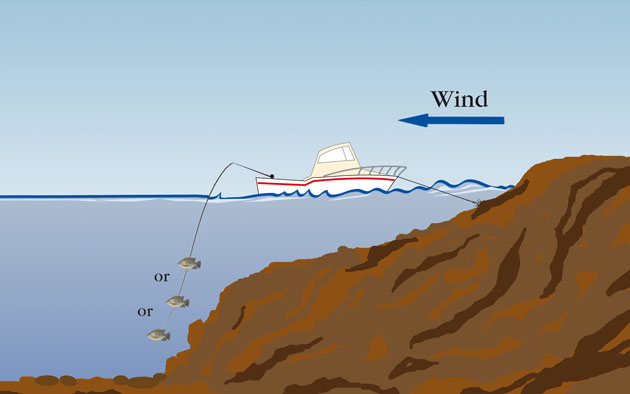
    Ideally what we do is look for a drop off point, then we anchor on the shallow side and fish into the deeper water, waiting patiently for the shoals to move past. Unlike the bass that ambush their prey, tigers will move around and physically hunt down their prey, so sitting in one spot and waiting for them to pass by is key.
    When fishing with livebait into the drop off, there is always a better chance for larger fish.
    Spoons are also used from time to time. We use copper double-bladed FZ spoons at 17/18g, or the single blade. When using spoons, again, look at the wind and pick a bank where you can start at the top of the bank and drift down the bank as the wind pushes you.
    Always be sure that the wind is coming straight off the shore so that you can anchor perfectly on the shallows and fish off the back of the boat into the deep water.
    Casting towards the bank with a fast retrieval can be a fun way of catching a lot of fish, but not necessarily big fish.
    I cannot stress enough what a big factor the wind is on Lake Jozini. You always want to be on the sheltered side of the lake, and you always want to be on the side bank from which the wind is coming. As soon as you see white caps on the water you need to move as the tigers here really don’t like the wind.
    I find some of the best fishing happens on a north or northeasterly wind, within fishing limitations depending on the strength of that wind. The southerly wind generally brings in rough weather.
    The tackle we use here varies from angler to angler, but in the 22 years I have been fishing this body of water, I have found that the best rig is a round profile baitcaster with 16 lb monofilament line on a 7ft medium/heavy rod.
    Do not use braid when fishing for tigerfish, as this line has no stretch in it at all and the force and speed at which the tiger hits the bait will break your line. I have proved this to many anglers over and over.
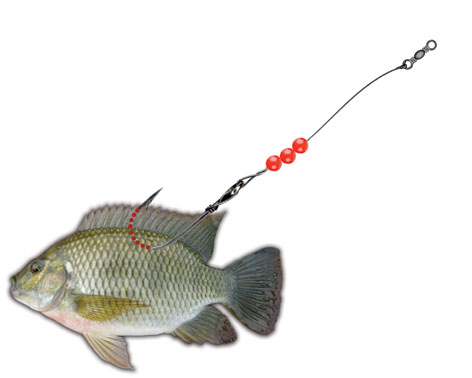
    The rig I personally use consists of a ±12 inch black carbon-coated steel trace with a power swivel on one end. I then like to slide about three orange or red beads on the trace between swivel and hook just for colour, and then finish with a 7/0 hook. This is my standard trace that I use on all my trips.
    I then hook the livebait through the tail, as this allows it free natural movement in the water. Try to avoid hooking the livebait so far up that it cannot swim properly, because tigerfish in Jozini are rather fussy feeders and I believe they can often see or sense when there is something trying to catch them.
    When fishing with bait, always remember to fish free spool. Never set the drag on your reels as these fish are very sensitive to any tension. If you strike and the fish feels the tension, it will almost immediately drop the bait. On free spool, however, they don’t feel any tension until you engage the spool to strike.
    Make sure to close the spool when you’re ready to strike, as some anglers completely forget about this and I have heard the words flying from across the dam as the fish strips the line.
    When fighting the tigerfish, be sure that you have no slack line. Keep the tension on the fish all the time, otherwise he will throw your hook very quickly. Tigerfish are notorious for jumping out the water, although this is more prevalent in smaller fish, and many anglers are completely surprised by the power of this fish as it shoots out the water. Again, be sure to keep that tension, not giving any slack, otherwise the fish is gone.
    The tigerfish is not the easiest fish to catch, and with a hook-up rate of 2:10 strikes, it is a fish that takes some patience to land, but if you stick to the tips above you will be sure to bring out that dream Jozini tigerfish.
    Lastly I would just like to remind everyone how unpredictable the weather can be on Lake Jozini. Strong storms can pick up very suddenly, going from calm, mirror-like water to sea conditions in a matter of minutes. This is very dangerous for smaller boats and you need to always be on the lookout for this, so check your weather before going out.
    You do not want to be on the main lake when the southerly is blowing, and need to be extra cautious as the conditions can get worse than the ocean. Wind currents are often heavily affected by the mountains, causing the water to turn into a washing machine with no distinct wave direction. Many boats, both big and small, have capsized in these conditions.
    In the summer months there are typically late afternoon thunder storms or wind storms, and many anglers have been caught offguard, so checking weather constantly through the day is important.

  • COURTING CUDA

    COURTING CUDA

    [Originally published in the January 2022 issue of Ski-Boat magazine]
    By Justin Paynter

    Justin Paynter with a king mackerel caught off Durban.

    KING mackerel, aka ’cuda are here, and it’s going to be a cracker of a season. The hunt for these fish excites any gamefisherman along our coastline, and the last couple of seasons have been something special. If the start of this season is anything to go by, we should see some good numbers being boated and new PBs being set in the months ahead.
    Just picture the scene: throttles down heading off to your selected spot, either with a tank full of bait or carefully selected dead bait in the anticipation of having your rod double over, while listening to the aggressive acceleration as it changes gears from zero to hero in a couple of seconds, and hoping that your preparation is going to pay off.
    In this article, I am going to look at all the aspects of ’cuda fishing including bait, traces, tackle and the two most important aspects — preparation and patience.
    Probably the biggest key ingredient of any successful fishing trip is preparation. This starts with selecting the craft you will be fishing on, the area you will be fishing, whether you’ll use dead or live bait, the traces you’ll use, and your rod and reel selection. Let’s dive in …

    CRAFT
    This may sound silly, but you need to know what sort of platform you will be fishing on. Will it be a paddleski, a jetski, a tiller arm rubber duck, or a 21ft ski-boat with multiple livebait tanks?
    The important thing to remember is that each one has its advantages and disadvantages. The most important thing you need to check is whether it has a live well and appropriate rod holders. The answer to this will have a ripple effect to the plan for the day.
    No live well would mean you would need to ensure you have the appropriate dead bait traces to suit the dead bait you have either caught prior to this trip or that you have purchased at your local fishing shop.
    Rod holders are vital, and I’m speaking from experience when I say that. Last season a very good mate of mine, Justin Collins, and I were fishing off Sea Belle. The ’cuda were boiling and, instead of re-doing a leader on my trolling rod, I took my grinder and tied a ’cuda trace on and placed it in a stand-up holder. The rod went off, the butt slipped through the slit in the holder, and a magnificent air bubble trail was left behind as the rod disappeared into the water. We were very lucky to catch the whole thing on GoPro and it made for some entertaining viewing.
    So, getting back to the point, taking ten rods out with you and only have place to put two rods is not the best idea. On both of my fishing platforms I like to have two flat rods that lie out to the side of the boat, and then I have one standing vertically. I generally don’t fish more than four rods at a time as it can cause chaos if you have inexperienced anglers on the boat.

    TIPS:
    • Ensure you have appropriate rod holders and that they are correctly spaced out.
    • Keep a spare live well pump on the boat. You never know when the pump may go. There is nothing worse than having to try and keep your bait alive using a bucket.
    • Ensure your dead bait is kept in a proper cooler box with ice. This will ensure it stays fresh even for the next trip.
    • A decent fishfinder/GPS is vital. So many ski-boaters make the fatal mistake of not spending money on a decent unit. Remember, this unit is your eyes under the water.

    AREA
    As the “Where to Fish” series of articles continues in this magazine, you will have a better idea of where to fish and at what times of the year. I have said this before, but it’s really a good idea to go onto social media and follow as many fishing pages as you possibly can. Follow some of South Africa’s influential anglers and guys that are fishing on a regular basis. You will soon get a better idea of what is coming out where.
    As fishermen we all like to see a good picture and like to let everyone know that we caught a monster, right? The best way to show this off is on the social media platforms.
    If you are planning a fishing trip, do your homework, phone around or try to make contact with a local charter company to get a better understanding of where the fish have been coming out.
    Locals are often very reluctant to pass on information if the fishing has been good, and this is understandable. If you are going to an area that you don’t normally fish, just be respectful towards the locals and their club and you shouldn’t have a problem. Buying a beer or five for a local in the pub is a sure way of getting better insight.

    TIPS:
    • Work an area. You can’t just put a bait in the water and expect ’cuda to jump in your boat. This type of fishing can be highly frustrating and, on a slow day, boring. But the rewards of hooking one of these fish is worth it, time and time again.
    • You need to locate the fish. This means find the depth/line at which they are eating and then work that area. Often an angler will get a pull, boat the fish and then troll away from where he/she hooked it. If you get a pull, stay there and be patient.
    • If you are fishing an area that you don’t normally fish, and you can see a group of paddle skis or boats working nearby, make your way over there and try to follow the line that they are working. You can’t beat local knowledge.

    DEAD BAIT VS LIVE BAIT
    It’s a coin toss. Do you run to get live bait early in the morning or do you run to your favourite spot and be the first one there with dead bait?
    Over the past season I have fished a lot with dead bait, and it has proved to be very effective. I’m not taking anything away from a live shad, mackerel or bonnie, as that is always first prize, but a dead bait rigged correctly is just as effective.
    Sometimes being the first one on the spot in the morning with nobody else around is first prize, and you can normally be back on the beach in a couple of hours with some fish in the hatch. As soon as more boats start arriving and they are pulling live baits around you, your chances with a dead bait decrease. Well, that’s my opinion anyway.
    When you’re hunting these fish, it is important to cover the entire water column to ensure all your bases are covered.

    Scenario 1: four rods with live bait
    Rod one — live shad/mackerel on the bottom using a Scotty downrigger. If you don’t have a downrigger put it on either an 8- or 10-ounce sinker. Let the sinker hit the bottom and wind it up four to six times. Rod two — live shad/mackerel on a 6-ounce. Rod three — either a mackerel or mozzie with a 2- to 3-ounce. Rod four — a mozzie on the top super far out; this is normally called a “Hong Kong”. The Hong Kong rod is normally placed in the T-top or standing vertically. When you think you have let it out far enough, let it out another 10m and then it’s ready.

    Scenario 2: three rods with dead bait
    Rod one — dead mackerel/bonnie/
    walla walla on the bottom using an 8- to10-ounce sinker. Rod two — dead mackerel/Japanese mackerel/walla walla on a 4- to 6-ounce. Rod three —either a mackerel or bonnie on the Hong Kong rod.

    TIPS:
    • Ensure your live or dead bait is swimming correctly. If you look at it and tilt your head a bit, bring it in and sort it out.
    • Check your baits regularly. Often a bait will get chomped in half and you will only realise it when you bring it in. I like to check my baits every 30 minutes.
    • Checking your baits also allows you to see what’s happening in the different water columns. One example is checking for dirt on the line, also known as gorilla snot. Feel your sinker to see if the water is warm or ice cold at the depth you had it at, and adjust the level if necessary.
    • Christmas is coming up, so ask for a Scotty downrigger. This is one piece of equipment that you will have forever and which will be worth its weight in gold. Use your finder to locate the depth of the fish, then you can literally let your bait down to that depth using the built-in depth range on the downrigger.
    • Use thin elastics to connect your sinker to the leader/line as it’s easier to snap off when you have a fish on.
    • Don’t place your sinker too close to the baits. Distances vary, but to be safe, maybe 3- to 6m away. This depends on the angler and their preference.
    • My leader will never be more than 40 lb when fishing for ’cuda. Sometimes, I don’t even fish a leader, depending on the type of line I am using.
    • Vary your trolling speeds. I firmly believe that the paddleski anglers are so successful because they are at the spot before we get there and because of their paddling action. They vary their speeds, which allows their baits to flutter up and down and drop a little deeper when they are having a rest. On a boat, keep clicking your engines in and out of gear to mimic this fluttering action. Live baits must be pulled just in gear, whereas dead baits, you can pull a little faster. Just remember that speed varies on each boat as well.

    TACKLE:
    We can debate this aspect till the cows come home. Every ’cuda angler has their own special ’cuda rod which has either been passed down from generation to generation, been re-done about five times and is one fish away from breaking, or is the standard rod we buy at our local tackle shop.
    When it comes to choosing a rod, it all comes down to preference. I like a rod with a soft tip. The reason for this is that it allows the bait to have a more natural action in the water. I am currently using the Kingfisher Poseidon Couta Lite and the Daiwa Grandwave boat 701 rod.
    I have them paired with the Daiwa Saltist Blue 40 H. I used to use the 50 H but just find that the 40 H combined with those rods is really well balanced. Again, it all depends on how deep your pockets go and your preference in brands. These have worked for me, they are robust and hard wearing, and I will continue to use them for many years to come.
    I generally like to fish 10kg line, as that is our normal line class for competitive angling, with no more than a 40 lb leader. However, if I am going to places like Zinkwazi and St Lucia or am fishing deeper waters, I’ll fish anywhere from 12- to 15kg line class. I would then opt not to fish with a leader, obviously water condition dependent.
    If the bite is slow, and you scale right down on your leader and ’cuda trace, you will find you have a better chance of getting a bite. Just remember, these aren’t stupid fish, and if you don’t take time with your preparation in terms of knots and bait presentation, you will not get a pull.

    TRACES
    I am going to run you through one of my standard ’cuda traces. As you progress in your techniques, you will try some new things which might work for you and not others. Again, that’s fishing; you must be confident in what you put in the water. If you see something working for someone else, don’t be shy to ask what he is doing or just steal with your eyes and try it out for yourself.
    Once again, this is the way I fish for them; you might prefer a different technique. I like to go as light and stealthy as possible, whereas other guys like big hooks, thick wire and big swivels. That works for them, so who is to judge. My preference is the following:

    WIRE
    I use No 3 Malin wire in the front. The length is normally between 30- and 50cm from swivel to first hook. I like to use a very small swivel, but again, it’s all down to preference and how good your eyesight is to tie the knot on the boat.  I use Malin because you get more for your buck.
    I use No 5 wire between the hooks. Length depends on the size of the bait you are using.
    Some guys will go heavier because a ’cuda has sharp teeth and they reckon it’s harder to bite through, but I believe that the thinner wire is less likely to kink and will be less likely to snap.
    No matter what size wire you use, if a ’cuda chomps that bait and gets that wire between its teeth, you are history.

    HOOKS — LIVEBAIT
    Competitive angling
    My setup has a No 2 in the nose and a No 3 or 4 in the back. I was using the Taman hooks by Gamakatsu, but I have recently moved over to the VMC Octopus/Dynamic live bait hooks and have been extremely happy with them.

    Social Angling
    I use one single No 1 or 2 in the nose and a No 6 VMC Black Nickel in the back
    I don’t tend to fish with more than two hooks unless I am fishing a bonnie or a walla walla. This is to ensure that I have covered the surface area of the bait and the fish doesn’t miss the hooks when it strikes.

    HOOKS — DEAD BAIT
    Pulsator makes an outstanding chin weight that has been very successful. The size of the chin weight you use will depend on the size of the bait.
    The chin weight comes with a single hook embedded in it, then I use a No 6 VMC Black Nickel in the back.

    DUSTERS:
    A green bead is a must, and whatever the rest of the setup, I will always have a bait out with a green bead.
    Everyone has their own special colour that works for them, but I like the pink Yamashita. Anything from the 1,5 to 2,5. There are cheaper makes on the market, but I don’t think they’re as successful.
    The dusters I use are the Pulsator HO33, HO13 and HO65. These are smaller dusters that don’t tend to drown your live bait and have been very effective.

    FLASHERS
    The flasher pictured above has been very successful for me and others. It is placed into the spread of baits while slow trolling and is made by well-known Zululand angler Johan Dejager, aka Patat.
    I hope this gives you a bit of insight into ’cuda fishing along our coastline. Remember, be prepared and have patience. I wish you screaming reels and silver slabs lying on your deck!

  • ON THE TRAIL OF TAIL

    ON THE TRAIL OF TAIL

    (Originally published in the January 2020 issue of Ski-Boat)
    By Donavan Cole

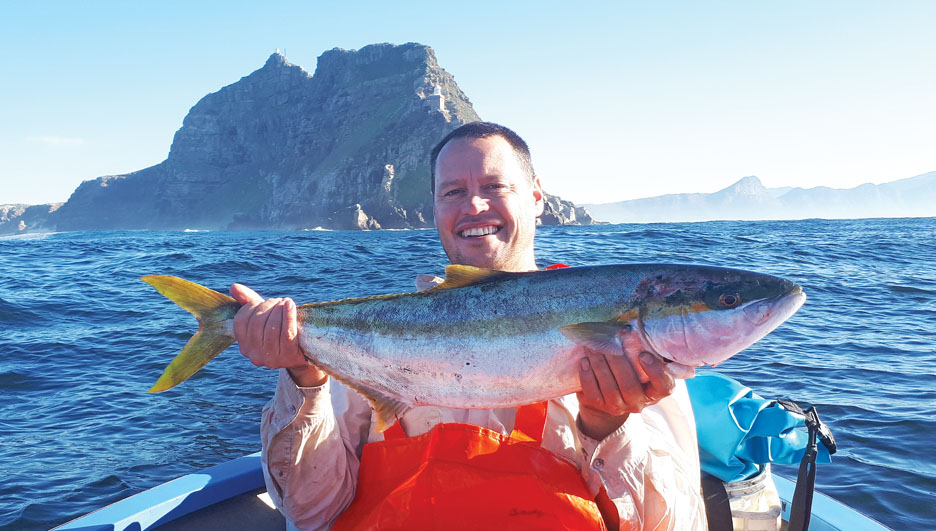
    IF you ask any Cape Town angler they will all agree that yellowtail fishing around Cape Point can be some of the most exciting or most frustrating fishing you’ll ever encounter. One day you will have them eating out of your hand and the next you will be pulling your hair out while they swim around any and every lure you present to them. However, the days when they do bite make all the mombak (no fish) days worthwhile!
    The average size of yellowtail encountered around False Bay is usually between 2- and 5kg; bigger fish up to 12kg are not uncommon, though, and a few specimens up to 20kg have been caught over the years. I have not landed one over 12kg despite fishing around the bay for more than 20 years, but I have had many big fish reef or run me off over the years.

    WHEN AND WHERE TO CATCH
    Around False Bay the yellowtail generally prefer warmer water of 15°C and upwards, but there are times when the fish can be caught in water as cold as 13°C. The fish will usually go off the bite with a sudden drop in water temp, but if there is a gradual drop in temperature over a few days then they can be caught in these colder waters.
    The colour of the water is also a big factor and we will usually find that the best catches will be made when it’s clean and blue. Catches will decline from little to nothing as the water turns green and then to dirty brown.
    A westerly wind is the favoured wind for catching them around the point as it will usually warm the water and make it nice and blue. During these times there is also a very good chance of encountering yellowfin tuna which usually results in the unsuspecting angler getting a hiding and a story of the big one that got away. I have, however, seen many large yellowfin landed on yellowtail tackle, so it doesn’t have to end badly.
    Having said all that, though, yellowtail fishing is still unpredictable. There are times when we will have perfect conditions with no baitfish around and not a sign of a yellowtail, and other days when the conditions will be terrible with large areas of baitfish and we will make good catches. Nothing is written in stone, so any day out there when the weather allows is worth a look.
    There are a few areas around Cape point where we regularly get good catches:
    • South west reefs a mile or two south west of Cape Point. The fish are usually caught on the edge of the kelp line.
    • Bellows Rock — an exposed rock around two miles south of Cape point, with deep water all around.
    • The Anvil — around a mile to the east of Cape Point. It’s a very shallow pinnacle that usually breaks when the swell picks up.
    • Rocky Bank — a large rocky area around five miles south east of Cape Point.
    The strong south easterly wind that usually prevails over the summer months will cool the waters around Cape Point and make the water rather dirty, but at the same time it will warm up the water inside the bay. We will then go and look for the ’tail inside the point, from under the lighthouse all along the kelp beds past Rooikrantz and into Buffels Bay. You generally don’t find massive concentrations of birds inside the point like you do on the outside, so keep a good eye out for one or two sterretjies and if you find them feeding you will be sure to get a yellowtail under them. If that doesn’t work your best bet is to troll lures.
    The strong SE winds will also push the fish deep inside the bay and catches can be made from Simonstown, Glencairn, Fish Hoek Bay and towards Muizenberg. The fish are quite skittish in these areas, though, and they can be very hard to catch, especially since they are not found under feeding birds like they are around Cape Point.
    This wind unfortunately pushes the shoals very close inshore along this stretch where the beach seine net fishermen will catch countless tons with their nets that are rowed out at Long Beach (Simonstown), Fish Hoek, Muizenberg and Strandfontein. As destructive as this method of fishing might appear, it has been going on for more than 100 years and little has changed since then with regard to their gear and methods used.
    Earlier is usually better when targeting yellowtail, and our day will start with us getting to Cape Point at sunrise. We will then have a look for birds actively feeding on the surface as an indication of where the fish are.
    The best birds to look for are terns or “sterretjies” — Afrikaans name comes from the way they look like twinking stars when they are seen hovering over baitfish with their rapidly flapping wings. When you find them feeding this is usually a good indication that the yellowtail are feeding underneath. Your best bet would then be to approach these birds and, depending on your favoured method of targeting them, get a lure in as quickly as possible.
    There are times when these birds will feed over splashing yellowtail for ages, and other times you will be running around between groups of birds as they drop down to feed for mere seconds and then frustratingly fly off again. Other times there will be a mass of terns, gannets, cormorants and gulls feeding on masses of bait as far as the eye can see.
    These feeding birds will usually disperse mid morning and the fish will go off the bite. When that happens tactics change and you need to use your echo sounder to find the schools, stop on them and try dropping your spinners or jigs down to where they are.

    SPINNING
    Spinning is by far the most exciting way to catch yellowtail as the chase and hookup is quite visual and there are many times when the whole school will chase after your lure just to have one of them grab it right at your feet.
    When you’re casting at surface feeding fish it’s always best not to cast into them if possible, but rather cast over the school and then pull your lure straight through the frenzy.
    Before spinning reels became so durable and popular the spinning setup of choice would be a Shimano Speedmaster or Daiwa SL50 Multiplier loaded with monofilament on a Purglas Tiger Special rod. It was quite challenging casting these multipliers when the fish were splashing on the surface as the excitement would usually result in a massive overwind. Those setups are also not ideal for casting small lighter lures.
    These days most guys are using grinders/spinning reels from 2500 to 8000 sizes loaded with braid, meaning they can fish with much thinner lines than before and not run the risk of overwinds. The smaller/lighter lures can thus be thrown much further with pin point accuracy.
    There is a wide range of rods out there and guys will use anything from 5ft to 10ft rods depending on reels and lures to be cast. Using the smallest, lightest setup will usually result in the most action and fun, but it can be impractical as you often need to bully the fish away from the reef and kelp, and then there are the seals that want to take your fish. My setup of choice is a Shimano Stradic 5000 or 6000 loaded with 30 or 50 lb braid on a 10ft Exage rod.

    CASTING LURES
    Anglers use a wide variety of spinners and surface lures in different sizes, but the lure that most closely mimics what the fish are feeding on naturally will always get the most action.
    When the fish are very fussy we shake out a few fish’s stomach contents and, depending on what we find, we will change lures accordingly.
    On days when they’re feeding on large sardines you can catch them on most lures, but on days when they’re feeding on tiny lantern fish or maasbankers you will need to throw the smallest lure your tackle can handle. There are, however, days when you will find the fish feeding ferociously on the surface and you change to every single lure you have in your box only to find they will take one specific lure and nothing else.
    Plastic surface poppers/plugs will also get a lot of action when targeting surface feeding fish. You get them in a wide range of sizes, shapes and colours, but my favourite is white or green in a long thin shape.

    TROLLING
    Trolling is the favoured method for targeting yellowtail around Cape Point as you’re able to cover a lot of ground. This method is usually most successful when there is not much bird action around and you rely on getting blind strikes.
    We generally troll multiple lures and a mix of deep diving lipped-lures and surface running squids and jet heads, at speeds between 5- and 6.5 knots. I like to run the deep divers on the port and starboard quarters and have them swimming just on the edge of the prop wash. My squids will run in the wake and I’ll run them in a V-formation with the shortest lines just outside the propeller wash and the longer lines out at around 20m.
    I usually run deep divers when the fish are not feeding hungrily as they are often the first lures to get a strike. When the fish really start biting I will remove these lures and just run surface lures as the lipped lures often don’t play well with other lures, resulting in tangles.
    You also can’t troll these treble-hooked lures through the kelp for obvious reasons.
    Treble-hook lures are generally pretty dangerous and many anglers have had to head home early with a treble embedded in their hands or legs. Handling a lively yellowtail with trebles swinging around from its mouth is an accident waiting to happen
    Over the last few years seals have become more and more of a nuisance and some days we will not be able to get a single yellowtail out as the seals follow the boat around like puppies and pounce on every fish that is hooked. This results in a lot of lost fish as well as lost and/or damaged tackle.
    To get around this problem we sometimes run bungees (a length of surgical rubber attached to a trace and lure) and short sticks similar to what the commercial boats use. This may seem unsportsmanlike for a recreational fisherman, but some days this is the only way that we can land a fish quick enough so that the seals don’t take them. We pull these heavy lines in by hand and lift the fish over the side without gaffing them.

    BAIT FISHING
    Catching yellowtail on bait is not a common practice among recreational fishermen around the Point, but the commercial boats use bait very successfully when the shoals move deeper beyond their trolled lures. The favoured bait for them is squid/chokka, while commercial linefish boats do very well using pike cut into blocks.
    The setup for bait fishing is pretty straightforward; I usually use a 9/0 hook on a trace around 1m long with a small power swivel between the leader and hook trace. When there is a bit of current we add a small sinker accordingly, but you want to fish with as little weight as possible so that the bait drifts slowly through the water column.
    The bite can be anything from a mad rush as the yellowtail swallows the bait, to a slight bite that you might think is a small reef fish.
    I also like to fish with a float, and I make the trace as long as possible to be cast with a large float which will keep it on the surface. It can be pretty exciting watching and waiting for the float to be pulled under when the yellowtail takes the bait which is quite reminiscent of my experiences catching mullet as a kid.

    FISHING ETIQUETTE
    Yellowtail fever can run pretty high when the fish are around, especially when there are birds all over and fish splashing under them. It is not uncommon to have more than 50 craft from kayaks and small rubber ducks to large commercial linefish boats in a small area all trying to get a piece of the action.
    Tension can run pretty high during these times and you need to keep a good eye out for collisions as you will have some boats trolling and others drifting and spinning. Common sense quite often does not prevail and you will find guys trolling over each other’s lines or charging right through shoals of fish.
    The commercial linefish boats will usually be catching fish on the “steam”, meaning they will be trolling a bunch of lines and when they get into a school of feeding fish they will do donuts on the school, hauling the fish in while the boat is travelling at trolling speeds. This is quite something to behold, but it is best to give these guys a wide berth as their movements can be quite erratic and if you have a run in with their heavy tackle you will usually lose whatever lures you have entangled with them, not to mention the verbal abuse that will follow. They are also trying their best to make a living from what they catch, so it is always best to try and give them space to work.
    When you’re trolling inside Cape Point take a wide berth around Rooikrantz ledges and Bortjiesdrif ledges as there will usually be guys spinning off the rocks. This is one of the few places around Cape Town where yellowtail can be caught from the shore, and as boat fishermen we have more than enough water to fish in without hindering these shore fishermen.
    When you encounter commercials on anchor or drifting and catching fish on bait it is best to not troll too close to them, especially across their sterns, as their bait lines will usually be drifting behind them in the current. If you’re going to anchor near them it’s also best not to anchor directly behind them.
    Happy fishing!

    If you’re keen to target yellowtail around Cape Point then contact Donavan on <fishing@oceanlife
    charters.co.za>, phone 082 443 0476 or visit <www.oceanlifecharters.co.za>.

Verified by MonsterInsights