Tag: outboard

  • THERE’S STILL LIFE IN HER

    THERE’S STILL LIFE IN HER

    British Seagull outboards keep going decades after the factory closes

    By Erwin Bursik

    (Originally published in the January 2025 issue of SKI-BOAT magazine)
    OUR recent “Snapshot of History” articles have produced much positive feedback from readers. Two of those responses provided us with some information on one of the front-runners that replaced the sail and/or oars as a means of propulsion for small craft.
    Both Karl Hermann from Kloof in KwaZulu-Natal and Carl Krause from Benoni, Gauteng, approached us with insight into the British Seagull outboard motors that first saw “service” during the run up to World War II.
    These were rugged two-stroke marine outboard motors with a relatively slow turning propeller that proved very popular for use on dinghies, tenders and small yachts.
    This simple single-cylinder, water-cooled two-stroke engine was basic, with an unprotected Magneto atop, a simple carburetor, pull-cord starter, and small fuel tanks bolted on top. It was powered via a drive shaft to the gearbox and a substantial propeller that provided staunch, slow speed thrust.
    They were originally manufactured in Wolverhampton in the UK around 1935, but the factory later moved to Poole and remained there until it stopped producing motors in 1996.
    During WWII the Royal Engineers and Royal Navy used these motors extensively to propel folding boats and inflatables, and they gained a reputation of being virtually indestructible.
    Some subsequent modifications to the original resulted in the Silver Century Plus model that manufacturers bragged could propel a displacement hull up to 26ft in length.
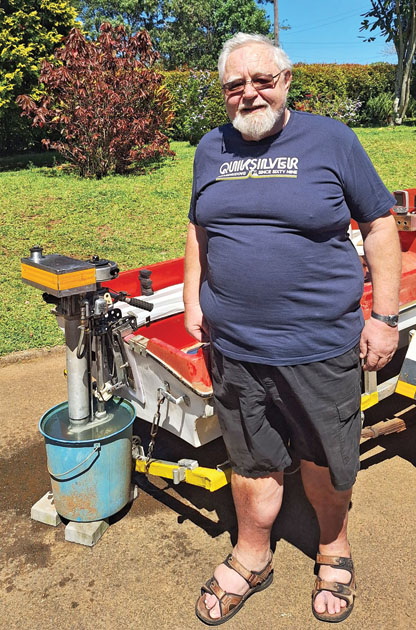
    Karl Hermann with his 50-year-old British Silver Seagull outboard motor.

    Karl Hermann owns a ± 50-year-old British Silver Seagull that he acquired in 2010, and which he still uses frequently on his bass boat on Inanda Dam. The dam is close to his home and allows him to access some easy fishing, but he also has a ski-boat based at Fairlands Angling Club for bay and offshore angling.
    When Karl invited me to visit him and see the Seagull motor, it immediately brought back memories of when I used a Seagull as a standby motor on my original ski-boat way back in the early 1960s.
    It was wrapped in plastic and kept in the centre hatch just in case the two old Johnson motors I had gave up the ghost. I pulled out the Seagull twice, if my memory serves me correctly, and then I thumb-screwed it to the transom, started it and used it to set a course back to DSBC while I tinkered with the obstinate Johnsons until I got them up and running.
    I never had to rely on the Seagull to power me all the way home, but I am sure the slow and steady pace we achieved with a single Seagull only, would have got me back to Vetch’s.
    When the Durban Ski-Boat Club first started, the British Seagull was very popular, usually as a second motor but there were a number of boats that used two Seagulls as their power source.
    In those early days, the saying was that Seagulls were so easy to work on, that if one broke down at sea, the skipper just had to take the motor off the transom and, with minimal tools, perform a full overhaul on the deck, and it would soon be up and running again.
    Physically seeing a Seagull again at Karl’s house and watching him put the pull rip cord around the flywheel was really exciting. A half-hearted pull was all it took to get the motor running beautifully with its lower unit immersed in a bucket of water. That sound alone made my day, and brought back even more memories of using a British Seagull.
    I spent a good while admiring the Seagull, checking that my memories aligned with the reality of the motor. I also poked and played with it both when it was running in the tank and also thereafter when I could get up close and personal with the motor.
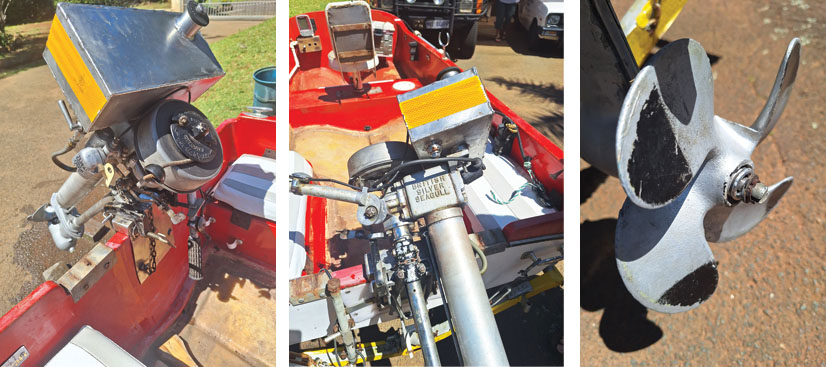
    Things to note on Karl’s Seagull motor: Transom mounted with clamps, not safety chains; it has simple mechanics making it easy to service on the water; it has a four-bladed propeller designed for thrust, not speed, and a shear pin device enabling a change at sea if necessary.

    Here’s a summary of some of the notable points when using one of these motors:
    • The starter rope slotted in the notch around the “flywheel” and the pull – haven’t done that in 40-plus years.
    • The throttle lever on the tiller bar.
    • The fuel tank on top of the motor that we had to shield while refueling at sea – 25:1 premix.
    • The transom clamp and turn buckle to tighten it on – and the safety chain (things we don’t have to worry about these days).
    • The special spring and shear pin holding the prop in place that could be changed at sea with spares held in one’s tackle box – along with some sparkplugs.
    • The aft seat in the boat needed while skippering the craft using the steering arm and throttle lever.
    • Finally, the sound of the un-muffled motor with the exhaust underwater.
    It all brought back a lot of wonderful memories of a very different era!
    Surprisingly, Karl isn’t the only one still using an old Seagull outboard. Every year on 30 December a large number of Seagull outboard owners hold a regatta on the Kariega River at Kenton on Sea especially for craft powered by British Seagulls. A massive 207 boats took part in the event at the end of 2023!
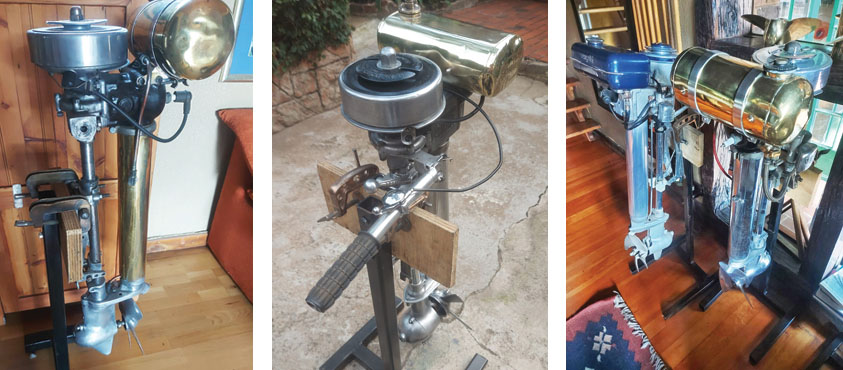
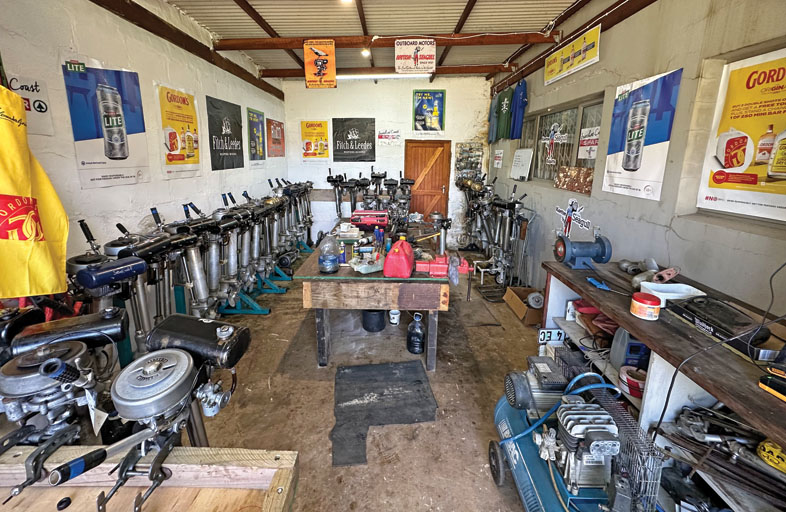
    Karl Crause has a hobby restoring vintage outboards. These four beauties are some he’s worked on.

    The Seagulls aren’t the only old outboard motors that have stood the test of time. Carl Krause of Camping and Boating Centre in Benoni has a hobby restoring vintage outboard motors, and he sent me this photo of a few meticulously restored outboards. He assures me that they all run sweetly when he has finished restoring them.
    There’s clearly still plenty of life in these motors after the warranties run out – if they’re properly maintained.

    If readers have photos of old tackle, boats or motors, or have a story to tell about the way they fished “in the old days”, they’re welcome to email them through to <sheena@mags.co.za>.

  • SWEET DREAM OR NIGHTMARE Part 2

    SWEET DREAM OR NIGHTMARE Part 2

    Tips on buying second-hand trailers and motors

    By Craig Stubbs

    (Originally published in the January 2025 issue of SKI-BOAT magazine)

    IN the November 2024 issue of SKI-BOAT we looked at the upsides and downsides of buying a secondhand vessel via a dealer or privately, and what potential pitfalls you could face. In that article I focused mainly on the vessel itself and its structural integrity. In this second part, I hone in on the outboard engines as well as something that’s often forgotten – the trailer the boat sits on.
    When it comes to outboard engines, there are basically two options that you will come across: two-strokes and four-strokes. Without getting too technical, two-stroke engines are older technology; they are being phased out pretty much globally, and are being replaced by four-stroke engines.
    This does not mean that you should avoid two-stroke engines, as there are some great deals to be had in the secondhand market on boats equipped with them. However, you need to know what to look out for, as the majority of two-stroke engines will have quite a few years on them.

    When buying a second-hand outboard, carefully check for corrosion externally and internally, for any build-up in the cooling jacket, and to see if the impeller needs replacing.

    TWO-STROKES
    Let’s talk two-strokes to begin with. As much as the technology may be a little outdated, a good pair of two-stroke engines will push you along very nicely when they’re running optimally. Parts for well established brands are still freely available in our market, and, with many experienced two-stroke mechanics still plying their trade, there is not too much on them that cannot be fixed. However, there are a few things to look out for.
    My golden rule is that if there is corrosion on the outside, then there is definitely corrosion on the inside. If a second hand outboard is riddled with external corrosion, then I recommend you think twice before purchasing it.
    When viewing an outboard, take off the cowling and thoroughly inspect the powerhead. Check around bolts and on the casings and covers for signs of paint bubbling and rust. Also check the actual external midsection and lowers of the outboard. If there is paint peeling and bubbling off, then it could be an indication that the motor was not well looked after and its lifespan may be reaching an end.
    I am also very wary of old outboard engines that have been resprayed. If the outside needed that level of restoration, then the inside is bound to be much worse.
    The challenge with internally corroded engines is that all those tiny fragments of corrosion and build up break off and quickly block up cooling jackets and channels. This causes overheating problems and, in the worse case scenario, corrosion can eat through water jackets, sleeves and housings. When that happens, it’s a big repair job.
    Also check around the outboard tilt tube and mounting brackets, as excessive corrosion can lead to these areas seizing up. If that happens, the motors will need to be taken off the vessel for replacement parts to be fitted. Depending on the level of corrosion, they may not actually be able to be removed without potential damage beyond repair.
    Once you have thoroughly inspected the engines externally, you need to hook them up to a pair of flush muffs and run them yourself. Ideally, you want to ask the seller not to pre-run the engines before you get there, and do the cold start yourself. I prefer to run them with the cowlings off so I can hear the engine better.
    Get your ear nice and close to the block and listen for any “knocking” or “piston slap” which could indicate some potential internal issues.
    Pay attention to the “telltale” of water coming from the engines – both in terms of strength and temperature. If the flow is very weak, you will probably need to replace the impeller and housing. If the water gets very hot after a few minutes, it is a good indication that the engine is perhaps not cooling very effectively. Of course the above two points depend on you having a good flow rate of water via your hose pipe in the first place.
    Nudge the motors into and out of gear to check that the engines’ gear shift is smooth. The shifts can be a little “clunky” on some engines but should never need to be wrestled in and out of gear and there should not be too much grinding or meshing of gears when engaging from neutral to either forward or reverse gear.
    If you do buy a secondhand two-stroke outboard, regardless of when it was last serviced I highly recommend you take it for a good carb strip and clean, fit new plugs, have it timed and tuned and have the gearbox oil replaced. Unless the water stream is really strong from the telltale, replacing the impeller is good standard practice too. This way, you are assured of a relatively hassle free time on the water from the start.

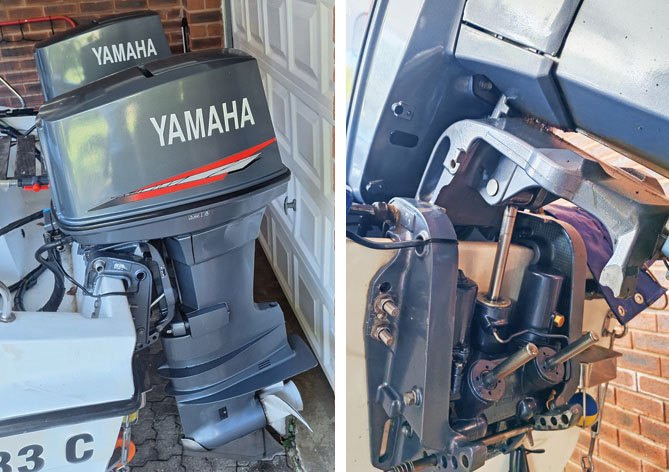
    The author’s motors are 15 years old but still look and run like new.

    FOUR-STROKES
    When it comes to four-stroke outboards, I follow the same basic checks for corrosion and, again, would shy away from an outboard showing signs of a lot of it.
    Mechanically speaking, a lot of the history and current status of these engines can be looked at via a professional diagnostic test. This needs to be carried out by a certified agent. Do not trust a diagnostic test done over 100 hours ago, as a lot can change in that time.
    Most vessels equipped with four-stroke motors will be at the higher end of the price bracket compared to vessels equipped with two-strokes, based purely on motor cost, and there is nothing wrong with insisting that a diagnostic is carried out (within reason).
    While two-stroke motors won’t necessarily have hour meters on the engines, nearly all four-stroke motors will. Certain brands need major (and costly) service work carried out at certain hour intervals (particularly at higher hours), so do your research before you buy and find out what those first few months of ownership may look like from a service cost point of view.
    Four-stroke engines can deliver some impressive hours (into their thousands) of smooth service when they’re well maintained, so don’t be scared off by the hours, but make sure you do your homework on short- to medium term maintenance needs.
    After popping on a set of flush muffs, most four-strokes will fire up within a turn or two of the ignition key and, within a few seconds, should run smoothly in idle and throughout the rev range.
    Any rough running is not a good sign, and I would definitely consult a trusted professional before buying a boat equipped with four-strokes that are running rough. It may well be a small problem, but four-strokes are a lot more complicated – mechanically and electronically – than two-strokes, and it can cost a lot more to resolve these issues.
    Here again, if I bought a vessel with a set of four-strokes on it, I would take them for a basic service even if they weren’t quite due for one, so that I could start my ownership journey with peace of mind.

    A well looked after galvanised trailer like this will give you years and years of dependable service.

    TRAILER TALK
    Next we’re going to look at something that’s often overlooked when it comes to secondhand vessel purchases – the boat trailer.
    It has become very expensive to rebuild trailers from scratch, and the costs of replacement parts such as axles and braking systems have also gone up and up, so if the trailer the vessel sits on looks like it’s on its “last legs”, then beware that building a new trailer for a 19ft vessel is going to set you back anywhere from R80 000 upwards, and extensive work on restoration adds up quickly.
    That’s not to say you shouldn’t buy a secondhand trailer, again just check it out carefully before you do.
    A fully galvanised trailer in decent, rust-free condition is an absolute blessing when buying, but if you find a boat with a painted steel trailer, with just a few rust spots, there is work you can do yourself to save you money and protect the longevity of your investment.
    Firstly, get your boat off the trailer onto some tyres (or similar), because working on a trailer with the boat still on it is absolutely back breaking work.
    Next, head down to your local hardware store and look for the Duram NS range which I rate highly. You will need a tin each of NS1, NS4 and NS8, as well as a steel brush and paint brushes. Use the steel brush to rid the trailer of any loose rust, then the NS1 to convert the rust, the NS4 to prime it, and the NS8 to coat the trailer. It’s dirty and tedious work, but the results can be surprisingly good at restoring a trailer that is not too far gone.
    Make sure you wear the correct protective gear when you’re working with corrosive paints and wire brushes etc as you don’t need any nasty mishaps during the process.
    As standard practice, regardless of condition, I always recommend changing wheel bearings on your new trailer – either yourself or via a service centre – so that this crucial element is taken care of to give you some peace of mind.
    Be very wary of unregistered trailers, or the good old seller trick telling you, “I’ve got the papers stored somewhere and I’ll send them to you soon.” The paperwork required to deregister/ scrap and re-register a trailer is quite a frustrating process that requires loads of patience and time and is not recommended unless it’s completely unavoidable.
    We all dream of owning that brand new, customised fishing boat that will fulfil our every dream, but often this is not possible or feasible, and you have to make do with a secondhand vessel. I hope this two-part series has given you some insight, tips and information that could lead to a more educated and pleasant buying experience if you are in the market.
    They say any deal that’s “too good to be true” should be avoided, and that definitely applies to boat buying, but there are some good boats available at reasonable prices in the private market – if you know what to look out for. If you are not confident that you know what to look out for, then I really would recommend working strictly through a recognised dealer.
    To wrap up, don’t “lowball” a potential deal just because you hold the cash and wish to squeeze every cent out of the seller. At the same time, know your potential post-purchase costs and don’t get suckered into a “money pit” because you’re over excited about making the purchase. The sign of a good deal is when both parties walk away feeling that they have each conceded a little.
    If you know what you are looking for and look around for long enough, you will most likely find the right deal for your specific needs.

Verified by MonsterInsights