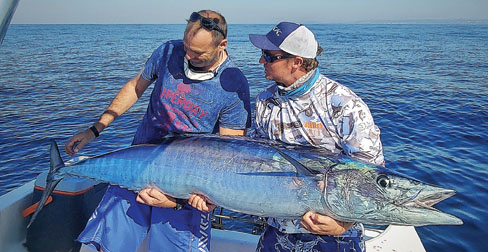
Tag: wahoo

  • WAHOO

    WAHOO

    [Originally published in the January 2021 issue of SKI-BOAT magazine]

    By Mark de la Hey
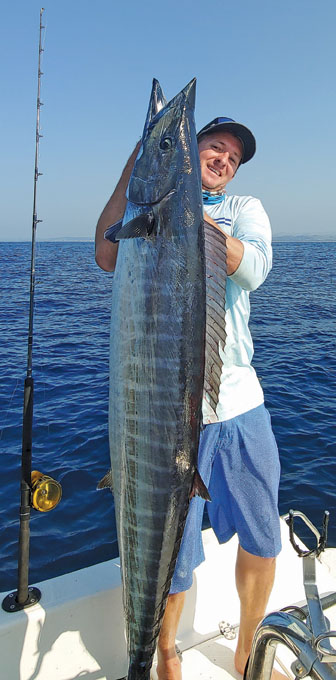
    THERE are a few unique things about wahoo. First, they are regarded as the fastest fish in the sea; hook one and you will very quickly see why! Another feature of this speedster is that both its top and bottom jaws are hinged which can make things difficult when you are trying to stay hooked up!
    Wahoo are generally open ocean creatures that follow the warm currents, feeding on flying fish and a variety of pelagic fish, so for most anglers the only time you would encounter one of these creatures is when you are trolling in the deep for marlin or tuna. They love a Kona or Rapala trolled at high speed, but even more than that, they love live bonnies. The only challenge is, once you catch a bonnie, where would you even start looking for a wahoo?
    Up and down our coast you do from time to time find them on the deeper pinnacles, but never really consistently or in great numbers, so using a live bonnie in these areas comes with an element of luck if you are lucky enough to hook even one.
    However, there is one special place along our KwaZulu-Natal coastline where wahoo turn up in great numbers year in and year out, without fail and pretty much in the middle of winter. In places like this you can spend the time to catch a live bonnie and actually target these elusive fish with good success — although there’s obviously plenty of failure too!
    Aliwal Shoal is a truly amazing place; it’s known as one of the best scuba diving destinations in South Africa and hosts some fantastic gamefishing throughout the year. From early May until the end of August the main wahoo migration also seems to take place there. Large shoals of big adult fish visit the area as well as massive shoals of small bonito which is exactly what we need to catch to catch them!

    STEP 1: CATCH A BONNIE
    This can be the most frustrating part of all. If a bonnie doesn’t want to bite, it just wont bite! You can spend hours and hours trying to catch one and while you are reeling it in it gets smashed off by a wahoo! This will be enough to make you want to go home, but don’t — just keep your eyes on the prize!
    There a few different ways to catch bonnies. To start with you can spin for them with small spoons when you see the flicking on the surface. This can be one of the most effective methods if you have the right spoon; there are a few that work really well:
    • The Sebiel fast cast 0.5 oz  — these spoons are nice and heavy and you can throw them a mile. More importantly, they do get eaten! All the colours work well, but the Natural Shiner and the True Shad are my go-to colours.
    • The Bite Me spoon — this one is legendary, catching almost anything that swims as well as the coveted bonito in a time of need! They come in various colours, but the redeye in 20g is undoubtedly the best.
    • The famous Halco Twisty — either in 20g or 30g size, this spoon has caught most species in the sea, including the bonito.  It’s basically foolproof — throw, drop your tip, and wind!
    Now it’s not every day that the bonnies oblige and eat the spoon, so what then?
    There are many things that work, including the Pulsator daisy chain, but on the tough days even these don’t always work. One thing that has worked on 95% of those tough occasions, though, is the 2.5cm Yamashita skirt. It’s hard to believe that the bonnies can even find this tiny skirt in the ocean, but don’t fear, they will find it time after time!
    Rigging a 2.5cm skirt can be challenging, but the most successful way I have found is with 16 lb Siglon fluorocarbon, a Mustad Hoodlum no 2 hook, and a no 8 power swivel.
    Use a 1m piece of fluoro between the hook and the swivel, go light on the drag and you will be okay. The only down side of this set up is that the bigger tuna often have a go at this tiny skirt which invariably ends in tears!
    Fishing the skirt is really easy; let it out about 50 metres and troll it at about 6km/h in the area where the bonnies are. Wait for the reel to go, and go easy on it when you are winding it in!

    STEP 2: PREPARING THE WAHOO LIVE BAIT TRACE
    There have been and will be many more debates on this subject, but ultimately over many years and countless hours this is what it boils down to. The trace I find most effective when fishing for wahoo is as follows: 1.5m no. 7 lead wire with a BKK 1/0 single lead hook, and no. 7 wire again between with no. 1 BKK Fang treble that should be placed halfway down your live bonnie.
    Nice and simple, it has proved to be the most successful trace over hundreds of hours of fishing.

    STEP 3: WHERE AND HOW TO FISH THE LIVEBAIT
    The most important thing is not to troll too slowly with a bonnie; if you go too slow it will die, so about 8km/h is ideal with either one or two motors. Also don’t be scared to fish the bonnie close to the boat. Wahoo are really inquisitive and aren’t shy to eat a bonnie close to the boat, and remember that the closer the bite is to the boat, the less complications there are on the hook up!
    While trolling the bonnie we use a feather-light drag that just stops the line from peeling out while trolling.
    The reason we place a single treble halfway down the bonnie is that on most occasions the wahoo will cut the bonnie in half, then swing around and swallow the rest. On the first bite we pick up the rod and, as it hits, free spool the bonnie. Then, as the wahoo turns for the second half of the bonnie, drop the rod, let it start running and slowly tighten up — then hold on for your life! Obviously anything can happen here, but in most cases this is what happens and if you get it right it results in a solid hook up!

    MY GO-TO SET UP
    I like a medium length rod and the Penn Ally 7ft MH is my favourite; it has plenty of back bone but a nice soft tip that is forgiving when the fish darts off at the boat. Any strong lever drag reel is essential, but with out a doubt the Penn Torque 40 is my baby — smooth as can be and plenty of power, it’s all that you could ask for and more.
    Other than that, plenty of time on the water will get you in the groove. Once you find that groove don’t forget it, and when it’s quiet, stick stay and make it pay!


  • OFF SEASON

    OFF SEASON

    (Originally published in the July 2019 issue of SKI-BOAT)

    By Jonathan Booysen

    WHEN people talk about their best day’s fishing, one immediately thinks of long, warm idyllic summer days with light breezes and calm seas. This begs the question: What about the rest of the year? Many believe that July to October are only good for boat, trailer and tackle maintenance; little is mentioned about the excellent fishing that is available during the cold days of winter and windy days of spring. Granted, the weather window is small and you need to be ready to launch at the drop of a hat, but I find that it is well worth the effort even if you only fish for a few hours. The secret, as with everything, is to be prepared when the time comes.
    In June/July the annual sardine run occurs and this draws fish like a magnet. So much so that many species’ migratory patterns coincide with this phenomenon. When the sardine shoals reach their northern limits, the shoals move out to sea and disappear. All the fish that accompanied them are left behind to find alternative food sources. This means that there are a number of species that can be targeted, the most popular being Natal snoek, ’cuda, garrick, geelbek and daga salmon.

    NATAL SNOEK
    Natal snoek are probably the most temperamental species found in our water; the stars basically need to align before they really feed well. They like clean green water, often on the edge of a rip or colour line. Mid- to late afternoon is by far my favourite time of day to fish for them. When the mist lies thick over the land and the barometer has been stable for a few days, there is a good chance that they will jump.
    Targeting them with a flickstick and small spoons is by far the most exciting way to fish for them, but when they are scattered, trolling whole redeye sardines or fillets is a great alternative to speeding over to the odd airborne fish. Look for birds working in an area and you are bound to find them.

    ’CUDA
    Winter ’cuda fishing is highly anticipated by all anglers from ski-boaters to kayak anglers. These fish are bigger than the January/February shoalies and every year anglers set their sights on that 30kg trophy fish. Big baits are the name of the game with wala-wala and live bonnies being the favourite. The best time for these fish seems to be April and May when they are preparing for the sardine feast. The shallows around Zinkwazi and 50m ledges south of Richards Bay are great locations to target big ’cuda.

    GARRICK
    When the weather is “deurmekaar” and conditions leave a lot to be desired, with off colour water and choppy seas, solace can be found in the backline of protected bays or in and around harbour entrances.
    Garrick provide anglers with many hours of enjoyment when the fair-weather folk are at home missing out on the action. Livebait is the name of the game, especially in dirty water, where garrick use their lateral line to pick up vibrations of prey. Shad, pinkies, maasbanker and mackerel are the desired baits, but anything with a pulse is likely to work including mullet, blacktail, stumpies and even small snapper salmon.
    An outgoing tide which creates a rip is the best place to start looking for garrick. Slow trolling, drifting or fishing at anchor with balloons in such an area will produce results. A nylon leader of 40- to 50 lb is more than enough. Just remember to give the fish time to eat the bait before hooking up, otherwise you are bound to pull the bait out of its mouth.

    BOTTOMFISH
    The majority of big bottomfish species like daga (kob) and geelbek targeted over this “off season” are fished for at night on the anchor. Daga and ’bek are normally found around some kind of structure, be it a reef, pipeline or wreck. Again, livebait is the key to success. I like to use circle hooks on nylon leaders as this allows you to release the fish easily. When you’re fishing in deep water with heavy tackle these fish can suffer barotrauma, so try not to pull them too hard if you intend releasing them.

    WAHOO
    There are also some other winter species that fly beneath the radar, unnoticed by most anglers, but as soon as you start targeting them the results can be great. My favourites among these are wahoo, kingfish and sailfish.
    If you speak to the spearos who operate on the north coast, they will tell you that July to September are their favourite months for big wahoo. Thought to be a summer species, more and more wahoo are being caught during winter and spring by anglers specifically targeting them.
    Bad weather conditions can make wahoo fishing very uncomfortable as these fish frequent the ledges in deep water far away from the protection of the land. They are partial to lures trolled at a bit of speed and often double and triple strikes occur, so don’t stop the boat immediately after hooking the first fish. If you find a shoal of jube-jubes over a pinnacle where there is a bit of current and blue water, you are going to find a wahoo lurking nearby. In this situation, a live jube-jube is a great bait if you can catch some and keep them alive.

    GIANT KINGFISH
    The biggest craze over the past few years has undoubtedly been catching giant kingfish, aka GTs. Anglers have travelled far and wide in search of these extremely powerful fish, spending incredible amounts of money for the chance to hook one. It is a pity that the kingfish fishery of the KZN coast istotally overlooked because winter months provide anglers with excellent opportunities to catch big GTs.
    As mentioned above, large bait shoals are abundant at this time of year and these draw the GTs like a magnet. The majority of large reef structures will have at least a few GTs patrolling it, hoping to snack on the passing shoals of bonito, mackerel or maasbanker. Vertical jigging and live baiting are surefire ways of getting connected with one, especially if there is a large showing on the sounder. Light tackle is not recommended, especially in water deeper than 40m.
    I strongly recommend releasing these fish. Tagging results have shown that they are resident and I have personally recaptured fish that were tagged on the same reef a year prior.

    SAILFISH
    Every year during this season, anglers find themselves hooked up to sailfish that have eaten one of the small baits intended for snoek. This is loads of fun on the light tackle. The abundance of baitfish including sardines, anchovies, mackerel and maasbanker from July to September doesn’t only attract snoek, but also sailfish which herd shoals together to feed on. From my experience, the best conditions to catch sailfish are in a north to south current with a south-westerly wind blowing — conditions which are common at that time of year.
    Trolling a sailfish spread of lures and dead baits is very effective, especially when combined with the use of dredge teasers. An alternative to fast trolling is live baiting. This is done by trolling live bait in a similar fashion to how you would for garrick, but bump up the leader size to 80 lb and you should be good to go. The odd wahoo might bite you off, but it’s worth the risk if you are looking for a sailfish.
    Winter and spring months might not be the most comfortable for fishing as far as weather and sea conditions are concerned, but those anglers who are willing to take the punch and put to sea will have plenty of new stories of their best day’s fishing.

Verified by MonsterInsights