Cape St Francis & Surrounds
By Wayne Gerber
(Originally published in the May 2025 issue of SKI-BOAT magazine)
CAPE St Francis and St Francis Bay includes a beautiful little village nestled on the dunes about halfway between Port Elizabeth and Plettenberg Bay, 100km by road to the west of Port Elizabeth. It is well known for its surfing hotspots and it has, over the years, become synonymous with the chokka (squid) industry.
Some interesting information regarding our local squid (Loligo reynaudii) is that they apparently do not return to the exact same spawning reef as the previous year, as it takes approximately 18 months for the left over gel from the eggs to dissipate from the reef. This species is also very fast growing and only lives for between a year to a year and a half.
Port St Francis is a privately owned and run port which is home to a large portion of the squid fleet, and is managed by the very capable and professional Johan Barnard.
St Francis Bay is home to a myriad different bottomfish species including kob, Cape salmon, black musselcracker, white musselcracker (brusher), dageraad, red romans, carpenters (silver fish), yellowtail and rockcods. Large breeding stock of Cape snoek can also be caught in the local fishing grounds between St Francis Bay and Plett.
That being said, the Cape St Francis fishing grounds actually start at Gamtoos River mouth. The river itself has amazing fishing and is home to numerous large dusky kob, spotted grunter and lots of garrick.
These species can also be found when fishing from the stunning sandy shore area which stretches from Maitlands on the outskirts of Port Elizabeth all the way to Jeffreys Bay where it is broken by rocky reef sections just off of the beautiful Marina Martinique, Aston Bay and Paradise Beach.
 TARGET SPECIES & BAIT
As Port St Francis is one of the two main squid-producing areas in South Africa, bait acquisition is easy. Ground baits consist mainly of squid and pilchards which are also locally caught.
Live baits such as shad and mullet are often used when targeting kob and garrick. When the Cape salmon are shoaling, they will eat anything – I once caught one on a potato peel! The stockfish prefer fleshy baits – mainly pilchards, or sardines as the chaps in KwaZulu-Natal call them.
Reef fish can be caught on a mixture between the two or even cut bait from other smaller reef dwelling species.
I’ve found – and this is only my opinion – that black musselcracker prefer Fransmadam, either in a flapper style or a fillet. Flappers are hardier than some other baits, and give the larger fish time to feed before the smaller peckers destroy the bait.
Sole can also be harvested between Aston Bay and Krom River in the shallow, sandy patches between the rocks.
TARGET AREAS
The area just offshore of the Gamtoos River mouth has some beautiful structure called The Caves, where the kob tend to aggregate during spawning season. From Gamtoos, the fishing area extends westward all the way up to Huisklip and the snoek banks.
To the south of Cape St Francis, the shore is caressed by the warm Agulhas current and the magnificent offshore zone there is home to some large yellowfin tuna and big marlin.
Back in 2005, Trevor Hansen was fishing aboard Reel Magic off Cape St Francis, when he hooked and landed a black marlin weighing around 420kg. The story gets even better, though, as the marlin was hooked when it grabbed the 27kg yellowfin tuna Trevor was fighting at the time!

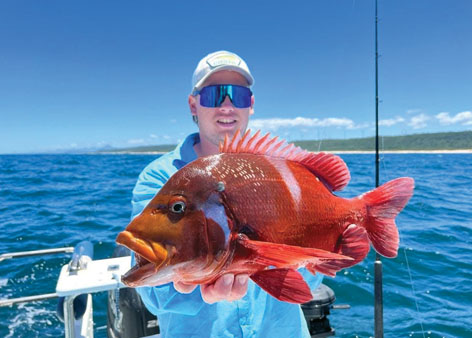 The inshore area in front of the water tower off Paradise Beach holds good linefish stock and some nice black musselcracker, dageraad and santer or basterman as we know them locally. That area often also hosts some beautiful Miss Lucys (red stump).
The bay itself holds some beautiful Cape salmon and kob which can be found in abundance from November through to the end of May most years.
All along the backline from the Krom River mouth to the St Francis Bay point, garrick are abundant, and targeting them always makes for a fun day’s fishing.
There is shale ground and rocky outcrops to the east-south-east of the bay in the 60- to 80 metre deep water, and you’ll find plenty of decent sized carpenters there.
Hake are found a little more south to south-east of the point in water between 80- and 110 metres deep. The hake catch was dismal a couple of years ago, but they have returned in numbers and nice sizes once again. Targeting them is hard work, but they’re my favourite fish to eat, and wow do they make great pickled fish!
Yellowtail or, as I call them, the reef thugs can be found just off the point of the lighthouse on the shallow water pinnacle. Cape St Francis has some decent sized yellowtail, and if you really want to have a challenging battle, spend a day catching them and then tell me that they’re not, pound-for-pound, the strongest fish in the sea.
The offshore fishing can be awesome off Cape St Francis, with a number of yellowfin tuna between 90kg and 103kg coming out. The current EP record yellowfin tuna was caught from here – a 102kg specimen landed by Warren Chapman. This beast was caught in 2021, and although bigger fish have been caught, the records have never been claimed.
The odd black marlin is caught in these waters, but the majority of our marlin are young blue marlin in the 80kg to 120kg range.
This past year has also been an amazing year for dorado, with them being caught in numbers. There was even one report of a dorado caught from the surf. It is unusual for us to find them in such number in our waters, but they are predominantly a summer fish in our area.
We als o have a fairly healthy population of mature Cape snoek in our waters. They can be found off what we call the Snoek Banks about 40 miles to the west of Cape St Francis. They usually make their appearance in late November through December, but don’t stick around too long. When targeting them, make sure you have plenty of ice so that you can keep them fresh and you don’t go home with “pap” snoek.
The Krom River holds some beautiful kob and spotted grunter, and you’ll find good garrick in the estuary almost all year round. This area also offers awesome rock and surf fishing for those bad weather days. You can fish both sides of the point. It is also one of the few places where good-sized yellowtail are caught from the bricks.
TACKLE
I use very simple tackle. For deep water I use a Poseidon Dorado rod and an eight-inch KP reel with 65 lb braid. For the shallower reefs I use a Shimano Trevala rod and 50 lb braid on a Saragosa 6000 reel.
Hooks vary from 6/O to 8/O when fishing in the shallows to quite large 12/O Kendal J hooks for the hake/stockfish and carpenters in the deeper water.
COORDINATES
1. Caves 33° 58.604’ S 25° 01.078’ E
2. Water Tower Reefs 34° 06.583’ S 24° 55.663’ E
3. Shallow Reefs 34° 07.473’ S 24° 53.770’ E
4. Deeper Kob Reefs 34° 08.911’ S 24° 54.774’ E
5. Carpenter 34° 11.138’ S 24° 58.303’ E
6. Hake/Stockfish 34° 16.154’ S 24° 58.265’ E
7. Yellowtail 34° 13.344’ S 24° 51.657’ E
8. Cape Salmon/Carpie 34° 12.497’ S 24° 45.390’ E
9. Cape Salmon 34° 12.311’ S 24° 39.889’ E
10. Line-/Reef fish 34° 12.044’ S 24° 34.779’ E
11. Snoek Banks 34° 13.830’ S 24° 04.556’ E
LOCAL CLUBS
The local ski-boat clubs are SADSAA affiliated and form a key part of the Eastern Province Deep Sea Angling Association. Chairman of the Port St Francis Ski-Boat and Yacht Club is Richard Fullford, and he is ably assisted by Laura Robinson, the club secretary. For more information on the EPDSAA email admin@epdsaa.co.za or visit <www.epdsaa.co.za>.
Port St Francis Ski-Boat and Yacht Club is very conservation conscious, with most of its league competitions being full tag and release events, with only the fish measurements counting.
Contact them on info@sfb-skiboatclub.co.za or visit https://sfb-skiboatclub.co.za/.
Tim Christy is chairman of St Francis Rod, Reel and Boat Club. Contact them on 082 569 3750 or look them up on FaceBook.
St Francis Bay really is a fantastic place to visit, with beautiful canals and stunning accommodation for anyone planning a trip. Some incredible restaurants are found in the harbour, where you’ll be able to enjoy the locally caught squid. And of course there’s great fishing too. All in all, it’s a magnificent place to spend some time.

 The shallow reefs to the north of the bay are known as “The Bushes”, but they have now mostly been incorporated into the Addo Marine Protected Area (MPA) which was promulgated in 2020.
 The Bushes reefs are home to Scotsman, poenskop (Black Mussel-cracker), dageraad, red Roman and by far the greatest number of basterman (soldier or santer) all around South Africa’s coastline. We are also blessed to have some great tuna fishing offshore, and some spectacular specimens have been caught over the years. The Port Elizabeth club’s current yellowfin record stands at an impressive 102kg, and this year we are already up to a 76.3kg fish.
 Beautiful yellowbelly-, catface- and brown rockcod are found in this area, and although ours are not the largest, they certainly can be plentiful at certain times of the year.
 For anyone wanting to fish these areas, note that only club members may launch out of the Port Elizabeth commercial port, as it is governed and managed by Portnet and their rules and regulations apply. There are, however, temporary and seasonal December memberships available for visitors to the area.