Tag: Cape

  • WHERE TO FISH Part 16

    WHERE TO FISH Part 16

    Working west of Knysna

    By Ewald Crause  and Connie Garstman

    (Originally published in the November 2024 issue of SKI-BOAT magazine)

    KNYSNA, a gem of the southern Cape coast, is a destination that offers anglers an unparalleled variety of fishing experiences. From the serene, sheltered waters of the Knysna estuary (perfect for light tackle enthusiasts), to the thrilling challenge of navigating the iconic Knysna Heads, this region is a paradise for those seeking diverse fishing adventures. Whether you choose to fish the estuary’s abundant channels, venture offshore towards Plettenberg Bay, or head west towards Walker Point, Knysna serves as a gateway to an array of species and fishing techniques, catering to both novice and experienced anglers alike.
    KNYSNA ESTUARY
    A haven for light tackle fishing and family fun
    For those seeking a relaxed and accessible fishing experience, the Knysna estuary is an excellent location. Its calm waters make it ideal for light tackle fishing, with species such as leervis (garrick) and spotted grunter being common targets. Early mornings and late afternoons are productive times to fish, and livebait like prawns or small mullet work well.
    The estuary is also a great place for families to enjoy fishing together. Children can easily catch baitfish and gorries (pinkies), providing an engaging introduction to the sport. The area is also frequented by skates and smooth-hound sharks, which offer a fun challenge for young anglers without being too difficult to handle. For those interested in flyfishing, the estuary’s waters provide the right conditions, with leervis often going for surface poppers and clousers.
    The combination of productive fishing, ease of access and family-friendly appeal makes the Knysna Estuary an ideal destination for anglers of all ages and skill levels.

    THROUGH THE KNYSNA HEADS
    Navigating between the Knysna Heads – two towering cliffs that frame a narrow channel between the estuary and the open ocean – presents a serious challenge due to the unpredictable nature of the conditions.
    Skippering through this passage requires skill and a solid understanding of local sea conditions. Many local skippers regard successfully passing through the Knysna Heads as a mark of experience and boating proficiency – essentially a rite of passage. It’s not a route recommended for novice boaters, but for those who manage it, the waters beyond offer rewarding fishing opportunities.
    The tidal currents between the Heads are strong and fast, funnelling through the narrow gap and creating turbulent waters, especially during the outgoing tide. For boaters, timing is critical. Passing through the Heads at slack tide, when the current is at its weakest, is strongly recommended to ensure a safe journey.
    In addition to the strong currents, waves at the Heads can become unpredictable, with larger swells pushing into the channel and creating rough conditions, even when the sea appears calm from inside the estuary. Skippers must be aware of both the tide and the swell size when planning to exit or enter through the Heads.
    Once they’re out on the ocean, anglers gain access to a variety of fishing options, with the choice of location often depending on the type of fishing they prefer.

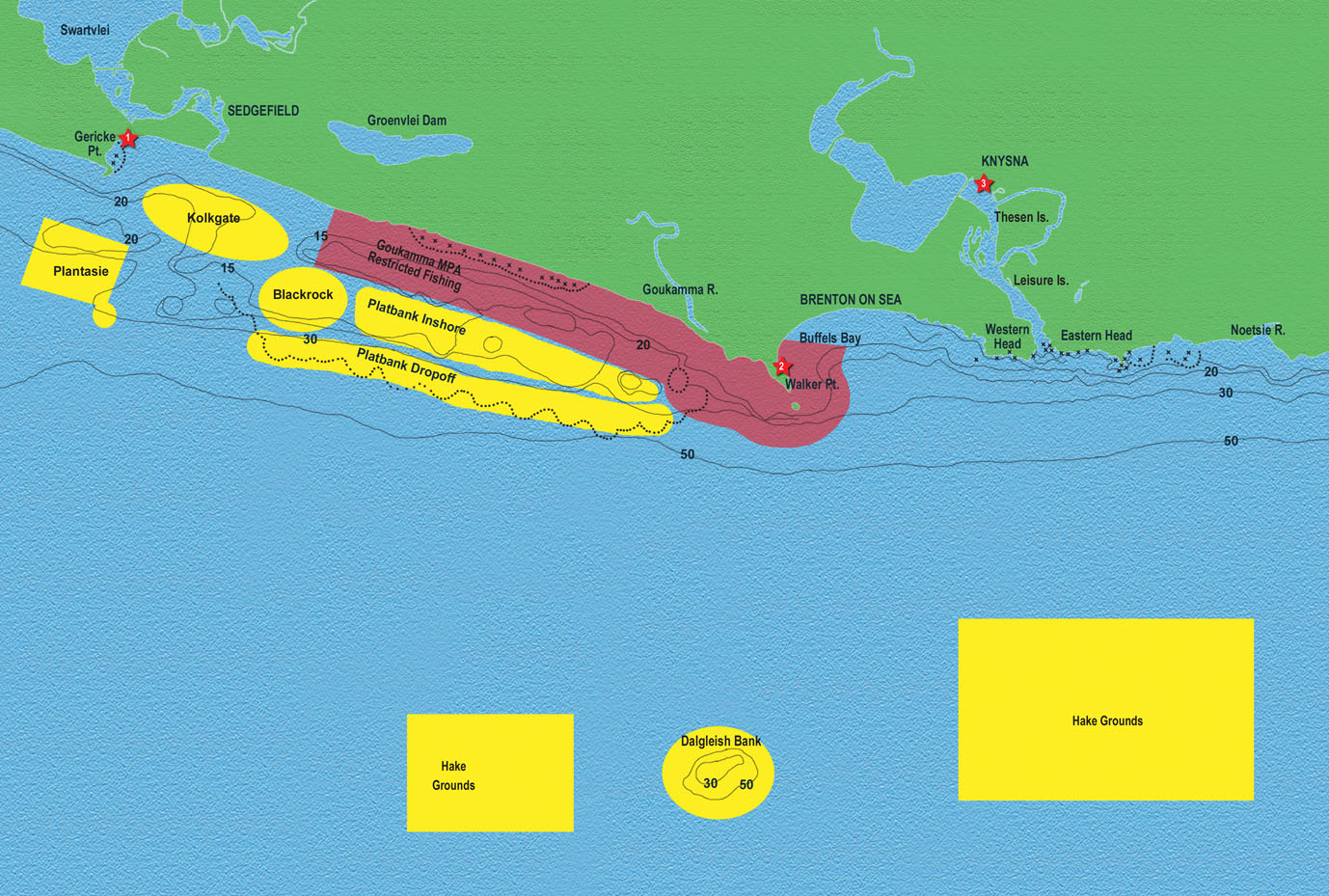
    DALGLEISH BANK
    Key features:
    Dalgleish is an offshore fishing ground where the depth rises sharply from around 65m to 30m. This depth change attracts both pelagic species near the surface and reef species near the bottom. Trolling along the edge of the bank often produces good results.
    GPS Coordinates:
    S 34°11.662’ E 22°57.403’
    This mark is pretty central to the reef, and there are plenty of beautiful pinnacles here.
    Target species:
    Pelagic: Yellowtail, bonito.
    Bottoms: Carpenter, red Roman, rockcod, geelbek, kob.
    Best time to fish:
    Pelagic species like yellowtail and bonito are most active from October to March. Bottomfishing is productive year-round, with the cooler months from April to August offering good chances for carpenter and other reef species.
    Preferred fishing methods:
    Trolling along the edge of the bank is effective for yellowtail and bonito. For bottomfishing, targeting the deeper areas (back of the bank) yields carpenter and typical reef species. Drifting near the rise or anchoring near the reef can be effective, depending on conditions.

    HAKE GROUNDS
    Key features:
    The Hake/Stokvis Grounds are a prime area for targeting this delicious table fish, particularly during the winter months when hake and other species like gurnard move into the region. When water temperatures drop, hake can be found as shallow as 50m, though the most productive depths are typically between 70m and 80m.
    GPS Coordinates:
    S 34°10.652’ E 23°03.394’
    This mark serves as a good reference point, and fishing within a 3- to 4-nautical-mile radius around it is productive for hake in the colder months.
    Target species:
    Hake and gurnard
    Best time to fish:
    The winter months (April to August) are best for Cape hake, particularly when water temperatures drop. Early mornings and late afternoons are productive times, with the best catches coming from the 70m to 80m depths.
    Preferred fishing methods:
    Bottomfishing is the most effective method here. Drifting allows you to cover some ground, and you may cross paths with the hake, but anchoring up and ensuring sufficient bait reaches the bottom will bring the fish into your patch, producing more consistent results.
    Bait and tackle:
    Pilchards are the go-to bait for hake and gurnard. You have to keep your bait on or near the bottom, so ensure you have plenty of weight and a healthy supply of patience.
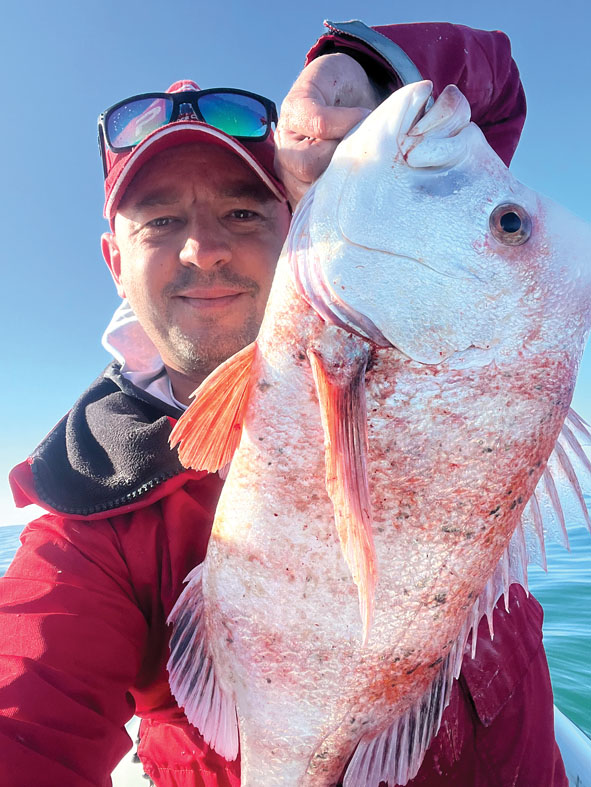
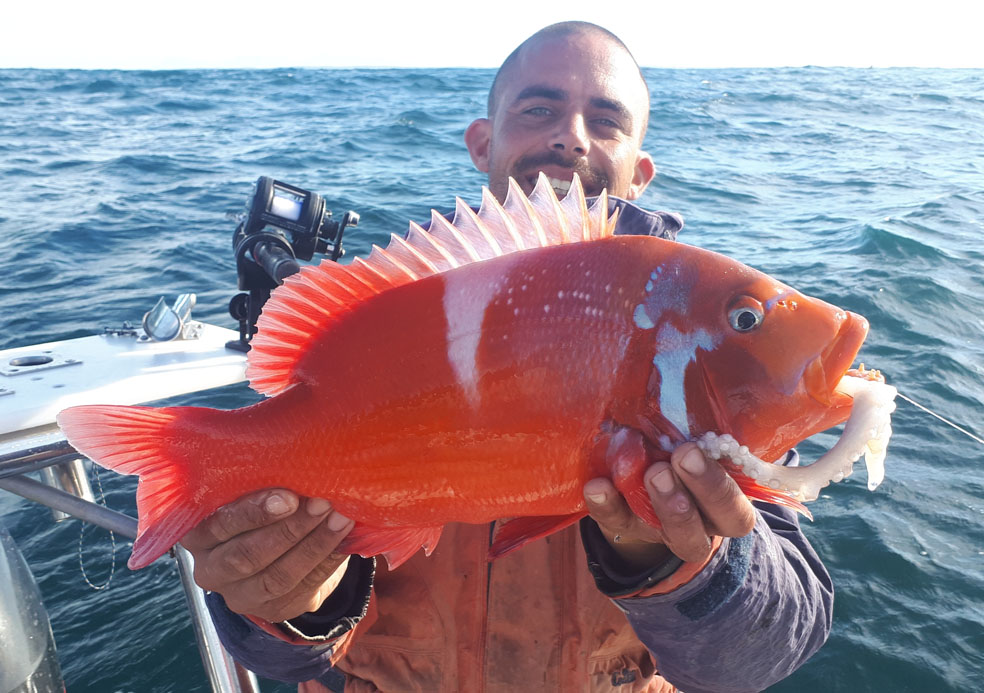
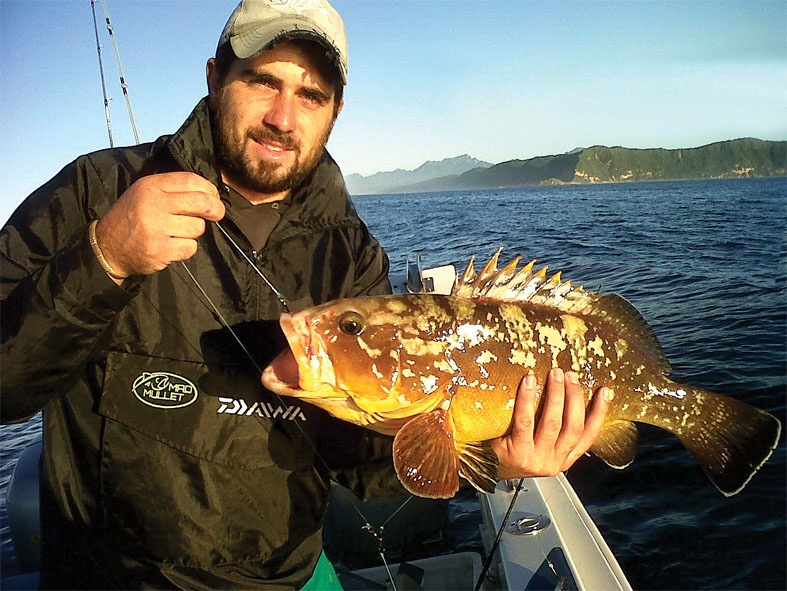
    Ewald Crause with a beautiful Miss Lucy.

    PLATBANK INSHORE
    Key features:
    Platbank Inshore is characterised by shallow reef structures. These reefs are productive year-round, attracting a variety of bottom-dwelling species that frequent rocky environments.
    Target species:
    Miss Lucy, geelbek, santer
    Best time to fish:
    Miss Lucy can be targeted throughout the year, with summer months being particularly productive. Geelbek fishing (drift fishing) is best from February to May, typically early in the morning or late in the afternoon when they are most active.
    Preferred fishing methods:
    Anchoring near the reef structures is the preferred method for targeting bottom species like Miss Lucy and other reef species. Drifting can also be effective, though care must be taken around the rocky terrain to avoid losing tackle.
    Bait and tackle:
    Medium tackle with strong leaders is recommended to avoid getting snagged on the reef. Use pilchards, mackerel or chokka for bottomfishing. For geelbek, live bait or pilchard baits on drift rigs are effective, especially during their active months.

    PLATBANK DROPOFF
    Key features:
    The Platbank Dropoff is a well-known fishing area located where the reef drops sharply from shallow waters into deeper areas of about 40m. The key feature of this spot is the dropoff, which is easily visible on your plotter. Fish often gather near this underwater structure, making it a great spot for targeting kabeljou and other species.The sandy bottom near the edge of the reef is especially productive for kob.
    Target species:
    Kabeljou (kob)
    Best time to fish:
    The best fishing at Platbank Dropoff is typically from December to May. Early mornings and late afternoons are especially productive times.
    Preferred fishing methods:
    Drifting or anchoring close to the drop-off while working bait or lures along the reef edge is effective. Trolling along the drop-off can also yield good results, particularly for pelagic species. For bottomfishing, focus on positioning near the sandy bottom and reef edge to target species like kabeljou.
    Bait and tackle:
    Pilchards and chokka are the preferred baits. Dropshots can also be used for kabeljou and other bottom-dwelling species. For pelagic species, trolling with live bait can also be effective. Medium-heavy tackle is recommended, with a strong leader for larger fish.

    BLACKROCK
    Key features:
    Blackrock is easily recognisable by the prominent rock structure on the beachfront. It is a versatile fishing area with depths ranging from 8m to 35m, making it suitable for a variety of species. The area is known for its many pinnacles, and targeting smaller pinnacles that hold fish is key to a successful trip. Due to the rough terrain, it is not advisable to drift fish here, as tackle loss is likely. Instead, anchoring is recommended to keep you in the productive areas. Ensure you have a steady supply of burley (chum) to attract fish.
    GPS Coordinates:
    S 34°03.748’ E 22°49.827’
    Target species:
    Kabeljou: Common around the pinnacles, particularly in deeper sections. Geelbek: Often found around the pinnacles, especially during their active months. Santer: Found year-round, particularly near the smaller pinnacles. Red Roman: Common in rocky environments. Rockcod: Yellowbelly and cat-eye rockcod are frequently caught here.
    Best time to fish:
    Fishing at Blackrock is productive year-round, with peak activity in the summer months for species like Santer and red roman. Geelbek is more active from February to May.
    Preferred fishing methods:
    Anchoring is essential when fishing at Blackrock due to the rough terrain. Use burley to attract fish to the area, and focus on bottom fishing near the pinnacles. Tackle should be prepared for the rocky environment to minimize losses. Avoid drifting, as the risk of getting snagged on the pinnacles is high.
    Bait and Tackle:
    Pilchards, squid, and chokka are effective baits. Use medium-heavy tackle with strong leaders to withstand the rocky environment. Be prepared for hard fights from species like kabeljou and geelbek.

    KOLKGATE
    Key features:
    Kolkgate is characterised by numerous dropoffs and deeper holes that attract a variety of bottom-dwelling species. Anglers should use their plotter to locate these dropoffs and the area’s pinnacles as they are prime areas for catching multiple species.
    GPS Coordinates:
    Between S 34°03.259’ and 34°02.644’ Between E 22°49.052’ and 22°46.959’
    Target species:
    Poensies: Found in the deeper holes near the dropoffs. Red steenbras: Common in the deeper sections, particularly in rocky areas. Groot santer: Often found year-round in deeper waters. Yellowbelly rockcod: Favour the rougher terrain around the pinnacles. Geelbek: Frequently found near the pinnacles, especially from February to May.
    Best time to fish:
    Kolkgate is productive throughout the year, with the best results seen during the cooler months for species like steenbras and poensies. Geelbek are most active in the late summer and early autumn months.
    Preferred fishing methods:
    Bottomfishing near the dropoffs and around the pinnacles is the most productive method at Kolkgate. Anchoring is recommended to effectively work the deeper holes and pinnacles. Keep a steady supply of burley/chum to attract fish, and be patient as the fish often hold close to the structure.
    Bait and tackle:
    Pilchards, squid, and chokka are effective baits for bottomfishing. Medium-heavy tackle with strong leaders is necessary due to the rocky terrain and the size of the fish typically caught here. For geelbek, livebait or pilchards on drift rigs are effective around the pinnacles.

    PLANTASIE
    Key features:
    Plantasie is a sand-bottomed area interspersed with small rocky outcrops, which is exactly what anglers should focus on. These outcrops are prime spots for finding larger kob, particularly in the 25m to 40m depth range. The sandy bottom combined with rocky patches creates an ideal habitat for bottom-dwelling species.
    GPS Coordinates:
    S 34°04.601’ E 22°45.917’
    Target species:
    Kob: Large kob frequent the area, particularly around the rocky outcrops in the 25m to 40m range. Geelbek: Can be found occasionally in deeper sections of the area. Carpenter: Often caught near the rocks, especially in slightly deeper water.
    Best time to fish:
    The area is productive year-round, but kob fishing is especially good from late summer to early winter. They’re most active in the early mornings and late afternoons.
    Preferred fishing methods:
    Bottomfishing is the go-to method at Plantasie, particularly around the small rocky outcrops. Anchoring near these outcrops and working the bait close to the bottom is effective for attracting kob and other species. Drifting is also an option in this area, especially in deeper water where kob tend to be more active.
    Bait and tackle:
    Use live bait, pilchards, or squid for bottomfishing. Medium-heavy tackle with strong leaders is ideal, as kob can be large and will fight hard. Be sure to position your bait near the rocky outcrops for the best chances of success.
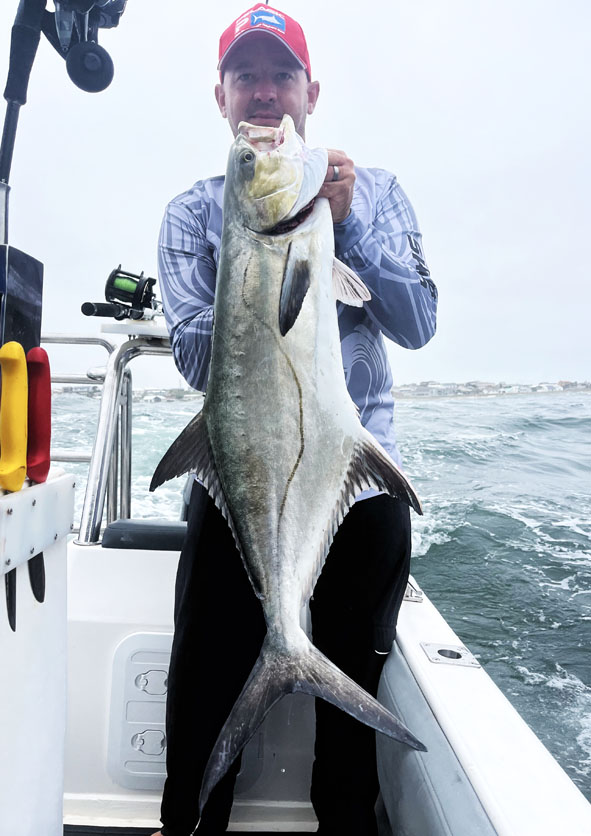
    MARINE PROTECTED AREA (MPA)
    The Goukamma MPA stretches from Walker Point to Buffels Bay and up to Groenvlei carpark, is designated as an MPA. The protected zone extends 1.8km (1nm) offshore, aimed at preserving marine biodiversity and ensuring sustainable use of the resources. The MPA plays a crucial role in protecting fish species, especially those that breed and feed in the area, contributing to healthier fish populations both within and beyond the protected boundaries.

    LAUNCHING OPTIONS
    The Knysna area provides several launching points for anglers, ranging from club launches to public access sites. Each has its own requirements and facilities, so it’s important to know the details before heading out.
    1. Gerrickes – Beach launch
    Description:
    Gerrickes offers a beach launch facility, but access is limited to members of George’s Ski-boat Club. This launch site is located in a spot with direct access to productive fishing grounds, but launching from the beach requires experience, as the surf conditions can sometimes be challenging. This launch site is popular among local anglers due to its proximity to key fishing spots.
    Key considerations: Only club members can use this facility. The beach launch means you need to handle your boat through surf, which can be difficult in rough conditions, so it is best suited for experienced skippers.
    2. Buffalo Bay – Open Public Launch
    Description: Buffalo Bay provides an open public launch, making it accessible to all anglers. This launch site is a popular choice for recreational fishers as it offers relatively easy access to the surrounding coastal waters, including the popular fishing grounds around the Knysna area. It is less restrictive than club-based launches and doesn’t require membership.
    Key considerations: As a public facility, it’s open to anyone, but the beach launch requires careful navigation because of local tide and surf conditions. Early arrivals are advised during busy periods, particularly in peak fishing seasons or weekends, to avoid congestion.
    3. Knysna Lagoon – KADA
    The Knysna Angling and Diving Association (KADA) launch point is available for anyone to use, but a public launching fee is charged. KADA offers access to the Knysna Lagoon, which is ideal for anglers targeting estuary species or for those looking for a calmer launching point before heading offshore. The safe, sheltered nature of the lagoon with easier access for small boats or beginners makes it a good option for those looking to avoid surf launches.
    Knysna Lagoon – Leisure Isle Boat Club
    For those looking to launch in more controlled conditions in the lagoon, Leisure Isle offers a more comfortable launch experience compared to beach launches. However, this facility is private, and more details about access requirements should be obtained directly from the club.

    RESCUE SERVICES
    The National Sea Rescue Institute (NSRI) branch in Knysna plays a vital role in ensuring the safety of those venturing out to sea along this section of coastline. Operating as part of South Africa’s national volunteer sea rescue service, the Knysna NSRI is on standby 24/7 to respond to emergencies and provide assistance to boaters, anglers, and the broader maritime community. Many skippers rely on the NSRI for updates on weather and sea conditions before attempting to pass through the Heads or head offshore.
    For emergencies or assistance, boaters can reach the Knysna NSRI directly on 082 990 5956. I recommended that all skippers keep this number on hand if they’re heading out to sea, particularly when navigating the challenging waters around the Knysna Heads.
    Happy fishing.
  • BLUEFIN BONANZA

    BLUEFIN BONANZA

    Bluefin tuna numbers up in the Cape

    By Ryan Nienaber

    [Originally published in the September 2023 issue of Ski-Boat magazine]

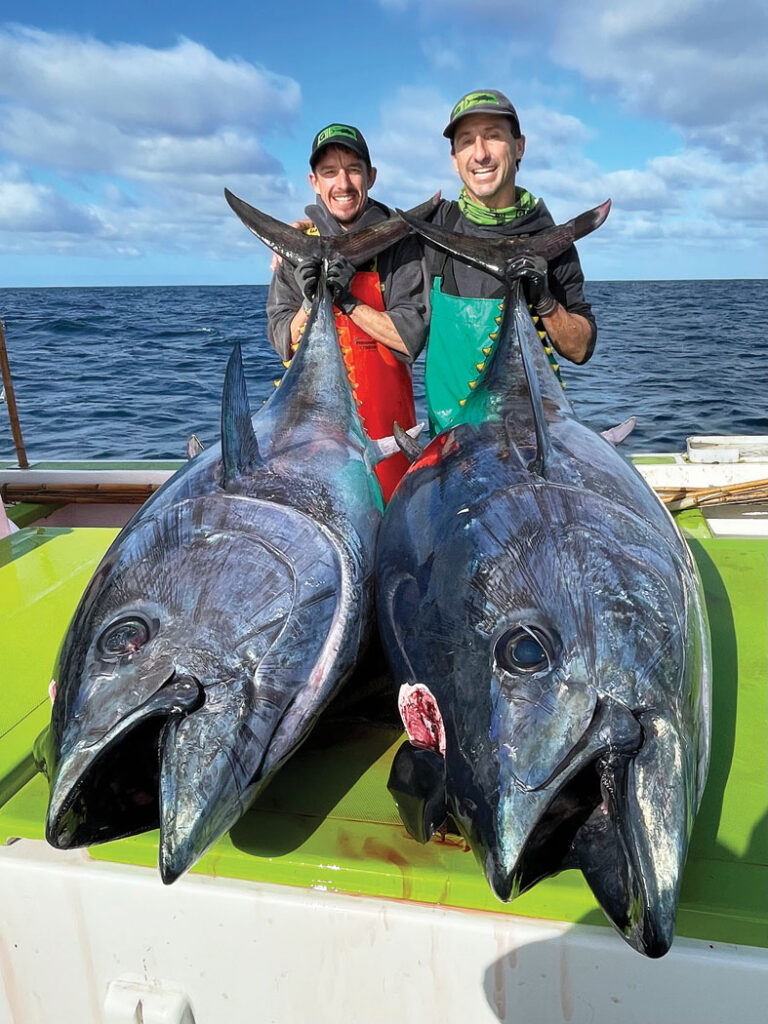
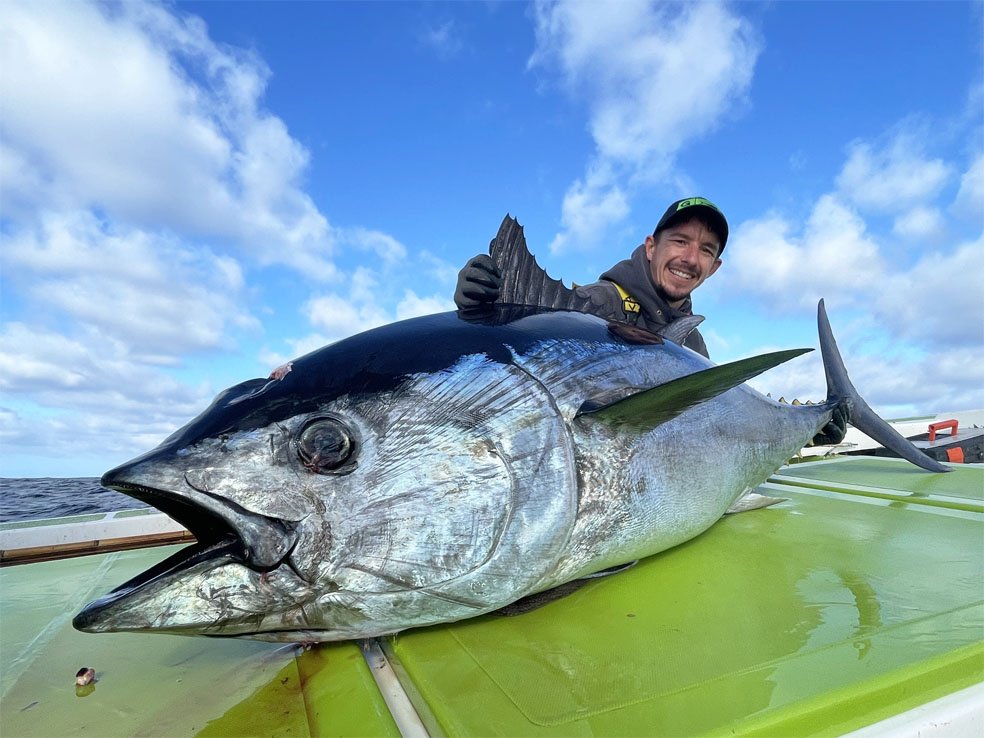
    Andrew and Ryan Nienaber celebrate the haul of two bluefin tuna over 100kg.

    A FEW days after our tuna grandslam in May 2023 (see the article in July 2023 issue of SKI-BOAT), spirits were still running high as we headed out into the deep blue again. With no boats having been out for the previous few days due to bad weather, we were happy to have a fishable day. We headed to an area similar to where we slammed it a few days prior and set out our lines.
    And then … nothing. By 2pm we thought we were going home empty-handed, when suddenly a rod went. Before long we had three younger 30-40kg yellowfin on the boat.
    The next minute my brother, Andrew, shouted that there was a fish swimming in the chum that didn’t look like a yellowfin, but which was definitely a big tuna species. A quick glance and the one unusual tuna turned into three big bluefin swimming in the chum line.
    Johan stripped a line and went tight, then Andrew also went tight. They were now fighting two big bluefin simultaneously. We thought about trying to hook up the third, but decided against it because we did not have a full complement of crew as many had headed up the west coast for the snoek run.
    We decided it would be safer to land the two bluefin we had on and keep the chum line going; we could always try for the third afterwards. The fish made very long, strong runs, very much like a yellowfin fight, but with longer deep runs before they settled into their circle and lay on their side to come up.
    Tuna fishing is all about teamwork, it’s not about who is on the rod. Many days of prep go into a day’s fishing, and each crew member has a role to play. In my opinion, the most important crew member of the day is actually the one who’s chumming. Without a proper chum line you will catch nothing. It’s probably the most unrewarding task that deserves the most credit, as someone sits and separates hundreds of frozen sardines, then cuts them into tiny blocks, separating the heads and tails and keeping a steady line going into the water.
    As the fight went on with two big fish, the tuna tango soon started, with the lines getting crossed. Over, under, over, under, rod tips together to keep the lines free. This continued for some time until Andrew finally presented his catch to the boat. We could clearly see it was a bluefin, and it had the weight to match as we tried to lift her over the side.
    Once we had her onboard I commented that this fish must be close to kissing the 100kg mark. Shortly thereafter Johan landed his, another big beauty.
    As darkness approached, the yellowfin started coming up and we started hooking up with more younger class yellowfin in the 40-50kg size range.
    At one stage I was on the rod and after a short initial run I saw the colour of my fish. Within a few minutes of hooking up it came alongside, but it did not move at all. When I called for the gaff to load it, I saw the tail had been bitten clean off and the fish had already bled out. A massive mako shark appeared in the chum line and took his tax out of the next four yellowfin we landed.
    An hour after dark we finally started the 32NM journey back to Hout Bay into a bumpy north-westerly wind on a pitch dark night. A trip like that is never great, but sometimes you have to stick it out to get the results.
    Despite the rough ride home our spirits were high because we knew we had two big fish in the box. The next day they tipped the scales to triple digits at 101.5kg and 103kg. Our staff at the factory shared in the excitement, all taking turns to take a photo with the impressive catch.
    Cape Town has one of the most special tuna fisheries in the world, and it’s right here on our doorstep for all to enjoy. I believe we will continue to see great tuna catches for the following years as these fish seem to becoming more abundant.

  • VARIETY CLOSE TO HOME

    VARIETY CLOSE TO HOME

    By Donavan Cole
    [Originally published in the November 2020 issue of SKI-BOAT magazine]

    FALSE Bay offers some really good reef fishing that many overlook as most boat anglers are usually chasing after the larger inshore and offshore pelagic species. The best part about targeting the smaller reef species is that you usually don’t have to travel very far from the launch site so these spots are accessible for most craft, and you will rarely return empty handed when reef fishing inshore.

    TARGET SPECIES
    False Bay reefs offer a wide range of species and it is not uncommon to catch more than ten different species of fish and small sharks in a day. The variety of species will, however, reduce as you go deeper, with more variety being found in water shallower than 30m. This is also the case as you move westwards out of the bay, because the water gets colder up the west coast. When you’re fishing west of the SW reefs outside the bay you will mostly only catch hottentot.
    The cold Atlantic Ocean is believed to meet the warm Indian Ocean at Cape Agulhas (southernmost tip of Africa) you will, however, find far more evidence of these two currents actually meeting at Cape Point if you look at the fish species caught in False Bay. We have many species that are commonly caught in False Bay and up the east coast into KZN, and most of these species will very rarely be caught west of Cape Point.

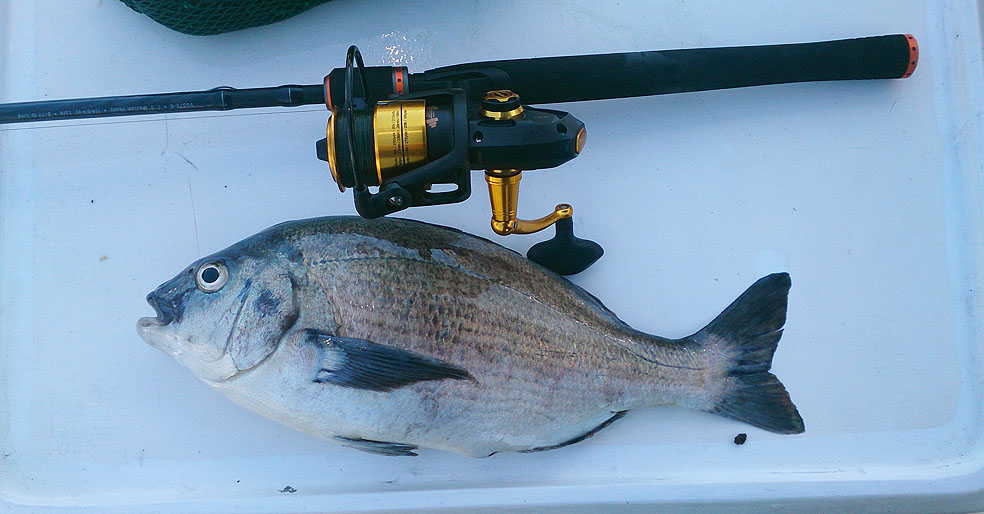
    ABOVE: A lovely hottentot caught on a light spinning reel setup.

    The most common species caught in False Bay is hottentot, also known as Cape- or black bream. You will find them close inshore between the kelp and out as deep as 100m outside the bay. You will generally find that the deeper you go the bigger the fish get, but large specimens can be caught in the shallows if your bait isn’t devoured too quickly by the small fish.
    Hottentot can also be like chameleons that change colour slightly according to their habitats. The fish you catch close to or in the kelp will most often be a dark brown colour, and as you move into deeper water they get lighter in colour. When catching them down off the sandy areas between Strandfontein and Macassar you’ll find they are a silver colour. I personally prefer to eat hottentot caught away from the kelp beds, as I think they taste better; those caught around the kelp beds apparently have a stronger taste due to the iodine in the kelp that they often feed on.
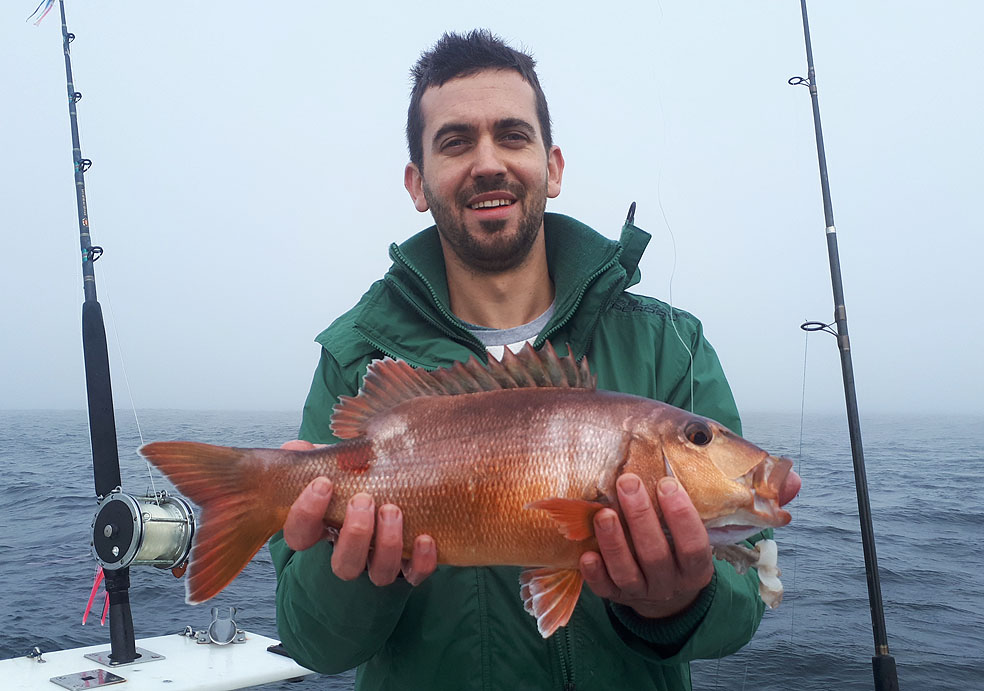
    Red roman are probably the most heavily targeted reef fish inside the bay. These beautiful, slow-growing red fish are the most aggressive feeders on reefs around the bay and you will quite often find that when you drop a bait they will are one of the first fish to grab your bait, rushing in and chasing away other smaller fish.
    I try to release most of the roman I catch around the bay and have tagged and released more than 300 in the last couple of years. A few of the tagged fish have been recaptured a year or two after being released while fishing on the very same reefs where they were originally tagged and released. This proves that these fish do not move around much, staying on a specific reef for great lengths of time.
    These fish are very aggressive feeders, so you will quite often hook them in their throats or deeper. If this happens it’s usually best to cut the line as close to the hook as possible and leave it to rust out rather than trying to pull or rip it out as the fish will most probably die after release in that case. Be very careful when handling a red roman as they have razor sharp gill plates; I have received a few nasty cuts while handling them.
    When considering whether to release or keep a nice big roman, please remember that a specimen of 45cm and upwards is 20 or more years of age.

    ABOVE: Ryan Cole with a red steenbras which was tagged and released.

    Red steenbras were once very common in the bay and some massive fish were landed in the early 1900s. They were, however, fished to near extinction and for many years you would rarely see any caught in the bay. Over the last few years there has, however, been a massive increase in juveniles caught all over the bay. Most are around 30- to 40cm in length, with the odd larger one coming out. I would like to appeal to all anglers to please handle these fish with care when landing them and try to return them to the water as quickly as possible. With any luck we could see the larger specimens also returning to the bay like in the good old days.
    You will quite often find that fish caught on the inshore reefs will carry some parasitic lice on the side of their heads and inside their mouths. While this puts many people off, it does not affect the quality or taste of the flesh. If I’m going to release fish that have these lice I will usually remove the lice before releasing the fish.
    When targeting reef fish in deeper water (30m-plus) you will usually find that the fish will embolize (suffer barotrauma) while being pulled up from the depths. This is due to the big pressure change from the bottom to the surface. When releasing these fish you will usually find that they battle to get down due to their expanded swim bladders and float away to be eaten by birds or seals. A way to minimise this is to pull the fish up as slowly as possible. You can also make up a simple weighted release tool using a biggish upside down hook with a clipped off point and a squashed barb. The line is attached to the bend of the hook and you hook the fish lightly in the lower jaw. You then send the fish down, keeping slight tension on the line, and when you recover the hook it will usually pull easily from the fish’s mouth, releasing the fish to swim off. I usually use a device called a SeaQualizer which clips on the fish’s lip; the clip is then set to open at a desired depth using a built in hydrostatic release.
    Please keep an eye out for tagged fish, and if you catch one please note the length, tag number and location where it was caught, and email that info to ORI <oritag@ori.org.za>. If you release the fish again please do so with the tag in place. Most anglers won’t carry a pen or pencil to write down the tag details, so the easiest thing to do then is to take a quick photo of the tag number.

    TACKLE
    When reef fishing, the bottom will generally be very rocky and foul which results in you hooking up to the seabed frequently; with lighter gear you tend to snap off very easily. I usually opt to fish with stronger braid which allows me to have a direct feel of any bites and great fun when pulling the fish in as I can feel every head shake and pull because there is little or no stretch in the braid.
    I generally use a standard “Paternoster rig” when bottomfishing, with three-way swivels to separate the hook and sinker traces. (See photo alongside.) I will usually fish a double rig with two hooks above each other. The hook traces are around 30cm long, with the sinker trace slightly longer so that when I’m fishing flat on the bottom my hook stays off a bit to minimise snagging and lost tackle.
    My hook and sinker traces will be of a lighter breaking strain than the main line so that when the hook or sinker trace snags up on the seabed I can just break off the trace instead of losing everything. When I’m fishing close to the kelp beds in shallow water I will make up a drift trace with a small swivel to allow it to sink slowly.
    I prefer to use “J” type hooks when reef fishing as I like to feel the bite and strike the fish as opposed to using circle hooks where you let the fish hook itself. I use 1/0 to 3/0 size hooks as smaller hooks will result in me hooking most of the smaller fish that come to nibble on the bait and missing out when a bigger fish comes along. I do, however, use circle hooks when targeting red roman as I release most of them. The circle hooks usually hook in the corner of the mouth and can then be removed quickly for the fish to be released with minimal damage, unlike the J hooks which often hook in their throats.
    Sinker size depends on tackle, depth of water and current. When fishing inshore in shallower water (under 20m) you will rarely need to fish heavier than 1- to 2oz. When fishing deeper, especially outside the bay, you might encounter some strong currents and need to fish much heavier. This is when braid will outperform mono filament as the thinner braid will create far less resistance in the current, meaning you can use lighter sinkers.
    I generally fish with a spinning reel setup loaded with 20 lb to 30 lb braid. When fishing close inshore a lighter rod can be used, but when you’re fishing deeper waters that require a bigger sinker a heavier rod is used.

    BAITS
    When reef fishing around False Bay almost any baits can be used, but I prefer to use the tougher baits like octopus and squid/chokka as there are loads of small nibblers that will tear most soft baits apart in seconds. Another favourite bait is white mussel which is really soft when fresh. I will usually defrost my white mussels a day or two before going fishing and then salt them heavily with coarse salt and leave in a strainer overnight; this will remove most of the moisture and the mussel meat will toughen up nicely.
    When using softer baits like sardine or red bait, I’ll put a thin strip of chokka on the hook first and then have the softer bait on the outside which will usually attract the fish. As it breaks up you will be left with the firmer chokka that will be chewed on until a bigger fish comes along.
    When it comes to using fish as bait I like to use pike instead of sardine as the tough skin on the pike keeps it on the hook a bit longer. The pike is also pretty oily which usually gets a lot of action. The pike can be filleted then cut into pieces or chopped into blocks. In the summer months mackerel is often caught in the bay, and if they’re frozen properly these make excellent bait as the skin and meat is quite firm and I don’t know of any fish that will swim past a strip of mackerel.
    I don’t usually chum while reef fishing as the chum will drift away in the current, and by the time it reaches the seabed it will be a way off from the boat where the baits are. You can, however, drop a weighted bait bag down to the bottom to attract the fish into the area where the lines are.
    A few anglers have shifted from using conventional baited hooks to artificial lures for reef fish with great success and most reef species can easily be enticed to grab a lure. Micro jigs have been proven to work for many of the reef fish encountered in and around False Bay.
    I’ve had great success using micro jigs on the bottom of a baited trace as a weight instead of a conventional sinker. On many occasions the fish have gone for the jig instead of taking the baited hooks just above. I think that the jig action from the moving boat will also attract fish quicker than a bait that’s just hanging there, but I often end up losing more tackle due to the hooks on the jig snagging the bottom which can become very costly.

    WHERE AND WHEN TO FIND THEM
    Reef and rocky bottom are found throughout False Bay and fish are found from the edge of the kelp line right out to a few miles off the coast. The most productive areas are, however, towards Cape Point where the largest variety of species and rockier grounds are found.
    When fishing close inshore it’s always worthwhile noting what the coastline contours looks like; that will give you a good indication of what the bottom is like. Deeper, rockier ground under the surface is usually found off steep cliffs, while softer, flatter grounds lead off beach stretches.
    The beach stretch between Muizenberg and Macassar is a perfect example of an area where the sandy bottom and shallow waters extend quite far out. Quite often the water a mile off the coast will be as shallow as 6m compared to the steep coast line around Cape Point where the seabed is mostly rocky and the water drops off past 30m very close in.
    Venture a bit further out for some very nice reef fishing around Whittle Rock/Bell buoy which is around four miles east of Miller’s Point out into the middle of False Bay, otherwise try Rocky Banks which is around five miles off Cape Point. Both these areas can quite easily be found on a nautical chart or on a plotter, and once you’re in the vicinity you will not have any problem finding fishing areas using a echo sounder.
    Don’t discount the sandy stretch between Muizenberg and Macassar, though, because there are plenty of spots to catch reef fish around there. Those reefs are usually small and not always easy to find, but you may be very well rewarded if you ride around a bit watching your echo sounder.
    One way to find some productive areas is to get a paper nautical chart for the bay and plot GPS positions of pinnacles or steep changes in depth contours. You should also be able to see these pinnacles and contour lines on your plotter fishing chart. You can also draw your own contour lines on some of the newer echo sounder/plotter electronic units using pre-installed software. I use Quickdraw™ Contours on my Garmin echo sounder/plotter. By drawing your own contours you can get a nice idea of the seabed structure and if you cross reference this with what fish you see on the echo sounder you can get a good idea of the best areas to fish.
    Reef fish around the bay usually bite in most water temps and wind conditions although there is usually far less action and fewer bites when the water drops below 13°C. There are, however, times when there is a rapid drop in water temp from day to day and the fish will go off the bite completely while they acclimatise.
    At other times the water is warm and we see plenty of fish on the echo sounder but get no bites. This might be because there is a thermocline (large temperature difference between the surface and bottom). A way to check this is to feel your sinker when you pull your line in; you’ll be able to tell if the water is abnormally cold as the bottom temp will transfer into the lead.
    I usually mark fishing spots on my plotter when I see nice structure, pinnacles, drop offs or fish markings on the seabed. Most of the spots around Cape Point and further out I have found and marked while trolling around for yellowtail. If I see any interesting structure or pinnacles I will usually mark them and come back and fish them at a later stage. You can usually tell when you are passing over rocky/reef areas as the thickness of the seabed reading on your echo sounder screen will increase as the bottom gets “harder”; when moving onto softer sand or shell the seabed image will be thinner.
    Once you find “the spot” head up into the wind and throw anchor, then come back slowly until you are on top of the spot you intend to fish. When fishing around the point or outside the bay always keep an eye on the swell as an anchor that is thrown too short could result in your bow being pulled under when a big set of waves come through as they peak over a reef or pinnacle.
    Once the anchor is hooked and lines are dropped you should get bites pretty soon if you have positioned the boat correctly. If you don’t get any bites then let out more anchor rope while watching your echo sounder to see if you come onto the fish. If you’re still not getting bites then it’s best to pick up the anchor and try again. When we’re reef fishing we won’t usually lie and wait for the fish to arrive as most of the reef fish will hang around a specific spot, and if you are not on top of it then you are wasting your time.
    If you manage to get onto the spot and start catching fish then you will usually find that the fish go off the bite or slow down after a while. When that happens I pick up my anchor and look for another spot.
    I usually use a grapnel anchor with a shorter length of chain when reef fishing as you generally don’t have a problem getting your anchor to hold, and if your chain is too long you run the risk of the chain hooking up which will often result in a lost anchor.
    Alternatively on calm, windless days you can drift instead of throwing anchor. This can be quite productive as you can drift across a reef and cover a lot more ground, especially where you have small pinnacles and drop offs that can be hard to anchor on exactly. Unfortunately you lose far more tackle when drifting as your line gets dragged along the seabed; this method is also not practical when you’re fishing in deeper water because even with a very slow drift you will need to keep on paying out line to keep your bait close to the seabed where the fish usually are.
    I usually drop my bait down to the seabed, and once the sinker hits the bottom I will take up the slack and try to keep my bait as close to the bottom as possible. I generally don’t strike when I feel the first bites but wait for a proper take or the biggest bites; this way you don’t end up hooking the smaller fish before something bigger comes along.
    Seals can be quite a nuisance when reef fishing in False Bay, especially when you are boat alone. A seal will sometimes hang around the boat taking almost every fish you hook! If this is the case then it is best to pick up and run to another area as the seal will usually hang around the boat until it has eaten its fill.

    FISHING RESTRICTIONS
    Please check the most recent marine recreational angling regulations for size and bag limits for the various reef species. Also ensure that you know details of the Marine Protected Areas that are off limits to fishing. MPAs are put in place around important reef areas which populate the outlying areas with fish, ensuring that we will still be able to catch reef fish in the future.
    The most important MPAs to note in this area are listed below, and they are visible on most plotter maps.
    • Boulders Restricted zone: in the area between the eastern end of Simonstown harbour and Oatlands extending out around Roman Rock Lighthouse.
    • Castle Rock Restricted Zone: between beacon VB1 at Miller’s Point just south of the Cape Boat and Ski-boat Clubhouse and beacon VB2 at Partridge Point extending one nautical mile seawards.
    • Paulsberg Restricted Zone: between Smitwinkel Point and Venus Pool, extending one nautical mile seawards.
    Remember: Limit your catch; don’t catch your limit.

  • KOB IN THE CAPE

    KOB IN THE CAPE

    [Originally published in the March 2020 issue of SKI-BOAT magazine]

    By Donavan Cole

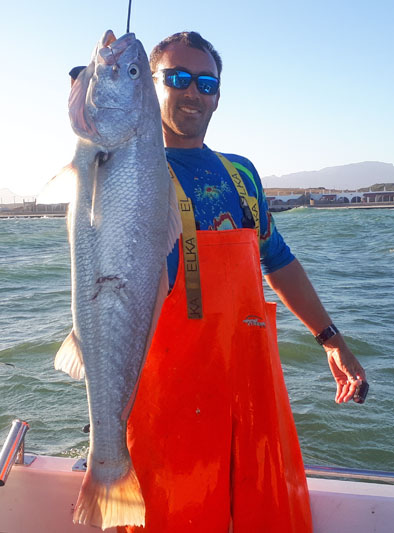
    KOB is probably my very favorite species to catch in the bay even though I will often return mombak. I still ask myself why I bother when I come back empty-handed, but those trips when we find the fish after the persistence makes it all worthwhile. What I love most about catching them is that when a fish take the bait you never know if it’s a 1kg or a 20kg specimen.
    The kob caught in the bay are often undersize (under 50cm) and most of the time you will throw back ten undersize fish for every one that is above the legal size limit of 50cm, but then you’ll find quite a few fish between 3kg and 12kg. Bigger fish are not uncommon, but around 20kg is the biggest that you will encounter.

    WHEN AND WHERE
    I will mainly be discussing fishing the areas accessible when launching from the western side of False Bay at Simonstown or Millers Point.
    In False Bay kob are predominately caught during the summer months, with catches starting around early October when the south-easterly winds start blowing and warming up the water in the bay. These winds will also start churning up the water creating the milky brown “kob water” that is seen inshore along the stretch between Muizenberg and Gordon’s Bay.
    A change of wind direction will, however, change conditions pretty quickly. When the wind swings more to the east this “kob water” will be pushed from Muizenberg towards Kalk Bay, and if it really blows then that water can sometimes move as far west as Simonstown. During these easterly blows you can almost be sure that kob will be off Fish Hoek and Kalk Bay and it will be worth having a look in these areas before running further down to Strandfontein.
    The opposite can be said about southerly and south-westerly wind days, as this will usually clean up the water along this stretch very quickly.
    The main reason that kob are found in this brown water is that this nutrient rich water will usually attract the bait fish that the kob feed on, unlike most species kob are known to be very good hunters in dirty water, these strong winds will also create a lot of wave action which will highly oxygenate the water, and the fish will in turn feed a lot more actively in these oxygen enriched waters.
    I will usually plan my trip according to the predicted weather reports. If the wind is due to drop in the afternoon or early evening then I’ll run down around 3pm and, depending on what the catches are like, run back home around 10pm. Otherwise if the wind is predicted to drop during the night then I’ll launch a couple of hours before sunrise and fish well into the day. I’ve found that the best catches come an hour or two either side of sunset and sunrise. There are, however, times when conditions are good in the evening and the fish are biting nicely and I’ll stay out all night and then get to fish sunset and sunrise. I’ve also had many times where we’ve gone down in near perfect conditions and caught very little, then boats go down the next evening in less than ideal conditions and catch plenty of fish, so there are no hard and fast rules here.
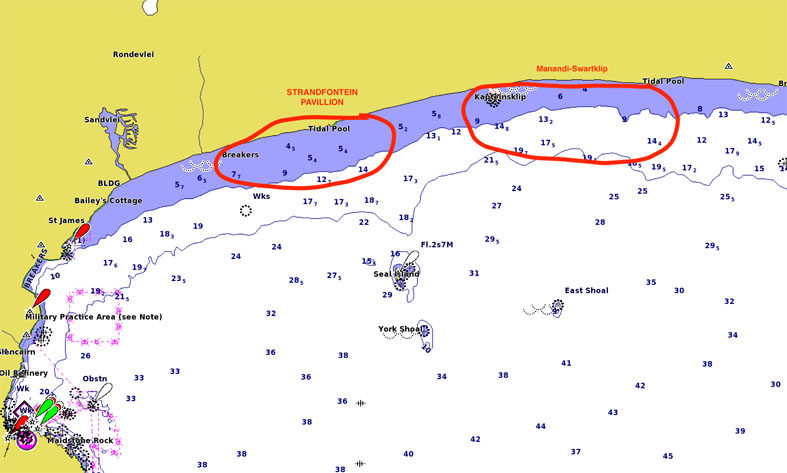
    I’ll usually start off running down to Strandfontein Pavilion and, if the swell and wind allow, I’ll try to get in as shallow as possible behind the tidal pool wall. If the swell does not allow then I will start looking from the edge of the surf line and work my way out to around 15m deep water. If conditions are not great there or if good catches are reported further down, then I will run down towards Kapteins Klip/ Manadi and work on towards Swartklip. I don’t have specific “numbers”, positions or spots that I run to and anchor on; I just head for these general areas and then use my echo sounder to find where the fish are.
    When you’re fishing the early season from October to November you need to be especially careful at night because during these months there is an increase in the number of whales in the bay, especially in the shallows. Keep a good lookout and run as slowly as possible.
    During the summer months the south-easterly winds can blow for days on end, driving everyone mad. As I write this we are in the middle of a ten day blow. When that happens I watch the weather predictions waiting for when the wind moderates, and take any gap I can get. Ideally you want the south-easter to drop off completely and then swing to the north-west. This change in direction will usually result in the best conditions, and the north-westerly, being offshore, will blow the sea flat enough so that you can get into the shallow waters that are usually in the surf zone during south easterly (onshore) winds.
    I also keep a eye on the swell; ideally you want it to be under 2m so that you can get into the best areas. If the swell is over 2m then I will start looking in the deeper water, but if the swell starts pushing towards 3m I’d rather just stay home.
    One funny thing about kob fishing is that when we’re out we are usually trying to get as close inshore as possible and at the same time the rock and surf anglers are trying to get as far out as possible. These days we will often see bait boats and drones taking baits out from the beach and dropping them close to us.
    When looking for kob I have a few indicators I look at. Watercolor plays the biggest part in selecting the area to fish. I always start out looking for the brown dirty water that’s a result of the strong south-easter, but don’t lose hope if you arrive in the area and the water is clean as this is usually when the kob will start feeding after dark.
    Kob can be very frustrating fish to catch, especially when you are among other boats. There are times when you will be so close to another boat that you can talk to one another, and you will watch them catch fish after fish after fish while you don’t get a thing. Then there are times where you will have guys on the top current side of the boat catching plenty of fish while the guys under current on the same boat will be catching absolutely nothing.
    The best position to fish from will always be the stern of the boat as the swell, wind and current will come from different directions and the boat will swing from side to side while on anchor. If space does not allow you to fish from the stern then always try to fish on the top current side which should keep your lines away from the keel and engines.

    TACTICS
    When fishing in shallow water — 5m and shallower — always first stop on the outside for a while and watch the sets of waves coming through so you can get a good idea of where the waves are breaking. That way you don’t end up anchoring in what you thought was flat water and then get into trouble when a set comes through. Also be mindful of what the tides are doing and watch your echo sounder, especially over spring tides as you might anchor in water that is perfectly safe at first and later you have breaking waves around you as the tide drops and water gets shallower.
    Once you have assessed the area then move in closer, watching your echo sounder. Kob can usually be seen on the echo and if they’re feeding then it won’t take long after anchoring to get them to take baits. Once you find the fish on the echo then move up ahead of them, into the wind and drop your anchor as quietly as possible. I like to lower the anchor hand over hand as quietly as possible. I also have a specific anchor set up to use in the shallow water — a grapnel with a very short, heavy chain because a long, thin chain has a tendency to get completely stuck in the rocky ground as you swing side to side. The longer chain also makes a lot more noise on the reef as it snatches up and down. I also like to have a short rope attached to the crown of my anchor with a small buoy on the end so that if the anchor or chain gets snagged and I’m unable to recover the conventional way, I can pick up the buoy and pull the anchor up inverted.
    Don’t forget to always put your engines in gear while on anchor, especially when there is a strong current, because when they’re in neutral the propellers will spin in the moving current and any lines close by will be snagged and wrapped up.

    TACKLE
    When fishing for kob I will usually opt for heavier tackle — 10kg line upwards — because of how rough the ground can get. When you hook bigger fish in the shallows they will usually run off to the nearest rocks or reef and you generally don’t stand a chance on light tackle. We also find that when the conditions are favourable there will be a good few boats all anchored in close proximity to one another and with lighter tackle the fish often run around your own anchor or another boat’s anchor or their lines and get cut off. I also prefer to use heavier tackle because we frequently hook big sharks and rays and end up spending ages trying to land these fish on light tackle, unsure if it’s a big kob and wasting the best fishing times.
    Having said that, when the kob are very shy you will get a lot more bites using light tackle, so it’s always worth a try when conditions are good and you’re not getting any action on the heavier tackle.
    I prefer to use circle hooks as they generally hook fish in the corner of the mouth and not deeper, so fish that you want to release have a greater chance of survival. I have also found that I get snagged less often on the bottom when I’m using circle hooks, especially when fishing with drift lines. I will usually use a 3/0 to 9/0 depending on the brand and size of fish around.
    Before circle hooks became so popular I would mostly use Kendal Round hooks and, depending on the size of fish around, use between a 6/0 and 9/0. I also never use wire traces, so when the elf are around I also get fewer bite offs because of the circles.
    I will usually fish a drift line (un-weighted) by attaching a swivel to the end of the main line and then use a fluorocarbon trace of around 50cm between the swivel and the hook. Depending on the depth of water and how strong the current is, I will add a small ball or barrel sinker (seldom bigger than 1 oz) to the trace by sliding it on the main line against the swivel.
    I like to fish drift lines using a multiplier reel loaded with monofilament line rather than using a spinning/ grinder reel loaded with braid. When casting light drift baits out repeatedly with braid you get a lot of wind knots and tangles, and they’re usually impossible to get undone in the dark. With multipliers as you can also put the rod in a rod holder and set the ratchet and wait for it to tell you there is a fish on. You really need a ratchet when you’re fishing in the dark. Another trick is to use a small light stick attached to the tip of your rod with a thin cable tie and you can then keep a good eye on what your rod is doing in the dark.
    I also use a second rod rigged up with a trace similar to what rock and surf fishermen use — attach a 3-way swivel to the end of the main line with a hook trace of around 30cm on one side and a slightly longer sinker trace on the other end. I will use 1- to 3 oz sinkers depending on the depth of the water, and smaller hooks around 3/0 size as there is always a good chance of catching white stumpnose and other smaller species on this setup. This line will be dropped straight down next to the boat, and when it hits the bottom I’ll just take up the slack and wait for the bite.
    In some spots where the bottom is very foul I will only fish “up and down” with the last mentioned trace as a drift line will usually get stuck as soon as it hits the bottom, and fishing the up and down method will allow you to fish with far less tackle loss.

    BAIT FISHING
    The main baits I use for kob are squid/ chokka and sardine, and I will always try to start a kob trip by catching a few fresh squid off Simonstown or Fish Hoek on our way down to the fishing grounds. I remove the head of the squid and open the squid, cutting it into long thin strips and threading one or two on the hook, leaving a long tail depending on the size hooks. The sardine will be cut into blocks and I’ll add a piece with the chokka. I don’t ever use bait cotton when fishing from the boat. Never throw that squid head away, because it’s probably the best part of the squid and you can use it guts and all; no kob could ever swim past that. A fresh elf fillet is also very hard to beat.
    Livebait can also be very productive, and there will quite often be small maasbankers and streepies/karanteen under the boat that can be easily caught with sabikis or small baited hooks. At times there will also be masses of mullet on the surface around the boat in the shallows, so carry a throw net on board for those times.
    Kob can be caught on most baits when they’re feeding properly, and I have caught many kob on white mussel and red bait while fishing for reef fish.
    Lures are not commonly used to target kob in False Bay, but I believe that if we tried harder we would have good results as we have caught a few fish on spinners while throwing them for elf. This previous season I managed to land a fish of 19kg on a jig, and on that particular morning I caught a good few small kob and geelbek on the same jig.
    I believe that paddle tails are used quite successfully by rock and surf guys off the Strand reefs. I have tried them on a few occasions off the boat but usually lost interest after losing one or two to the foul bottom, even when rigged weedless.

    SIZE AND BAG LIMITS
    In False Bay/Cape Town we follow different bag limits/restrictions on kob to anglers on the east coast and up into KZN as we mostly catch silver kob while further up the coast their main catch is dusky kob, especially inshore and in estuaries east of Agulhas.
    In the Cape the bag limit is five kob per person per day with a minimum size of 50cm. Please also remember that the bag limit is what you may have in your possession at any one time, so if you spend the night at sea fishing over two days that does not mean that you are permitted to keep two days’ quota.
    I try to tag and release as often as possible and have tagged more than 300 kob over the last few years. The tag recapture rates are unfortunately quite low, but in this past year two fish that I tagged off Strandfontein were recaptured on the west coast between Melkbos and Gaanzekraal. This has surprised many other anglers as most fishermen believed that the west coast and east coast kob were different stocks with Cape Point being that imaginary border. One of the most interesting kob recaptures I’ve had was a fish I tagged and released off Melkbos on the west coast and which was recaptured by a commercial boat fishing off Stillbaai more than 600km away.

    FISHING ETIQUETTE
    When conditions are good, especially over weekends, you’ll find a good few boats out there. Just be mindful that in very shallow waters you can quickly scare fish away with too much noise, so try your best to move into the area as slowly as possible. When you’re approaching other boats try not to pass too close across their sterns as that is where the lines will usually be out; rather pass around their bow and watch out for anchor ropes. The same goes for when you’re anchoring — rather anchor next to another boat (not too close) instead of directly behind them because any big fish will usually run down with the current at first and the other boat then has a very good chance of losing their fish around your anchor rope if you’re anchored behind them.

    BELIEFS AND THEORIES
    One of my theories that many other regular kob fishermen in our area agree with, is that when we’re fishing from a catamaran in the very shallow water we catch a lot less fish than when fishing from a monohull, especially in a choppy sea. This is due to the tunnel slap as the wave action pushes through the tunnel of a cat creating a slapping noise which I’m pretty sure can be felt and/or heard by the fish.
    Another theory is that you should not use bright lights while night fishing. Most of the old kob fishermen will never switch on any deck lights or shine any torches in the water as they believe it spooks the fish. I’ve fished on some boats in the past where you would almost be thrashed for shining a torch anywhere near the water.
    Please note that I am by no means an authority on catching kob in False Bay and after catching these fish for more than 25 years I am still learning new things every time I go to sea. What I will say, though, is that persistence pays off with these fish more than anything else.

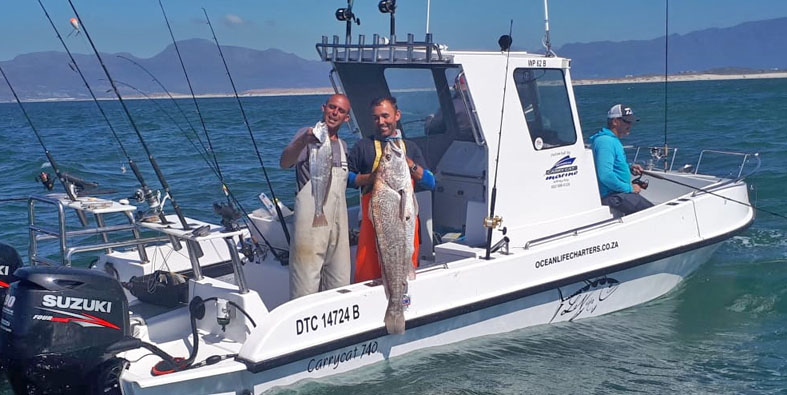
    If you’re keen to join us for a day’s fishing in False Bay to target kob or if you would like some updated info and catch reports then contact Donavan via <www.oceanlifecharters.co.za>.

  • BIG BOY Part 1

    BIG BOY Part 1

    (Originally published in the July 2019 issue of Ski-Boat magazine)

    By Rob and Scott Naysmith

    I CAUGHT my first big eye tuna way back in the early 1980s and, to be honest, at first I didn’t know I had. I thought I’d gone a few rounds with George Foreman when I was booked to fight the local bully. It looked much like a yellowfin tuna, fish we tried to avoid in those days, but there were a few anomalies and the fight was quite different. Only back at the dock did the “fishianados” confirm that it was in fact a big eye, and to prove it they hauled out its liver which is quite distinctive.
    In those days catching a big eye was not a common occurrence — a result of a fluke more than skill — and they were hard to identify. But times have changed, and we’ve learned so much about the species, its habits and its beautiful oily steaks that it is now possible to specifically target them. However, I urge everyone reading this article to use this knowledge sparingly and responsibly.
    To target any species of fish or animal, the key to success is knowing and understanding your quarry, and the big eye tuna is no exception.
    The big eye tuna (Thunnus obesus) is a tuna species spread across all oceans of the world. Preferring cooler waters than the yellowfin and skipjacks, it is more likely to be found where the longfin tuna roam. Rarely found in our waters with a surface temperature over 20°C, it appears that their optimum temperature range is between 10- and 15°C, usually found in depths below 40 metres. That said, an echo-sounder with the ability to show thermoclines becomes an added advantage when you’re hunting big eye.
    This tuna species derives its common name from the unusually large eye compared to that of other tuna species. Now that is a vital clue in understanding and targeting these fish. The large eye suggests that the species spends a big portion of its hunting life in the deeper, darker waters, which in turn indicates it can tolerate colder temperatures. Now you’re beginning to understand where the big eye gets its ability to effortlessly empty a reel going straight down, through cold thermoclines all the way to the ground.
    In fact, the big eye spends only about 5% of its day feeding in the top 40 metres of water, and that’s predominantly in the early morning and late afternoon.
    Another indicator of the amount of time these fish spend down in the cold depths of the ocean, is the high fat content of their flesh. This makes them highly sought after by the sushi market and one of the tastiest eating tuna in the world.
    At first glance a big eye looks a lot like a yellowfin, but in younger fish, with their proportionally longer pectoral fins, they can be mistaken for young longfin until you look closely. This pectoral length ratio reduces as they get bigger and the fin reaches between the first and second dorsal in adults.
    The dorsal and anal sickle-shaped fins do not get as long as those of a big yellowfin, and the finlets running from the top and bottom fins to the tail are not as bright yellow, but more of a dusty mottled colour. Of course, the eye is disproportionately larger than a yellowfin and it is generally a much more rounded fish, though I have caught some really fat yellowfin as well. The big tell-tale is the liver which is crinkle-cut as opposed to smooth.
    Big eye primarily feeds on cephalopods (squid, cuttlefish, etc.), crustaceans (shrimps, crabs, etc.) and almost any fish species it can find. Although fishing methods have become more refined, I still find squid to be their best bait, followed closely by a whole skipjack. However, when we’re not specifically targeting them, most bait-caught fish are taken on pilchards in a chum line while fishing for yellowfin.
    The big eye tuna caught in our Cape waters are often of a bigger class than our yellowfin, with fish well over the 100kg mark being not uncommon. Erwin Bursik holds the World and All Africa records for a fish of 156.5kg (right) caught off Ghana, while Donavan Cole regularly catches smaller class big eye on a handline out in the deep off Angola, showing the vast areas these fish roam. The increasing catches of fish over the 120kg mark in Cape waters is an indication of the dedication to learning and understanding the species by the younger generation of anglers.
    SEASONS
    As a recreational angler I found the most likely time of year to find a big eye was from April through to June, our autumn months when the water was cooling down. In hindsight with what we have learned since those days, this would have been an obvious conclusion. A few of our younger anglers who have followed the progress of their friends and fellow skippers on the tuna line and pole boats have brought us a much better understanding of the species which has resulted in much more refined targeting and more consistent catches.
    Now we have learned to start targeting the big eye from late September and early October, through to when the water gets too warm in mid- to late December. I’m sure that if we braved the cold weather and winter seas, we would find them in July and August too.
    The period from April to June still stands as a productive time, and as it’s a calm period of year in the Cape it makes big eye fishing much more pleasurable.

    FISHING METHODS
    Before the introduction of chumming for yellowfin behind longliners and trawlers, we located the tuna by trolling. Our target species was the longfin in preference to yellowfin; yellowfin were a nuisance unless you were in a competition. Now and again you’d hook a big eye and curse until it either came to the boat or broke off.
    In years gone by the general observation amongst the more accomplished anglers was that surface lures, predominantly jetheads (before all the new designs came about) in pink or brown were most productive. Diving lures caught a few fish but surface lures were better.
    Today I make use of slant faced and flat faced kona-type lures in a pink/dark blue or pink/medium brown colour combination. After dedicating a tanker load of fuel to figuring out what makes these fish tick, I finally discovered that Big T in Plett make the best lures for targeting big eye. We worked closely in refining the lure action of the Smoking Joe 30 over two seasons and it’s deadly. Well there’s one secret gone…
    However, the latest trend, and one which was never pursued until recently amongst recreational anglers, is the bait and drift method. Maybe our lust for the big eye wasn’t what it is today and that’s why there were few advancements in this method, but it’s definitely the most productive way to target them. Here is where our young anglers like Scott come to the fore; they practice this method and are way more successful than us older generation anglers ever were.
    The constantly rising prices for quality sushi tuna on the world market have led to massive strides forward in catch, production and storage methods through endless studies by some of the top scientists in the field. This brought about a massive refinement in the approach to targeting big eye tuna.
    First were the tuna longliners, and then came the trawlers, each taking increasing numbers of fish from the oceans, resulting in international controls being implemented through bodies such as ICCAT which monitors the Atlantic, our fishing ground.
    This is where our younger generation in the form of Scott takes over …
    As recreational anglers, my friends and I chat with, listen to, watch and learn from our friends and skippers on the commercial boats because their years of record keeping have given them extensive knowledge of when and where to target specific tuna species. From this we’ve learned to make use of baits in preference to lures. We’ve also learned that there are far more big eye down below the thermocline than on the surface and that, at certain times of the year, they prefer certain baits to others.
    As discussed earlier, the physical make-up of a big eye tuna gives us a number of clues on how to target them. The large eyed, like those of swordfish, are better suited to hunting in conditions of low light rather than bright sunlight. The fatty flesh is an indication that they spend long periods in cold water temperatures. We know that they love squid and fish at certain times of the year and for the rest they like tiny crayfish type things, but our crayfish don’t last that long.
    After assessing all the options we decided that using squid baits drifted just below the thermocline, almost swordfish-style, is the way to go. Big eye show a preference for lolligo squid but will eat a potter.
    We’ve refined the traces and use 8/0 to 10/0 Mustad carbon circle hooks because hook-up rates are better and the fish stay on. We use soft mono and don’t bother with fluorocarbon because it’s a waste and it’s hard. Use 1.5mm to 2mm line sanded with 600 grit waterpaper to take the shine off. Balloons are handy so that you can control the distances between baits; as you drop deeper the different currents come into play. Florescence is a big key to attracting fish in the dark depths.
    Day fishing is good when there’s nothing else happening, but night time is the most productive, and this is when you could run into either a swordfish or a big eye. They both come closer to the surface at night, depending on the brightness of the moon.
    Day fishing requires that you fish deep, often below 60 metres, whereas the fish will almost come to the surface on a dark night. On bright nights you’ll find them from 10- to 30 metres below the surface. Swords and big eye feed deeper on a full moon and shallower on a new moon, so you’ll have to work out the depth accordingly.
    Glo-sticks are an advantage during both day and night; green and red are the best colours, but keep them at least two metres away from the baits.
    The traces we use are basically an 8/0 or 10/0 circle with a two metre long bite trace to a swivel with the glo-stick and break-away sinker, attached to a four metre long leader to the main line. Then you put the rod in the gunnel and wait…

    THE FIGHT
    Big eye have the ability to run from the surface, all the way to digging sea-lice off the ground, deeper than what you’d ever believe you’d have to cope with. I’ve had fish strip a reel while going straight down — 600m before you can blink; it’s crazy.
    For the most part the fight is the same as that of the yellowfin which stays deep and makes clockwise circles, but the big eye can run way deeper than a yellowfin and this is usually the first indicator of what you’ve hooked.
    They usually give up above 20 metres from the surface as opposed to a yellowfin, and trust me, that’s a Godsend.
    Big eye fight deep and know how to stay down there. When the small of your back aches, your muscles burn and your arms stop listening to your brain, you know that you’re getting towards halfway, but how close is the question. The fight can last hours for the uninitiated; you gain line and lose line and eventually believe you’ll never get the fish to the top … and then you begin to wish it would just break off. This is why I admire the determination of all those anglers who have stayed the course to land their big eye.
    The only way I’ve found to shorten the fight on these fish is to apply maximum drag after the initial run.
    Stand at the gunnel and let the tip of the rod almost touch the water, then lift it level with the reel and wind down hard. You may only get a half turn on the reel but it’s the only way to make progress; you need to keep the fish’s head coming towards you and use its swimming to help. When it can turn its head it will take line, so you need to hang in there and just keep going.
    Ease up slightly on the drag when it makes a dash then tighten up immediately when it stops. Remember that the drag on the line is greater when your reel is half full than when you started, and is compounded by the friction of the water.
    A good friend Wayne Lauffs landed a record fish of around 75kg on a spinner with 15kg line class, in an epic battle where no quarter was given for what seemed like eternity. I watched him break down to pulp, with no harness and no mercy given. Wayne, I still admire your determination and achievement.
    So there you have it … disseminate what we’ve given you, dig deep into this information, become an angler and go and catch yourself a classy big eye tuna. But please, again, I reiterate, only take what you need and then stop targeting, that’s the faith in which we give you this valuable information.

    In the next issue Rod and Scott Naysmith will provide further details on the lures and traces they use to catch big eye tuna.

  • HANDLINING YELLOWTAIL Part 1

    HANDLINING YELLOWTAIL Part 1

    (Originally published in the January 2019 issue of Ski-Boat magazine)
    By Johan Smal

    GENETICALLY encoded by Mother Nature, the prerequisite for any living being to exist principally revolves around three indispensable needs; survival, nourishment and reproduction. As they say, necessity is the mother of invention. From the first recorded invention — documented as the construction of a shelter some 500 000 years ago — until this modern era of nano technology, the human race and its exponential progression has thrived on this very same principle. Fishing is no exception. In this series of articles I have tracked the evolutionary routes of fishermen, leading up to the contemporary chukkie linefishermen who ply their trade at the southernmost tip of Africa.
    In 2017 we published a series of articles called “Secrets of the Yellowtail” (see May/June 2017 to November/
    December 2017 issues of SKI-BOAT magazine). While drafting those articles, in an effort to get information on the idiosyncrasies and circumstances surrounding the yellowtail, we interviewed several Agulhas linefishermen. These discussions augmented our own knowledge and understanding by some 350 years of additional local experience, stretching as far back as 1940. The telling is always as good as the catching and the interviewees were quite forthcoming and eagerly shared their most treasured involvements exploiting those large yellowtail shoals. The footprints of their efforts and attentiveness catching and working those large feisty specimens were clearly visible on those weather-worn faces. At times their body language spoke louder than their words.
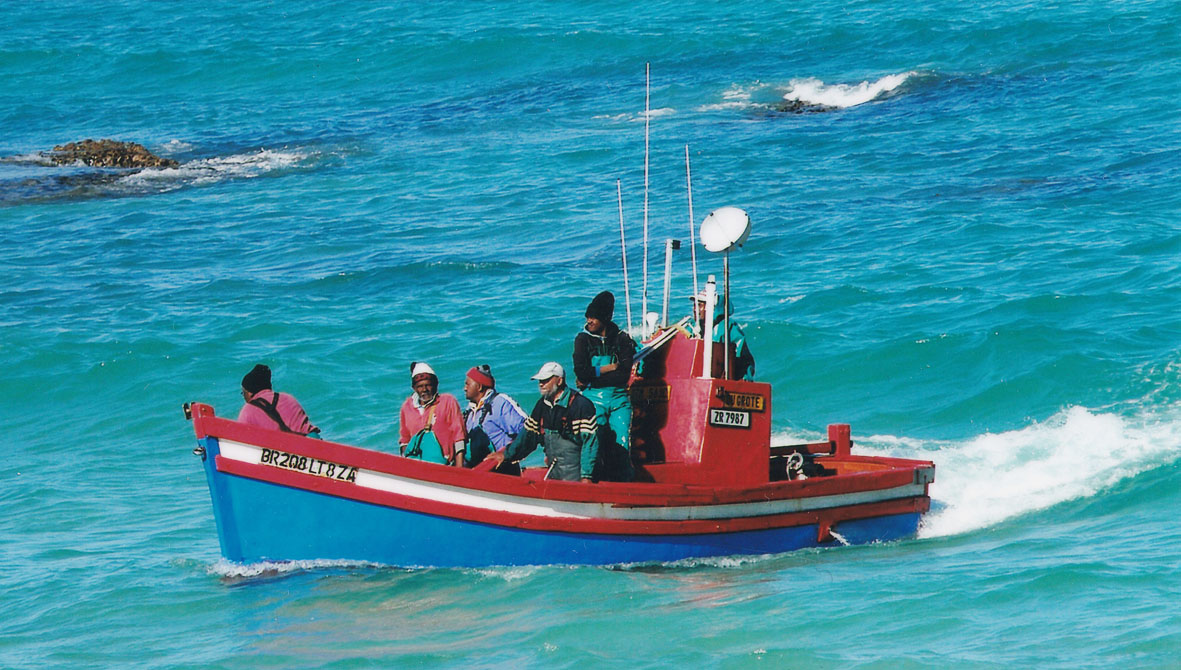
    For those commercial linefishermen, handlining yellowtail (among other species) was their lifelong occupation. It’s a job that’s greatly reliant on the weather and demands special skills which have been honed into a very fine art. These skills, handed down by their ancestors, have allowed them to make a living from the sea. Buttressed by the fact that many of them are still using old-styled fishing platforms — boats called chukkies — and purposely retaining the original handlining methodology, they are in fact a very unique category — a special breed of finfish gatherers. These deliberations were also a stark reminder that their total existence and that of their families is entirely dependent on the bounty of the oceans. Sadly, this dependence is based on resources which have lost some 95% of their original biomasses and which are still declining.
    Mindful of their particular quest, fortified by their great appreciation and respect for the treacherous waters surrounding the southern tip of the dark African continent, they remain dedicated to continuing to catch these fish well into the future. However, most of these fishermen are older individuals, with few youngsters entering the pipeline to follow in their parents’ footsteps. They have, in fact, been branded as “a declining breed” these handlining commercial chukkie fishermen.
    Their story had to be told at some stage, I concluded, and that time is now … Part 1 of this series will deal mostly with the evolution of fishing in general, the associated fishing gear and propulsion of offshore fishing craft.

    THE EVOLUTION OF FISHING
    Along with hunting, fishing originated as a means of providing food for survival. It is therefore generally accepted that subsistence fishing originated some 500 000 years ago. Back then it consisted of catching fish by hand or by using rudimentary tools made from natural materials, of which no trace remains.
    Anatomically modern human beings (Homo sapiens) have been eating seafood for at least 164 000 years. Caves in South Africa contain the very earliest evidence for humans consuming shallow-water fish, since some 140 000 years ago. The people of that time lived a nomadic hunter-gatherer lifestyle, but their permanent settlements, shell middens, discarded fish bones and cave paintings show that they fished extensively in salt- and freshwater.
    Fishing only really developed after the appearance of Homo sapiens sapiens around 40 000 years ago. Very little is known about the different fishing practices at that time, but a Chinese account written around the fourth century BC refers to fishing with a silk line, a hook made from a needle, and a bamboo rod with cooked rice used as bait. References to fishing around those times are also found in ancient Greek, Assyrian, Roman, and Jewish writings.

    THE EVOLUTION OF HOOKS
    The history of tackle runs parallel to the history of fishing. Fish hooks have been employed by fishermen since ancient times. They played such a cardinal role in the evolution of fishing that in 2005 the fish hook was chosen by Forbes magazine as one of the top twenty tools in the history of mankind.
    The world’s oldest discovered fish hooks, made from sea snails shells, were discovered in Sakitari Cave on Okinawa Island, and dated back somewhere between 22 380 and 22 770 years. They are older than the fish hooks from the Jerimalai cave in East Timor which were estimated to be between 16 000 and 23 000 years old. Others found in New Ireland in Papua New Guinea, are between 18 000 and 20 000 years old These findings also provided some proof that fishing was a universal activity dating back to antiquity.
    The predecessor of the fishhook was called a “gorge” — a prehistoric invention that’s still being used in survival excursions today. Sharply pointed at both ends, the device consisted of a long, thin piece of wood, bone or stone with a line attached around its midpoint. The gorge was covered with some kind of bait, and when a fish swallowed it, a pull on the line wedged it across the gullet of the fish, which could then be pulled in. With the line constructed of animal or plant material, the method was only effective when used from a fishing platform, be it fixed or movable. The practice of attaching the line to a rod — at first probably a stick or tree branch — made it possible to also fish from the bank or shore and even to reach over vegetation bordering the water.
    Eventually, with the advent of metals, the hook was one of the first tools made. Improved methods of making fish hooks were devised in the 1650s by Charles Kirby. Later he also invented the Kirby bend, a distinctive shape of hook with an offset point that is still in common use worldwide. The use of a landing hook (gaff) for lifting large hooked fish from the water, was first noted by Barker in 1667.

    EVOLUTION OF FISHING LINE
    We know that most ancient populations were dependent on fishing, but we don’t know when fishing line was invented. As with many other things, these lines were also made of materials that did not survive the centuries. We do, however, know that already around 3000 BC the Chinese used line made of silk for angling. This widely used commodity was brought to the Western society via the “Silk Road” around 200 BC. It was also reported that some people used woven cotton made from the fibres of the cotton plant or linen made from flax fibres from the flax plant, with early American Indians also using plants and stalks to make fishing line. The Norse allegedly made their line from sea grasses and stalks.
    In 1667 the diarist Samuel Pepys wrote that fishing line was also made of animal gut material. Fisherman Col. Robert Venables reported in 1676 that lute string (a silk fabric of high sheen, formerly used in the manufacture of dresses) was also used. When fishing became popular in Europe in the 15th century, the fishermen in England used braided horsehair for line. This line used to wear out quickly, though, with individual strands breaking and finally leading to line failures.
    The horsehair was replaced by silk line in 1908. Also woven, the silk threads were long, much stronger than horsehair and could be made by machines. The downside, however was that it had to be rinsed and dried on open spools after every use. It was also susceptible to damage by the sun’s ultraviolet light. Linen line also appeared and was mainly used for catching big game fish. However, linen line was also susceptible to wear and UV light damage.
    Eventually a very peculiar solution was devised to counter the degeneration of these lines — pig’s blood! The lines were regularly covered with the substance, rigorously steamed and wiped clean, a practice widely accepted and applied by the local fishermen. When available, sheep’s blood was also used. Although I’m personally ignorant about the biological processes at work here, reports from the fishermen are all unanimous — “it worked very well!”
    The Second World War brought, amongst other things, many scientific discoveries, inter alia the improvements of synthetic materials from which the first synthetic fishing lines were made. Marketed by Du Pont and well known for its strength, Dacron entered the fishing market during the 1950’s. In 1954 the Du Pont chemists invented nylon and made a braided nylon line, but it was too elastic for fishing. This was then replaced with a monofilament made from a single high-strength line which is still in use today. Today’s lines are almost all made of synthetic materials such as Dacron, nylon, polyvinylidene fluoride, polyethylene, copolymers and fluorocarbon.

    EVOLUTION OF FISHING RODS
    When people started to fish in prehistoric times, they used their bare hands to catch the fish in shallow water. As this was not practical in deeper water, someone then invented a contraption consisting of a fishing hook attached to a line. However, fisherman soon realised the difficulty in placing the baited hook in an intended spot, especially when having to reach over some obstacles. This then lead to further advancement with the line tied to the simplest organic stick, most probably a shoot from a plant. The enhanced control also enabled the fisherman to cast the hook and bait much further and more accurately. This particular configuration became popular and was widely used by early civilizations. Based on stone inscriptions dating back to 2000 BC, fishing rods were used in ancient Egypt, China, Greece, Trinidad and Tobago, Rome and medieval England.
    For thousands of years, the fishing rod remained short — not more than a few feet in length. The earliest reference to a longer jointed rod came from Roman times during the 4th century AD. There’s also evidence that at that time Macedonians were catching trout on artificial flies and actually described how each fly was dressed. The rod they used was only six feet long and the line the same length, implying that the method used was probably dapping — gently dropping the bait or fly on the surface of the water.
    The history of sportfishing in England began around 1496, but the first period of great improvement only came during the mid-17th century. About this time some unknown angler attached a wire loop or ring at the tip end of the rod which allowed them to use a running line which was useful for both casting and playing a hooked fish. Rods were also improved as heavy native woods were replaced by straight-grained, tough, elastic woods such as bamboo and also lancewood and greenheart from South America and the West Indies. By the end of the 18th century a technique had been developed by which several strips of bamboo were glued together, retaining the strength and pliancy of the cane, but greatly reducing the thickness. Between 1865 and 1870 complete hexagonal rods (made by laminating together six triangular strips of bamboo) were produced on both sides of the Atlantic.
    In the 20th century, rods became shorter and lighter without sacrificing strength. Eventually split bamboo was replaced by fibre glass and finally by carbon fibre to make the rods we know today.

    THE EVOLUTION OF REELS
    The necessity for a reel came long after the advent of rods, line and hooks. Apparently the fishing reel was invented in China during the Song dynasty (960–1279 AD), where the earliest known illustration of a fishing rod fitted with a fishing reel was revealed in Chinese paintings and records dated about 1195 AD.
    Fishing reels first appeared in England around 1650, the time of growing interest in flyfishing. The first English book on fishing was produced in 1496. Named A Treatise of Fishing with an Angle, it made no mention of a reel. A primitive reel was first cited in the book The Art of Angling published in 1651. By the 1760s London tackle shops were advertising multiplying or gear-retrieved reels and by 1770 a rod with guides for the line along its length and a reel was in common use. The first popular American fishing reel appeared in the USA around 1820.
    The first true reel was a geared multiplying reel attached under the rod, in which one turn of the handle moved the spool through several revolutions. In the Nottingham reel the wood was replaced by ebonite (a hard rubber) or metal, so that it became even more free-spinning. However, since the reel revolved faster than the line runoff, a considerable tangle could result. In 1896 William Shakespeare of Kalamazoo, Michigan, devised the level-wind, which automatically spread the line evenly as it was wound on the reel.
    In 1880 the firm Malloch, located in Scotland, introduced the first turntable reel which had one side of the spool open. During casting, the reel was turned 90°, bringing it in line with the rod guides so that the line slipped easily off the end of the spool. The reel was used mainly for casting heavy lures for salmon fishing, but it influenced the reel invented by the English textile magnate Holden Illingworth, which the British called a fixed-spool reel and the Americans a spinning reel. In this kind of reel, the spool permanently faces up along the rod and the line peels off during casting. After the 1930s the fixed-spool reel was taken up in Europe and after World War II it created a boom in spin casting in North America and the rest of the world.

    EVOLUTION OF BOAT PROPULSION
    The evolution of sportfishing boats has already been dealt with in a comprehensive six-part series (How the Wet was Won) published in SKI-BOAT in 2014 and 2015, so we won’t go into too much detail here.
    Boats have served as transportation since very early times. Circumstantial evidence such as the findings in Flores Island near Indonesia suggest that boats have been used since very ancient times. The earliest boats are thought to have been “log-boats”, with the oldest recovered sample in the world being the Pesse canoe, a dugout or hollowed tree trunk made from a Pinus Sylvestris (Scott’s pine) somewhere between 8200 and 7600 BC.
    Some 5 000 years ago, the Mesopotamian civilisation was one of the first kingdoms to flourish and they reportedly invented, inter alia, wheels, cuneiform (the earliest form of writing), and most importantly sailboats. Their boat designs were simple with hulls made from natural materials — primarily wood although reed, bark and animal skins were also used. Since then boat design developed steadily to enhance speed, manoeuvrability and cargo load, reflecting unique aesthetic and technological innovations as the industry advanced.
    Rowing or sailing by utilising the wind, were the principal means of watercraft propulsion since inception. Sails could be used in favourable winds, but human strength was always the primary method of thrust independent of winds and currents. Destined to transform the status quo for these ways of propulsion forever, the era of mechanisation eventually dawned. Reciprocating piston engines were conceptualised which craftily manipulated the stored energy of compressed steam.
    The first steam-powered boat, Perseverance, propelled by a bank of oars on either side of the boat, was engineered in 1787 by John Fitch. He was also the operator of the first steamboat service in the United States. The first iron-hulled steamship, the Aaron Manby, crossed the English Channel in 1822. On her maiden voyage in 1838, the oak-hulled, side-wheel paddle steamer, the SS Great Western was the first purpose-built transatlantic steamship to cross the Atlantic Ocean.
    The development of the piston-engine steamships was a complex process, but progressed considerably over the rest of the 19th century. Although the first steamboat used oars for propulsion transmitted from the engines’ power, these mechanisms were replaced by paddle wheels, either stern or side-fitted. Although this design was effective on the calm waters of rivers and inland lakes, it was not suited to the open seas. In heavy seas the waves could lift one wheel right out of the water while the other one went right under, unduly straining the engines. They were soon replaced with rear fitted screw type propellers.
    As these technologies became reliable, designs were changed for faster and more economic performances. Initially these ocean faring steamships were still fitted with masts, enabling the vessels to hoist auxiliary sails. The sails were not just to provide ancillary propulsion if needed, but were also used in rough seas to keep the ship on an even keel to ensure that both paddle wheels remained in the water, driving the ship in a straight line.
    However, sailing remained the dominant form of commercial propulsion until the late nineteenth century, and continued to be used well into the twentieth century on routes where wind was assured and coal was not available.
    In the early 20th century, heavy fuel oil came into more general use and began to replace coal as the fuel of choice in steamships. Reciprocating engines were replaced by steam turbines, also fuelled by coal and later, fuel oil or nuclear power. .
    The reciprocating marine diesel engine first came into use in 1903 when the diesel electric river-tanker, Vandal, was put into service. Soon after diesel engines offered greater efficiency than the steam turbine, but for many years had an inferior power-to-space ratio. The advent of turbocharging however hastened their adoption, by permitting greater power densities.

    RISE AND FALL OF THE CHUKKIE
    And so we come full circle back to much smaller diesel-powered boats closer to home — the chukkies, so-named because of the “chuck, chuck, chuck, chuck” sound made by their inboard diesel engines when starting up.
    Their simple, robust design meant they could be manufactured in a reasonably short space of time at relatively low costs. Ideal for their purpose, the chukkies became popular among inshore fishermen for many years to follow, and the Struisbaai and Arniston commercial fishermen still use them extensively. Sadly the remaining boats still in use are out-dated and generally beleaguered by many downsides, and are rapidly reaching the very end of their shelf-life.
    In part two of this series we’ll take a closer look at the history of the chuckkie in particular as well as the diligence and ingenuity of the local fishermen needed to stay afloat.

  • FISH OF A LIFETIME

    FISH OF A LIFETIME

    (Published in the January 2019 issue of Ski-Boat magazine)

    By Jacqui Decker

    ON Tuesday 9th October 2018 the weather conditions were perfect for yellowfin fishing. The Sunday before we had made the trip out to the deep but had only found longfin tuna, not the first yellowfin tuna of the season that we were looking for. With the aim of getting in a bit of fishing time before the Cape Boat and Ski Boat Club’s 50th October Tuna Invitational Competition and hopefully a yellowfin tuna, my husband, Gareth, our friend, Clinton Sassman, and I had all taken the day off work.
    After launching our Sea Cat 565 Mahi Mahi at Millers Point at the site of the Cape Boat and Ski Boat Club, and with the sun peeking over the horizon, we soon arrived at Cape Point. A bit of early morning spinning ensued, and within a short space of time we had four nice sized yellowtail on board. We then made the run to the Canyon about 25 miles south of Cape Point.
    After heading on a course of 240 degrees, we found a lot of ski-boats and poling boats sitting in 16.9°C water. We spent an hour trolling the area without success, but we had seen one or two guys sitting on big tuna, so we knew there were fish in the area. We decided to begin baiting, and within 45 minutes Gareth went vas on a good yellowfin tuna that took about 40 minutes to land It was a nice fish of 80kg and we were stoked to have a good fish on board.
    It was then my turn to bait. With the finder showing good echos below I watched a beautiful looking yellowfin take my bait and it was FISH ON!
    I knew it was a big fish by the speed the line was peeling off; with a strike drag setting of 10kg, the ratchet was screaming.
    The fish began the fight on the surface before diving, and when he had peeled off a large amount of line from my Tiagra 50W he did a U-turn and came flying back up the line! I had to reel for my life to try to keep the tension on the line.
    He then surfaced and went down again, putting a huge bend in the Profile tuna stopper rod. We got into a steady paced fight, the Black Magic harness helping me while I made sure my rod was at 90 degrees to the boat and giving lots of little pumps and winds. I wanted to make sure nothing went wrong, while Gareth and Clinton decided it was a good time to try out the new Rapala popper while I took a long time on what they thought was “not a big fish”.
    During the battle the tuna surfaced three times, and on the second surface he jumped clean out of the water; what an amazing sight! After a 70 minute fight, and what seemed like a hundred circles, the fish was finally at the boat.
    My legs, arms and lower back were burning. Despite my regular three days a week of boxing training I was grateful when hubby finally gaffed the fish. It took the three of us a few attempts, with much grunting and groaning, to get the yellowfin over the gunnel.
    Looking at the fish’s tail I could not believe the size of it. A quick check with the tape and the fish weights application confirmed the fish was over a century. With Gareth wondering why he hasn’t caught a fish over 100kg and Clinton saying he wasn’t interested in catching a fish that size, I was beyond stoked and could not believe it; my previous personal best yellowfin tuna was 75kg.
    After seeing that the fish was never going to fit in our large fish bag or hatches, we covered it with two damp beach towels and set a course at 20 knots for the two-and-a-half-hour run back to Cape Boat and Ski Boat Club. Along with my aching muscles I had a massive smile on my face. I could not help but wonder at the exact weight of the fish on deck. Growing up fishing on Lake Tanganyika I certainly never dreamed I would catch such an amazingly beautiful, streamlined, powerful fish such as this.
    Once we were ashore and with the help of some of the guys at Cape Boat and Ski Boat Club we had Team Mahi’s achievement on the gantry. That magnificent fish weighed 112.2kg! After plenty of congratulations we arranged to have the fish donated to several charities. We also did all that was required to apply for an SA woman’s 37kg yellowfin tuna record, and that is now pending confirmation.

    Watch some of the day’s action at <https://www.facebook.com/298067787638469/videos/347641162649435/>.

Verified by MonsterInsights