Tag: deep sea fishing

  • SHOW ME THAT FISH

    SHOW ME THAT FISH

    How to handle fish safely for release

    By Nikki Smit

    (Originally published in the January 2026 issue of SKI-BOAT magazine)


    FISHERMEN are well known for their tall stories, arms stretching as their story progresses, but with the advent of social media, these stories have moved from the mythical to the real deal, and now with the growth of AI, well, who knows where these tales of tails will end!

    Every angler loves to see great fishy pics, whether it’s to capture a moment in time, a memory of an exhilarating fight, or bragging rights of a new PB. However, with these pictures comes a certain amount of responsibility.

    We have all seen how pictures zoom around on social media like a hooked yellowtail heading for the bricks. Suddenly we are exposed. Anything can happen. Anyone can see it, pass it on, praise it – and throw abuse.

    I refuse to be an online troll, but sometimes it’s hard not to shake one’s head at some of the pictures that are posted. Some of my pet hates are:

    • Posting a photo of a dead fish lying in the sink and asking what it is!
    • Posting photos of undersized fish or catches that clearly exceed the bag limit – and bragging about it!
    • Holding a fish up by the gills and claiming to have safely released it!

    These issues make my skin crawl, so I hope this article will help to educate anglers on better ways of doing things.

    We anglers have a responsibility to learn to identify fish and to ensure that we know the size and bag limits of various species. Going fishing and not knowing these basics, is like driving and not knowing the rules of the road. If you don’t know what the fish is that you’ve caught, release it.

    The ORI fish app is a wonderful tool that gives anglers all the information needed to ensure they fish responsibly, from photos of the fish for identification, to bag limits and sizes as well as a length-to-weight conversion calculator. It can be used on both Android and IOS devices, and the cost is minimal and goes to a wonderful cause.

    Visit https://saambr.org.za/app-marine-fish-guide-for-southern-africa-2/ or search for “Marine Fish Guide” on your app store.

    If you’re planning to release your fish, do not touch their gill plates at all. Rather, carefully support the body and hold the tail at the caudal peduncle. Ideally hold them with a wet cloth, or at least wet hands, and limit their time out of the water.

    There’s also no excuse for keeping undersized fish or for taking more than your bag limit. If an undersized fish died when you caught it, throw it back so it can at least contribute to the ocean’s food chain.

    Sometimes there’s nothing you can do to save a fish, but if you know in advance that you’re planning to release your catch, it needs to be handled correctly, so that it is given every possible chance of survival.

    Some fish, such as Roman, don’t have a good release record, but they should still be handled carefully to give them a fighting chance.

    So, what can we do to help ensure the survival of the fish we release?

    REDUCE FIGHT TIME

    As with human athletes, lactic acid levels accumulate in the fish’s muscles during a long fight, leading to a longer recovery time, higher mortality rates and reduced flesh quality in retained fish. To reduce the fight time, opt for a heavier line and leader, and avoid light tackle when targeting large fish.


    REDUCE AIR EXPOSURE

    Fish suffer from hypoxia (oxygen deprivation) from extended periods of time out of the water, which greatly increases the likelihood of death.

    If you’re going to release a fish, try to keep it in the water while removing the hook. If you are unable to unhook the fish in the water or if you want to take a photograph, always work as quickly as possible and ensure that all the required tools are nearby.

    A good de-hooking tool can reduce the air exposure and limit any injury to the fish.
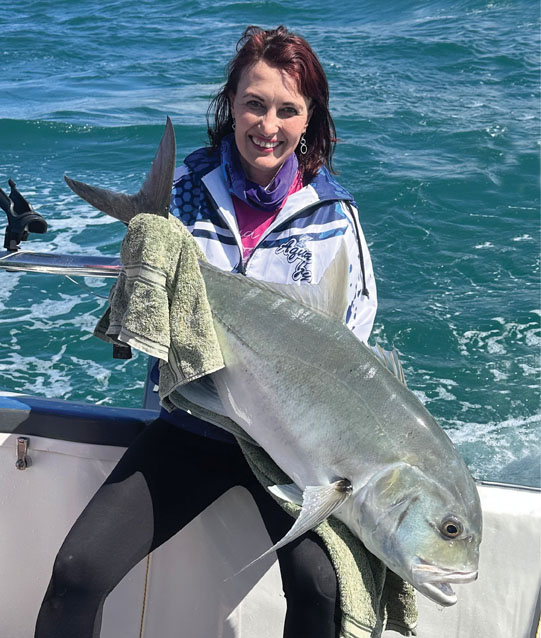
    Fransien Myburg prepares to safely release a GT.

    HANDLE CAREFULLY

    If the fish is removed from the water, use a wet cloth to pick it up. Cover its eyes with a wet cloth to protect them from bright light and to calm the fish, thus preventing injury from excessive flapping. Handling the fish with a wet cloth also protects the angler from injury caused by sharp spines and scutes. You can place the fish on the wet towel while you remove the hooks to protect it’s skin from being damaged by a hot, dry deck.

    A plastic fish stretcher or a soft, knotless landing net is useful when landing a fish, although care must be taken to avoid injury to fins and tail in a landing net. Avoid getting lures or hooks tangled in a landing net, too, as this will increase the fish’s air exposure while the hooks are being untangled.

    Avoid gaffing fish you plan to release, as gaff injuries and bleeding greatly reduce the chances of survival.  If you absolutely must use a gaff, follow these best practice tips:

    • Never gaff fish in the stomach, gills or head; rather gaff in the bottom lip.
    • For sharks, skates and rays, gaff in the jaw area. If this is not an option, gaff in the muscle below the dorsal fin. Do not gaff skates or rays in the wing area as this tears easily.
    • If fishing from a boat, rather use a knotless landing net or a lip-grip.

    Large-mouthed or sharp-toothed species such as barracuda can be landed using a lip-grip attached to the fish’s lower jaw, but be sure to also support the fish’s weight as it is lifted from the water.


    REDUCE INJURIES

    Fish often suffer injuries from tackle as well as handling. These injuries, combined with the exhaustion and stress of the fight, greatly increase the likelihood of death. There are, however, ways to reduce these injuries.

    Fish have a protective slime over their skin and scales that prevents bacterial and fungal infection. This layer can be damaged by excessive handling. Always keep handling to a minimum and use wet hands or a soft wet cloth when lifting fish and returning them to the water.

    Fish’s gills and eyes are sensitive organs, so do not touch or damage them if you plan to release the fish. Do not hold the fish up by the gills if you want to take a photo, and do not pull it into the boat by its gills. Placing anything under the gill plates damages the plates and the gills and can cause the fish to die.

    When removing hooks, do not apply pressure on the gill plate or put your fingers inside the gill plate to hold the fish. Also do not to put undue pressure on the fish’s body.

    When fishing from the shore, never drag fish over the rocks or sand. This is particularly harmful to flatfish (stingrays and sand sharks) whose gills are on the underside and can be filled with sand, causing serious damage.

    Do not turn stingrays upside down to remove hooks as this causes serious damage to the animal’s internal organs and may result in death.

    Never drag flatfish by their spiracles (the small openings behind the eyes that are vital for breathing on the sea floor). Rather use the groove in the top lip to lift the head and gills from the sand before moving the fish.

    Sharks should not be dragged by their tails or be left to lie on the sand for long periods, as their cartilaginous skeleton does not protect the internal organs from being crushed under their own body weight.

    USE BARBLESS OR CIRCLE HOOKS

    Barbless hooks not only reduce injury to the fish, but also substantially reduce the amount of handling required to remove the hook before returning the fish to the water.

    You don’t have to buy special barbless hooks; long-nosed pliers can be used to squash the barbs, or the barbs can be filed off.

    To remove a barbed hook that is well set in the lip or jaw, push the point of the hook through and flatten the barb when it protrudes. This will make removal easier and will result in less injury to the fish.

    If a fish is hooked in the gills or in the throat, or if the hook is swallowed, simply cut the line as close as possible to the hook and release the fish as normal. Ideally, use circle hooks which are designed to set in the corner of the mouth, resulting in less physical damage to the fish as the hook is seldom swallowed.

    When using a circle hook, simply lifting the rod while simultaneously reeling in and applying firm pressure will be sufficient to set the hook. Barbless circle hooks are ideal if you’re planning to release all fish caught.

    Hooking injuries in fish are more prevalent when more than one hook is used per line. It’s also preferable to use single hooks rather than treble hooks. Removing the middle hook from a multiple hook lure can also reduce injury without affecting catch rates. Treble hooks can be replaced by inline single hooks, or one of the hook points on the treble hook can be removed using side-cutters.

    Choosing the right size hook for the target species will greatly reduce the chance of deep hooking the fish.

    Using artificial baits and lures is also preferable to using natural bait. For one thing, it reduces the extractive pressure on bait populations and destruction of their habitats. For most species, hard lures, spinners or plugs are less likely to result in deep hooking than soft artificial or natural baits.


    ADDRESS BAROTRAUMA

    Bottom-dwelling fish caught in deep water (over 20m deep) may experience barotrauma due to the decrease in water pressure and inflation of the fish’s swim bladder as it is brought to the surface.

    Barotrauma is obvious if you see a fish’s inverted stomach protruding from the mouth.

    Some sharp-toothed species such as santer and seventy-four, may inadvertently bite their protruding stomaches, thus self-releasing the built-up gases, and may not require intervention before release. Other species such as Roman and slinger are more susceptible to barotrauma and will float on the surface, unable to return to the deep water without assistance.

    Anglers with a lot of experience may know how to vent the swim bladder using a hypodermic needle, but even though this allows the fish to return to their preferred depth in the water column, it can result in secondary infections and death, and is not the preferred method to deal with barotrauma.

    The best way to release a fish with barotrauma is to use the reverse hook  or downrigger method (see diagram below) or a Seaqualizer.
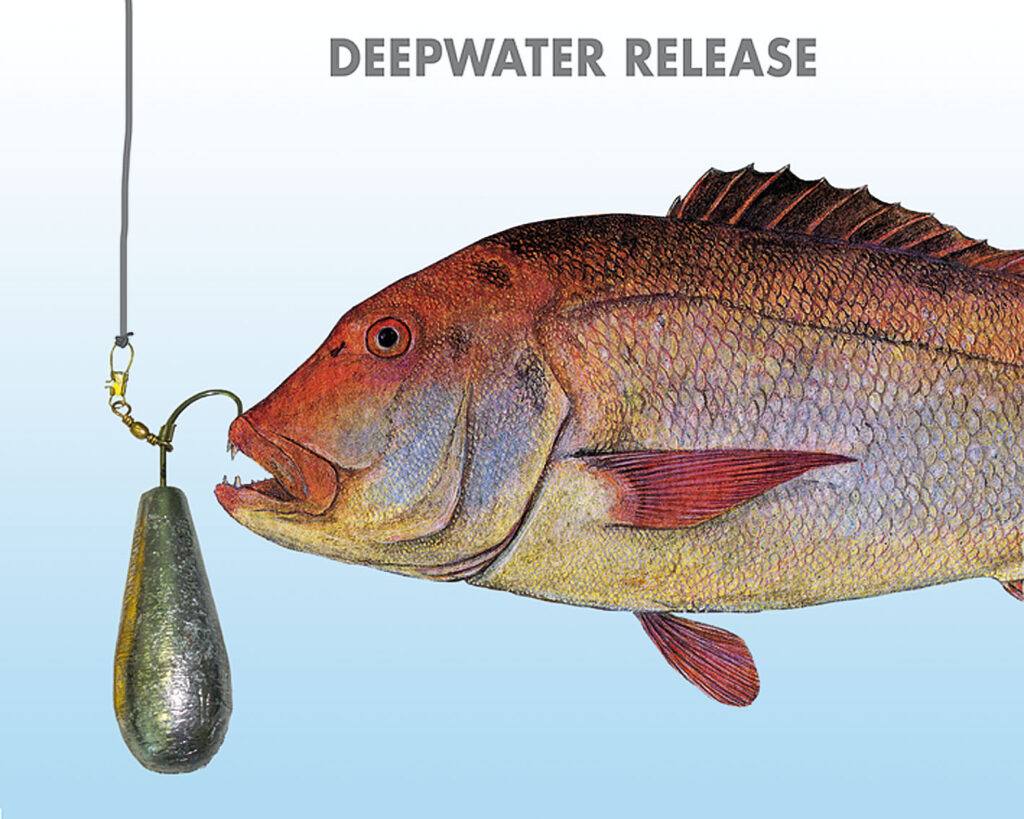
    Take a barbless stainless steel hook attached to one or more sinkers; total weight 500g to 1kg. Hook the fish through the upper lip from top to bottom. When the fish reaches the bottom, allow it to recover, then pull up sharply to release the hook.


    There are many home-made varieties of this, but essentially a large weight or downrigger ball heavy enough to counteract the fish’s buoyancy is tied to the eye of a large, inverted barbless hook. Heavy fishing line, long enough to reach the depth where the fish was caught, is then attached to the bend of the hook.

    The hook is gently but firmly placed in the top lip of the fish with the hook pointing downwards, and the fish is released to sink to deeper water. It is important to let the fish descend as smoothly as possible, avoid jerking and pulling on the line.

    If possible, try to get the fish all the way to the bottom. Once the fish has descended to the bottom, give it a little time to recover, then sharply tug the line to dislodge the hook and weight, releasing the fish.
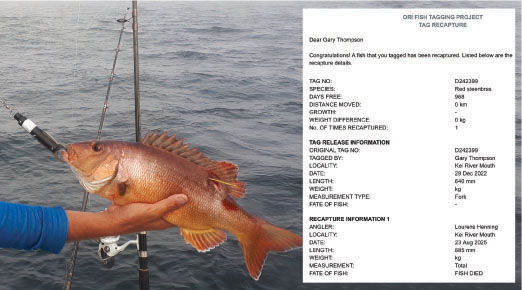
    While many anglers think that deep-water species like red steenbras won’t survive being released, if they’re carefully handled and are correctly released using a Seaqualizer (shown above) or a homemade release device, they can indeed survive for years, as this tag recapture information shows.

    REVIVE IF NECESSARY

    If you’ve handled a fish carefully with minimal time out the water, it should swim away strongly as soon as it is put back in the water. However, some fish may need reviving.

    Hold the fish headfirst into the current. Do not move it backwards and forwards in the water or restrict the flow of water through the mouth and gills.

    If the fish shows no sign of recovery, move it gently forwards through the water so that oxygenated water can flow over the gills. It may take a few minutes for the fish to recover its balance and swim away unaided.


    KEEP YOUR TOOLS READY

    Equipping oneself with the following items, will help ensure a fish is released as quickly as possible with the least amount of harm. These items must be kept within easy reach :

    • Long-nose pliers: to remove a hook set in the jaw and to squash barbs.
    • Side-cutters: to cut through line or steel trace if the hook is swallowed.
    • Measuring tape: to record the length of the fish. The length can be converted to weight using an online species length/weight ratio.
    • Measuring mat: to protect fish and avoid sand entering the gills on the fish’s underside while measuring. Keep it wet and cool.
    • Waterproof camera: to ensure a quick release if a photograph is desired.

    It is our responsibility as anglers to ensure that we are educated. For further information regarding correct handling of fish, visit ORI’s website www.oritag.org.za.

  • GETTING HOOKED

    GETTING HOOKED

    Teaching small fry how to land the big one

    By Brett Bartho

    (Originally published in the March 2025 issue of SKI-BOAT magazine)

    SOME anglers may be able to recall that exact moment when the fish bit and they were hooked for life, while others may have been too young to remember all the nitty gritty details of their first fishy encounter. Either way, rest assured those who found their way onto a boat or had a rod put into their small hands with a fish tugging hard on the other end will most likely be telling stories today of those very same emotions that stirred within them as a youngster.
    Those of us fortunate enough to have had the opportunity to go fishing as a young kid out at sea, from the beach or on a dam or river, know it definitely wasn’t about the size of our first fish, but rather the excitement in tussling the unknown object on the end of the line and then the sense of achievement once we’d brought it in.
    I’m sure anyone who has taken a newbie or child fishing and got them hooked up to a fish can relate to the sheer joy and excitement that it is experienced in that moment. They are fully immersed in the moment, so much so, in fact, that sometimes the finest details are etched into their memories and recalled many years later as though the event had just occurred.
    My brothers and I were blessed to have a grandfather who often took us fishing when we were young. Now we get to do the same with our own children, and, although it requires extra patience and planning, it is an absolute joy to spend time out on the water with them and to share in their excitement.
    Here are some tips on how to make the most of these fishing trips with kids, and ensure they get properly hooked.

    Lacey Bartho (5) with a small queen mackerel that was her first taste of deep sea fishing.

    KEEPING IT FUN BEYOND THE CATCH
    In the beginning, making sure that they are always having as much fun as possible and enjoying all the elements is what makes a fishing trip exciting and keeps them wanting more. Here it’s often what us oldies consider the small and mundane things, like catching baitfish, seeing dolphins swim by or having a shark eat a fish that bring a lot of joy and interest to the excursion for the young ones.
    Show patience and be content with watching the kids do their own bit of fishing. Here catching as many small fish as possible is key, as it keeps them involved and they get a great sense of achievement by hooking and reeling in the fish.
    My boys often had the most fun catching livebait with sabiki jigs and then playing with the fish that were swimming in the livewell.

    LEARNING VALUABLE LESSONS
    Fishing is way more than just a hobby – it’s an opportunity to connect with nature, develop important life skills, and create lasting memories. So, when you teach kids how to fish, you’re not simply teaching them how to catch a fish, you’re also imparting valuable lessons in ethics, sustainability, patience, and enjoying what the outdoors has to offer.
    Ethical fishing involves far more than just following local rules and regulations – it’s also about fostering a sense of responsibility towards nature and teaching kids the importance of looking after the beautiful environment that we are blessed with. Lessons here vary from tidying up after one self and not discarding unused or damaged tackle into the ocean or surroundings, to releasing small or unwanted species as quickly and gently as possible to maintain healthy fish populations and ecosystems.
    Teaching them the importance of conservation at a young age – and that not every fish caught needs to be kept – will ensure there are fish for future generations to catch.
    My brothers and I learnt this valuable lesson from our grandfather. He would always release the smaller of the fish caught out of the keepnet once we’d bagged a bigger fish, and we only ever kept enough to feed the family. He also taught us to look after our catch that we were taking home and then to enjoy what nature had provided for us.
    Now, some 40-odd years later, we are passing on this same knowledge and respect to our children. Kids learn a lot quicker by witnessing the actions of elders, and and this has a much longer lasting impression on them than simply reading some article, pamphlet or information on a website.
    Other great lessons learnt in our childhood through fishing involved patience, perseverance and, later on, the importance of being prepared.
    Fishing is called fishing for a reason, it’s not always “rainbows and unicorns” with catch after catch occurring in quick succession. Learning to be patient will often lead to one of your most memorable catches being made, and so this is a prime opportunity to teach a youngster the importance of this life trait and show them to appreciate being present in the situation.

    Hayden Bartho (6) with a big bull dorado
    Tori Bartho (8) with a 16.5kg daga salmon caught unaided on a slow pitch jig.

    FISHING AS A TOOL FOR GROWTH
    The lessons learned while fishing often extend far beyond the water and can help shape kids into more thoughtful, resilient, and responsible individuals.
    Encouraging kids to observe patterns out on the water, like which species are active at different times of the day, and how fish respond to certain changes in conditions and baitfish offerings will develop their problem-solving and critical-thinking skills.
    It’s key for kids to learn that not every day on the water will be a success and will result in a big catch, but rather that each outing offers an opportunity to learn something new and to grow from such experiences.
    Fishing is a wonderful tool to instill a sense of personal responsibility and accomplishment. As kids start to go fishing more regularly, you can begin to teach them to take on more responsibility during these fishing trips. This will teach them the importance of being accountable for their actions – whether it’s planning for a day out on the water, cleaning up after a trip, taking care of their equipment, respecting the environment, or being aware of safety issues.
    With more practice they will naturally want to learn the many varied fishing techniques that will make them more successful anglers.
    With this gain in experience and a greater understanding of their surroundings and capabilities, it’s always nice to put them up against tougher challenges and piscatorial adversaries.  However, here is the catch (pun intended): often one sees photos of kids posing with mighty big fish and immediately one questions the validity of such a small person making such a spectacular catch.
    First and foremost, when they’re very young a little assistance is always required. This could be in the form of helping take the rod out of the rod holder and transferring it into the kid’s rod belt, perhaps having a hand on the rod grip to help secure the rod should the fish make an unexpected dash boat side, or gently helping to lift the rod and guide the line evenly onto the reel. I see this as fair game in the non-competitive scene. Remember, we are all here to have fun and learn as we go and grow.
    Nowadays, there are far more opportunities for juniors to fish competitively than there were in the past. SADSAA and its various associated bodies are working hard at driving the sport forward and hosting many development clinics, competitive events and offering youngsters the ability to earn national colours. This comes with different rules.
    Understandably, providing the bits of help I’ve suggested would be a no-no in a competitive environment where there is either a big value prize dangling or, perhaps, a national title or honours at stake.
    This raises the question of whether there should even be such a high value reward at this early age. That’s a topic for a discussion at another time, but personally I would prefer it if every kid were acknowledged for their participation in a competition and then the better catches given slightly more recognition.
    Back to fishing for fun …

    Benjamin Bartho (6) and dad Brett with a spotted grunter caught at Kosi Bay on the same rod and reel that Brett’s grandfather bought when Brett was a youngster.

    PERSONAL ADVICE FROM MY HUMBLE LEARNINGS
    I’ve done loads of fishing with my sons and nieces and other kids, so here are some tips for those just starting out in this area: Start them off slowly. Fishing may not be for everyone from the word go, but if you start with some small simple steps listed below and follow the advice of those more experienced around you, you certainly will be heading in the right direction.
    • Keep trips short and ensure they are in a safe setting or conditions.
    • Make them as interactive as possible and try to give your child the freedom of choice.
    On one occasion my youngest son wanted to jig with a small 15g Halco twisty spoon on a very light spinning rod setup used for catching bonnies. I told him I didn’t think it work considering that we were drifting quite quickly with wind and current. He was persistent and I gave in. He then proceeded to catch on his first down, and then got thoroughly dusted on his second drop! Needless to say, he hasn’t let me forget that, nor has he forgotten that raw feeling of excitement he experienced at hookup.
    • Choose tackle that suits their ability.
    I started out at the age of two catching spotted grunter from the shore in the Richards Bay harbour with my gran, using 4kg nylon. Now I’m mentoring my boys aged seven and eight. I’ve learnt to let them start on light tackle gear. This way they will quickly learn the importance of “playing” the fish, correct drag setting and then the technique of feeling the fish and learning when and how to slowly lift one’s rod and wind back down to gain line and subdue one’s catch. By using lighter tackle and lower drag settings, you allow the youngster the freedom to handle the rod by themselves and complete their catch unaided.
    • Start them out with a fixed-spool reel (coffee grinder) with a fairly light monofilament line (nylon) on a medium length rod with a fairly fast taper. The softer tip is more forgiving and absorbs a lot of the pressure exerted by any fish.
    • Make use of fine gauge circle hooks which not only allow for an easy hookup by simply winding onto the fish when they feel the bite, but also often stay in better during the fight. They also allow for a safe and healthy release for the fish.
    • Begin with easy-to-learn techniques, such as casting with a spinning rod, how to reel in correctly, and how to tie basic fishing knots. These foundational skills will build their confidence.
    On our family holidays to Kosi Bay every year in January, our kids love waking up early and taking their own fishing rods and throwing a line out front for glassies, perch, stumpies and just about anything that will nibble on their hooks. No adult supervision is required here, thanks!
    • As they progress, start introducing more complex techniques such as jigging or using more advanced technology such as braided lines, overhead fishing reels and specialised equipment that is capable of catching some amazing fish.
    We took my niece out fishing with us on our commercial vessel one day, as she didn’t want to go along to a birthday party her sister was attending. We gave her a light slow pitch jigging outfit and left her to her own devices in the front of the boat. She is a more than capable angler, but we were amazed when this seven-year-old girl pulled up an impressive 16.5kg daga all on her own without a single bit of assistance. While she was fighting it, we all presumed it was just a “decent” rockcod! It ended up being the biggest catch of the day.
    Every fish caught, every successful cast, and every new skill learned is a boost to their confidence and fosters a sense of achievement and pride that helps them develop a growth mindset. They’ll learn that, with time and practice, they can improve their skills and overcome many tough challenges.

    MAKING MEMORIES FOR LIFE
    Finally, remember that it’s not just about the fish they catch – it’s about the memories made, the lessons learnt, and the time you get to spend together out on the water with them. I cherished every moment out on the water with our grandfather, and now relish every moment I get to spend fishing with my two boys.
    Whether we end the day with a hatch of nice fish or simply enjoy each others’ company and conversation, the true reward of fishing is in the journey itself and the lasting memories one will always keep.

  • WHERE TO FISH Part 18

    WHERE TO FISH Part 18

    Gericke’s Point to Mossel Bay

    By Nikki Smit

    (Originally published in the March 2025 issue of SKI-BOAT magazine)

    THE coastline between Gericke’s Point and Mossel Bay is characterised by steep dunes and cliffs interspersed with gorgeous sections of beach. While it’s a truly beautiful section of coastline, it does not offer many options for launching a boat to go to sea. Inland, however, options abound, ensuring that between the sea and the estuaries, anglers will certainly have enough to keep them happy.

    SWARTVLEI ESTUARY AND SEDGEFIELD LAGOON
    These water bodies provide a vast area to fish in. The lagoon is relatively shallow and, if the mouth is open, can be quite tide dependent, especially for launching, so make sure you check the tides when you plan a trip. The mouth sometimes closes for extended periods and then this is no longer a problem, but if Swartvlei gets too full, access under the old train bridge from the lagoon is problematic as it is very low.
    Grunter, kob, Cape stumpnose, elf and garrick can all be caught here. The train bridge is a favourite spot for shore-based anglers who want to target garrick. The shallows between the N2 bridge and the train bridge are often frequented by flyfishers, as are the shallows north of the train bridge.
    Access to these areas can be gained by parking at the train line where it crosses the outward-bound road. Ensure that no valuables are left visible in your vehicle when parking here.
    Swartvlei has many options and can pretty much be fished anywhere. There are boat exclusion zones, but these are clearly marked with buoys. Grunter tend to be found on the shallower banks and kob in the deeper sections on the northern side of the vlei. Garrick are also sometimes caught while trolling livebait.
    Public access directly onto Swartvlei is very limited, but one can launch a boat from Bayswater. Note that a daily fee is payable and the access hours are very strict. Alternatively, you need to get onto the lagoon and travel upriver and under the train bridge to Swartvlei, but this is not an option for bigger boats or cabin boats.
    Fishing in the lagoon produces similar species to what you’ll find at Swartvlei, with grunter probably being the most targeted, usually by drifting across the banks on the pushing tide. When the mouth is open, the water is beautiful and clear, and as the lagoon is relatively shallow, the bottom can be seen most of the time.
    There are two launch sites, but they can be heavily affected by the tide, so be aware of that and take the size of your boat into account.
    One launch site is near the mouth, and there’s another on the island, but both have limited parking space. These areas can get very busy during the holiday season so it’s best to get there early.
    Take note that skippers may have to navigate a fair bit of weed when leaving the slipways, but the channels are clearly marked with buoys. Care must be taken to observe the no wake and no boat zones.
    A SANParks permit is needed to access the lagoon and Swartvlei with a boat, whether it be a paddle/rowing boat or one with a motor. These permits are available either from the Knysna office, located on Thesen Island (044 302 5600) or from the Wilderness office located at Ebb and Flow, (044 877 1197). This permit is required for all the vleis and estuaries within the Garden Route National Park area.
    A variety of baits can be used on the vlei and in the lagoon, but sand prawns and sardines are firm favourites. Sand prawns can be pumped at low tide or be caught with the use of a float ring.

    Nikki Smit with a beaut of a kob.

    SWARTVLEI BEACH, GERICKE’S POINT AND SWARTVLEI LAUNCH SITE TO KAAIMANS
    This section of coast is characterised by shallow banks and deep gullies. Swartvlei Beach is popular among surf anglers and offers a wide variety of fish to target, both edible and non-edible.
    Gericke’s Point is very popular among shark fishermen and spearfishermen. One has to be mindful of the tide when fishing the Point, as it can be dangerous in places when you’re walking back to the car park at spring high tide.
    Between Gericke’s Point and Wilderness is a spectacular piece of coastline, and if you are willing to tackle a fairly substantial walk, some wonderful spots can be found. Once again you will need to be mindful of the spring high tides when walking along this section.
    Swartvlei Beach is also a launching site for boats wishing to go out to sea. George Ski-Boat Club manages the launch site on behalf of SANParks. It’s a surf launch and is very much swell and tide dependent. A 4×4 vehicle is required. For further informtion on the launch site, contact the George Ski-Boat Club via email <secretary@george
    skiboatclub.co.za>.
    There are a number of good deep sea fishing options between Gericke’s Point and the Kaaimans River mouth, and reef fish can be caught along this whole section.
    There is a long reef relatively close inshore in around 30m of water, which runs most of the way from Gericke’s Point to Wilderness Beach. Each day out produces a different selection of catches – a bit like Forrest Gump’s “Life is like a box of chocolates, you never know what you’re gonna get”. Be prepared for anything from kob and geelbek to red fish. Chokka and sardines are the baits most often used.
    Hake can also be found along this section anywhere in the 60m+ depths.
    There are many patches of reef off Wilderness Beach ranging in depths from 25- to 40m. Beautiful santer and the occasional kob can be found here. Big carpenters like to frequent the area in front of Klein Kranz.

    A lovely fat garrick caught at Swartvlei.

    ISLAND LAKE AND TOUW RIVER
    Island Lake is a fascinating place to fish due to the variety of species found there. It is one of the few places where one can catch grunter, leervis and carp. Both artificials and bait provide good results, and one can launch a boat at the slipway located next to the Island Lake Holiday Resort.
    The launch site is managed by SANParks and a park fee is payable. Information is available from SANParks Wilderness. The Serpentine River, which links Island Lake to the Touw River, is a no boat zone.
    To access the Touw River by boat, you can launch from SANParks Wilderness at Ebb and Flow. Touw River is a great place to target grunter, kob and leeries.

    KAAIMANS RIVER
    At present the public can only fish the Kaaimans River from the shore or from a canoe. Some decent sized grunter have been caught here, and leervis can be targeted close to the mouth. Please ensure that you respect private property at Kaaimans if you fish there.

    WILDERNESS TO VICTORIA BAY
    (Along the train line)
    There are some great places to fish off the rocks along this section although for security reasons people are advised not to go there alone as there have been a few incidents. Use of the old train bridge is also not advisable as it is badly rusted and degraded with huge sections missing and is a severe safety hazard. The mouth is currently quite deep so care would need to be taken if one wants to cross over.

    GROOT BRAK, KLEIN BRAK AND HARTENBOS RIVERS
    These three rivers are located relatively close to one another as we move closer to Mossel Bay. Species to be targeted in this area are grunter and leervis, with the occasional kob also being caught here. Grunter can be caught on the pushing tide, as well small kob and leervis.
    Kleinbrak has a small public slipway opposite the police station, but the launch is quite tight. It is not a proper concrete slipway, though, and is just made from compacted sand, so it is advisable to use a 4×4. This is a public launch site so there’s no fee for using it.
    Boats may not travel left around the island near the beach as it is too shallow.

    MOSSEL BAY
    Those looking to go deep sea fishing in Mossel Bay have a couple of options – book a charter with one of the local charter companies which operate from the harbour, or launch your own boat from the public slipway at the harbour.
    Just be careful if you choose this second ption, because the slipway can be tricky to navigate at times due to quite a serious surge. A tractor service is available should it be required.
    Due to the slipway being part of the harbour, a harbour permit is required, as is a Port Clearance certificate. For information on costs and what documents are required, contact Elfie on 060 870 4299 or <admin@mbskippers.co.za>.
    There is a fair amount of reef close inshore between Mossel Bay and Victoria Bay, and reef fish including kob can be caught on most of these reefs. Depths vary between 20m and 40m.
    Garrick can be caught from the shore or close inshore from a boat between Reebok and Diaz Beach. There are ample places to fish along the whole section of beach between Groot Brak and Diaz Beach.
    When conditions are right you can catch bonito from the Point at the Lighthouse. Hake are generally found out in the bay in depths around 70m, but water temperature influences this and sometimes they are found in shallower water. Kob sometimes come out among the hake too.

    FOR THE NON-FISHERS
    If the rest of the family aren’t quite as enthusiastic about a day out on the sea, the area boasts many other outings and adventures they might enjoy.
    Sedgefield is a quaint little seaside town that’s often missed by passersby. Things to do here include visiting the Saturday morning Farmers and Craft Market, paragliding, beautiful beach walks, canoeing on the lagoon (you can rent canoes at the slipway near the mouth during the holiday season), mountain biking, horse riding and swimming.
    Wilderness offers a variety of shops and entertainment including quad bike riding, segway tours, paintball and paragliding, or you can swing in the trees with Acrobranch.
    There’s also kayak hire and kloofing trips on the Kaaimans River.
    In George you can go mountain biking, hiking, strawberry picking or horse riding. You can also visit the Outeniqua farmers market on a Saturday or visit the old train museum, or take trips on the Outeniqua power van.Vic Bay and Heralds Bay have lovely beaches.
    Mossel Bay has a coastal zip line which will certainly get the heart rate up, as will cage diving with sharks and whale watching. Then there are the beautiful beaches, game farms and museums to visit. You can also go diving, skydiving, parasailing, hiking and trail running.
    In short, there is plenty to keep the family busy while the fishermen collect dinner.

    GENERAL INFO
    There are a number of charter companies and tackle shops in the area and a Google search will help you identify them.
    There is also plenty of accommodation along this stretch of coastline. If you look on one of the many online booking portals such as Lekkeslaap, Airbnb or Safarinow, you are bound to find something that will suit your needs and pocket.
    For more information on the area as a whole, contact the Mossel Bay Tourism office on 044 691 2202 or visit <www.visitmosselbay.co.za>.
    Sincere thanks to Jandre Blom from Bloudam Fishing Adventures, Marius Opperman, Bertie Steward, Dylan Erasmus from Mayfly, and Elfie from MB Skippers for their input and photos.

  • WHERE TO FISH Part 15

    WHERE TO FISH Part 15

    Port Alfred and surrounds

    By Colin Fletcher and Clinton Schultz

    [Originally published in the July 2024 issue of Ski-Boat magazine]

    THE hidden gem of the South African coastline, the area between Kenton-On-Sea and the Mgwalana River, not only offers plenty of tourist attractions and luxury game lodges, but also some of the best fishing in the Eastern Cape.

    Colin Fletcher shows off a solid dorado.

    The variety is vast – everything from dageraad, poensie, kob and geelbek to incredible gamefishing in the current line which produces yellowfin tuna, dorado and marlin. This area truly offers it all.
    I have been privileged to grow up on this section of the coast, fishing both rock and surf as well as offshore. The amazing history of this coastline never ceases to amaze me and the stories of massive catches have intrigued me for years.
    Accommodation for visitors to this area is well priced and it won’t cost you an arm and a leg for a fishing holiday with the family.
    Launch sites are also plentiful. From beach launches to harbours, there are a number of different options.
    Port Alfred is one of the easier launch spots to get to logistically, but it can be a hair raising launch through the mouth if the weather is not good. Make sure you get local advice if you’re not familiar with the launch.
    Other beach and slipway/river surf launches along the coast include Boknes, Kenton, Kleinemonde, Mpekweni, Mgwalana and Birha.
    If you’re not confident launching safely in this region, professional charter companies are readily available in Port Alfred. Their services are generally well priced, and the skippers have intricate local knowledge and experience thanks to spending hundreds of hours on the water. This is a great option for a family day outing for those roadtripping down to the area.
    If you are visiting and want to meet up with some of the locals, then stop by at the Port Alfred River & Ski-Boat Club situated along the Kowie River. It is a good place to pick up some local information and there’s a great pub and restaurant where you can enjoy the generous hospitality.
    Contact the club on 046 624 4532 or visit their Facebook page <www.facebook.com/parscpa/> for further details.

    SPECIES

    Colin and Megan Fletcher with a few pan-sized kob and a carpenter.

    Kob
    A highly sought after fish along the South African coastline, kob are great fun to catch and are great eating too. In this area they range from1kg to 20kg, so you never know what you are in for.
    The daily bag limit, according to www.saambr.org.za, is one per person per day if caught from the shore and in estuaries east of Cape Agulhas, and five per person per day if caught west of Cape Agulhas or if caught anywhere from a boat offshore.
    Minimum size limit is 60cm total length if caught from the shore and in estuaries east of Cape Agulhas, and 40cm total length (KZN) and 50cm total length (EC & WC) if caught from a boat offshore or from the shore west of Cape Agulhas. Only one kob greater than 110 cm total length may be caught per person per day regardless of area or sector.
    You’ll often catch slightly undersized kob that have to be put back, but when you get into a shoal of keeper-size fish, great fun can be had. The smaller fish, around 60cm, are best for eating.
    Chokka and sardines are easy and popular baits for these fish. A great option on a spinning setup is to use paddletails or dropshots.
    Kob can be lazy fish and will sometimes lie in water sheltered by structure, waiting for prey fish to swim past. Smaller fish tend to shoal when feeding, and when you tuck into a shoal it is great fun. With a more aggressive bite than geelbek, shoaling kob closer to the bottom will more often than not bite in an upwards direction and you will feel an upwards bump followed by momentary slack, then SMASH!

    Colin Fletcher with a nice poensie caught near Lighthouse Point.

    Poensie
    Black steenbras aka musselcracker aka poensie is probably the most prized bottomfish species in this area. A big specimen is both memorable and extremely fun to catch.
    These fish occur along most of the east coast of South Africa and are most abundant along the Eastern Cape/Transkei and KwaZulu-Natal coastlines.
    Chokka strips/legs, fresh fillet, a dead Frans Madam (big-eye) or sardine are all effective dead baits for these “cracker” fish. I have been smoked by big crackers on a maasbanker live bait, so that is also a good option to try.
    Some people choose to keep the daily bag limit of one per person but I personally choose to release them.
    Be extremely careful when handling these fish, especially on an inflatable boat, as they have a few sharp spines.

    Dageraad
    These fish are endemic to South Africa and are only found in the waters stretching from the lower South Coast in KwaZulu-Natal to Cape Point in the south-western Cape. They are most common along the Western and Eastern Cape coast.
    Dageraad are generally found around offshore reefs between depths of 20m and 100m, and will bite on chokka, sardine and fillets.
    They are listed as critically endangered on the IUCN Red data list, so the current bag limit is one fish per person per day at a minimum size of 40cm.

    Red Roman
    Arguably one of the prettiest reef fish on the Eastern Cape coastline, red Roman are also tender fish to eat. These beautifully coloured fish can weigh between 1kg and 3kg on average, and a big Roman provides a fun fight on lighter tackle.
    Caught throughout the year, these fish can be caught on red bait, worms, chokka, fillet and sardines. Look for them around reefs or pinnacles in shallow water.
    The minimum size is 30cm with a daily limit of two per angler.

    Carpenter/Dog/Silverfish
    These fish are abundant along the Eastern Cape coastline and are found in waters anywhere between 20m and 100m deep.
    They have a vicious tooth structure and will eat almost anything. Adults feed on anchovies, sardines and squid, while juveniles feed mainly on crabs, crab larvae and worms. It can be frustrating when you get into a large shoal of small dogs and nothing else bites.
    These fish are underrated as a table fish but are fast gaining popularity among South Africans.The current bag limit is four fish per angler per day, with a minimum size of 35cm.

    Geelbek
    These fish are sporadic and unpredictable. You might see a shoal on the finder and drop a bait, only for it to be left completely untouched. We call this “bek lockjaw”. The daily bag limit for these fish is two per angler with a minimum length of 60cm.
    In the months following the sardine run these fish will be caught around the deeper reefs, but they are often found on shallower reefs as well.
    They bite very distinctively, creating slack in the line on their way up, and fight aggressively. Geelbek are great fun on light to medium tackle. Bait options include sardines, fillets and chokka. Due to their big mouths, large hooks (around 10/0) should be used .

    Miss Lucy
    These beautiful fish, with their banded shades of red and white and large forehead bumps, can be enticed to bite by chokka, sardine and octopus. The bag limit is one daily per angler with a minimum size of 40cm.

    Gamefish and billfish
    A variety of gamefish including yellowfin tuna, marlin and dorado can be found around the area off Port Alfred known as “the eye”.
    For years this area has been frequented by migrating populations of smaller tuna, mostly in the 10- to 30kg weight class. However, in the last year or so there has been a noticeable increase in the number of big tuna in the area, 50kg-plus bullets which have offered plenty of fun.
    Dorado have spoilt us with their presence for many years. These beautiful fish are found in warmer water (around 25 degrees) and congregate around floating objects in the current. Keep an eye out for small baitfish around floating debris, and the dorado won’t be far away.
    Marlin and dorado seem to like hanging around deeper depths around the 100m drop-offs and current lines, where floating debris can be found.
    Marlin are definitely more difficult to target, but many have been hooked in this area and some landed.
    A big marlin will bully you on a light tuna or dorado trolling setup, so ensure that you are well prepared if you plan on targeting these majestic creatures.
    A variety of diving lures and spreads at staggered distances can be used to pick up a bite at a trolling speed of around 12 kph. A good setup for targeting these species in the warmer water is something like a Shimano Tiagra 30/50 stand-up rod with a Shimano Tiagra 50W reel. This setup provides a fun fight but is powerful enough to wrestle a big tuna or marlin.

    TACKLE
    Generally, in the shallow waters, a light rod of around 7- to 8 feet can be used, along with a matching reel of your choice and light braid or nylon up to around 20kg. This will give the angler the most fun when fighting a fish.
    When dropping deeper, scale up your equipment in accordance with your preference and target species – as long as it still offers a fun fighting experience. There is nothing worse than pulling in dead weight on an ultra-heavy setup.
    Scarborough reels, multipliers and spinning reels are all good, versatile options for the fishing in this area.
    Hook sizes will vary from species to species, but you can’t go wrong with an 8/0 for most applications. You can, however, go as small as a 4/0 when fishing in shallower water for smaller reef fish such as Romans.
    Use whichever trace is easiest for you to tie quickly; I use a very “rural” double loop trace which my late grandfather taught me. Believe it or not, with this simple trace you can comfortably handle larger fish. It is, however, a lazy trace and a split swivel trace is ideal.
    When it comes to sinkers, I have used ones as light as 3 oz in shallow water, but current can mess you around quickly. Local commercial boats prefer 10- to 12 oz sinkers for the 20- to 70m depths. Just remember that when you are dropping deep, you have to pull that sinker up every time peckers clean your hook, so don’t go excessively heavy.

    JUDGING CONDITIONS
    Sea conditions in this area can vary dramatically with wind and current variations. As an example, a south easterly to south-south easterly wind can create very choppy seas, and the more southerly the wind, the worse it gets.
    This wind also pushes the cold water to the shore. Water temperatures in these conditions can plummet to 12/13 degrees and this brings out critters like the dorrie shark and barbel.
    In these conditions, you’ll find tiny shoaling carpenters and baitfish are abundant, so it’s not ideal for most types of bottomfishing, except for stockfish and gurnard in the 50m-plus depths.
    Conditions most ideal for going deep off this stretch of the coast, are after a day of light westerly winds. In these conditions the wind drops off and the surface water warms, heading inshore, which improves inshore and deep sea fishing.

  • ISLAND OF DREAMS

    ISLAND OF DREAMS

    Rodrigues Island will fulfil all your fishing fantasties

    By Jaco Visser

    [Originally published in the September 2023 issue of Ski-Boat magazine]

    ERNEST Hemingway famously said: “A man is never lost at sea” and “It is good to have an end to journey toward; but it is the journey that matters, in the end.”
    Hemingway was on my mind as my short flight from Mauritius crossed the vast expanse of the Indian Ocean en-route to Rodrigues Island. An awful lot of ocean surrounds this little rock that would be our home for the next couple of weeks.
    About 650km north-east of Mauritius, isolated on a ridge between Hawkins Bank and the Eastern Bank, you’ll find an island several million years older than its siblings, Mauritius and Reunion. Isolated from the world and stuck in a time warp, the island provides an interesting and authentic cultural experience for any adventurous traveller – and even more so adventurous anglers.
    More famous for wind sports and dried octopus, the island’s big game fishing is one of the best and worst kept secrets of the sportfishing world. A quick page through IGFA’s book of world records soon reveals the illustrious reputation and potential of this destination.
    Disguised as a digital nomad, and fully intending to use the island as a temporary home while working and maintaining a life–work balance, my wife and I booked one of the many available self-catering establishments scattered all over the island.
    Walking distance to Port Mathurin, sparkling pool, steps from the beach, air-conditioning and good Wi-Fi sealed the deal for The Beach House to be our abode and island office for some weeks as we justified our reason to elope to a place as unique and tranquil as Rodrigues. Of course the main reason for being there was the incredible fishing the island has to offer.
    But, before we get to the fishing, some more about the island.
    Time truly seems to stand still on Rodrigues. With unique charm and a simple, unhurried ease, friendly people, varied cuisine and striking natural beauty, the island is surely one of the best places in the world to spend a quiet, calm and isolated holiday. There are several categories of accommodation so there will be something for every pocket.
    Unlike Mauritius, there are no major resorts, and small family-owned establishments and B&Bs are the order of the day. Taxis, busses and car rentals are all available, but the preferred and most fun alternative is affordable scooter hire. There are numerous activities available, including visiting the many walking trails, beautiful beaches, caves, secret sensual gardens and spas and ancient tortoises. Visitors can indulge in beach braais, scuba diving, surfing, bungee jumping, zip lines and gorge swings.
    A volcanic island along the edge of the Mascarene plateau, the island is surrounded by coral reefs that are uniquely self-seeding as it receives no coral zooplankton from elsewhere. This led to the development of a unique ecosystem for many marine and afcoral species and adds to the excitement for any diver or angler who wants to explore the bio-diversity on offer. Outside of the coral barrier, the island is surrounded by a basaltic plate varying in depth from 40- to 60m and between 5- and 16km wide, before a drop-off in steps up to 1000m-plus deep.

    Dgini Visser added a wahoo to her species tally.

    Hemingway noted that “anglers have a way of romanticizing their battles with fish” and “it was considered a virtue not to talk unnecessarily at sea”. There is, however a great deal to say about the fishing off Rodrigues while reflecting on the incredible time we spent with Captain Yann Colas of Rod Fishing Club aboard Black Marlin.
    The waters around the island, especially at the end of the season, are not for the faint hearted as a consistent south-easterly wind and varying currents make for fairly big seas most of the time. However, this did not pose a major challenge for Black Marlin as her full 50ft, 30 tonnes sportfish hull was specially designed to keep anglers and crew safe. Captain Yann’s 20 years of experience working the unpredictable waters off the island also helps to land any angler their dream fish.
    Rodrigues is a true multi species destination and will have something to offer any style of angling, with numerous world records to her name. It’s not by chance that one operator has collected so many records over the years. The operators of Rod Fishing Club pride themselves on careful preparation that only requires the motivated angler to be matched with the right opportunity to make his dreams come true. Captain Yann is also an IGFA approved captain and operates an official IGFA weigh station for anglers wanting to chase a world record.

    Devin Klein was thrilled with his golden trevally.

    Trolling, baiting, jigging, slow jigging, livebait fishing, bottomfishing, pitching and light tackle methods are employed to target exciting bottomfish and reef species like coral trout, red snapper, blue emperor and various groupers. These are complimented by the true warriors of the deep like dogtooth tuna, giant trevally, golden trevally and jobfish as well as the speedsters like yellowfin tuna, wahoo and dorado. That’s without mentioning the trio of billfish, with giant Indo-Pacific sailfish, black- and blue marlin available almost all year round.
    Overnight and multiple day trips are also possible to Hawkins Bank or the Eastern Bank to explore these hardly-touched waters, where anglers can experience the thrill of being completely alone fishing rich waters where few have ventured before. These trips also allow for experimental bottomfishing at night and during low light hours for those targeting multiple species. Two overnight trips for us resulted in more than 30 different species collected, with every take a veritable lucky packet.
    Apart from general big game fishing, we were particularly interested in slow pitch jigging and targeting big dogtooth tuna on lighter tackle. Not only did Rodrigues deliver, it exceeded all expectations with regard to quantity and variety.

    Your chances of catching a dogtooth tuna are good during their peak season from October to April, as Jess and Dgini proved.

    Smaller blue runners used as livebait produced lots of doggies and smaller GTs, while bigger livebaits were the ticket for larger doggies and a marlin as a bonus. Slow jigging in depths of 50- to 80m over structure either on the plate or near the drop-off accounted for lots of decent size GTs, bluefin trevallies and a particular run of exceptionally good sized golden trevallies. Whenever we needed a break, trolling along the drop-off produced several sailfish and some really good wahoo.
    The golden ticket for this destination, and especially Captain Yann and his team, remains the big dogtooth tuna. Rod Fishing Club has recorded over 250 doggies over 50kg with theirclients over the years, and your chances of catching these monsters are very good during their peak season from October to April.
    During the season, smaller boats and operators also take anglers on day trips near the coral barrier, and these outings often account for incredibly good GTs caught while popping and stick baiting in the surf zone. There’s also very good general gamefishing around the island and even as far as the drop-off if the conditions allow.
    I was especially privileged to join Jean-Marc of GlobalRodrigues for just such an outing by ski-boat and managed two decent GTs on surface popper within spitting distance of Ile Aux Cocos, one of the region’s main attractions.
    As with any fishing excursion or trip, there are always one or two particularly memorable fish that prove Hemingway’s point of anglers’ tending to romanticise their battles with fish. After a dozen or so excursions to secret marks around the island, we have several of those life-time catches that stand out and will be etched in memory forever and will probably be romanticised in fishermen’s yarns as we re-live all the detail with every telling.
    In the months of anticipation leading up to the Rodrigues stay, Dgini, my better half had only one wish: ‘I want to catch a big red fish!”
    On our first shake down outing with Captain Yann she was drifting a bonito cutlet, weightless, over some structure on a light spinning outfit; suddenly she was on! Under-gunned and still finding her sea legs, Dgini held on for dear life and, through sheer determination, won the 30-minute tug-o-war to land her “big red fish” on our first outing. Trip made!

    A huge red fish for Dgini Visser.

    The 30kg-plus coral trout was promptly released after a few pictures. While Dgini followed that up with several other red species and some impressive red snapper, doggies and wahoo in the following weeks, that first fish will forever be memorable.
    Another yarn-worthy fish belongs to Devin Klein, a friend and boat partner, who joined us on Rodrigues for a few days with Jess and three-year-old Connor. Armed with a wish list including monster GT and a “real” doggy, Devin’s day came soon after Dgini’s.
    We’d spent an afternoon catching several good size doggies in the 15- to 30kg class on both slow jigging and live blue runners when Captain Yann sounded “Good activity near the floor for jigging” from the helm. The only rod loaded and ready for action was one of Rod Fishing Club’s left-hand drive Stellas on a custom jigging rod. No sooner had Devin cast than he was on with a real fish!
    When you’re accustomed to a right-hand drive outfit and are suddenly faced with a Herculean battle on a “French outfit”, all co-ordination relies on pure adrenalin. To make matters worse, the reel seat dislodged mid-fight.
    Every angler who has had the good fortune to battle a real doggy will know that the fight is all determination and little finesse. Relief and exhilaration were the overwhelming emotions when the near 50kg dogged gladiator finally hit the deck.
    I also had many memorable catches, and one of the highlights was catching a good black marlin on stand-up tackle while swimming a live bonito at a very lively spot called the Escalier. This catch was on 50 lb tackle on Williamson’s new Reef Donkey rod that Captain Yann is testing in conjunction with Williamson.
    To say that the rod impressed is an understatement, as it soon became the crew’s favourite as well and definitely earned its place among all the custom rods available on Black Marlin.
    The fish, or rather, series of fish that will, however, be recalled with most fondness was caught on my penultimate outing, when several drifts over a rock just near the drop-off east of the island resulted in a run of particularly good size golden trevallies. It was the proverbial “every down a vas!”
    All of them were caught while slow pitch jigging with a baby blue Goofish rod, affectionately nicknamed “jelly” by the crew. These strong fighters with their thick lips and aggressive takes, on a jelly rod, on a continuous loop, is as much fun as any angler could wish for.
    Now that we’re back to reality and the grind of daily life, reflecting on our remarkable experience, there are lessons to be had:
    1. Do not go in under-gunned!
    Like most operators and charter skippers, Rod Fishing Club and GlobalRodrigues, as well as the other operators on the island, provide excellent quality custom tackle for trolling and general big game fishing. Black Marlin also carries an impressive array of custom jigging rods, all equipped with Stellas.
    Personal taste and preference, however, dictate that for jigging, popping and light tackle outfits it is best to take your own, and herein lies the lesson of not going with tackle too light to do the job. You might just lose the fish of a lifetime and, unless you are planning to chase specific line class records, rather err on the heavier side.
    We found that 80 lb braid and jigs between 120- and 200 grams on a 100 lb leader would be the minimum for jigging, and 200 lb leaders with heavy gauge hooks the minimum for baiting and bottoms. After all, if you are planning on releasing your catch, this is kinder on the fish.
    2. We have a world class fishery on our doorstep.
    After spending six weeks on the island, we have yet to explore all the delights it has to offer and, even less so, the incredible fishing Rodrigues has to offer. Hawkins Bank, Eastern Bank, broadbill fishing, jigging and deep slow pitch jigging, deep trolling and other modern methods of angling currently developed and refined across the globe have yet to be fully explored around Rodrigues Island. Her captains and crews could just be the opportunity that an innovative angler is looking for to make their angling dreams come true.
    Fishing is our drug of choice, and as Rodriguez, in his famous song Sugar Man, said: “For a blue coin, won’t you bring back all those colors to my dreams?” Rodrigues Island will do that for you.

  • THE GRINDER EFFECT

    THE GRINDER EFFECT

    Tips on using a grinder reel for gamefishing

    By Justin Paynter

    [Originally published in the September 2023 issue of Ski-Boat magazine]

    THE new age of fishing is upon us, and the advancements we have at our fingertips every time we go fishing are unbelievable. Shore anglers have set the charge by changing from conventional reels to grinders. The new rods and reels made by Daiwa are hailed as the best we have ever seen and probably the best we will see for many years to come.
    Of late, I have been fishing with a grinder for gamefish, and it has been very effective. The logic behind it is simple: a faster retrieval rate, a rod that has a lovely tip action for bait fishing, and a backbone when needed to apply pressure. It also just feels so much more comfortable in hand.
    In my months of experimenting, I have found that you are able to land a fish a lot quicker with a grinder – and it has been more successful at getting the fish past the sharks. As we have sadly learned, 2023 has been a very taxing year for most anglers, and many strategies have been put to the test to try and get that trophy fish past the taxman.
    These strategies include:
    • Switching off the engines and GPS/finder unit and fighting the fish without chasing it down.
    • Winding up all the lines and chasing the fish down, getting on top of it, then pumping and winding as quickly as possible to get the fish to the boat. If you pull the hooks, well, it’s better than getting taxed. This is the theory most ski-boaters are going with these days.
    • When you get the feeling your fish is being chased, free spool it and let it go, then run up onto it and pump and wind.
    These are all great theories that work some days and don’t work on others. I now believe a grinder is the way to go.
    Here’s why:
    First, conventional reels usually have a loud ratchet, and some anglers believe that a screaming reel calls the sharks to the boat. As a result, some guys up on the KZN North Coast fish with their ratchets off. On a grinder your ratchet isn’t as loud as those on a conventional reel is, and the reduced noise may not attract that unwanted taxman.
    Second, if you are able to get on top of a fish with a grinder setup, you are really able to pump and wind as it’s a lot more comfortable in hand and your pulling power is far superior to when you’re using a normal trolling setup.
    Third, when using a conventional reel if an angler is onto a fish and he gets the feeling it’s being chased, he hits free spool to let the fish go and inevitably his reel explodes in his hands with the biggest bird’s nest you have ever seen, and the anticipated snap of the line is heard soon afterwads. This isn’t the case when it comes to a grinder; you literally just flick the bail arm over and let the fish do its thing.
    I asked some of the top anglers on kayaks, jet-skis and boats what they think about using grinders. Some of them are under the impression that it’s too direct, there’s not enough line capacity, and, well, that’s just not how you fish for pelagic fish. Then there are others who only fish with grinders as it’s a multifaceted reel that can be used for the majority of fishing facets, especially when you have limited space on certain fishing platforms.

    Some of Daiwa’s grinder reels, from entry level up to the most expensive.

    After considering the feedback I received, I tried grinders myself to test out the various theories.
    I prepared this setup the same way I would when fishing an IGFA rated competition, using a top shot. I loaded my reels with 30 lb J braid and added a top shot of 20m of either 12.5kg or 16kg (depending on your preference). This will elevate the directness (so-called, not enough stretch) when the fish is close.
    Having tried it, I disagree with those who say it’s too direct. I have seen time and again how, when a fish is close to the boat, the angler tightens up and when the fish does take a last run or dart close to the boat, the angler either pulls the hooks, or the line or trace parts due to the amount of pressure on the line. What has worked for me is to back off on the drag. If need be, you can always thumb the spool or, if you’re using a grinder, you can lightly palm the spool, almost like a brake caliper on a car.
    What setup should you use?
    This question always sparks a lot of debate, although the debate is normally around how much money you have to spend or how you can hide a Saltiga box away from your wife.
    I was blessed to fish with a few Saltigas when doing this article and while fishing in Egypt, and if I had the money, I would buy them. They have a super smooth drag, and you can literally feel the quality when retrieving a fish.
    I suppose it’s like owning a GUCCI handbag for a woman. They all have the same function, but once you own one, well, there’s no going back.
    If you’re like my mates on Fun-A-Galore, Vaai Dalla and Texan Girl, it’s like owning a GUCCI store. You climb on their boats and are handed either a Shimano Stella or Saltiga reel to catch bait. It’s what dreams are made of!
    My current reels of choice are a BG 4500 and BG 5000, and they are bulletproof. For the amount of work those reels have endured, they are my definite go-to as well-priced reels that won’t give you a day’s hassle. Mine have been dunked, dropped, thrown out of T-Tops, and they are still as good as when I took them out of the box. However, maintenance on any reel is imperative to ensure its longevity and performance when it counts most.
    The rod I have been using with these reels is the Poseidon Eclipse Boat Spin 7ft. It’s an awesome rod, with enough backbone to pull a variety of pelagic fish. The Saltist range of rods is also exceptional, and they are rods you will hand down to your children. The way this range of rods is being built these days and the technology used to ensure their durability is phenomenal.
    You may well ask whether all this is just an ambassador pushing specific products he’s aligned with. I don’t believe so, but it’s up to you to decide. Many anglers already own Daiwa, Shimano and Penn setups. Next time you’re on the water, give it a try and let us know what you think.
    Please don’t forget to follow me – aka Pink Pants – @jt_paynter

  • WHERE TO FISH Part 6

    WHERE TO FISH Part 6

    Sodwana Bay — A Sportfishing Mecca

    By Henk du Plessis, Chairman Sodwana Ski-Boat Club

    [Originally published in the November 2022 issue of Ski-Boat magazine]

    SODWANA Bay is, without doubt, the epicentre of offshore big game fishing in South Africa. From its semi-secluded position at Jesser Point where the substantial reef juts out in a north-easterly direction, to Mgobezeleni Lagoon further north, this long stretch of beach is the launching pad for an exceptionally fine array of sportfishing craft during the major billfish competitions run from this base.
    When 70-plus ski-boats — outriggers erect and bowed for action — are lined up on the water’s edge, awaiting the signal to commence launching, it’s a sight that burns deep into the soul of any offshore angler.
    But this is not where ski-boating began at Sodwana Bay. Way back in the 1960s, intrepid farmers of the north Zululand coast and Pongola area cut their way through the coastal bush to camp and surf fish at Jesser Point.
    Surf fishing gradually expanded to boat fishing, and the fertile waters of the area provided huge hauls of bottomfish and limited catches of inshore gamefish that were taken home to use for farm rations.
    In later years, once the then Natal Parks Board opened the area and serviced campsites were set up, many more ski-boaters began venturing to this pristine fishery.
    During the late 1970s a number of ardent billfish anglers from the Natal Deep Sea Rod and Reel Club, beefed up by billfish experience gained in Cairns, Australia, and/or Bazaruto Island off Moçambique, banded together with about eight ski-boats to test the waters off Sodwana Bay for marlin potential.
    This venture was so promising that in 1978 the Sodwana Gamefish Club was formed, formally putting the billfish of Sodwana on the map.
    During this period many of the Transvaal and Eastern Transvaal fishing club members also travelled to that section of coast to try their luck.
    During these forays in pursuit of the mighty billfish, three big black marlin stood out and really set a high benchmark. The biggest was a 936 lb marlin caught on Piet Joubert’s Bonito, then another of just over 900 lb was caught, and then one of 927 lb on Erwin Bursik’s Sea Lord.
    With the advent of trolling lures instead of deadbaits and livebaits, anglers experienced an above average catch of striped marlin deep off Jesser Point. This tactic was introduced by Piet van Dyk, a Kenyan farmer who had relocated to South Africa and who had a great deal of lure trolling experience in the billfish-rich waters off Malindi on the Kenyan coast.
    Now almost the norm, two massive blue marlin — one of 1 112 lb caught on Francois Erasmus’s craft Big Time and shortly thereafter the current All Africa record blue marlin of 1 149 lb caught on Lappies Labuschagne’s Black Magic — set the current trend of lure fishing as being the most effective way to target marlin in this area.
    Having said all that, there is also a very strong following of light tackle offshore ski-boats that target the wide variety of gamefish species and sailfish this area has to offer.
    King mackerel (aka ’cuda), yellowfin tuna, dorado, wahoo and the various kingfish species give the gamefish anglers something to target virtually all year round. However, with such a vast expanse of ocean available to explore, everyone wants to know exactly where to catch the specific fish they’re after.
    I have spent many years fishing for gamefish off Sodwana, and now run a charter operation targeting almost exclusively the light tackle gamefish this area has to offer. I will thus focus mostly on this aspect in detail as Sodwana Bay has a lot more ski-boaters visiting the launch site all through the year than those who just come to target the billfish which frequent this area in summer.

    On the map alongside, I have not only marked my most prolific areas from Black Rock in the north to Red Sands in the south, but also indicated available livebait marks and times of the year when I have found light tackle gamefishing is most productive.
    Since the implementation of the inshore marine reserve many years ago by the Natal Parks Board, no bottomfishing or jigging has been allowed. The iSimangaliso Marine Protected Area begins south of the beacon at Red Sands (south of Jesser Point) and all angling from the beach and at sea is prohibited in that area. Fishing is also restricted from Black Rock north.
    King mackerel (’cuda) will always be the premier sportfish targeted off Sodwana, because not only is it an exciting fish to catch, but it also remains a most appreciated table fish and the fillets hold well in a freezer to take back home after a fishing trip to Sodwana.
    It is well known that ’cuda are basically reef specific, and for this reason I am including the positions of a number of my favourite areas where these fish are most frequently found.
    Bearing in mind the virtually continuous current that’s experienced off Sodwana Bay, slow trolling is the preferred method of targeting this species. Having said that, if the current is not strong on a specific outing, then you can drift over the suggested areas, especially if your sounder reflects more fish showing near the bottom than in a higher water column.
    Again I must stress the importance of being area specific and fully focused; one can’t just set a drift and sit back and snooze.

    Henk du Plessis with some gamefish caught off Sodwana Bay.

    The reefs holding the gamefish are small and don’t run parallel to the shoreline for long distances. Also, being species specific in this article, I don’t fish for ’cuda by just pulling deep diving lures for hours on end and hope for a lucky shot.
    From February to June I fish for ’cuda at Diepgat, working a straight line between the two marks I’ve shown on the map alongside, slow trolling with bait or maasbankers.
    The reef at Island Rock produces shoaling ’cuda from March to May, and the spot called “Piet” is an excellent location for big winter ’cuda on the downrigger. Mabibi also produces big ’cuda during winter months.
    King Marlin is a long reef on the 45m to 50m depth mark about 5km south of Diepgat. The reef is not in a straight line, so I have shown its location with six waypoints. From July to September, when we struggle to get gamefish, I exclusively fish up and down this reef with Speed Pro, Rapala or Halco lures, favouring the dark colours like black or purple.
    You will get ’cuda, yellowfin tuna, skipjack, wahoo and the odd sailfish here. It is also a very productive reef where you can use a downrigger to reach big ’cuda from February to June.
    A new white buoy has been anchored at 18m depth at Red Sands. This is much further north than the boundary line for the MPA on our GPS maps. Be careful not to cross this line as you will be challenged by Sharklife’s Grant Smith who has taken it upon himself to guard this buoy. The buoy is an excellent gamefish spot for ’cuda and dorado from November to March.
    Specific baits are important, and whilst we have access to hand-caught halfbeaks which are very successful in the area, I rely on frozen baits such as sardines, mackerel and other exotics that are available.
    Livebaiting used to be quite popular, but there is now a restricted dive zone in the shallow waters which is part of the MPA, and which stretches from the launch site to just past Nine Mile. This restricted dive zone took away about 70% of our livebait spots to the north of Sodwana. However, I have shown a number of areas on the map alongside where livebait (especially maasbanker) can be caught on Yozuris.
    The three other species that are specifically targeted are dorado, wahoo and tuna. Each of these is a little more difficult to specifically target and, to a large extent, they are caught using either Rapala-type lures or small, straight-swimming plastic lures or chuggers with a halfbeak or fish fillet tucked in behind it.
    Tuna can be caught specifically on the southern wall of Diepgat at around 80m depth from mid-January to May. We use 50 lb rigs from January to April, though as sharks are a big problem.
    While the small yellowfin tuna are definitely more abundant in specific areas, they are best targeted when they show themselves working bait shoals. This often happens on an upwelling on the edge of some of the deep canyons we are so fortunate to have close to Jesser Point. Prime examples of this are the ledge of Diepgat in the south and the base area of the canyons off White Sands.
    Wahoo and dorado are ocean wanderers and one has to cover distance in search of these fish. In saying that, the ocean off our area is magnificent, clear and warm, carrying many of the tropical baitfish species such as friggies, bonito and “sprats”, so one’s chances of finding or attracting a wahoo or dorado into one’s spread of various lures being pulled at 3- to 5 knots is good.
    Piet is an excellent spot to target wahoo early in the morning, and “Elusive”, north of Island Rock, is a good spot for kingfish, ’cuda and wahoo, although sharks can be a problem in summer.
    In Rocktail Bay the water temperature always seems to be one or two degrees warmer than in Sodwana Bay itself, and I have won numerous gamefish competitions over the years by fishing in this area.
    Black Rock is very far to travel to, but it’s always rewarding from February to May.
    When targeting the gamefish mentioned, it’s paramount that you get an early start to your day on the ocean. Most, if not all, of these species feed well up until 10am, after which, as the sun rises well above the eastern horizon, fishing becomes a lot more difficult and then working very specific reefs and/or working shoals are the only ways you’ll get acceptable results.
    The clear water off Sodwana Bay makes it difficult to catch Natal snoek (queen mackerel), but if we get them, it will be right behind the backline in 5m water and usually in a light southerly wind, very far from the boat. August and September are the best months to target Natal snoek.
    Sailfishing off Sodwana Bay is not to be underestimated. Although a number of sails are taken by the marlin boys as an incidental catch, they are an essential and very exciting fish for our light tackle brigade to target. What’s more, they are found year-round in varying degrees of profusion.

    Henk du Plessis about to release another sailfish off Sodwana Bay.

    I have personally released more than 100 sailfish at Piet over the last eight years; it’s my go-to in sailfish tournaments. During the winter months my first stop and working area for sailfish is known as Sailfish Knoppie and it is also marked on the map.
    Our best time for marlin is from the beginning of November up to March. In April and May we get the big blue marlin, but during the winter months we only get small black marlin (40- to 80kg) in the shallow water (40- to 100m depth). During November and December there are a lot of striped marlin around Sodwana (300- to 500m depth).
    In conclusion, we at Sodwana welcome all ski-boaters to our area, and if we can help you enjoy the area’s gamefishing to the maximum, we will certainly do so. Anglers are more than welcome to join our local ski-boat club, and this is where they will get most of their information regarding what is on the bite and where.

Verified by MonsterInsights