Tag: gamefish

  • CHASING BILLS OFF SANTA MARIA

    CHASING BILLS OFF SANTA MARIA

    A marlin fishing dream come true

    By Hailey Harris

    (Originally published in the May 2025 issue of SKI-BOAT magazine)

    THERE are fishing trips that are good, some that are great, and then there are those that change the way you see the ocean forever. My recent adventure in Santa Maria, Moçambique, was one of the latter – an electrifying journey filled with adrenaline, learning and sheer fishing magic.
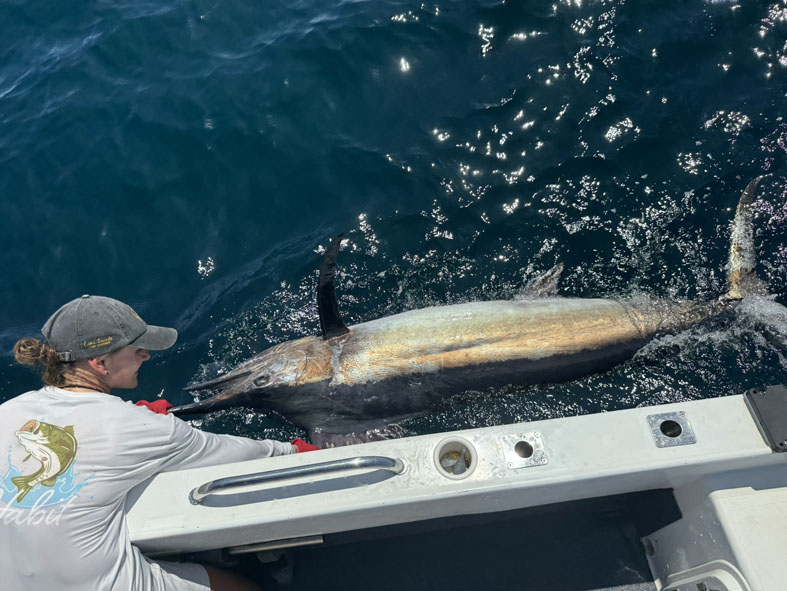
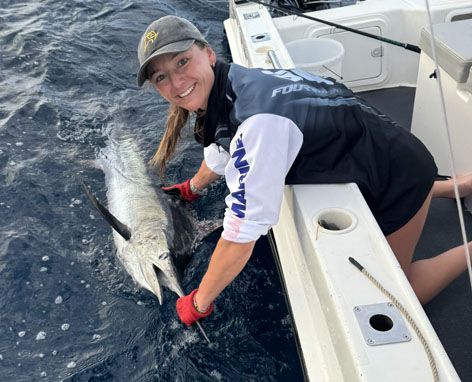
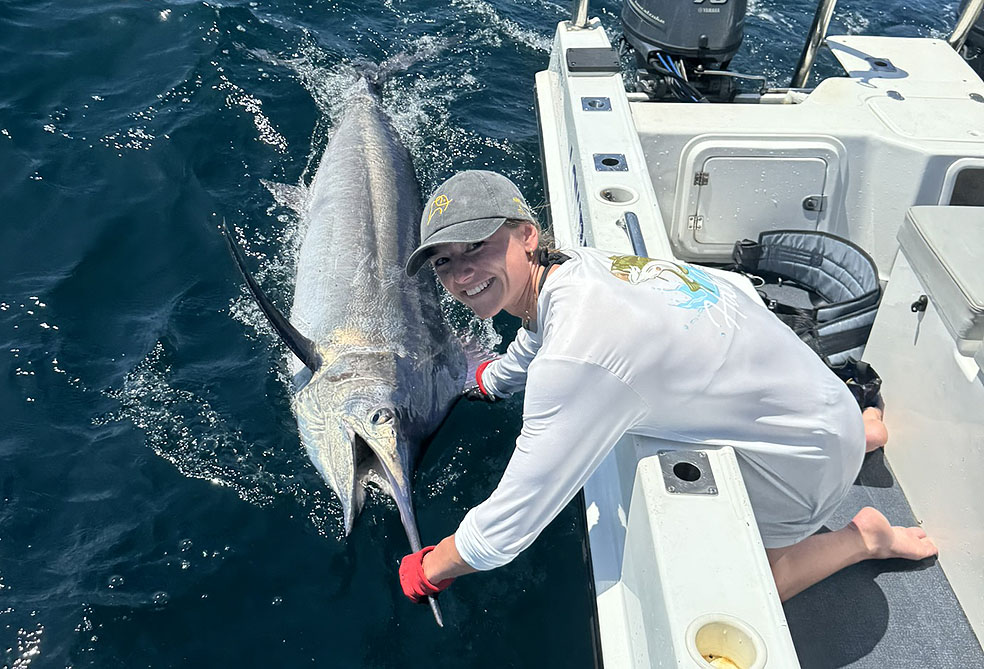
    After boarding Malakas with skipper Branden Brodell, I set out with one goal: to catch a marlin. Not only did that dream come true, but we landed four!
    The trip started at The View at Santa Maria, a fitting base for an experience that would be nothing short of spectacular. As we made our way in and out of Hell’s Gate – a treacherous passage known for its shifting tides and strong currents – Branden navigated it with a confidence that only comes from years of experience. His knowledge of the waters, the fish, and the conditions was beyond impressive.
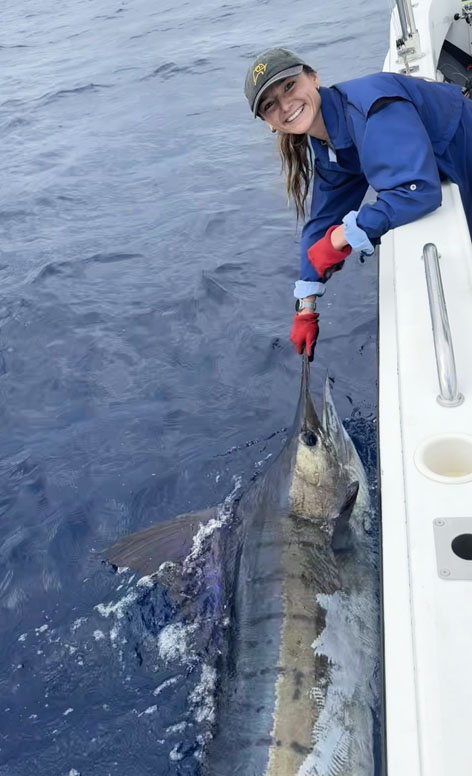
    The first day started with a bang! At 8.30 a.m., we saw a fin chasing the first lure; no bite. We held our breaths as the marlin fell back, chased the outside long kona, and ultimately hooked on that – my first striped marlin!
    The fight was intense, the adrenaline coursing through me as I worked to bring in my dream fish. This was a tough fight – one that tested my endurance right from the start. The marlin, put up an incredible battle, peeling line off the reel. Every time I made ground, it would dive again, forcing me to dig deep and keep my composure.
    After an exciting fight, I finally brought it in – a truly unforgettable first marlin. It was everything I had dreamed of and more. That single moment alone would have made the trip a success, but the ocean had more in store for us.
    Over the next few days, we hooked three black marlin, each one a lesson in power and endurance.
    The second marlin was a completely different fight to my first with the stripey. This time the marlin was hooked on a light setup with 50 lb leader. I had to fight it differently, knowing that with 20 lb mainline onto light leader, the line could snap at any moment. This time it was not only a physical challenge, but one that would test my technical skills too.
    Whilst reeling it in, I could feel this marlin had a different energy to the previous one – it was agile, making sharp runs that kept me on my toes. Compared to the first, it was a fight of speed as well as brute force, forcing me to adjust my technique to keep up with its unpredictable movements and immense power.
    Finally, after about a 40-minute fight, I landed an estimated 120kg black marlin. The excitement aboard Malakas was unimaginable – not just marlin number two for me, but a black marlin, the fastest and strongest fish in the world!
    We made sure to celebrate with a well-deserved local Mozambican beer.
    The third marlin was the smallest of the blacks we caught, but it was just as fierce. Hooked in shallower water at 6.30 a.m. on the fourth day of my fishing trip, it surprised us with its acrobatics, leaping multiple times and giving me a chance to test my reaction times. Just because it was smaller didn’t mean an easy fight, though; it still had that relentless marlin spirit. However, after a shorter battle, we successfully brought it in, and it was wonderful to have another boat nearby, with those anglers screaming in excitement for us.
    The last marlin of the trip, however, was the one that truly tested me. At 5 p.m. on that fourth day, Branden had just put out a live rainbow runner in the hope that something would bite, as we’d had a long, quiet patch. Just as we were thinking of calling it, the line screamed, and we knew we had something big.
    Both Branden and I had seen a splash as we hooked it, but we couldn’t quite tell what it was. For the next 15 minutes I battled the fish, still unaware it was a marlin, making me wonder if I was just lacking strength from the last few days of hard fishing, or if this was something really big. My back was sore, and eventually we both started to wonder if it might be another marlin.
    Just as the thought crossed our minds, the marlin breached the surface! It erupted from the water in a display of power, its body twisting and thrashing against the setting sun. The moment was mesmerising, but I had no time to admire it – I continued to reel furiously, knowing that every second counted.
    Branden spoke me through the fight, his voice like a lifeline, reminding me to stay calm, to breathe, to keep fighting. For an hour I battled that fish, every muscle in my body burning and my mind locked in focus. Every time I thought I was making progress, the marlin would make another deep dive, stripping away all the line I had just gained, emphasising that this was a give and take relationship. The sweat dripped from my forehead as I pushed through the burning fatigue, refusing to lose this battle.
    This marlin was the biggest of the trip. Estimated to be around 150kg, it was an absolute beast that pushed me to my limits. By the time we brought it alongside the boat, I was trembling from exhaustion, but the satisfaction of that final, massive catch made every aching muscle worth it. It was a moment of pure triumph and exhaustion.
    Unlike traditional marlin fishing from a fighting chair, I fought all four of these giants on stand-up tackle, my legs bracing against the gunnel, my core locked to maintain balance, and my arms burning with every turn of the reel. Each fight felt like a marathon, pushing me to the edge of my physical limits; it was a test of willpower as much as it was a battle with the fish.
    By the end of the trip, my hands told the full story – raw, blistered and sore from gripping the rod and working the reel, a testament to the sheer effort that went into landing every marlin. But every blister was worth it for the experience of fighting those fish, feeling their power through the rod, and ultimately witnessing them swim off strong after the release. It was brutal, it was exhilarating and it was unforgettable.
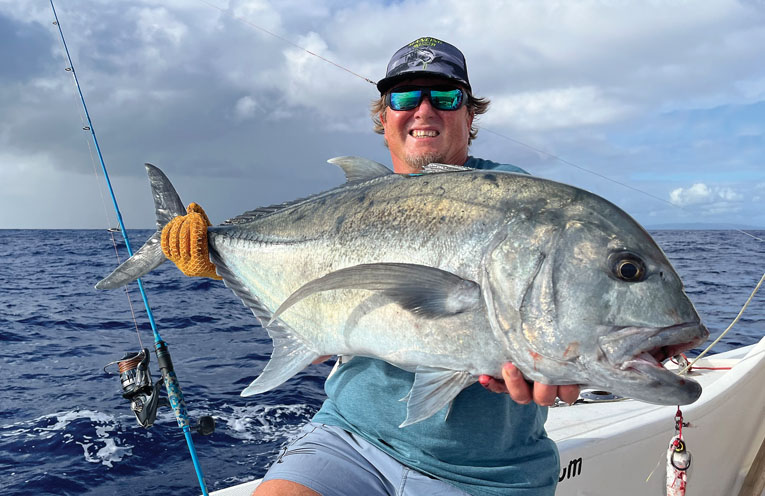
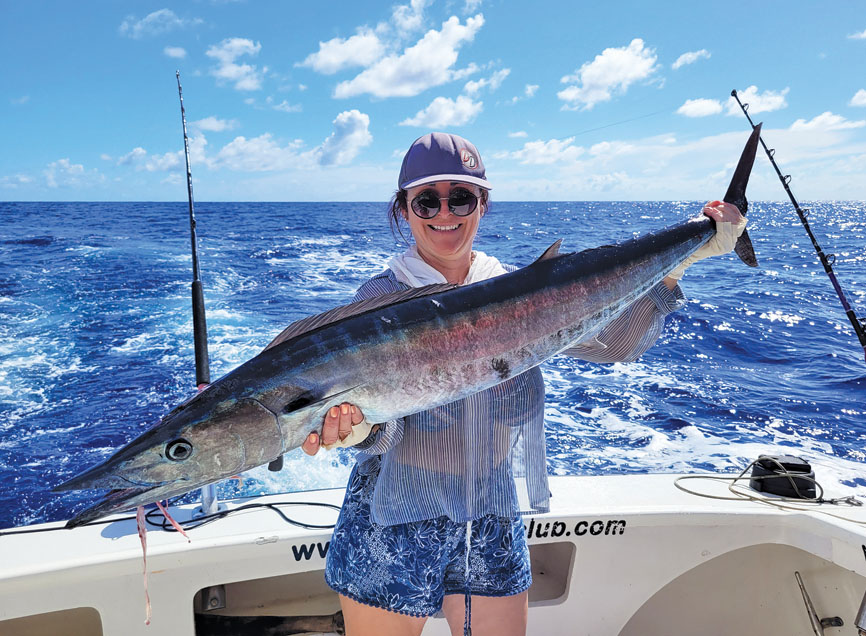
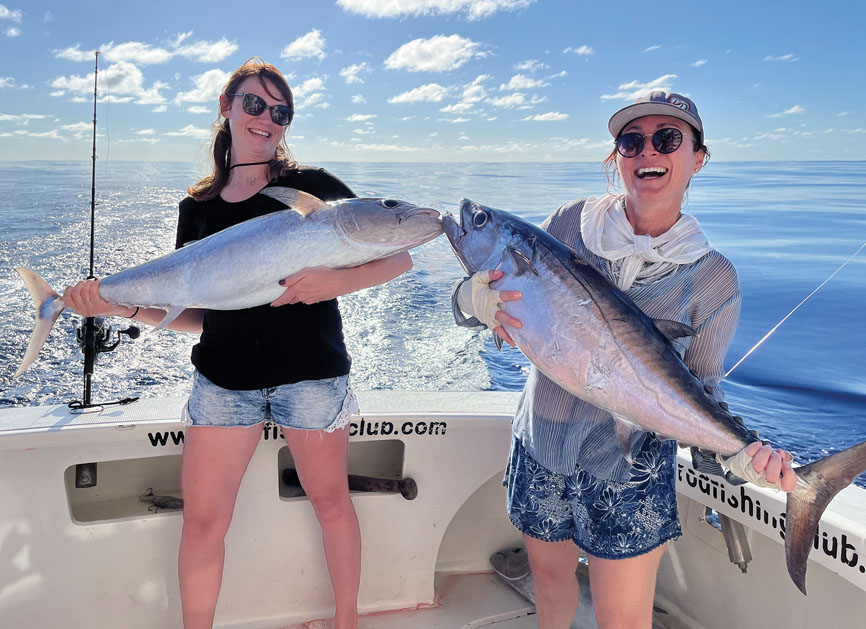
    Beyond the marlin, the trip also delivered a bounty of gamefish – ’cuda, wahoo, dorado, GT and yellowfin tuna, each one adding to the thrill of the experience. The ocean seemed to be on our side, rewarding our efforts with incredible catches time and time again.
    Fighting marlin is unlike anything else, and with Branden’s expert guidance, I learned the nuances of handling these magnificent fish – reading their movements, adjusting my technique, and enduring the physical challenge. It was a masterclass in big game fishing, and I relished every moment, including releasing the marlin and watching them swim away as the adrenaline rush in my body slowly turned to an overwhelming feeling of euphoria.
    Many anglers go years chasing one marlin, and yet I managed to catch four in a single trip of four days. That kind of luck is something I will never take for granted. Fishing around Santa Maria with Branden gave me memories that will last a lifetime, and reinforced why I love fishing – the unpredictability, the challenge and the ultimate reward of landing a dream catch.
    Beyond the thrill of the catch, staying at The View @ Santa Maria was an experience in itself. Every time I visit, I’m left in awe of its breathtaking beauty – the endless ocean views, the peaceful surroundings, and the way nature seamlessly blends into the adventure. It’s a place that never fails to amaze me.
    As a woman who discovered a love for fishing only two years ago, I’ve been fortunate to land some remarkable gamefish off Santa Maria, including a 40kg GT, a 13kg green jobfish and a 24kg ’cuda.
    I am still at the start of my fishing journey, and there is so much I have yet to learn, but Branden has been an invaluable teacher, guiding me through each trip and slowly helping me understand different techniques, read the ocean, and improve my ability to handle big game fish.
    Branden’s expertise, instincts, and deep understanding of the ocean made this trip unforgettable. Every time he had a gut feeling about what we were going to catch, he was right!
    As I look back on this experience, I know one thing for sure: the ocean has so much more to teach me, and I can’t wait for the next adventure.
  • SLOWLY DOES IT Part 2

    SLOWLY DOES IT Part 2

    All you need to know about slow pitch jigging

    By Dwayne Boshoff

    (Originally published in the March 2025 issue of SKI-BOAT)

    IN the previous issue of SKI-BOAT I introduced readers to the concept of slow pitch jigging as opposed to speed jigging, and shared at length about all the tackle requirements. In this issue I’ll explain how to put all that tackle to good use to have some real fun out on the water.

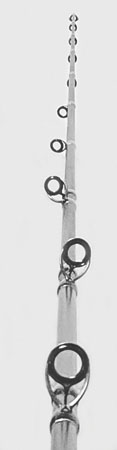
    The guides on the overhand rods spiral around the blank, and although this may look a bit odd, it’s to avoid blank rub which will damage your line.

    ACTION AND RETRIEVES
    There are many different methods of retrieving with slow pitch jigging. The golden rule – as with any lure fishing – is not to get stuck in a rut.
    Mix up your retrieves.
    You’ll hear talk of a “quarter pitch”, “half pitch”, “full pitch”, “lift and fall” and various different methods of retrieving, but it’s all quite simple: The pitch refers to the crank of the reel handle.
    You need to crank the reel handle at the same time as you lift the rod, because this loads the rod in order to pitch the lure. With the pitch, the lure kicks to the side, aligning itself in a horizontal position. As you lower the rod to repeat the action, the lure starts to sink or fall and flutter, imitating a wounded baitfish.
    This YouTube video shows exactly what happens to your jig underwater
    Your pitch, the speed at which you retrieve, the weight of the jig and the current will all affect the jig’s movement as it falls.
    Always allow short pauses between pitching the lure again, to allow for the lure’s action to take effect. Mix it up with some longer pauses to allow the lure to fall and flutter more.
    I generally mix up my retrieve and the speed of my retrieves according to what I am targeting. For bottomfish, lift and fall – no retrieve. I simply lift the rod and drop it back down to creating resistance-free falling, keeping the lure within 1.5m of the bottom. For pelagics I retrieve a little faster and higher up in the water column; generally 5m to 10m off the floor. This is one colour change of your multi-coloured braid, for ease of reference. This is where the bites are at.
    You’ll be amazed at how slow you can fish these jigs and how little movement is required to trigger a bite. Having said that, slow pitch jigs can be fished fast too.


    Slow pitch jigging can be used to target fish at a variety of depths.

    WHAT TO LOOK OUT FOR
    A good showing is crucial in any depth of water. I’ve jigged at depths from 10- to 120m off Durban, so don’t think you need to target a specific depth, just keep an eye on your fishfinder.
    A good healthy reef system in the shallows will almost always have kingfish hanging around it, especially in the summer months. Pinnacles, drop offs, coral or structure provide shelter for smaller fish and baitfish, so the predators will hang around there to feed on them.
    When I see bait showing, or even fish for that matter, on top of the reef, I get very excited. Remember that you are trying to imitate an injured baitfish, and if there’s bait down there, you have the perfect opportunity to present the weakest link.
    I don’t necessarily jig all day, as there’s always lots to do on a boat, so if I’m busy with something else, Dad will often give me the heads up that there’s a good showing on the finder, then I’ll grab the jig and go down – sometimes even while slow trolling.
    When you’re drifting, it’s best to turn the steering full tilt in order to ensure the boat drifts sideways. Never jig with your line going down at an angle underneath the boat, because then you’re more likely to get tip wraps.

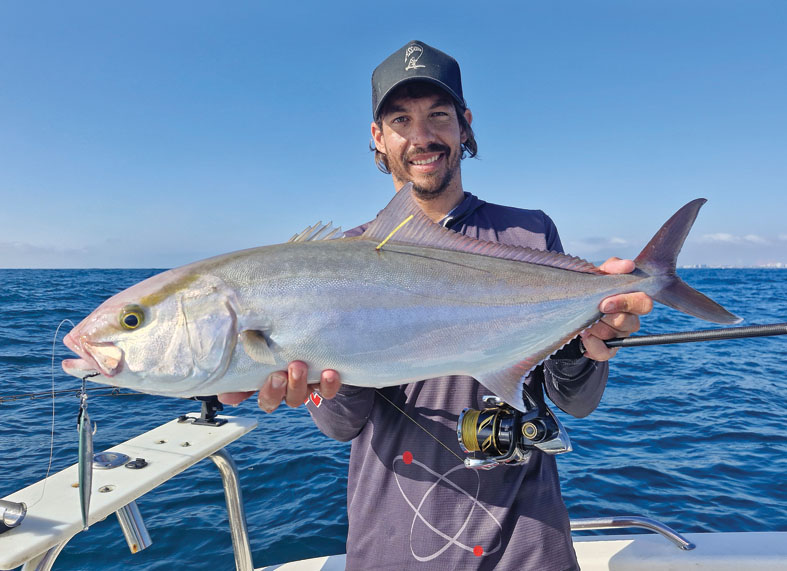
    Slow pitch jigging is a great way to target hard-fighting greater amberjack like this 70cm fork length specimen Dwayne caught.

    TARGET SPECIES
    With regard to species, you can really target anything – amberjack, kingfish, pelagics, bottomfish, you name it.
    There are quite a few gamefish that dwell near the bottom, and for years they were never really targeted – or not successfully anyway. Anglers tried trolling plastics and lipped lures or even livebait along the surface, while others used dead baits or squid, often to no avail.
    Now we have an effective method of targeting these fish and there’s a good chance of catching queenies, garrick, prodigal son, amberjack, yellowtail and other less common gamefish species.
    For me, ambers are king, and those who follow me on social media will know I flood my feed with them. Although the ones off Durban are relatively small models, pound for pound they are one of the strongest fighting fish in the ocean. With the right gear, as they say in Afrikaans, “Dis jare se pret!”
    Kingfish are also such cool fish and there are so many in the family that you’ll never get bored. They go hard and make for good sportfishing, I simply love them.
    We’ve also caught quite a few ’cuda, snoek, yellowfin and even dorado on slow jigs, along with countless bottomfish. The point is, they will all eat a jig!

    Before you drop your jig, check the wind and current and position yourself so that the boat drifts side-on to the wind and current. Ensure that the boat does not drift over your line.

    CONDITIONS
    Having good conditions certainly helps, and, as with all fishing, water colour and temperature bring the gamefish on the bite. However, if the weather’s not playing ball it’s often still worth having a go, because if the water is too clean it may make artificial fishing more difficult.
    Don’t be put off by green or off-colour water; we’ve caught a span of fish in that.
    Watch out for a strong current or drift, as this presents a bigger problem than offcolour water. In a strong current you obviously drift off the mark quicker, have big bows in your line, or your line goes down at a big angle rather than straight down which is what you want. One also tends to get stuck a lot more when the conditions are like this.
    First light is always best for fishing, but with slow pitch jigging you are not limited to fish feeding times. This goes back to the fundamentals of slow pitch jigging where you are imitating an injured baitfish rather than a fleeing baitfish. It takes a lot of effort for a fish to chase a fleeing baitfish, whereas a slow jig is an easy snack – even for a fat, lazy yellowbelly – whatever the hour of the day.

    BITE DETECTION
    To me, the bite on the retrieve is the highlight of the jigging experience and is what keeps me hooked.
    However, you need to be alert all the time, because the bite also quite often happens on the fall due to the jig’s effective fluttering action. It is thus important to carefully watch your slack braid floating on the surface of the water. If your braid stops going down before you anticipated it would hit the floor, lift the rod because you have most likely been picked up.
    My braid often suddenly starts peeling off at an increased pace while the jig is still dropping. If that happens to you, clip over – you are tight. If the braid is peeling off rapidly and you struggle to clip over, lift your rod, then lower it quickly to provide some slack so you can clip over.

    CONCLUSION
    Don’t be afraid to try out new things. Technology is moving at a rapid pace, and you don’t want to get left behind, because a whole new exciting offshore fishing experience awaits you.
    It took me a while to get my dad into slow pitch jigging, but he recently made a statement that I’ll never forget. He said, “It’s like this slow pitch thing has re-ignited my passion for fishing.” I can assure you that passion never died, but that’s coming from someone who has been fishing for over 50 years; a man who has seen and experienced many things – even the good old days.
    Experienced anglers might think the gear looks small, incapable or even funny, but it’s specifically designed for this facet of angling, so trust it.
    In conclusion, I know Justin Paynter did warn you in a previous article, but I have to reiterate, that this “gogga” bites hard – harder than most of the others I’ve experienced.
    If you’ve been getting a bit bored with using the same old fishing tactics and maybe not getting the results you’d hoped for, why not try slow pitch jigging to spice things up again. You can thank me later.

  • WHERE TO FISH Part 15

    WHERE TO FISH Part 15

    Port Alfred and surrounds

    By Colin Fletcher and Clinton Schultz

    [Originally published in the July 2024 issue of Ski-Boat magazine]

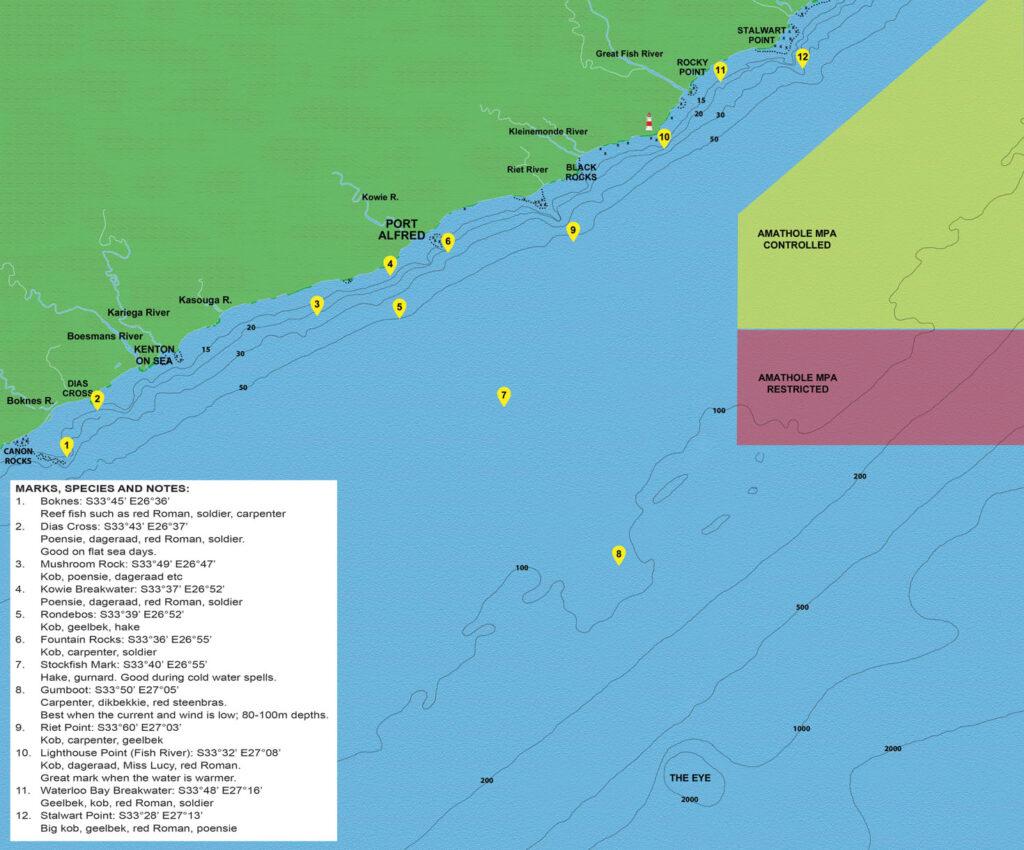
    THE hidden gem of the South African coastline, the area between Kenton-On-Sea and the Mgwalana River, not only offers plenty of tourist attractions and luxury game lodges, but also some of the best fishing in the Eastern Cape.

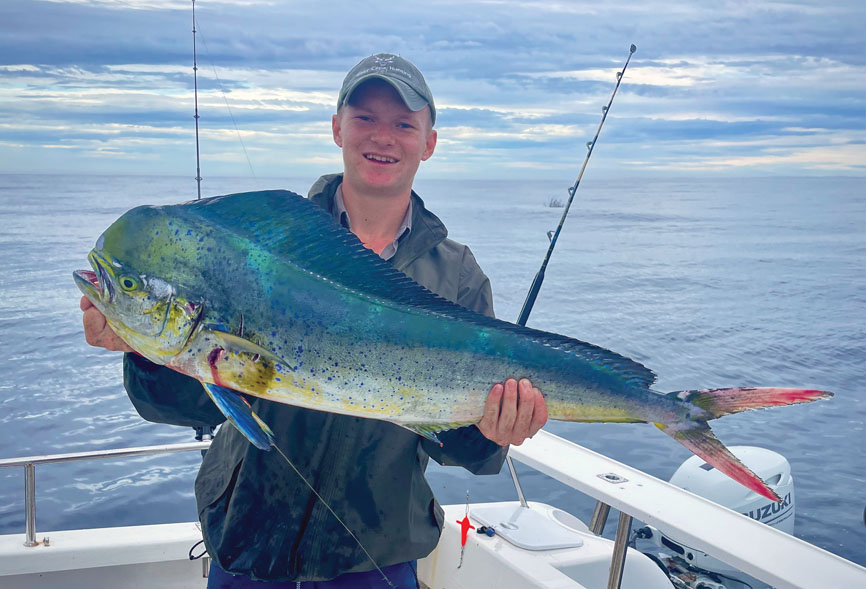
    Colin Fletcher shows off a solid dorado.

    The variety is vast – everything from dageraad, poensie, kob and geelbek to incredible gamefishing in the current line which produces yellowfin tuna, dorado and marlin. This area truly offers it all.
    I have been privileged to grow up on this section of the coast, fishing both rock and surf as well as offshore. The amazing history of this coastline never ceases to amaze me and the stories of massive catches have intrigued me for years.
    Accommodation for visitors to this area is well priced and it won’t cost you an arm and a leg for a fishing holiday with the family.
    Launch sites are also plentiful. From beach launches to harbours, there are a number of different options.
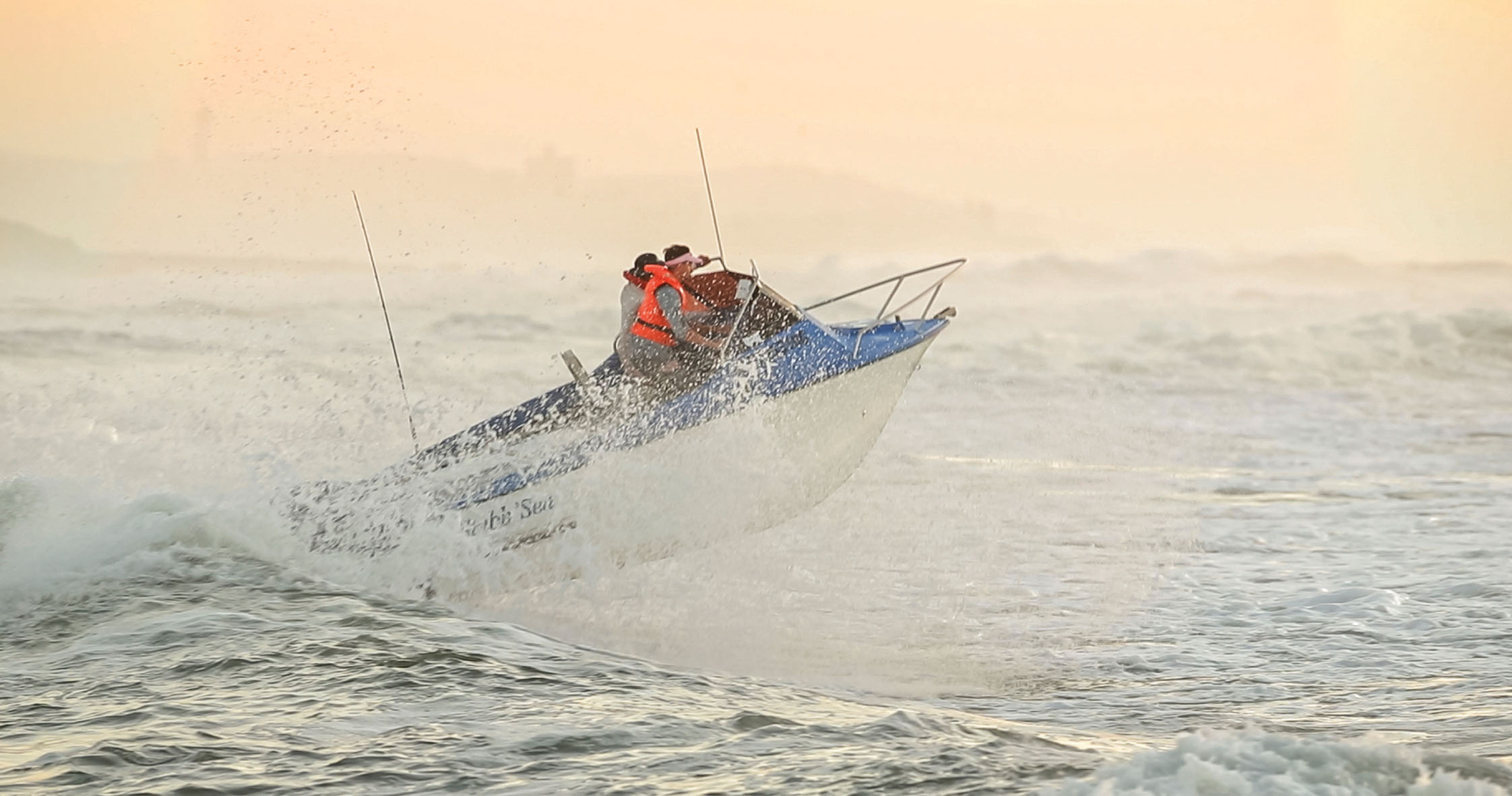
    Port Alfred is one of the easier launch spots to get to logistically, but it can be a hair raising launch through the mouth if the weather is not good. Make sure you get local advice if you’re not familiar with the launch.
    Other beach and slipway/river surf launches along the coast include Boknes, Kenton, Kleinemonde, Mpekweni, Mgwalana and Birha.
    If you’re not confident launching safely in this region, professional charter companies are readily available in Port Alfred. Their services are generally well priced, and the skippers have intricate local knowledge and experience thanks to spending hundreds of hours on the water. This is a great option for a family day outing for those roadtripping down to the area.
    If you are visiting and want to meet up with some of the locals, then stop by at the Port Alfred River & Ski-Boat Club situated along the Kowie River. It is a good place to pick up some local information and there’s a great pub and restaurant where you can enjoy the generous hospitality.
    Contact the club on 046 624 4532 or visit their Facebook page <www.facebook.com/parscpa/> for further details.

    SPECIES

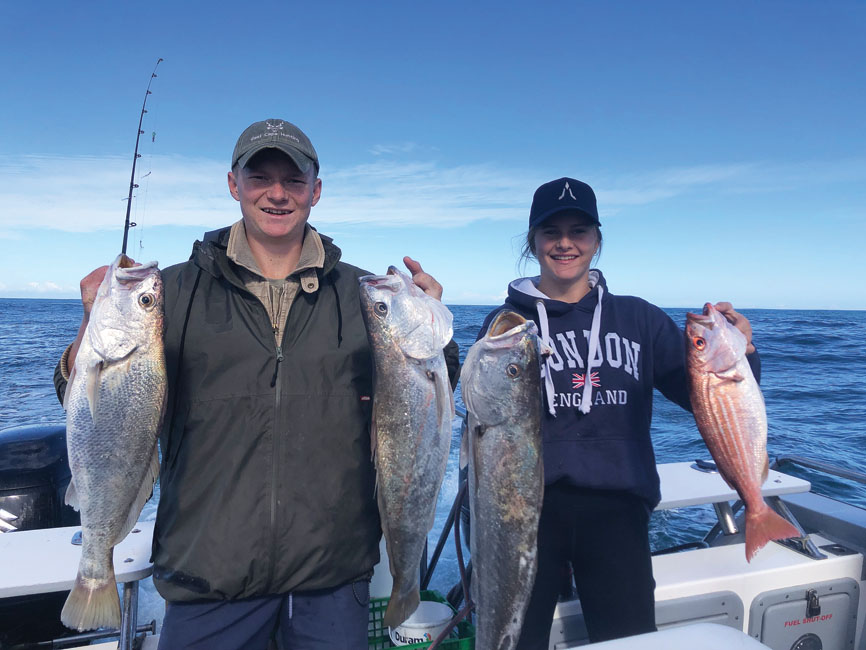
    Colin and Megan Fletcher with a few pan-sized kob and a carpenter.

    Kob
    A highly sought after fish along the South African coastline, kob are great fun to catch and are great eating too. In this area they range from1kg to 20kg, so you never know what you are in for.
    The daily bag limit, according to www.saambr.org.za, is one per person per day if caught from the shore and in estuaries east of Cape Agulhas, and five per person per day if caught west of Cape Agulhas or if caught anywhere from a boat offshore.
    Minimum size limit is 60cm total length if caught from the shore and in estuaries east of Cape Agulhas, and 40cm total length (KZN) and 50cm total length (EC & WC) if caught from a boat offshore or from the shore west of Cape Agulhas. Only one kob greater than 110 cm total length may be caught per person per day regardless of area or sector.
    You’ll often catch slightly undersized kob that have to be put back, but when you get into a shoal of keeper-size fish, great fun can be had. The smaller fish, around 60cm, are best for eating.
    Chokka and sardines are easy and popular baits for these fish. A great option on a spinning setup is to use paddletails or dropshots.
    Kob can be lazy fish and will sometimes lie in water sheltered by structure, waiting for prey fish to swim past. Smaller fish tend to shoal when feeding, and when you tuck into a shoal it is great fun. With a more aggressive bite than geelbek, shoaling kob closer to the bottom will more often than not bite in an upwards direction and you will feel an upwards bump followed by momentary slack, then SMASH!

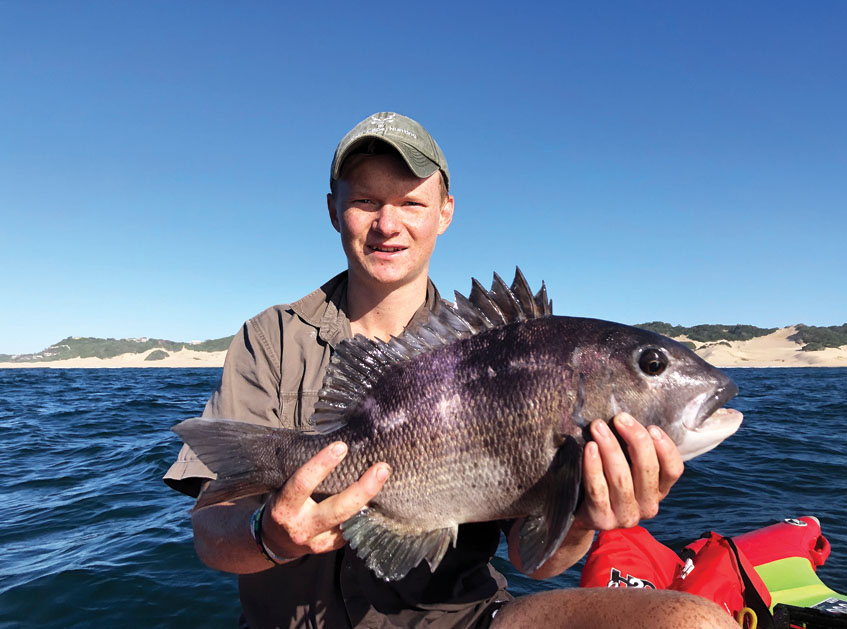
    Colin Fletcher with a nice poensie caught near Lighthouse Point.

    Poensie
    Black steenbras aka musselcracker aka poensie is probably the most prized bottomfish species in this area. A big specimen is both memorable and extremely fun to catch.
    These fish occur along most of the east coast of South Africa and are most abundant along the Eastern Cape/Transkei and KwaZulu-Natal coastlines.
    Chokka strips/legs, fresh fillet, a dead Frans Madam (big-eye) or sardine are all effective dead baits for these “cracker” fish. I have been smoked by big crackers on a maasbanker live bait, so that is also a good option to try.
    Some people choose to keep the daily bag limit of one per person but I personally choose to release them.
    Be extremely careful when handling these fish, especially on an inflatable boat, as they have a few sharp spines.

    Dageraad
    These fish are endemic to South Africa and are only found in the waters stretching from the lower South Coast in KwaZulu-Natal to Cape Point in the south-western Cape. They are most common along the Western and Eastern Cape coast.
    Dageraad are generally found around offshore reefs between depths of 20m and 100m, and will bite on chokka, sardine and fillets.
    They are listed as critically endangered on the IUCN Red data list, so the current bag limit is one fish per person per day at a minimum size of 40cm.

    Red Roman
    Arguably one of the prettiest reef fish on the Eastern Cape coastline, red Roman are also tender fish to eat. These beautifully coloured fish can weigh between 1kg and 3kg on average, and a big Roman provides a fun fight on lighter tackle.
    Caught throughout the year, these fish can be caught on red bait, worms, chokka, fillet and sardines. Look for them around reefs or pinnacles in shallow water.
    The minimum size is 30cm with a daily limit of two per angler.

    Carpenter/Dog/Silverfish
    These fish are abundant along the Eastern Cape coastline and are found in waters anywhere between 20m and 100m deep.
    They have a vicious tooth structure and will eat almost anything. Adults feed on anchovies, sardines and squid, while juveniles feed mainly on crabs, crab larvae and worms. It can be frustrating when you get into a large shoal of small dogs and nothing else bites.
    These fish are underrated as a table fish but are fast gaining popularity among South Africans.The current bag limit is four fish per angler per day, with a minimum size of 35cm.

    Geelbek
    These fish are sporadic and unpredictable. You might see a shoal on the finder and drop a bait, only for it to be left completely untouched. We call this “bek lockjaw”. The daily bag limit for these fish is two per angler with a minimum length of 60cm.
    In the months following the sardine run these fish will be caught around the deeper reefs, but they are often found on shallower reefs as well.
    They bite very distinctively, creating slack in the line on their way up, and fight aggressively. Geelbek are great fun on light to medium tackle. Bait options include sardines, fillets and chokka. Due to their big mouths, large hooks (around 10/0) should be used .

    Miss Lucy
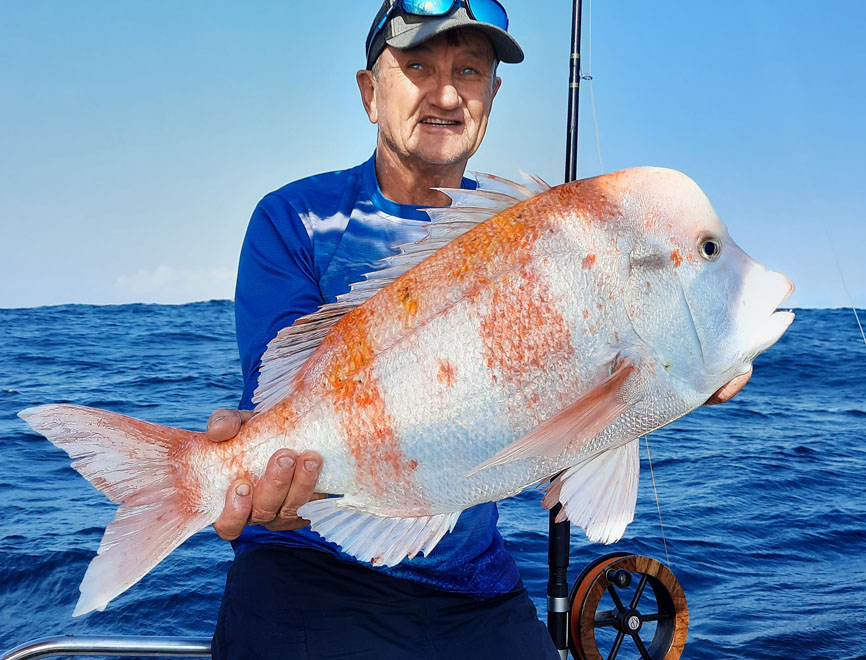
    These beautiful fish, with their banded shades of red and white and large forehead bumps, can be enticed to bite by chokka, sardine and octopus. The bag limit is one daily per angler with a minimum size of 40cm.

    Gamefish and billfish
    A variety of gamefish including yellowfin tuna, marlin and dorado can be found around the area off Port Alfred known as “the eye”.
    For years this area has been frequented by migrating populations of smaller tuna, mostly in the 10- to 30kg weight class. However, in the last year or so there has been a noticeable increase in the number of big tuna in the area, 50kg-plus bullets which have offered plenty of fun.
    Dorado have spoilt us with their presence for many years. These beautiful fish are found in warmer water (around 25 degrees) and congregate around floating objects in the current. Keep an eye out for small baitfish around floating debris, and the dorado won’t be far away.
    Marlin and dorado seem to like hanging around deeper depths around the 100m drop-offs and current lines, where floating debris can be found.
    Marlin are definitely more difficult to target, but many have been hooked in this area and some landed.
    A big marlin will bully you on a light tuna or dorado trolling setup, so ensure that you are well prepared if you plan on targeting these majestic creatures.
    A variety of diving lures and spreads at staggered distances can be used to pick up a bite at a trolling speed of around 12 kph. A good setup for targeting these species in the warmer water is something like a Shimano Tiagra 30/50 stand-up rod with a Shimano Tiagra 50W reel. This setup provides a fun fight but is powerful enough to wrestle a big tuna or marlin.

    TACKLE
    Generally, in the shallow waters, a light rod of around 7- to 8 feet can be used, along with a matching reel of your choice and light braid or nylon up to around 20kg. This will give the angler the most fun when fighting a fish.
    When dropping deeper, scale up your equipment in accordance with your preference and target species – as long as it still offers a fun fighting experience. There is nothing worse than pulling in dead weight on an ultra-heavy setup.
    Scarborough reels, multipliers and spinning reels are all good, versatile options for the fishing in this area.
    Hook sizes will vary from species to species, but you can’t go wrong with an 8/0 for most applications. You can, however, go as small as a 4/0 when fishing in shallower water for smaller reef fish such as Romans.
    Use whichever trace is easiest for you to tie quickly; I use a very “rural” double loop trace which my late grandfather taught me. Believe it or not, with this simple trace you can comfortably handle larger fish. It is, however, a lazy trace and a split swivel trace is ideal.
    When it comes to sinkers, I have used ones as light as 3 oz in shallow water, but current can mess you around quickly. Local commercial boats prefer 10- to 12 oz sinkers for the 20- to 70m depths. Just remember that when you are dropping deep, you have to pull that sinker up every time peckers clean your hook, so don’t go excessively heavy.

    JUDGING CONDITIONS
    Sea conditions in this area can vary dramatically with wind and current variations. As an example, a south easterly to south-south easterly wind can create very choppy seas, and the more southerly the wind, the worse it gets.
    This wind also pushes the cold water to the shore. Water temperatures in these conditions can plummet to 12/13 degrees and this brings out critters like the dorrie shark and barbel.
    In these conditions, you’ll find tiny shoaling carpenters and baitfish are abundant, so it’s not ideal for most types of bottomfishing, except for stockfish and gurnard in the 50m-plus depths.
    Conditions most ideal for going deep off this stretch of the coast, are after a day of light westerly winds. In these conditions the wind drops off and the surface water warms, heading inshore, which improves inshore and deep sea fishing.

  • ISLAND OF DREAMS

    ISLAND OF DREAMS

    Rodrigues Island will fulfil all your fishing fantasties

    By Jaco Visser

    [Originally published in the September 2023 issue of Ski-Boat magazine]

    ERNEST Hemingway famously said: “A man is never lost at sea” and “It is good to have an end to journey toward; but it is the journey that matters, in the end.”
    Hemingway was on my mind as my short flight from Mauritius crossed the vast expanse of the Indian Ocean en-route to Rodrigues Island. An awful lot of ocean surrounds this little rock that would be our home for the next couple of weeks.
    About 650km north-east of Mauritius, isolated on a ridge between Hawkins Bank and the Eastern Bank, you’ll find an island several million years older than its siblings, Mauritius and Reunion. Isolated from the world and stuck in a time warp, the island provides an interesting and authentic cultural experience for any adventurous traveller – and even more so adventurous anglers.
    More famous for wind sports and dried octopus, the island’s big game fishing is one of the best and worst kept secrets of the sportfishing world. A quick page through IGFA’s book of world records soon reveals the illustrious reputation and potential of this destination.
    Disguised as a digital nomad, and fully intending to use the island as a temporary home while working and maintaining a life–work balance, my wife and I booked one of the many available self-catering establishments scattered all over the island.
    Walking distance to Port Mathurin, sparkling pool, steps from the beach, air-conditioning and good Wi-Fi sealed the deal for The Beach House to be our abode and island office for some weeks as we justified our reason to elope to a place as unique and tranquil as Rodrigues. Of course the main reason for being there was the incredible fishing the island has to offer.
    But, before we get to the fishing, some more about the island.
    Time truly seems to stand still on Rodrigues. With unique charm and a simple, unhurried ease, friendly people, varied cuisine and striking natural beauty, the island is surely one of the best places in the world to spend a quiet, calm and isolated holiday. There are several categories of accommodation so there will be something for every pocket.
    Unlike Mauritius, there are no major resorts, and small family-owned establishments and B&Bs are the order of the day. Taxis, busses and car rentals are all available, but the preferred and most fun alternative is affordable scooter hire. There are numerous activities available, including visiting the many walking trails, beautiful beaches, caves, secret sensual gardens and spas and ancient tortoises. Visitors can indulge in beach braais, scuba diving, surfing, bungee jumping, zip lines and gorge swings.
    A volcanic island along the edge of the Mascarene plateau, the island is surrounded by coral reefs that are uniquely self-seeding as it receives no coral zooplankton from elsewhere. This led to the development of a unique ecosystem for many marine and afcoral species and adds to the excitement for any diver or angler who wants to explore the bio-diversity on offer. Outside of the coral barrier, the island is surrounded by a basaltic plate varying in depth from 40- to 60m and between 5- and 16km wide, before a drop-off in steps up to 1000m-plus deep.

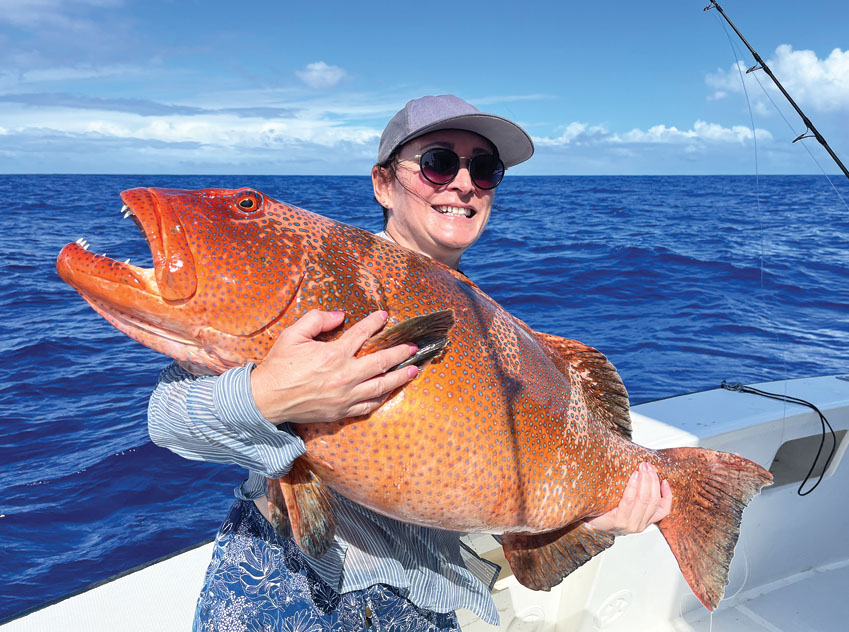
    Dgini Visser added a wahoo to her species tally.

    Hemingway noted that “anglers have a way of romanticizing their battles with fish” and “it was considered a virtue not to talk unnecessarily at sea”. There is, however a great deal to say about the fishing off Rodrigues while reflecting on the incredible time we spent with Captain Yann Colas of Rod Fishing Club aboard Black Marlin.
    The waters around the island, especially at the end of the season, are not for the faint hearted as a consistent south-easterly wind and varying currents make for fairly big seas most of the time. However, this did not pose a major challenge for Black Marlin as her full 50ft, 30 tonnes sportfish hull was specially designed to keep anglers and crew safe. Captain Yann’s 20 years of experience working the unpredictable waters off the island also helps to land any angler their dream fish.
    Rodrigues is a true multi species destination and will have something to offer any style of angling, with numerous world records to her name. It’s not by chance that one operator has collected so many records over the years. The operators of Rod Fishing Club pride themselves on careful preparation that only requires the motivated angler to be matched with the right opportunity to make his dreams come true. Captain Yann is also an IGFA approved captain and operates an official IGFA weigh station for anglers wanting to chase a world record.

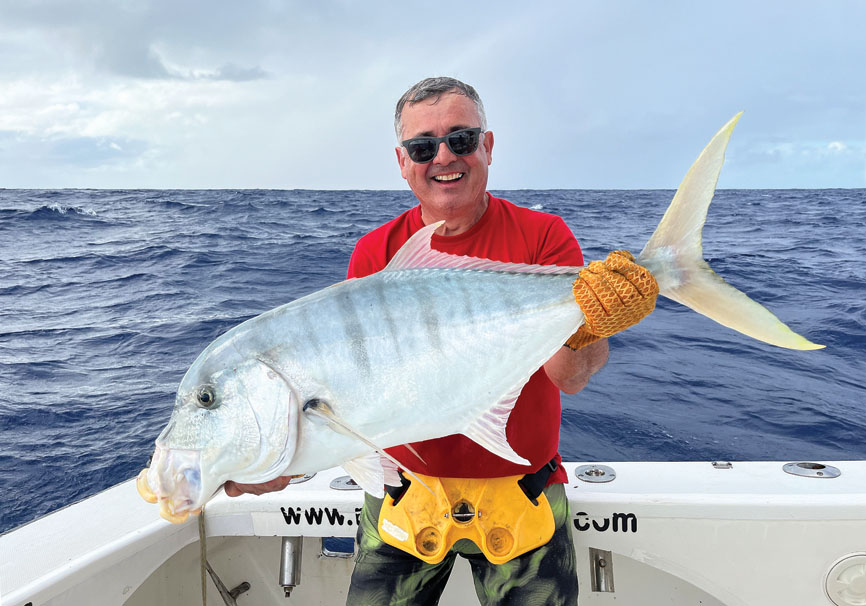
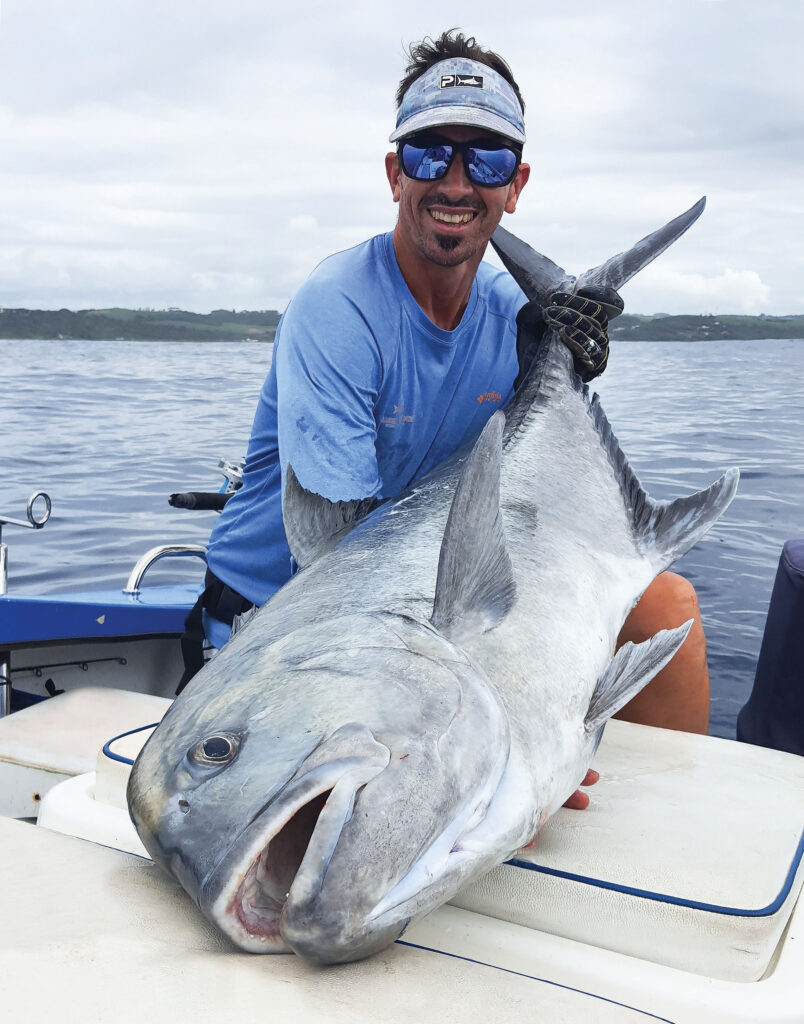
    Devin Klein was thrilled with his golden trevally.

    Trolling, baiting, jigging, slow jigging, livebait fishing, bottomfishing, pitching and light tackle methods are employed to target exciting bottomfish and reef species like coral trout, red snapper, blue emperor and various groupers. These are complimented by the true warriors of the deep like dogtooth tuna, giant trevally, golden trevally and jobfish as well as the speedsters like yellowfin tuna, wahoo and dorado. That’s without mentioning the trio of billfish, with giant Indo-Pacific sailfish, black- and blue marlin available almost all year round.
    Overnight and multiple day trips are also possible to Hawkins Bank or the Eastern Bank to explore these hardly-touched waters, where anglers can experience the thrill of being completely alone fishing rich waters where few have ventured before. These trips also allow for experimental bottomfishing at night and during low light hours for those targeting multiple species. Two overnight trips for us resulted in more than 30 different species collected, with every take a veritable lucky packet.
    Apart from general big game fishing, we were particularly interested in slow pitch jigging and targeting big dogtooth tuna on lighter tackle. Not only did Rodrigues deliver, it exceeded all expectations with regard to quantity and variety.

    Your chances of catching a dogtooth tuna are good during their peak season from October to April, as Jess and Dgini proved.

    Smaller blue runners used as livebait produced lots of doggies and smaller GTs, while bigger livebaits were the ticket for larger doggies and a marlin as a bonus. Slow jigging in depths of 50- to 80m over structure either on the plate or near the drop-off accounted for lots of decent size GTs, bluefin trevallies and a particular run of exceptionally good sized golden trevallies. Whenever we needed a break, trolling along the drop-off produced several sailfish and some really good wahoo.
    The golden ticket for this destination, and especially Captain Yann and his team, remains the big dogtooth tuna. Rod Fishing Club has recorded over 250 doggies over 50kg with theirclients over the years, and your chances of catching these monsters are very good during their peak season from October to April.
    During the season, smaller boats and operators also take anglers on day trips near the coral barrier, and these outings often account for incredibly good GTs caught while popping and stick baiting in the surf zone. There’s also very good general gamefishing around the island and even as far as the drop-off if the conditions allow.
    I was especially privileged to join Jean-Marc of GlobalRodrigues for just such an outing by ski-boat and managed two decent GTs on surface popper within spitting distance of Ile Aux Cocos, one of the region’s main attractions.
    As with any fishing excursion or trip, there are always one or two particularly memorable fish that prove Hemingway’s point of anglers’ tending to romanticise their battles with fish. After a dozen or so excursions to secret marks around the island, we have several of those life-time catches that stand out and will be etched in memory forever and will probably be romanticised in fishermen’s yarns as we re-live all the detail with every telling.
    In the months of anticipation leading up to the Rodrigues stay, Dgini, my better half had only one wish: ‘I want to catch a big red fish!”
    On our first shake down outing with Captain Yann she was drifting a bonito cutlet, weightless, over some structure on a light spinning outfit; suddenly she was on! Under-gunned and still finding her sea legs, Dgini held on for dear life and, through sheer determination, won the 30-minute tug-o-war to land her “big red fish” on our first outing. Trip made!

    A huge red fish for Dgini Visser.

    The 30kg-plus coral trout was promptly released after a few pictures. While Dgini followed that up with several other red species and some impressive red snapper, doggies and wahoo in the following weeks, that first fish will forever be memorable.
    Another yarn-worthy fish belongs to Devin Klein, a friend and boat partner, who joined us on Rodrigues for a few days with Jess and three-year-old Connor. Armed with a wish list including monster GT and a “real” doggy, Devin’s day came soon after Dgini’s.
    We’d spent an afternoon catching several good size doggies in the 15- to 30kg class on both slow jigging and live blue runners when Captain Yann sounded “Good activity near the floor for jigging” from the helm. The only rod loaded and ready for action was one of Rod Fishing Club’s left-hand drive Stellas on a custom jigging rod. No sooner had Devin cast than he was on with a real fish!
    When you’re accustomed to a right-hand drive outfit and are suddenly faced with a Herculean battle on a “French outfit”, all co-ordination relies on pure adrenalin. To make matters worse, the reel seat dislodged mid-fight.
    Every angler who has had the good fortune to battle a real doggy will know that the fight is all determination and little finesse. Relief and exhilaration were the overwhelming emotions when the near 50kg dogged gladiator finally hit the deck.
    I also had many memorable catches, and one of the highlights was catching a good black marlin on stand-up tackle while swimming a live bonito at a very lively spot called the Escalier. This catch was on 50 lb tackle on Williamson’s new Reef Donkey rod that Captain Yann is testing in conjunction with Williamson.
    To say that the rod impressed is an understatement, as it soon became the crew’s favourite as well and definitely earned its place among all the custom rods available on Black Marlin.
    The fish, or rather, series of fish that will, however, be recalled with most fondness was caught on my penultimate outing, when several drifts over a rock just near the drop-off east of the island resulted in a run of particularly good size golden trevallies. It was the proverbial “every down a vas!”
    All of them were caught while slow pitch jigging with a baby blue Goofish rod, affectionately nicknamed “jelly” by the crew. These strong fighters with their thick lips and aggressive takes, on a jelly rod, on a continuous loop, is as much fun as any angler could wish for.
    Now that we’re back to reality and the grind of daily life, reflecting on our remarkable experience, there are lessons to be had:
    1. Do not go in under-gunned!
    Like most operators and charter skippers, Rod Fishing Club and GlobalRodrigues, as well as the other operators on the island, provide excellent quality custom tackle for trolling and general big game fishing. Black Marlin also carries an impressive array of custom jigging rods, all equipped with Stellas.
    Personal taste and preference, however, dictate that for jigging, popping and light tackle outfits it is best to take your own, and herein lies the lesson of not going with tackle too light to do the job. You might just lose the fish of a lifetime and, unless you are planning to chase specific line class records, rather err on the heavier side.
    We found that 80 lb braid and jigs between 120- and 200 grams on a 100 lb leader would be the minimum for jigging, and 200 lb leaders with heavy gauge hooks the minimum for baiting and bottoms. After all, if you are planning on releasing your catch, this is kinder on the fish.
    2. We have a world class fishery on our doorstep.
    After spending six weeks on the island, we have yet to explore all the delights it has to offer and, even less so, the incredible fishing Rodrigues has to offer. Hawkins Bank, Eastern Bank, broadbill fishing, jigging and deep slow pitch jigging, deep trolling and other modern methods of angling currently developed and refined across the globe have yet to be fully explored around Rodrigues Island. Her captains and crews could just be the opportunity that an innovative angler is looking for to make their angling dreams come true.
    Fishing is our drug of choice, and as Rodriguez, in his famous song Sugar Man, said: “For a blue coin, won’t you bring back all those colors to my dreams?” Rodrigues Island will do that for you.

  • WHERE TO FISH PART 11

    WHERE TO FISH PART 11

    Umkomaas to Pennington, KwaZulu-Natal

    By Craig Stubbs

    [Originally published in the September 2023 issue of Ski-Boat magazine]

    THE 22km long beautiful stretch of coastline from Umkomaas to Pennington on the KwaZulu-Natal south coast has long been renowned as a holiday haven for those who love spending time on the ocean. The area is tremendously popular with divers, shark cage enthusiasts, lovers of coastal living and – most importantly for us – anglers.
    From a fishing point of view, as productive as this stretch of coastline can be, and as much as it offers in terms of reef structure and fishing opportunities, it is also a piece of water that is highly affected by environmental conditions which are often a primary factor in the success of a day’s outing.
    There are some big river systems in the area, the largest being the Mkomazi River at Umkomaas and the Mpambanyoni River at Scottburgh. There are also numerous smaller blind rivers which periodically open and close.
    Heavy rain inland can quickly dirty the inshore waters. A large amount of silt is deposited in the shallows by these rivers, and any large swell quickly stirs up this sediment and creates a cloud of tainted water that affects fishing.
    This piece of coastline is also subject to quite a lot of varying and often heavy currents, both inshore and, even more so, on the deeper reefs.
    However, it’s certainly not all doom and gloom. These conditions also contribute in a positive way to a fishery which, when it’s firing, is extremely productive from a bottom- and game fishing point of view.
    The popularity of this piece of coastline is highlighted by the fact that it has four launch sites along its length. Starting from the north, there’s one at Umkomaas, Scottburgh, Rocky Bay and Pennington. Each of these launch sites is overseen by well established clubs, with both Rocky Bay and Pennington having some lovely facilities and a restaurant/bar where you can enjoy a good meal and a cold beer after fishing.
    Each launch has its own idiosyncrasies, so I would encourage any visitors to this area to touch base with some of the local skippers to gain insight into the prevailing conditions and to pick up relevant launching tips before pushing into the surf.

    ALIWAL SHOAL
    On to the fishing … The biggest and most renowned piece of structure in this area is the Aliwal Shoal. This huge reef structure lies a few kilometres offshore between Umkomaas and Scottburgh, and from a fishing point of view it can be a gamefisher’s paradise.
    The summer months are the most productive when it comes to the variety of species that can be caught there. When the conditions are good you can expect to catch dorado, tuna, king mackerel, kingfish and often surprise billfish, particularly sailfish and smaller black marlin. The winter months usually see fewer species, but that’s compensated for by the arrival of wahoo and big yellowfin tuna.
    The shoal and its surrounding areas are popular with divers, shark cage operations, spearfishers, ski-boaters, and even paddle ski anglers who venture far offshore. At times the ocean here can be very busy, which means fish do get “put down” with all the activity. However, when the conditions are right, even if the fishing gets slow, it can pay dividends to “stick, stay and make it pay”, because the fishing often picks up again when traffic subsides.
    Pulling lures early on can result in good action from tuna species, but I prefer fishing livebaits around the shoal, particularly small live bonito (jube-jubes). At certain times of the year they are relatively abundant, and although they’re not always easily caught, when one gets a few live bonnies, it’s the closest thing to a guaranteed bite you can get.
    Fishing success at the shoal depends largely on current, and this area is most productive when the current is running north to south, often the harder the better. When this north to south current streams hard and brings with it clean, warm water, the fishing can be red hot.
    Don’t be scared to fish a bit further away from the shoal, as gamefish often congregate a few hundred metres away from the structure and not directly on it.

    GREENPOINT/CLANSTHAL
    Inshore of Aliwal is Green Point/ Clansthal. The shallower reefs between Green Point and Scottburgh can be a productive fishery for king mackerel and tuna as well as quite a few “surprise” GTs which are not specifically targeted, but are a bycatch of slow trolling livebaits.
    This is not an easy area to fish, and even a few kilometres offshore the water can be rather shallow, particularly as one moves closer to Scottburgh.
    Many small bottomfish species quickly devour your dead- and livebaits, even those running only a few metres below the surface. I recommend that you regularly check your baits and make sure they are in good condition.
    This area used to be famous for its fair share of massive winter ’cuda (king mackerel) and, in my opinion, was one of the best places to look for that 20kg-plus ’cuda, but in recent years it hasn’t really produced that quality of fish. I put this down to the extraordinary amount of late autumn/early winter rain we have had for the last three years which has created a lot of dirty water. I believe that as these seasonal patterns change, the good fishing will return.

    OUTSIDE THE SHOAL
    Deeper off Scottburgh and outside the line of the shoal is a long piece of reef that breaks up and re-forms along its length. This line is colloquially referred to as “19 fathom”, and runs from there, all the way to offshore of Rocky Bay, where it forms a large piece of structure known as Landers Reef.
    The 19 fathom line can be extremely productive for ’cuda and tuna species, and a host of surprises awaits in the form of wahoo, GTs and billfish.
    Much the same as when fishing Aliwal Shoal, a live bonnie is first prize, but many great catches have been made on traditional live- and dead baits. When the toothy species are not around, drifting or slow trolling livebaits without wire traces is the best way to go for tuna species and dorado. Although they can be caught on wire traces, these species definitely more readily take baits without the wire.

    INSHORE REEFS
    Moving back inshore, between Scottburgh and Rocky Bay there is a lot of shallow, broken and scattered reef lying in water between 12- and 20 metres deep.
    In the late summer, autumn and early winter months these shallow areas can be very productive, particularly for king mackerel.
    This stretch is the preferred area for local baitfish species such as maasbanker, red eye and, at times, mackerel, so it makes sense that where the food is, the predators will be too. On days when there is a lot of bait, try to fish around it for a while before racing off to further spots; you may well be surprised at how productive the fishing can be.

    UMZIMAI REEF
    The final big piece of reef in this area lies offshore between Rocky Bay and Pennington and is known as Umzimai.
    Sitting on a line virtually parallel to the Aliwal Shoal and rising from around 35m of water to around 22m at its shallowest, this can be a really productive spot for all the usual suspects.
    Umzimai receives less pressure than some of the other areas as it is further away, which means that you can spend a good deal of time there and wait for the fish to turn on. Drifting live baits in this area can be really good for catching yellowfin tuna.

    BOTTOMFISHING
    In this article, I have focused mainly on the gamefishing available in this area as they are the primary targets for most visiting anglers. However, there are also some fantastic bottomfishing spots which yield everything from good quality red- and linefish to rockcod, mussel cracker and the odd copper steenbras.
    Covering individual bottomfishing areas would be an article on its own, so if you would like to get to know some of the potential that this area has to offer from a bottomfishing perspective, I recommend joining one of the clubs in the area and, over time, getting to know the spots via some local insight and time on the water.
    Other articles I have written for SKI-BOAT covering specific species will give you an idea of how to target them individually.
    When it comes to bottomfishing techniques, my four-part series that appeared in the July 2021, September 2021, November 2021 and January 2022 issues of SKI-BOAT covers most aspects of bottomfishing. Reading these articles may also help shorten the learning curve for you.

    MARINE PROTECTED AREA
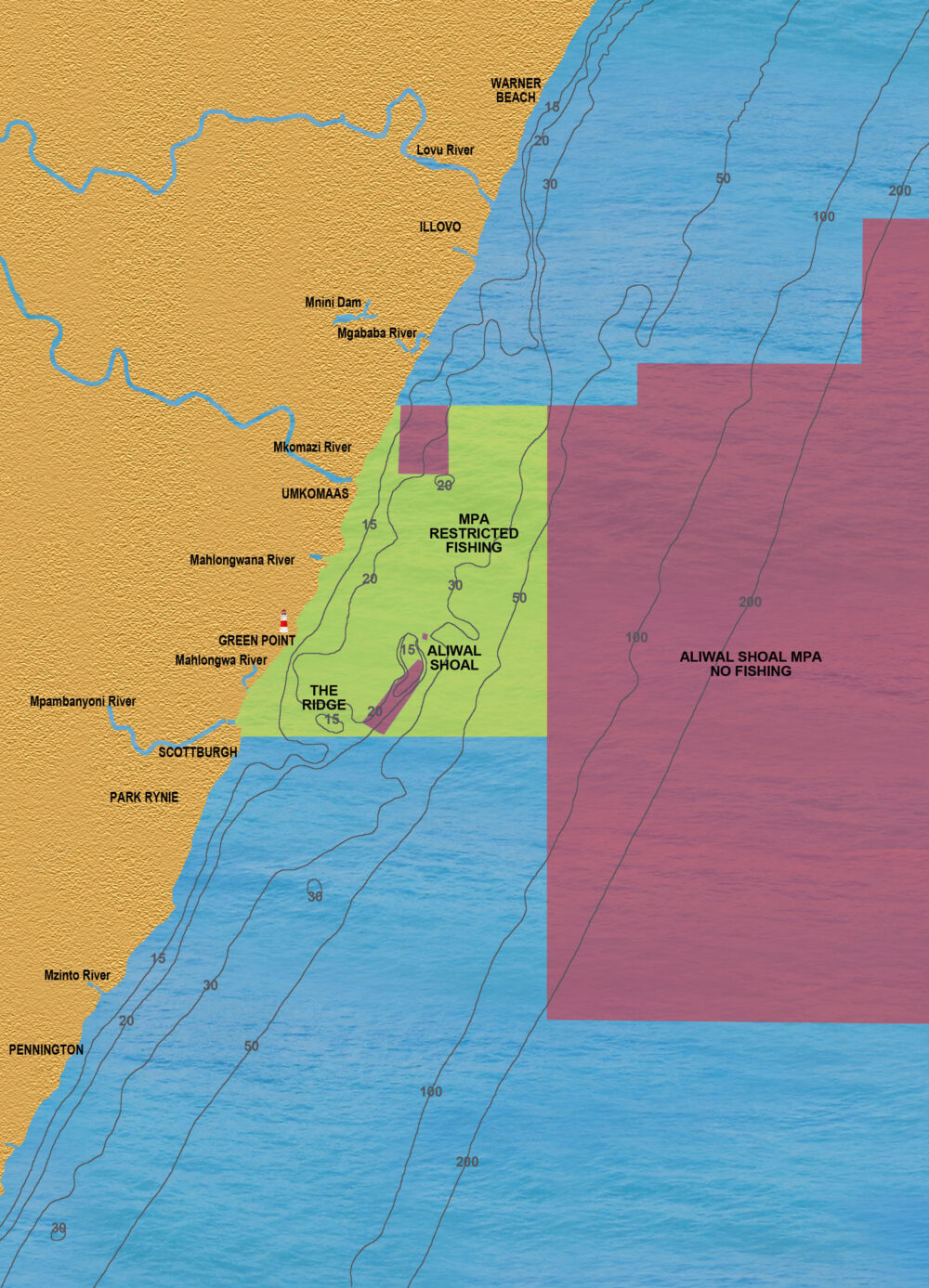
    A final note on this area: As can be seen on the accompanying map, it is home to a rather large Marine Protected Area (MPA) that extends all the way from Umzimai in the south to far beyond Aliwal Shoal in the north.
    This MPA has three distinct zones, namely Green, Orange and Red, each with their own set of restrictions. With the exception of Aliwal Shoal itself, gamefishing is largely unaffected, and even on Aliwal itself, if you refrain from fishing right on top of the reef, you are in the clear.
    My best advice is to visit https://www.saambr.org.za/marine-protected-areas-mpas/ which has a host of information on these MPAs and even a digital map that you can download onto your smartphone and link via Google Maps.
    Also bear in mind that both Umkomaas and Scottburgh launch sites fall within MPA zones that have restrictions on what tackle you may launch with. This means that from those launch sites you may not launch with bottomfishing tackle on board even if you plan to fish outside the MPA.
    See you on the water!

  • COMING FULL CIRCLE

    COMING FULL CIRCLE

    Small to big and back again

    By Mush Nichols

    [Originally published in the March 2023 issue of Ski-Boat magazine]

    I BEGAN my fishing and boating journey in the suburban area of Pinetown, on the New Germany border of Durban in the mid 1950s.
    I soon had a few friends, both black and white, and boy did we have fun. The days were simply too short. In those days we had thousands of acres of forest, grasslands and of course a lovely little river full of small fish, eels and crabs to explore. There was so much to do, and we set about it all with unlimited energy..
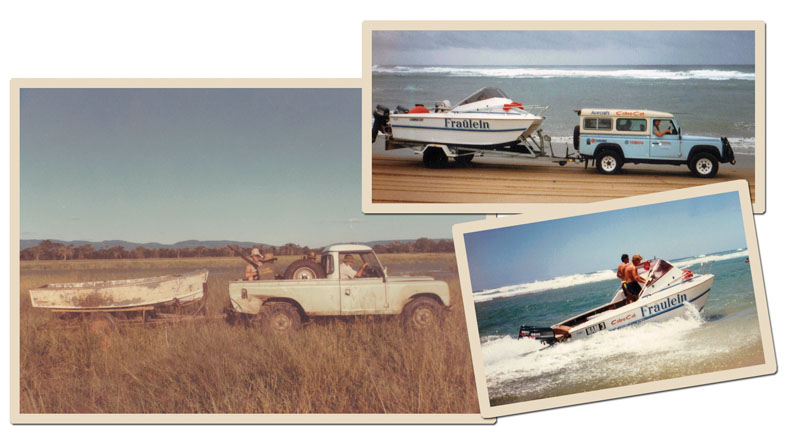
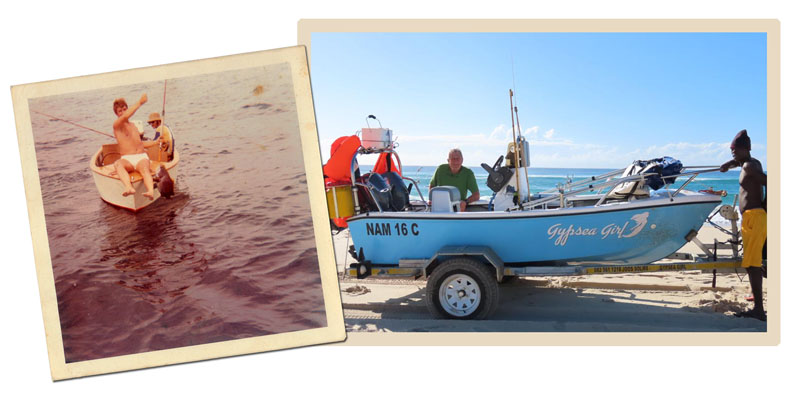
    My pal Robin, nicknamed Bin, decided to build a boat to tame the mighty Palmiet River — although actually it was just a small stream. My late father, being a master carpenter, cut us a thin transom and a bow post, and the rest was easy. Bin and I used our combined marine engineering skills, and flattened a piece of corrugated iron into an uncorrugated piece.
    My mother, being a German thoroughbred, insisted our boat had a name; she also decided unilaterally that the name would be Fraülein. And so Fraülein #1 was born — a six foot master craft.
    A few kilometres downstream lived Monkey Mcgee. There was no doubt about how he obtained his name — he not only resembled a vervet monkey, but also acted like one. When he was not up to mischief he was a help to our small Huckleberry-type group. His role was to get our boat back upstream by dragging it along the sandy bush path with the aid of one of his father’s donkeys. In return he was allowed the use of our boat. Rednecks? Well, if not, we weren’t far off
    By the mid 1960s boarding school was behind us and it was time to get really serious about fishing. Real fishing. In the sea. A soft loan from Pa enabled us to purchase an Ace Craft paddleski kit, and within two weeks we were ready to put to sea.
    Our base was Vetch’s Pier, and the fishing was hectic on Limestone Reef. Watching the large boats from the Durban Ski-Boat Club which often anchored in the same area taight us a great deal, and it was not long before we caught our first ’cuda. We were totally hooked on our new sport.
    There were no shoal ’cuda near the shark nets, they were all big fish — seldom less than 15kg and many in the 20kg range.
    The bulk of our catches were made up of snappper salmon and shad, along with the silkies and walla walla, all of which came in with the off-coloured water from the Umgeni River. The silkies (wolf herring) and the walla walla (ribbonfish) were put out as live baits and accounted for the large ’cuda.
    Soon we decided it was time for a bigger boat; our small paddle craft limited us from venturing out to the main grounds, and we needed something with a motor. The purchase of a used 13 footer with one 35hp Mercury motor was the next step forward. Tongaat here we come!
    As the years passed by the boats slowly increased in size, and at long last I was granted a number at the Durban Ski-Boat Club.

    FISHING BUDDIES
    One day in the late 1970s this farmer-type character arrived at my small boat building factory and introduced himself as Joos Solms, a farmer from Winterton. He pronounced it without the first T and added another N next to the first one — Winnerton. His English was far better than my Afrikaans but, he explained, his volcalvary was not so good!
    This was the start of a very special friendship. Joos grew up near Nongoma in Northern Zululand and had a similar Huckleberry-type childhood as I did, and his love for fishing was and is unquestionable. His small ski-boat, Capt’n Morgan, was well known at Umdloti and Cape Vidal.
    Joos later progressed to larger boats, but he never lost his love of fishing on small boats. Whether it be fishing for bass or bream in Zimbabwe, tackling marlin and sailfish in Moçambique, or just fishing from the river bank or beach, he and I do it all. Our beach fishing trips to Moz were always accompanied by some tiny craft of his, and the two I recall very well could hardly be classed as boats! All the same, they did the job for some fair weather backline fishing.
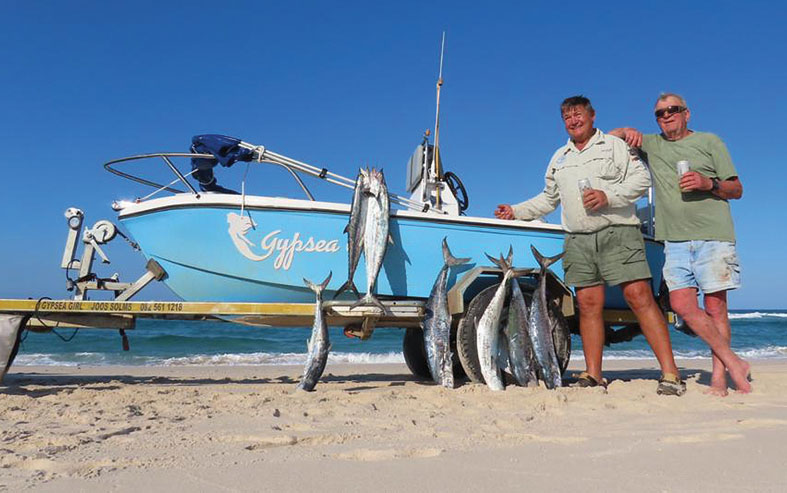
    Out of the blue an excited Joos called me last year to say he had ordered a small boat to suit our needs in Moz. He asked my advice on fitting a single 30hp or two 15hp motors. I mentioned — as diplomatically as possible — that my days of going to sea with one motor were officially over. Now we have a lovely 12 foot Gypski with two motors and even a canopy. Her name is Gypsea Girl.
    Since then we have made two trips to Moz and have had an absolute ball. We never say nice things to each other, but I must add that Joos is one of the best skippers and fishermen I have had the privilege of fishing with, and when the fishing is slow he keeps the show alive with his great humour and wit.
    In November 2022 Joos and I were sitting in the bar at the San Antonio Motel, Landela, Moçambique, enjoying the company of the owners Vic and Adelaine, and getting stuck into the ice cold beers. Suddenly we noticed a large catamaran with two huge outboards hanging on the transom arriving in the car park. It looked very similar to Joos’s new Cobra Cat 650.
    Shortly thereafter the owners arrived in the bar and were also thirsty. They introduced themselves as farmers from Komatipoort — a short guy and a tall guy. The short guy began the interrogation, as is usually the case: “Waar het julle baars probeer vang?” They had obviously seen little Gypsea Girl.
    Joos spoke in Afrikaans, explaining that in fact we had been sea angling. There was a brief silence as the short guy and tall guy looked at each other, not sure if they were being handled or not. The short guy then asked me in English what we’d caught. I mentioned that we’d had good angling with an array of gamefish and a marlin.
    There silence again as our new friends were even more confused as to whether or not they were being set up. Clearly it was time for show and tell, and we ran the movie of Joos fighting a small marlin which I somehow managed to film. It was really spectacular, with the fish dancing all around the boat.
    The farmers, now relaxed, had one more question — the short guy again: “Hoekom vis julle twee saam? Boer en Engelsman?” Joos looked at the short guy with that natural naughty smile on his face, and retorted: “Because no one else will fish with me!”

    SMALL BOATS OR LARGE BOATS?
    Now, in the latter years of our fishing careers, Joos and I have become fairly selective about our fishing venues. We no longer fish in Durban, and at Cape Vidal we use the big boat; with tractors to launch the boat there one does not even get one’s feet wet! In Moçambique and other far off places the small craft is more suitable, and one is hardly aware of towing the little craft with a 2.8 Hilux. Cost wise, there is no comparison — in seven days of fishing we used 55 litres of petrol.
    Other than the much higher costs involved in travelling, obtaining licences, launch fees etc when using a big boat, there are other reasons why we enjoy the small boat so much. It certainly has nothing to do with comfort and keeping dry, because Gypsea Girl is a tiny craft — strictly a two man boat with little space to move. However, she more than makes up for her size with the pleasure she affords us. We are now fishing the way we did a long time ago, the way we enjoyed fishing so much in our youth.
    I fish from the front where there is a comfortable padded little bench seat (the suicide seat!), whilst Joos has a seat behind the console. There’s no problem until all four rods bend simultaneously!
    We normally manage the small space without too much fuss as we both have our own gaffs and priests. In other words, you are on your own! Occasionally a fish may surface in front of the other angler and it is only polite to gaff the other guy’s fish for him, but do not miss-gaff your pal’s fish, because the verbal abuse is most unpleasant — both ways.
    That said, I have always preferred gaffing my own fish and so does Joos; this comes from the old days when one had no choice. Besides, it is far easier to present the fish to gaff the way you want to. We always gaff the fish we wish to keep in the middle on top so that the fish is well presented for the head blow without trying to give it an upper cut as one does with an upside down fish.

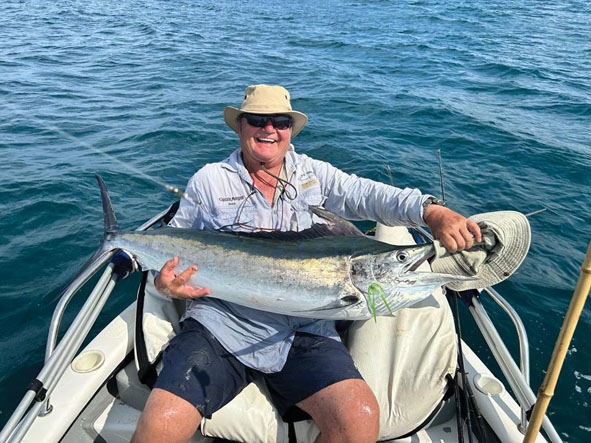
    Joos Solms with the marlin he caught from his 12ft Gypski, Gypsea Girl.

    Catching billfish in a small boat is an entirely different story. The highlight of our last adventure was the marlin Joos caught. We have both caught several marlin, but boy, this small marlin could fly! With each leap, we both applauded the fish with with loud shouts and laughter. After bringing her alongside we took a quick pic and she swam away happily.
    In conclusion, I would say we have come full circle … or perhaps we’re just enjoying our second childhood!

    • For more reasons why fishing from a small boat might be a good idea, see Justin Paynter’s article in the November 2022 issue of SKI-BOAT.

  • WHERE TO FISH PART 9

    WHERE TO FISH PART 9

    Exploring south-west of Christmas Rock, Eastern Cape

    By John Luef and Fred Clarke

    [Originally published in the May 2023 issue of SKI-BOAT magazine]

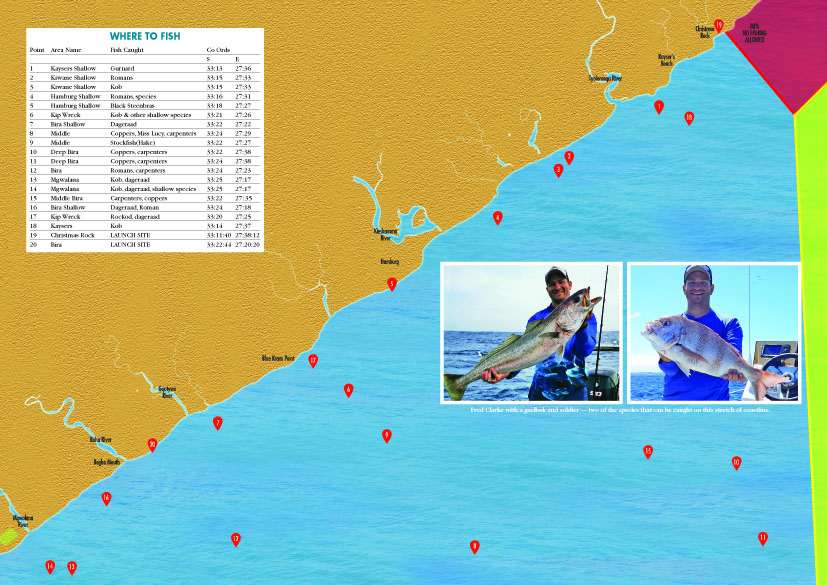
    THE coastline from Christmas rock to Bira (pronounced Biga) is one of the most picturesque of Southern Africa, being surpassed only by the Wild Coast of the old Transkei, in my opinion.
    This area also has a great diversity of species that can be caught from just behind the breakers, all the way out to the “shelf” approximately 20- to 25km offshore, in depths ranging from under 10m up to 100m, with shallow, mid and deep reefs in abundance. In this article we will cover the fishing from Christmas Rock all the way down to Mgwalana river mouth.
    Christmas Rock is on the southern boundary of the Gulu Marine Protected Area, so all skippers angling in the area are reminded to ensure they have the coordinates and are aware of all regulations pertaining to the MPAs.
    This area is particularly well known for its abundance of decent sized carpenters (dogs) which average over 3kg. The current SA record — a whopping 4.8kg — comes from the area and is held by Garth Roux.
    The abundance and diversity of the species in the area can mainly be attributed to:
    a) The effectiveness of the MPAs which have become overpopulated over the years, and many fish are migrating out of them.
    b) Bag and size limits being implemented years ago that are now showing their effectiveness.
    c) Recreational fishermen being far more responsible due to the awareness and protection measures created by clubs and associations.
    The area covered in this article has two registered clubs from which vessels may proceed to sea to partake in recreational angling. Visitors to the area can contact the clubs (information below) to enquire about launch permits, costs, and any other relevant information for that site.
    • Christmas Rock Ski-Boat Club
    Claud Wilken 084 951 2696
    • Bira Ski-Boat Club
    Anthony Thompson 082 577 9097
    Both launches are surf launches and a tractor or 4×4 is definitely required.

    SPECIES TO CATCH
    When fishing in the shallow reefs up to approximately 40m depths, the more common species to expect are kob, black musselcracker, Scotsman, dageraad, santer (soldier), Roman and yellowbelly rockcod. Gurnard and stockfish are also occasionally caught on sandy areas in approximately 40m water depths.
    The mid- to deeper reefs will produce red steenbras, Miss Lucy (red stump), carpenter (dogs), seventy-four, butterfish and geelbek. Although these are predominantly deeper water fish, they have also at times been landed in relatively shallow waters.
    Gamefish are rare and not often targeted in these areas.
    The coordinates supplied alongside this article need three more numbers on the end (a fisherman has to have some secrets), but they do give a general area where these species can be targeted. Good luck and tight lines.

    TACKLE
    Generally, in the shallow waters, a light rod of around 7 to 8 foot should be used, along with a reel of your choice and light braid or nylon up to around 20kg. This will give the angler the most pleasure when fighting a fish. For shallower waters an 8-to-12-ounce sinker is usually sufficient.
    In this region, anglers mostly use the “Scarborough” (KP) fishing reel, which generally gives a great feel of one-to-one on any fish, but anglers can use whatever they are most comfortable with.
    On the deeper reefs, a heavier rod with an 8-inch Scarborough is mostly used. Braid is virtually a must due to the strong currents. As braid is thinner than nylon line, it cuts through the water, gives you more chance of keeping your bait on the seabed, and allows you to feel the bites better.
    Nylon has a lot of stretch, and when you’re fishing at 80m-plus depths in a strong current, a lot of bites will not be felt.
    In these deeper waters you rarely get away with a light sinker and generally a 16- to 32-ounce sinker is required, depending on the current strength.
    The Agulhas current is predominant in this area on the mid- to deeper reefs, running from north to south down the coast and can get extremely strong at times.

    KOB
    Bag limit is five per angler from a boat; minimum length is 50cm, with only one of the five allowed to be above 110cm.
    The general area off Hamburg is the best place to target this species, with some very nice sized ones being landed from time to time. Kob can be caught from very shallow to depths up to 40m.
    Kob seem to like a neat bait and will readily bite on pilchards, squid and even octopus leg. They are targeted in this area, using three strips of squid dangling off the hook. Some anglers like to use small white or colored skirts above the hook. Generally, a 6/0 to 9/0 hook can be used with a relatively long hook trace, as kob seem to be sensitive to feeling resistance on the hook trace.

    DAGERAAD
    Bag limit is one per angler with a minimum 40cm total length. Dageraad feed on many types of bait, including but not limited to pilchards, squid, and sliced fillet. However, their favourite bait is a nice, cleaned piece of octopus leg and in this area the leg is cut into medallions like coins and put on the hook.
    A 5/0 to 6/0 hook is a good size to use for this species.

    Dale Webb with a black musselcracker.

    BLACK STEENBRAS/MUSSELCRACKER
    Bag limit is one per angler with a minimum 50cm total length.
    Black musselcracker are abundant in the shallows and up to around 40m deep, although have been caught deeper. This species likes very clear water and areas where there are lots of smaller fish and large reefs.
    They will feed on most baits but prefer a big eye (Frans Madam) or steintjie flapper (tail and spine removed). Black steenbras are extremely exciting to catch as they bite ferociously and fight all the way up. They also try to head for the nearest reef to cut off your trace.
    A minimum of a 10/0 hook is ideal for this species.

    SCOTSMAN
    Bag limit is one per angler with minimum 40cm total length.
    Scotsman are generally found hanging around with black musselcrackers, and usually when one of these species is caught, the other is caught soon after.
    Scotsman can be caught in all depths of water up to 100m, but are more common in the shallows in less than 30m of water.
    They feed on most small baits with their favourite being a couple of pieces of squid. A 5/0 hook — not bigger — is ideal for this species as they have relatively small mouths.
    Scotsman are also strong, clean fighters and give immense pleasure to light tackle anglers. They are one of the more stunning fish in the ocean with very vibrant colours.

    RED ROMAN
    Bag limit is two per angler with minimum 30cm total length.
    Romans are, without doubt, one of the most colourful fish in the sea, and their bright red colour is unmistakable. From in front of Christmas Rock all the way down to Bira, they are quite abundant, and specimens of over 3kg are caught regularly.
    These fish are mostly found in shallow water under 20m deep where they feed on a variety of small baits like squid, octopus and pilchards. They have very small mouths, and a 3/0 to 5/0 hook will be ideal.

    SOLDIER (SANTER)
    Bag limit is five per angler with minimum 30cm total length.
    Soldiers are normally found in the shallows in less than 40m of water, in shoals where they will aggressively feed on just about any bait presented to them. Usually a couple of strips of squid or a whole pilchard works well. A 5/0 hook is the ideal size for this species.
    They are extremely feisty fighters and are very enjoyable to catch.

    ENGLISHMAN
    Bag limit is one per angler with minimum 40cm total length. These fish are relatively rare in this area and are not often caught. It is advisable to release them to allow their stocks to multiply.

    YELLOWBELLY ROCKCOD
    Bag limit is one per angler with minimum length of 60cm.
    This fish is known to be extremely slow growing and very territorial. Yellowbellies will readily take sliced bait as well as small flapper baits. They can also be targeted on old smelly pilchards which most other species will not take. They have very large mouths and can be caught on 8/0 and larger hooks.
    Yellowbelly rockcod are known to grab a bait and head into holes or crevices, with the angler having a hard time getting them out.
    Beware when handling them because their gill plates are very sharp and have sliced open many an angler’s hands.

    GURNARD
    This species has no size limit, and the bag limit is ten per person.
    Gurnards are almost always only caught in sandy areas and in water round 40m deep.
    They generally like pilchard baits and are found right on the sea bed, so are targeted with a very short sinker trace. Despite their fearsome appearance, gurnards are extremely tasty and very sought after.

    STOCKFISH (HAKE)
    Bag limit is five per angler with no size limit. They are very popular table fish in South Africa and have huge commercial value, being netted and caught on long line commercial vessels.
    Stockfish can be caught along this area of the coast and are generally also found in sandy areas from 40m depths. The trawlers and long liners usually catch deep water hake in much deeper areas.
    Hake enjoy a strip of squid or pilchards and are generally targeted with 8/0 or bigger hooks. Their mouth is relatively soft, so they cannot be brought up fast or the hook may tear out.
    They also have very sharp teeth and anglers must take care when handling them.

    RED STEENBRAS
    Bag limit is one per angler with minimum 60cm total length. They have a closed season for October and November each year, although clubs and associations have voluntary increased this to include September for their members.
    Red steenbras is the iconic species for the Border area and they are fairly abundant on the deeper reefs, although they sometimes pop up on the shallow reefs as well. This species gives anglers one of the most exciting thrills when it bites as the bite is very aggressive and exaggerated; they then go on to give one of the most exciting fights — long, hard and tiring, but very satisfying in the end.
    Generally red steenbras are caught in around 90m of water. This fish will feed on most baits from a mixed grill to a live smaller fish (butterfish, dikbekkie or carpenter), sliced baits, flappers and pilchards, and have even taken small strips of squid. Some days they can be extremely fussy and will only take on certain baits, which makes it a great challenge to the angler. A 10/0 or larger hook can be used to catch this species.
    These great fish do not release very well, so rather move to other areas once you have caught your quota, as they will continue to feed.

    John Luef with a beautiful Miss Lucy caught on a Scarborough reel.

    MISS LUCY (RED STUMP)
    Bag limit is one per angler with minimum 40cm total length.
    Miss Lucy is one of the most beautifully coloured fish to catch, with banded shades of bright red and white which vary extensively in males and females, and black speckles. They have huge bumps on their foreheads which are more pronounced in the males. Once landed, they also have a very strong distinctive smell and are quite slimy.
    They will feed on a variety of baits including pilchard, squid, mixed baits, and octopus. Their favourite is a long, thin mixed bait and a squid head. They can generally be caught on 5/0 to 6/0 hooks.

    CARPENTER (DOG)
    Bag limit is four per angler with minimum 35cm total length.
    Carpenters are nicknamed dogs due to the structure of their teeth which is very similar to that of a dog.
    As mentioned earlier, this species is the most abundant in this area and can generally be caught at any depth from 20m and up, even beyond 100m. They congregate in very large shoals, and it can become very frustrating when an angler cannot get any other species due to their abundance and continuous feeding.
    Carpenter will feed and bite very aggressively on absolutely any bait. They have large mouths and can be caught on 8/0 hooks with a large luminous bead above the hook, which attracts the fish.

    BUTTERFISH
    Bag limit is five per angler with minimum 30cm total length.
    These fish are not as abundant in this area as they are in the East London area, but can be caught on the deeper reefs. They are generally found in shoals and will feed on small squid baits. They can be caught on a 2/0 or 3/0 hook with one small strip of squid and a luminous bead above the hook. They have tiny mouths and make an excellent bait for red steenbras.

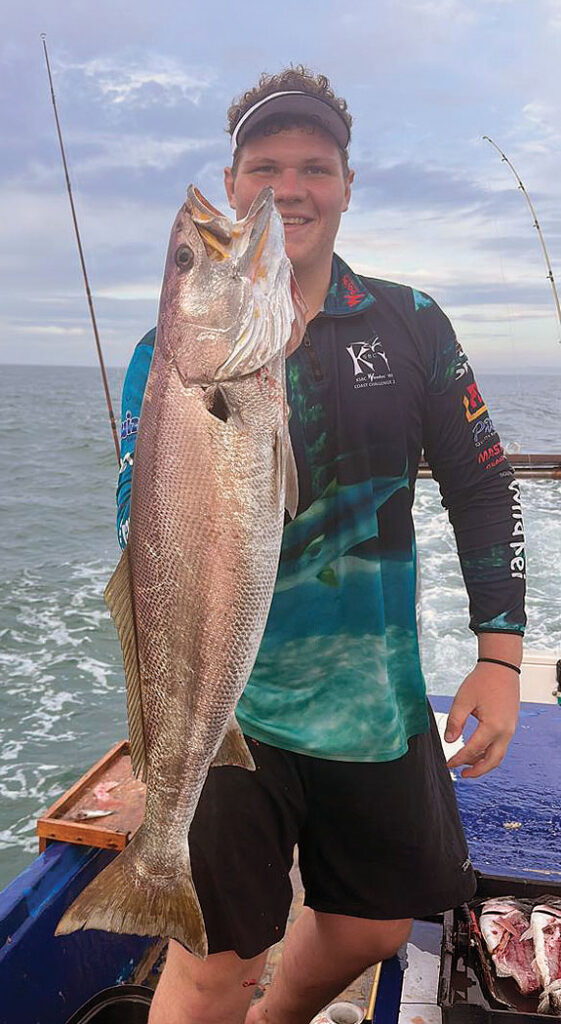
    Keagan Nieuwenhuis with a lovely geelbek.

    GEELBEK
    Bag limit is two per angler with minimum 60cm total length.
    Geelbek are so called, because of the bright yellow colour inside their mouths. They are long, streamlined fish and give a very hard fight to any angler. Their bite is an unmistakable aggressive shake, and they often swim up with your bait, creating slack line.
    This is probably the most unpredictable species in our waters as they are mostly caught on the deeper reefs for three- to four months following the annual sardine run, but they can often be caught on the shallower reefs as well. They are also caught sporadically in unexpected areas all year around. They usually move around in large shoals.
    Geelbek will feed on pilchards, sliced bait and squid, but sometimes get “lockjaw”, and although they can be seen on the fishfinder, they cannot be enticed with any bait.
    Due to their large mouths 10/0 or bigger hooks can be used.

    SEVENTY-FOUR
    This is a banned species and must be released. They are, however, extremely abundant in this area on the deeper reefs and some days are pests as they are so abundant that you cannot catch any other species.
    They feed on any baits put down for other species.
    In my opinion, it’s long overdue that the decision makers un-ban this species.

    GAMEFISH
    As mentioned earlier, gamefish are not usually targeted in this area, but dorado, bonito and yellowfin tuna can be found in our waters from November through to March each year. The most common species caught then are bonitos, with the odd yellowfin tuna being caught.
    Angling in the Christmas Rock and Bira areas can be very exciting and rewarding due to the many species available to target and the diverse seascape, so go out there and have some fun.

  • WHERE TO FISH Part 6

    WHERE TO FISH Part 6

    Sodwana Bay — A Sportfishing Mecca

    By Henk du Plessis, Chairman Sodwana Ski-Boat Club

    [Originally published in the November 2022 issue of Ski-Boat magazine]

    SODWANA Bay is, without doubt, the epicentre of offshore big game fishing in South Africa. From its semi-secluded position at Jesser Point where the substantial reef juts out in a north-easterly direction, to Mgobezeleni Lagoon further north, this long stretch of beach is the launching pad for an exceptionally fine array of sportfishing craft during the major billfish competitions run from this base.
    When 70-plus ski-boats — outriggers erect and bowed for action — are lined up on the water’s edge, awaiting the signal to commence launching, it’s a sight that burns deep into the soul of any offshore angler.
    But this is not where ski-boating began at Sodwana Bay. Way back in the 1960s, intrepid farmers of the north Zululand coast and Pongola area cut their way through the coastal bush to camp and surf fish at Jesser Point.
    Surf fishing gradually expanded to boat fishing, and the fertile waters of the area provided huge hauls of bottomfish and limited catches of inshore gamefish that were taken home to use for farm rations.
    In later years, once the then Natal Parks Board opened the area and serviced campsites were set up, many more ski-boaters began venturing to this pristine fishery.
    During the late 1970s a number of ardent billfish anglers from the Natal Deep Sea Rod and Reel Club, beefed up by billfish experience gained in Cairns, Australia, and/or Bazaruto Island off Moçambique, banded together with about eight ski-boats to test the waters off Sodwana Bay for marlin potential.
    This venture was so promising that in 1978 the Sodwana Gamefish Club was formed, formally putting the billfish of Sodwana on the map.
    During this period many of the Transvaal and Eastern Transvaal fishing club members also travelled to that section of coast to try their luck.
    During these forays in pursuit of the mighty billfish, three big black marlin stood out and really set a high benchmark. The biggest was a 936 lb marlin caught on Piet Joubert’s Bonito, then another of just over 900 lb was caught, and then one of 927 lb on Erwin Bursik’s Sea Lord.
    With the advent of trolling lures instead of deadbaits and livebaits, anglers experienced an above average catch of striped marlin deep off Jesser Point. This tactic was introduced by Piet van Dyk, a Kenyan farmer who had relocated to South Africa and who had a great deal of lure trolling experience in the billfish-rich waters off Malindi on the Kenyan coast.
    Now almost the norm, two massive blue marlin — one of 1 112 lb caught on Francois Erasmus’s craft Big Time and shortly thereafter the current All Africa record blue marlin of 1 149 lb caught on Lappies Labuschagne’s Black Magic — set the current trend of lure fishing as being the most effective way to target marlin in this area.
    Having said all that, there is also a very strong following of light tackle offshore ski-boats that target the wide variety of gamefish species and sailfish this area has to offer.
    King mackerel (aka ’cuda), yellowfin tuna, dorado, wahoo and the various kingfish species give the gamefish anglers something to target virtually all year round. However, with such a vast expanse of ocean available to explore, everyone wants to know exactly where to catch the specific fish they’re after.
    I have spent many years fishing for gamefish off Sodwana, and now run a charter operation targeting almost exclusively the light tackle gamefish this area has to offer. I will thus focus mostly on this aspect in detail as Sodwana Bay has a lot more ski-boaters visiting the launch site all through the year than those who just come to target the billfish which frequent this area in summer.

    On the map alongside, I have not only marked my most prolific areas from Black Rock in the north to Red Sands in the south, but also indicated available livebait marks and times of the year when I have found light tackle gamefishing is most productive.
    Since the implementation of the inshore marine reserve many years ago by the Natal Parks Board, no bottomfishing or jigging has been allowed. The iSimangaliso Marine Protected Area begins south of the beacon at Red Sands (south of Jesser Point) and all angling from the beach and at sea is prohibited in that area. Fishing is also restricted from Black Rock north.
    King mackerel (’cuda) will always be the premier sportfish targeted off Sodwana, because not only is it an exciting fish to catch, but it also remains a most appreciated table fish and the fillets hold well in a freezer to take back home after a fishing trip to Sodwana.
    It is well known that ’cuda are basically reef specific, and for this reason I am including the positions of a number of my favourite areas where these fish are most frequently found.
    Bearing in mind the virtually continuous current that’s experienced off Sodwana Bay, slow trolling is the preferred method of targeting this species. Having said that, if the current is not strong on a specific outing, then you can drift over the suggested areas, especially if your sounder reflects more fish showing near the bottom than in a higher water column.
    Again I must stress the importance of being area specific and fully focused; one can’t just set a drift and sit back and snooze.

    Henk du Plessis with some gamefish caught off Sodwana Bay.

    The reefs holding the gamefish are small and don’t run parallel to the shoreline for long distances. Also, being species specific in this article, I don’t fish for ’cuda by just pulling deep diving lures for hours on end and hope for a lucky shot.
    From February to June I fish for ’cuda at Diepgat, working a straight line between the two marks I’ve shown on the map alongside, slow trolling with bait or maasbankers.
    The reef at Island Rock produces shoaling ’cuda from March to May, and the spot called “Piet” is an excellent location for big winter ’cuda on the downrigger. Mabibi also produces big ’cuda during winter months.
    King Marlin is a long reef on the 45m to 50m depth mark about 5km south of Diepgat. The reef is not in a straight line, so I have shown its location with six waypoints. From July to September, when we struggle to get gamefish, I exclusively fish up and down this reef with Speed Pro, Rapala or Halco lures, favouring the dark colours like black or purple.
    You will get ’cuda, yellowfin tuna, skipjack, wahoo and the odd sailfish here. It is also a very productive reef where you can use a downrigger to reach big ’cuda from February to June.
    A new white buoy has been anchored at 18m depth at Red Sands. This is much further north than the boundary line for the MPA on our GPS maps. Be careful not to cross this line as you will be challenged by Sharklife’s Grant Smith who has taken it upon himself to guard this buoy. The buoy is an excellent gamefish spot for ’cuda and dorado from November to March.
    Specific baits are important, and whilst we have access to hand-caught halfbeaks which are very successful in the area, I rely on frozen baits such as sardines, mackerel and other exotics that are available.
    Livebaiting used to be quite popular, but there is now a restricted dive zone in the shallow waters which is part of the MPA, and which stretches from the launch site to just past Nine Mile. This restricted dive zone took away about 70% of our livebait spots to the north of Sodwana. However, I have shown a number of areas on the map alongside where livebait (especially maasbanker) can be caught on Yozuris.
    The three other species that are specifically targeted are dorado, wahoo and tuna. Each of these is a little more difficult to specifically target and, to a large extent, they are caught using either Rapala-type lures or small, straight-swimming plastic lures or chuggers with a halfbeak or fish fillet tucked in behind it.
    Tuna can be caught specifically on the southern wall of Diepgat at around 80m depth from mid-January to May. We use 50 lb rigs from January to April, though as sharks are a big problem.
    While the small yellowfin tuna are definitely more abundant in specific areas, they are best targeted when they show themselves working bait shoals. This often happens on an upwelling on the edge of some of the deep canyons we are so fortunate to have close to Jesser Point. Prime examples of this are the ledge of Diepgat in the south and the base area of the canyons off White Sands.
    Wahoo and dorado are ocean wanderers and one has to cover distance in search of these fish. In saying that, the ocean off our area is magnificent, clear and warm, carrying many of the tropical baitfish species such as friggies, bonito and “sprats”, so one’s chances of finding or attracting a wahoo or dorado into one’s spread of various lures being pulled at 3- to 5 knots is good.
    Piet is an excellent spot to target wahoo early in the morning, and “Elusive”, north of Island Rock, is a good spot for kingfish, ’cuda and wahoo, although sharks can be a problem in summer.
    In Rocktail Bay the water temperature always seems to be one or two degrees warmer than in Sodwana Bay itself, and I have won numerous gamefish competitions over the years by fishing in this area.
    Black Rock is very far to travel to, but it’s always rewarding from February to May.
    When targeting the gamefish mentioned, it’s paramount that you get an early start to your day on the ocean. Most, if not all, of these species feed well up until 10am, after which, as the sun rises well above the eastern horizon, fishing becomes a lot more difficult and then working very specific reefs and/or working shoals are the only ways you’ll get acceptable results.
    The clear water off Sodwana Bay makes it difficult to catch Natal snoek (queen mackerel), but if we get them, it will be right behind the backline in 5m water and usually in a light southerly wind, very far from the boat. August and September are the best months to target Natal snoek.
    Sailfishing off Sodwana Bay is not to be underestimated. Although a number of sails are taken by the marlin boys as an incidental catch, they are an essential and very exciting fish for our light tackle brigade to target. What’s more, they are found year-round in varying degrees of profusion.

    Henk du Plessis about to release another sailfish off Sodwana Bay.

    I have personally released more than 100 sailfish at Piet over the last eight years; it’s my go-to in sailfish tournaments. During the winter months my first stop and working area for sailfish is known as Sailfish Knoppie and it is also marked on the map.
    Our best time for marlin is from the beginning of November up to March. In April and May we get the big blue marlin, but during the winter months we only get small black marlin (40- to 80kg) in the shallow water (40- to 100m depth). During November and December there are a lot of striped marlin around Sodwana (300- to 500m depth).
    In conclusion, we at Sodwana welcome all ski-boaters to our area, and if we can help you enjoy the area’s gamefishing to the maximum, we will certainly do so. Anglers are more than welcome to join our local ski-boat club, and this is where they will get most of their information regarding what is on the bite and where.

  • THE GREATEST SHOAL ON EARTH

    THE GREATEST SHOAL ON EARTH

    South Africa’s massive sardine run leads fish into an ecological trap

    [Published in the July 2022 issue of SKI-BOAT magazine]

    Winter in KwaZulu-Natal is synonymous with the sardine run, when uncountable numbers of sardines travel from the Cape to KZN, bringing heightened excitement all along the east coast. In addition to the enthusiasts who flock to net the sardines, gamefish anglers target the predators that closely follow the little fish.
    Until recently it has been a great mystery as to why this migration happens. Scientists examined the DNA sequences of 284 sardines captured along the South African coast to try to answer this question.
    In anticipation of this year’s sardine run, we republish this article which originally appeared on The Conversation, in which scientists reveal why the little silver fish migrate, even if it inevitably ends badly for them.

    By Peter Teske, University of Johannesburg; Carl van der Lingen, University of Cape Town; Christopher David McQuaid, Rhodes University, and Luciano Beheregaray, Flinders University.

    ONE of the world’s most spectacular marine migrations is the KwaZulu-Natal sardine run. The so-called “greatest shoal on Earth” takes place during the southern hemisphere’s winter. It involves the movement of tens to hundreds of millions of sardines from the warm, temperate waters of South Africa’s south coast to the subtropical waters of the east coast, over a thousand kilometres away.
    This annual mass migration, first reported in 1853, is triggered by cold water upwelling on South Africa’s south-east coast. In this process, cold, nutrient-rich water rises up from the deep, creating a highly productive food web.
    The migration attracts vast numbers of predators: the sardine schools are followed northwards by seabirds, sharks, seals, dolphins and even large baleen whales. These devour as many of the helpless sardines as they can, which is made easier by the fact that their prey is sandwiched between dry land and the hot, tropical waters of the southward-flowing Agulhas Current, which exceed the sardines’ physiological tolerances.
    To make matters worse, those fish that survive the predation still don’t have it easy: the journey is so strenuous that the sardines which eventually arrive on the east coast are emaciated.
    This goes against what scientists understand about animal migrations — such large-scale population movements normally provide some “selective advantage” by allowing animals to make optimal use of environmental resources.
    Surely the obvious negatives of participating in the sardine run must be hugely outweighed by some fitness benefits to make it all worthwhile. The answer, our new research suggests, is “no” — and the reasons for the sardines’ behaviour lies in their genes.

    Some of the factors at play in the sardine migration.

    A DISTINCT EAST COAST POPULATION?
    One popular explanation for why the sardine run occurs is that the migration might be a relic of spawning behaviour dating back to the last glacial period, about 10 000 years ago. What is now subtropical Indian Ocean habitat may have been an important nursery area with cooler waters.
    When the ice age ended, the sardines would have physiologically adapted to tolerate the subtropical conditions in this region and evolved into a distinct east coast population that continues to spawn there to this day.
    These sardines mix with south coast sardines during summer, then separate from them in winter as they migrate up the east coast. The presence of sardine eggs in the plankton confirms that spawning does occur in this region.
    Surprisingly, we discovered that sardines participating in the migration are not part of a distinct east coast population. Instead, they primarily originate from the colder waters off South Africa’s Atlantic west coast.
    Why would these sardines migrate to the opposite end of the country, only to end up in habitat that is obviously too warm for them? We suggest that the fish are drawn into what amounts to an ecological trap — a rare example of a mass migration that has no obvious fitness benefits.

    A map of the South African range of the southern African population of Pacific sardine, Sardinops sagax, showing sites at which sardines were caught for genome and transcriptome sequencing.

    GENOMIC ANALYSES
    Our research started from the assumption that the sardine run represents the spawning migration of a distinct stock of sardines that is physiologically well adapted to tolerate subtropical conditions.
    Physical characteristics and other data indicate that sardines on the east coast are indeed distinct. But this may result from different environmental pressures, including the stress of participating in the migration. We knew that understanding the sardines’ heritable genetic traits would provide stronger evidence for this hypothesis — or debunk it.
    So we used thousands of genetic markers from across the genomes of hundreds of sardines captured throughout the species’ South African range. Although most of these markers showed little differentiation, a suite of genetic markers with a signal of adaptation to water temperature showed regional differences.
    We found evidence for two regional populations — but it was not the east coast sardines that were distinct. Instead, we found genetic differences within the species’ temperate core range: one population was associated with South Africa’s cool-temperate west coast (Atlantic Ocean) and the other with the warm-temperate south coast (Indian Ocean).
    The strong affiliation with water temperature suggests that thermal adaptation maintains these regional patterns; each population cluster is adapted to the temperature range that it experiences in its native region.
    The sardines participating in the run showed a clear affiliation with the west coast population. Not only are these sardines not well adapted to subtropical conditions, but they actually prefer the colder, upwelled waters of the south-eastern Atlantic Ocean.

    MAJOR RIDDLES SOLVED
    This study solves some of the major riddles concerning the sardine run, which make perfect sense in the light of the new evidence.
    Our findings explain why only a small fraction of the sardines present on the south coast participates in the run. The bulk of those sardines are native to this region and are adapted to warm-temperate conditions. Because of this, they show little interest in the cold, upwelled water.
    The results also explain why no sardine runs occur in years when there is no cold water upwelling.
    The upwelling on the south-east coast attracts west coast sardines that have dispersed to the south coast, but that are not well adapted to the warmer water temperatures in this region. They essentially consider the upwelling regions in the south-east to be west coast habitat. For a short time, it is as if they are back home in the Atlantic — but when the upwelling ends and water temperatures rise, their fateful error is revealed.
    At this point, the predators have gotten wind of their presence, and as the sardines try to escape, they travel ever farther north into unbearably warm subtropical habitat. The fate of the fish that survive the sardine run is uncertain.
    Our genomic explanation shows that much still remains to be discovered about how marine life interacts with its environment. A great deal of integrative, multidisciplinary research is still needed before humans can efficiently and sustainably benefit from the incredible diversity of life and the resources available in the sea.

    This article is republished from The Conversation under a Creative Commons license. Read the original article at <theconversation.com/south-africas-massive-sardine-run-leads-fish-into-an-ecological-trap-168413>.

    The original scientific article appeared on SCIENCE ADVANCES <www.science.org/doi/10.1126/sciadv.abf4514>.

  • WHERE TO FISH Part 5

    WHERE TO FISH Part 5

    Secret Spots of the Eastern Cape

    By John Luef and Fred Clarke

    [Originally published in the May 2022 issue of Ski-Boat magazine]

    THE Eastern Cape around East London has quite an extensive coastline with many offshore areas to fish from a boat. In this article we are going to cover the entire area from the Nyara River which is the southern boundary of the Kei Marine Protected Area (MPA), down to the northern boundary of the Gxulu MPA.
    There are three extensive MPAs in this area and all skippers angling here are reminded to ensure they have the coordinates and are aware of all regulations pertaining to the MPAs.
    East London boasts a great diversity of species that can be caught from shallow reefs all the way out to and beyond the continental shelf, up to and over 100 metres of water depth. Fishing has generally improved in this area over the last number of years, with an abundance of species. This can be attributed mainly to the following things:
    a) The effectiveness of the MPAs, whereby, over the years, they have become overpopulated and many fish are migrating out of them.
    b) Bag and size limits that were implemented years ago are now showing their effectiveness.
    c) Recreational fishermen being far more responsible due to awareness and protection measures created by organisations such as clubs and associations.
    This area is also well known for very rough offshore seas and extremely difficult fishing conditions due to the notorious Agulhas current which predominantly runs down the coast off KwaZulu-Natal to Cape Town. At times, the water can move at more than 10km/h, making it almost impossible to keep a sinker and bait in the strike zone on the seabed.
    The area covered in this article has four registered clubs where vessels can launch from and proceed to sea to partake in recreational angling. Visitors to the area can contact the clubs (information below) to enquire about launch permits, costs, and any other relevant information for that site.
    • Cintsa East (Beach Launch) Mark Steinhobel 060 505 8653; Alt. Guy Swart 082 655 2739
    • Kwelera Ski-Boat Club (River Launch) John Luef 082 898 2316.
    • Gonubie Marine Club (River Launch) Grant Keth 083 279 0260.
    • East London Ski-Boat Club (Harbour Launch) Graham Kingsley-Wilken 083 417 3920

    SPECIES TO CATCH
    When fishing in the shallow reefs up to approximately 50m depths, the more common species to expect are kob, black steenbras/musselcracker, Scotsman, dageraad, santer (soldier), Roman, Englishman, yellowbelly rockcod and moustache rockcod. The rarer species are German bream, white musselcracker, bank steenbras, baardman, John Dory and catface rockcod amongst others.
    The deeper reefs will produce red steenbras, Miss Lucy (red stump), carpenter (dogs), seventy-four, yellowtail, butterfish and geelbek. Although these are predominantly deeper water fish, they have also at times been landed in relatively shallow waters.
    Gamefish are rare to our area, but usually bonito, marlin and yellowfin can be caught from around November to March each year.

    TACKLE
    In this area, anglers mostly use the “Scarborough” fishing reel, which generally gives a great feel of one-to-one on any fish, but anglers can use whatever they are most comfortable with.
    In the shallow waters, to reap the most fun out of the experience, any light tackle rod up to around 10kg is perfect with a 7” Scarborough reel and nylon line or braid, whichever you prefer. Generally, an 8- to 12 ounce sinker is sufficient.
    On the deeper reefs, a heavier rod with an 8” Scarborough is the most used. Braid is a must due to the strong currents. Because it is thinner than line, it can cut through the water and give you a better chance of keeping your bait on the seabed and a better chance of feeling the bites due to the depths at which we’re fishing. Nylon line has a lot of stretch so you don’t feel the bites as well.
    Here you rarely get away with a light sinker and generally a 16- to 32 ounce sinker is required. The old argument between circle or J hooks will forever continue, so I suggest using what you are comfortable with and adjust the size of hook depending on the species being targeted.

    KOB
    The bag limit is five per angler from a boat; minimum 50cm with only one above 110cm allowed. Kob are relatively scarce here compared to other coastal areas, but there are a few areas, as indicated on the maps alongside, where they can be caught.
    Kob seem to like a neat bait and will readily bite on pilchard, squid and even octopus leg. Their favourite seems to be a mixed bait with a piece of squid dangling in the current. Generally, a 6/0 to 9/0 hook can be used with a relatively long hook trace as they seem to be sensitive to feeling resistance on the hook trace.

    DAGERAAD
    The bag limit is one per angler, minimum 40cm. Dageraad are extremely plentiful in the East London area and can be caught in all areas and depths, even on the shelf. There are currently many of this species which are just under size, which is a good sign for this species in the future.
    Dageraad feed on many types of bait including but not limited to pilchard, squid and sliced fillet, but their favourite bait is a nice cleaned piece of octopus leg. A 5/0 to 6/0 hook is a good size to use for this species.

    BLACK STEENBRAS AKA MUSSELCRACKER
    The bag limit is one per angler, minimum 50cm. Black steenbras are abundant in the shallows and up to around 40m; there are also many juveniles of this species found in water up to 12m deep which is exciting for the future.
    They will feed on most baits but prefer a big eye (Fransmadam) or steintjie flapper. They are extremely exciting to catch as they bite ferociously and fight all the way up. They are also known to head for the nearest reef to cut off your trace.
    Black steenbras prefer very clear water and like areas where there are lots of smaller fish and large reef. A minimum of a 10/0 hook is ideal for this species.

    SCOTSMAN
    The bag limit is one per angler, minimum 40cm. Scotsman were at one time a rare species for our area, but in the last few years they have become more abundant and some nice sized specimens are being caught.
    This species can be caught in all depths of water but they are more common in the shallows under 30m deep. They feed on most small baits with their favourite being a couple of pieces of squid. A 5/0 hook, not bigger, is ideal for this species as they have relatively small mouths.
    They are also strong fighters and give immense pleasure to light tackle anglers. They are one of the more stunning fish in the ocean with very vibrant colours.

    RED ROMAN
    The bag limit is two per angler, minimum 30cm. The red Roman is a beautiful bright red. For some reason, the bigger specimens are not found in our area and they generally get bigger as you go down the coast towards Cape Town. The average size here is about 1.5kg.
    These fish are mostly found in shallow water under 20m where they feed on a variety of small baits like squid, octopus and pilchard. They have very small mouths and a 3/0- to 5/0 hook will be ideal.

    SOLDIER (SANTER)
    The bag limit is five per angler, minimum 30cm. Soldiers can normally be found in the shallows under 30m of water in shoals where they will aggressively feed on just about any bait presented to them. They are extremely feisty fighters and are great fun to catch. A 5/0 hook is the ideal size for this species.

    ENGLISHMAN
    The bag limit is one per angler minimum 40cm. These fish are relatively rare for our area, but in recent times more of them are being caught in shallow waters up to 20m depth.
    Like soldiers, they feed on most small baits of pilchard, squid and sliced bait, and are also ferocious fighters. It is advisable to release them to allow their stocks to multiply. They can be caught on 5/0 hooks.

    YELLOWBELLY ROCKCOD
    The bag limit is one per angler, minimum 60cm. This fish is known to be extremely slow growing and very territorial. There are plenty of juveniles around our area and very few will make the size limit.
    These fish enjoy sliced bait as well as small flapper baits. They can also be targeted on old smelly pilchards which most other species will not take. They have very large mouths and can be caught on 8/0 and larger hooks. They are known to grab a bait and head into a hole or crevice, giving the angler a hard time to get them out.
    A warning to anglers: yellowbelly rockcod’s gill plates are as sharp as razor blades and have sliced open many an angler’s hands, so beware.

    RED STEENBRAS
    The bag limit is one per angler, minimum 60cm. They have a closed season for October and November each year, although clubs and associations have voluntary increased this to include September amongst their members.
    Red steenbras are the iconic species of our area and are fairly abundant on the deeper reefs, although they sometimes pop up on the shallow reefs as well. This species gives anglers one of the most exciting thrills when it bites as the bite is very aggressive and exaggerated. They then go on to give you one of the most exciting fights. Generally caught in around 90m of water, the fight is long, hard and tiring, but very satisfying in the end.
    This fish will feed on most baits from a mixed grill to a live smaller fish (butterfish, dikbekkie or carpenter), sliced baits, flappers and pilchard. Some have even taken small strips of squid.
    Some days they can be extremely fussy and will only take on certain baits, which makes it a great challenge to the angler.
    These great fish do not release very well, so it is sensible to move to other areas once you have caught your quota, as they will continue to feed. A 10/0 or larger hook can be used to catch this species.

    MISS LUCY (RED STUMP)
    The bag limit is one per angler, minimum 40cm. The Miss Lucy is one of the most beautiful fish to catch as they have banded shades of bright red and white which vary extensively in males and females, and have black speckles. They have huge bumps on their forehead which is more pronounced in the males. Once landed, they also have a very strong, distinctive smell.
    These stunning fish are mostly caught in the deeper waters in our area but can also be caught in shallow waters. They will feed on a variety of baits including pilchard, squid, mixed baits and octopus. Their favourite is a long, thin mixed bait.
    They give a very good fight especially in shallow waters, and can generally be caught on 5/0 and 6/0 hooks.

    CARPENTER (DOGS)
    The bag limit is four per angler, minimum 35cm. Carpenters are nicknamed dogs because their teeth structure is very similar to that of a dog.
    These are the most abundant species in our waters and can generally be caught in any depths from 20m and up to beyond 100m. They accumulate in very large shoals and it can become very frustrating when an angler cannot get any other species due to their abundance and continuous feeding.
    They will feed and bite very aggressively on absolutely any bait. Because they have large mouths, they can be caught on 8/0 hooks.

    BUTTERFISH
    The bag limit is five per angler, minimum 30cm. These fish are also fairly abundant, with the juveniles mostly in shallow water and adults in deeper water on the shelf.
    They are also found in shoals and will feed on small baits of squid. They can be caught on a 3/0 hook with one small strip of squid and a luminous bead above the hook. They also make an excellent bait for red steenbras.

    GEELBEK
    The bag limit is two per angler, minimum 60cm. Geelbek are so named because of the bright yellow colour inside their mouths. They are long streamlined fish and give a very hard fight to any angler. They have relatively soft mouths, though, and must be gently played so as not to rip the hook out of their mouths. Their bite is an unmistakable aggressive shake, and they often swim up with your bait, creating slack line.
    These are probably the most unpredictable species in our waters as they are mostly caught for three to four months following the annual sardine run on the deeper reefs. However, they can often be caught on the shallower reefs as well and can also be caught sporadically in unexpected areas all year around. They usually move around in large shoals.
    They will feed on pilchard, sliced bait and squid, but sometimes get “lockjaw” and although they can be seen on the fish finder, they cannot be enticed with any bait. Due to their large mouths 10/0 or bigger hooks can be used.

    SEVENTY-FOUR
    This is a banned species and must be released. Seventy-fours have become extremely abundant on most of the deeper reefs in our area and large specimens are caught on virtually every trip to the shelf without being targeted. They feed on any baits put down for other species. In my opinion the decision makers should unban this species.

    YELLOWTAIL
    The bag limit is ten per angler with no size limit. This species is better known in the Cape and Struisbaai area where relatively smaller ones appear in very large shoals each year. They are abundant and are even netted from the beaches. In our area this species is not often caught, but those that are are usually much bigger, over 10kg and even up to 20kg in size.
    They are one of the strongest fighting fish in the sea, and when hooked, will run around the nearest reef to cut you off, so not many are landed. That is why heavy tackle is suggested. This species produces the most talk of the ones that got away when anglers are socialising over a cold beer and many stories of snapped 10/0 hooks will be heard.
    They will take on any large bait like two or three pilchards hooked through the eye together, flappers, and mixed grills. A big luminous orange floating bead above the hook can attract them to your bait. A thick gauge hook, at least 10/0, can be used to try and land this very strong fish.

    GAMEFISH
    As mentioned earlier, gamefish usually only frequent our waters from November through to March each year. The most common species caught then are bonitos, with the odd yellowfin tuna also coming out.
    Some skippers in the area have perfected the art of catching marlin and boast of quite a few being caught and released.
    Generally, bonnies can be caught on any feather, daisy chain or lure trolled at around 14km/h.
    Yellowfin also readily take this but are much scarcer.
    Tareting marlin is a very specialised form of angling, but they seem to take slow-trolled live bonito.
    Angling in the East London area is very exciting and rewarding due to the many species that are available to target and the vast areas that can be fished, from water less than 10m deep to over 100m deep.
    Deep sea angling in this area will never become boring as after many years of angling there is still the chance you can improve on any of your personal best catches and, as time goes on, the angling just gets better.
    To continue along this path and protect our heritage for future generations, please be responsible. The old saying comes to mind: “Limit your catch, don’t catch your limit.”

Verified by MonsterInsights