THE stretch of coastline between Mossel Bay and Stilbaai offers some of the most diverse and rewarding fishing experiences in South Africa. Whether you’re a seasoned offshore angler or a shoreline enthusiast, this region is a paradise brimming with opportunity – if you know where to go and what to target.
This article offers a comprehensive look at the fishing hotspots from Mossel Bay to Stilbaai, including seasonal insights and proven tips to help you make the most of your time on the water.
Shawn Mey shows off a lovely fresh dageraad.
The Southern Cape’s Coastal Gems: Mossel Bay, Gouritsmond and Stilbaai
Mossel Bay is a thriving harbour town that combines natural beauty with historical richness. Known for its mild climate and golden beaches, it’s also a hub for deep sea fishing, offering quick access to productive offshore reefs.
The town boasts a well-developed marina and plenty of services catering to the angling community.
Gouritsmond is a quieter, more laid-back coastal village nestled at the mouth of the Gourits River. Known for its unspoiled beaches and excellent river and reef fishing, it’s a favourite for anglers seeking a more tranquil experience without compromising on fishing quality.
Stilbaai is a scenic seaside town situated on the Goukou River estuary. It’s a well-known summer holiday destination and a hotspot for inshore fishing, especially for kob.
Stilbaai’s waters are teeming with life, particularly during the warmer months.
Fishing from Mossel Bay – A Worldclass Start
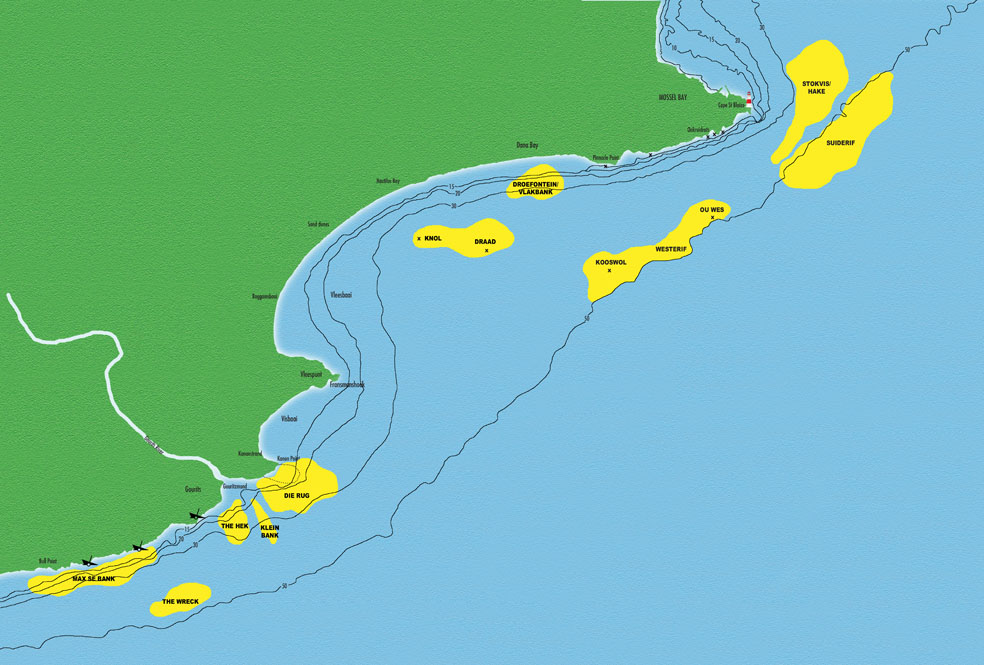
Fishing from Mossel Bay offers a range of opportunities, starting with the hake-rich clay banks which are found between 45– and 80 metres. Key spots include Bob se Bank, Kooswol, Ou Wes, and the well-known Guide Bank.
These deeper areas produce exceptional results, especially for hake, but in the winter months, Kooswol and Ou Wes often surprise anglers with schools of loose kob cruising through.
Closer to shore, Danabaai offers access to productive mid-depth reefs (25–45m) such as Knol Draad and *Vlak Bank, where kob and red roman are regularly caught.
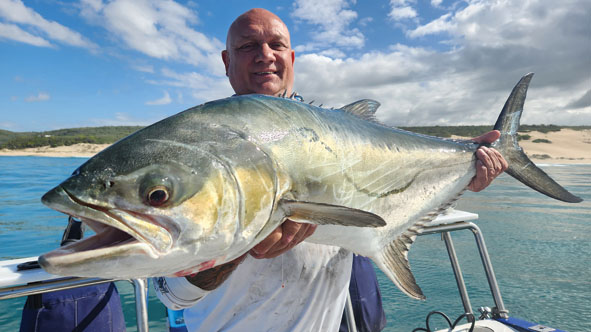
Garrick are often found along the sandy shoreline from Danabaai to Vleesbaai during summer.
Drifting the Inshore Waters
The sandy shoreline from Danabaai to Vleesbaai offers consistent summer action for garrick (leervis) and bonito.
Anglers drift slowly in this stretch, casting plugs and presenting live bait to surface-hunting predators. This style of fishing is exciting, especially when the water is warm and baitfish are abundant.
Rugged Reefs and Rewards
From Vleesbaai, around Fransmanshoek and past Kanon Point, the coastline is marked by shattered, shallow reefs.
These nearshore rocks provide excellent structure for targeting species like red roman, musselcracker (both white and black) and yellowtail.
However, the real gem begins just beyond Kanon Point.
This area is known locally as “Die Rug” – a vast and complex reef system stretching all the way to the Gouritsmond River mouth. It is, without doubt, one of the top kob (kabeljou) fishing areas in the country during the summer months from November to March.
Here kob are caught on lures, jigs, dead bait and live bait. The reef spans depths from 15- to 45 metres, and fish location often requires sonar work and experience to pinpoint schools.
Gouritsmond’s Offshore Gold
Just offshore from the Gouritsmond River, you’ll find the productive Klein Bank, a reef system in depths between 25– and 45 metres that consistently produces kob.
Slightly to the east lies The Hek, a legendary kob hotspot often considered one of the best-known reefs for this species in South Africa.
The reef features a mix of broken clay banks, with depths dropping from 22- to 40 metres. Aside from kob, anglers may encounter red roman, yellowtail and even schools of bonito during the summer season.
Hidden Challenges and Rich Rewards
Further along the coast, The Wreck presents one of the more challenging spots to fish due to conflicting currents and swell, making anchoring difficult.
When conditions are unfavourable at The Wreck, many anglers head inshore to Max se Bank, a dynamic reef system stretching toward Gouriqua Nature Reserve. These shallower banks (15- to 30 metres) are echo-sounding zones, meaning fish locations vary by day.
This area is known for diverse catches including musselcracker, roman and yellowtail.
Gouriqua and Beyond – The Lighthouse Reefs
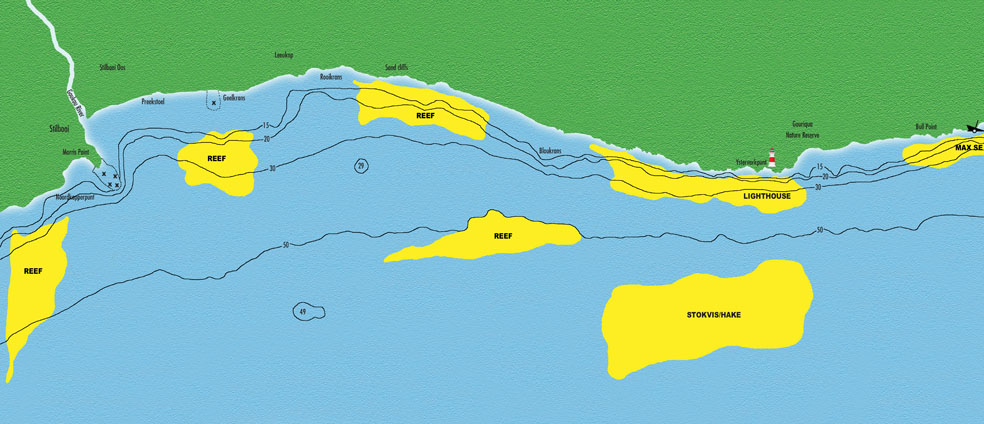
In front of the Gouriqua/Ystervark Point Lighthouse, anglers can target nearly every major reef species found in South Africa. This includes trophy-sized yellowtail up to 20kg, red steenbras, roman, and both types of musselcracker.
From the lighthouse, anglers can also head offshore to the clay banks around the 80-metre mark, which are ideal for deep water hake fishing.
Investigating kob country
The final leg of this angling journey takes you to the shallower reefs from Stilbaai heading further west to Duiwenhoks River. These 15- to 30 metre deep reefs are ever-changing; fish move constantly, making sonar your best ally.
Stilbaai is renowned for kob, particularly in the warmer months. While most kob here range from 3- to 8kg (locally referred to as “korthol”), they often appear in dense schools, making for exciting fishing sessions.
Final thoughts
Fishing the waters between Mossel Bay and Stilbaai offers both variety and abundance. Whether you’re hunting kob, reef dwellers or deep sea species, this stretch of coast delivers thrilling opportunities throughout the year. With a bit of local knowledge and the right gear, your next fishing trip could turn into the experience of a lifetime.
So, pack your rods, check your echo sounder, and make your way to the Southern Cape – world-class fishing awaits.
THE coastline between Gericke’s Point and Mossel Bay is characterised by steep dunes and cliffs interspersed with gorgeous sections of beach. While it’s a truly beautiful section of coastline, it does not offer many options for launching a boat to go to sea. Inland, however, options abound, ensuring that between the sea and the estuaries, anglers will certainly have enough to keep them happy.
SWARTVLEI ESTUARY AND SEDGEFIELD LAGOON
These water bodies provide a vast area to fish in. The lagoon is relatively shallow and, if the mouth is open, can be quite tide dependent, especially for launching, so make sure you check the tides when you plan a trip. The mouth sometimes closes for extended periods and then this is no longer a problem, but if Swartvlei gets too full, access under the old train bridge from the lagoon is problematic as it is very low.
Grunter, kob, Cape stumpnose, elf and garrick can all be caught here. The train bridge is a favourite spot for shore-based anglers who want to target garrick. The shallows between the N2 bridge and the train bridge are often frequented by flyfishers, as are the shallows north of the train bridge.
Access to these areas can be gained by parking at the train line where it crosses the outward-bound road. Ensure that no valuables are left visible in your vehicle when parking here.
Swartvlei has many options and can pretty much be fished anywhere. There are boat exclusion zones, but these are clearly marked with buoys. Grunter tend to be found on the shallower banks and kob in the deeper sections on the northern side of the vlei. Garrick are also sometimes caught while trolling livebait.
Public access directly onto Swartvlei is very limited, but one can launch a boat from Bayswater. Note that a daily fee is payable and the access hours are very strict. Alternatively, you need to get onto the lagoon and travel upriver and under the train bridge to Swartvlei, but this is not an option for bigger boats or cabin boats.
Fishing in the lagoon produces similar species to what you’ll find at Swartvlei, with grunter probably being the most targeted, usually by drifting across the banks on the pushing tide. When the mouth is open, the water is beautiful and clear, and as the lagoon is relatively shallow, the bottom can be seen most of the time.
There are two launch sites, but they can be heavily affected by the tide, so be aware of that and take the size of your boat into account.
One launch site is near the mouth, and there’s another on the island, but both have limited parking space. These areas can get very busy during the holiday season so it’s best to get there early.
Take note that skippers may have to navigate a fair bit of weed when leaving the slipways, but the channels are clearly marked with buoys. Care must be taken to observe the no wake and no boat zones.
A SANParks permit is needed to access the lagoon and Swartvlei with a boat, whether it be a paddle/rowing boat or one with a motor. These permits are available either from the Knysna office, located on Thesen Island (044 302 5600) or from the Wilderness office located at Ebb and Flow, (044 877 1197). This permit is required for all the vleis and estuaries within the Garden Route National Park area.
A variety of baits can be used on the vlei and in the lagoon, but sand prawns and sardines are firm favourites. Sand prawns can be pumped at low tide or be caught with the use of a float ring.
Nikki Smit with a beaut of a kob.
SWARTVLEI BEACH, GERICKE’S POINT AND SWARTVLEI LAUNCH SITE TO KAAIMANS
This section of coast is characterised by shallow banks and deep gullies. Swartvlei Beach is popular among surf anglers and offers a wide variety of fish to target, both edible and non-edible.
Gericke’s Point is very popular among shark fishermen and spearfishermen. One has to be mindful of the tide when fishing the Point, as it can be dangerous in places when you’re walking back to the car park at spring high tide.
Between Gericke’s Point and Wilderness is a spectacular piece of coastline, and if you are willing to tackle a fairly substantial walk, some wonderful spots can be found. Once again you will need to be mindful of the spring high tides when walking along this section.
Swartvlei Beach is also a launching site for boats wishing to go out to sea. George Ski-Boat Club manages the launch site on behalf of SANParks. It’s a surf launch and is very much swell and tide dependent. A 4×4 vehicle is required. For further informtion on the launch site, contact the George Ski-Boat Club via email <secretary@george
skiboatclub.co.za>.
There are a number of good deep sea fishing options between Gericke’s Point and the Kaaimans River mouth, and reef fish can be caught along this whole section.
There is a long reef relatively close inshore in around 30m of water, which runs most of the way from Gericke’s Point to Wilderness Beach. Each day out produces a different selection of catches – a bit like Forrest Gump’s “Life is like a box of chocolates, you never know what you’re gonna get”. Be prepared for anything from kob and geelbek to red fish. Chokka and sardines are the baits most often used.
Hake can also be found along this section anywhere in the 60m+ depths.
There are many patches of reef off Wilderness Beach ranging in depths from 25- to 40m. Beautiful santer and the occasional kob can be found here. Big carpenters like to frequent the area in front of Klein Kranz.
A lovely fat garrick caught at Swartvlei.
ISLAND LAKE AND TOUW RIVER
Island Lake is a fascinating place to fish due to the variety of species found there. It is one of the few places where one can catch grunter, leervis and carp. Both artificials and bait provide good results, and one can launch a boat at the slipway located next to the Island Lake Holiday Resort.
The launch site is managed by SANParks and a park fee is payable. Information is available from SANParks Wilderness. The Serpentine River, which links Island Lake to the Touw River, is a no boat zone.
To access the Touw River by boat, you can launch from SANParks Wilderness at Ebb and Flow. Touw River is a great place to target grunter, kob and leeries.
KAAIMANS RIVER
At present the public can only fish the Kaaimans River from the shore or from a canoe. Some decent sized grunter have been caught here, and leervis can be targeted close to the mouth. Please ensure that you respect private property at Kaaimans if you fish there.
WILDERNESS TO VICTORIA BAY
(Along the train line)
There are some great places to fish off the rocks along this section although for security reasons people are advised not to go there alone as there have been a few incidents. Use of the old train bridge is also not advisable as it is badly rusted and degraded with huge sections missing and is a severe safety hazard. The mouth is currently quite deep so care would need to be taken if one wants to cross over.
GROOT BRAK, KLEIN BRAK AND HARTENBOS RIVERS
These three rivers are located relatively close to one another as we move closer to Mossel Bay. Species to be targeted in this area are grunter and leervis, with the occasional kob also being caught here. Grunter can be caught on the pushing tide, as well small kob and leervis.
Kleinbrak has a small public slipway opposite the police station, but the launch is quite tight. It is not a proper concrete slipway, though, and is just made from compacted sand, so it is advisable to use a 4×4. This is a public launch site so there’s no fee for using it.
Boats may not travel left around the island near the beach as it is too shallow.
MOSSEL BAY
Those looking to go deep sea fishing in Mossel Bay have a couple of options – book a charter with one of the local charter companies which operate from the harbour, or launch your own boat from the public slipway at the harbour.
Just be careful if you choose this second ption, because the slipway can be tricky to navigate at times due to quite a serious surge. A tractor service is available should it be required.
Due to the slipway being part of the harbour, a harbour permit is required, as is a Port Clearance certificate. For information on costs and what documents are required, contact Elfie on 060 870 4299 or <admin@mbskippers.co.za>.
There is a fair amount of reef close inshore between Mossel Bay and Victoria Bay, and reef fish including kob can be caught on most of these reefs. Depths vary between 20m and 40m.
Garrick can be caught from the shore or close inshore from a boat between Reebok and Diaz Beach. There are ample places to fish along the whole section of beach between Groot Brak and Diaz Beach.
When conditions are right you can catch bonito from the Point at the Lighthouse. Hake are generally found out in the bay in depths around 70m, but water temperature influences this and sometimes they are found in shallower water. Kob sometimes come out among the hake too.
FOR THE NON-FISHERS
If the rest of the family aren’t quite as enthusiastic about a day out on the sea, the area boasts many other outings and adventures they might enjoy.
Sedgefield is a quaint little seaside town that’s often missed by passersby. Things to do here include visiting the Saturday morning Farmers and Craft Market, paragliding, beautiful beach walks, canoeing on the lagoon (you can rent canoes at the slipway near the mouth during the holiday season), mountain biking, horse riding and swimming.
Wilderness offers a variety of shops and entertainment including quad bike riding, segway tours, paintball and paragliding, or you can swing in the trees with Acrobranch.
There’s also kayak hire and kloofing trips on the Kaaimans River.
In George you can go mountain biking, hiking, strawberry picking or horse riding. You can also visit the Outeniqua farmers market on a Saturday or visit the old train museum, or take trips on the Outeniqua power van.Vic Bay and Heralds Bay have lovely beaches.
Mossel Bay has a coastal zip line which will certainly get the heart rate up, as will cage diving with sharks and whale watching. Then there are the beautiful beaches, game farms and museums to visit. You can also go diving, skydiving, parasailing, hiking and trail running.
In short, there is plenty to keep the family busy while the fishermen collect dinner.
GENERAL INFO
There are a number of charter companies and tackle shops in the area and a Google search will help you identify them.
There is also plenty of accommodation along this stretch of coastline. If you look on one of the many online booking portals such as Lekkeslaap, Airbnb or Safarinow, you are bound to find something that will suit your needs and pocket.
For more information on the area as a whole, contact the Mossel Bay Tourism office on 044 691 2202 or visit <www.visitmosselbay.co.za>.
Sincere thanks to Jandre Blom from Bloudam Fishing Adventures, Marius Opperman, Bertie Steward, Dylan Erasmus from Mayfly, and Elfie from MB Skippers for their input and photos.
THE coastline from Christmas rock to Bira (pronounced Biga) is one of the most picturesque of Southern Africa, being surpassed only by the Wild Coast of the old Transkei, in my opinion.
This area also has a great diversity of species that can be caught from just behind the breakers, all the way out to the “shelf” approximately 20- to 25km offshore, in depths ranging from under 10m up to 100m, with shallow, mid and deep reefs in abundance. In this article we will cover the fishing from Christmas Rock all the way down to Mgwalana river mouth.
Christmas Rock is on the southern boundary of the Gulu Marine Protected Area, so all skippers angling in the area are reminded to ensure they have the coordinates and are aware of all regulations pertaining to the MPAs.
This area is particularly well known for its abundance of decent sized carpenters (dogs) which average over 3kg. The current SA record — a whopping 4.8kg — comes from the area and is held by Garth Roux. The abundance and diversity of the species in the area can mainly be attributed to:
a) The effectiveness of the MPAs which have become overpopulated over the years, and many fish are migrating out of them.
b) Bag and size limits being implemented years ago that are now showing their effectiveness.
c) Recreational fishermen being far more responsible due to the awareness and protection measures created by clubs and associations.
The area covered in this article has two registered clubs from which vessels may proceed to sea to partake in recreational angling. Visitors to the area can contact the clubs (information below) to enquire about launch permits, costs, and any other relevant information for that site.
• Christmas Rock Ski-Boat Club
Claud Wilken 084 951 2696
• Bira Ski-Boat Club
Anthony Thompson 082 577 9097
Both launches are surf launches and a tractor or 4×4 is definitely required.
SPECIES TO CATCH
When fishing in the shallow reefs up to approximately 40m depths, the more common species to expect are kob, black musselcracker, Scotsman, dageraad, santer (soldier), Roman and yellowbelly rockcod. Gurnard and stockfish are also occasionally caught on sandy areas in approximately 40m water depths.
The mid- to deeper reefs will produce red steenbras, Miss Lucy (red stump), carpenter (dogs), seventy-four, butterfish and geelbek. Although these are predominantly deeper water fish, they have also at times been landed in relatively shallow waters.
Gamefish are rare and not often targeted in these areas.
The coordinates supplied alongside this article need three more numbers on the end (a fisherman has to have some secrets), but they do give a general area where these species can be targeted. Good luck and tight lines.
TACKLE
Generally, in the shallow waters, a light rod of around 7 to 8 foot should be used, along with a reel of your choice and light braid or nylon up to around 20kg. This will give the angler the most pleasure when fighting a fish. For shallower waters an 8-to-12-ounce sinker is usually sufficient.
In this region, anglers mostly use the “Scarborough” (KP) fishing reel, which generally gives a great feel of one-to-one on any fish, but anglers can use whatever they are most comfortable with.
On the deeper reefs, a heavier rod with an 8-inch Scarborough is mostly used. Braid is virtually a must due to the strong currents. As braid is thinner than nylon line, it cuts through the water, gives you more chance of keeping your bait on the seabed, and allows you to feel the bites better.
Nylon has a lot of stretch, and when you’re fishing at 80m-plus depths in a strong current, a lot of bites will not be felt.
In these deeper waters you rarely get away with a light sinker and generally a 16- to 32-ounce sinker is required, depending on the current strength.
The Agulhas current is predominant in this area on the mid- to deeper reefs, running from north to south down the coast and can get extremely strong at times.
KOB
Bag limit is five per angler from a boat; minimum length is 50cm, with only one of the five allowed to be above 110cm.
The general area off Hamburg is the best place to target this species, with some very nice sized ones being landed from time to time. Kob can be caught from very shallow to depths up to 40m.
Kob seem to like a neat bait and will readily bite on pilchards, squid and even octopus leg. They are targeted in this area, using three strips of squid dangling off the hook. Some anglers like to use small white or colored skirts above the hook. Generally, a 6/0 to 9/0 hook can be used with a relatively long hook trace, as kob seem to be sensitive to feeling resistance on the hook trace.
DAGERAAD
Bag limit is one per angler with a minimum 40cm total length. Dageraad feed on many types of bait, including but not limited to pilchards, squid, and sliced fillet. However, their favourite bait is a nice, cleaned piece of octopus leg and in this area the leg is cut into medallions like coins and put on the hook.
A 5/0 to 6/0 hook is a good size to use for this species.
Dale Webb with a black musselcracker.
BLACK STEENBRAS/MUSSELCRACKER
Bag limit is one per angler with a minimum 50cm total length.
Black musselcracker are abundant in the shallows and up to around 40m deep, although have been caught deeper. This species likes very clear water and areas where there are lots of smaller fish and large reefs.
They will feed on most baits but prefer a big eye (Frans Madam) or steintjie flapper (tail and spine removed). Black steenbras are extremely exciting to catch as they bite ferociously and fight all the way up. They also try to head for the nearest reef to cut off your trace.
A minimum of a 10/0 hook is ideal for this species.
SCOTSMAN
Bag limit is one per angler with minimum 40cm total length.
Scotsman are generally found hanging around with black musselcrackers, and usually when one of these species is caught, the other is caught soon after.
Scotsman can be caught in all depths of water up to 100m, but are more common in the shallows in less than 30m of water.
They feed on most small baits with their favourite being a couple of pieces of squid. A 5/0 hook — not bigger — is ideal for this species as they have relatively small mouths.
Scotsman are also strong, clean fighters and give immense pleasure to light tackle anglers. They are one of the more stunning fish in the ocean with very vibrant colours.
RED ROMAN
Bag limit is two per angler with minimum 30cm total length.
Romans are, without doubt, one of the most colourful fish in the sea, and their bright red colour is unmistakable. From in front of Christmas Rock all the way down to Bira, they are quite abundant, and specimens of over 3kg are caught regularly.
These fish are mostly found in shallow water under 20m deep where they feed on a variety of small baits like squid, octopus and pilchards. They have very small mouths, and a 3/0 to 5/0 hook will be ideal.
SOLDIER (SANTER)
Bag limit is five per angler with minimum 30cm total length.
Soldiers are normally found in the shallows in less than 40m of water, in shoals where they will aggressively feed on just about any bait presented to them. Usually a couple of strips of squid or a whole pilchard works well. A 5/0 hook is the ideal size for this species.
They are extremely feisty fighters and are very enjoyable to catch.
ENGLISHMAN
Bag limit is one per angler with minimum 40cm total length. These fish are relatively rare in this area and are not often caught. It is advisable to release them to allow their stocks to multiply.
YELLOWBELLY ROCKCOD
Bag limit is one per angler with minimum length of 60cm.
This fish is known to be extremely slow growing and very territorial. Yellowbellies will readily take sliced bait as well as small flapper baits. They can also be targeted on old smelly pilchards which most other species will not take. They have very large mouths and can be caught on 8/0 and larger hooks.
Yellowbelly rockcod are known to grab a bait and head into holes or crevices, with the angler having a hard time getting them out.
Beware when handling them because their gill plates are very sharp and have sliced open many an angler’s hands.
GURNARD
This species has no size limit, and the bag limit is ten per person.
Gurnards are almost always only caught in sandy areas and in water round 40m deep.
They generally like pilchard baits and are found right on the sea bed, so are targeted with a very short sinker trace. Despite their fearsome appearance, gurnards are extremely tasty and very sought after.
STOCKFISH (HAKE)
Bag limit is five per angler with no size limit. They are very popular table fish in South Africa and have huge commercial value, being netted and caught on long line commercial vessels.
Stockfish can be caught along this area of the coast and are generally also found in sandy areas from 40m depths. The trawlers and long liners usually catch deep water hake in much deeper areas.
Hake enjoy a strip of squid or pilchards and are generally targeted with 8/0 or bigger hooks. Their mouth is relatively soft, so they cannot be brought up fast or the hook may tear out.
They also have very sharp teeth and anglers must take care when handling them.
RED STEENBRAS
Bag limit is one per angler with minimum 60cm total length. They have a closed season for October and November each year, although clubs and associations have voluntary increased this to include September for their members.
Red steenbras is the iconic species for the Border area and they are fairly abundant on the deeper reefs, although they sometimes pop up on the shallow reefs as well. This species gives anglers one of the most exciting thrills when it bites as the bite is very aggressive and exaggerated; they then go on to give one of the most exciting fights — long, hard and tiring, but very satisfying in the end.
Generally red steenbras are caught in around 90m of water. This fish will feed on most baits from a mixed grill to a live smaller fish (butterfish, dikbekkie or carpenter), sliced baits, flappers and pilchards, and have even taken small strips of squid. Some days they can be extremely fussy and will only take on certain baits, which makes it a great challenge to the angler. A 10/0 or larger hook can be used to catch this species.
These great fish do not release very well, so rather move to other areas once you have caught your quota, as they will continue to feed.
John Luef with a beautiful Miss Lucy caught on a Scarborough reel.
MISS LUCY (RED STUMP)
Bag limit is one per angler with minimum 40cm total length.
Miss Lucy is one of the most beautifully coloured fish to catch, with banded shades of bright red and white which vary extensively in males and females, and black speckles. They have huge bumps on their foreheads which are more pronounced in the males. Once landed, they also have a very strong distinctive smell and are quite slimy.
They will feed on a variety of baits including pilchard, squid, mixed baits, and octopus. Their favourite is a long, thin mixed bait and a squid head. They can generally be caught on 5/0 to 6/0 hooks.
CARPENTER (DOG)
Bag limit is four per angler with minimum 35cm total length.
Carpenters are nicknamed dogs due to the structure of their teeth which is very similar to that of a dog.
As mentioned earlier, this species is the most abundant in this area and can generally be caught at any depth from 20m and up, even beyond 100m. They congregate in very large shoals, and it can become very frustrating when an angler cannot get any other species due to their abundance and continuous feeding.
Carpenter will feed and bite very aggressively on absolutely any bait. They have large mouths and can be caught on 8/0 hooks with a large luminous bead above the hook, which attracts the fish.
BUTTERFISH
Bag limit is five per angler with minimum 30cm total length.
These fish are not as abundant in this area as they are in the East London area, but can be caught on the deeper reefs. They are generally found in shoals and will feed on small squid baits. They can be caught on a 2/0 or 3/0 hook with one small strip of squid and a luminous bead above the hook. They have tiny mouths and make an excellent bait for red steenbras.
Keagan Nieuwenhuis with a lovely geelbek.
GEELBEK
Bag limit is two per angler with minimum 60cm total length.
Geelbek are so called, because of the bright yellow colour inside their mouths. They are long, streamlined fish and give a very hard fight to any angler. Their bite is an unmistakable aggressive shake, and they often swim up with your bait, creating slack line.
This is probably the most unpredictable species in our waters as they are mostly caught on the deeper reefs for three- to four months following the annual sardine run, but they can often be caught on the shallower reefs as well. They are also caught sporadically in unexpected areas all year around. They usually move around in large shoals.
Geelbek will feed on pilchards, sliced bait and squid, but sometimes get “lockjaw”, and although they can be seen on the fishfinder, they cannot be enticed with any bait.
Due to their large mouths 10/0 or bigger hooks can be used.
SEVENTY-FOUR
This is a banned species and must be released. They are, however, extremely abundant in this area on the deeper reefs and some days are pests as they are so abundant that you cannot catch any other species.
They feed on any baits put down for other species.
In my opinion, it’s long overdue that the decision makers un-ban this species.
GAMEFISH
As mentioned earlier, gamefish are not usually targeted in this area, but dorado, bonito and yellowfin tuna can be found in our waters from November through to March each year. The most common species caught then are bonitos, with the odd yellowfin tuna being caught.
Angling in the Christmas Rock and Bira areas can be very exciting and rewarding due to the many species available to target and the diverse seascape, so go out there and have some fun.
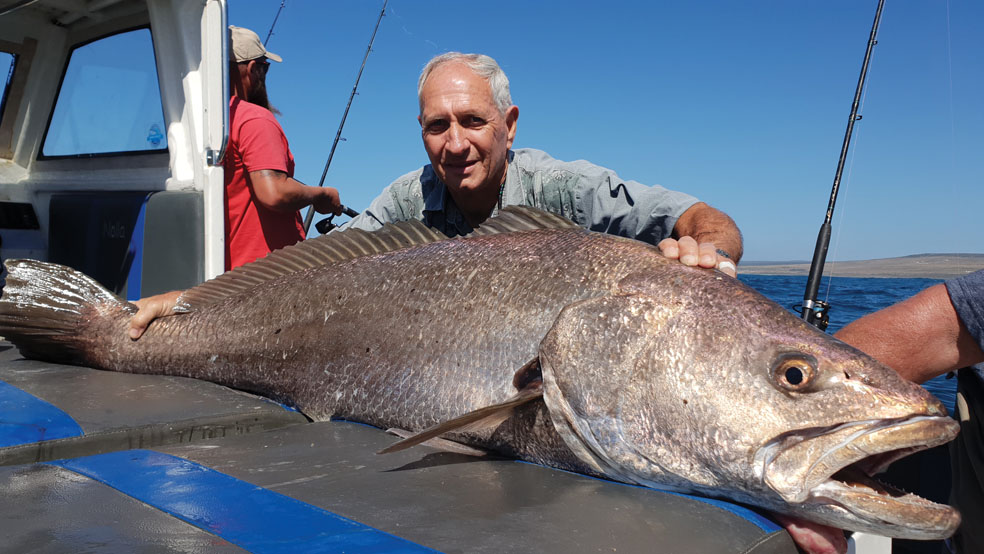
THE black steenbras/musselcracker, alongside the red steenbras, is probably the most prized bottomfish species that ardent bottomfishing anglers target and long for, and a big specimen is both memorable and often celebrated on board.
Known colloquially as “poensies” or “cracker”, these fish occur along most of the east coast of South Africa and are most abundant along the Eastern Cape/Transkei and KwaZulu-Natal coastlines.
The Transkei is recognised as the nursery for these fish, and many juveniles are hooked and landed there, whereas, along the KZN coast, most of the fish are larger adults. They are present all year round, throughout their range, but there are periods where they gather over certain reefs in higher numbers. This is often associated with spawning aggregations which occur in the cooler months between May and October.
These fish stir up quite a bit of emotion from a conservation point of view, so it is worth expanding on the subject. Firstly, they are an endemic species (native to our eastern seaboard), they are extremely slow growing and take a number of years to reach sexual maturity. They are listed as Orange on the WWF SASSI List, meaning that they are prone to exploitation, and one should think twice before harvesting this species.
So, from an angling point of view, be responsible with your catch, and remember the bag limit is one fish per person, with a minimum size of 50cm tail length.
Once you have caught your limit of one black steenbras you can use this simple method to release any further black steenbras [or other deepwater species] accidentally caught. As the weight takes the fish down to the depths at which it was caught, the pressure increases and the swimbladder deflates so the fish stays down.
Although they are caught as by-catch during “general” bottomfishing, there are a number of things you can do to up the odds in your favour should you wish to target these beasts of the deep. They are incredibly strong fighters, and are fine sports fish, particularly when they get around and above the 20kg mark. If you are ever fortunate enough to get one above that magical 30kg mark, you are going to be in for a proper game of tug of war which will test your skills and tackle to the limit.
WHERE
Cracker can be found in shallow water along the Transkei coast, but larger adults are best located in water between 40- and 70m deep in KZN, with a few fish occurring deeper in water up to 100m in depth.
Without doubt, my most consistent cracker spots are in water depths of 55- to 70m, so when I am fishing that depth zone there is always that little tingle of excitement and an air of expectation.
Isolated, larger pinnacles of rock within a given reef structure are prime cracker habitat, but unlike rockcod that set up camp and reside largely in a small area on a reef, cracker seem to be willing to travel around the reef or between reefs as they defend their territory or seek out a meal.
Although they can be caught throughout the day, the majority of my cracker have come earlier on in the day, or later in the afternoon/evening.
HOW
One sometimes hears stories of cracker being caught on a “piece of squid” on a small 2/0 hook, but these stories are few and far between and 90% of my cracker have been caught when I was rigged and baited accordingly.
You have two options here. One is to deliberately target cracker (or other large bottomfish species) with a single hook rig and big bait, and the other is to include a large hook and bait in your general bottomfishing trace.
It is for this exact reason that I recommend always having a large hook and bait included in your bottomfishing traces even if you are targeting red fish, so that when Mr Cracker shows up, you have a nice snack for him to crunch down upon.
Hook wise, a good old Mustad Kendal Round in size 9/0 or 10/0 is a good choice. If you prefer circle hooks, which I find myself fishing more and more these days, then a circle around a 14/0 or 16/0 in size will do the job, depending on manufacturer.
Minimum line diameter of .8mm is preferable, and nothing heavier that 1mm line is needed.Make sure your swivels are in good shape and knots are well tied.
I find that once you have used a swivel for a while, some of the protective coating seems to crack and peel off, and actually leaves a fine but sharp cutting edge which can cut into your line. For that reason I regularly replace my swivels and throw old ones away as soon as they show any signs of wear.
This problem of line damage can easily be overcome by using heavier mono, of 1 to 1.2mm which is more abrasion resistant, but I honestly feel that as one goes heavier, your strike rate reduces. My choice is nearly always to fish lighter, but I make sure my components and knots are not going to let me down.
As a further note, and particularly if you are fishing lighter, regularly run your mono trace through your fingers to check it for abrasion, particularly if you have caught a nice rockcod, as their fine, sharp teeth can damage lighter line. If there’s any doubt, rather take a minute and replace your snoot than later lose a nice big fish.
BAIT
Black musselcrackers love a nice, energetic live mackerel, so that rates as my favourite for targeting them. Like most fish, they also seem to be willing to move a fair distance to get that mackerel in their mouths.
When fishing a live mak, a bridle rig with a cable tie between the eyes is preferred as the live bait is less likely to tear off the hook during the bite and this method also exposes the majority of the hook shank which plays towards a more solid hookup.
Fear not, however, if you can’t get your hands on live bait, as cracker readily devour dead baits too. A whole, dead sand soldier (regular bycatch on smaller hooks when bottomfishing) is a very effective bait, particularly with the tail chopped off, the fins trimmed and a slice or two made in the side of the bait to release some scent.
Another very effective cracker bait is a mixed bait of squid arms and fillet. Trim a portion of the squid that contains the arms so that three or four arms remain, and thread this onto your hook, so that the arms are free to move about in the current.
Next, cut a slender and relatively long fillet of fish (fillet of descaled redfish), and thread this onto the hook so that the majority of the fillet hangs down below the hook bend. What you now have is a long, well proportioned bait with plenty of movement and smell that is relatively hardy too.
When tying this bait on a circle hook, be careful of overcrowding the hook which makes setting the hook difficult.
You can also try a whole red eye sardine in lieu of the trimmed fillet, but red eyes can be a little fragile and are easily pulled from the hook.
STRIKE AND FIGHT
Cracker are not normally shy or delicate with a bait. They are large, and often aggressive fish, which means that if one is showing interest in your bait, you will be well aware of it. There will be the odd occasion when your rod is virtually pulled out of your hands as you are instantly connected to a powerful fish, but generally this bite consists of a series of hard jolts as the cracker bites at your bait.
The cracker’s jaws are powerful and armed with strong and mainly blunt teeth which it uses to crush and devour a bait, so when you feel that strong bite, be patient and use the line control that a KP reel so beautifully allows. Keep light tension on the line and wait for a solid pull before winding hard and sinking the hook home.
I’ve definitely lost a few cracker by waiting too long and being stripped of my bait, but being patient on the bite has allowed me to hook my fair share. The upside of being overly patient and missing a fish from it stripping your bait, is that you may have another shot at the same fish on your next down, but if you strike early and prick a fish, you won’t get a second chance at it.
When hooked, cracker are incredibly tough fighters, particularly for the first few minutes after being hooked. They take short, fast runs along the reef as soon as they are hooked, so give them their due by backwinding while still applying maximum “safe” pressure.
Those powerful short runs and big head nods are very characteristic of a big cracker, so one is seldom left guessing what one has hooked. Cracker also tend to run “along” a reef rather than dive behind ledges etc, so being cut off isn’t as common as it is with fish such as yellowtail and big amberjack.
Once the cracker begins to tire, the rest of the fight is about slowly gaining line while remaining vigilant of not pulling hooks on those powerful head nods. A long, soft bottomfishing rod does well at absorbing those nods, but once you have a fish under control be patient and slowly bring it up to reveal your prized specimen.

 Fishing from Mossel Bay – A Worldclass Start
 Gouriqua and Beyond – The Lighthouse Reefs

 SWARTVLEI ESTUARY AND SEDGEFIELD LAGOON


 The abundance and diversity of the species in the area can mainly be attributed to:


 BAIT
