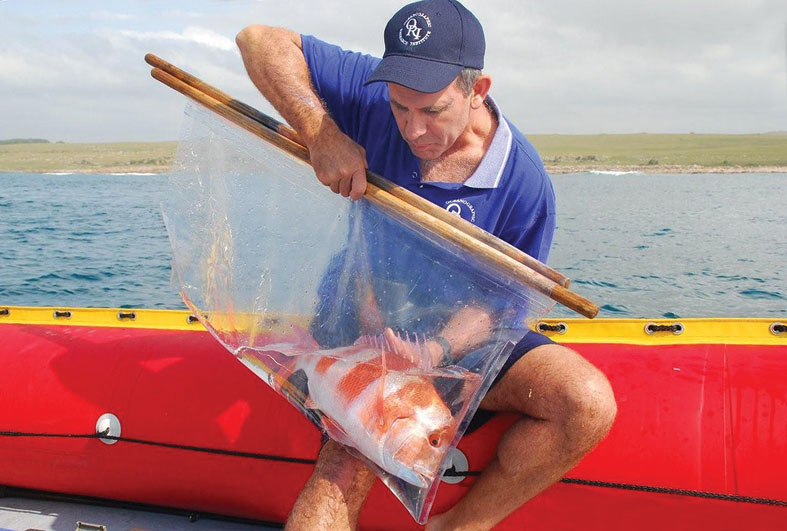
Tag: recapture

  • CITIZEN SCIENCE AT ITS BEST

    CITIZEN SCIENCE AT ITS BEST

    Impact of the ORI Cooperative Fish Tagging Project

    By Gareth Jordaan and Bruce Mann

    [Originally published in the July 2023 issue of SKI-BOAT magazine]

    ONE of the earliest fish tagging projects started in the mid-1800s when Atlantic salmon were tagged by means of fin clips and by attaching pieces of wire to their tails and jaws with unique labels.
    Closer to home, many tagging projects have been initiated in South Africa, but few yielded tangible results, with much of the data being unpublished or unused. During the 1970s, ORI’s Rudy van der Elst recognised the value of fish tagging information and involving the angling public in the collection of such data, subsequently establishing the ORI Cooperative Fish Tagging Project (ORI-CFTP).
    The project was formally started in 1984, with the aim of enlisting active angler support in tagging specific marine fish species around the entire southern African coastline. Still in operation over 38 years later, this project has become one of the longest ongoing operational citizen science projects of its kind in Africa.
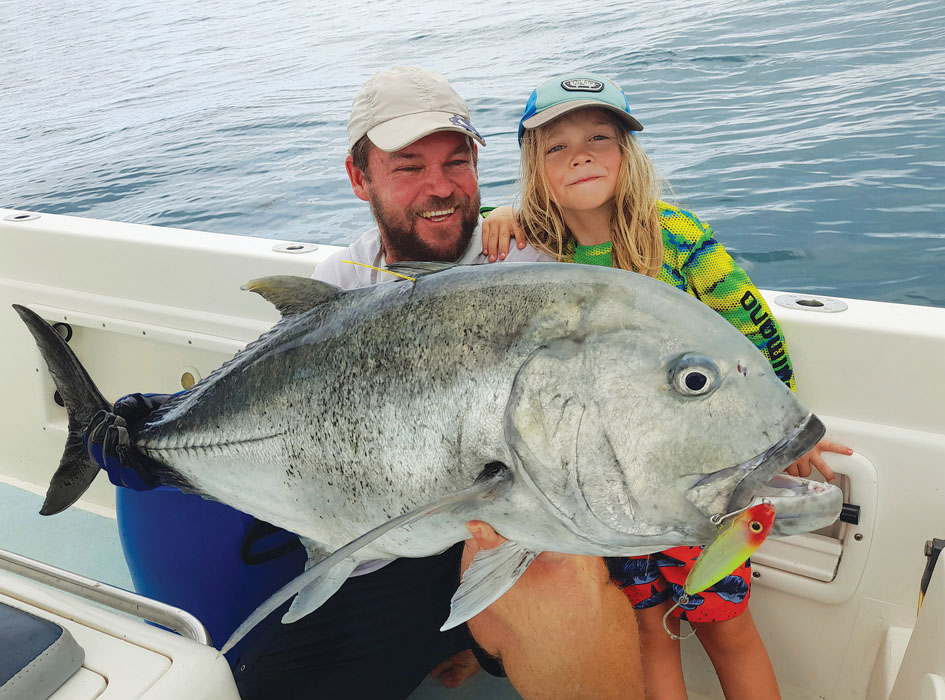
    Graham Pollard and his son, Aiden, with a tagged giant kingfish nearly ready for release.

    Over the years, different types of tags have been used and these have gradually been improved, as have the tagging methods. Today, the main types of tags used in the project are dart or “spaghetti tags” supplied by Hallprint in Australia.
    Technology has also vastly improved over the years, allowing for easier reporting and collection of data, and for the data to be housed on a large online database, rather than hand-written and recorded into a logbook, as was done in the early days of the project.
    As an added bonus, the project has also been able to improve the methods of fishing and fish handling used by tagging members. From the types of hooks used (we suggest using barbless circle hooks rather than barbed J-hooks or treble hooks), to the way fish are landed and handled fish (using a wet cloth over the eyes, landing the fish on a stretcher or using a knotless landing net, and keeping the fish in fresh seawater as much as possible), to methods of safely releasing fish, especially those caught in deep water and suffering from barotrauma, the project has helped change anglers’ thinking and methods.
    Over the 38-year duration of the project, a veritable goldmine of data has been collected which has led to some incredible results and achievements. Over 7 000 anglers have joined the project, with some of the original members still remaining active to this day, including Bruce Mann, Charles Lilford, Derick Stemmet, John Rance, Nic de Kock and Riekert van Heerden.
    It has been very encouraging to see how the ORI-CFTP has gained popularity more recently, with more anglers becoming aware of fish tagging and wanting to join the project. Currently there are about 483 active members (anglers who tag at least one fish in a year) and an average of 183 new members who join each year. 2021 was a record year for the project with more than 380 new members joining.
    With more anglers joining the project, more fish are being tagged each year. On average there are about 9 613 fish tagged each year. Since the start of the project an incredible 374 897 fish have been tagged and released.
    Although the total number of fish tagged is impressive, the number of tagged fish recaptured is even more important, as it is the recapture data that allows scientists to calculate things like fish growth rates and movements patterns.
    We continually remind our tagging members that it is not about the number of fish they tag, but rather the importance of the species they tag (based on our priority species list), the manner in which they catch, handle and tag their fish, and the frequency with which tagged fish are recaptured.
    Overall, there have been more than 23 600 tag recaptures (about 6.3%) since the start of the ORI-CFTP, with an average of 605 tag recaptures each year. Importantly, the recapture percentage has continued to increase over the years, suggesting that, besides there being more tagged fish in the ocean increasing the chances of catching a tagged fish, members are catching, handling, landing and tagging their fish in a more responsible manner. It is also possible that there has been an improvement in the reporting of recaptured tagged fish.
    Over the years we have had some incredible recaptures reported to us, such as a raggedtooth shark that was at liberty for more than 26 years, a red steenbras that was at liberty for more than 25 years and a Roman that was at liberty for more than 22 years.
    The Roman recapture is a prime example of just how useful tag and release projects can be. Roman were originally thought to live to a maximum age of 19 years, based on counting growth rings in sectioned otoliths, however, when this Roman was recaptured after 22 years at liberty, it proved that they can live longer than that.
    This recapture also highlighted how slow growing this species is, with the fish having grown only about 20cm in just over 22 years. The fish was recaptured in the exact same spot that it was originally tagged, proving again how resident Roman are.
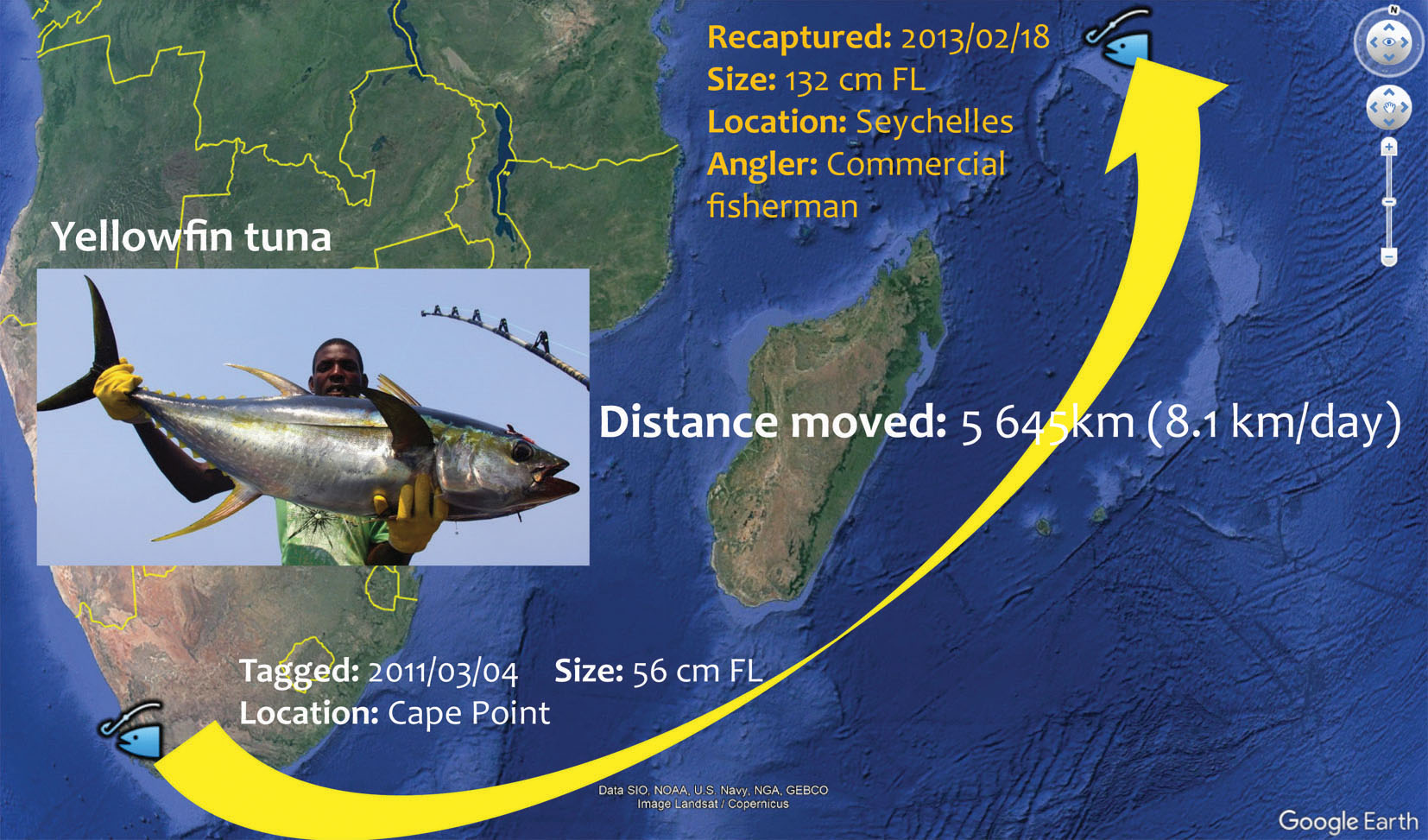
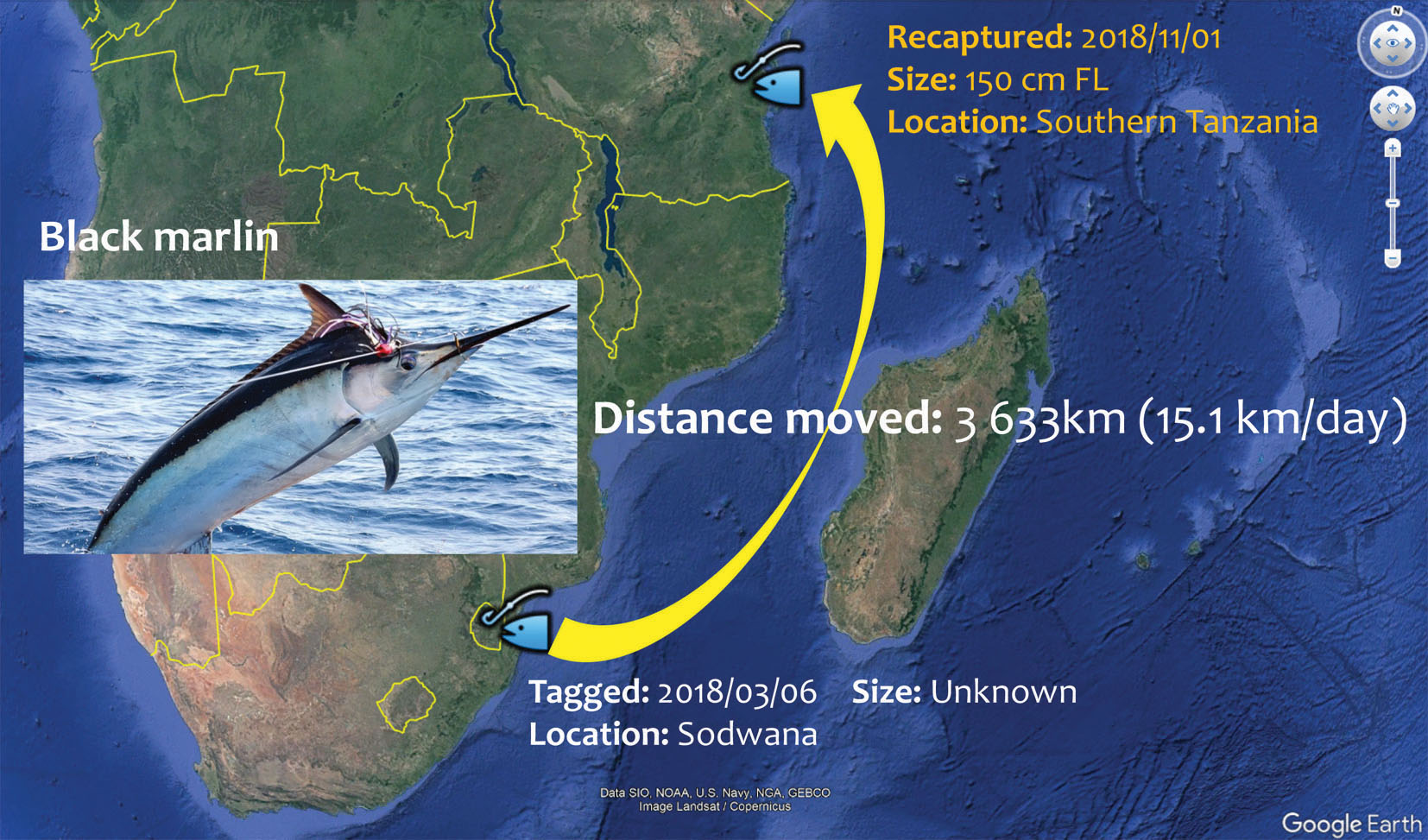
    It’s even more exciting when recaptures are reported to us further afield than South African waters. For example, a yellowfin tuna originally tagged off Cape Town was recaptured in Seychelles, and a black marlin that was tagged off Sodwana was recaptured in Tanzanian waters.
    Members of the ORI-CFTP originally tagged fish all along the entire southern African coastline, from Namibia to Mozambique. However, in the late 1990s the Namibian authorities asked ORI tagging members to stop tagging fish in Namibian waters as they were starting their own national tagging project. Similarly, the Mozambican fisheries authorities have requested that only migratory gamefish species be tagged by ORI tagging members in Mozambique waters.
    In South Africa, the Western Cape has the most tag releases and recaptures, followed by the Eastern Cape and KwaZulu-Natal. Several scientific fish tagging and monitoring projects around our coastline — particularly in some of our marine protected areas (MPAs) such as DeHoop, Tsitsikamma, Pondoland, Dwesa/Cwebe and iSimangaliso — have also contributed significantly to the number of fish tagged and recaptured.
    These projects have also played an important role in improving our understanding of the movement patterns of various linefish species and have shown just how important our MPAs are in helping to conserve many of our more resident linefish species. They have also proved that healthy fish populations within MPAs can spill over into adjacent fished areas, thus helping to ensure sustainable fishing.
    Overall, 375 different species have been tagged in the ORI-CFTP. The galjoen (South Africa’s national fish) has the greatest number of tag releases, with over 72 000 having been tagged since 1984, and more than 5 300 recaptures (making up 21% of the total recaptures overall).
    Gathering tagging data on so many different fish species over such a long time has allowed us to make this information available to numerous scientists and students who have used it in their research projects and theses. This has also resulted in many scientific publications in peer-reviewed journals which are critical to improving fisheries policy and management.
    For example, some recent scientific publications have looked at the movement patterns and growth rates of various linefish species such as the critically endangered giant sandsharks, cavebass, catface rockcod and Scotsman.
    The data collected by the ORI-CFTP has provided important baseline data for movement studies on numerous fish species. Using conventional external dart tags, you know where the fish is when you tag it, and you know where it is if you recapture it, but you have little idea where it has gone during its time at liberty.
    Excitingly, this gap in our knowledge can now be filled using more sophisticated methods of tagging such as acoustic telemetry and satellite tagging (see https://saiab.ac.za/platforms/
    acoustic-tracking-array-tracking/) which is producing some truly fascinating results.
    The recent results from acoustic tagging of giant kingfish (Caranx ignobilis) and their amazing annual spawning migration to southern Mozambique is a fine example and you can read more about this at DOI: https://doi.org/10.3354/meps12975 .
    In addition to pure fish research, the ORI-CFTP has helped to improve the cooperation between anglers, managers and scientists, and has also helped to change the conservation ethics of marine recreational anglers in South Africa towards catch-and-release fishing.
    In 2021, a survey of ORI-CFTP members was conducted with the aim of critically assessing the contribution that the project has had on the marine recreational angling community in South Africa. Some of the comments from this survey are quoted below and show just how much this project means to, and has encouraged, anglers around the country.
    “Without any doubt, the concept of tag and release has encouraged the release of more fish.”
    “The Tagging Project, more than any other initiative, has engendered a spirit of conservation in South Africa.”
    “I joined the Tagging Project during its year of inception, when I was 18 years old. I remain a proud member of the project. I hope to be a member of this project for many years to come.”
    To read more about this assessment visit https://doi.org/10.2989/1814232X.2022.2126525
    Anglers who’ve joined the project learnt about tag and release, gained a better understanding of the movement patterns and growth rates of many of our linefish species and the value of sustainable fishing, and ultimately contribute towards the improved conservation and management of these species.
    We thank all the anglers who have joined the ORI-CFTP over the years and helped this project grow from strength to strength. Without your support and tagging efforts, this great achievement would not have been possible.

    For further information follow ORITag on Facebook and Instagram and visit the SAAMBR YouTube channel <https://www.saambr.org.za/ori-tag-release/> to view ORI-CFTP instructional videos.

    FURTHER READING…
    Daly R, Filmalter JD, Daly CAK, Bennett RH, Pereira MAM, Mann BQ, Dunlop SW, Cowley PD. 2019. Acoustic telemetry reveals multi-seasonal spatiotemporal dynamics of a giant trevally Caranx ignobilis aggregation. Marine Ecology Progress Series 621: 185-197. DOI: https://doi.org/10.3354/meps12975

    Mann BQ, Dalton WN, Jordaan GL, Daly R. 2023. Movement patterns and growth rate of Scotsman Polysteganus praeorbitalis (Family: Sparidae) tagged in the Pondoland Marine Protected Area, Eastern Cape, South Africa. African Zoology 56(1): DOI: 10.1080/15627020.2023.2170717

    Mann-Lang JB, Mann BQ, Jordaan GL, Daly R. 2022. Assessment of the impact of participation in the Oceanographic Research Institute’s – Cooperative Fish Tagging Project on angler attitudes and behaviour. African Journal of Marine Science 44(4): 299-309, DOI: 10.2989/1814232X.2022.2126525

  • SHAD AHOY

    SHAD AHOY

    [Originally published in the September 2020 issue of Ski-Boat magazine]

    By Erwin Bursik
    ON 23 December 2019 the Oceanographic Research Institute (ORI) had the 372nd elf/shad tag recapture for the ORI Tagging Project. This shad was originally tagged on 21 February 2018 by a team of scientists from the Department of Environment, Forestry and Fisheries at Lekkerwater which is part of the De Hoop Marine Protected Area in the Western Cape. At the time it measured 51.1cm fork length.
    It was recaptured 670 days later by Gary Heath in Richards Bay by which time it had grown to 72cm FL. It had travelled an impressive 1 496km north from the place it was first caught! Considering the time that had lapsed it’s even possible this was the shad’s second visit up the coast in those 670 days. Quite a feat for a small fish.
    Adult and sub-adult shad generally undertake an annual northward seasonal migration between the Cape and KwaZulu-Natal. The arrival of shad in KZN coincides with the onset of spawning activity. These shad feed primarily on sardines, which also undergo a northward migration during winter. There is an annual, nationwide two-month closed season for this species, from 1 October to 30 November, to protect shad during their peak breeding season.
    According to Bruce Mann, “The shad recapture was fairly typical of the annual spawning migration of this species. The quality of the tagging and recapture details was good and this type of recapture helps to emphasise why there are specific regulations in place.”
    Gary Heath is the angler who caught the tagged shad after its incredibly long swim up the east coast of South Africa. A prominent competitive deep sea angler, Gary has spent his life fishing off the Zululand Coast and attained provincial and national colours for light tackle gamefishing.
    After a slow day trolling for dorado deep off Richards Bay in December last year Gary decided to head for home, leaving the dorado lures out with the long lines on a bird. Approximately 4km out to sea in around 60m of water in “no man’s land”, he noticed the long line rod bending and something flapping on the water’s surface a good 25m behind the boat. Presuming he had hooked a bit of plastic or debris, Gary maintained his troll speed and retrieved the line with the object still flapping on the surface.
    To his surprise, as it got closer he realised it was a small fish. When it was boated he was even more surprised to see it was a shad, and a tagged shad at that. The well dragged shad had been properly hooked through the roof of the mouth with the 9/0 and was unfortunately too badly damaged to be revived and released.
    “This was a very unusual catch in deep water. In fact, in my 40 years of fishing this area I have never caught a shad on the surface in such deep water,” said Gary (pictured below).
    This unusual catch reaffirms the scientific value of the entire tagging program as it makes one think about what this small fish has done to travel almost 1 500km up the coast.
    The Oceanographic Research Institute’s Cooperative Fish Tagging Project (ORI-CFTP) has recently released 15 new instructional tagging videos. These videos provide the background to the ORI-CFTP and what they need from their members; they also offer some important tips on how to be a more aware and responsible angler.
    The videos cover all aspects of the ORI-CFTP including: why you should tag and release fish; tagging kit contents; priority species they would like tagged; different hook types and preparation; how to measure different species; handling, landing and tagging various species from the shore and on a boat; recording and sending in tag release information; and most importantly reporting a recapture and filling in a tag recapture form. Viewers can also see how to handle a fish that may be suffering from barotrauma, a common occurrence in some species caught in deep water.
    Included are videos on various hook types, knots and information on debarbing hooks that ensure quick and safe hook removal from your fish. For new and existing members there are tips on kit maintenance. All tagging members are encouraged to watch and share these useful videos.
    The videos also provide all the information that you need to correctly report tag recapture information. Tag recaptures are one of the most important and exciting aspects of the ORI-CFTP. Recaptured fish allow them to investigate movement patterns, growth rates and population dynamics of the fish species tagged along the southern African coastline and ultimately contribute towards their conservation.
    It is interesting and exciting to see where a recaptured fish was originally tagged, how far it has travelled, who originally tagged it and how much it has grown. As anyone who is fishing in the sea stands a chance of catching a tagged fish, it is very important to know exactly what information to record and how to send it to ORI.
    For more information on the tagging project and to watch the tagging videos visit <www.saambr.org.za/ori-tag-release/>.

  • COPPER RECAPTURED

    COPPER RECAPTURED

    [Originally published in the March 2020 issue of SKI-BOAT magazine]

    by Kyle Hansen

    RED Steenbras (Petrus rupestris), or “coppers” as they are affectionately known, are prized catches among recreational and small scale fishers alike off the east shores of South Africa. They are known to reach weights over 100 lb and are renowned for their dogged fighting ability that will test even the most skilled angler’s technique and tackle to the limit.
    Sepia-tinged memories will recall a time when these fish were caught in vast numbers from shore and boat, the former a distant memory of days gone by for all but the lucky few. As a child I was obsessed with this iconic predator of the deep. Perhaps it was the stunning pink hues they don or their reputation or scarcity — likely a combination of all three. I spent hours staring at pictures of men in suits and ties with primitive tackle, nonchalantly hovering around heaps of coppers big and small, dreaming what it might have been like to be around in that day and age.

    In September 2015 I enjoyed a day out at sea with Org Nieuwoudt, an experienced Gouritsmond skipper-cum-conservation-advocate. On that day I was fortunate to land my first decent sized copper — a 61cm fork length beauty [pictured above].
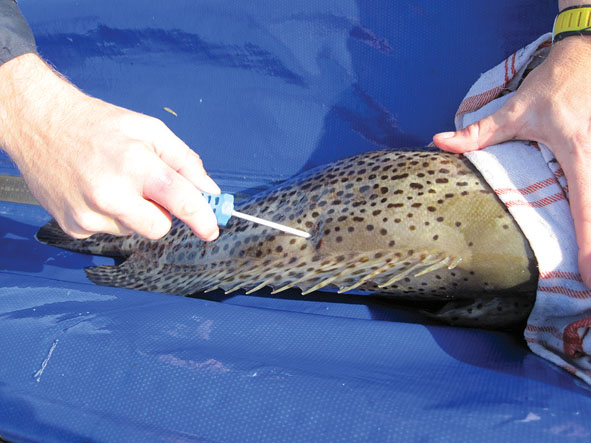
    Org and I worked quickly to get her measured, tagged and released. We also made a shallow puncture in the abdomen of the fish to help it descend back to its rocky habitat some 30m below. This was to be the start of a good thing as Org soon became a regular ORI tagger, often educating his charter clients on the values of the project.
    One lucky angler got to witness this first hand. Andries Riersma was fishing with Org in early January 2020 when he recaptured my originally tagged red steenbras more than four years later, on exactly the same GPS co-ordinates.
    Personally I found it nothing short of thrilling to see how the adolescent copper I caught had developed the hallmark yellow colouration characteristic of the larger specimens. The fish had grown from 61cm to 93cm.
    Coppers are incredibly aggressive by nature, a trait that had, until recently, relegated this all-conquering reef dweller to the prohibited list. They are often first to the bait and usually the angler with the biggest, ugliest offering will be the first to “go tight”.
    The complete ban on catching red steenbras has since been lifted and recreational anglers are now allowed one fish of 60cm or larger per day. However, those anglers with any inkling of conservation ethics will agree that these majestic predators are too precious to end up on the dinner table.
    The idea of slot-limits is a notion that’s gaining momentum and could be implemented as a condition to the bag limit of coppers and other species slow to sexual maturity. The powers-that-be would do well to look into this option as it would keep the “catch and cook” contingent happy while protecting the larger breeding specimens.
    Fortunately a general shift in consciousness seems to be under way among a healthy portion of the general angling public. Nowadays catch and kill en masse efforts are largely a thing of the past, with there being a stigma attached to such efforts and the anglers being branded destructive and wasteful as opposed to how in the past it was seen as heroic or admirable. Social media has also played a large part by calling anglers out for going over bag limits and creating general awareness around conservation practises.

    ENSURING SAFE RELEASE
    Although releasing fish is a step in the right direction and is in itself admirable, it is important for the angler to understand that release efforts are inevitably futile if they’re not administered correctly, particularly with bottomfish.
    Coppers, like many reef fish, are considered demersal (bottom-dwelling), compared to pelagics which roam a wide range of depths. Unlike pelagics, demersal fish are not adapted to handle a rapid ascent of the water column. Stark pressure changes experienced by the fish while it’s being hauled up cause internal gases to expand. This creates tremendous pressure on the fish’s internal organs, a syndrome known as barotrauma. When they’re bloated like this the fish cannot get back down to their normal home depth and just float on the surface until their almost certain death. They thus need help getting back down.

    One option is “down-rigging” the fish by by using a release-weight. A barbless hook rigged with a heavy weight is pushed through the fish’s top lip (see diagram) and takes the fish down quickly; the barbless hook can be dislodged easily with a tug of the line when the fish is at the bottom. One can also use a Seaqualizer to do this job — a purpose designed piece of equipment.
    The whole idea of this method is to avoid pricking or venting the fish and to allow the weights to take the fish back down to the depth where it was caught. The pressure at that depth recompresses the gas in the swimbladder back down to what it was before the fish was bought to the surface and allows the fish to swim off without being buoyant. This systems works very well if you are set up to do it on the boat and is non-invasive, but the strong surface currents in areas where red steenbras are found often makes it difficult to successfully use this sytem.
    As most anglers know, when the gas in the swimbladder expands it often forces the stomach inside out and it sometimes protrudes from the fish’s mouth. According to Bruce Mann, senior scientist at ORI, in some fish species such as soldier/santer and seventy-four, the fish themselves bite their own stomach thereby releasing the gas and enabling them to swim down after release, even if caught in very deep water.
    In order to give red steenbras or other bottomfish a better chance of survival anglers need to release the expanded gas present in the abdomen thereby lowering buoyancy and allowing the fish to reach the depth where it normally lives.
    When it comes to this aspect Org has some more concise advice: “Honestly anglers need to do more than just taking the fish down deep with three or four 6 oz sinkers. We use our normal tagging equipment to pinch a small hole in the fish’s stomach to release the oxygen.
    “It’s vital to release the oxygen prior to dropping the fish down to the bottom because if you don’t release the oxygen the fish will just come up to the surface of the water a short while later and you will not even notice it because of the current. If the stomach is visible or protruding out through the mouth it’s easier to puncture, but if not you must puncture the stomach or swim bladder through the fish’s skin.
    “When I drop the fish to the bottom I leave it to recover for a couple of minutes before I unhook it.”
    Note that the position of the swimbladder is approximately in line with the top of the pectoral fin and halfway between the pectoral fin and the anus,but it varies in each fish so do some homework on where you need to insert the needle to puncture the swim bladder without causing more damage.
    It is good practise to implement sensible handling techniques to improve the likelihood of survival of any fish. These include:
    • Keeping the fish wet at all times and taking it out the water for as short a time as possible, if at all.
    • Assisting revival of the fish until it swims off.
    • Minimising the fish’s time out of the water.
    • Using barbless or circle hooks.
    • Being prepared. Ensure all necessary equipment — release weights, tag applicator etc — is ready at hand.
    • Don’t touch the gills at all as they are very sensitive.
    For more information on ORI tags or if a tagged fish is caught contact Gareth Jordaan on <oritag@ori.org.za>.
    For a great sustainable deep sea fishing experience contact Org Nieuwoudt via <www.gouritsfishing.co.za>.

Verified by MonsterInsights