Tag: dageraad

  • WHERE TO FISH Part 20

    WHERE TO FISH Part 20

    From Stilbaai to Mossel Bay

    By Shawn Mey

    (Originally published in the July 2025 issue of Ski-Boat magazine)

    THE stretch of coastline between Mossel Bay and Stilbaai offers some of the most diverse and rewarding fishing experiences in South Africa. Whether you’re a seasoned offshore angler or a shoreline enthusiast, this region is a paradise brimming with opportunity – if you know where to go and what to target.
    This article offers a comprehensive look at the fishing hotspots from Mossel Bay to Stilbaai, including seasonal insights and proven tips to help you make the most of your time on the water.

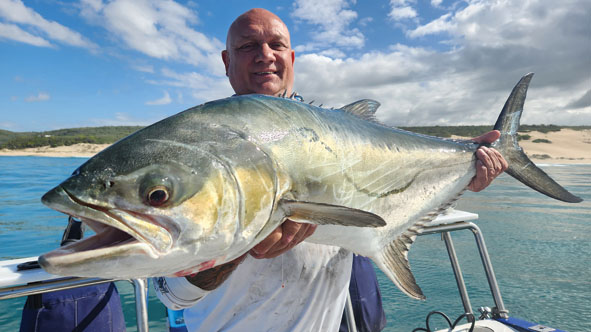
    Shawn Mey shows off a lovely fresh dageraad.

    The Southern Cape’s Coastal Gems:
    Mossel Bay, Gouritsmond and Stilbaai
    Mossel Bay is a thriving harbour town that combines natural beauty with historical richness. Known for its mild climate and golden beaches, it’s also a hub for deep sea fishing, offering quick access to productive offshore reefs.
    The town boasts a well-developed marina and plenty of services catering to the angling community.
    Gouritsmond is a quieter, more laid-back coastal village nestled at the mouth of the Gourits River. Known for its unspoiled beaches and excellent river and reef fishing, it’s a favourite for anglers seeking a more tranquil experience without compromising on fishing quality.
    Stilbaai is a scenic seaside town situated on the Goukou River estuary. It’s a well-known summer holiday destination and a hotspot for inshore fishing, especially for kob.
    Stilbaai’s waters are teeming with life, particularly during the warmer months.


    Fishing from Mossel Bay – A Worldclass Start
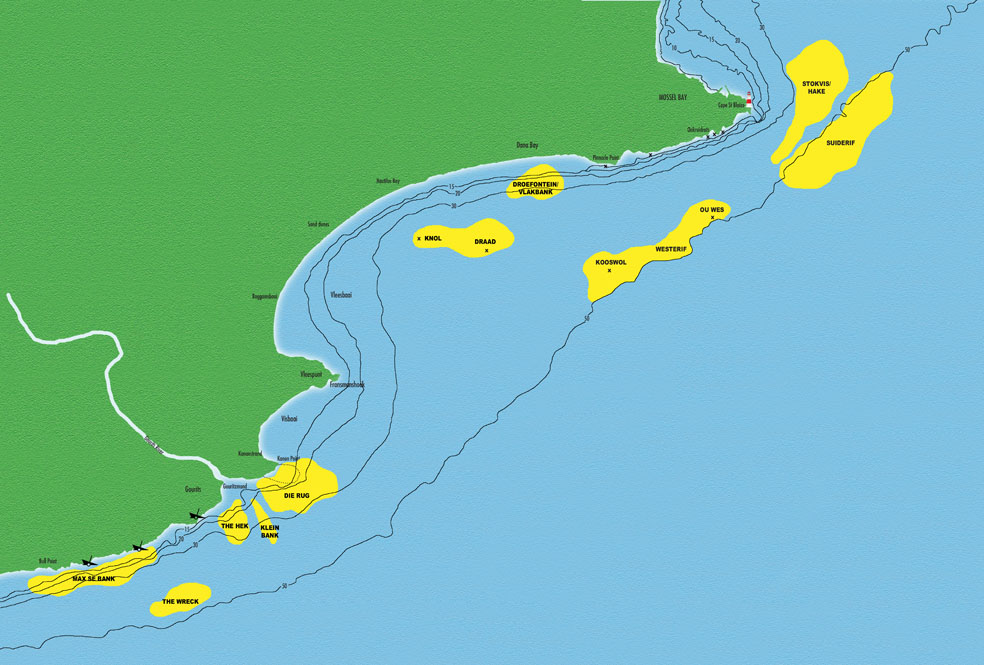
    Fishing from Mossel Bay offers a range of opportunities, starting with the hake-rich clay banks which are found between 45– and 80 metres. Key spots include Bob se Bank, Kooswol, Ou Wes, and the well-known Guide Bank.
    These deeper areas produce exceptional results, especially for hake, but in the winter months, Kooswol and Ou Wes often surprise anglers with schools of loose kob cruising through.
    Closer to shore, Danabaai offers access to productive mid-depth reefs (25–45m) such as Knol Draad and *Vlak Bank, where kob and red roman are regularly caught.

    Garrick are often found along the sandy shoreline from Danabaai to Vleesbaai during summer.

    Drifting the Inshore Waters
    The sandy shoreline from Danabaai to Vleesbaai offers consistent summer action for garrick (leervis) and bonito.
    Anglers drift slowly in this stretch, casting plugs and presenting live bait to surface-hunting predators. This style of fishing is exciting, especially when the water is warm and baitfish are abundant.


    Rugged Reefs and Rewards
    From Vleesbaai, around Fransmanshoek and past Kanon Point, the coastline is marked by shattered, shallow reefs.
    These nearshore rocks provide excellent structure for targeting species like red roman, musselcracker (both white and black) and yellowtail.
    However, the real gem begins just beyond Kanon Point.
    This area is known locally as “Die Rug” – a vast and complex reef system stretching all the way to the Gouritsmond River mouth. It is, without doubt, one of the top kob (kabeljou) fishing areas in the country during the summer months from November to March.
    Here kob are caught on lures, jigs, dead bait and live bait. The reef spans depths from 15- to 45 metres, and fish location often requires sonar work and experience to pinpoint schools.

    Gouritsmond’s Offshore Gold
    Just offshore from the Gouritsmond River, you’ll find the productive Klein Bank, a reef system in depths between 25– and 45 metres that consistently produces kob.
    Slightly to the east lies The Hek, a legendary kob hotspot often considered one of the best-known reefs for this species in South Africa.
    The reef features a mix of broken clay banks, with depths dropping from 22- to 40 metres. Aside from kob, anglers may encounter red roman, yellowtail and even schools of bonito during the summer season.

    Hidden Challenges and Rich Rewards
    Further along the coast, The Wreck presents one of the more challenging spots to fish due to conflicting currents and swell, making anchoring difficult.
    When conditions are unfavourable at The Wreck, many anglers head inshore to Max se Bank, a dynamic reef system stretching toward Gouriqua Nature Reserve. These shallower banks (15- to 30 metres) are echo-sounding zones, meaning fish locations vary by day.
    This area is known for diverse catches including musselcracker, roman and yellowtail.

    Gouriqua and Beyond – The Lighthouse Reefs
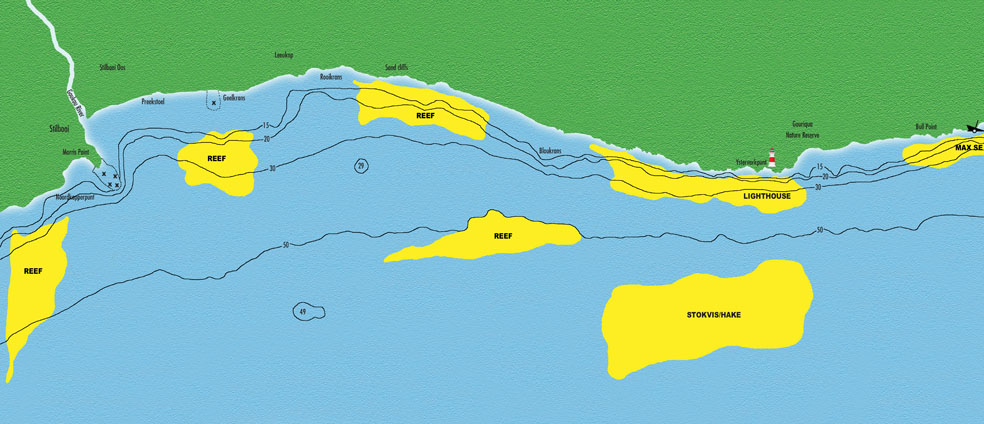
    In front of the Gouriqua/Ystervark Point Lighthouse, anglers can target nearly every major reef species found in South Africa. This includes trophy-sized yellowtail up to 20kg, red steenbras, roman, and both types of musselcracker.
    From the lighthouse, anglers can also head offshore to the clay banks around the 80-metre mark, which are ideal for deep water hake fishing.

    Investigating kob country
    The final leg of this angling journey takes you to the shallower reefs from Stilbaai heading further west to Duiwenhoks River. These 15- to 30 metre deep reefs are ever-changing; fish move constantly, making sonar your best ally.
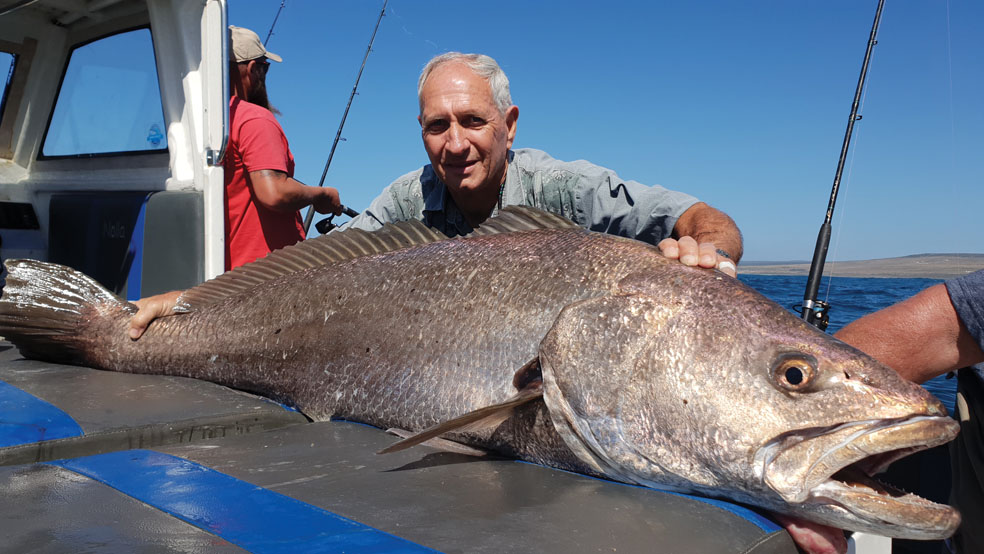
    Stilbaai is renowned for kob, particularly in the warmer months. While most kob here range from 3- to 8kg (locally referred to as “korthol”), they often appear in dense schools, making for exciting fishing sessions.

    Final thoughts
    Fishing the waters between Mossel Bay and Stilbaai offers both variety and abundance. Whether you’re hunting kob, reef dwellers or deep sea species, this stretch of coast delivers thrilling opportunities throughout the year. With a bit of local knowledge and the right gear, your next fishing trip could turn into the experience of a lifetime.
    So, pack your rods, check your echo sounder, and make your way to the Southern Cape – world-class fishing awaits.

  • WHERE TO FISH Part 15

    WHERE TO FISH Part 15

    Port Alfred and surrounds

    By Colin Fletcher and Clinton Schultz

    [Originally published in the July 2024 issue of Ski-Boat magazine]

    THE hidden gem of the South African coastline, the area between Kenton-On-Sea and the Mgwalana River, not only offers plenty of tourist attractions and luxury game lodges, but also some of the best fishing in the Eastern Cape.

    Colin Fletcher shows off a solid dorado.

    The variety is vast – everything from dageraad, poensie, kob and geelbek to incredible gamefishing in the current line which produces yellowfin tuna, dorado and marlin. This area truly offers it all.
    I have been privileged to grow up on this section of the coast, fishing both rock and surf as well as offshore. The amazing history of this coastline never ceases to amaze me and the stories of massive catches have intrigued me for years.
    Accommodation for visitors to this area is well priced and it won’t cost you an arm and a leg for a fishing holiday with the family.
    Launch sites are also plentiful. From beach launches to harbours, there are a number of different options.
    Port Alfred is one of the easier launch spots to get to logistically, but it can be a hair raising launch through the mouth if the weather is not good. Make sure you get local advice if you’re not familiar with the launch.
    Other beach and slipway/river surf launches along the coast include Boknes, Kenton, Kleinemonde, Mpekweni, Mgwalana and Birha.
    If you’re not confident launching safely in this region, professional charter companies are readily available in Port Alfred. Their services are generally well priced, and the skippers have intricate local knowledge and experience thanks to spending hundreds of hours on the water. This is a great option for a family day outing for those roadtripping down to the area.
    If you are visiting and want to meet up with some of the locals, then stop by at the Port Alfred River & Ski-Boat Club situated along the Kowie River. It is a good place to pick up some local information and there’s a great pub and restaurant where you can enjoy the generous hospitality.
    Contact the club on 046 624 4532 or visit their Facebook page <www.facebook.com/parscpa/> for further details.

    SPECIES

    Colin and Megan Fletcher with a few pan-sized kob and a carpenter.

    Kob
    A highly sought after fish along the South African coastline, kob are great fun to catch and are great eating too. In this area they range from1kg to 20kg, so you never know what you are in for.
    The daily bag limit, according to www.saambr.org.za, is one per person per day if caught from the shore and in estuaries east of Cape Agulhas, and five per person per day if caught west of Cape Agulhas or if caught anywhere from a boat offshore.
    Minimum size limit is 60cm total length if caught from the shore and in estuaries east of Cape Agulhas, and 40cm total length (KZN) and 50cm total length (EC & WC) if caught from a boat offshore or from the shore west of Cape Agulhas. Only one kob greater than 110 cm total length may be caught per person per day regardless of area or sector.
    You’ll often catch slightly undersized kob that have to be put back, but when you get into a shoal of keeper-size fish, great fun can be had. The smaller fish, around 60cm, are best for eating.
    Chokka and sardines are easy and popular baits for these fish. A great option on a spinning setup is to use paddletails or dropshots.
    Kob can be lazy fish and will sometimes lie in water sheltered by structure, waiting for prey fish to swim past. Smaller fish tend to shoal when feeding, and when you tuck into a shoal it is great fun. With a more aggressive bite than geelbek, shoaling kob closer to the bottom will more often than not bite in an upwards direction and you will feel an upwards bump followed by momentary slack, then SMASH!

    Colin Fletcher with a nice poensie caught near Lighthouse Point.

    Poensie
    Black steenbras aka musselcracker aka poensie is probably the most prized bottomfish species in this area. A big specimen is both memorable and extremely fun to catch.
    These fish occur along most of the east coast of South Africa and are most abundant along the Eastern Cape/Transkei and KwaZulu-Natal coastlines.
    Chokka strips/legs, fresh fillet, a dead Frans Madam (big-eye) or sardine are all effective dead baits for these “cracker” fish. I have been smoked by big crackers on a maasbanker live bait, so that is also a good option to try.
    Some people choose to keep the daily bag limit of one per person but I personally choose to release them.
    Be extremely careful when handling these fish, especially on an inflatable boat, as they have a few sharp spines.

    Dageraad
    These fish are endemic to South Africa and are only found in the waters stretching from the lower South Coast in KwaZulu-Natal to Cape Point in the south-western Cape. They are most common along the Western and Eastern Cape coast.
    Dageraad are generally found around offshore reefs between depths of 20m and 100m, and will bite on chokka, sardine and fillets.
    They are listed as critically endangered on the IUCN Red data list, so the current bag limit is one fish per person per day at a minimum size of 40cm.

    Red Roman
    Arguably one of the prettiest reef fish on the Eastern Cape coastline, red Roman are also tender fish to eat. These beautifully coloured fish can weigh between 1kg and 3kg on average, and a big Roman provides a fun fight on lighter tackle.
    Caught throughout the year, these fish can be caught on red bait, worms, chokka, fillet and sardines. Look for them around reefs or pinnacles in shallow water.
    The minimum size is 30cm with a daily limit of two per angler.

    Carpenter/Dog/Silverfish
    These fish are abundant along the Eastern Cape coastline and are found in waters anywhere between 20m and 100m deep.
    They have a vicious tooth structure and will eat almost anything. Adults feed on anchovies, sardines and squid, while juveniles feed mainly on crabs, crab larvae and worms. It can be frustrating when you get into a large shoal of small dogs and nothing else bites.
    These fish are underrated as a table fish but are fast gaining popularity among South Africans.The current bag limit is four fish per angler per day, with a minimum size of 35cm.

    Geelbek
    These fish are sporadic and unpredictable. You might see a shoal on the finder and drop a bait, only for it to be left completely untouched. We call this “bek lockjaw”. The daily bag limit for these fish is two per angler with a minimum length of 60cm.
    In the months following the sardine run these fish will be caught around the deeper reefs, but they are often found on shallower reefs as well.
    They bite very distinctively, creating slack in the line on their way up, and fight aggressively. Geelbek are great fun on light to medium tackle. Bait options include sardines, fillets and chokka. Due to their big mouths, large hooks (around 10/0) should be used .

    Miss Lucy
    These beautiful fish, with their banded shades of red and white and large forehead bumps, can be enticed to bite by chokka, sardine and octopus. The bag limit is one daily per angler with a minimum size of 40cm.

    Gamefish and billfish
    A variety of gamefish including yellowfin tuna, marlin and dorado can be found around the area off Port Alfred known as “the eye”.
    For years this area has been frequented by migrating populations of smaller tuna, mostly in the 10- to 30kg weight class. However, in the last year or so there has been a noticeable increase in the number of big tuna in the area, 50kg-plus bullets which have offered plenty of fun.
    Dorado have spoilt us with their presence for many years. These beautiful fish are found in warmer water (around 25 degrees) and congregate around floating objects in the current. Keep an eye out for small baitfish around floating debris, and the dorado won’t be far away.
    Marlin and dorado seem to like hanging around deeper depths around the 100m drop-offs and current lines, where floating debris can be found.
    Marlin are definitely more difficult to target, but many have been hooked in this area and some landed.
    A big marlin will bully you on a light tuna or dorado trolling setup, so ensure that you are well prepared if you plan on targeting these majestic creatures.
    A variety of diving lures and spreads at staggered distances can be used to pick up a bite at a trolling speed of around 12 kph. A good setup for targeting these species in the warmer water is something like a Shimano Tiagra 30/50 stand-up rod with a Shimano Tiagra 50W reel. This setup provides a fun fight but is powerful enough to wrestle a big tuna or marlin.

    TACKLE
    Generally, in the shallow waters, a light rod of around 7- to 8 feet can be used, along with a matching reel of your choice and light braid or nylon up to around 20kg. This will give the angler the most fun when fighting a fish.
    When dropping deeper, scale up your equipment in accordance with your preference and target species – as long as it still offers a fun fighting experience. There is nothing worse than pulling in dead weight on an ultra-heavy setup.
    Scarborough reels, multipliers and spinning reels are all good, versatile options for the fishing in this area.
    Hook sizes will vary from species to species, but you can’t go wrong with an 8/0 for most applications. You can, however, go as small as a 4/0 when fishing in shallower water for smaller reef fish such as Romans.
    Use whichever trace is easiest for you to tie quickly; I use a very “rural” double loop trace which my late grandfather taught me. Believe it or not, with this simple trace you can comfortably handle larger fish. It is, however, a lazy trace and a split swivel trace is ideal.
    When it comes to sinkers, I have used ones as light as 3 oz in shallow water, but current can mess you around quickly. Local commercial boats prefer 10- to 12 oz sinkers for the 20- to 70m depths. Just remember that when you are dropping deep, you have to pull that sinker up every time peckers clean your hook, so don’t go excessively heavy.

    JUDGING CONDITIONS
    Sea conditions in this area can vary dramatically with wind and current variations. As an example, a south easterly to south-south easterly wind can create very choppy seas, and the more southerly the wind, the worse it gets.
    This wind also pushes the cold water to the shore. Water temperatures in these conditions can plummet to 12/13 degrees and this brings out critters like the dorrie shark and barbel.
    In these conditions, you’ll find tiny shoaling carpenters and baitfish are abundant, so it’s not ideal for most types of bottomfishing, except for stockfish and gurnard in the 50m-plus depths.
    Conditions most ideal for going deep off this stretch of the coast, are after a day of light westerly winds. In these conditions the wind drops off and the surface water warms, heading inshore, which improves inshore and deep sea fishing.

  • WHERE TO FISH PART 14

    WHERE TO FISH PART 14

    Angling around Algoa Bay

    By Wayne Gerber

    [Originally published in the May/June 2024 issue of SKI-BOAT magazine]

    WHEN you’re talking fishing around Algoa Bay, there are two things synonymous with this area – chokka (calamari) and big kob.
    We have one of the most stunning coastlines which has a unique beauty of its own, with its beautiful rolling sand dunes along the Woody Cape area in the north of the bay and sandstone cliffs off Cape Padrone. The ocean around here explodes with its bounty and has the most unique and diverse range of species found along the South African coastline.
    The shallow reefs to the north of the bay are known as “The Bushes”, but they have now mostly been incorporated into the Addo Marine Protected Area (MPA) which was promulgated in 2020.
    The Bushes reefs are home to Scotsman, poenskop (Black Mussel-cracker), dageraad, red Roman and by far the greatest number of basterman (soldier or santer) all around South Africa’s coastline. We are also blessed to have some great tuna fishing offshore, and some spectacular specimens have been caught over the years. The Port Elizabeth club’s current yellowfin record stands at an impressive 102kg, and this year we are already up to a 76.3kg fish.
    The controlled fishing area in the northern sections of the bay still holds some good fishing and, with the spill over from the restricted fishing areas of the MPA, there are some good specimens of dageraad and kob and some beautiful red romans among other species in this area.
    Due to the odd shape of the MPA care must be taken to ensure you stay in the areas where it’s legal to fish. Unfortunately most of our historical kob grounds have been swallowed up by the MPA restricted zone, but there are still some good specimens to be found in and around the Sundays River mouth area.

    Beautiful yellowbelly-, catface- and brown rockcod are found in this area, and although ours are not the largest, they certainly can be plentiful at certain times of the year.
    Our waters also shelter red steenbras and geelbek that are found everywhere from the shallow reefs and warmer water all the way out to the deeper reefs on what we commonly call the south-west grounds, up to depths of 80m. Good class linefish such as dageraad and Miss Lucys are also found all the way from 12m depths up to these 70m deep reefs.
    We also have the amazing Bird Island area where some of the best yellowtail fishing is to be had. These fierce warriors or reef donkeys putting up an awesome fight and, pound for pound, I rate them as the strongest fish in the sea. They are certainly not gentlemen, and will happily bang their heads on the reef (and in the process injure themselves) to cut the line, rather than give up.
    They are beautiful fish to boot, and by far my favourite fish to target. They usually enjoy a livebait or a mix of a whole pilchard and a strip of chokka, and if you can keep your squid alive to use as bait then that would be first prize.
    Our fishing area extends all the way up to Boknes, Cannon Rocks and includes Port Alfred, but to concentrate on the area we fish predominantly we will, for the sake of this article, stick to the Algoa Bay area.
    Algoa Bay or Port Elizabeth (now officially Gqeberha) has two deep sea angling clubs, but only Port Elizabeth Deep Sea Angling Club is affiliated to the national body, SADSAA. The email contact for any enquiries is <denise@pedsac.co.za>.
    For anyone wanting to fish these areas, note that only club members may launch out of the Port Elizabeth commercial port, as it is governed and managed by Portnet and their rules and regulations apply. There are, however, temporary and seasonal December memberships available for visitors to the area.
    The next area that is very popular for our anglers is called the Rye Banks. This set of reefs 12 miles east-south-east of the port is frequented by a lot of the local boats from all clubs. It is not a long run in Algoa Bay fishing terms, and is a set of immaculate shallow reefs or banks that holds some yellowtail and a wide variety of other species.
    The most commonly fished area is on the deeper southern side where some good quality carpenters and romans are found, along with the odd geelbek that frequents the area in the autumn to winter time.
    The geelbek usually make their appearance from March through April and May, and used to be prolific in earlier years. Some very good size fish are still to be found after a good south-westerly wind with some long rolling ground swells. The banks also holds a fair number of Miss Lucy’s and even some Scotsman and the odd nice basterman.
    The Western Grounds are, as the name suggests, found on the western side of Algoa Bay and start from the point at Cape Recife stretching all the way up to Sea View. A myriad species can be caught there, including poenskop, romans, Scotsman, Miss Lucy’s, kob, geelbek and rockcod on the shallow and midwater reefs. Hake (stock fish), gurnards and the odd kingklip are found on the deeper shale and muddy bottoms. Carpenters are a pest at the best of times, but some really good quality carpenter can be found on the deeper banks which we commonly refer to as the Crayfish Banks.
    Take note that there is an MPA in front of Sardinia Bay which protects a few shallow water reefs and the shallow water reef fish. In the deeper waters there are pretty good stock fish to be found, and although it’s not a great fighting fish, it surely is one of the best eating fish in our waters.
    Our deeper waters, all the way up to 120m, can be found up to 22 miles offshore, after which you hit the continental shelf drop off and the Agulhas current. This is where our tuna area starts, but they are not limited to this area and have been found as close as one mile off Cape Recife.
    Tuna frequent our waters almost all year round, and we have some amazing tuna at times, with most shoal fish being in the 20- to 25kg range. The larger gas bottles all the way up to a 100kg-plus are usually found in late autumn and early winter.
    The tuna fishing is hard work, as they are usually far off shore – up to 40 miles – and one always needs to take the sea conditions into consideration as the warm Agulhas current sweeps around the corner at Bird Island. The edge of this current is where most of our tuna fishing is done and is the most productive.
    Port Elizabeth also has an area we call The Canyon which is very popular with the locals. As the name suggests, it is an area where the ocean floor drops from 200m all the way down to over 1000m deep.
    This obviously causes some challenging sea conditions but also brings great rewards. The area holds a number of pelagic species such as dorado, marlin and, recently, even some wahoo.
    The weather patterns seem to be changing generally, and in this part of South Africa we are getting a lot more of the tropical conditions in our offshore current area. I believe this is the reason we’re also seeing a change in the species we find in the area.

    TACKLE
    The most popular reels we use for bottomfishing are KP or Scarboroughs, and grinders in the shallower waters. Some anglers still prefer multipliers, but I only use those when I am targeting either yellowtail or yellowfin. My preference is KP or Scarborough in the deeper water from about 50m. I like a grinder on the shallower reefs and, as mentioned, a multiplier on the stronger, bigger fish.
    The most popular line, of course, would be braid, and we mostly use 50 lb line on our grinders, possibly going up to 80 lb when targeting yellowtail.
    I can only tell you what I use, so please don’t take it as gospel. I use a 60 lb fluorocarbon bite trace on the shallow reefs and 80 lb fluorocarbon when I fish deeper. My leader line is monofilament, predominantly 80 lb and up, but I do use 100 lb on the yellowtail.
    My sinkers are 6- or 8 ounce on the shallow reefs up to 35m, and I’ll then switch over to a 10- or 12 ounce sinker when fishing deeper. However, I sometimes go as heavy as a 16 ounce sinker when fishing deep due to the strong current and tide we have from time to time.
    Hooks? Well, that depends on each angler’s preference, but I use circle hooks – 7/0 mainly – and 12/0 Kendal round hooks for stock fish and deeper water species including geelbek and kob.
    I pair my KP 7.5 inch reels with an 8ft Kingfisher Poseidon dorado rod for reef fish and the Poseidon geelbek rod for the kob and geelbek. These rods have a great action and I enjoy fishing them in the deep. I also like an 8 000-10 000 size grinder on a 7ft Okuma jigging stick or flick stick for the reefs.
    For the yellowtail I use a Maxel Transformer 60 multiplier reel on a CT Craftsman Power Rap rod. The rod is high specialised, but the equivalent would be a Jigrex, I guess. These rods are short – 1.2m in length – and are built to put huge pressure on the fish to pull them away from the reef. Yellowtail are dirty fighters, so you need to bully them back.
    The tuna rods are standard, as used anywhere in South Africa, with the Tiagra 50w being the go-to reel. Most of our tuna are caught on the troll, with a few exceptions, and when the stars align and the weather and current play along, we have caught some beautiful tuna on bait as well.
    Marlin are not as prevalent here as they are on the east coast but we do have a couple of them around and they’re caught fairly often. Our biggest marlin caught in these waters was a black marlin caught in 2005 which weighed in at a hefty 425kg. It was caught when it decided to eat a 27kg yellowfin that had been hooked by an angler.
    So yes, when I say we have a wide variety of fish, I mean we have the best of both worlds – bottoms and game fish – and we are spoiled for choice in Port Elizabeth.

  • WHERE TO FISH PART 9

    WHERE TO FISH PART 9

    Exploring south-west of Christmas Rock, Eastern Cape

    By John Luef and Fred Clarke

    [Originally published in the May 2023 issue of SKI-BOAT magazine]

    THE coastline from Christmas rock to Bira (pronounced Biga) is one of the most picturesque of Southern Africa, being surpassed only by the Wild Coast of the old Transkei, in my opinion.
    This area also has a great diversity of species that can be caught from just behind the breakers, all the way out to the “shelf” approximately 20- to 25km offshore, in depths ranging from under 10m up to 100m, with shallow, mid and deep reefs in abundance. In this article we will cover the fishing from Christmas Rock all the way down to Mgwalana river mouth.
    Christmas Rock is on the southern boundary of the Gulu Marine Protected Area, so all skippers angling in the area are reminded to ensure they have the coordinates and are aware of all regulations pertaining to the MPAs.
    This area is particularly well known for its abundance of decent sized carpenters (dogs) which average over 3kg. The current SA record — a whopping 4.8kg — comes from the area and is held by Garth Roux.
    The abundance and diversity of the species in the area can mainly be attributed to:
    a) The effectiveness of the MPAs which have become overpopulated over the years, and many fish are migrating out of them.
    b) Bag and size limits being implemented years ago that are now showing their effectiveness.
    c) Recreational fishermen being far more responsible due to the awareness and protection measures created by clubs and associations.
    The area covered in this article has two registered clubs from which vessels may proceed to sea to partake in recreational angling. Visitors to the area can contact the clubs (information below) to enquire about launch permits, costs, and any other relevant information for that site.
    • Christmas Rock Ski-Boat Club
    Claud Wilken 084 951 2696
    • Bira Ski-Boat Club
    Anthony Thompson 082 577 9097
    Both launches are surf launches and a tractor or 4×4 is definitely required.

    SPECIES TO CATCH
    When fishing in the shallow reefs up to approximately 40m depths, the more common species to expect are kob, black musselcracker, Scotsman, dageraad, santer (soldier), Roman and yellowbelly rockcod. Gurnard and stockfish are also occasionally caught on sandy areas in approximately 40m water depths.
    The mid- to deeper reefs will produce red steenbras, Miss Lucy (red stump), carpenter (dogs), seventy-four, butterfish and geelbek. Although these are predominantly deeper water fish, they have also at times been landed in relatively shallow waters.
    Gamefish are rare and not often targeted in these areas.
    The coordinates supplied alongside this article need three more numbers on the end (a fisherman has to have some secrets), but they do give a general area where these species can be targeted. Good luck and tight lines.

    TACKLE
    Generally, in the shallow waters, a light rod of around 7 to 8 foot should be used, along with a reel of your choice and light braid or nylon up to around 20kg. This will give the angler the most pleasure when fighting a fish. For shallower waters an 8-to-12-ounce sinker is usually sufficient.
    In this region, anglers mostly use the “Scarborough” (KP) fishing reel, which generally gives a great feel of one-to-one on any fish, but anglers can use whatever they are most comfortable with.
    On the deeper reefs, a heavier rod with an 8-inch Scarborough is mostly used. Braid is virtually a must due to the strong currents. As braid is thinner than nylon line, it cuts through the water, gives you more chance of keeping your bait on the seabed, and allows you to feel the bites better.
    Nylon has a lot of stretch, and when you’re fishing at 80m-plus depths in a strong current, a lot of bites will not be felt.
    In these deeper waters you rarely get away with a light sinker and generally a 16- to 32-ounce sinker is required, depending on the current strength.
    The Agulhas current is predominant in this area on the mid- to deeper reefs, running from north to south down the coast and can get extremely strong at times.

    KOB
    Bag limit is five per angler from a boat; minimum length is 50cm, with only one of the five allowed to be above 110cm.
    The general area off Hamburg is the best place to target this species, with some very nice sized ones being landed from time to time. Kob can be caught from very shallow to depths up to 40m.
    Kob seem to like a neat bait and will readily bite on pilchards, squid and even octopus leg. They are targeted in this area, using three strips of squid dangling off the hook. Some anglers like to use small white or colored skirts above the hook. Generally, a 6/0 to 9/0 hook can be used with a relatively long hook trace, as kob seem to be sensitive to feeling resistance on the hook trace.

    DAGERAAD
    Bag limit is one per angler with a minimum 40cm total length. Dageraad feed on many types of bait, including but not limited to pilchards, squid, and sliced fillet. However, their favourite bait is a nice, cleaned piece of octopus leg and in this area the leg is cut into medallions like coins and put on the hook.
    A 5/0 to 6/0 hook is a good size to use for this species.

    Dale Webb with a black musselcracker.

    BLACK STEENBRAS/MUSSELCRACKER
    Bag limit is one per angler with a minimum 50cm total length.
    Black musselcracker are abundant in the shallows and up to around 40m deep, although have been caught deeper. This species likes very clear water and areas where there are lots of smaller fish and large reefs.
    They will feed on most baits but prefer a big eye (Frans Madam) or steintjie flapper (tail and spine removed). Black steenbras are extremely exciting to catch as they bite ferociously and fight all the way up. They also try to head for the nearest reef to cut off your trace.
    A minimum of a 10/0 hook is ideal for this species.

    SCOTSMAN
    Bag limit is one per angler with minimum 40cm total length.
    Scotsman are generally found hanging around with black musselcrackers, and usually when one of these species is caught, the other is caught soon after.
    Scotsman can be caught in all depths of water up to 100m, but are more common in the shallows in less than 30m of water.
    They feed on most small baits with their favourite being a couple of pieces of squid. A 5/0 hook — not bigger — is ideal for this species as they have relatively small mouths.
    Scotsman are also strong, clean fighters and give immense pleasure to light tackle anglers. They are one of the more stunning fish in the ocean with very vibrant colours.

    RED ROMAN
    Bag limit is two per angler with minimum 30cm total length.
    Romans are, without doubt, one of the most colourful fish in the sea, and their bright red colour is unmistakable. From in front of Christmas Rock all the way down to Bira, they are quite abundant, and specimens of over 3kg are caught regularly.
    These fish are mostly found in shallow water under 20m deep where they feed on a variety of small baits like squid, octopus and pilchards. They have very small mouths, and a 3/0 to 5/0 hook will be ideal.

    SOLDIER (SANTER)
    Bag limit is five per angler with minimum 30cm total length.
    Soldiers are normally found in the shallows in less than 40m of water, in shoals where they will aggressively feed on just about any bait presented to them. Usually a couple of strips of squid or a whole pilchard works well. A 5/0 hook is the ideal size for this species.
    They are extremely feisty fighters and are very enjoyable to catch.

    ENGLISHMAN
    Bag limit is one per angler with minimum 40cm total length. These fish are relatively rare in this area and are not often caught. It is advisable to release them to allow their stocks to multiply.

    YELLOWBELLY ROCKCOD
    Bag limit is one per angler with minimum length of 60cm.
    This fish is known to be extremely slow growing and very territorial. Yellowbellies will readily take sliced bait as well as small flapper baits. They can also be targeted on old smelly pilchards which most other species will not take. They have very large mouths and can be caught on 8/0 and larger hooks.
    Yellowbelly rockcod are known to grab a bait and head into holes or crevices, with the angler having a hard time getting them out.
    Beware when handling them because their gill plates are very sharp and have sliced open many an angler’s hands.

    GURNARD
    This species has no size limit, and the bag limit is ten per person.
    Gurnards are almost always only caught in sandy areas and in water round 40m deep.
    They generally like pilchard baits and are found right on the sea bed, so are targeted with a very short sinker trace. Despite their fearsome appearance, gurnards are extremely tasty and very sought after.

    STOCKFISH (HAKE)
    Bag limit is five per angler with no size limit. They are very popular table fish in South Africa and have huge commercial value, being netted and caught on long line commercial vessels.
    Stockfish can be caught along this area of the coast and are generally also found in sandy areas from 40m depths. The trawlers and long liners usually catch deep water hake in much deeper areas.
    Hake enjoy a strip of squid or pilchards and are generally targeted with 8/0 or bigger hooks. Their mouth is relatively soft, so they cannot be brought up fast or the hook may tear out.
    They also have very sharp teeth and anglers must take care when handling them.

    RED STEENBRAS
    Bag limit is one per angler with minimum 60cm total length. They have a closed season for October and November each year, although clubs and associations have voluntary increased this to include September for their members.
    Red steenbras is the iconic species for the Border area and they are fairly abundant on the deeper reefs, although they sometimes pop up on the shallow reefs as well. This species gives anglers one of the most exciting thrills when it bites as the bite is very aggressive and exaggerated; they then go on to give one of the most exciting fights — long, hard and tiring, but very satisfying in the end.
    Generally red steenbras are caught in around 90m of water. This fish will feed on most baits from a mixed grill to a live smaller fish (butterfish, dikbekkie or carpenter), sliced baits, flappers and pilchards, and have even taken small strips of squid. Some days they can be extremely fussy and will only take on certain baits, which makes it a great challenge to the angler. A 10/0 or larger hook can be used to catch this species.
    These great fish do not release very well, so rather move to other areas once you have caught your quota, as they will continue to feed.

    John Luef with a beautiful Miss Lucy caught on a Scarborough reel.

    MISS LUCY (RED STUMP)
    Bag limit is one per angler with minimum 40cm total length.
    Miss Lucy is one of the most beautifully coloured fish to catch, with banded shades of bright red and white which vary extensively in males and females, and black speckles. They have huge bumps on their foreheads which are more pronounced in the males. Once landed, they also have a very strong distinctive smell and are quite slimy.
    They will feed on a variety of baits including pilchard, squid, mixed baits, and octopus. Their favourite is a long, thin mixed bait and a squid head. They can generally be caught on 5/0 to 6/0 hooks.

    CARPENTER (DOG)
    Bag limit is four per angler with minimum 35cm total length.
    Carpenters are nicknamed dogs due to the structure of their teeth which is very similar to that of a dog.
    As mentioned earlier, this species is the most abundant in this area and can generally be caught at any depth from 20m and up, even beyond 100m. They congregate in very large shoals, and it can become very frustrating when an angler cannot get any other species due to their abundance and continuous feeding.
    Carpenter will feed and bite very aggressively on absolutely any bait. They have large mouths and can be caught on 8/0 hooks with a large luminous bead above the hook, which attracts the fish.

    BUTTERFISH
    Bag limit is five per angler with minimum 30cm total length.
    These fish are not as abundant in this area as they are in the East London area, but can be caught on the deeper reefs. They are generally found in shoals and will feed on small squid baits. They can be caught on a 2/0 or 3/0 hook with one small strip of squid and a luminous bead above the hook. They have tiny mouths and make an excellent bait for red steenbras.

    Keagan Nieuwenhuis with a lovely geelbek.

    GEELBEK
    Bag limit is two per angler with minimum 60cm total length.
    Geelbek are so called, because of the bright yellow colour inside their mouths. They are long, streamlined fish and give a very hard fight to any angler. Their bite is an unmistakable aggressive shake, and they often swim up with your bait, creating slack line.
    This is probably the most unpredictable species in our waters as they are mostly caught on the deeper reefs for three- to four months following the annual sardine run, but they can often be caught on the shallower reefs as well. They are also caught sporadically in unexpected areas all year around. They usually move around in large shoals.
    Geelbek will feed on pilchards, sliced bait and squid, but sometimes get “lockjaw”, and although they can be seen on the fishfinder, they cannot be enticed with any bait.
    Due to their large mouths 10/0 or bigger hooks can be used.

    SEVENTY-FOUR
    This is a banned species and must be released. They are, however, extremely abundant in this area on the deeper reefs and some days are pests as they are so abundant that you cannot catch any other species.
    They feed on any baits put down for other species.
    In my opinion, it’s long overdue that the decision makers un-ban this species.

    GAMEFISH
    As mentioned earlier, gamefish are not usually targeted in this area, but dorado, bonito and yellowfin tuna can be found in our waters from November through to March each year. The most common species caught then are bonitos, with the odd yellowfin tuna being caught.
    Angling in the Christmas Rock and Bira areas can be very exciting and rewarding due to the many species available to target and the diverse seascape, so go out there and have some fun.

  • WHERE TO FISH Part 5

    WHERE TO FISH Part 5

    Secret Spots of the Eastern Cape

    By John Luef and Fred Clarke

    [Originally published in the May 2022 issue of Ski-Boat magazine]

    THE Eastern Cape around East London has quite an extensive coastline with many offshore areas to fish from a boat. In this article we are going to cover the entire area from the Nyara River which is the southern boundary of the Kei Marine Protected Area (MPA), down to the northern boundary of the Gxulu MPA.
    There are three extensive MPAs in this area and all skippers angling here are reminded to ensure they have the coordinates and are aware of all regulations pertaining to the MPAs.
    East London boasts a great diversity of species that can be caught from shallow reefs all the way out to and beyond the continental shelf, up to and over 100 metres of water depth. Fishing has generally improved in this area over the last number of years, with an abundance of species. This can be attributed mainly to the following things:
    a) The effectiveness of the MPAs, whereby, over the years, they have become overpopulated and many fish are migrating out of them.
    b) Bag and size limits that were implemented years ago are now showing their effectiveness.
    c) Recreational fishermen being far more responsible due to awareness and protection measures created by organisations such as clubs and associations.
    This area is also well known for very rough offshore seas and extremely difficult fishing conditions due to the notorious Agulhas current which predominantly runs down the coast off KwaZulu-Natal to Cape Town. At times, the water can move at more than 10km/h, making it almost impossible to keep a sinker and bait in the strike zone on the seabed.
    The area covered in this article has four registered clubs where vessels can launch from and proceed to sea to partake in recreational angling. Visitors to the area can contact the clubs (information below) to enquire about launch permits, costs, and any other relevant information for that site.
    • Cintsa East (Beach Launch) Mark Steinhobel 060 505 8653; Alt. Guy Swart 082 655 2739
    • Kwelera Ski-Boat Club (River Launch) John Luef 082 898 2316.
    • Gonubie Marine Club (River Launch) Grant Keth 083 279 0260.
    • East London Ski-Boat Club (Harbour Launch) Graham Kingsley-Wilken 083 417 3920

    SPECIES TO CATCH
    When fishing in the shallow reefs up to approximately 50m depths, the more common species to expect are kob, black steenbras/musselcracker, Scotsman, dageraad, santer (soldier), Roman, Englishman, yellowbelly rockcod and moustache rockcod. The rarer species are German bream, white musselcracker, bank steenbras, baardman, John Dory and catface rockcod amongst others.
    The deeper reefs will produce red steenbras, Miss Lucy (red stump), carpenter (dogs), seventy-four, yellowtail, butterfish and geelbek. Although these are predominantly deeper water fish, they have also at times been landed in relatively shallow waters.
    Gamefish are rare to our area, but usually bonito, marlin and yellowfin can be caught from around November to March each year.

    TACKLE
    In this area, anglers mostly use the “Scarborough” fishing reel, which generally gives a great feel of one-to-one on any fish, but anglers can use whatever they are most comfortable with.
    In the shallow waters, to reap the most fun out of the experience, any light tackle rod up to around 10kg is perfect with a 7” Scarborough reel and nylon line or braid, whichever you prefer. Generally, an 8- to 12 ounce sinker is sufficient.
    On the deeper reefs, a heavier rod with an 8” Scarborough is the most used. Braid is a must due to the strong currents. Because it is thinner than line, it can cut through the water and give you a better chance of keeping your bait on the seabed and a better chance of feeling the bites due to the depths at which we’re fishing. Nylon line has a lot of stretch so you don’t feel the bites as well.
    Here you rarely get away with a light sinker and generally a 16- to 32 ounce sinker is required. The old argument between circle or J hooks will forever continue, so I suggest using what you are comfortable with and adjust the size of hook depending on the species being targeted.

    KOB
    The bag limit is five per angler from a boat; minimum 50cm with only one above 110cm allowed. Kob are relatively scarce here compared to other coastal areas, but there are a few areas, as indicated on the maps alongside, where they can be caught.
    Kob seem to like a neat bait and will readily bite on pilchard, squid and even octopus leg. Their favourite seems to be a mixed bait with a piece of squid dangling in the current. Generally, a 6/0 to 9/0 hook can be used with a relatively long hook trace as they seem to be sensitive to feeling resistance on the hook trace.

    DAGERAAD
    The bag limit is one per angler, minimum 40cm. Dageraad are extremely plentiful in the East London area and can be caught in all areas and depths, even on the shelf. There are currently many of this species which are just under size, which is a good sign for this species in the future.
    Dageraad feed on many types of bait including but not limited to pilchard, squid and sliced fillet, but their favourite bait is a nice cleaned piece of octopus leg. A 5/0 to 6/0 hook is a good size to use for this species.

    BLACK STEENBRAS AKA MUSSELCRACKER
    The bag limit is one per angler, minimum 50cm. Black steenbras are abundant in the shallows and up to around 40m; there are also many juveniles of this species found in water up to 12m deep which is exciting for the future.
    They will feed on most baits but prefer a big eye (Fransmadam) or steintjie flapper. They are extremely exciting to catch as they bite ferociously and fight all the way up. They are also known to head for the nearest reef to cut off your trace.
    Black steenbras prefer very clear water and like areas where there are lots of smaller fish and large reef. A minimum of a 10/0 hook is ideal for this species.

    SCOTSMAN
    The bag limit is one per angler, minimum 40cm. Scotsman were at one time a rare species for our area, but in the last few years they have become more abundant and some nice sized specimens are being caught.
    This species can be caught in all depths of water but they are more common in the shallows under 30m deep. They feed on most small baits with their favourite being a couple of pieces of squid. A 5/0 hook, not bigger, is ideal for this species as they have relatively small mouths.
    They are also strong fighters and give immense pleasure to light tackle anglers. They are one of the more stunning fish in the ocean with very vibrant colours.

    RED ROMAN
    The bag limit is two per angler, minimum 30cm. The red Roman is a beautiful bright red. For some reason, the bigger specimens are not found in our area and they generally get bigger as you go down the coast towards Cape Town. The average size here is about 1.5kg.
    These fish are mostly found in shallow water under 20m where they feed on a variety of small baits like squid, octopus and pilchard. They have very small mouths and a 3/0- to 5/0 hook will be ideal.

    SOLDIER (SANTER)
    The bag limit is five per angler, minimum 30cm. Soldiers can normally be found in the shallows under 30m of water in shoals where they will aggressively feed on just about any bait presented to them. They are extremely feisty fighters and are great fun to catch. A 5/0 hook is the ideal size for this species.

    ENGLISHMAN
    The bag limit is one per angler minimum 40cm. These fish are relatively rare for our area, but in recent times more of them are being caught in shallow waters up to 20m depth.
    Like soldiers, they feed on most small baits of pilchard, squid and sliced bait, and are also ferocious fighters. It is advisable to release them to allow their stocks to multiply. They can be caught on 5/0 hooks.

    YELLOWBELLY ROCKCOD
    The bag limit is one per angler, minimum 60cm. This fish is known to be extremely slow growing and very territorial. There are plenty of juveniles around our area and very few will make the size limit.
    These fish enjoy sliced bait as well as small flapper baits. They can also be targeted on old smelly pilchards which most other species will not take. They have very large mouths and can be caught on 8/0 and larger hooks. They are known to grab a bait and head into a hole or crevice, giving the angler a hard time to get them out.
    A warning to anglers: yellowbelly rockcod’s gill plates are as sharp as razor blades and have sliced open many an angler’s hands, so beware.

    RED STEENBRAS
    The bag limit is one per angler, minimum 60cm. They have a closed season for October and November each year, although clubs and associations have voluntary increased this to include September amongst their members.
    Red steenbras are the iconic species of our area and are fairly abundant on the deeper reefs, although they sometimes pop up on the shallow reefs as well. This species gives anglers one of the most exciting thrills when it bites as the bite is very aggressive and exaggerated. They then go on to give you one of the most exciting fights. Generally caught in around 90m of water, the fight is long, hard and tiring, but very satisfying in the end.
    This fish will feed on most baits from a mixed grill to a live smaller fish (butterfish, dikbekkie or carpenter), sliced baits, flappers and pilchard. Some have even taken small strips of squid.
    Some days they can be extremely fussy and will only take on certain baits, which makes it a great challenge to the angler.
    These great fish do not release very well, so it is sensible to move to other areas once you have caught your quota, as they will continue to feed. A 10/0 or larger hook can be used to catch this species.

    MISS LUCY (RED STUMP)
    The bag limit is one per angler, minimum 40cm. The Miss Lucy is one of the most beautiful fish to catch as they have banded shades of bright red and white which vary extensively in males and females, and have black speckles. They have huge bumps on their forehead which is more pronounced in the males. Once landed, they also have a very strong, distinctive smell.
    These stunning fish are mostly caught in the deeper waters in our area but can also be caught in shallow waters. They will feed on a variety of baits including pilchard, squid, mixed baits and octopus. Their favourite is a long, thin mixed bait.
    They give a very good fight especially in shallow waters, and can generally be caught on 5/0 and 6/0 hooks.

    CARPENTER (DOGS)
    The bag limit is four per angler, minimum 35cm. Carpenters are nicknamed dogs because their teeth structure is very similar to that of a dog.
    These are the most abundant species in our waters and can generally be caught in any depths from 20m and up to beyond 100m. They accumulate in very large shoals and it can become very frustrating when an angler cannot get any other species due to their abundance and continuous feeding.
    They will feed and bite very aggressively on absolutely any bait. Because they have large mouths, they can be caught on 8/0 hooks.

    BUTTERFISH
    The bag limit is five per angler, minimum 30cm. These fish are also fairly abundant, with the juveniles mostly in shallow water and adults in deeper water on the shelf.
    They are also found in shoals and will feed on small baits of squid. They can be caught on a 3/0 hook with one small strip of squid and a luminous bead above the hook. They also make an excellent bait for red steenbras.

    GEELBEK
    The bag limit is two per angler, minimum 60cm. Geelbek are so named because of the bright yellow colour inside their mouths. They are long streamlined fish and give a very hard fight to any angler. They have relatively soft mouths, though, and must be gently played so as not to rip the hook out of their mouths. Their bite is an unmistakable aggressive shake, and they often swim up with your bait, creating slack line.
    These are probably the most unpredictable species in our waters as they are mostly caught for three to four months following the annual sardine run on the deeper reefs. However, they can often be caught on the shallower reefs as well and can also be caught sporadically in unexpected areas all year around. They usually move around in large shoals.
    They will feed on pilchard, sliced bait and squid, but sometimes get “lockjaw” and although they can be seen on the fish finder, they cannot be enticed with any bait. Due to their large mouths 10/0 or bigger hooks can be used.

    SEVENTY-FOUR
    This is a banned species and must be released. Seventy-fours have become extremely abundant on most of the deeper reefs in our area and large specimens are caught on virtually every trip to the shelf without being targeted. They feed on any baits put down for other species. In my opinion the decision makers should unban this species.

    YELLOWTAIL
    The bag limit is ten per angler with no size limit. This species is better known in the Cape and Struisbaai area where relatively smaller ones appear in very large shoals each year. They are abundant and are even netted from the beaches. In our area this species is not often caught, but those that are are usually much bigger, over 10kg and even up to 20kg in size.
    They are one of the strongest fighting fish in the sea, and when hooked, will run around the nearest reef to cut you off, so not many are landed. That is why heavy tackle is suggested. This species produces the most talk of the ones that got away when anglers are socialising over a cold beer and many stories of snapped 10/0 hooks will be heard.
    They will take on any large bait like two or three pilchards hooked through the eye together, flappers, and mixed grills. A big luminous orange floating bead above the hook can attract them to your bait. A thick gauge hook, at least 10/0, can be used to try and land this very strong fish.

    GAMEFISH
    As mentioned earlier, gamefish usually only frequent our waters from November through to March each year. The most common species caught then are bonitos, with the odd yellowfin tuna also coming out.
    Some skippers in the area have perfected the art of catching marlin and boast of quite a few being caught and released.
    Generally, bonnies can be caught on any feather, daisy chain or lure trolled at around 14km/h.
    Yellowfin also readily take this but are much scarcer.
    Tareting marlin is a very specialised form of angling, but they seem to take slow-trolled live bonito.
    Angling in the East London area is very exciting and rewarding due to the many species that are available to target and the vast areas that can be fished, from water less than 10m deep to over 100m deep.
    Deep sea angling in this area will never become boring as after many years of angling there is still the chance you can improve on any of your personal best catches and, as time goes on, the angling just gets better.
    To continue along this path and protect our heritage for future generations, please be responsible. The old saying comes to mind: “Limit your catch, don’t catch your limit.”
Verified by MonsterInsights