Tag: kob

  • WHERE TO FISH Part 20

    WHERE TO FISH Part 20

    From Stilbaai to Mossel Bay

    By Shawn Mey

    (Originally published in the July 2025 issue of Ski-Boat magazine)

    THE stretch of coastline between Mossel Bay and Stilbaai offers some of the most diverse and rewarding fishing experiences in South Africa. Whether you’re a seasoned offshore angler or a shoreline enthusiast, this region is a paradise brimming with opportunity – if you know where to go and what to target.
    This article offers a comprehensive look at the fishing hotspots from Mossel Bay to Stilbaai, including seasonal insights and proven tips to help you make the most of your time on the water.

    Shawn Mey shows off a lovely fresh dageraad.

    The Southern Cape’s Coastal Gems:
    Mossel Bay, Gouritsmond and Stilbaai
    Mossel Bay is a thriving harbour town that combines natural beauty with historical richness. Known for its mild climate and golden beaches, it’s also a hub for deep sea fishing, offering quick access to productive offshore reefs.
    The town boasts a well-developed marina and plenty of services catering to the angling community.
    Gouritsmond is a quieter, more laid-back coastal village nestled at the mouth of the Gourits River. Known for its unspoiled beaches and excellent river and reef fishing, it’s a favourite for anglers seeking a more tranquil experience without compromising on fishing quality.
    Stilbaai is a scenic seaside town situated on the Goukou River estuary. It’s a well-known summer holiday destination and a hotspot for inshore fishing, especially for kob.
    Stilbaai’s waters are teeming with life, particularly during the warmer months.


    Fishing from Mossel Bay – A Worldclass Start
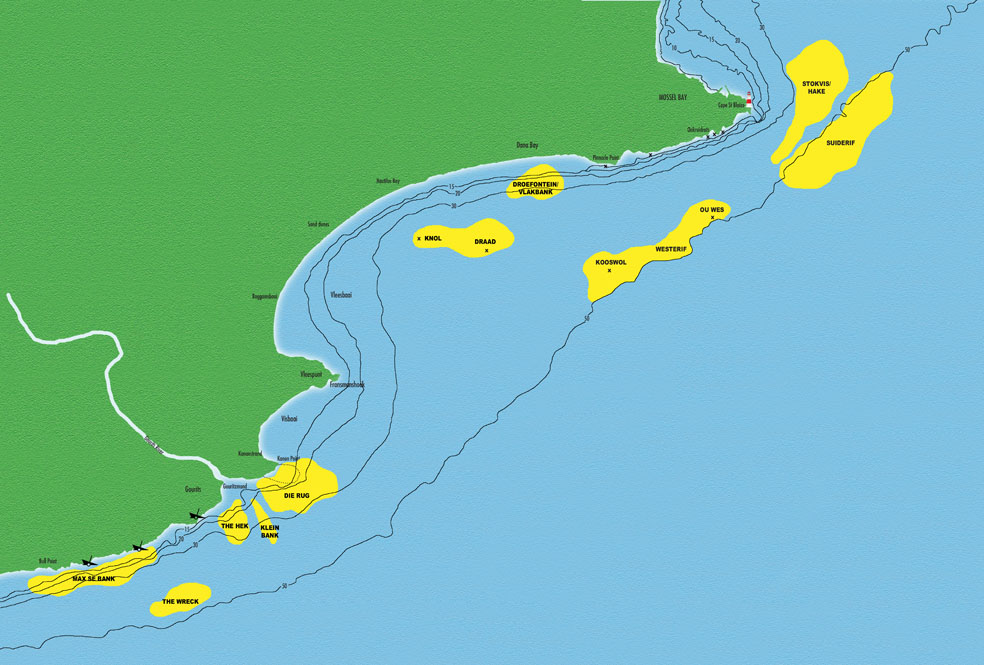
    Fishing from Mossel Bay offers a range of opportunities, starting with the hake-rich clay banks which are found between 45– and 80 metres. Key spots include Bob se Bank, Kooswol, Ou Wes, and the well-known Guide Bank.
    These deeper areas produce exceptional results, especially for hake, but in the winter months, Kooswol and Ou Wes often surprise anglers with schools of loose kob cruising through.
    Closer to shore, Danabaai offers access to productive mid-depth reefs (25–45m) such as Knol Draad and *Vlak Bank, where kob and red roman are regularly caught.

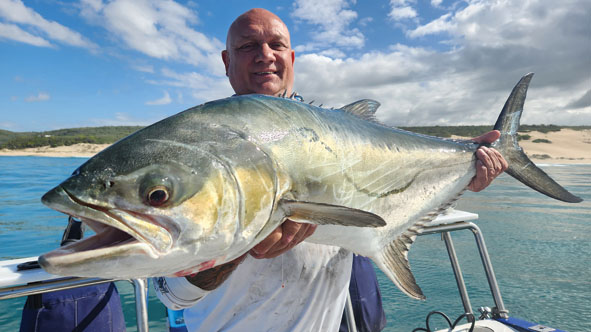
    Garrick are often found along the sandy shoreline from Danabaai to Vleesbaai during summer.

    Drifting the Inshore Waters
    The sandy shoreline from Danabaai to Vleesbaai offers consistent summer action for garrick (leervis) and bonito.
    Anglers drift slowly in this stretch, casting plugs and presenting live bait to surface-hunting predators. This style of fishing is exciting, especially when the water is warm and baitfish are abundant.


    Rugged Reefs and Rewards
    From Vleesbaai, around Fransmanshoek and past Kanon Point, the coastline is marked by shattered, shallow reefs.
    These nearshore rocks provide excellent structure for targeting species like red roman, musselcracker (both white and black) and yellowtail.
    However, the real gem begins just beyond Kanon Point.
    This area is known locally as “Die Rug” – a vast and complex reef system stretching all the way to the Gouritsmond River mouth. It is, without doubt, one of the top kob (kabeljou) fishing areas in the country during the summer months from November to March.
    Here kob are caught on lures, jigs, dead bait and live bait. The reef spans depths from 15- to 45 metres, and fish location often requires sonar work and experience to pinpoint schools.

    Gouritsmond’s Offshore Gold
    Just offshore from the Gouritsmond River, you’ll find the productive Klein Bank, a reef system in depths between 25– and 45 metres that consistently produces kob.
    Slightly to the east lies The Hek, a legendary kob hotspot often considered one of the best-known reefs for this species in South Africa.
    The reef features a mix of broken clay banks, with depths dropping from 22- to 40 metres. Aside from kob, anglers may encounter red roman, yellowtail and even schools of bonito during the summer season.

    Hidden Challenges and Rich Rewards
    Further along the coast, The Wreck presents one of the more challenging spots to fish due to conflicting currents and swell, making anchoring difficult.
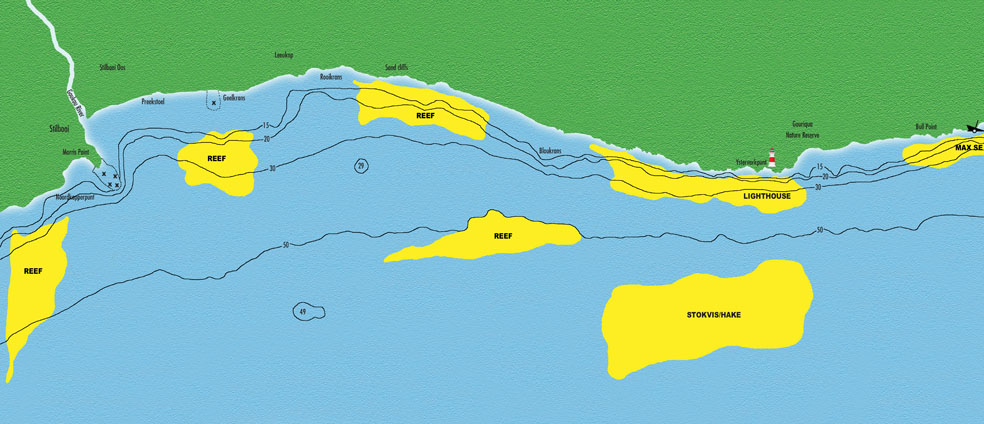
    When conditions are unfavourable at The Wreck, many anglers head inshore to Max se Bank, a dynamic reef system stretching toward Gouriqua Nature Reserve. These shallower banks (15- to 30 metres) are echo-sounding zones, meaning fish locations vary by day.
    This area is known for diverse catches including musselcracker, roman and yellowtail.

    Gouriqua and Beyond – The Lighthouse Reefs
    In front of the Gouriqua/Ystervark Point Lighthouse, anglers can target nearly every major reef species found in South Africa. This includes trophy-sized yellowtail up to 20kg, red steenbras, roman, and both types of musselcracker.
    From the lighthouse, anglers can also head offshore to the clay banks around the 80-metre mark, which are ideal for deep water hake fishing.

    Investigating kob country
    The final leg of this angling journey takes you to the shallower reefs from Stilbaai heading further west to Duiwenhoks River. These 15- to 30 metre deep reefs are ever-changing; fish move constantly, making sonar your best ally.
    Stilbaai is renowned for kob, particularly in the warmer months. While most kob here range from 3- to 8kg (locally referred to as “korthol”), they often appear in dense schools, making for exciting fishing sessions.

    Final thoughts
    Fishing the waters between Mossel Bay and Stilbaai offers both variety and abundance. Whether you’re hunting kob, reef dwellers or deep sea species, this stretch of coast delivers thrilling opportunities throughout the year. With a bit of local knowledge and the right gear, your next fishing trip could turn into the experience of a lifetime.
    So, pack your rods, check your echo sounder, and make your way to the Southern Cape – world-class fishing awaits.

  • WHERE TO FISH Part 18

    WHERE TO FISH Part 18

    Gericke’s Point to Mossel Bay

    By Nikki Smit

    (Originally published in the March 2025 issue of SKI-BOAT magazine)

    THE coastline between Gericke’s Point and Mossel Bay is characterised by steep dunes and cliffs interspersed with gorgeous sections of beach. While it’s a truly beautiful section of coastline, it does not offer many options for launching a boat to go to sea. Inland, however, options abound, ensuring that between the sea and the estuaries, anglers will certainly have enough to keep them happy.

    SWARTVLEI ESTUARY AND SEDGEFIELD LAGOON
    These water bodies provide a vast area to fish in. The lagoon is relatively shallow and, if the mouth is open, can be quite tide dependent, especially for launching, so make sure you check the tides when you plan a trip. The mouth sometimes closes for extended periods and then this is no longer a problem, but if Swartvlei gets too full, access under the old train bridge from the lagoon is problematic as it is very low.
    Grunter, kob, Cape stumpnose, elf and garrick can all be caught here. The train bridge is a favourite spot for shore-based anglers who want to target garrick. The shallows between the N2 bridge and the train bridge are often frequented by flyfishers, as are the shallows north of the train bridge.
    Access to these areas can be gained by parking at the train line where it crosses the outward-bound road. Ensure that no valuables are left visible in your vehicle when parking here.
    Swartvlei has many options and can pretty much be fished anywhere. There are boat exclusion zones, but these are clearly marked with buoys. Grunter tend to be found on the shallower banks and kob in the deeper sections on the northern side of the vlei. Garrick are also sometimes caught while trolling livebait.
    Public access directly onto Swartvlei is very limited, but one can launch a boat from Bayswater. Note that a daily fee is payable and the access hours are very strict. Alternatively, you need to get onto the lagoon and travel upriver and under the train bridge to Swartvlei, but this is not an option for bigger boats or cabin boats.
    Fishing in the lagoon produces similar species to what you’ll find at Swartvlei, with grunter probably being the most targeted, usually by drifting across the banks on the pushing tide. When the mouth is open, the water is beautiful and clear, and as the lagoon is relatively shallow, the bottom can be seen most of the time.
    There are two launch sites, but they can be heavily affected by the tide, so be aware of that and take the size of your boat into account.
    One launch site is near the mouth, and there’s another on the island, but both have limited parking space. These areas can get very busy during the holiday season so it’s best to get there early.
    Take note that skippers may have to navigate a fair bit of weed when leaving the slipways, but the channels are clearly marked with buoys. Care must be taken to observe the no wake and no boat zones.
    A SANParks permit is needed to access the lagoon and Swartvlei with a boat, whether it be a paddle/rowing boat or one with a motor. These permits are available either from the Knysna office, located on Thesen Island (044 302 5600) or from the Wilderness office located at Ebb and Flow, (044 877 1197). This permit is required for all the vleis and estuaries within the Garden Route National Park area.
    A variety of baits can be used on the vlei and in the lagoon, but sand prawns and sardines are firm favourites. Sand prawns can be pumped at low tide or be caught with the use of a float ring.

    Nikki Smit with a beaut of a kob.

    SWARTVLEI BEACH, GERICKE’S POINT AND SWARTVLEI LAUNCH SITE TO KAAIMANS
    This section of coast is characterised by shallow banks and deep gullies. Swartvlei Beach is popular among surf anglers and offers a wide variety of fish to target, both edible and non-edible.
    Gericke’s Point is very popular among shark fishermen and spearfishermen. One has to be mindful of the tide when fishing the Point, as it can be dangerous in places when you’re walking back to the car park at spring high tide.
    Between Gericke’s Point and Wilderness is a spectacular piece of coastline, and if you are willing to tackle a fairly substantial walk, some wonderful spots can be found. Once again you will need to be mindful of the spring high tides when walking along this section.
    Swartvlei Beach is also a launching site for boats wishing to go out to sea. George Ski-Boat Club manages the launch site on behalf of SANParks. It’s a surf launch and is very much swell and tide dependent. A 4×4 vehicle is required. For further informtion on the launch site, contact the George Ski-Boat Club via email <secretary@george
    skiboatclub.co.za>.
    There are a number of good deep sea fishing options between Gericke’s Point and the Kaaimans River mouth, and reef fish can be caught along this whole section.
    There is a long reef relatively close inshore in around 30m of water, which runs most of the way from Gericke’s Point to Wilderness Beach. Each day out produces a different selection of catches – a bit like Forrest Gump’s “Life is like a box of chocolates, you never know what you’re gonna get”. Be prepared for anything from kob and geelbek to red fish. Chokka and sardines are the baits most often used.
    Hake can also be found along this section anywhere in the 60m+ depths.
    There are many patches of reef off Wilderness Beach ranging in depths from 25- to 40m. Beautiful santer and the occasional kob can be found here. Big carpenters like to frequent the area in front of Klein Kranz.

    A lovely fat garrick caught at Swartvlei.

    ISLAND LAKE AND TOUW RIVER
    Island Lake is a fascinating place to fish due to the variety of species found there. It is one of the few places where one can catch grunter, leervis and carp. Both artificials and bait provide good results, and one can launch a boat at the slipway located next to the Island Lake Holiday Resort.
    The launch site is managed by SANParks and a park fee is payable. Information is available from SANParks Wilderness. The Serpentine River, which links Island Lake to the Touw River, is a no boat zone.
    To access the Touw River by boat, you can launch from SANParks Wilderness at Ebb and Flow. Touw River is a great place to target grunter, kob and leeries.

    KAAIMANS RIVER
    At present the public can only fish the Kaaimans River from the shore or from a canoe. Some decent sized grunter have been caught here, and leervis can be targeted close to the mouth. Please ensure that you respect private property at Kaaimans if you fish there.

    WILDERNESS TO VICTORIA BAY
    (Along the train line)
    There are some great places to fish off the rocks along this section although for security reasons people are advised not to go there alone as there have been a few incidents. Use of the old train bridge is also not advisable as it is badly rusted and degraded with huge sections missing and is a severe safety hazard. The mouth is currently quite deep so care would need to be taken if one wants to cross over.

    GROOT BRAK, KLEIN BRAK AND HARTENBOS RIVERS
    These three rivers are located relatively close to one another as we move closer to Mossel Bay. Species to be targeted in this area are grunter and leervis, with the occasional kob also being caught here. Grunter can be caught on the pushing tide, as well small kob and leervis.
    Kleinbrak has a small public slipway opposite the police station, but the launch is quite tight. It is not a proper concrete slipway, though, and is just made from compacted sand, so it is advisable to use a 4×4. This is a public launch site so there’s no fee for using it.
    Boats may not travel left around the island near the beach as it is too shallow.

    MOSSEL BAY
    Those looking to go deep sea fishing in Mossel Bay have a couple of options – book a charter with one of the local charter companies which operate from the harbour, or launch your own boat from the public slipway at the harbour.
    Just be careful if you choose this second ption, because the slipway can be tricky to navigate at times due to quite a serious surge. A tractor service is available should it be required.
    Due to the slipway being part of the harbour, a harbour permit is required, as is a Port Clearance certificate. For information on costs and what documents are required, contact Elfie on 060 870 4299 or <admin@mbskippers.co.za>.
    There is a fair amount of reef close inshore between Mossel Bay and Victoria Bay, and reef fish including kob can be caught on most of these reefs. Depths vary between 20m and 40m.
    Garrick can be caught from the shore or close inshore from a boat between Reebok and Diaz Beach. There are ample places to fish along the whole section of beach between Groot Brak and Diaz Beach.
    When conditions are right you can catch bonito from the Point at the Lighthouse. Hake are generally found out in the bay in depths around 70m, but water temperature influences this and sometimes they are found in shallower water. Kob sometimes come out among the hake too.

    FOR THE NON-FISHERS
    If the rest of the family aren’t quite as enthusiastic about a day out on the sea, the area boasts many other outings and adventures they might enjoy.
    Sedgefield is a quaint little seaside town that’s often missed by passersby. Things to do here include visiting the Saturday morning Farmers and Craft Market, paragliding, beautiful beach walks, canoeing on the lagoon (you can rent canoes at the slipway near the mouth during the holiday season), mountain biking, horse riding and swimming.
    Wilderness offers a variety of shops and entertainment including quad bike riding, segway tours, paintball and paragliding, or you can swing in the trees with Acrobranch.
    There’s also kayak hire and kloofing trips on the Kaaimans River.
    In George you can go mountain biking, hiking, strawberry picking or horse riding. You can also visit the Outeniqua farmers market on a Saturday or visit the old train museum, or take trips on the Outeniqua power van.Vic Bay and Heralds Bay have lovely beaches.
    Mossel Bay has a coastal zip line which will certainly get the heart rate up, as will cage diving with sharks and whale watching. Then there are the beautiful beaches, game farms and museums to visit. You can also go diving, skydiving, parasailing, hiking and trail running.
    In short, there is plenty to keep the family busy while the fishermen collect dinner.

    GENERAL INFO
    There are a number of charter companies and tackle shops in the area and a Google search will help you identify them.
    There is also plenty of accommodation along this stretch of coastline. If you look on one of the many online booking portals such as Lekkeslaap, Airbnb or Safarinow, you are bound to find something that will suit your needs and pocket.
    For more information on the area as a whole, contact the Mossel Bay Tourism office on 044 691 2202 or visit <www.visitmosselbay.co.za>.
    Sincere thanks to Jandre Blom from Bloudam Fishing Adventures, Marius Opperman, Bertie Steward, Dylan Erasmus from Mayfly, and Elfie from MB Skippers for their input and photos.

  • WHERE TO FISH Part 17

    WHERE TO FISH Part 17

    Fishing from Plett to Bloukrans

    By Nikki Smit & Graham Braby

    (Originally published in the January 2025 issue of Ski-Boat magazine)

    BAHIA Formosa, or Bay Beautiful as it was named by Portuguese navigator and cartographer Manuel de Perestrelo, has a long and, at times, tragic history of fishing, that includes the establishment of a whaling station in the early 1830s where the iconic Beacon Isle Hotel stands today. Thankfully these giants are no longer targeted in this beautiful bay, but fishermen are certainly spoilt for choice with other species when fishing this coastline.
    In decades gone by, commercial fishing was a prominent feature of Plettenberg Bay, with a colourful selection of trawlers gently bobby away in the usually calm waters off Central Beach. These trawlers are now mostly absent, however, and fishing here is now predominantly a recreational activity.
    Plett is a truly special place, and I can only imagine what settlers must have felt when they first saw the bay and its surrounds.
    Protected from the elements by the majestic Robberg Peninsula, one of my favourite places to visit, you are treated to incredible vistas over the bay towards the mountains as well as the often contrasting wild scenes out to sea. No doubt sailors felt enormous relief when they rounded the point at Robberg and eased into the relatively protected waters of Bahia Formosa.
    Plett Tourism recently announced that, in addition to being nominated as Africa’s leading beach destination for the 15th year, the town was also nominated in the category of the world’s leading beach destination at the World Travel Awards. This marks its first global nomination, placing it alongside renowned beaches like those in Thailand, Hawaii and the Maldives.
    We are indeed very privileged to live in one of South Africa’s most beautiful areas, one which features six Blue Flag Beaches, two marine protected areas, dramatic scenery and an abundance of marine life. Situated right in the middle of Plett’s famous Central Beach, is another well-known and extremely popular landmark – Plett Ski-Boat Club.

    FOR THE FAMILY
    Plett offers a variety of activities for the whole family, which is great news for fishermen whose families might not be quite as enthusiastic about spending a day out on the water. The local attractions and activities include beautiful beaches, whale watching trips, hikes around Robberg, kloofing, elephant parks, Monkey Land, birds of prey, adventures parks and farmers’ markets. For those keen on spending time out on the ocean, this can either done with their own boat, or by hiring a charter boat – whichever is easiest and best sits their budget.

    LAUNCHING
    There are two public launch sites – one at Central Beach and one up the Keurbooms River. They are marked with red stars on the map alongside.
    Plett Ski-Boat Club offers a beach launch facility at Central Beach, and permits can be obtained and paid for at the Beach Control Office at the club house next to the NSRI. Most boats are launched via a dolly as the boats generally have to be pushed in quite deep before motors can be dropped. A push pole can also be used if your boat can accommodate this, and sometimes conditions allow for a traditional reverse drop on the beach.
    The surf, on the whole, is not too taxing, and it is generally considered a relatively protected beach to launch from. Another bonus is that the site is not tide dependent.
    There is a tractor service which can be hired, but skippers who are launching their own boats need a 4×4.
    Alternatively, boats can launch up the Keurbooms River at Alkantmooi, near the N2 Bridge. This site is managed by Cape Nature. Day permits are available at the boom, and annual permits are available from the Cape Nature offices in town.
    This option is tide dependent, as the river gets very shallow between the slipway and the mouth at low tide, and the channels need to be navigated with care. The section of river between the slipway and the mouth is also a no-wake zone. Skippers need to ensure they watch the tides carefully so that they are able to safely navigate both the channels and the mouth, and will not be caught high and dry in the impact zone. The mouth can also be tricky to navigate through, with a challenging surf to deal with, so skippers have to be sharp when using this option.

    MPAS
    Once you’re out on the big blue, options abound, but there are two MPAs which skippers and anglers need to familiarise themselves with:

    • Robberg MPA bounded by the latitudes S34°04.916’ and S34°07.633’ and longitudes E23°22.300’ and E23°25.967’.
    • Tsitsikamma MPA boundaries: Northwest S33°58.99’ E23°34.561’, Southwest S34°1.99’, E23°34.561’, South midway S34°1.817’, E23°38.857’, Southeast S34°6.6’, E24°11.665’, Northwest S34°3.6’, E24°11.665.
      There is currently an appeal underway with regard to this MPA, but until this has been resolved, the Gazetted boundaries as detailed above are effective.
    Bruce Noble shows off a snoek caught off Plettenberg Bay.

    FISHING AT SEA
    On colder days, Plett produces some pretty decent hake, and, as we all know, there are few things that beat fresh hake. They are found pretty much anywhere in the bay at around the 50-60m marks. Sometimes snoek are also caught, but this is not a common occurrence and it normally involves a fairly long run towards Eerste River and fishing the deep banks offshore.
    Tuna have also been known to come into the bay, but this is also not an everyday occurrence, and, on the rare occasion that they are there, it’s normally over the summer months.
    Kob, geelbek, roman, silvers and other reef fish can be found around the 24m depth off Natures Valley and Salt River. Please be mindful of the MPA boundaries in that are, and of sticking to the regulated bag and size limits. Anglers are encouraged to release the bigger breeding stock specimens as well as slow-growing fish such as poensies and rockcod.
    Garrick can be caught along the backline along the sandy beaches on live bait or while trolling lures or casting plugs. The whole bay is also good for catching bonito, which certainly give a good fight for their size.

    Kian Evans with a lovely yellowtail.

    ESTUARY FISHING
    If conditions are not conducive for fishing out at sea, the estuary will certainly provide some enjoyment. Remember to obtain a permit from Cape Nature when launching. As I mentioned, the river and estuary are very tide dependent, so make sure you don’t get stuck.
    Species that can be targeted in the estuary include grunter, kob and garrick. The area surrounding the N2 bridge on both the Keurbooms and Bitou rivers seems to be good for garrick, and pretty much anywhere with shallow banks will produce grunter. Prawns are the bait of choice, and if you have the patience, you will be rewarded on surface lure and fly.

    ROCK AND SURF
    Rock and surf fishing in this area, like with most fishing, is totally dependent on the conditions. However, with a very large stretch of beach to choose from, one is sure to find a spot that works. Species caught include white steenbras, kob and garrick.

    ROBBERG PENINSULA
    While fishing off a boat is prohibited in the MPA, fishing from land is not.
    Garrick and bonito are some of the favourites caught from the point, but this involves a long but beautiful walk.
    Species such as white musselcracker and galjoen can be caught on the wild side, as can kob. Ensure you are familiar with the closed season for galjoen.
    To reach the coastline here you will also need an access permit which is available from Cape Nature at the entrance to Robberg.
    No bait collection is allowed in the reserve.
    For those wanting to make a weekend of it, the Fountain Shack is an absolute treat and only a relatively short walk from the parking area.

    USEFUL CONTACTS
    Plett Ski-Boat Club 044-5334147
    Cape Nature Offices 044-5332125
    Robberg Nature Reserve 044-5332125

  • WHERE TO FISH Part 16

    WHERE TO FISH Part 16

    Working west of Knysna

    By Ewald Crause  and Connie Garstman

    (Originally published in the November 2024 issue of SKI-BOAT magazine)

    KNYSNA, a gem of the southern Cape coast, is a destination that offers anglers an unparalleled variety of fishing experiences. From the serene, sheltered waters of the Knysna estuary (perfect for light tackle enthusiasts), to the thrilling challenge of navigating the iconic Knysna Heads, this region is a paradise for those seeking diverse fishing adventures. Whether you choose to fish the estuary’s abundant channels, venture offshore towards Plettenberg Bay, or head west towards Walker Point, Knysna serves as a gateway to an array of species and fishing techniques, catering to both novice and experienced anglers alike.

    KNYSNA ESTUARY
    A haven for light tackle fishing and family fun
    For those seeking a relaxed and accessible fishing experience, the Knysna estuary is an excellent location. Its calm waters make it ideal for light tackle fishing, with species such as leervis (garrick) and spotted grunter being common targets. Early mornings and late afternoons are productive times to fish, and livebait like prawns or small mullet work well.
    The estuary is also a great place for families to enjoy fishing together. Children can easily catch baitfish and gorries (pinkies), providing an engaging introduction to the sport. The area is also frequented by skates and smooth-hound sharks, which offer a fun challenge for young anglers without being too difficult to handle. For those interested in flyfishing, the estuary’s waters provide the right conditions, with leervis often going for surface poppers and clousers.
    The combination of productive fishing, ease of access and family-friendly appeal makes the Knysna Estuary an ideal destination for anglers of all ages and skill levels.

    THROUGH THE KNYSNA HEADS
    Navigating between the Knysna Heads – two towering cliffs that frame a narrow channel between the estuary and the open ocean – presents a serious challenge due to the unpredictable nature of the conditions.
    Skippering through this passage requires skill and a solid understanding of local sea conditions. Many local skippers regard successfully passing through the Knysna Heads as a mark of experience and boating proficiency – essentially a rite of passage. It’s not a route recommended for novice boaters, but for those who manage it, the waters beyond offer rewarding fishing opportunities.
    The tidal currents between the Heads are strong and fast, funnelling through the narrow gap and creating turbulent waters, especially during the outgoing tide. For boaters, timing is critical. Passing through the Heads at slack tide, when the current is at its weakest, is strongly recommended to ensure a safe journey.
    In addition to the strong currents, waves at the Heads can become unpredictable, with larger swells pushing into the channel and creating rough conditions, even when the sea appears calm from inside the estuary. Skippers must be aware of both the tide and the swell size when planning to exit or enter through the Heads.
    Once they’re out on the ocean, anglers gain access to a variety of fishing options, with the choice of location often depending on the type of fishing they prefer.

    DALGLEISH BANK
    Key features:
    Dalgleish is an offshore fishing ground where the depth rises sharply from around 65m to 30m. This depth change attracts both pelagic species near the surface and reef species near the bottom. Trolling along the edge of the bank often produces good results.
    GPS Coordinates:
    S 34°11.662’ E 22°57.403’
    This mark is pretty central to the reef, and there are plenty of beautiful pinnacles here.
    Target species:
    Pelagic: Yellowtail, bonito.
    Bottoms: Carpenter, red Roman, rockcod, geelbek, kob.
    Best time to fish:
    Pelagic species like yellowtail and bonito are most active from October to March. Bottomfishing is productive year-round, with the cooler months from April to August offering good chances for carpenter and other reef species.
    Preferred fishing methods:
    Trolling along the edge of the bank is effective for yellowtail and bonito. For bottomfishing, targeting the deeper areas (back of the bank) yields carpenter and typical reef species. Drifting near the rise or anchoring near the reef can be effective, depending on conditions.

    HAKE GROUNDS
    Key features:
    The Hake/Stokvis Grounds are a prime area for targeting this delicious table fish, particularly during the winter months when hake and other species like gurnard move into the region. When water temperatures drop, hake can be found as shallow as 50m, though the most productive depths are typically between 70m and 80m.
    GPS Coordinates:
    S 34°10.652’ E 23°03.394’
    This mark serves as a good reference point, and fishing within a 3- to 4-nautical-mile radius around it is productive for hake in the colder months.
    Target species:
    Hake and gurnard
    Best time to fish:
    The winter months (April to August) are best for Cape hake, particularly when water temperatures drop. Early mornings and late afternoons are productive times, with the best catches coming from the 70m to 80m depths.
    Preferred fishing methods:
    Bottomfishing is the most effective method here. Drifting allows you to cover some ground, and you may cross paths with the hake, but anchoring up and ensuring sufficient bait reaches the bottom will bring the fish into your patch, producing more consistent results.
    Bait and tackle:
    Pilchards are the go-to bait for hake and gurnard. You have to keep your bait on or near the bottom, so ensure you have plenty of weight and a healthy supply of patience.

    Ewald Crause with a beautiful Miss Lucy.

    PLATBANK INSHORE
    Key features:
    Platbank Inshore is characterised by shallow reef structures. These reefs are productive year-round, attracting a variety of bottom-dwelling species that frequent rocky environments.
    Target species:
    Miss Lucy, geelbek, santer
    Best time to fish:
    Miss Lucy can be targeted throughout the year, with summer months being particularly productive. Geelbek fishing (drift fishing) is best from February to May, typically early in the morning or late in the afternoon when they are most active.
    Preferred fishing methods:
    Anchoring near the reef structures is the preferred method for targeting bottom species like Miss Lucy and other reef species. Drifting can also be effective, though care must be taken around the rocky terrain to avoid losing tackle.
    Bait and tackle:
    Medium tackle with strong leaders is recommended to avoid getting snagged on the reef. Use pilchards, mackerel or chokka for bottomfishing. For geelbek, live bait or pilchard baits on drift rigs are effective, especially during their active months.

    PLATBANK DROPOFF
    Key features:
    The Platbank Dropoff is a well-known fishing area located where the reef drops sharply from shallow waters into deeper areas of about 40m. The key feature of this spot is the dropoff, which is easily visible on your plotter. Fish often gather near this underwater structure, making it a great spot for targeting kabeljou and other species.The sandy bottom near the edge of the reef is especially productive for kob.
    Target species:
    Kabeljou (kob)
    Best time to fish:
    The best fishing at Platbank Dropoff is typically from December to May. Early mornings and late afternoons are especially productive times.
    Preferred fishing methods:
    Drifting or anchoring close to the drop-off while working bait or lures along the reef edge is effective. Trolling along the drop-off can also yield good results, particularly for pelagic species. For bottomfishing, focus on positioning near the sandy bottom and reef edge to target species like kabeljou.
    Bait and tackle:
    Pilchards and chokka are the preferred baits. Dropshots can also be used for kabeljou and other bottom-dwelling species. For pelagic species, trolling with live bait can also be effective. Medium-heavy tackle is recommended, with a strong leader for larger fish.

    BLACKROCK
    Key features:
    Blackrock is easily recognisable by the prominent rock structure on the beachfront. It is a versatile fishing area with depths ranging from 8m to 35m, making it suitable for a variety of species. The area is known for its many pinnacles, and targeting smaller pinnacles that hold fish is key to a successful trip. Due to the rough terrain, it is not advisable to drift fish here, as tackle loss is likely. Instead, anchoring is recommended to keep you in the productive areas. Ensure you have a steady supply of burley (chum) to attract fish.
    GPS Coordinates:
    S 34°03.748’ E 22°49.827’
    Target species:
    Kabeljou: Common around the pinnacles, particularly in deeper sections. Geelbek: Often found around the pinnacles, especially during their active months. Santer: Found year-round, particularly near the smaller pinnacles. Red Roman: Common in rocky environments. Rockcod: Yellowbelly and cat-eye rockcod are frequently caught here.
    Best time to fish:
    Fishing at Blackrock is productive year-round, with peak activity in the summer months for species like Santer and red roman. Geelbek is more active from February to May.
    Preferred fishing methods:
    Anchoring is essential when fishing at Blackrock due to the rough terrain. Use burley to attract fish to the area, and focus on bottom fishing near the pinnacles. Tackle should be prepared for the rocky environment to minimize losses. Avoid drifting, as the risk of getting snagged on the pinnacles is high.
    Bait and Tackle:
    Pilchards, squid, and chokka are effective baits. Use medium-heavy tackle with strong leaders to withstand the rocky environment. Be prepared for hard fights from species like kabeljou and geelbek.

    KOLKGATE
    Key features:
    Kolkgate is characterised by numerous dropoffs and deeper holes that attract a variety of bottom-dwelling species. Anglers should use their plotter to locate these dropoffs and the area’s pinnacles as they are prime areas for catching multiple species.
    GPS Coordinates:
    Between S 34°03.259’ and 34°02.644’ Between E 22°49.052’ and 22°46.959’
    Target species:
    Poensies: Found in the deeper holes near the dropoffs. Red steenbras: Common in the deeper sections, particularly in rocky areas. Groot santer: Often found year-round in deeper waters. Yellowbelly rockcod: Favour the rougher terrain around the pinnacles. Geelbek: Frequently found near the pinnacles, especially from February to May.
    Best time to fish:
    Kolkgate is productive throughout the year, with the best results seen during the cooler months for species like steenbras and poensies. Geelbek are most active in the late summer and early autumn months.
    Preferred fishing methods:
    Bottomfishing near the dropoffs and around the pinnacles is the most productive method at Kolkgate. Anchoring is recommended to effectively work the deeper holes and pinnacles. Keep a steady supply of burley/chum to attract fish, and be patient as the fish often hold close to the structure.
    Bait and tackle:
    Pilchards, squid, and chokka are effective baits for bottomfishing. Medium-heavy tackle with strong leaders is necessary due to the rocky terrain and the size of the fish typically caught here. For geelbek, livebait or pilchards on drift rigs are effective around the pinnacles.

    PLANTASIE
    Key features:
    Plantasie is a sand-bottomed area interspersed with small rocky outcrops, which is exactly what anglers should focus on. These outcrops are prime spots for finding larger kob, particularly in the 25m to 40m depth range. The sandy bottom combined with rocky patches creates an ideal habitat for bottom-dwelling species.
    GPS Coordinates:
    S 34°04.601’ E 22°45.917’
    Target species:
    Kob: Large kob frequent the area, particularly around the rocky outcrops in the 25m to 40m range. Geelbek: Can be found occasionally in deeper sections of the area. Carpenter: Often caught near the rocks, especially in slightly deeper water.
    Best time to fish:
    The area is productive year-round, but kob fishing is especially good from late summer to early winter. They’re most active in the early mornings and late afternoons.
    Preferred fishing methods:
    Bottomfishing is the go-to method at Plantasie, particularly around the small rocky outcrops. Anchoring near these outcrops and working the bait close to the bottom is effective for attracting kob and other species. Drifting is also an option in this area, especially in deeper water where kob tend to be more active.
    Bait and tackle:
    Use live bait, pilchards, or squid for bottomfishing. Medium-heavy tackle with strong leaders is ideal, as kob can be large and will fight hard. Be sure to position your bait near the rocky outcrops for the best chances of success.

    MARINE PROTECTED AREA (MPA)
    The Goukamma MPA stretches from Walker Point to Buffels Bay and up to Groenvlei carpark, is designated as an MPA. The protected zone extends 1.8km (1nm) offshore, aimed at preserving marine biodiversity and ensuring sustainable use of the resources. The MPA plays a crucial role in protecting fish species, especially those that breed and feed in the area, contributing to healthier fish populations both within and beyond the protected boundaries.

    LAUNCHING OPTIONS
    The Knysna area provides several launching points for anglers, ranging from club launches to public access sites. Each has its own requirements and facilities, so it’s important to know the details before heading out.
    1. Gerrickes – Beach launch
    Description:
    Gerrickes offers a beach launch facility, but access is limited to members of George’s Ski-boat Club. This launch site is located in a spot with direct access to productive fishing grounds, but launching from the beach requires experience, as the surf conditions can sometimes be challenging. This launch site is popular among local anglers due to its proximity to key fishing spots.
    Key considerations: Only club members can use this facility. The beach launch means you need to handle your boat through surf, which can be difficult in rough conditions, so it is best suited for experienced skippers.
    2. Buffalo Bay – Open Public Launch
    Description: Buffalo Bay provides an open public launch, making it accessible to all anglers. This launch site is a popular choice for recreational fishers as it offers relatively easy access to the surrounding coastal waters, including the popular fishing grounds around the Knysna area. It is less restrictive than club-based launches and doesn’t require membership.
    Key considerations: As a public facility, it’s open to anyone, but the beach launch requires careful navigation because of local tide and surf conditions. Early arrivals are advised during busy periods, particularly in peak fishing seasons or weekends, to avoid congestion.
    3. Knysna Lagoon – KADA
    The Knysna Angling and Diving Association (KADA) launch point is available for anyone to use, but a public launching fee is charged. KADA offers access to the Knysna Lagoon, which is ideal for anglers targeting estuary species or for those looking for a calmer launching point before heading offshore. The safe, sheltered nature of the lagoon with easier access for small boats or beginners makes it a good option for those looking to avoid surf launches.
    Knysna Lagoon – Leisure Isle Boat Club
    For those looking to launch in more controlled conditions in the lagoon, Leisure Isle offers a more comfortable launch experience compared to beach launches. However, this facility is private, and more details about access requirements should be obtained directly from the club.

    RESCUE SERVICES
    The National Sea Rescue Institute (NSRI) branch in Knysna plays a vital role in ensuring the safety of those venturing out to sea along this section of coastline. Operating as part of South Africa’s national volunteer sea rescue service, the Knysna NSRI is on standby 24/7 to respond to emergencies and provide assistance to boaters, anglers, and the broader maritime community. Many skippers rely on the NSRI for updates on weather and sea conditions before attempting to pass through the Heads or head offshore.
    For emergencies or assistance, boaters can reach the Knysna NSRI directly on 082 990 5956. I recommended that all skippers keep this number on hand if they’re heading out to sea, particularly when navigating the challenging waters around the Knysna Heads.
    Happy fishing.

  • WHERE TO FISH Part 15

    WHERE TO FISH Part 15

    Port Alfred and surrounds

    By Colin Fletcher and Clinton Schultz

    [Originally published in the July 2024 issue of Ski-Boat magazine]

    THE hidden gem of the South African coastline, the area between Kenton-On-Sea and the Mgwalana River, not only offers plenty of tourist attractions and luxury game lodges, but also some of the best fishing in the Eastern Cape.

    Colin Fletcher shows off a solid dorado.

    The variety is vast – everything from dageraad, poensie, kob and geelbek to incredible gamefishing in the current line which produces yellowfin tuna, dorado and marlin. This area truly offers it all.
    I have been privileged to grow up on this section of the coast, fishing both rock and surf as well as offshore. The amazing history of this coastline never ceases to amaze me and the stories of massive catches have intrigued me for years.
    Accommodation for visitors to this area is well priced and it won’t cost you an arm and a leg for a fishing holiday with the family.
    Launch sites are also plentiful. From beach launches to harbours, there are a number of different options.
    Port Alfred is one of the easier launch spots to get to logistically, but it can be a hair raising launch through the mouth if the weather is not good. Make sure you get local advice if you’re not familiar with the launch.
    Other beach and slipway/river surf launches along the coast include Boknes, Kenton, Kleinemonde, Mpekweni, Mgwalana and Birha.
    If you’re not confident launching safely in this region, professional charter companies are readily available in Port Alfred. Their services are generally well priced, and the skippers have intricate local knowledge and experience thanks to spending hundreds of hours on the water. This is a great option for a family day outing for those roadtripping down to the area.
    If you are visiting and want to meet up with some of the locals, then stop by at the Port Alfred River & Ski-Boat Club situated along the Kowie River. It is a good place to pick up some local information and there’s a great pub and restaurant where you can enjoy the generous hospitality.
    Contact the club on 046 624 4532 or visit their Facebook page <www.facebook.com/parscpa/> for further details.

    SPECIES

    Colin and Megan Fletcher with a few pan-sized kob and a carpenter.

    Kob
    A highly sought after fish along the South African coastline, kob are great fun to catch and are great eating too. In this area they range from1kg to 20kg, so you never know what you are in for.
    The daily bag limit, according to www.saambr.org.za, is one per person per day if caught from the shore and in estuaries east of Cape Agulhas, and five per person per day if caught west of Cape Agulhas or if caught anywhere from a boat offshore.
    Minimum size limit is 60cm total length if caught from the shore and in estuaries east of Cape Agulhas, and 40cm total length (KZN) and 50cm total length (EC & WC) if caught from a boat offshore or from the shore west of Cape Agulhas. Only one kob greater than 110 cm total length may be caught per person per day regardless of area or sector.
    You’ll often catch slightly undersized kob that have to be put back, but when you get into a shoal of keeper-size fish, great fun can be had. The smaller fish, around 60cm, are best for eating.
    Chokka and sardines are easy and popular baits for these fish. A great option on a spinning setup is to use paddletails or dropshots.
    Kob can be lazy fish and will sometimes lie in water sheltered by structure, waiting for prey fish to swim past. Smaller fish tend to shoal when feeding, and when you tuck into a shoal it is great fun. With a more aggressive bite than geelbek, shoaling kob closer to the bottom will more often than not bite in an upwards direction and you will feel an upwards bump followed by momentary slack, then SMASH!

    Colin Fletcher with a nice poensie caught near Lighthouse Point.

    Poensie
    Black steenbras aka musselcracker aka poensie is probably the most prized bottomfish species in this area. A big specimen is both memorable and extremely fun to catch.
    These fish occur along most of the east coast of South Africa and are most abundant along the Eastern Cape/Transkei and KwaZulu-Natal coastlines.
    Chokka strips/legs, fresh fillet, a dead Frans Madam (big-eye) or sardine are all effective dead baits for these “cracker” fish. I have been smoked by big crackers on a maasbanker live bait, so that is also a good option to try.
    Some people choose to keep the daily bag limit of one per person but I personally choose to release them.
    Be extremely careful when handling these fish, especially on an inflatable boat, as they have a few sharp spines.

    Dageraad
    These fish are endemic to South Africa and are only found in the waters stretching from the lower South Coast in KwaZulu-Natal to Cape Point in the south-western Cape. They are most common along the Western and Eastern Cape coast.
    Dageraad are generally found around offshore reefs between depths of 20m and 100m, and will bite on chokka, sardine and fillets.
    They are listed as critically endangered on the IUCN Red data list, so the current bag limit is one fish per person per day at a minimum size of 40cm.

    Red Roman
    Arguably one of the prettiest reef fish on the Eastern Cape coastline, red Roman are also tender fish to eat. These beautifully coloured fish can weigh between 1kg and 3kg on average, and a big Roman provides a fun fight on lighter tackle.
    Caught throughout the year, these fish can be caught on red bait, worms, chokka, fillet and sardines. Look for them around reefs or pinnacles in shallow water.
    The minimum size is 30cm with a daily limit of two per angler.

    Carpenter/Dog/Silverfish
    These fish are abundant along the Eastern Cape coastline and are found in waters anywhere between 20m and 100m deep.
    They have a vicious tooth structure and will eat almost anything. Adults feed on anchovies, sardines and squid, while juveniles feed mainly on crabs, crab larvae and worms. It can be frustrating when you get into a large shoal of small dogs and nothing else bites.
    These fish are underrated as a table fish but are fast gaining popularity among South Africans.The current bag limit is four fish per angler per day, with a minimum size of 35cm.

    Geelbek
    These fish are sporadic and unpredictable. You might see a shoal on the finder and drop a bait, only for it to be left completely untouched. We call this “bek lockjaw”. The daily bag limit for these fish is two per angler with a minimum length of 60cm.
    In the months following the sardine run these fish will be caught around the deeper reefs, but they are often found on shallower reefs as well.
    They bite very distinctively, creating slack in the line on their way up, and fight aggressively. Geelbek are great fun on light to medium tackle. Bait options include sardines, fillets and chokka. Due to their big mouths, large hooks (around 10/0) should be used .

    Miss Lucy
    These beautiful fish, with their banded shades of red and white and large forehead bumps, can be enticed to bite by chokka, sardine and octopus. The bag limit is one daily per angler with a minimum size of 40cm.

    Gamefish and billfish
    A variety of gamefish including yellowfin tuna, marlin and dorado can be found around the area off Port Alfred known as “the eye”.
    For years this area has been frequented by migrating populations of smaller tuna, mostly in the 10- to 30kg weight class. However, in the last year or so there has been a noticeable increase in the number of big tuna in the area, 50kg-plus bullets which have offered plenty of fun.
    Dorado have spoilt us with their presence for many years. These beautiful fish are found in warmer water (around 25 degrees) and congregate around floating objects in the current. Keep an eye out for small baitfish around floating debris, and the dorado won’t be far away.
    Marlin and dorado seem to like hanging around deeper depths around the 100m drop-offs and current lines, where floating debris can be found.
    Marlin are definitely more difficult to target, but many have been hooked in this area and some landed.
    A big marlin will bully you on a light tuna or dorado trolling setup, so ensure that you are well prepared if you plan on targeting these majestic creatures.
    A variety of diving lures and spreads at staggered distances can be used to pick up a bite at a trolling speed of around 12 kph. A good setup for targeting these species in the warmer water is something like a Shimano Tiagra 30/50 stand-up rod with a Shimano Tiagra 50W reel. This setup provides a fun fight but is powerful enough to wrestle a big tuna or marlin.

    TACKLE
    Generally, in the shallow waters, a light rod of around 7- to 8 feet can be used, along with a matching reel of your choice and light braid or nylon up to around 20kg. This will give the angler the most fun when fighting a fish.
    When dropping deeper, scale up your equipment in accordance with your preference and target species – as long as it still offers a fun fighting experience. There is nothing worse than pulling in dead weight on an ultra-heavy setup.
    Scarborough reels, multipliers and spinning reels are all good, versatile options for the fishing in this area.
    Hook sizes will vary from species to species, but you can’t go wrong with an 8/0 for most applications. You can, however, go as small as a 4/0 when fishing in shallower water for smaller reef fish such as Romans.
    Use whichever trace is easiest for you to tie quickly; I use a very “rural” double loop trace which my late grandfather taught me. Believe it or not, with this simple trace you can comfortably handle larger fish. It is, however, a lazy trace and a split swivel trace is ideal.
    When it comes to sinkers, I have used ones as light as 3 oz in shallow water, but current can mess you around quickly. Local commercial boats prefer 10- to 12 oz sinkers for the 20- to 70m depths. Just remember that when you are dropping deep, you have to pull that sinker up every time peckers clean your hook, so don’t go excessively heavy.

    JUDGING CONDITIONS
    Sea conditions in this area can vary dramatically with wind and current variations. As an example, a south easterly to south-south easterly wind can create very choppy seas, and the more southerly the wind, the worse it gets.
    This wind also pushes the cold water to the shore. Water temperatures in these conditions can plummet to 12/13 degrees and this brings out critters like the dorrie shark and barbel.
    In these conditions, you’ll find tiny shoaling carpenters and baitfish are abundant, so it’s not ideal for most types of bottomfishing, except for stockfish and gurnard in the 50m-plus depths.
    Conditions most ideal for going deep off this stretch of the coast, are after a day of light westerly winds. In these conditions the wind drops off and the surface water warms, heading inshore, which improves inshore and deep sea fishing.

  • WHERE TO FISH PART 14

    WHERE TO FISH PART 14

    Angling around Algoa Bay

    By Wayne Gerber

    [Originally published in the May/June 2024 issue of SKI-BOAT magazine]

    WHEN you’re talking fishing around Algoa Bay, there are two things synonymous with this area – chokka (calamari) and big kob.
    We have one of the most stunning coastlines which has a unique beauty of its own, with its beautiful rolling sand dunes along the Woody Cape area in the north of the bay and sandstone cliffs off Cape Padrone. The ocean around here explodes with its bounty and has the most unique and diverse range of species found along the South African coastline.
    The shallow reefs to the north of the bay are known as “The Bushes”, but they have now mostly been incorporated into the Addo Marine Protected Area (MPA) which was promulgated in 2020.
    The Bushes reefs are home to Scotsman, poenskop (Black Mussel-cracker), dageraad, red Roman and by far the greatest number of basterman (soldier or santer) all around South Africa’s coastline. We are also blessed to have some great tuna fishing offshore, and some spectacular specimens have been caught over the years. The Port Elizabeth club’s current yellowfin record stands at an impressive 102kg, and this year we are already up to a 76.3kg fish.
    The controlled fishing area in the northern sections of the bay still holds some good fishing and, with the spill over from the restricted fishing areas of the MPA, there are some good specimens of dageraad and kob and some beautiful red romans among other species in this area.
    Due to the odd shape of the MPA care must be taken to ensure you stay in the areas where it’s legal to fish. Unfortunately most of our historical kob grounds have been swallowed up by the MPA restricted zone, but there are still some good specimens to be found in and around the Sundays River mouth area.

    Beautiful yellowbelly-, catface- and brown rockcod are found in this area, and although ours are not the largest, they certainly can be plentiful at certain times of the year.
    Our waters also shelter red steenbras and geelbek that are found everywhere from the shallow reefs and warmer water all the way out to the deeper reefs on what we commonly call the south-west grounds, up to depths of 80m. Good class linefish such as dageraad and Miss Lucys are also found all the way from 12m depths up to these 70m deep reefs.
    We also have the amazing Bird Island area where some of the best yellowtail fishing is to be had. These fierce warriors or reef donkeys putting up an awesome fight and, pound for pound, I rate them as the strongest fish in the sea. They are certainly not gentlemen, and will happily bang their heads on the reef (and in the process injure themselves) to cut the line, rather than give up.
    They are beautiful fish to boot, and by far my favourite fish to target. They usually enjoy a livebait or a mix of a whole pilchard and a strip of chokka, and if you can keep your squid alive to use as bait then that would be first prize.
    Our fishing area extends all the way up to Boknes, Cannon Rocks and includes Port Alfred, but to concentrate on the area we fish predominantly we will, for the sake of this article, stick to the Algoa Bay area.
    Algoa Bay or Port Elizabeth (now officially Gqeberha) has two deep sea angling clubs, but only Port Elizabeth Deep Sea Angling Club is affiliated to the national body, SADSAA. The email contact for any enquiries is <denise@pedsac.co.za>.
    For anyone wanting to fish these areas, note that only club members may launch out of the Port Elizabeth commercial port, as it is governed and managed by Portnet and their rules and regulations apply. There are, however, temporary and seasonal December memberships available for visitors to the area.
    The next area that is very popular for our anglers is called the Rye Banks. This set of reefs 12 miles east-south-east of the port is frequented by a lot of the local boats from all clubs. It is not a long run in Algoa Bay fishing terms, and is a set of immaculate shallow reefs or banks that holds some yellowtail and a wide variety of other species.
    The most commonly fished area is on the deeper southern side where some good quality carpenters and romans are found, along with the odd geelbek that frequents the area in the autumn to winter time.
    The geelbek usually make their appearance from March through April and May, and used to be prolific in earlier years. Some very good size fish are still to be found after a good south-westerly wind with some long rolling ground swells. The banks also holds a fair number of Miss Lucy’s and even some Scotsman and the odd nice basterman.
    The Western Grounds are, as the name suggests, found on the western side of Algoa Bay and start from the point at Cape Recife stretching all the way up to Sea View. A myriad species can be caught there, including poenskop, romans, Scotsman, Miss Lucy’s, kob, geelbek and rockcod on the shallow and midwater reefs. Hake (stock fish), gurnards and the odd kingklip are found on the deeper shale and muddy bottoms. Carpenters are a pest at the best of times, but some really good quality carpenter can be found on the deeper banks which we commonly refer to as the Crayfish Banks.
    Take note that there is an MPA in front of Sardinia Bay which protects a few shallow water reefs and the shallow water reef fish. In the deeper waters there are pretty good stock fish to be found, and although it’s not a great fighting fish, it surely is one of the best eating fish in our waters.
    Our deeper waters, all the way up to 120m, can be found up to 22 miles offshore, after which you hit the continental shelf drop off and the Agulhas current. This is where our tuna area starts, but they are not limited to this area and have been found as close as one mile off Cape Recife.
    Tuna frequent our waters almost all year round, and we have some amazing tuna at times, with most shoal fish being in the 20- to 25kg range. The larger gas bottles all the way up to a 100kg-plus are usually found in late autumn and early winter.
    The tuna fishing is hard work, as they are usually far off shore – up to 40 miles – and one always needs to take the sea conditions into consideration as the warm Agulhas current sweeps around the corner at Bird Island. The edge of this current is where most of our tuna fishing is done and is the most productive.
    Port Elizabeth also has an area we call The Canyon which is very popular with the locals. As the name suggests, it is an area where the ocean floor drops from 200m all the way down to over 1000m deep.
    This obviously causes some challenging sea conditions but also brings great rewards. The area holds a number of pelagic species such as dorado, marlin and, recently, even some wahoo.
    The weather patterns seem to be changing generally, and in this part of South Africa we are getting a lot more of the tropical conditions in our offshore current area. I believe this is the reason we’re also seeing a change in the species we find in the area.

    TACKLE
    The most popular reels we use for bottomfishing are KP or Scarboroughs, and grinders in the shallower waters. Some anglers still prefer multipliers, but I only use those when I am targeting either yellowtail or yellowfin. My preference is KP or Scarborough in the deeper water from about 50m. I like a grinder on the shallower reefs and, as mentioned, a multiplier on the stronger, bigger fish.
    The most popular line, of course, would be braid, and we mostly use 50 lb line on our grinders, possibly going up to 80 lb when targeting yellowtail.
    I can only tell you what I use, so please don’t take it as gospel. I use a 60 lb fluorocarbon bite trace on the shallow reefs and 80 lb fluorocarbon when I fish deeper. My leader line is monofilament, predominantly 80 lb and up, but I do use 100 lb on the yellowtail.
    My sinkers are 6- or 8 ounce on the shallow reefs up to 35m, and I’ll then switch over to a 10- or 12 ounce sinker when fishing deeper. However, I sometimes go as heavy as a 16 ounce sinker when fishing deep due to the strong current and tide we have from time to time.
    Hooks? Well, that depends on each angler’s preference, but I use circle hooks – 7/0 mainly – and 12/0 Kendal round hooks for stock fish and deeper water species including geelbek and kob.
    I pair my KP 7.5 inch reels with an 8ft Kingfisher Poseidon dorado rod for reef fish and the Poseidon geelbek rod for the kob and geelbek. These rods have a great action and I enjoy fishing them in the deep. I also like an 8 000-10 000 size grinder on a 7ft Okuma jigging stick or flick stick for the reefs.
    For the yellowtail I use a Maxel Transformer 60 multiplier reel on a CT Craftsman Power Rap rod. The rod is high specialised, but the equivalent would be a Jigrex, I guess. These rods are short – 1.2m in length – and are built to put huge pressure on the fish to pull them away from the reef. Yellowtail are dirty fighters, so you need to bully them back.
    The tuna rods are standard, as used anywhere in South Africa, with the Tiagra 50w being the go-to reel. Most of our tuna are caught on the troll, with a few exceptions, and when the stars align and the weather and current play along, we have caught some beautiful tuna on bait as well.
    Marlin are not as prevalent here as they are on the east coast but we do have a couple of them around and they’re caught fairly often. Our biggest marlin caught in these waters was a black marlin caught in 2005 which weighed in at a hefty 425kg. It was caught when it decided to eat a 27kg yellowfin that had been hooked by an angler.
    So yes, when I say we have a wide variety of fish, I mean we have the best of both worlds – bottoms and game fish – and we are spoiled for choice in Port Elizabeth.

  • WHERE TO FISH PART 10

    WHERE TO FISH PART 10

    Exploring Agulhas’s graveyard of ships

    By Johan Smal
    [Originally published in the July 2023 issue of Ski-Boat]

    THE southern part of the meridian 20° east of Greenwich, stretching from Antarctica to the southernmost point of the African continent, makes landfall at the little town called Agulhas. Renowned for separating the great Atlantic from the Indian Ocean, this famous line of longitude cuts neatly through the heart of the notorious “Graveyard of Ships”, the fishing theatre we focus on in this article.
    The seas that pound our shores, although enchanting, are some of the most treacherous in the world. Legendary for its sudden weather changes with gale-force winds whipping up the seas, this area sees massive, fast-moving swells exceeding 10 metres. The 130-odd shipwrecks which lie scattered along the coastline, bear testimony to this phenomenon.
    And yet, these treacherous and captivating waters also provide recreation, adventure and sustenance for thousands. Famous for its annual bumper yields of yellowtail in particular, the area’s rich marine life and breathtaking sea- and landscape scenery, is appropriately considered as a place of plenty.
    The continual mixing of the icy north-flowing Benguela current up the west coast and the warm south-flowing Agulhas current hugging the east coast, generates one of the five richest marine ecosystems in the world. This Agulhas area has been synonymous with fishing for millennia, and Arniston (also named Waenhuiskrans in Afrikaans) and Struisbaai, with its quaint little harbour, are two of a few remaining line-fishing communities along the Cape’s east coast.
    From September to April, the mighty Agulhas current sweeps across the Agulhas Banks, swathing very large inshore areas with generous plankton- and baitfish-rich warm eddies. The abundance of fish species caught in the area, especially at this time, fuels the zest of fishermen even from afar.
    For this article in the popular Where to Fish series, our focus area stretches from Die Dam near Quoin Point in the west, up to Cape Infanta, located at the mouth of the Breede River some 125km east along the coast. Die Dam is where Rob Naysmith finally cut his line in Part 4 of this series, “Exploring the Overberg”, in the January/February 2022 issue of SKI-BOAT.

    LAUNCHING AND TRAILERING FACILITIES
    Due to the rocky nature of the coastline, there are only two official launching facilities serving this huge fishing area. If you want to fish both the Atlantic and Indian oceans in one day, then you launch from Struisbaai harbour.
    This is the home of the Suidpunt Deep Sea Angling Club that stages the popular Two Oceans Marlin Tournament and Yellowtail Bonanza. (For further details please contact the club manageress, Marinda de Kock on 0761913744 or 2017sphk@gmail.com.)
    Struisbaai is the only conventional breakwater launching and trailering facility, and over 95% of all boat anglers fishing this huge Agulhas area launch there.
    Built in 1986 though, it was not designed to cope with as many boats in a short space of time as is experienced nowadays. On busy holidays, when over 150 craft could make use of the facility on fishable days for example, some serious logjams are caused with boats queuing far back into town. The harbour also sometimes sands up, resulting in very low water levels being encountered around the slipways during spring low tide. A three or four hour no-go safe window is usually then observed to avoid boats getting stuck on the sandbar which would cause damage to drive mechanisms, especially on the bigger craft.
    Renowned for breaking heavily at times, another risk is the very shallow bank called Borrelgat located to the port side immediately as you leave the harbour. During heavy breaking waves skippers must also take note of the risks associated with the remaining engine block of the Oriental Pioneer (S34 48 783 E20 05 295) located off Northumberland Point. The Chinese ore carrier ran aground in July 1974, and the engine block still sticks out at spring low tide.
    Launching from the Arniston harbour also needs sober, clearheaded and well-prepared skippers and crews. Running your precious ski-boat down this unique, 7° angle concrete slipway on special wheel modifications, directly into the oncoming surf, makes for exceptional challenges and exciting launches.
    Deprived of the normal thrust at your disposal due to disproportionately trimmed engines to prevent prop and drive gear damage, and even further disadvantaged by the excessive drag created by the detachable wheels fitted on the sides of the boat, one must negotiate the surf at greatly reduced speeds.
    With very little margin for error and no opportunity to turn away from oncoming waves or run to protected areas, the skipper’s timing must be impeccable. This is especially crucial during low tides when he must also negotiate the narrow six-metre wide gap between protruding rocks, which is the only passage out to sea. Fortunately, after unclipping and stowing the wheels, the last 80 metres of incoming surf can be faced at full thrust if necessary.

    THE FISHING THEATRE
    Situated entirely on top of the Agulhas Continental Shelf, although annoying to mariners around the globe due to its treacherous nature, the area offers relatively shallow fishing grounds. Referred to as some of the best fishing waters in South Africa, copious quantities of a large variety of both bank- and gamefish species are lifted from these productive waters each year.
    The area is broadly shaped like a skewed, upside-down triangle. Sited on the western extreme, we have the Brandvlei area that is popular for kob. To the south-east of that you find the Agulhas 6-Mile Bank (also called Blougansie) which is located 13km diagonally offshore and produces good yellowtail and geelbek at times.
    On its seaboard side, located 28km from the Struisbaai harbour and essentially signifying the outer range for Category C craft, is the famous Agulhas 12-Mile Bank. Having to negotiate the busy shipping lane that runs around Africa means that sometimes numerous huge cargo ships will cross your path, but it’s worth it, just go carefully. This bank boasts two very productive 30m deep pinnacles, producing vast yellowtail catches at times.
    During high summer months the areas along the 100m contour line stretching further beyond the bank, is a very popular choice for tuna, marlin, and other gamefish species.
    If you head straight into the rising sun some 6km out of the Struisbaai harbour, you’ll find the Struisbaai Vlakbank, the most popular structure where mainly yellowtail are targeted. Due to the strong flowing current, anchoring is seldom possible and catches are taken either on the troll or drift.
    Many years ago this bank was known as the seventy-four bank and yielded hundreds of tons of this fine table fare. Although seventy-four numbers have recovered remarkably further up the coast, only a few small fish have lately been reported hooked and safely released since they were fished out in the area around the mid-1950s.
    Also referred to as the Bulldog, the treacherous Saxon Reef is located further up the coast at Struispunt, only 3km west of Arniston. It is a shallow structure that runs diagonally seawards from shore and is demarcated by a 13m high solid stone beacon erected in the intertidal zone many moons ago.
    Anglers pulling trolling baits parallel to the reef and as close as possible to the structure can catch giant yellowtail and yellowfin tunny within 100 metres of the shore. Several of these trophy yellowtail specimens have brought their catchers the first prize spoils of the annual Suidpunt Yellowtail Bonanza. However, this fishing spot is jealously guarded by razor-sharp rocks cunningly concealed underneath the serene beauty of the surrounding waters, so skippers must take the utmost care and maintain vigilance while working this area.
    At the top end of the “triangle” in the eastern corner near Cape Infanta, there are also some popular fishing spots. These are fished by boats which launch in the Breede River from Witsand and then work their way down in a south-westerly direction.
    The popular Skipskop bank area located some 24km from Arniston, often yields good catches of various species, especially yellowtail, geelbek and santer. When good catches are reported in this area, it is not uncommon to experience a real traffic rush with many Struisbaai boats also joining in to get some of the bounty on offer.
    This area is located near the world famous De Hoop Nature Reserve, legendary for its countless whale sightings and considered one of the most diverse floral habitats on this planet in terms of the biota. The reserve’s offshore extension, the De Hoop Marine Protected Area (MPA), is zoned as a restricted no-take area. Conserving a vast and fascinating variety of marine life, this World Heritage Site is one of the largest marine protected areas in Africa.
    At the bottom, southernmost point of our triangular area, essentially the outer limits for Category B craft and located 65km south from Cape Infanta and 75km from Struisbaai harbour, you’ll find our own unique underwater archipelago — the Alphard Bank. Because it’s so shallow, this area has been defined as a Traffic Separation Scheme, as ruled by the International Maritime Organization.
    Due to its distance from shore and because adverse weather conditions sometimes curtail the approachability, it remains the most unspoiled and fish-rich angling destination in the Agulhas theatre. Rising to depths of between 48- and 15m, some 20 apexes above the 50m contour of the underwater islands offer excellent trolling, jigging and soak-baiting opportunities for intrepid anglers. Even Cape snoek are taken here on jigs at 60m depths.

    TARGETING AGULHAS SPECIES
    Other articles in this series have comprehensively covered all the basics required to fish off the South African coast, including general tackle and boating requirements, so I’m not going to go over those. Instead, I’ve opted to share our general local practices when launching for a day out on the deep blue.
    Obviously planning should begin with assessing reports of recent catches so you can determine what species to target, the route to take (noting the most important marks) and where to commence the first lines-down. Based on species abundance, availability, endangered status and habitat, I’ve also loosely classified the day’s intended proceeds in logical groupings, categorised under two main headings: Reef Species and Gamefish Species. These are further subdivided into species specifically targeted and bycatch.
    Although there are substantially more species found in the Agulhas areas, I’ve focused on the most important targeted and bycatch ones.
    During summer months the Agulhas hallmark, yellowtail, is always on top of the list for the day’s pickings. If they’re not available, kabeljou, geelbek, red steenbras and red stumpnose (in order of priority) tend to be the targeted fallback species. The remaining reef species, essentially caught among the targeted species and usually not purposely targeted for the day, are classified as bycatches.
    Having searched for the abovementioned target species for some hours without any reward, the crew might well be treated to a last-chance decision by an emptyhanded skipper to stop over a known spot on the way back home. These are the points that tend to yield more bycatches than targeted species.

    TARGETED REEF SPECIES
    CAPE YELLOWTAIL
    A highly nomadic species that aggregates and moves between offshore reefs.
    Main areas: 2, 3, 4, 13, 16 and 17.
    Time of year: Habitually, from September or October with huge shoals of small (2-3kg) fish massing in the area, but reluctant to go on the bite. Catches slowly improve exponentially with bigger fish (2-6kg) taken until about December. Bumper catches of shoaled fish up to 14kg are then sporadically taken for some months. A limited number of loners up to 25kg are also taken. Numbers start to dwindle again towards the end of April when catches become much scarcer. Their most productive feeding times are usually early morning and late afternoon.
    On the troll: If they are not feeding on or near the surface, try hard diving lures such as Rapalas in a mixture of sizes and colours. When the ’tail are feeding on the surface, switch to skirted lures and spinners in a mixture of sizes and colours.
    Drifting or on anchor: Jigs of various sizes and colours can be used. If you opt for bait, the best is fresh pilchard or pike, sandwiched with a piece of octopus or squid. When the ’tail are in an eating frenzy, they’ll take anything you throw at them.
    Water temperature: Over 16°C
    Size: 2 to 25kg, with the bulk of catches during high season being 4- to 13kg fish.
    (Interesting to note that juvenile amberjack have also been caught on both the Agulhas 12-Mile and Skipskop banks, with a tropical yellowtail caught from a boat anchored in the Struisbaai harbour during a marlin competition.)

    KABELJOU/KOB
    Both species are very mobile. Silver kob are mostly found on moderate and low-profile reefs in 20-120m depths, with dusky kob predominantly found in the near-shore marine environment, river mouths and estuaries. Based on the numbers taken lately, both these species are under serious pressure.
    Main areas: 1, 4, area 5 to 6, 8, 11, 13, 14, 15 and 16
    Time of year: Mostly December to June. Usually found in shoals, but individual fish are often taken amongst other species, especially geelbek shoals.
    Drifting or on anchor: Use the large baits or cut baits shown.
    Water temperature: Over 18°C
    Size: up to 45kg

    GEELBEK
    A shoaling species found over sandy and shallow rocky substrata to depths of 150m throughout their distribution.
    Main areas: 2, 3, 4, 11, 12, 13, 14, 16 and 17.
    Time of year: Mostly Nov to Apr. The geelbek is a nocturnal feeder and normally caught at night, but for daytime fishermen the best time to catch them is during morning twilight. Experience has shown that the moment the sun appears on the horizon they go off the bite … meaning that if one of the crew members “oversleeps” and launching is delayed, the whole crew might have to do without that so wanted geelbek for dinner.
    Drifting or on anchor: Use the large baits or cut baits shown.
    Water temperature: Over 18°C
    Size: Up to 12 kg.

    RED STEENBRAS
    These coppery-red fish with large canine-teeth are the largest of the seabream family and feed mainly on reef fish. The older males become more yellow in colour with black markings on the head and back.
    Main areas: 3, 4, 9, 10, 11, 13, 14, 15, 16 and 17.
    Time of year: They tend to remain in deep water during the winter months, but are caught on reefs closer to shore mainly from September to June.
    Drifting or on anchor: Use the large baits or cut baits shown. For this species the best bait is a live steentjie or one with the backbone removed and the “calling flaps” swaying enticingly in the current.”
    Water temperature: Over 14°C
    Size: Mostly young fish from 3- to 10kg but can be up to 57kg like one specimen that was caught on the Agulhas 12 Mile Bank.

    RED STUMPNOSE
    A highly resident species found on offshore reefs to depths of 150m, red stumpnose have partially lost their localised migratory patterns due to severe population depletion.
    Main areas: Found on all reef structures, but as they are seriously under pressure please think long and hard before removing them.
    Time of year: More abundant from August to May, but they are also caught during the winter months.
    Drifting or on anchor: Use the cut baits I’ve detailed. Red stumpnose are not very fussy, but a longish piece of octopus leg usually does the trick, nicely and quickly.
    Water temperature: Over 14°C
    Size: Up to 5kg.

    REEF SPECIES BYCATCH
    RED ROMAN
    Highly resident species with a small home range, less than 100m in linear extent. Of all the bycatch species it is the most prolific, being found on all reefs and caught all year round. Mostly juveniles have been caught lately, and this is yet another species under pressure.

    SANTER
    This is my favourite table fare. A nomadic species, santer move up to 10km between structures, with local movements into shallow waters following cold water upwelling events. They are caught on most reef complexes during the summer months. Some 5kg specimens have been caught, but catches are also dwindling notably lately.

    CARPENTERS
    This is a shoaling species with adult fish mostly found in further offshore water columns just above high-profile reefs from 50-200m. Juveniles are found on shallower reefs 10-40m with individuals usually caught among other species on all reef structures.

    BLACK MUSSELCRACKER
    Adults are found on high-profile inshore and offshore reefs down to 100m, with juveniles found in the rocky surf-zone and shallow subtidal reefs. Catches are also dwindling.

    YELLOWBELLY ROCKCOD
    Catches in this area are mainly juveniles which are found on most rocky reefs from the surf zone down to 200m.

    LEERVIS
    This is not a bycatch species nor specifically targeted regularly, but adults up to around 25kg are found all along the Agulhas nearshore surface waters during the summer months.
    Popping or spin-fishing whilst casting into the surf zone from a stationary boat, or trolling lures, spinners or live-bait near the surf zone are the only ways to reach them from a craft, but unfortunately have not proven to be very effective. Leervis are usually caught while feeding on shoals of spawning elf close to shore during December and January, using a live elf as bait.

    TARGETED GAMEFISH SPECIES
    MARLIN
    It’s mostly black- and striped marlin that are caught in this area, but blue marlin and the odd white marlin, as well as the odd sailfish, have been caught in the Agulhas 12-Mile bank (especially along the 100m contour), Struisbaai Vlakbank, Skipskop Bank and Alphard Bank areas. These are caught during the high summer months of January and February, using both lures and livebait, of which a yellowtail, if available, yields very good results.

    TUNA SPECIES
    Yellowfin tuna, skipjack tuna and Atlantic bonito (katonkel) are regularly caught in the Agulhas area from December to March. Use a mixture of lures, Rapalas and spinners to target them.

    GAMEFISH SPECIES BYCATCH
    Dorado are regularly caught during the high summer season, with the odd wahoo also showing its face inbetween marlin and tuna. Dorado are usually caught in the warm current further offshore.
    My thanks go to local fishermen Traill Witthuhn, Johan van der Walt and Henk Aggenbach who eagerly assisted in compiling this article. Lekker stywe lyne vir almal daar buite op die diep blou!


    AGULHAS FISHING AREAS
    OCEAN NO AREA COORDINATES
    Atlantic Ocean

    1 Brandfontein S 34 49 31 E 19 52 22
    2 Agulhas 6 Mile bank S 34 55 46 E 19 56 53
    3 Agulhas 12 Mile bank S 35 01 40 E 19 55 31

    Indian Ocean

    4 Struisbaai vlakbank S 34 50 43 E 20 08 08
    5 De Mond S 34 44 61 E 20 06 02
    6 Oubrand S 34 42 11 E 20 13 32
    7 Saxon reef S 34 42 28 E 20 15 4
    8 Klippe S 34 42 70 E 20 21 71
    9 Straights S 34 41 21 E 20 21 68
    10 Miles Barton reef S 34 38 95 E 20 21 80
    11 Volieklip S 34 38 50 E 20 24 07
    12 Die Hel S34 38 18 E20 29 09
    13 Skipskop bank S 34 37 28 E 20 27 04
    14 Infanta 6 Mile bank S 34 33 65 E 20 43 78
    15 Groot Sandkop S 34 51 20 E 20 06 47
    16 Halfway house S 34 59 61 E 20 28 47
    17 Alphard banks S 35 02 34 E 20 51 75

    De Hoop MPA

    S 34 27 130 E 20 52 250
    S 34 28 378 E 20 55 653
    S 34 30 378 E 20 53 904
    S 34 10 295 E 20 51 277
    S 34 31 880 E 20 48 865
    S 34 30 416 E 20 45 593
    S 34 29 950 E 20 41 128
    S 34 30 438 E 20 34 900
    S 34 32 329 E 20 29 699
    S 34 37 600 E 20 23 757
    S 34 34 940 E 20 21 890
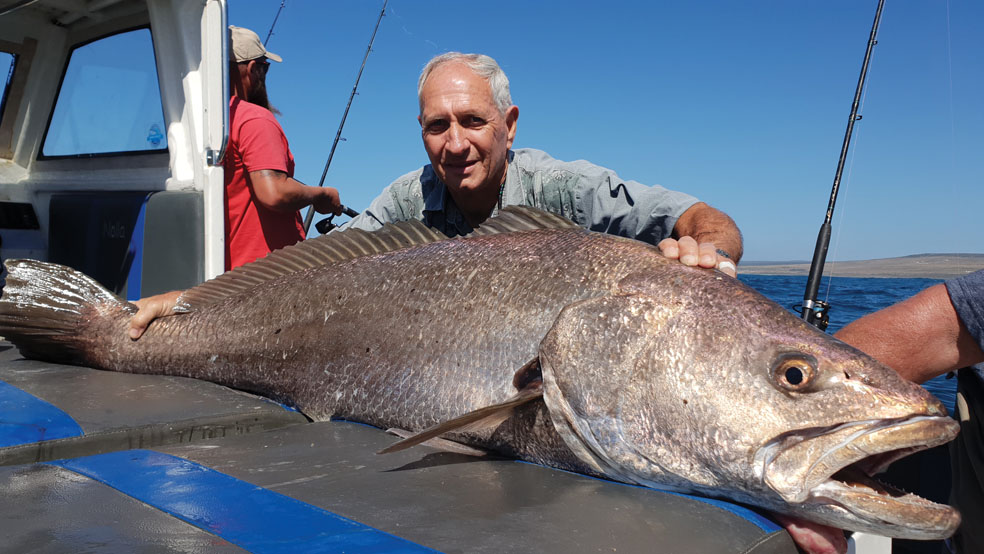
  • WHERE TO FISH PART 9

    WHERE TO FISH PART 9

    Exploring south-west of Christmas Rock, Eastern Cape

    By John Luef and Fred Clarke

    [Originally published in the May 2023 issue of SKI-BOAT magazine]

    THE coastline from Christmas rock to Bira (pronounced Biga) is one of the most picturesque of Southern Africa, being surpassed only by the Wild Coast of the old Transkei, in my opinion.
    This area also has a great diversity of species that can be caught from just behind the breakers, all the way out to the “shelf” approximately 20- to 25km offshore, in depths ranging from under 10m up to 100m, with shallow, mid and deep reefs in abundance. In this article we will cover the fishing from Christmas Rock all the way down to Mgwalana river mouth.
    Christmas Rock is on the southern boundary of the Gulu Marine Protected Area, so all skippers angling in the area are reminded to ensure they have the coordinates and are aware of all regulations pertaining to the MPAs.
    This area is particularly well known for its abundance of decent sized carpenters (dogs) which average over 3kg. The current SA record — a whopping 4.8kg — comes from the area and is held by Garth Roux.
    The abundance and diversity of the species in the area can mainly be attributed to:
    a) The effectiveness of the MPAs which have become overpopulated over the years, and many fish are migrating out of them.
    b) Bag and size limits being implemented years ago that are now showing their effectiveness.
    c) Recreational fishermen being far more responsible due to the awareness and protection measures created by clubs and associations.
    The area covered in this article has two registered clubs from which vessels may proceed to sea to partake in recreational angling. Visitors to the area can contact the clubs (information below) to enquire about launch permits, costs, and any other relevant information for that site.
    • Christmas Rock Ski-Boat Club
    Claud Wilken 084 951 2696
    • Bira Ski-Boat Club
    Anthony Thompson 082 577 9097
    Both launches are surf launches and a tractor or 4×4 is definitely required.

    SPECIES TO CATCH
    When fishing in the shallow reefs up to approximately 40m depths, the more common species to expect are kob, black musselcracker, Scotsman, dageraad, santer (soldier), Roman and yellowbelly rockcod. Gurnard and stockfish are also occasionally caught on sandy areas in approximately 40m water depths.
    The mid- to deeper reefs will produce red steenbras, Miss Lucy (red stump), carpenter (dogs), seventy-four, butterfish and geelbek. Although these are predominantly deeper water fish, they have also at times been landed in relatively shallow waters.
    Gamefish are rare and not often targeted in these areas.
    The coordinates supplied alongside this article need three more numbers on the end (a fisherman has to have some secrets), but they do give a general area where these species can be targeted. Good luck and tight lines.

    TACKLE
    Generally, in the shallow waters, a light rod of around 7 to 8 foot should be used, along with a reel of your choice and light braid or nylon up to around 20kg. This will give the angler the most pleasure when fighting a fish. For shallower waters an 8-to-12-ounce sinker is usually sufficient.
    In this region, anglers mostly use the “Scarborough” (KP) fishing reel, which generally gives a great feel of one-to-one on any fish, but anglers can use whatever they are most comfortable with.
    On the deeper reefs, a heavier rod with an 8-inch Scarborough is mostly used. Braid is virtually a must due to the strong currents. As braid is thinner than nylon line, it cuts through the water, gives you more chance of keeping your bait on the seabed, and allows you to feel the bites better.
    Nylon has a lot of stretch, and when you’re fishing at 80m-plus depths in a strong current, a lot of bites will not be felt.
    In these deeper waters you rarely get away with a light sinker and generally a 16- to 32-ounce sinker is required, depending on the current strength.
    The Agulhas current is predominant in this area on the mid- to deeper reefs, running from north to south down the coast and can get extremely strong at times.

    KOB
    Bag limit is five per angler from a boat; minimum length is 50cm, with only one of the five allowed to be above 110cm.
    The general area off Hamburg is the best place to target this species, with some very nice sized ones being landed from time to time. Kob can be caught from very shallow to depths up to 40m.
    Kob seem to like a neat bait and will readily bite on pilchards, squid and even octopus leg. They are targeted in this area, using three strips of squid dangling off the hook. Some anglers like to use small white or colored skirts above the hook. Generally, a 6/0 to 9/0 hook can be used with a relatively long hook trace, as kob seem to be sensitive to feeling resistance on the hook trace.

    DAGERAAD
    Bag limit is one per angler with a minimum 40cm total length. Dageraad feed on many types of bait, including but not limited to pilchards, squid, and sliced fillet. However, their favourite bait is a nice, cleaned piece of octopus leg and in this area the leg is cut into medallions like coins and put on the hook.
    A 5/0 to 6/0 hook is a good size to use for this species.

    Dale Webb with a black musselcracker.

    BLACK STEENBRAS/MUSSELCRACKER
    Bag limit is one per angler with a minimum 50cm total length.
    Black musselcracker are abundant in the shallows and up to around 40m deep, although have been caught deeper. This species likes very clear water and areas where there are lots of smaller fish and large reefs.
    They will feed on most baits but prefer a big eye (Frans Madam) or steintjie flapper (tail and spine removed). Black steenbras are extremely exciting to catch as they bite ferociously and fight all the way up. They also try to head for the nearest reef to cut off your trace.
    A minimum of a 10/0 hook is ideal for this species.

    SCOTSMAN
    Bag limit is one per angler with minimum 40cm total length.
    Scotsman are generally found hanging around with black musselcrackers, and usually when one of these species is caught, the other is caught soon after.
    Scotsman can be caught in all depths of water up to 100m, but are more common in the shallows in less than 30m of water.
    They feed on most small baits with their favourite being a couple of pieces of squid. A 5/0 hook — not bigger — is ideal for this species as they have relatively small mouths.
    Scotsman are also strong, clean fighters and give immense pleasure to light tackle anglers. They are one of the more stunning fish in the ocean with very vibrant colours.

    RED ROMAN
    Bag limit is two per angler with minimum 30cm total length.
    Romans are, without doubt, one of the most colourful fish in the sea, and their bright red colour is unmistakable. From in front of Christmas Rock all the way down to Bira, they are quite abundant, and specimens of over 3kg are caught regularly.
    These fish are mostly found in shallow water under 20m deep where they feed on a variety of small baits like squid, octopus and pilchards. They have very small mouths, and a 3/0 to 5/0 hook will be ideal.

    SOLDIER (SANTER)
    Bag limit is five per angler with minimum 30cm total length.
    Soldiers are normally found in the shallows in less than 40m of water, in shoals where they will aggressively feed on just about any bait presented to them. Usually a couple of strips of squid or a whole pilchard works well. A 5/0 hook is the ideal size for this species.
    They are extremely feisty fighters and are very enjoyable to catch.

    ENGLISHMAN
    Bag limit is one per angler with minimum 40cm total length. These fish are relatively rare in this area and are not often caught. It is advisable to release them to allow their stocks to multiply.

    YELLOWBELLY ROCKCOD
    Bag limit is one per angler with minimum length of 60cm.
    This fish is known to be extremely slow growing and very territorial. Yellowbellies will readily take sliced bait as well as small flapper baits. They can also be targeted on old smelly pilchards which most other species will not take. They have very large mouths and can be caught on 8/0 and larger hooks.
    Yellowbelly rockcod are known to grab a bait and head into holes or crevices, with the angler having a hard time getting them out.
    Beware when handling them because their gill plates are very sharp and have sliced open many an angler’s hands.

    GURNARD
    This species has no size limit, and the bag limit is ten per person.
    Gurnards are almost always only caught in sandy areas and in water round 40m deep.
    They generally like pilchard baits and are found right on the sea bed, so are targeted with a very short sinker trace. Despite their fearsome appearance, gurnards are extremely tasty and very sought after.

    STOCKFISH (HAKE)
    Bag limit is five per angler with no size limit. They are very popular table fish in South Africa and have huge commercial value, being netted and caught on long line commercial vessels.
    Stockfish can be caught along this area of the coast and are generally also found in sandy areas from 40m depths. The trawlers and long liners usually catch deep water hake in much deeper areas.
    Hake enjoy a strip of squid or pilchards and are generally targeted with 8/0 or bigger hooks. Their mouth is relatively soft, so they cannot be brought up fast or the hook may tear out.
    They also have very sharp teeth and anglers must take care when handling them.

    RED STEENBRAS
    Bag limit is one per angler with minimum 60cm total length. They have a closed season for October and November each year, although clubs and associations have voluntary increased this to include September for their members.
    Red steenbras is the iconic species for the Border area and they are fairly abundant on the deeper reefs, although they sometimes pop up on the shallow reefs as well. This species gives anglers one of the most exciting thrills when it bites as the bite is very aggressive and exaggerated; they then go on to give one of the most exciting fights — long, hard and tiring, but very satisfying in the end.
    Generally red steenbras are caught in around 90m of water. This fish will feed on most baits from a mixed grill to a live smaller fish (butterfish, dikbekkie or carpenter), sliced baits, flappers and pilchards, and have even taken small strips of squid. Some days they can be extremely fussy and will only take on certain baits, which makes it a great challenge to the angler. A 10/0 or larger hook can be used to catch this species.
    These great fish do not release very well, so rather move to other areas once you have caught your quota, as they will continue to feed.

    John Luef with a beautiful Miss Lucy caught on a Scarborough reel.

    MISS LUCY (RED STUMP)
    Bag limit is one per angler with minimum 40cm total length.
    Miss Lucy is one of the most beautifully coloured fish to catch, with banded shades of bright red and white which vary extensively in males and females, and black speckles. They have huge bumps on their foreheads which are more pronounced in the males. Once landed, they also have a very strong distinctive smell and are quite slimy.
    They will feed on a variety of baits including pilchard, squid, mixed baits, and octopus. Their favourite is a long, thin mixed bait and a squid head. They can generally be caught on 5/0 to 6/0 hooks.

    CARPENTER (DOG)
    Bag limit is four per angler with minimum 35cm total length.
    Carpenters are nicknamed dogs due to the structure of their teeth which is very similar to that of a dog.
    As mentioned earlier, this species is the most abundant in this area and can generally be caught at any depth from 20m and up, even beyond 100m. They congregate in very large shoals, and it can become very frustrating when an angler cannot get any other species due to their abundance and continuous feeding.
    Carpenter will feed and bite very aggressively on absolutely any bait. They have large mouths and can be caught on 8/0 hooks with a large luminous bead above the hook, which attracts the fish.

    BUTTERFISH
    Bag limit is five per angler with minimum 30cm total length.
    These fish are not as abundant in this area as they are in the East London area, but can be caught on the deeper reefs. They are generally found in shoals and will feed on small squid baits. They can be caught on a 2/0 or 3/0 hook with one small strip of squid and a luminous bead above the hook. They have tiny mouths and make an excellent bait for red steenbras.

    Keagan Nieuwenhuis with a lovely geelbek.

    GEELBEK
    Bag limit is two per angler with minimum 60cm total length.
    Geelbek are so called, because of the bright yellow colour inside their mouths. They are long, streamlined fish and give a very hard fight to any angler. Their bite is an unmistakable aggressive shake, and they often swim up with your bait, creating slack line.
    This is probably the most unpredictable species in our waters as they are mostly caught on the deeper reefs for three- to four months following the annual sardine run, but they can often be caught on the shallower reefs as well. They are also caught sporadically in unexpected areas all year around. They usually move around in large shoals.
    Geelbek will feed on pilchards, sliced bait and squid, but sometimes get “lockjaw”, and although they can be seen on the fishfinder, they cannot be enticed with any bait.
    Due to their large mouths 10/0 or bigger hooks can be used.

    SEVENTY-FOUR
    This is a banned species and must be released. They are, however, extremely abundant in this area on the deeper reefs and some days are pests as they are so abundant that you cannot catch any other species.
    They feed on any baits put down for other species.
    In my opinion, it’s long overdue that the decision makers un-ban this species.

    GAMEFISH
    As mentioned earlier, gamefish are not usually targeted in this area, but dorado, bonito and yellowfin tuna can be found in our waters from November through to March each year. The most common species caught then are bonitos, with the odd yellowfin tuna being caught.
    Angling in the Christmas Rock and Bira areas can be very exciting and rewarding due to the many species available to target and the diverse seascape, so go out there and have some fun.

  • THE GLORY OF GABON

    THE GLORY OF GABON

    Fishing wild and remote African waters

    By Hannes Vorster

    [Originally published in the July 2022 issue of Ski-Boat]

    IF you are anything like me and have an insatiable urge to fish wild and remote waters, to create your own magic, then a trip to Gabon may be for you.
    Growing up in Matatiele, I knew no other holidays than fishing in the surf, from the rocks in the remote parts of the Transkei coast. There is something special about shore fishing — I find it more challenging catching large fish from the shore than from a boat. However, after my family and I moved to Abu Dhabi 15 years ago, I spent more time fishing offshore even though I still use every opportunity I get to do some rock and surf fishing.
    Over the years I’ve done a fair bit of travel to Accra in Ghana for work, and even though I never got the chance to fish there I was intrigued about stories of large billfish doing the “Atlantic Migration” between the east coast of America and West Africa. However, what excited me even more were the stories about catching tarpon in the surf in Angola and Gabon.
    Gabon — officially the Gabonese Republic — may not be on many people’s radar, but this west African country is progressive and extremely tourist friendly.
    A while back I met up with a group of friends who I often fish with locally in the UAE, and they told me about trip they did to Gabon in 2019. Listening to their stories and seeing the photos had me lit up like a sailfish chasing a teaser! Of course that went straight onto my bucket list, and when my old university mate Ross Urquhart from Ballito suggested I join him on a trip to Setté Cama Camp in Gabon, there was absolutely no hesitation.
    We quickly made up the required group of eight with our tickets booked for February 2021. Of course Covid put a spanner in the works and our trip was eventually delayed by a whole year. The next mission was finding new dates that would work with the tides, seasons and work commitments, but fortunately the tarpon season in Gabon only ends at the end of April and March 2022 worked for everyone. Even more special was the fact that our new dates coincided with the school holidays, and I was able to take my youngest son (a very keen and able fisherman) with me.
    Some folks say the destination is the the most important feature of a trip, others say the journey or the company are more important. Well in this case, I can truly say that it has been a combination of all the above.
    Our group of eight eager anglers consisted of AJ Pretorius and his father Bertus (Springbok freshwater fisherman), Werner Rooseboom, Carl Herbst, Riaan Botha, Eugene Venter, my son Liam and me.
    I have never prepared as much for any fishing trip as I did for this one; there were just so many things that did not fall into the remit of a “normal” fishing trip. I guess the remoteness accounts for much of that, but the type of lures, the gear, the conditions, the logistics, the weather, the water colour and the uncommon species all made for a unique planning experience.

    Riaan Botha shows off his tropical garrick.

    GETTING THERE
    Travelling to Setté Cama Camp is part of the excitement. The logistics around Covid played a part in that, but getting a group of people from Dubai, Abu Dhabi, Johannesburg, Durban and Bloemfontein, all to meet up in Addis Ababa, Ethiopia, for onward travel to Libreville in Gabon was challenging to say the least.
    The main routes to Libreville seem to be via Addis Ababa, Istanbul and Paris. From Libreville there are weekly helicopter flights between Port Gentil (smaller airport in Libreville) and Gamba, and depending on availability there may be an option to make use of the Presidential flight (ATR 72 twin-engine turboprop). The other alternative is to use the military Pumas which could take you straight to Setté Cama Camp.
    Anglers thinking of going there need to understand that none of these options is ever guaranteed. This is Africa, and one needs to be prepared for logistical changes and challenges at short notice.
    The most reliable of these three choices are the helicopter flights, but then the amount of gear you can take is greatly limited. There are for example restrictions on the length of rods, but if you’re stuck the camp has all the required gear available for rent and it’s top quality.
    From Gamba, there are two options to get to the Setté Cama Camp — either by boat down the scenic Ndogo River with sightings of elephant, crocodiles, hippos, monkeys and an abundance of bird species, via the bouncy 4×4 drive through the rain forest with sightings of various game species including red riverine hogs, forest sitatunga and numerous forest duikers.
    I have used both options and found them both equally adventurous and rewarding.
    If you are lucky, you may even see chimpanzees, lowland gorillas or forest buffalo. The area is also world famous for its unique birds, with a chance to see vermiculated fishing owls, chocolate-backed kingfishers and white-crested tiger herons amongst many others.

    THE CAMP
    In the sixteenth century Setté Cama was a major European colonial sea port trading in timber and ivory. Long declined, the village is now home to a museum and an airstrip. The Setté Cama Camp lies on the edge of the Loango National Park (aka “Africa’s Last Eden” and one of the world’s best wildlife destinations) and on the peninsula between the Ndogo Lagoon and the Atlantic Ocean.
    Perfectly placed on one of the longest and wildest stretches of untouched coastline on the African continent and alongside a massive estuary system, this combination offers the wild-at-heart saltwater fisherman an opportunity to target many unique species of West Africa, with both spin and fly tackle. The experience is complemented by Africa’s most pristine tropical rain forest that creates the backdrop to a one-of-a-kind saltwater fishing experience. It is hard to put into words how special and unique Setté Cama really is.
    Accommodation in the camp takes the form of rustic chalets with twin bed configuration, each equipped with its own toilet and hot shower. It is not a five-star lodge experience, but the camp is comfortable and guests will want for nothing more. Meals are enjoyed in the main living area, which includes a stocked bar and a deck overlooking the estuary.
    The deck area is where you spend most of your time if you’re not sleeping or fishing. Here you can relax at night, take in the local wildlife and watch the awe-inspiring African sunset before you get your head down, just to be woken up by the sound of the African fish eagle, ready for the next day’s adventure!
    One of the wildlife highlights is the local elephant population. Elephants regularly enter the Setté Cama camp and are seen on most days while travelling to and from the beach.
    Guests at Setté Cama also have the opportunity to experience guided walks through Loanga National Park with an abundance of African wildlife on show. Gabon has also been described as “the land of the surfing hippos” after a National Geographic photographer captured photos of hippos playing in the ocean just off the beach in Loango National Park.

    RIGGING UP
    When we finally arrived at camp we were welcomed with a cold beverage by the friendly African Waters hosts and soon started preparing for our first trip out into the estuary later that afternoon. The air was vibrating with our excitement.
    Soon everyone was showcasing their latest kit and the expensive lures they believed would catch the biggest fish. The next few hours were filled with laughter and fishing stories of the ones that got away and those which were not so lucky but got released anyway.

    Hannes Vorster with a giant African threadfin.
    Bertus Pretorius with a longfin jack.
    Carl Herbst shows off a toothy Guinean barracuda.

    FISH SPECIES
    This trip is all about targeting species in the estuary from the boat or from the shore with medium to large spinning or flyfishing gear. There is an abundance of large and aggressive gamefish, all eager to attack a well-presented lure or a well-fished fly. Species such as longfin- and crevalle jacks, giant African threadfin, colossal Cubera snapper, Guinean barracuda, sand shark, Senegal kob and tropical garrick are all found here.
    Giant African threadfin are one of the main trophy fish in Gabonese waters. They are very strong and can grow to well over 50kg in these waters. These fish will strike a lure or plug, but can also be caught on bait. The more rain the better, as they prefer the fresh tannin-stained water that flows from the river mouth into the sea.
    And then of course there is the jackpot — giant tarpon. This is one of the only destinations in the world where it is possible to target these iconic fish from the beach on spinning gear, and the only one where you do it in the company of forest elephants, buffalo and gorillas.
    It is not uncommon to hook 200 lb-plus tarpon, but the added challenge of trying to land it in the middle of the night during a tropical rainstorm is the ultimate test of angler and equipment. Not to forget the abundance of Zambezi sharks around you which are just too eager to “tax” some of your hard-earned trophy.
    Whilst fishing Setté Cama, you are guided by local fishing guides who have fished the area for many years and have valuable insights into where the fish will be and when. There are two guided trips planned daily, all determined by fish movements, tides, sunset/sunrise, and weather conditions. This invariably means that at least one trip a day is in the dark.
    There is also the option to either fish the estuary by boat or fish in the surf at the river mouth from the beach. Both of these are very rewarding and target similar species. Cubera snappers, jacks and barracuda are abundant and it’s not uncommon to have triple hookups among the three anglers sharing a boat.
    Generally the estuary trip is recommended as the first trip out, as this allows the anglers to get accustomed to the boats, the skippers, the environment and the general lay of the land. Both trips require entry into the Loango National Park which is charged at a fee of 50 Euro per person per day.

    Only in Africa are you fishing on the beach metres from elephants.

    ON THE WATER
    Eventually 3pm arrived along with the voice of our professional guide calling us to board the boats; it was music to our ears.
    We split into three smaller groups and myself, my son Liam and Riaan Botes were together on the first trip . It soon became clear why everybody raved about fishing this place. Liam landed a large jack crevalle literally on his first cast. We all looked at one another and without a word being spoken, agreed this was going to be a trip to remember!
    The entire week turned out to be a massive success with teammates landing personal bests nearly every day. A fair mix between spinning and flyfishing produced some great rewards made for incredible stories later that evening when we were back in the camp relaxing on the deck with a cold beverage overlooking the estuary.
    The highlight and absolute sensory overload was standing in the surf line, waves crashing and water tumbling around you in the dark, with big fish coming up to hunt their prey in a few feet of water only metres from the beach.
    At the same time, we knew that our arrival there literally chased the forest elephants from the beach back into the thick growth behind us, and that leopard tracks had been spotted at the same place on the beach earlier that morning… Only in Africa!
    A typical evening on the beach started with watching the gorgeous orange and red sunset fading away in the west as the sky turned a dark grey. Your eyes battle to adjust at this time as it is not dark enough for the moonlight to have an effect and not worth using your headlamp.
    That was the window we had been waiting for — the magical 30 minutes after sunset when the big tarpon roll in to ambush the baitfish still outside on the playground.
    The guides all lined up on the bank searching and listening for signs of the tarpon. The anglers would be lined up below, each one convinced that he had the right lure and was ready to make the cast that would entice one of these West African poons to eat.
    On average, our group caught between 30 and 40 fish each day, and apparently this was one of the least successful trips to Setté Cama ever. If that is the case, I would love to see what a “good” trip produces.
    As far as tarpon are concerned, we were not as successful as we would have liked, but we did see them come into the territory, rolling and splashing after baitfish. If this does not give you an immediate injection of adrenaline into your system, then fishing is not for you!
    We did get a few hookups but only two were successfully landed, both by AJ Pretorius. The aerial display of these magnificent fish after a hookup and the enormous battle they put up after realising they are in trouble, is something one cannot fully describe or capture on paper.
    Unfortunately, on the night they turned out to be really active in the mouth of the estuary, I had asked one of the guides to accompany Liam and me further down the beach to try our luck on some other species. I was rewarded with a beautiful kob that we kept for dinner.
    Riaan Botes was very fortunate to catch a prime specimen of the elusive Gabon leervis aka garrick or “liche” as they are called in Francophone Africa.
    These are all considered to be the same species (monotypic) across their distribution which ranges from Southern Africa all the way up into the Mediterranean Sea. Most leervis look identical, whether they’re caught in Angola, Morocco or South Africa, but those caught in Central West Africa look remarkably different.
    The West African leervis has a more compact and stout body, much like the jacks. It also has a few spots running along its sides, smaller dorsal and anal fins, and a much fainter lateral line when compared to the other leeries we know.
    Although classified as the same fish (Lichia Amia) across their distribution, it doesn’t take an ichthyologist to see that is not the case. Little to no research has been done on the West African leervis, and one would hope that in future genetic samples would be collected from these specimens to shed more light on this amazing gamefish.
    Carl Herbst also caught a number of new species including a really large barracuda on his well designed handmade lures, especially his flagship lure the Tapajera.
    All credit to the professional guides from African Waters — Ewan Kyle, Teddy Coulter and Mike Dames — who made this trip an unforgettable one with lasting memories imprinted on our minds forever.
    Setté Cama Gabon is a world-class fishery, but this experience, is far more than a fishing trip, it’s a true adventure into the heart of Africa — truly a destination like no other.

    USEFUL INFO
    PASSPORTS : All visitors require a valid passport with at least six months’ validity. All nationals require a visa which should be obtained before departure. For South African passport holders, a stay of 30 days or less does not need a visa. The process is easy and requires little input from guests.

    INNOCULATIONS & HEALTH: Valid yellow fever certificates are required by most countries. Please enquire with your local travel clinic. Gabon is a malaria area, so please consult your doctor before travelling.

    COMMUNICATION: There is sporadic cell phone reception and wifi is available in camp at a fee.

    CURRENCY: Gabon’s currency is Central African francs (CFA) but the euro is widely accepted and can be used to settle bar accounts, etc. in camp.

    LANGUAGE: French

  • WHERE TO FISH Part 5

    WHERE TO FISH Part 5

    Secret Spots of the Eastern Cape

    By John Luef and Fred Clarke

    [Originally published in the May 2022 issue of Ski-Boat magazine]

    THE Eastern Cape around East London has quite an extensive coastline with many offshore areas to fish from a boat. In this article we are going to cover the entire area from the Nyara River which is the southern boundary of the Kei Marine Protected Area (MPA), down to the northern boundary of the Gxulu MPA.
    There are three extensive MPAs in this area and all skippers angling here are reminded to ensure they have the coordinates and are aware of all regulations pertaining to the MPAs.
    East London boasts a great diversity of species that can be caught from shallow reefs all the way out to and beyond the continental shelf, up to and over 100 metres of water depth. Fishing has generally improved in this area over the last number of years, with an abundance of species. This can be attributed mainly to the following things:
    a) The effectiveness of the MPAs, whereby, over the years, they have become overpopulated and many fish are migrating out of them.
    b) Bag and size limits that were implemented years ago are now showing their effectiveness.
    c) Recreational fishermen being far more responsible due to awareness and protection measures created by organisations such as clubs and associations.
    This area is also well known for very rough offshore seas and extremely difficult fishing conditions due to the notorious Agulhas current which predominantly runs down the coast off KwaZulu-Natal to Cape Town. At times, the water can move at more than 10km/h, making it almost impossible to keep a sinker and bait in the strike zone on the seabed.
    The area covered in this article has four registered clubs where vessels can launch from and proceed to sea to partake in recreational angling. Visitors to the area can contact the clubs (information below) to enquire about launch permits, costs, and any other relevant information for that site.
    • Cintsa East (Beach Launch) Mark Steinhobel 060 505 8653; Alt. Guy Swart 082 655 2739
    • Kwelera Ski-Boat Club (River Launch) John Luef 082 898 2316.
    • Gonubie Marine Club (River Launch) Grant Keth 083 279 0260.
    • East London Ski-Boat Club (Harbour Launch) Graham Kingsley-Wilken 083 417 3920

    SPECIES TO CATCH
    When fishing in the shallow reefs up to approximately 50m depths, the more common species to expect are kob, black steenbras/musselcracker, Scotsman, dageraad, santer (soldier), Roman, Englishman, yellowbelly rockcod and moustache rockcod. The rarer species are German bream, white musselcracker, bank steenbras, baardman, John Dory and catface rockcod amongst others.
    The deeper reefs will produce red steenbras, Miss Lucy (red stump), carpenter (dogs), seventy-four, yellowtail, butterfish and geelbek. Although these are predominantly deeper water fish, they have also at times been landed in relatively shallow waters.
    Gamefish are rare to our area, but usually bonito, marlin and yellowfin can be caught from around November to March each year.

    TACKLE
    In this area, anglers mostly use the “Scarborough” fishing reel, which generally gives a great feel of one-to-one on any fish, but anglers can use whatever they are most comfortable with.
    In the shallow waters, to reap the most fun out of the experience, any light tackle rod up to around 10kg is perfect with a 7” Scarborough reel and nylon line or braid, whichever you prefer. Generally, an 8- to 12 ounce sinker is sufficient.
    On the deeper reefs, a heavier rod with an 8” Scarborough is the most used. Braid is a must due to the strong currents. Because it is thinner than line, it can cut through the water and give you a better chance of keeping your bait on the seabed and a better chance of feeling the bites due to the depths at which we’re fishing. Nylon line has a lot of stretch so you don’t feel the bites as well.
    Here you rarely get away with a light sinker and generally a 16- to 32 ounce sinker is required. The old argument between circle or J hooks will forever continue, so I suggest using what you are comfortable with and adjust the size of hook depending on the species being targeted.

    KOB
    The bag limit is five per angler from a boat; minimum 50cm with only one above 110cm allowed. Kob are relatively scarce here compared to other coastal areas, but there are a few areas, as indicated on the maps alongside, where they can be caught.
    Kob seem to like a neat bait and will readily bite on pilchard, squid and even octopus leg. Their favourite seems to be a mixed bait with a piece of squid dangling in the current. Generally, a 6/0 to 9/0 hook can be used with a relatively long hook trace as they seem to be sensitive to feeling resistance on the hook trace.

    DAGERAAD
    The bag limit is one per angler, minimum 40cm. Dageraad are extremely plentiful in the East London area and can be caught in all areas and depths, even on the shelf. There are currently many of this species which are just under size, which is a good sign for this species in the future.
    Dageraad feed on many types of bait including but not limited to pilchard, squid and sliced fillet, but their favourite bait is a nice cleaned piece of octopus leg. A 5/0 to 6/0 hook is a good size to use for this species.

    BLACK STEENBRAS AKA MUSSELCRACKER
    The bag limit is one per angler, minimum 50cm. Black steenbras are abundant in the shallows and up to around 40m; there are also many juveniles of this species found in water up to 12m deep which is exciting for the future.
    They will feed on most baits but prefer a big eye (Fransmadam) or steintjie flapper. They are extremely exciting to catch as they bite ferociously and fight all the way up. They are also known to head for the nearest reef to cut off your trace.
    Black steenbras prefer very clear water and like areas where there are lots of smaller fish and large reef. A minimum of a 10/0 hook is ideal for this species.

    SCOTSMAN
    The bag limit is one per angler, minimum 40cm. Scotsman were at one time a rare species for our area, but in the last few years they have become more abundant and some nice sized specimens are being caught.
    This species can be caught in all depths of water but they are more common in the shallows under 30m deep. They feed on most small baits with their favourite being a couple of pieces of squid. A 5/0 hook, not bigger, is ideal for this species as they have relatively small mouths.
    They are also strong fighters and give immense pleasure to light tackle anglers. They are one of the more stunning fish in the ocean with very vibrant colours.

    RED ROMAN
    The bag limit is two per angler, minimum 30cm. The red Roman is a beautiful bright red. For some reason, the bigger specimens are not found in our area and they generally get bigger as you go down the coast towards Cape Town. The average size here is about 1.5kg.
    These fish are mostly found in shallow water under 20m where they feed on a variety of small baits like squid, octopus and pilchard. They have very small mouths and a 3/0- to 5/0 hook will be ideal.

    SOLDIER (SANTER)
    The bag limit is five per angler, minimum 30cm. Soldiers can normally be found in the shallows under 30m of water in shoals where they will aggressively feed on just about any bait presented to them. They are extremely feisty fighters and are great fun to catch. A 5/0 hook is the ideal size for this species.

    ENGLISHMAN
    The bag limit is one per angler minimum 40cm. These fish are relatively rare for our area, but in recent times more of them are being caught in shallow waters up to 20m depth.
    Like soldiers, they feed on most small baits of pilchard, squid and sliced bait, and are also ferocious fighters. It is advisable to release them to allow their stocks to multiply. They can be caught on 5/0 hooks.

    YELLOWBELLY ROCKCOD
    The bag limit is one per angler, minimum 60cm. This fish is known to be extremely slow growing and very territorial. There are plenty of juveniles around our area and very few will make the size limit.
    These fish enjoy sliced bait as well as small flapper baits. They can also be targeted on old smelly pilchards which most other species will not take. They have very large mouths and can be caught on 8/0 and larger hooks. They are known to grab a bait and head into a hole or crevice, giving the angler a hard time to get them out.
    A warning to anglers: yellowbelly rockcod’s gill plates are as sharp as razor blades and have sliced open many an angler’s hands, so beware.

    RED STEENBRAS
    The bag limit is one per angler, minimum 60cm. They have a closed season for October and November each year, although clubs and associations have voluntary increased this to include September amongst their members.
    Red steenbras are the iconic species of our area and are fairly abundant on the deeper reefs, although they sometimes pop up on the shallow reefs as well. This species gives anglers one of the most exciting thrills when it bites as the bite is very aggressive and exaggerated. They then go on to give you one of the most exciting fights. Generally caught in around 90m of water, the fight is long, hard and tiring, but very satisfying in the end.
    This fish will feed on most baits from a mixed grill to a live smaller fish (butterfish, dikbekkie or carpenter), sliced baits, flappers and pilchard. Some have even taken small strips of squid.
    Some days they can be extremely fussy and will only take on certain baits, which makes it a great challenge to the angler.
    These great fish do not release very well, so it is sensible to move to other areas once you have caught your quota, as they will continue to feed. A 10/0 or larger hook can be used to catch this species.

    MISS LUCY (RED STUMP)
    The bag limit is one per angler, minimum 40cm. The Miss Lucy is one of the most beautiful fish to catch as they have banded shades of bright red and white which vary extensively in males and females, and have black speckles. They have huge bumps on their forehead which is more pronounced in the males. Once landed, they also have a very strong, distinctive smell.
    These stunning fish are mostly caught in the deeper waters in our area but can also be caught in shallow waters. They will feed on a variety of baits including pilchard, squid, mixed baits and octopus. Their favourite is a long, thin mixed bait.
    They give a very good fight especially in shallow waters, and can generally be caught on 5/0 and 6/0 hooks.

    CARPENTER (DOGS)
    The bag limit is four per angler, minimum 35cm. Carpenters are nicknamed dogs because their teeth structure is very similar to that of a dog.
    These are the most abundant species in our waters and can generally be caught in any depths from 20m and up to beyond 100m. They accumulate in very large shoals and it can become very frustrating when an angler cannot get any other species due to their abundance and continuous feeding.
    They will feed and bite very aggressively on absolutely any bait. Because they have large mouths, they can be caught on 8/0 hooks.

    BUTTERFISH
    The bag limit is five per angler, minimum 30cm. These fish are also fairly abundant, with the juveniles mostly in shallow water and adults in deeper water on the shelf.
    They are also found in shoals and will feed on small baits of squid. They can be caught on a 3/0 hook with one small strip of squid and a luminous bead above the hook. They also make an excellent bait for red steenbras.

    GEELBEK
    The bag limit is two per angler, minimum 60cm. Geelbek are so named because of the bright yellow colour inside their mouths. They are long streamlined fish and give a very hard fight to any angler. They have relatively soft mouths, though, and must be gently played so as not to rip the hook out of their mouths. Their bite is an unmistakable aggressive shake, and they often swim up with your bait, creating slack line.
    These are probably the most unpredictable species in our waters as they are mostly caught for three to four months following the annual sardine run on the deeper reefs. However, they can often be caught on the shallower reefs as well and can also be caught sporadically in unexpected areas all year around. They usually move around in large shoals.
    They will feed on pilchard, sliced bait and squid, but sometimes get “lockjaw” and although they can be seen on the fish finder, they cannot be enticed with any bait. Due to their large mouths 10/0 or bigger hooks can be used.

    SEVENTY-FOUR
    This is a banned species and must be released. Seventy-fours have become extremely abundant on most of the deeper reefs in our area and large specimens are caught on virtually every trip to the shelf without being targeted. They feed on any baits put down for other species. In my opinion the decision makers should unban this species.

    YELLOWTAIL
    The bag limit is ten per angler with no size limit. This species is better known in the Cape and Struisbaai area where relatively smaller ones appear in very large shoals each year. They are abundant and are even netted from the beaches. In our area this species is not often caught, but those that are are usually much bigger, over 10kg and even up to 20kg in size.
    They are one of the strongest fighting fish in the sea, and when hooked, will run around the nearest reef to cut you off, so not many are landed. That is why heavy tackle is suggested. This species produces the most talk of the ones that got away when anglers are socialising over a cold beer and many stories of snapped 10/0 hooks will be heard.
    They will take on any large bait like two or three pilchards hooked through the eye together, flappers, and mixed grills. A big luminous orange floating bead above the hook can attract them to your bait. A thick gauge hook, at least 10/0, can be used to try and land this very strong fish.

    GAMEFISH
    As mentioned earlier, gamefish usually only frequent our waters from November through to March each year. The most common species caught then are bonitos, with the odd yellowfin tuna also coming out.
    Some skippers in the area have perfected the art of catching marlin and boast of quite a few being caught and released.
    Generally, bonnies can be caught on any feather, daisy chain or lure trolled at around 14km/h.
    Yellowfin also readily take this but are much scarcer.
    Tareting marlin is a very specialised form of angling, but they seem to take slow-trolled live bonito.
    Angling in the East London area is very exciting and rewarding due to the many species that are available to target and the vast areas that can be fished, from water less than 10m deep to over 100m deep.
    Deep sea angling in this area will never become boring as after many years of angling there is still the chance you can improve on any of your personal best catches and, as time goes on, the angling just gets better.
    To continue along this path and protect our heritage for future generations, please be responsible. The old saying comes to mind: “Limit your catch, don’t catch your limit.”

Verified by MonsterInsights