Tag: tigerfish

  • HOW TO TEMPT A TIGER

    HOW TO TEMPT A TIGER

    Lessons from marlin masters turned tiger tamers

    By Andre Maree and Berno Meyer

    (Originally published in the January 2025 issue of SKI-BOAT magazine)

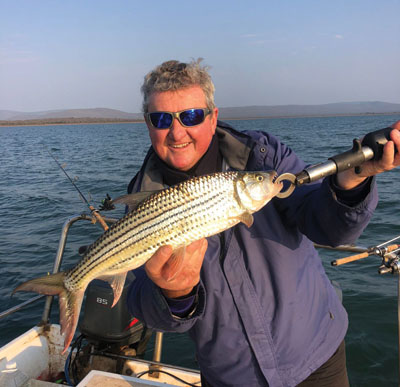
    It may seem that there’s not much linking billfish and tigerfish other than the fact that they’re both species of fish found in South African waters, but many South African billfish anglers also eagerly venture to inland venues like Jozini/Pongolapoort Dam to catch these tough-fighting smaller, sharp-toothed, stripey species of fish.
    Andre Maree and Berno Meyer are two such anglers. These cousins earned their billfish stripes in the 1970s, catching their fair share of marlin off Sodwana on their boat fm Charlie, and although they still target marlin sometimes, in recent years they have particularly enjoyed targeting the tigers of Jozini.
    Berno and Andre have introduced their sons to the sport too, and the two families did particularly well at the 2024 Tigerfish Bonanza. Erwin Bursik persuaded them to share some of their sectrets to tempting tigers to bite…

    THERE is a certain feeling of inadequacy that overcomes a person when the leaderboard at the competition you’re fishing at keeps ticking over, but no matter how hard you try, your boat is not able to make it onto that leaderboard.
    An array of questions fog one’s mind: What’s the right place, right bait, right trace?
    Adding to the pressure is the fact that, in this new digital age, the crew is able to keep tabs on the minute by minute additions to that leaderboard, and they’re quick to tell the skipper he’s not keeping up. This was very much the case during the recent Tigerfish Bonanza held at Jozini/Pongolapoort Dam.
    This year those of us aboard fm Charlie and Obsession were acutely aware of that leaderboard, but, to our delight, we were right up there and very much “in the prizes”.

    Andre Maree and Berno Meyer have been catching tigerfish since long beforre catch and release was the modus operandi at Jozini.

    As cousins who both farm in the Pongola/Piet Retief area and who are both ardent anglers, the two of us have fished together for decades.
    We started off frequenting Sodwana Bay when we acquired our original fm Charlie in the mid-1970s. We were very much part of the group of dedicated billfishermen who, during the late 1970s and early 1980s, set out to prove there was a billfishery off Sodwana that could compete with the one off the central Moçambique coast.
    We clearly got something right, as the flags on fm Charlie showed when we returned to the beach.
    We were never “bounty hunters”, though, generally preferring to fish simply for our own pleasure rather than competing in the events held annually off Sodwana Bay. We did, however, compete in those occasionally, and fm Charlie won the Billfish 15 000 in 1998 with Andre skippering and Berno as crew. Berno also won a comp on Lady Ace, so the two of us did scoop up a few prizes. In those days the biggest fish won the comp, and there was one occasion when we had the most points but didn’t win because we didn’t have the biggest fish.
    Since the early ’90s we’ve been fishing in Bazaruto, always on the hunt for that elusive grander. However, despite our efforts, we’ve yet to land a fish weighing 900 lb or more. We have hooked some impressive catches that might have reached that mark, but haven’t managed to bring them to the boat.
    We also explored a few other areas in Moçambique – Berno has fished at Inhaca, and together we also explored the waters around Canda Island when our children were younger. That was a fantastic experience, as there’s an abundance of gamefish in that area and the kids quickly picked up fishing skills.

    Kyle Maree and Hugo Meyer show off some of the tigers they caught at the 2024 Tigerfish Bonanza.

    While we’ve continued to fish at Sodwana, we stepped away from those competitions for a while. Our sons are older now, and we still target marlin there whenever time allows, but our passion for fishing extends beyond just billfish. We enjoy pursuing all species, both in saltwater and freshwater, and targeting the tigers at Jozini is one of our favourite pastimes.
    We’ve got pretty good at that too, and at the 2024 Tigerfish Bonanza, fm Charlie took the prize for top boat with four tigerfish (2 500 points), including the fourth biggest tiger of 69cm. Obsession, skippered by Berno, caught the second biggest fish which measured 69.5cm and the tenth biggest which measured 65.5cm.
    I guess the Maree & Meyer “old boys” still know a few tricks!
    Erwin Bursik has stayed in touch with us over all these decades, and he twisted our arms at this year’s Tigerfish Bonanza, urging us to pass on the knowledge we – and these days our sons – have gained on how to catch tigerfish in our home waters of Jozini Dam.
    Both of us have always been intensely single minded with regard to our fishing exploits, setting our own gameplan and then sticking to it and, above all, never stopping working to achieve our goals. We don’t believe in the “follow my leader” plan and spend as much time as we can in the area where we believe fish will be holding – be they marlin or tigerfish.
    Luck is a major factor in angling, and whether one is fishing the OET or Billfish 15 000 with close on 100 boats ploughing up the waters off Sodwana Bay, or the Tigerfish Bonanza on Jozini Dam with 200 boats racing around, temping a fish to strike is the first goal. Thereafter tackle and rodmanship play their role and you, the angler, are totally responsible for your part.
    With this in mind, we will happily share our knowledge of where to look for tigerfish and the tackle and bait we use. Hopefully that will result in you getting a big tigerfish to strike and hookup, and in you bringing one of those magnificent fish to the net.
    So, let’s get down to business!

    TYPE OF ROD
    While the type of rod is not as important here as it is when you’re deep sea angling, and largely any light tackle rod will suffice, we recommend 6- to 8 foot fast action rods that have a “backbone” to exert pressure on what can be a fast and hard fighting fish. Tigers know the tricks of using underwater structures and reed banks to tangle up one’s line, so you need to bully them way from that.

    TYPE OF REEL AND LINE
    The open-faced spinning reels in the 4 000 to 6 000 class are what we prefer. It’s important to ensure that the drag – from just off freespool to full strike – is extremely smooth, thus ensuring an even connection between rod and fish during the aerobatics and head shaking that’s so prevalent with this species.
    We use braid line in 15- to 30 lb breaking strain, and a fluorocarbon leader.

    The authors’ preferred trace configuration.

    TRACE CONFIGURATIONS
    This is the most lengthily deliberated of all aspects of targeting tigerfish.
    The tiger’s teeth are legendary and so is the bony structure of its mouth and throat. Added to this, the tiger hits hard and fast with little finesse. This results in the well accepted adage that, whether you’re fishing in fresh- or saltwater, tigerfish are the hardest gamefish to get to the boat. If you actually get a hookup, your tackle then has to weather their speed and acrobatics as they fight for their freedom.
    The diagram above shows the trace setup we use as well as the style of float we have found most effective. We use fluorocarbon leader in the 20- to 30 lb class attached to 30cm of Black Tiger Wire (stainless steel leader) in 30- 40 lb breaking strain.
    The hooks we usually use are Penetrator J-hooks in 4/0 size. We use either one or two hooks depending on the size of the livebait we use.

    BAIT VERSUS LURES
    There is no doubt that fishing spinners and trolling certain lures produces fish, but we find those mainly bring in the smaller tigers, and spinning while on anchor with livebaits set for the big mamas doesn’t seem to entice the big fish to bite.
    For this reason we generally don’t mess around with this style of fishing, as Murphy’s law states that when you are doing this and a big strike happens, you’ll be playing pick up sticks and will lose the strike you have been eagerly awaiting.
    Some anglers believe that using whole sardines, redeyes, chicken livers or hearts can encourage big fish in the area to strike. This is another school of thought we generally don’t subscribe to. It’s a case of an impala temping you when you are after a buffalo.
    At Jozini when we’ve used spinners, chicken livers, hearts and sardines, we’ve typically only caught smaller fish. Although we usually stick to bait, we have, however, caught some tigerfish while trolling CD 9 Rapalas.
    We are fortunate that Berno lives in Pongola and is able to supply us with fresh livebait, and for this we like bream larger than 80mm. Alternatively we use dead bream with cuts made in the body.
    We only use chicken hearts, livers and sardines if we’re targeting smaller tigers.

    WHEN TO FISH
    Tigers don’t like the north-easterly winds, and certainly we tend to have more success when the westerly blows. The old adage of “West is best and east is worst” seems to hold true.
    During normal conditions, when there are not 200 boats running around the dam, the early mornings produce the best results.

    WHERE TO FISH
    From early spring until the first significant rains, the best fishing action can be found at the point where the river enters the dam – depending on the dam’s water level. Upriver towards the bridge and up towards Royal Swazi are also good.
    During the summer and autumn months, particularly April and May, the western shores are prime fishing location and the eastern side tends to have less fish activity.

    WHERE TO ANCHOR
    We prefer to anchor close to the bank and reed clusters in about 3–8 metres of water along the old river channel. Make sure you keep a fair distance from any structure to avoid your fishing line snagging frequently.
    Always deploy two anchors – one in the bow and one in the stern, especially if there is a lot of wind. This is vital!
    On a calm day, drifting in the suggested areas often produces good fish.
    How long should you stay in one area? Our thinking is this: give it an hour, and if there’s no action, move on.
    The above is good advice for fishing in the hotter months. In the colder months we fish much deeper – generally depths up to 20 metres.

    HOW TO FISH
    When you’re fishing with light line and a single hook using livebait, it’s important to feed the tigerfish for ten to 15 seconds before striking. However, this method can often lead to you getting snagged on structure when you strike. This technique also increases the likelihood of the tigerfish swallowing the hook which can result in a higher mortality rate for the fish.
    When using a float, strike as soon as you see a bite, and consider using more than one hook.
    As I’ve said, tigerfish are a challenge to catch, especially the big fish, but as the years go by, it seems more and bigger fish are being caught than there were in previous years. The regulation requiring all tigers caught in Jozini to be released does seem to be working, and we look forward to witnessing this trend continuing into the future.
    A day spent targeting tigers on Jozini is a wonderful experience, so we hope these tips improve your chances of landing some.
  • WHAT LIES BENEATH?

    WHAT LIES BENEATH?

    FishTec charts reveal Jozini’s secrets

    By Erwin Bursik and John Easton
    [Originally published in the November 2022 issue of SKI-BOAT magazine]

    IT’S nothing short of amazing! Soon after I popped the FishTec HD fishfinding chart into the slot in the Lowrance HD510 on Mr. SKI-BOAT, up popped the full, detailed chart.
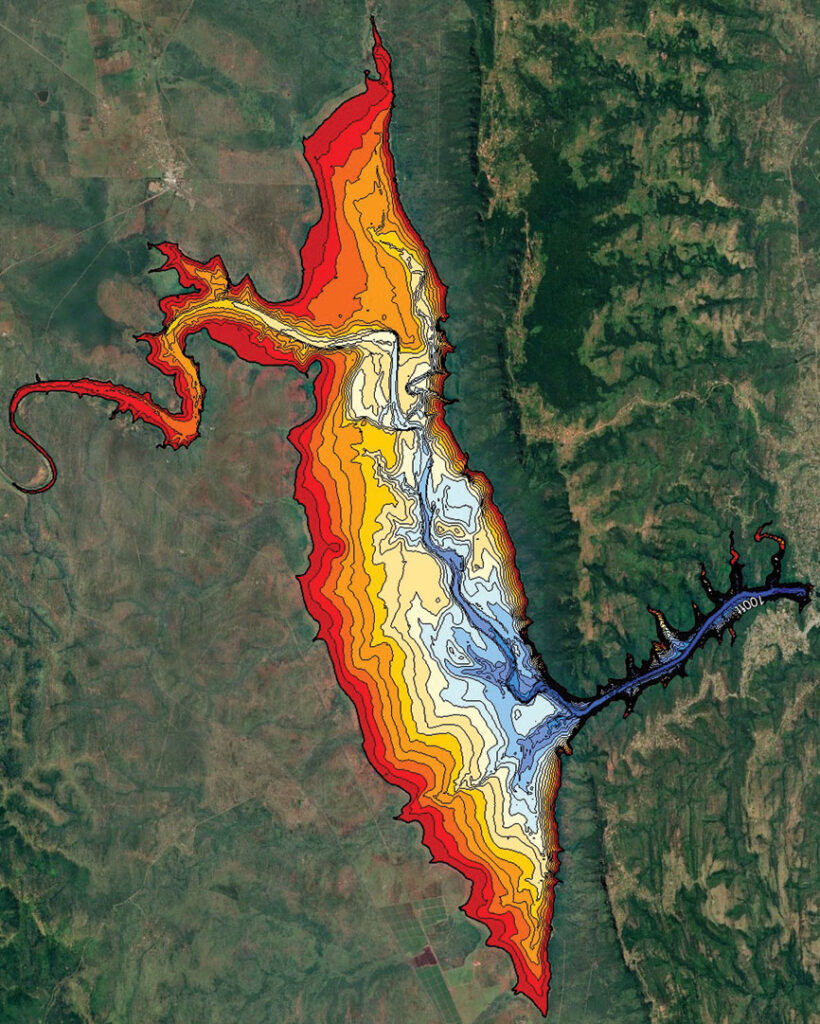
    It showed incredible images not only of the contour lines of Jozini Dam in northern KwaZulu-Natal, but superimposed on it was also the “snail trail” of my personal wanderings on this large lake during the last two Tigerfish Bonanza Tournaments I have attended.

    Guess what? The way points and trails I had marked on the previously blank screen were superimposed exactly where they should be on the new FishTec chart. Mind blowing!
    John Easton, an independent cartography expert and CEO of FishTec HD Fishing Charts, has done the detailed mapping of most of the inland waters of South Africa, and while I had noticed some of his work on social media, I had not paid detailed attention as I didn’t think further than believing it was not directed at offshore ski-boating.
    To be honest, I didn’t even give a thought to its possible application on Jozini Dam.
    When John sat in my office with his Elite 9 Lowrance and started to throw up images on my big computer screen of his very first FishTec chart of Jozini, I was spellbound.
    There, right before my eyes, were the full views of the entire lake and the Pongola River as it runs past the bridge on Kim Landman’s Pongola Reserve. It also showed the full details of the old (pre-dam wall) course of this river along with the pre-existing railway lines which ran through the area prior to the damming of the Pongola River.
    As he zoomed in on various areas, John highlighted many of the “special spots” I have acquired during the last almost two decades of fishing the Tigerfish Bonanza. I was amazed at just how incredibly accurate the map was. When fully zoomed in on certain areas, the tilapia breeding rings could even be clearly seen, as well as what seem to be pre-existing reed beds that still exist. Apparently they have produced some great tigerfishing for John who is renowned for his light tackle fishing on inland waters.
    This article was written prior to the 2022 Tigerfish Bonanza which is featured elsewhere in this issue of SKI-BOAT, and I’m trusting that the info that is now loaded on my sounder will enable me to improve my score at this exciting event.

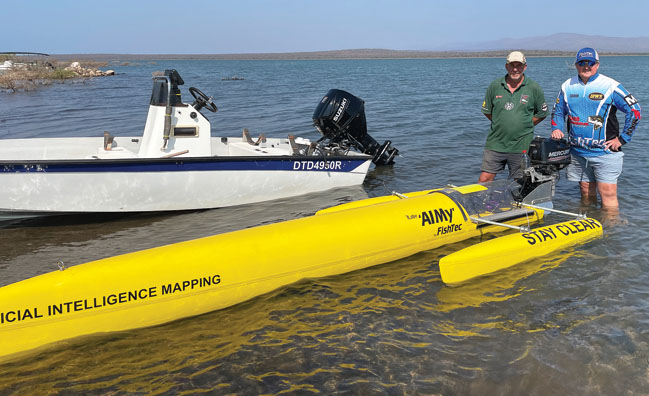
    At this stage I would be naïve to think I could properly explain the more technical aspects of John’s chart of Jozini and how he does it with the AIMy — the autonomously guided craft he has personally designed and built.
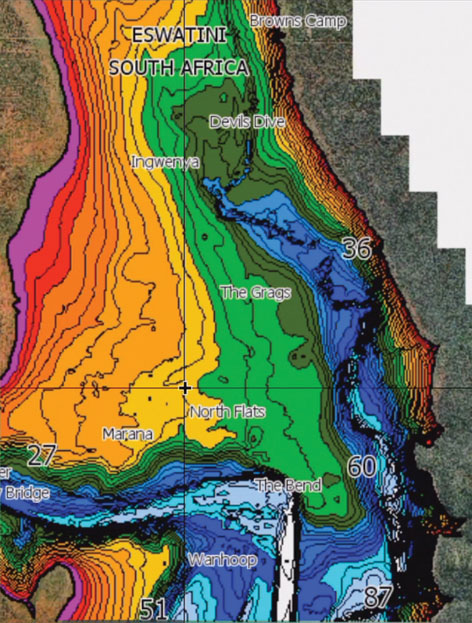
    My mind is already jumping into the future and wondering whether there is an application for this advanced cartography in the inshore area — say up to 50m — of South Africa’s shoreline.
    Can you just imagine, for example, what Sodwana Bay would look like on one’s sounder screen when you view the few images shown alongside of what Jozini looks like using this technology?
    Before I get carried away, I’ll let John expplain more about Jozini and the finer details of this technology…

    STATISTICS
    Jozini is the fifth largest dam in South Africa, with an area of well over 30 000 acres when full. In August 2022, when the survey was carried out, it was sitting just on 30 000 acres at 82% of its capacity which is around 6ft or 2m below full capacity. The deepest part of the dam is obviously the gorge at 190ft or 60m.
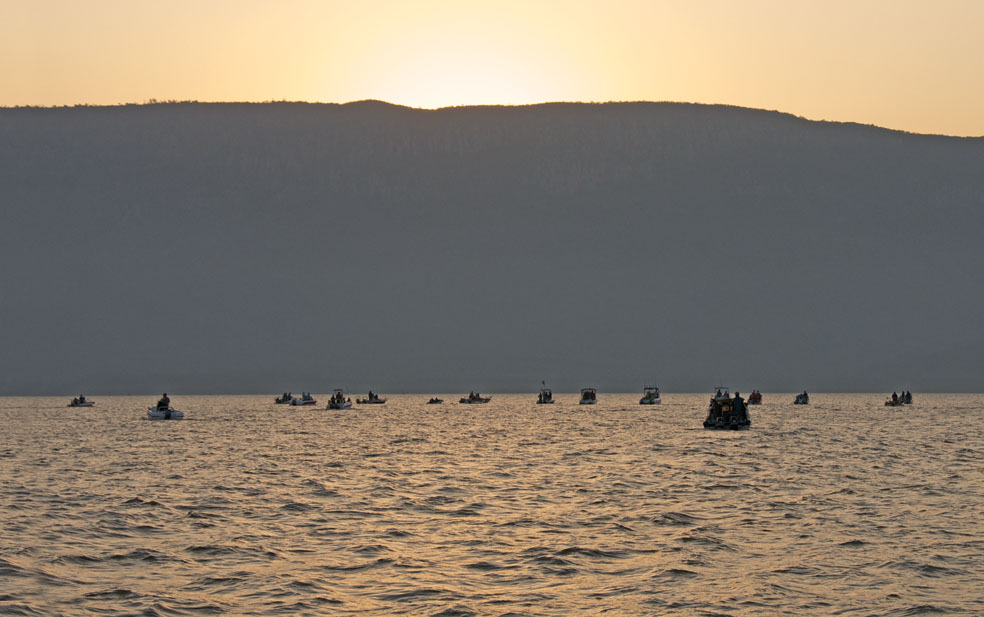
    The dam demands some very healthy respect from a danger aspect, as the main body of the dam, which is around 30km in length from north to south, offers very little shelter. The river section is a popular fishing area and makes up approximately 2 600 acres or 8% of the dam, while the gorge is an area of around 1 600 acres or 5% of the dam.

    BATHYMETRY SURVEY
    The primary objective of the FishTec bathymetry survey was to create a contour chart of the dam using a very narrow beam transducer for accurate depth measurement. This survey is the first time since the dam was built, that accurate sediment, depth and volume data has been captured for the entire dam, which will still be relevant for many years to come.
    For example, according to the records, the total capacity is just shy of 2.5 billion cubic metres, and at the current 82%, that should equate to 2.005 billion cubic metres. However, the capacity is now 1.963 billion cubic metres which means that, due to silting, nearly 50 million cubic metres of capacity has been lost over the years.

    SURVEY EQUIPMENT
    A unique aspect of this survey is that the majority of the dam was surveyed using a hydrone which has been in development by FishTec since 2016. Instead of having a human erratically driving a craft designed to plane on the water, which creates all sorts of sonar issues, this craft acts more like an extension of the transducer by riding in, instead of on, the water. This concept offers high-quality sonar data at good speeds even in windy or choppy conditions.
    The unique craft is creatively named AIMy which stands for ‘My Artificial Intelligence Mapping’. She is a 4.3m delta design powered by a 5hp four-stroke outboard motor capable of semi-submersible operation should the conditions get wild enough.
    As far as we are aware, this is a first of its kind for this specific feature.  AIMy is capable of running completely autonomously while being tracked by 4G on a cellphone from anywhere in the world for as long as the batteries and fuel can last, which is around 12 hours.

    THE CHART
    The chart itself is encrypted for copy protection to a micro SD card in a full SD card adaptor and comes in a jewel case for protection.
    The card includes the following charts:
    • Jozini 82% — 2m
    • Sediment
    • Mosaic
    • NorthHC
    • SouthHC
    • MidHC
    • RiverHC

    Jozini 82% — 2m Chart
    This is the primary chart for the entire dam and includes 10ft interval major contours with coloured isobaths which can be turned on and off individually under Chart Options and Categories. There are labels for some key locations around the dam as well as the South Africa–Eswatini border. At the main launch site there is a “Sponsors” area where users can click on a specific name and an image of that business’s advert will pop up if you tap on it.
    The chart also includes a free satellite background of when the dam was down and around 30-40ft. Coupled with the precision contour lines overlay, this makes it very easy to determine what depth those points of interest are in when you are sitting at home studying the chart on your Lowrance chart plotter. As Benjamin Franklin said, “By failing to plan, you are preparing to fail.”

    Sediment Chart (DWAF)
    A major feature of the Jozini chart is that it includes a calibrated Department of Water Affairs & Forestry (DWAF) Sediment chart that shows exactly what was in the valley prior to the dam wall being built.
    The biggest problem with these old charts is that one had no idea where the shoreline was and at what depth the points of interest were in. Now that FishTec has placed precision contours as an overlay, this is no longer a problem. In addition, colour isobaths can be turned on and off depending on the depth range you are targeting, making it all very easy to understand.

    Sidescan Mosaic Chart
    The river section was also surveyed using a smaller hydrone, which not only captured depth data but sidescan sonar as well, which is labelled as “Mosaic” on the chart. This shows very detailed imagery of rocks, timber, weeds, spawn beds, ledges, old buildings, sunken boats etc. which comes in very handy when putting a game plan together.

    High Contrast (HC) Charts
    High contrast charts like the one above offer 3ft major contour intervals and 1ft minor contour intervals to give very precise structure detail of the bottom while the high contrast isobaths make it easy to maintain a targeted depth range.
    The dam has been split into four sections in order to offer the best contrast for the specific depth range of that area — North, Mid, South and River.  Each of these also includes a low level satellite background and area labels.

    SITUATIONAL AWARENESS
    Wikipedia says, “Situational awareness or situation awareness (SA) is the perception of environmental elements and events with respect to time or space, the comprehension of their meaning, and the projection of their future status.”
    When you’re on a body of water such as Jozini, situational awareness and safety have to be on your mind before you even launch your boat. Many anglers prefer to use a charter service on Jozini, depending on the local knowledge/situational awareness of the skipper, not only with regard to the best fishing spots but for safety as well.
    Charts go a long way to contributing to your situational awareness if you take the time to study them before going on your fishing trip or tournament. Over the past 10 years, watching anglers that use FishTec HD Fishing Charts, it is clear as day how their situational awareness and fishing success has improved in comparison to those who do not use the charts.

    John Easton with a very respectable tigerfish.

    FAQ
    Q: What format is the chart in?
    A: The chart is encrypted onto an SD card for Lowrance units only.

    Q: Which Lowrance units are compatible?
    A1: For contour only, any Lowrance chart plotter from LMS to the latest entry-level Hook (not ‘X’ models).
    A2: For full imagery (sediment, satellite, sidescan mosaic) any Lowrance unit from HDS Gen2 and EliteTi up and to the latest EliteFS and HDS Live units.

    Q: Can I view the chart on my PC or laptop?
    A: No, but all Lowrance units from HDS Gen3 and EliteTi have WiFi, so using the Lowrance Link App, you can use your phone, tablet or even full HD TV to view and plan your fishing trips and tournaments.

    Q: Can I save waypoints while using the Link App?
    A: Yes, anything you can do on your unit you can do via the App, except for controlling an autopilot for obvious safety reasons.

    Q: Can I use Genesis Live while my FishTec chart is in the unit?
    A: No. Any form of writing to the card can damage the encryption and corrupt the data.

    Q: How do I backup my waypoints if I’m using a FishTec Chart?
    A: Remove the FishTec chart and insert a blank formatted SD card, then export your waypoints to that.

    Q: How do I order a FishTec Chart?
    A: Contact Lowrance SA on 031 368-6649, phone Colleen on 0824460914 or email <sales@fishtec.co.za>.

  • DREAMS COME TRUE ON YOUR DOORSTEP

    DREAMS COME TRUE ON YOUR DOORSTEP

    Tigerfishing at Lake Jozini

    By Philip van Wyk, Tiger Hunter Tours and Safaris

    [Originally published in the May 2022 issue of SKI-BOAT magazine]

    WHENEVER one thinks of tigerfishing, our minds seem to almost automatically drift to some remote wilderness in Africa where you have to battle your way through hippo pods and crocodiles to get to the best fishing waters. And then — as the sun sets romantically in a blaze of orange, with the call of a fish eagle in the background — you’ll be standing there fighting this behemoth of a tigerfish. A true angler’s paradise.
    For many anglers this experience remains something that they can only dream about. Travelling to some of the African countries has become a logistical nightmare and costs have shot up, making it next to impossible for the average angler to experience the true fight of Africa’s river monster.
    The thing is, there is actually no need to leave South Africa to catch tigerfish; you can experience first-hand what it feels like to be fighting with a river monster right here!
    Pongolapoort dam, better known as Lake Jozini, is the southernmost point in Africa where tigerfish are naturally found. The lake sprawls across Maputaland in northern KwaZulu-Natal, nestled between the Obombo and Lebombo mountain ranges. Built in 1972, the dam was to be used as a holding reservoir for water desperately needed to irrigate the surrounding areas. As this is the only lake in South Africa where tigerfish naturally occur, it’s a popular destination for angling enthusiasts in search of the ultimate freshwater fishing experience.
    Today the lake is surrounded by game reserves teeming with wildlife on the shores of the lake, making it a spectacular place not just for the fishing, but also for water-based game viewing and birding. There are regular sightings of buffalo, elephant, rhino, waterbuck, tsesebe, wildebeest, giraffe, zebra, kudu, bushbuck, duiker, nyala, impala, warthog and even the occasional sighting of leopard which roam the Lebombo mountains. Over 350 species of birds have been recorded in the area.
    If you have to compare the quality and quantity of fish in Jozini to other places such as the Zambezi, I would personally say that it is up there with some of the best destinations.

    At Jozini the average size fish are 5- to 6 lb (around 2.5kg) and we have regular catches of fish over 10 lb (4.5kg). With the dam record standing at just over 21 lb (9.5kg), it’s fair to say that there are some real trophy fish in this lake.
    Lake Jozini has an amazing climate with warm to extremely hot weather all year round. Winter temperatures average 25°C and summer 35°C, making it ideal to target tigerfish all year round. Unlike other destinations where the fishing is limited depending on rainfall and water colour, Jozini always has a pocket of clean water somewhere.
    I have found that if you are after quality fish then the winter months from mid-March to end of August are the best. However, if you are after quantity rather than quality, then the summer months are best, and you can sometimes catch up to 30 fish in a two-hour session.
    Methods of tigerfishing vary all over southern Africa, with each place having its own best method. These methods range from flyfishing, spinning and trolling with lures and spoons, to dead bait and livebait fishing with fillets and live tilapia/bream.
    Fishing successfully for tigerfish on Jozini requires a lot of local knowledge and patience, as techniques used in other areas of Africa don’t necessarily work here.
    On Jozini we prefer to use livebait as the main option, but this means that you will need to have some patience out there. We also use other methods such as spinning and trolling, but find these are more effective in the warmer months when the fish are more active on the surface.
    One must remember that the tigerfish at Jozini are very different to those in other areas in Africa, and prefer open water to structure. They do congregate around structures, but unlike bass you don’t find them within these structures.
    Here we often see anglers sitting at these structures for a short time and then moving off, which does not work at Jozini. Here patience is the key; we often sit for hours in one spot before considering moving.
    Ideally what we do is look for a drop off point, then we anchor on the shallow side and fish into the deeper water, waiting patiently for the shoals to move past. Unlike the bass that ambush their prey, tigers will move around and physically hunt down their prey, so sitting in one spot and waiting for them to pass by is key.
    When fishing with livebait into the drop off, there is always a better chance for larger fish.
    Spoons are also used from time to time. We use copper double-bladed FZ spoons at 17/18g, or the single blade. When using spoons, again, look at the wind and pick a bank where you can start at the top of the bank and drift down the bank as the wind pushes you.
    Always be sure that the wind is coming straight off the shore so that you can anchor perfectly on the shallows and fish off the back of the boat into the deep water.
    Casting towards the bank with a fast retrieval can be a fun way of catching a lot of fish, but not necessarily big fish.
    I cannot stress enough what a big factor the wind is on Lake Jozini. You always want to be on the sheltered side of the lake, and you always want to be on the side bank from which the wind is coming. As soon as you see white caps on the water you need to move as the tigers here really don’t like the wind.
    I find some of the best fishing happens on a north or northeasterly wind, within fishing limitations depending on the strength of that wind. The southerly wind generally brings in rough weather.
    The tackle we use here varies from angler to angler, but in the 22 years I have been fishing this body of water, I have found that the best rig is a round profile baitcaster with 16 lb monofilament line on a 7ft medium/heavy rod.
    Do not use braid when fishing for tigerfish, as this line has no stretch in it at all and the force and speed at which the tiger hits the bait will break your line. I have proved this to many anglers over and over.
    The rig I personally use consists of a ±12 inch black carbon-coated steel trace with a power swivel on one end. I then like to slide about three orange or red beads on the trace between swivel and hook just for colour, and then finish with a 7/0 hook. This is my standard trace that I use on all my trips.
    I then hook the livebait through the tail, as this allows it free natural movement in the water. Try to avoid hooking the livebait so far up that it cannot swim properly, because tigerfish in Jozini are rather fussy feeders and I believe they can often see or sense when there is something trying to catch them.
    When fishing with bait, always remember to fish free spool. Never set the drag on your reels as these fish are very sensitive to any tension. If you strike and the fish feels the tension, it will almost immediately drop the bait. On free spool, however, they don’t feel any tension until you engage the spool to strike.
    Make sure to close the spool when you’re ready to strike, as some anglers completely forget about this and I have heard the words flying from across the dam as the fish strips the line.
    When fighting the tigerfish, be sure that you have no slack line. Keep the tension on the fish all the time, otherwise he will throw your hook very quickly. Tigerfish are notorious for jumping out the water, although this is more prevalent in smaller fish, and many anglers are completely surprised by the power of this fish as it shoots out the water. Again, be sure to keep that tension, not giving any slack, otherwise the fish is gone.
    The tigerfish is not the easiest fish to catch, and with a hook-up rate of 2:10 strikes, it is a fish that takes some patience to land, but if you stick to the tips above you will be sure to bring out that dream Jozini tigerfish.
    Lastly I would just like to remind everyone how unpredictable the weather can be on Lake Jozini. Strong storms can pick up very suddenly, going from calm, mirror-like water to sea conditions in a matter of minutes. This is very dangerous for smaller boats and you need to always be on the lookout for this, so check your weather before going out.
    You do not want to be on the main lake when the southerly is blowing, and need to be extra cautious as the conditions can get worse than the ocean. Wind currents are often heavily affected by the mountains, causing the water to turn into a washing machine with no distinct wave direction. Many boats, both big and small, have capsized in these conditions.
    In the summer months there are typically late afternoon thunder storms or wind storms, and many anglers have been caught offguard, so checking weather constantly through the day is important.

  • TAGGING TIGERS IN THE KAVANGO

    TAGGING TIGERS IN THE KAVANGO

    By Dr. Francois Jacobs
    Chief Fisheries Biologist, Kamutjonga Inland Fisheries Institute, Ministry of Fisheries and Marine Resources, Namibia

    [Originally published in the May/June 2020 issue of Ski-Boat]

    KNOWLEDGE about area use by freshwater fishes — such as for feeding, spawning and colonisation of new habitats — is important for managing fish populations. In Africa, there is scant information on area use by most freshwater fish species and this has constrained the effective management of many fishes. This is concerning because many fish populations have come under increasing pressure and declining catch rates, particularly of the larger, more valuable species is evident in many systems. One of these species is the African tigerfish Hydrocynus vittatus, a large predatory fish species that is endemic to the African continent, is important in small-scale fisheries and, is one of the most sought-after species by recreational anglers.
    In an effort to improve management of freshwater fish species in Namibia, the Ministry of Fisheries and Marine Resources, in collaboration with the Norwegian Institute for Nature Research (NINA), the South African Institute for Aquatic Biodiversity (SAIAB), the University of KwaZulu-Natal, the University of Namibia and, and Namibian Nature Foundation combined their resources to determine whether freshwater protected areas (FPAs) could be an effective tool for the management and conservation of this species.
    Freshwater protected areas are a promising management and conservation approach for freshwater fishes. FPAs are modelled on marine protected areas where benefits, including the spill-over of fish from protected areas to increase fish biomass and yield in adjacent fished areas, are well documented. To be effective, FPAs need to afford protection for a considerable portion of the lifetime of a fish and knowledge of the life-history, movement and migration behaviour of the target species is required if FPAs are to be designed appropriately.
    During the study 49 tigerfish were caught with standard recreational fishing gear and tagged with radio transmitters (approximately R3 000 per transmitter) in the Mahangu Game Park area of the Kavango River. Of the 49 tagged tigerfish, data from 14 tagged fish was excluded from the analysis because 11 tigerfish could not be located for the whole period, one tigerfish was caught by a crocodile, and two more tigerfish were reported recaptured by anglers. The final dataset, therefore, comprised 35 individuals.


    Tigerfish were manually tracked by boat and light aircraft in the core study area of 33km every 12 days from July 2016 to May 2017 for up to 246 days. In addition, 14 extended surveys were carried out for up to 680km to determine the total area use of the tagged individuals.
    Twenty-three (66%) of the tigerfish had high site fidelity, using an area of less than 33km of river, whereas 12 tigerfish (34%) undertook long distance movements of up to 397km upstream and 116km downstream from their tagging locations. This substantially exceeds the previous estimate of individual means that ranged from 0.5–105.9km river length recorded in the Zambezi River.
    The distance of 397km by an individual tigerfish documented during this study is currently the furthest movement recorded for any potamodromous fish species on the African continent. Although smaller pelagic species such as Brycinus leuciscus and Alestes baremoze in the Niger River were believed to migrate similar distances, during the time of those studies (1952) the technology to accurately record freshwater fish movements simply did not exist. It is plausible that other freshwater fish species can move similar distances, but behavioural ecology studies on freshwater fishes in Africa is scant.

    During the long-distance movement, tigerfish crossed the territorial boundaries of Angola, Namibia and Botswana which highlights the need for international cooperation in the management of this species. The river use recorded during this study further indicates that a portion of the tigerfish population may be migratory while others exhibit residential behaviour. Migratory and residential behaviours are important within the same species as this promotes genetic diversity, and are considered highly important in the formulation of conservation and management strategies, especially concerning the protection of local tigerfish stocks and special habitats.
    Of the 35 fish that were monitored, 40% spent more than 80% of the monitored time in the 33km study area and 51% stayed within the study area for at least 50% of the monitored time. These findings suggest that freshwater protected areas may be a useful management tool and we predict that a protected river area of 2–5km river length could protect 25.9–34.6% of the population for at least 75% of the time, whereas protection of 10km river length could protect at least 50% of tigerfish for at least 75% of the time.
    This suggests that FPAs would provide some protection to at least a portion of the tigerfish population in the river. It is essential that FPAs incorporate the lateral and longitudinal connectivity of the river system required for a species to access habitats required for spawning and feeding, and accounts for the human activities in the area under consideration. In this regard, we note that the recommendations of the current study are limited to recommending the size of potential FPAs based on an assessment of area use by tigerfish. Ultimately, recommendations on the optimal design and placement of FPAs will require additional research to elucidate on the linkages between the biological habitat requirements of tigerfish (e.g., for spawning and feeding), their movement biology, and the risk that interactions with human activities pose to the maintenance of these biological processes.
    Furthermore, there are at least 30 tourist lodges situated next to the Kavango River in Namibia and Botswana. The majority of these lodges offer recreational fishing for tigerfish and are directly benefiting from healthy tigerfish populations. From this study it is clear that the local subsistence fishermen living next to the Kavango River and recreational anglers at tourist lodges share the same tigerfish resource. Therefore, the decline in tigerfish populations could cause further conflicts between stakeholders of the Kavango River that are often dependent on one another. Increased conflicts between subsistance fishermen and recreational anglers have occurred along the Zambezi River and this has been attributed to the declining fisheries.
    Fairly recently the first community-based fish protected areas were established within the Sikunga (Sikunga channel) and Impalila (Kasaya channel) conservancies on the Zambezi River, Namibia. Following the successful establishment of these fisheries reserves, several areas on the Kwando River have also been identified by communities and are currently in the process of being Gazetted, as are two areas on the Kavango River.
    These protected areas are co-managed by communities and function on the same principle as conservancies in Namibia, and may be the only viable option that can ensure tigerfish (and other riverine species) populations remain viable.
    In conclusion, we could see that tigerfish cross the territorial boundaries of Angola, Namibia and Botswana which emphasises the need for cross boundary initiatives and ideas. We are therefore working to ultimately promote the establishment of FPAs over the entire SADC region to ensure that our rivers remain sustainable for future generations.

    The scientific article “Implications of the movement behaviour of African tigerfish Hydrocynus vittatus for the design of freshwater protected areas” can be downloaded from the Journal of Fish Biology. https://onlinelibrary.
    wiley.com/doi/10.

  • HUNTING TIGERS IN THE CAPRIVI

    HUNTING TIGERS IN THE CAPRIVI

    (Originally published in the January 2020 Issue of Ski-Boat)
    By Erwin Bursik

    THE sun’s golden orb settled gently over the red western sky into the bush-lined horizon of the north bank of the mighty Zambezi River. Before disappearing for the dark of night, it left its telltale path of shining gold over the rippled surface of this, one of the biggest east-flowing rivers in Africa.
    A sight such as this not only reignites the soul, but also for me personally brought back memories of standing on the same spot exactly 30 years before, witnessing this same spectacular sunset on my first expedition to hunt the Zambezi’s legendary tigerfish.
    During the final stages of the ceasefire of the Border War I was a guest at a Captain Morgan competition held at a military camp on the very site where the new fantastic Zambezi Mubala Lodge stands. I was filled with excitement and anticipation at the thought of hunting the waters to hopefully catch my very first river tiger. (See the November/December 1989 issue of SKI-BOAT). This time, as I surveyed the river, I held in my hand a tall glass of Captain Morgan to toast my return to a magical destination and the fervent hope of tackling one of the big tigerfish for which this stretch of river within Namibia’s Caprivi panhandle is renowned.
    Gondwana Collection Namibia purchased the two adjacent lodges that previously occupied this high cliff situation on the river bank. They subsequently demolished them and, with innovative design encompassing modern construction methods, brought the recently opened Zambezi Mubala Lodge into being.
    Lining the cliff top are 22 self-standing ultra modern cabins which stretch east and west of the lodge’s lounge, dining, bar and swimming pool complex, and are all connected by a boardwalk.
    However, at that moment of contemplation. it was the mystery and magic of the river that held my attention until the blackness of the African night closed its curtain on past memories and opened my mind to the extremely comfortable and inviting surroundings of the lodge itself.
    Gondwana Collection’s lodges in the Caprivi panhandle provide access to both the Kavango River that arises in Angola and runs eastward forming the border between Namibia and Angola, as well as the famous Okavango swamps. Gondwana’s Hakusebe Lodge is situated just west of Rundu and Namushasha, a lot closer to the Botswana border. Just east of Katima Mulilo are two Gondwana Collection Lodges — the Mubala Fishing Camp and, approximately six kilometres east, the new Gondwana Mubala Lodge. Further towards the Botswana border on the banks of the Chobe River is the Tented Gondwana Choba Lodge that overlooks the expansive flood plains that traditionally attract the huge herds of elephants, buffalo and plains game of the Chobe National Park. It’s a spectacular sight when the waters of the Zambezi push back into the Chobe River system, filling to capacity all the small waterways and providing the much needed water to perpetuate the cycle of life of that region.
    For me, however, the draw of the tigerfish took centre stage and Gondwana Holdings’ Financial Director, Jaco Visser, and his high performance river craft had me more than excited for the dawn of the following morning.
    River fishing, especially in Namibia’s Kavango and Zambezi rivers, has expanded exponentially over the last decade. It has also developed into a specialised art form of angling where fishing with ultra light fishing gear and artificial lures is the norm. A number of highly competitive competitions such as the Crockango Bonanza on the Kavango River, the Zambezi Classic on the Zambezi and a Bream Classic in the Okavango swamps has brought about a revelation of tackle and specialised boats that are capable of high speed navigation along extensive stretches of all these rivers.

    LOCAL KNOWLEDGE IS KING
    I was in very accomplished company, accompanied as I was by Jaco and Lappies Loubser, Gondwana’s Northern Regional General Manager, who won the Zambezi Classic in late August 2019.
    Although tigerfish were uppermost in my mind, they were determined to expose me to the art lure side of the sport, targeting the large bream that are found in these waters and which play a very important part in these angling competition. I soon learned that the equipment and efficient use of it is not easy and immense skill and local knowledge is extremely important.
    Drifting down a fast flowing river with reasonably strong upstream winds, a mere 2- to 4 metres from the reeds and bush-strewn banks is an art in itself. Add to that flicking a quarter-ounce jig into pockets, holes and undercuts that hold these big bream — especially nembwe — was nigh impossible for a novice like me.
    Initially it was highly embarrassing as eight out of ten of my casts ended with me snagging on seen and unseen structures. However, seeing my companions hooking and tussling with some good sized bream made me more and more determined to get the lure in the right area. In the end I caught two respectable nembwe, quite a few three spot and even more “humpies” — humpback bream.
    As a sport it is highly addictive, and I soon became obsessed with placing the lure into the right hole and getting these bream to eat. Once one gets these 2- to 3kg fish out of the “hole” and into the strong current of the Zambezi, they put up a tremendous fight on the light tackle we used. Very exciting indeed!

    TIGERS AT DUSK
    We tended to leave the targeting of tigerfish till the last few hours before darkness, which resulted in a few very big tigers being caught. I personally still get an incredible thrill from the tigers’ ferocious take, aerial display and the tenacious fight next to the boat; and then there’s the relief of the netting. Finally you get a few minutes of close-at-hand adrenaline-fueled photography and then the thrill of holding the tiger in the water until it kicks and powers its way back into the green water of the Zambezi River.
    One of the methods used to target tigers is to suspend a live baitfish (bream) beneath a balloon. On one of the days a pink floating balloon attached to a live bream was attacked by a two metre long crocodile that made a surface charge across the last ten metres to engulf the balloon and get entangled in my line. The fight was on, and it was a lot more visible than those against the sharks that take our tuna or ’cuda at sea. Needless to say, on light tiger tackle the attachment didn’t last long, but it was very exciting until the croc rolled me up and smashed the line.
    Fishing the Zambezi is an almost calming experience. There’s no swell, big seas, strong wind and violent rocking like one experiences on the ocean, but rather a calm, hushed atmosphere as one drifts downstream. The beautiful views along both banks and the cool off-water breeze keeping one reasonably cool adds to the overall enjoyment.
    Whilst our fish expeditions took us up to 30km downstream of the lodge, most of the fish, especially the tigerfish, were caught in the eight kilometre stretch between the Mubala Camp and the Mubala Lodge. Clients that fish on the lodge’s charter boats have access to arguably the best fishing areas in that region, and each evening they shared stories in the bar of their experience fishing the mighty Zambezi.
    The Zambezi Mubala Camp Lodge is accessible by road some 30km east of Katima Mulilo and provides bush-style tented accommodation with self-catering facilities sited above the river in park-like surroundings. Excellent food is available in the bar area although the menu is very limited. For two nights of my stay I was accommodated in the camp and enjoyed the meals. The tented accommodation is very comfortable with an en-suite bathroom, a double bed and two single beds, and a verandah that doubles as the cooking and socialising area.
    This camp is very popular among visiting Namibian fishermen as well as SA tourists driving through this area and the northern regions of Namibia.
    Gondwana Lodges offers South African tourists a Gondwana Card that entitles them to a 40% discount on the rack rate accommodation charges and makes this camp very affordable. Add to this the twenty-odd permanent tents, swimming pool, lodge, tackle shop and other facilities and its clear why it’s such a popular venue.
    It’s worth noting that the Zambezi Mubala Camp is sited on a backwater channel of the Zambezi with Kalimbeza Island on its opposite bank. The surrounding waters of this island are protected and policed by Sikunga Protection Area Guards to ensure that the prolific illegal commercial gill netting is virtually eliminated. As a result, the number of fish in this protected area has dramatically increased and all concerned believe this seeding will improve the overall fish population in this area and downstream towards Gondwana Mubala Lodge to perpetually sustain the fisheries in this area. A catch and release policy is rigorously promoted.
    Gondwana’s Zambezi Mubala Lodge is, in my opinion, outstanding. Brilliant in design and even more exceptional when put to use by this fishing-weary fisherman. The cabins are very spacious and I am certain my wife, Annie, would have been thrilled to stay in Cabin no.8 with me. Fully air-conditioned, with magnificent views of the Zambezi whether you’re lying in bed, in the “rain” shower or on the secluded outdoor veranda, it feels as if you are right on the water. The cabins are stylishly decorated and have everything one would wish for on a trip to southern Africa.
    The dining area is designed for comfort and is open to receive the cool upriver breeze. It also offers a magnificent view of the river.
    The meals are superbly prepared and presented and cater for all tastes. The “table de hôte” menu varied substantially every evening I stayed there, with the superb-tasting food being beautifully presented and efficiently served.
    A large firepit is situated between the bar and the dining area and it’s extremely pleasant to relax there while enjoying an after dinner drink.
    Off necessity the entire lodge is built on pillars, ensuring that when the Zambezi reaches its peak during the high water season and overflows its banks, guests at Mubala Lodge will not be affected. It must be quite an experience to be able to park your boat almost next to the bar access!
    This lodge is primarily aimed at the international tourist market, but it’s becoming incredibly popular among visiting anglers who appreciate the additional luxury this lodge offers, especially when they’re accompanied by their non-fishing partners.
    Zambezi Mubala Lodge is not accessible by vehicle, so all guests are transported by river ferries from Mubala Camp to the lodge, a 6km boat meander downstream which in itself is a wonderful experience.

    HORSES ON THE WATER
    In conclusion I need to enthuse about Jaco’s new craft — Ruffnek Boats Namibia’s most recent design. This craft was designed especially for the big rivers of northern Namibia where exceptional stability is required. The ability to use huge outboard motors on these craft enables the highly competitive anglers to cover up to 100km of river during fishing competitions. This year this boat ran 90km downstream to Impala Island and back — all within the day’s fishing. I was astounded! At nearly full throttle, we recorded an S0G of 115kph. The 300hp Mercury motor was running at 6 000rpm and swinging a 25 pitch prop.
    The boat’s lateral stability was most impressive, both at speed and more especially while fishing.
    As a skipper on the Zambezi one can’t just run straight at high speed — sand bars, bends in the river, hippos and local makoros require one to make many sharp turns.
    During the time I was aboard with Jaco this was all achieved, with him rarely reducing speed to avoid the obstacles. To prove his boat’s capabilities, in one wide and deep stretch of the river he submitted us to some full-lock turns at very high speed. It was thrilling but frightening for me as we felt the “G” effects as the craft turned with great style, hardly tilting into the turn and not requiring much if any reduction of speed. I studied with interest the planing surfaces of the craft’s hull that enable it to achieve the speeds it does and, more importantly, its stability while three large anglers plied their “trade” during a days fishing on the river.
    Jurgen Geiger of Ruffnek Boats Namibia needs to be lauded for departing from the traditional hull design to produce a craft that can load a 400hp on its transom and achieve the stability that Jaco’s TomCat showed.

    GETTING THERE
    I travelled from Durban via Johannesburg to Kasane in Botswana, leaving Durban at 08:00 and arriving in Kansane at 13:30.  Thereafter it was a two-hour (140km) road transfer through the Chobe National Park to the customs border between Botswana and Namibia and then on to Mubala Camp. Overall, a very interesting experience.
    My fervent hope is that I don’t have to wait another 30 years to revisit this very special destination on the Zambezi River.

Verified by MonsterInsights