
40 YEARS DOWN THE LINE
Celebrating the ORI Cooperative Fish Tagging Project
(Originally published in the May 2025 issue of Ski-Boat magazine)
MOST South African anglers have heard of the practice of tagging and releasing fish, and many have become regular supporters of it while others think it’s a waste of time and effort tagging fish that could well end up in trawler nets. The Oceanographic Research Institute’s Cooperative Fish Tagging Project (ORI-CFTP) has now been going for 40 years,gathering some truly mindblowing information that certainly proves the project’s worth to both scientists and anglers.
While scientists are more focused on conserving a species and anglers are more
interested in catching a new PB,there is a lot of overlap between their interests.
Gareth Jordaan, the current ORI Tagging Officer, shared some interesting history
and information about the highly successful project…
By Gareth Jordaan, ORI Tagging Officer
THE ORI-CFTP has come a long way since its early beginnings in 1984 and has achieved some remarkable recapture records that highlight the project’s value. One standout case involved a raggedtooth shark that was at liberty for no less than 26.2 years before being recaptured, with its original tag still intact!
Another remarkable recapture was that of a red steenbras tagged by scientists in the Tsitsikamma MPA and recaptured by ski-boat anglers off Kei Mouth 25.4 years later.
Other impressive recaptures include a galjoen that travelled 1 200km around Cape Point in just 90 days and a Roman (previously thought to only live for 19 years) that was recaptured after 22 years at liberty in the exact same spot where it was originally tagged.

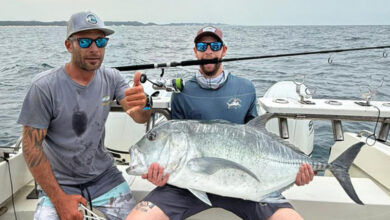
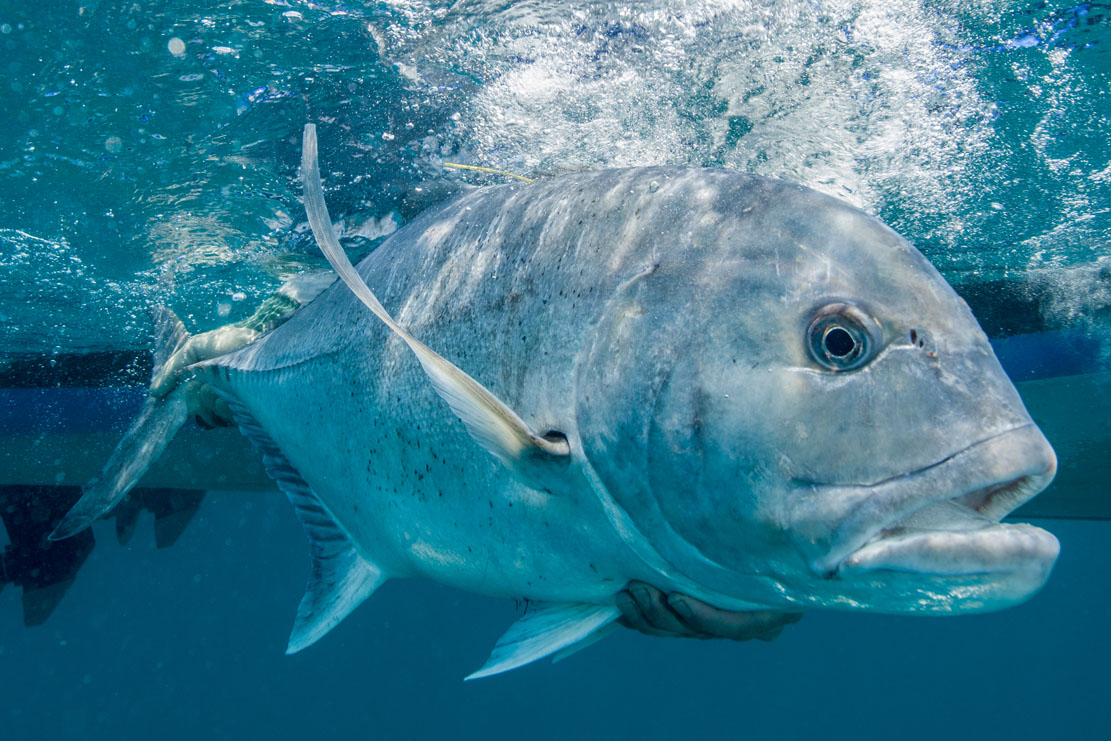
The project has also contributed to groundbreaking discoveries about species like the giant kingfish. In 2018 Dr Ryan Daly tagged a 92cm individual in Bazaruto, Moçambique, with both an acoustic and an ORI conventional dart tag, and the fish was recaptured in the same place by a charter boat angler two years later.
This recapture might not sound like much, but recent discoveries about GTs from tagging research are nothing short of game changing. Thanks to advanced acoustic telemetry technology, researchers have gained fascinating insights into the secret lives of these powerful predators.
For instance, we now know that all adult GTs found in South African waters migrate annually to southern Moçambique to spawn in a large temporally and spatially predictable spawning aggregation during the summer months (November to January) over the full moon. Once they have finished spawning, individuals return to their own home ranges along the coast, sometimes travelling distances of over 600km in one direction in less than a week! This clearly has profound implications for the future conservation and sustainable use of this species.
Conventional dart tagging methods used by the ORI-CFTP only capture the release and recapture points, leaving gaps in our understanding of what fish do in between. Acoustic telemetry is now helping to fill in these blanks by using acoustic tags (transmitters) and a large array of “listening stations” to track fine-scale movements, revealing a detailed picture of the movement behaviour of numerous species.
These exciting discoveries and the success of the project as a whole would not have been possible if it were not for the early pioneers of tagging in South Africa.
PIONEERS IN SA
Tagging projects in South Africa have taken various forms over the decades, with varying degrees of success. Many initiatives, despite their good intentions, have faltered due to inadequate data collection or failures to publish the findings. However, amidst these challenges, South Africa’s Oceanographic Research Institute (ORI) has emerged as a beacon of consistency and innovation in marine research.
Fish tagging in South Africa first gained momentum when Dr David Davies and Dr John Bass, researchers at ORI, started tagging dusky sharks along the KwaZulu-Natal (KZN) coast in the 1960s. Their primary goal was to understand the sharks’ migratory behaviour. Their work laid the foundation for a new era in marine research, and it wasn’t long before others were inspired to take up the challenge.
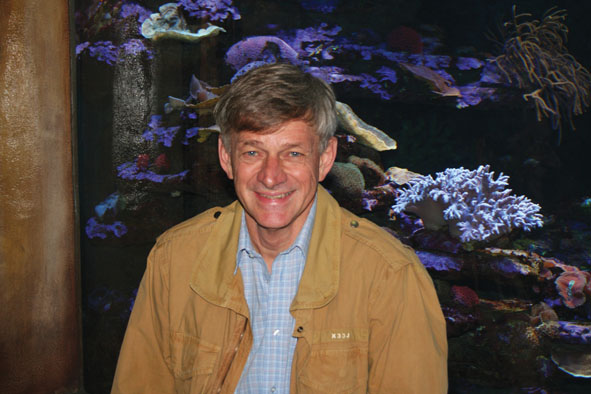
One such individual was Rudy van der Elst, who joined ORI in the late 1960s. Interested in what the Americans and Australians were doing with tagging billfish, Rudy was determined to replicate similar efforts in South Africa.
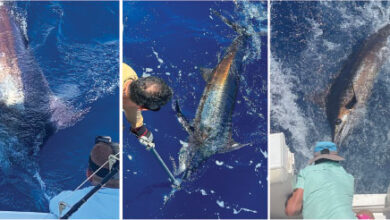
In the 1970s, with the support of the Sodwana Bay Ski-Boat Club, Rudy spearheaded the country’s first billfish tagging initiative. Armed with a tagging pole and American-made Floy tags, the group ventured into the waters off Sodwana Bay and tagged the first marlin and sailfish off southern Africa.
Around the same time, Rudy was also focused on a contentious topic: the management of shad/elf. As he pursued his master’s degree, he noticed a significant gap in knowledge regarding whether the shad populations in the Cape waters were the same as those in KZN. This uncertainty sparked the creation of a dedicated shad tagging project, which Rudy led with the help of his colleague Simon Chater.
Thousands of shad were tagged along the South African coastline, and the results were groundbreaking. From this project, the scientists found that several of the fish that were tagged in the Cape were recaptured in KZN and vice versa, proving that they could be managed as a single stock with the same size limits, bag limits and seasonal regulations.
BIRTH OF THE PROJECT
Building on the successes of these projects, 1984 marked the official launch of the ORI-CFTP. The project was Rudy’s brainchild, and he envisioned “a collaborative citizen science project between scientists and anglers to collect information on fish movement patterns, growth rates and population dynamics to help ensure their wise and sustainable use and to create awareness amongst anglers”.
Rudy’s vision for the ORI-CFTP extended beyond mere data collection. He also saw it as a way to bridge the gap between scientists and anglers, fostering a community united by a shared commitment to marine conservation.
THE UNSUNG HEROES
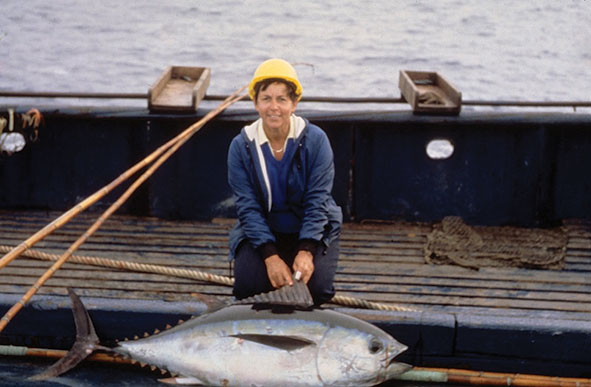
Any largescale conservation project has to have the right team in place if it’s going to be successful. Enter Elinor Bullen, ORI-CFTP’s first official tagging officer.
Elinor was a passionate angler with deep knowledge about fishing, and her organisational skills played a critical role in the early success of the project. Her no-nonsense approach ensured that anglers submitted their tag returns promptly. At a time when digital tools were limited, Elinor meticulously recorded data by hand in logbooks before transitioning to early handheld computers. Her dedication was instrumental in building the project’s credibility and popularity among the angling community.
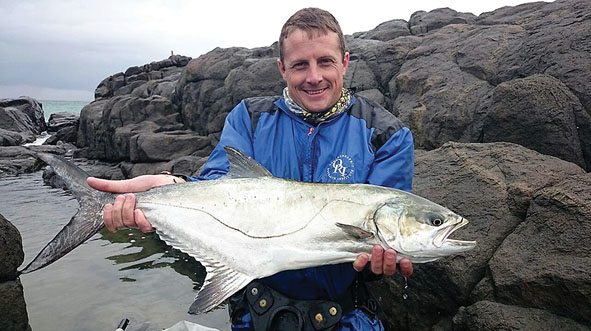
After 26 years of dedicated service in this role, Elinor passed the baton on to Stuart Dunlop in 2010. A recent MSc graduate, Stuart was eager to take on the challenge of expanding the project. He brought a fresh perspective, leveraging the power of technology to modernise ORI-CFTP’s operations.
Under his leadership, the project embraced social media, launched a dedicated WhatsApp line (079 529 0711), and revamped the tagging website (www.oritag.org.za) so that the project would be more interactive.
Stuart’s contributions not only increased engagement but also streamlined data collection processes, making the project more efficient and user-friendly. In 2018, Stuart and his wife took up an opportunity to work in the Seychelles, giving me the gap to take over as the new tagging officer.

Despite these transitions, the project continued to thrive, thanks in part to the unwavering support of Bruce Mann who managed the ORI Linefish Portfolio for an impressive 31 years until his retirement in 2023.
TRIUMPHS AND CHALLENGES
Celebrating its 40th anniversary in 2024, ORI-CFTP stands as a testament to resilience, collaboration, and innovation, but the journey hasn’t always been smooth.
Like any long-term project, ORI-CFTP has faced its share of challenges, particularly in securing consistent funding. While the support from various organisations such as Sedgewick’s Old Brown, the Tony and Lisette Lewis Foundation and the KZN Department of Economic Development, Tourism and Environmental Affairs, has been invaluable, the uncertainty of future funding remains a constant concern.
In the early 2000s the project also experienced a dip in participation, with waning interest from anglers and management alike. Fortunately, these quiet years were only a temporary setback in the project’s overall trajectory.
On the flip side, the highs far outweigh the lows. The ORI-CFTP has grown into one of the most successful marine citizen science projects in Africa, earning recognition on the global stage. Since its inception, the project has recruited over 7 300 anglers, with an impressive average of 483 active members per year. These dedicated participants have collectively tagged more than 387 000 fish, resulting in a notable 6.3% recapture rate with over 24 600 fish recaptured.
This wealth of data has not only enhanced our understanding of fish movement behaviour and growth rates, but has also informed critical management decisions that have contributed to the sustainable use of South Africa’s linefish resources.
CONTRIBUTIONS TO SCIENCE, CONSERVATION AND POLICY
The insights gained from tagging data have been used to refine size and bag limits, set open and closed seasons, and implement other conservation measures.
Most notably, the role played by the ORI-CFTP in monitoring the effectiveness of our marine protected areas (MPAs) has been phenomenal, giving us a better understanding of the residency of many of our reef fish species, as well as the benefits of spillover from our MPAs.
One of the most profound achievements of the ORI-CFTP has been its influence on fostering a culture of conservation among anglers.
The shift towards catch-and-release practices, partly inspired by the ORI-CFTP, has helped ensure greater sustainability of linefish populations.
The project’s efforts also led to changes in competitive fishing, with some official organisations embracing catch-and-release methods in the mid- to late 1990s already.
A SHARED MISSION
At its core, ORI-CFTP is more than just a data collection initiative; it’s a movement that unites anglers, scientists, and fishery managers in a shared mission to better understand and protect marine fish resources.
By actively involving the fishing community in research, the project has built a bridge of trust and collaboration that benefits both science and management. Participants have not only learned about the movement behaviour and growth rate of their favourite fish species, but have also contributed valuable insights that are critical to the long-term management and sustainable use of these fish populations.
The project’s success in fostering a conservation mindset among anglers cannot be overstated.
By educating members on proper fish handling and tagging techniques, the ORI-CFTP has helped ensure higher survival rates for released fish. This ethical approach to fishing has had a ripple effect, encouraging a new generation of anglers to prioritise sustainability over catch and kill.
LOOKING TO THE FUTURE
The ORI-CFTP’s journey is a testament to the incredible thngs that can be achieved when people come together for a common cause.
As we look back on the past four decades, we celebrate the dedicated anglers, scientists and conservationists who have made this project a model for citizen science worldwide.
Here’s to another 40 years of tagging, learning, and protecting our precious marine linefish resources.
DID YOU KNOW…
• Galjoen can travel 1 200km in 90 days.
• Roman can live for 22 years.
• South Africa’s GTs migrate to Moçambique to spawn.
• GT can travel 600km in one week
ORI CFTP STATS:
40 years
7 300 participating anglers
387 000 fish tagged
24 600 fish recaptured