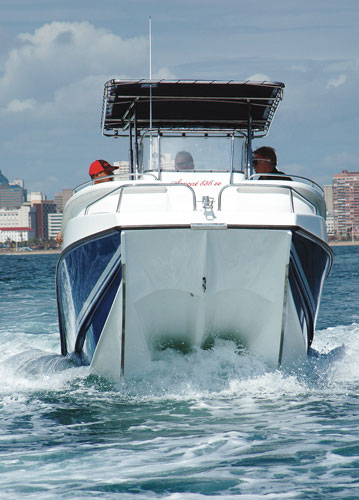
Tag: Seacat

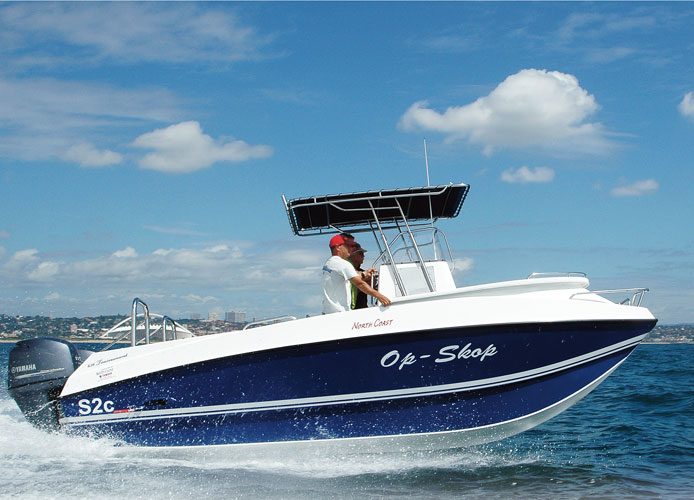
  • Seacat 465 FC — by Yamaha

    Seacat 465 FC — by Yamaha

    Tested by Heinrich Kleyn (September/October 2010)

    Contact 0800 926 242 for your nearest Yamaha Marine dealer. 
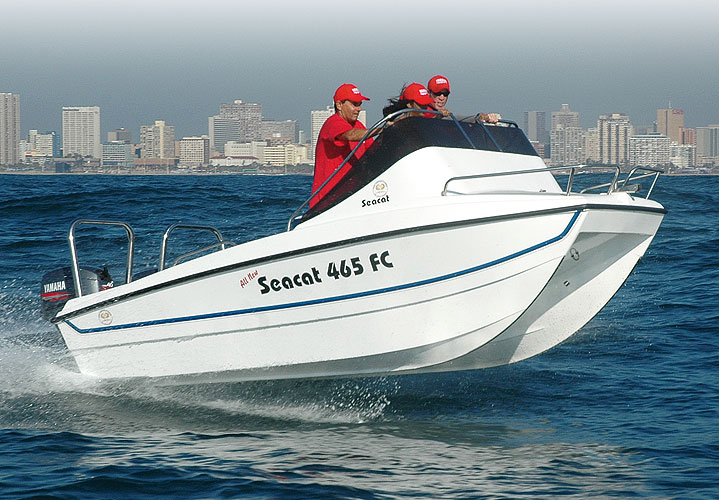

    SPECIFICATIONS
    Length – 4.65m
    Beam – 2.2m
    Boat weight — 450kg
    Min hp — 2 x 20hp 4-stroke or 2 x 25hp 2-stroke
    Max hp — 2 x 40hp 4-stroke or 2 x 50hp 2-stroke
    Buoyancy — foam-filled
    Power as tested — 2 x 60hp 4-strokes


    PEOPLE often make comments about our boat reviews: why didn’t you say this and why did you say that, and can’t the manufacturers change this or that … The bottom line is that it’s very difficult to keep everybody happy, and you as a potential buyer and fisherman may have different priorities to mine, based on the type of fishing you do and your personal preferences.

    At SKI-BOAT we do a large number of on-the-water tests, all following a fairly set routine so that we can maintain consistency and are able to make valid comparisons between different craft and the situations in which they might find themselves at sea. For this reason many of the tests may look more or less the same, but in actual fact they differ greatly … just read the fine print.

    My honest opinion is that you should always test-drive a boat yourself if you’re interested in buying it. Don’t rely solely on written reviews.
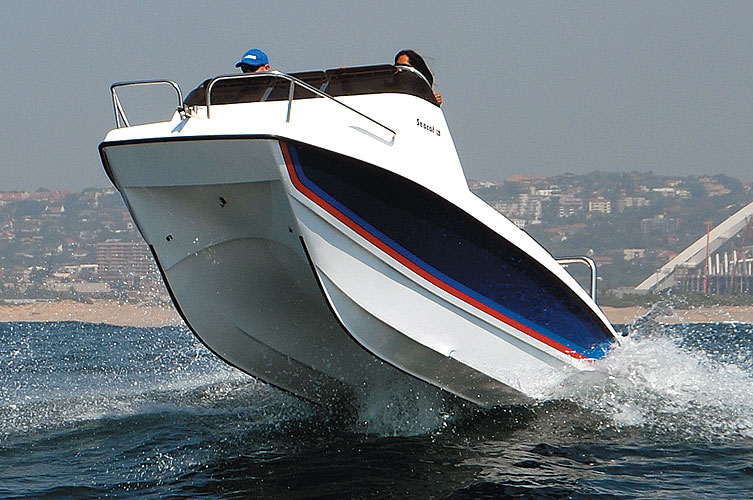
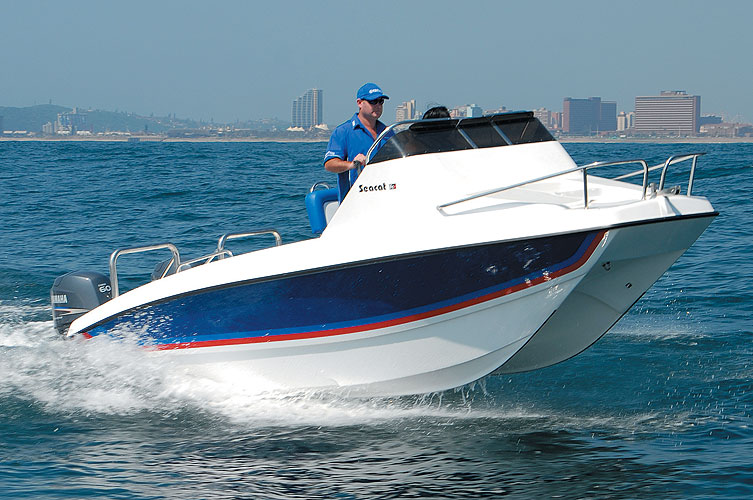
    The Seacat 465 FC is the same hull as the one I tested in the previous issue, except of course this one has a forward console, not a centre console. Some people feel there’s a huge difference between forward- and centre console craft, but I don’t think there is.

    It’s all about centre of gravity and correct weight distribution. With this sorted out, performance factors even out, so when choosing either a CC or an FC, it then boils down to personal preference.

    As a result of this, Yamaha SA and Grant Reed have made sure that when they put a boat on the market, they have both centre console and forward console configurations available.

    Once again I met up with the staff of Yamaha and Grant Reed at Durban Ski-Boat Club to test these two lovely small boats.

    TRAILERING AND LAUNCHING
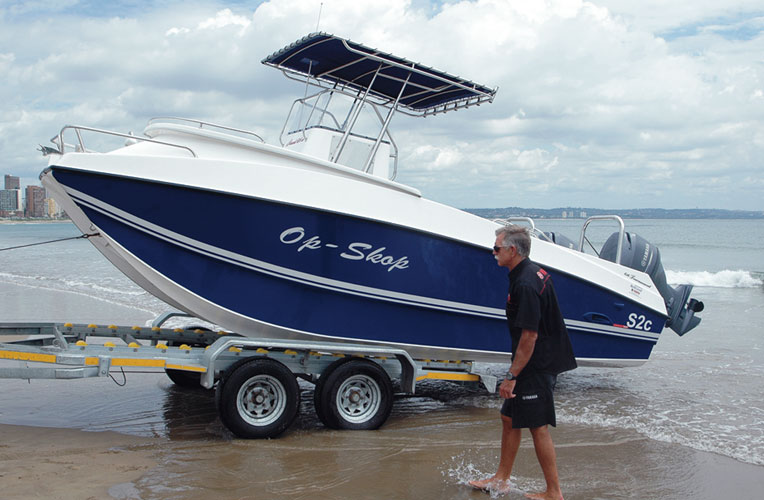
    With the boat weighing a mere 500kg, towing her is as easy as towing a small loaded trailer, and she handles easily in the traffic. When I put her on the beach, the trailer tracked 100% — perfectly in the tyre tracks — behind the car and it was easy for me to get her on to the sand and down to the water. Offloading was no problem with the breakneck trailer, and it was also easy to get her into the water.
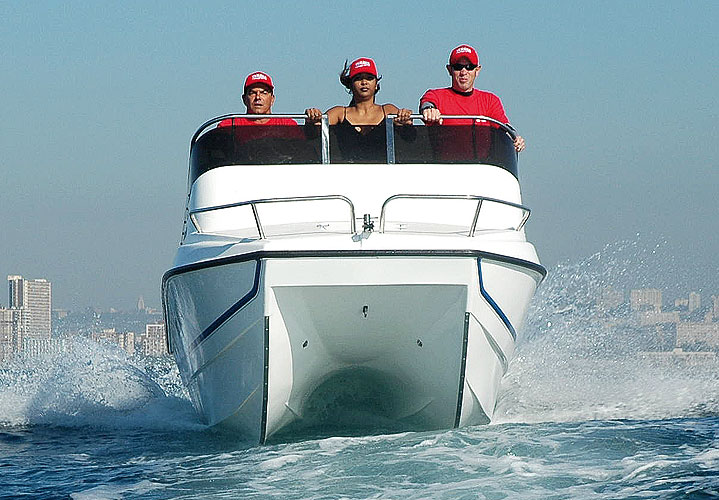
    After the test, running her up the beach onto the sand and then pulling her onto the trailer with the winch was also very simple. With these trailers built so that the boat fits perfectly on them, loading and offloading is even easier.

    Getting her off the beach was also a cinch because the trailer follows exactly in the tracks of the 4×4. If the tracking is only 90% and not 100%, it’s much harder to tow a craft on the sand, even if it is just a smaller boat or a jetski. Every little bit that the tracking is off causes more resistance and makes it harder to tow on the sand.

    CONDITIONS
    There was no wind on the day of the test, but the sea was like a washing machine, making it more difficult for us to do a proper test and also take decent pictures.
    MOTORS AND CONTROLS
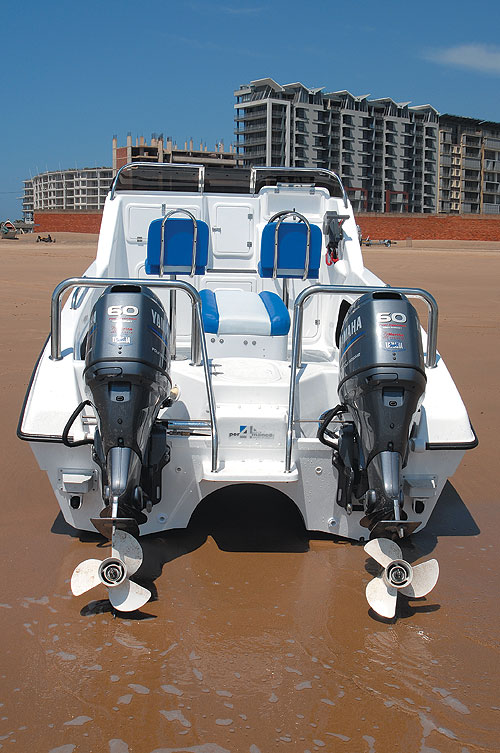
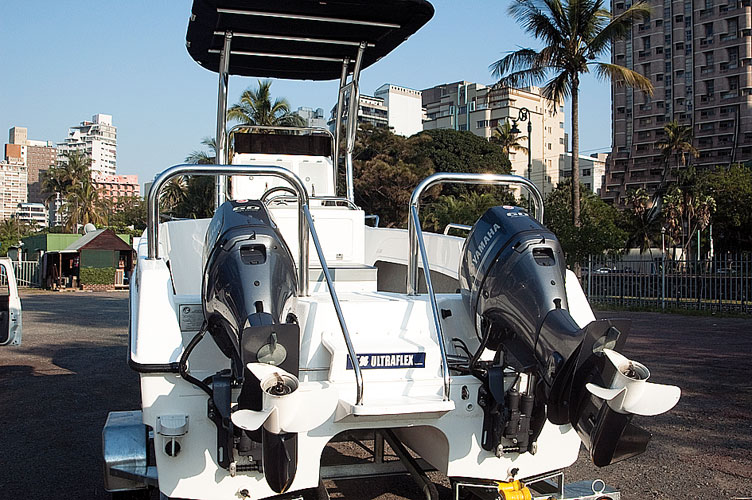
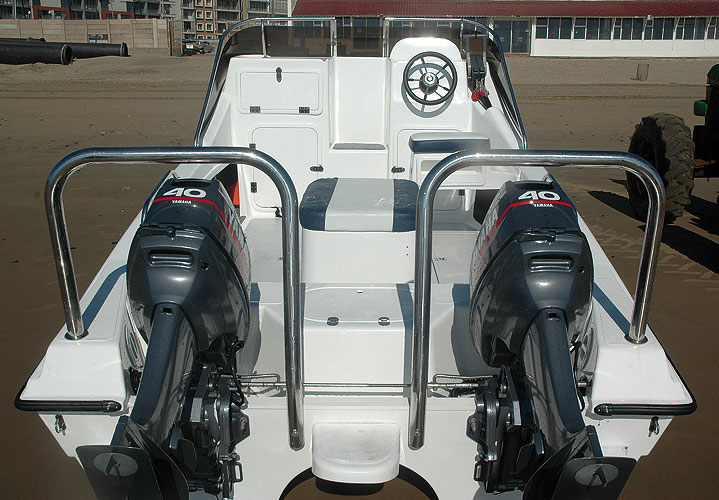
    This forward console Seacat 465 was fitted with two 60hp four-stroke Yamaha engines with sidemount controls and hydraulic steering. The controls were normal cable controls, and once again, if the controls are fitted correctly you’ll feel that putting the boat into and out of gear is very smooth.

    With the two 60hp motors on the back, hydraulic steering is ideal for this craft, and that’s certainly what I would recommend.

    PERFORMANCE
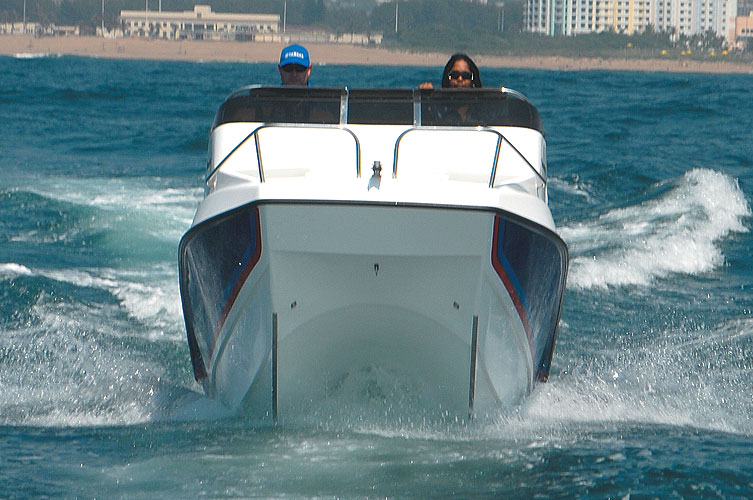
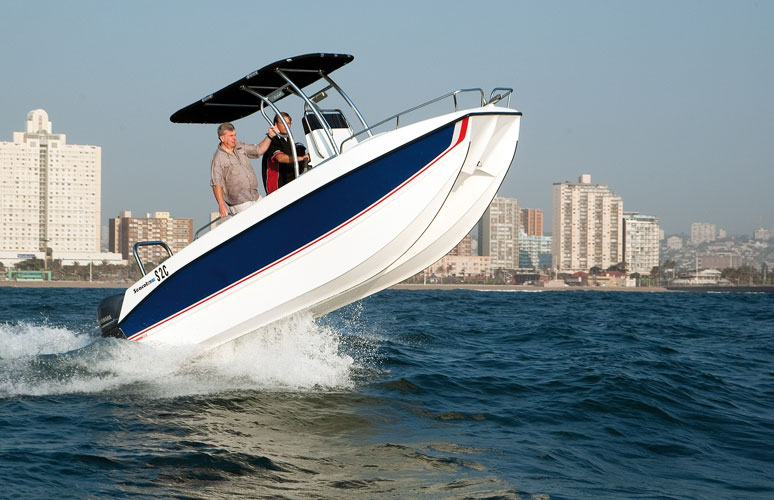
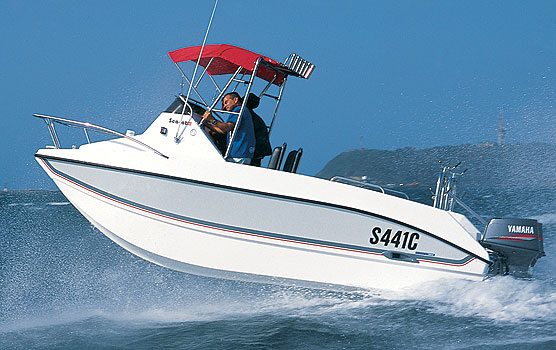
    With the Seacat 465 FC fitted with the two 60hp four-strokes, there was a vast difference between the performance of this craft and the centre console craft which was fitted with twin 40hp two-strokes. The 60hp motors pushed the FC boat from a standing position onto the plane within three seconds, and she jumped out the hole in a flash.

    Even though the engines were bigger than on the CC, I could not get her to cavitate on the turns to starboard and port. Running into the swells she was more than alive, and I had to hold back to ensure I was not airborne all the time.

    With this power package, she would be ideal for surf launching as well as protected launches.

    With a following sea the boat did not show any sign of broaching, even at high speed. In this case, the forward console seemed to be more comfortable and able to take up to four people, whereas I would not recommend more than three people aboard the centre console craft at any one time.

    Even with four people on board, the FC craft had more than enough power to handle the sea safely.
    LAYOUT
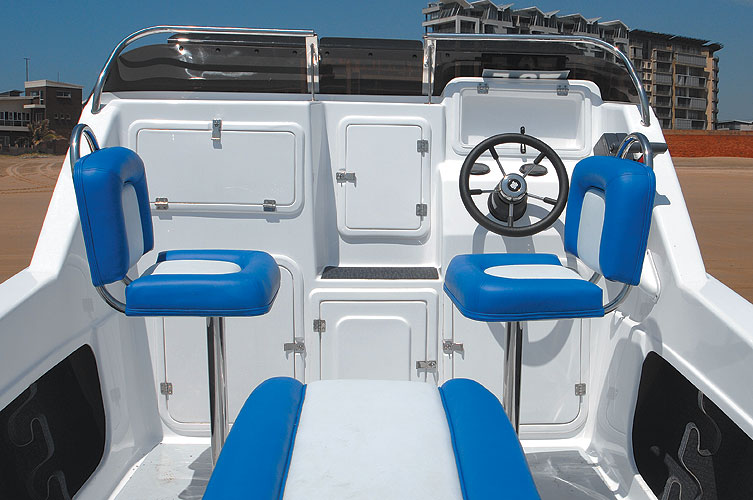
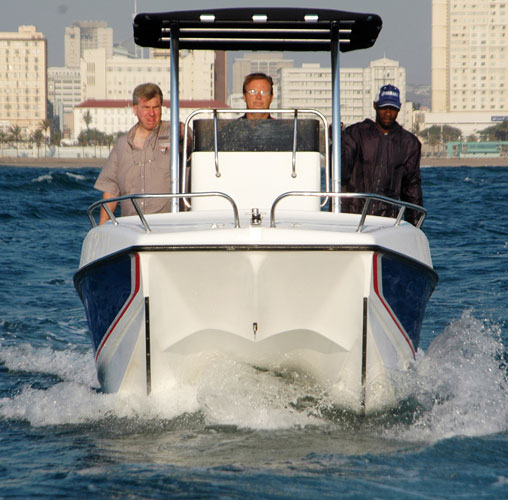
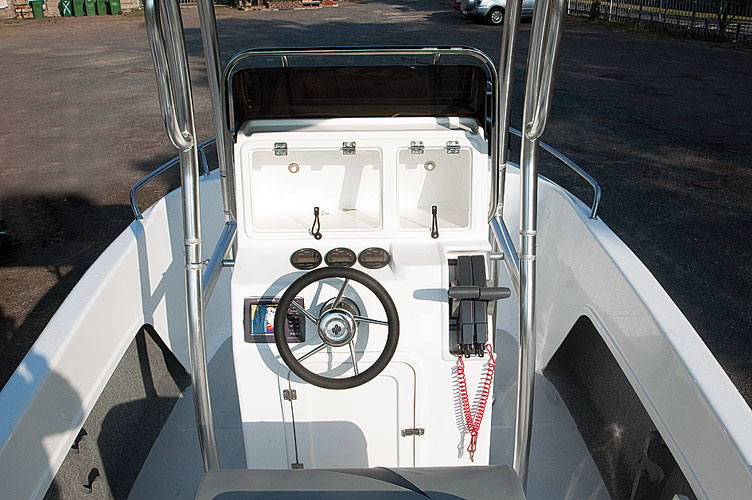
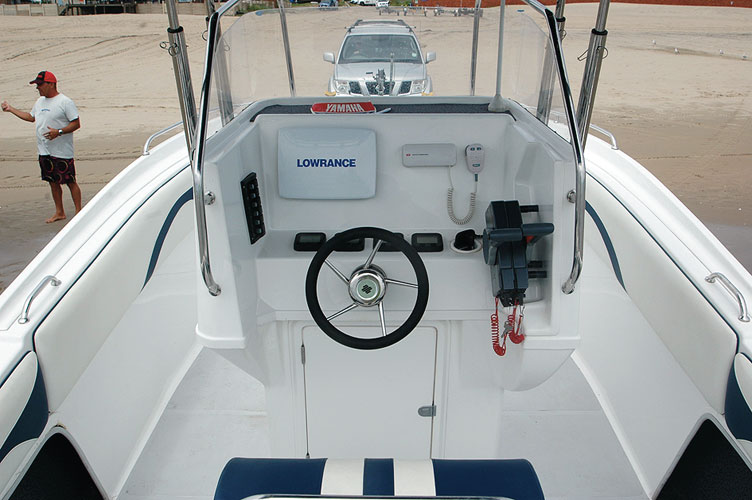
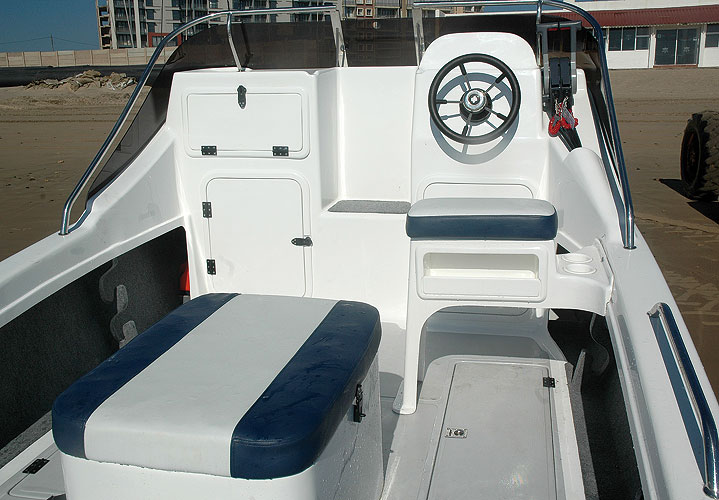
    Let’s start at the bow of the boat … The forward console craft has a window in the front that you can remove, thereby giving you easy access to the anchor hatch in the front. At the anchor hatch she has two steps which are comfortable and easy to sit on when you’re letting down the anchor.

    Wind and water deflectors are also fitted on the front window, making it a bit more comfortable for the skipper and crew on those windy, uncomfortable days on the water.
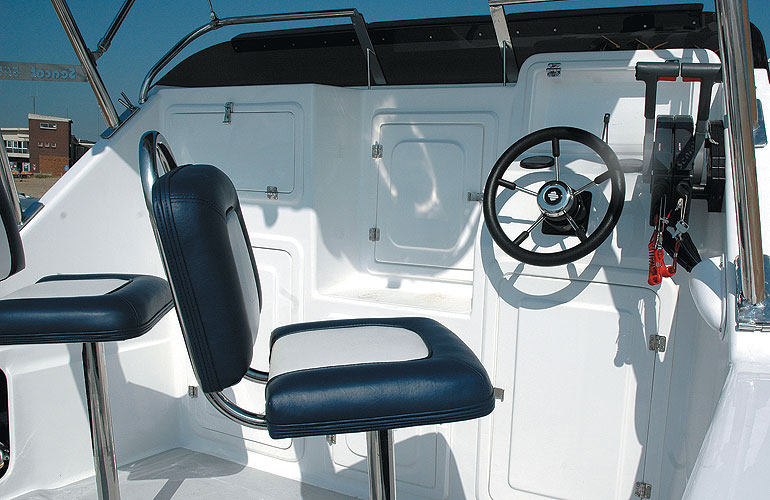
    There’s more than enough storage space in the front for all the tackle and extras that anglers normally carry with them. Above the steering there is a lovely console for the fishfinder and radios.

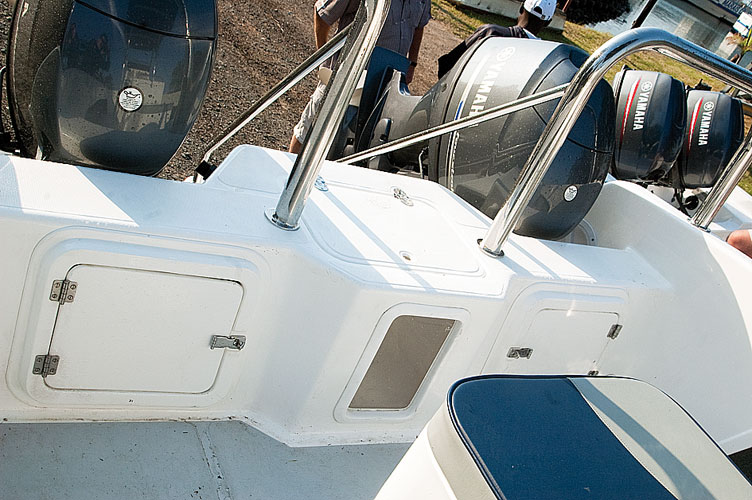
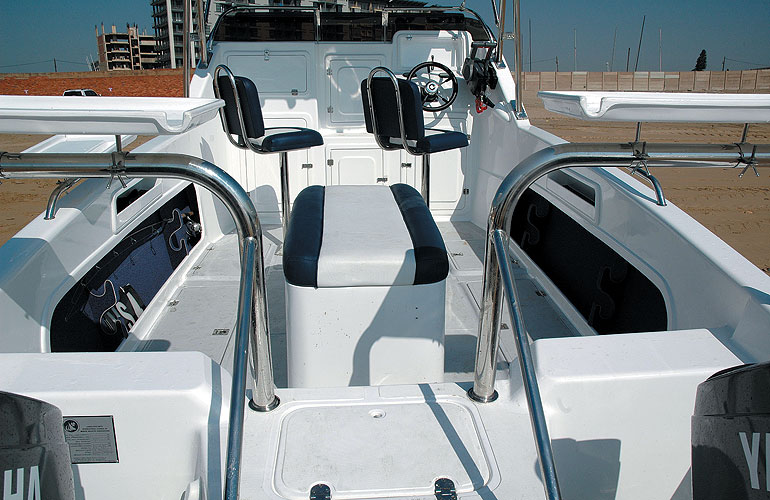
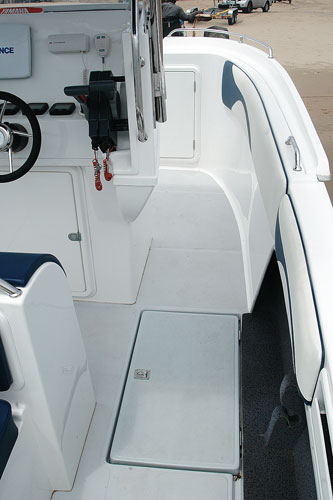
    There’s rod storage space beneath the gunnels on each side of the boat, and there are also two spacious flush below deck fish hatches, one on each side of the boat.

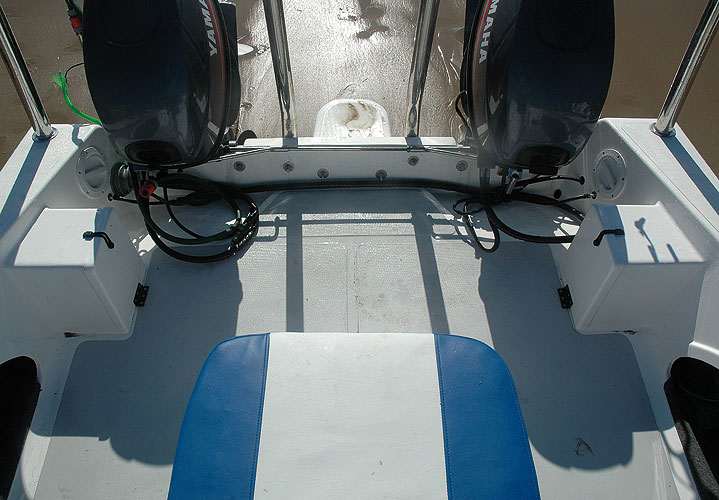
    There’s a very comfortable, removable seat for the skipper and one for the crew, and the fuel hatch in the middle of the deck allows you to carry enough fuel for every trip. In the stern the boat is fitted with a removable splashwell with a livebait well. This is easy to remove if it’s not needed for the trip, and is even easier to re-install when needed. It’s a very nifty idea and a clever installation.

    Then of course there are the normal stainless-steel railings around the boat.

    CONCLUSION
    As I said in the previous issue, I am most impressed with the collaboration between Yamaha and Grant Reed. They are always trying to satisfy the customers’ needs, while constantly coming up with new improvements. The quality of their boats is excellent and I could not fault them.

    Slowly but surely they are starting to establish themselves as a major boat manufacturers in the marketplace. I also happen to know that Grant and Yamaha have a couple of developments in the pipeline that will further augment their popular range of craft.

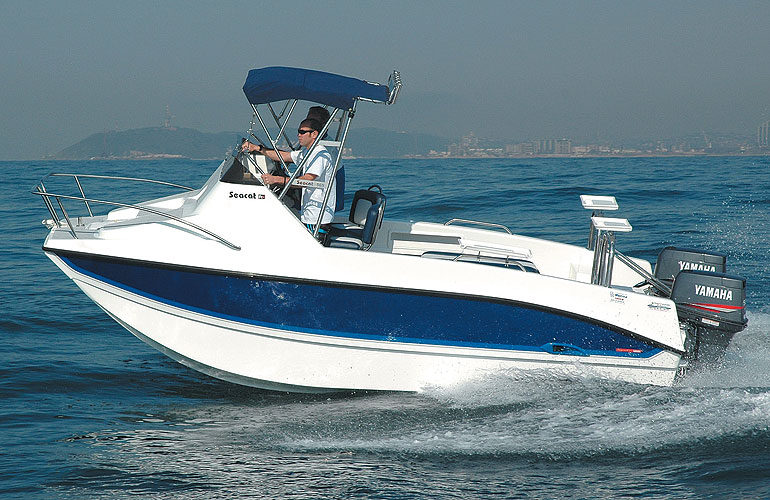
    Although the Seacat 465 FC is a small boat, she is very stable and performs excellently. She’s ideal for somebody who wants a good forward console boat at an affordable price.

  • Seacat 510 CC — by Yamaha

    Seacat 510 CC — by Yamaha

    Tested by Heinrich Kleyn (March/April 2009)

    Contact 0800 926 242 for your nearest Yamaha Marine dealer

    SPECIFICATIONS
    Length – 4.9m
    Beam – 2.13m
    Min hp — 2 x 40hp
    Max hp — 2 x 60hp
    Buoyancy — foam-filled
    Power as tested — 2 x 50hp 2-strokes


    THE Seacat 510 Centre Console is the sister of the Seacat 510 Forward Console and was introduced to the market at more or less at the same time. Like the FC, the CC is something to look at for the entry-level ski-boat fisherman.

    GENERAL IMPRESSIONS
    I saw the CC and the FC at the same time and wondered what the differences would be between the two. I think the decision between buying either the FC or CC would come down to a matter of personal choice, because the hulls are identical. It is just the deck and the motors that differ. The FC was fitted with twin 60hp four-strokes and the CC with twin 50hp Yamaha two-strokes.

    CONDITIONS 
    With the swell all over the place, the test was going to be very challenging. Luckily there was no wind, so we were able to to work on our suntans as we took a slow run northwards, from Durban towards Blue Lagoon and the open sea, enjoying the thrill of testing these new boats for the first time.

    TRAILERING AND LAUNCHING 
    The Seacat 510 CC arrived on a galvanised breakneck single-axle trailer. These boats are so light that you don’t need a double axle. Getting her onto the beach was simple and without any hassle, then I just pulled her down the beach on her trailer to the water’s edge. All the checks were done and I was pushed very softly and smoothly into the surf off the trailer.

    If your timing is correct this can easily be done by two people. You just need one to handle the car and the other the boat. When the boat is dropped off, one person can turn her around while number two parks the car. This kind of boat certainly does simplify things.

    The same applies when you load her back onto the trailer. This is such an easy task that it could easily be done by one person, but two sets of hands make it that much easier.

    MOTORS AND CONTROLS 
    I firstly tested the Seacat FC with two Yamaha 60hp four-strokes. At the time I thought I would feel the difference dropping to 50hp motors on the CC. To my surprise it wasn’t the case at all.

    The Seacat was fitted with two 50hp Yamaha two-stroke motors with side-mount controls. The cable operation from the controls to the engine was very smooth — a clear indication that the setup was done correctly.

    PERFORMANCE 
    In my opinion, the CC with two 50hp Yamaha motors on the back is ideal for a surf launch. In the lumpy sea we were stuck with, the Seacat 510 CC jumped out the hole very quickly. She also hopped on the plane very quickly and accelerated to the top end in a flash, giving more than enough time to get through the surf.

    She has plenty of power in reserve too, so that if a wave should suddenly rise up in front of you, you would be able to turn around in time. The CC’s ride is similar to that of the FC into the swell, and with a following sea I did not experience any broaching, pounding or rolling. On the sharp turns the boat handled well without cavitation and got back on the plane with ease.

    Because of the high gunnels the Seacat 510 CC is very dry and stable for a centre console craft. I experienced a softer ride on the CC than on the FC, because the controls are further back, closer to the engines.

    With the CC being such a light boat, an added bonus would be excellent fuel economy, even with the two-strokes.

    LAYOUT 
    The first thing you see when you look at the Seacat CC is space. The centre console makes the Seacat look much bigger than she really is.

    With the high gunnels, moving all around the boat is safe and easy, and with the new look these boats are sporting — including splash wells at the back and a higher false transom — it is nearly impossible to get water on the deck from the stern. She also has a big livewell built into the false transom.

    Behind the centre console there is a nice storage hatch to pack away tackle and other equipment, and on either side of the centre console there’s a fish hatch flush with the deck. The gunnels incorporate recessed holders for storing your rods while travelling.

    Besides this, there’s a spacious compartment on top of the console where you can mount your fishfinder and radio, so overall this boat boasts ample storage space.

    FISHABILITY 
    I thought that the 510 FC had a lot of space, but the 510 CC’s spacious design makes her even roomier than her sister. Five people would be able to fish comfortably on this boat, and any species from gamefish to bottomfish could be targeted with ease. Her clever design makes it very easy to move around on this boat, and it also gives anglers space to control their fish without falling over each other.

    The 510 CC is very stable, even when you move around a lot, and she doesn’t tilt to one side. This boat would be ideal for people who want to do vertical jigging or flyfishing, particularly because of her nice high gunnels.

    FINISH 
    As with all the previous Seacats, it’s hard to find fault with the 510 Centre Console model. Her finish looks superb and the workmanship is in a class of its own.

    CONCLUSION 
    This is a great boat for the person who wants a small, easy-to-handle craft, and is the ideal boat for the entry-level fisherman. Considering the price and what you get, I certainly think it’s worth it.

    When it come to choosing the size of the motors, a lot will depend on your budget. I think she will run well with either 40hp or 50hp four-stroke motors, and if you prefer two-strokes you might even fit a pair of 60hp motors.

    Yamaha have done well to add yet another classy boat to their already stunning range.

  • Seacat 510 FC — by Yamaha

    Seacat 510 FC — by Yamaha

    Tested by Heinrich Kleyn (January/February 2009)

    Contact 0800 926 242 for your nearest Yamaha Marine dealer

    SPECIFICATIONS
    Length – 4.9m
    Beam – 2.13m
    Min hp — 2 x 40hp
    Max hp — 2 x 60hp
    Buoyancy — foam-filled
    Weight — 450kg
    Power as tested — 2 x 60hp 4-strokes

    JUST when we thought Yamaha had finished expanding their Seacat range, they’ve surprised us with another model. The latest additions to the fleet are the Seacat 510 forward console and centre console models. These new boats target entry-level ski-boat fishermen as well as the more serious angler who might fish more competitively.

    GENERAL IMPRESSIONS
    When I saw the both the console and centre console versions arriving at DBSC, I could immediately see they were baby versions of the bigger 565 Seacat.

    The shape and colours Yamaha are using on their boats these days are certainly very eye-catching. They’ve clearly been designed by fishermen for fishermen, and sport a very classy look indeed.

    CONDITIONS
    For a couple of days before the boat test, Durban had been punished by bad weather and strong winds, and although there was no wind and our test took place on a lovely sunny day, the sea was not nice at all. The swell was coming from every direction, and the conditions really gave the boats a thorough test.


    TRAILERING AND LAUNCHING
    Like most boats produced these days, the Seacats come on galvanised, breakneck trailers. However, trailer preference is up to the customer. Getting these boats onto the beach and into the water was very simple, especially at Durban Ski-Boat Club. I got onto the Seacat 510 FC, and they just pushed me off the trailer and into the protected surf.

    The boat slid off very smoothly, I trimmed the motors halfway down and was able to reverse her and turn her around without any problem. Of course, this can only be done when the sea is flat — as was the case within the protection of the Vetch’s launch area that day — with no shore dumps.

    Reloading the boats after the test was also made very easy with the electric winches fitted on to the 4×4. They didn’t even bother to turn the 4×4 around to pull the boats off the beach — they just reversed it.

    MOTORS AND CONTROLS
    I had drawn the Seacat 510 FC for testing that day, and she was fitted with two 60hp Yamaha four-strokes. My first reaction to this was that she was overpowered, and to some extent she was, but I would rather have too much power than too little. She was also fitted with side-mount controls, and getting the four-strokes into and out of gear was very smooth for cable-operated boxes.

    These models can be operated with twin 40hp, 50hp or 60hp Yamaha four-strokes.

    PERFORMANCE
    Being a 16ft (4.9m) boat fitted with twin 60hp Yamaha four-strokes, the Seacat 510 jumped out the hole in a flash. Despite the very unstable sea, the 510 still performed very well, and she remained very dry and stable. Not once did it feel like she wanted to broach or tilt to one side or the other.

    I pushed the boat into the swell and drove her with the following sea without changing the trim setting on the engines, and there was no pounding, rolling or broaching. Even on sharp turns I didn’t experience any cavitation.

    Personally, I think twin 50hp four-strokes would be more than enough power for this model, and I would have liked to have tested a model fitted with two 50s.

    Taking into account a number of fuel efficiency tests that we’ve done over a period of time, I reckon you would save 40 to 50% on your fuel bill if you swopped your two-strokes for four-strokes. Note that this is an approximate saving, because fuel consumption varies depending on the sea conditions and how you drive your boat.

    LAYOUT
    Looking at the Seacat one notices immediately that they’ve tried to cater for a broad spectrum of the fishermen’s needs. It’s very difficult to make everybody happy, but I reckon they’ve come very close to it.

    Let’s start at the stern with the false transom. With the new modern look that they’ve brought into the smaller boats, they’ve got splashwells right at the back, with the higher false transom in front of it. This makes it nearly impossible to get water over the stern and onto the deck.

    A livewell has been built into the centre of this false transom. Fish hatches have been fitted into the deck and the fuel tanks fit into a raised hatch-cum-seat in the middle of the deck. The gunnels have been raised to about knee-height, and rod racks have been recessed into them.

    The bow area incorporates enough stowage space to store all the excess equipment that might be needed. A pullout window in the middle of the windscreen allows you easy access to the anchor.

    One thing that particularly impressed me was that they have made a flat area on the bow of the 510 Seacat just behind the anchor hatch, where you can sit to pull up the anchor or let it down. This is often a problem on some boats with the poor crew member whose turn it is to retrieve or lower the anchor battling to maintain his balance without sliding all over the place.

    FISHABILITY
    The Seacat 510 FC’s spacious design makes her one of the nicest and most comfortable small boats to fish on, and she can accommodate up to five people very easily. Indeed, she is the ideal smaller boat for targeting gamefish and bottomfish. The attention to detail with the recess in the bow behind the anchor hatch (above, right) just gives her that little bit of an edge.

    The 510 FC is very stable when it comes to slow trolling and when you’re on anchor fishing for bottoms, which means overall she’s a stable and comfortable small boat. The 510 FC has a lot of open space and is also ideal for the angler who wants to try flyfishing offshore. With the high gunnels she’s also great for vertical jigging and dropshot fishing.

    For those who prefer a centre console version, the 510 CC has room to play with in the fishability department.

    FINISH
    Looking at the finish on the Seacat 510, it is clear she follows in the footsteps of the bigger Seacats. She cannot be faulted when it comes to finishing touches — everything fits neatly and tidily into its place — and she clearly fits in with the Yamaha corporate culture of precise efficency.

    CONCLUSION
    The Seacat 510 FC has been built to cater for the ski-boat fisherman that prefers a smaller boat, and the people at Yamaha have done a great job putting such a neat, tidy, comfortable boat on the market. Indeed, they’ve come a long way in their development of both the 510 FC and the 510 CC, and I am sure they will get the desired results.

    Apparently there are also other bigger developments in the pipeline, so watch this space to see what Yamaha have got planned for you.

  • SEACAT 520 CC — by Yamaha

    SEACAT 520 CC — by Yamaha

    Tested by Heinrich Kleyn (November/December 2012)

    SPECIFICATIONS
    Length – 5.2m
    Beam – 2.22m
    Min hp — 2 x 50hp 2- or 4-stroke
    Max hp — 2 x 70hp 2- or 4-stroke
    Buoyancy — High density foam
    Power as tested — 2 x 60hp Yamaha 4-strokes

    IT has been a while since I last tested a new boat for Yamaha, so I was happy to have a look at the new Seacat 520 when they asked me to test her. The range of Seacats is getting so wide you have no shortage of choice. Grant Reed always gives a lot of thought to the boats he puts into the marketplace, so I was keen to see what changes he had made with this craft. 
    My first impression was that, as always, Grant’s quality and finish are faultless.

    CONDITIONS
    On the day of our test we had clear, sunny skies with a northeaster blowing, but not too hard. The sea conditions were not what I like to go fishing in and made for challenging photography. However, as for the boat test itself, they would be ideal.

    LAUNCHING AND TRAILERING
    This centre-console boat was still on the trailer when I arrived at Natal Rod and Reel Club. Charles Leydekkers from Durban Yamaha asked if I could help push her into the water. Once again the trailer was custom-made for the boat which makes it easy to offload and load in the bay. I simply pushed her slightly back, touched the brakes and she slid off the trailer. 
    By the time we returned the tide was very low, so we had two options — either try to drive her straight onto the trailer, or else pull her up with the hand winch. We decided to drive her up and she went all the way to the front of the trailer without any hassles. 
    The Seacats come standard with a single-axle galvanised breakneck trailer which makes for easy trailering, especially when you have to load or offload on the sand.

    MOTORS AND CONTROLS
    This demo model was fitted with twin 60hp Yamaha four-stroke motors with hydraulic steering and sidemount cable controls. The steering was very light and the hydraulic system is a winner, especially when you start using bigger engines. Getting her into and out of gear was very smooth.

    PERFORMANCE
    With these two 60hp Yamaha motors on the back of a 17ft 6in boat, there’s a lot of power behind you. Even though they’re four-strokes, the boat was nippy enough at pull away from a standing position and would be ideal for surf launching. 
    I was most impressed the way the new Seacat 520 easily handled the rough conditions and that I could run into the swells at 10 to 15 knots without the boat pounding. 
    The bow is very proud and high out of the water which prevents the water and spray coming over the front — great for anglers who don’t like to get wet. Her turning circle is very tight and she makes a perfect figure-of-eight which is a clear indication that the engines are mounted correctly. 
    With three of us on board she was still very alive when standing still and I pushed her to full throttle — she literally took off! Running with the swell and even over a swell she gave no indication at all that she would broach. Running along the shore with the swell coming from the side I also had no cause to feel unsafe or uneasy — she handled the conditions with flying colours. 
    Apparently Grant has also worked on the boat’s beam. I have found on some other boats that if they are a little broader they tend to be more stable and have a softer ride, but there’s a very fine line between wide and too wide.
    Overall, the the performance of the Seacat 520 CC was, in my opinion, flawless. She is stable, very comfortable with ample room to move about in, and she provides a very smooth ride.

    LAYOUT
    The first thing you notice on this new Seacat is that there’s plenty of space. 
    Grant has made a number of changes to this Seacat, including raising the height of the gunnels which makes it more comfortable to lean against them when fighting a fish standing up or when jigging. 
    When it comes to the below-deck hatches, they have created channels in the floor, on the top next to the lid, to drain away any water on the deck. This is one of the few boats I have tested that has these measures in place to ensure as little water as possible goes into the hatches. So many times when out at sea and the weather turns bad — with water over the front or side — most of this water runs into your hatches. This adds a lot of weight to the boat. However, if this new system works correctly, most of the water should drain off the deck. It’s a very clever idea indeed. 
    Starting at the front of the craft, you have easy access to the anchor hatch with a bow rail on each side. On each side of the deck you’ll find the fish hatches with self-draining lids, and in the gunnels on each side you’ll find a few rod holders.
    This centre console craft has been fitted with an aluminium T-top which looks very elegant and saves a lot on weight. No electronic equipment had yet been fitted to the boat I tested, so I cannot comment on that aspect. 
    The battery hatches are fitted at the stern in the false transom — one on each side — with the livebait well in the middle.

    CONCLUSION
    I have tested a lot of boats of this size, and this is the second boat in this class that stands out way above the rest as far as I’m concerned. The Seacat 520 CC is suitable for all facets of fishing. 
    Well done to Grant Reed and his team for putting together such a great boat. Overall, I reckon this is one of the better boats currently on the market, but in the end — although we’re happy to give advice — it is a personal choice. Every skipper has his own way of handling a boat, so test a few different craft in your price range, and once you find one that you like, if it’s from a reputable dealer, buy the boat. 
    For further information on the Seacat contact Ryan Hansen or Charles Leydekkers at Durban Yamaha, or any of the other Yamaha dealers who should have her in stock shortly.

  • Seacat 565 CC — by Yamaha

    Seacat 565 CC — by Yamaha

    Tested by Heinrich Kleyn (July/August 2018)

    THE Seacat 565 CC was tested back in 2007 by my good friend Kevin Smith (see November/December 2007 issue of SKI-BOAT magazine), and now, 11 years later, I got to test an updated model which has had a few modifications made to it. I tested the Seacat 565 FC model in 2009 and was eager to give the centre console a try, so when I got the call from Erwin Bursik telling me to call Ryan Hansen from Durban Yamaha to arrange a test I was over the moon.

    There are so many boats on the market these days, so how does a manufacturer convince you to buy their product? One way is to make a couple of changes that will make it much more comfortable on the boat and more to your liking. This is exactly what Grant Read did for Yamaha when he did some changes to the Seacat 565 CC.

    FIRST IMPRESSIONS

    There are quite a few Seacat 565s among the local fishing fraternity so it was not the first time I’d seen the boat. I was, however, very excited to see what changes have been made to make it more appealing to the fisherman, because in my opinion this boat was already one of the best in the marketplace.

    One surprise on the new boat was that Ryan Hansen from Durban Yamaha fitted two-stroke engines on her stern. At 70hp they weren’t very big engines either considering the size of the boat.

    A little skeptical about that aspect, I approached her on the Durban Point beach where she lay on the sand ready for the tractor to push us into the water. I was accompanied by Malcolm Fischer from Durban Yamaha while Erwin Bursik, Ryan Hansen and Shaun Lavery from Yamaha would be on the photo boat.

    I have to add that this was the first time we’ve ever started a boat test before sunrise and that Shaun Lavery was there before 8am!

    WEATHER CONDITIONS

    We were a little concerned that the weather would not playalong and that it would be raining, but the day before I saw that there was a gap in the weather and we might be lucky to have a little sunshine. Still concerned on the morning, we got pushed into the water with a slight north-easterly wind blowing and some clouds around. By the time the sun came out the clouds had drifted away and we had a stunning sunrise with a slight wind blowing.

    The swells were a little bumpy, but if I timed it right it would be good conditions to do the test. I generally prefer the test conditions to be a little like a washing machine anyway, to give me a good indication on how the boat will react to all conditions. In short, the conditions were perfect for testing.

    TRAILERING

    Like all the other Seacats, the 565 CC comes standard on a galvanised breakneck trailer manufactured by Grant Read at his factory. This means that the trailers are a perfect fit for the boats.

    Towing is easy and dropping her off on the beach is simple — if you let your tyres down to the required pressure. Loading her back onto the trailer was a little more challenging because Ryan had left his winch controls outside his front door at home so we had to do it by hand. I have to say it was easier than I thought it would be to hand winch her onto the trailer, but I would still recommend an electric winch to make it easy for yourself. Remember, this is not a small boat so she’s heavy to move by hand.

    MOTORS, CONTROLS AND PERFORMANCE

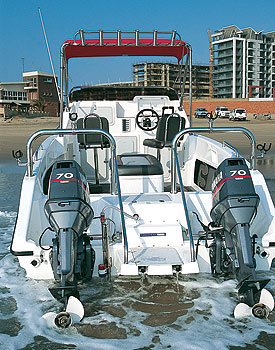
    As I mentioned earlier, Ryan has fitted this Seacat 565 CC with twin 70hpYamaha two-stroke trim and tilt engines with 704 binnacle controls. At first I thought that the 70hp two-strokes would be a little pap for this size of boat, but I was in for a surprise with their performance.

    The tractor pushed us into the water, and as soon as I turned the keys the motors were running. These days 90% of the deep sea fishermen have got four-stroke engines and we tend to forget that there is not much difference between a four-stroke and a two-stroke engine. Yes, the four-stroke is a little bit lighter on fuel and it does not use two stroke oil, but then the two-stroke engine has a bit more power when you pull away on the throttle.

    I was incredibly impressed with the 70hp Yamaha two-strokes that were used for the test. The fuel consumption was also very good, especially on a boat of this size. Ryan travelled at an average of 30.5km/h for 1 hour 35 minutes and they manage to get 48.5km on two tanks of fuel. This is much faster than normal trolling speed so fuel usage will be lower if you take it at normal 12-19km/h for trolling.

    Considering the cost of living nowadays it’s worth being able to reduce costs by fitting Yamaha two-stroke motors when you buy a boat. These motors certainly produced all the power we needed.

    Like many other people, I often play down the power produced by two-strokes in comparison to four-strokes, and our first instinct is to fit a four-stroke outboard. But boy, just take this Seacat fitted with 70hp two-stokes for a test and your eyes will water.

    At one point we were just drifting and I told Malcolm that he must just hold on while I tried a couple of manoeuvres. When I pushed the smooth throttles right open I got a serious fright at the power of the pull off. I believe she was about two- to three seconds faster than a four-stroke getting out the hole onto the plane. I had to tap back on the controls before I could do my figure-of-eight turns in the water because she was just too fast out the hole.

    The turning circle between the swells is very small and perfect for surf launching. I expected some cavitation with such a small turning circle, but there was none in either direction, nor when I straightened her up after a 360 degree turn and pushed the controls open. All I felt was pure power.

    The hull produced a smooth and soft ride through the water and I could not get her to broach. Riding with the swell I trimmed the engines up a little bit and she handled it with ease. Against the swell I found she produced one of the softest rides of any boat I have been.

    The Seacat 565 CC, with her brilliant steering ability, will handle any conditions that you throw at her.

    Many years ago I was on a Seacat with a doctor in Moçambique. This doctor’s mantra was that you get on the boat, push the controls wide open, and only tap back when you reach your fishing destination. That was the first time I was scared on a boat. He said he was trying his best to break the boat. Well, today, I can say with all honesty, “Good luck, Doctor! After what I saw on this test you’re going to have to work a lot harder; the boat is going to break you before you break it.”

    LAYOUT

    As I mentioned earlier, Grant has made a few changes to the design of the new 565 CC.For a startthe centre console is a little wider which creates a lot of space. Extra seating has been provided on the battery boxes which are also bigger than before, and more seats have been fitted on the transom. By moving the roll bar further back they have created a more comfortable sitting space.

    The fuel hatches and the fish hatches are still fitted in the deck, but they have changed the hatch lids and made them flush with the deck, and have fitted a gutter system. What this mean is that your hatch lid is flush with the deck but if water gets onto the deck it will not run into your hatches but will rather drain away through the gutter system.

    The back of the boat has been straightened out to provide more protection for the motors against spray. The splash-well has been made smaller which means that less water will accumulate in the splash-well and you will have better buoyancy.

    The bow has been raised, but note that this has only been done on the center console Seacats and not on the forward consoles.

    Taking a look at the whole layout, starting from the back you get the splash-well which is smaller than before, with two nice seats fitted just in front of the roll bar. This Seacat 565 CC has been fitted with a nice livebait well with a glass window between the two back seats.

    The centre console has a beautiful stainless steel T-top with rod holders at the top. The new console area has plenty of space for all the electronics that your heart desires.

    There are two fish hatches, one on each side of the deck, with two fuel hatches — also one on each side — built into the deck with a nice drainage system that will minimise the risk of water flowing into the hatches. There’s a comfortable bum box with hatch and seats behind the centre console. In the front you have two hatches and the anchor hatch.

    The gunnels are higher than before and space has been created to fit rods into the side of the gunnels. There’s plenty of open space on this boat as well as a lot of storage space. The Seatcat 565 CC’s well thought-out layout means it’s one of the few boats where you really could fish with ease 360 degrees around the boat without any obstruction.

    I don’t think there are many more changes that Grant could come up with, but I’d better bite my tongue because every time I say that he manage to shut me up.

    CONCLUSION

    I have to say that this is one of the softest boat rides I have been on.Furthermore, the great surprise I got with the two 70hp Yamaha two-strokes will make me think twice before I just buy four-strokes in future.

    Grant has once again done an awesome job with all the changes and, as usual, his work is also of a very high standard. Yamaha are very blessed to have somebody like this in their corner producing such high quality boats for them.

    This boat is an all-rounder that will suit the serious deep sea angler as well as inland anglers who focus on freshwater fishing. The Seacat 565 CC is easy to tow around and I know that Ryan Hansen uses this boat personally for competitions as well as video footage for TV programmes.

    If you really are interested and you have a limited budget speak to the guys at Durban Yamaha; they might be able to give you a good deal on a Seacat with two-stroke Yamahas on the back.

  • Seacat 565 CC — by Yamaha

    Seacat 565 CC — by Yamaha

    Tested by Kevin Smith (November/December 2007)

    SPECIFICATIONS
    Length – 5.65m
    Beam – 2.3m
    Hull weight – 750kg
    Min hp – 2 x 60hp
    Max hp – 2 x 100hp
    Buoyancy – Foam-filled
    Power as tested — 2 x 75hp 2-strokes
    Price — R243 000 (as tested).

    LAST year we tested the Unique 575 RTB Cat, manufactured by Grantley Read (see SKI-BOAT September/October 2006). The ride was very impressive on this particular boat, and Erwin Bursik and I both commented that a ski-boat version of her would be great.

    Well, less than a year later, the Seacat 565 forward and centre consoles hit the market, compliments of the Yamaha team and Grantley who are striving to keep up with the trends and keep improving their range. These cats have a similar hull design to that of the Unique 575. So, it was off to Durban Ski-Boat Club for the tests to see if the 565s would match the quality of the rest of the Yamaha craft available.

    GENERAL IMPRESSIONS
    It’s amazing how boat designs are evolving, and this is a perfect case in point. My first sight of the Seacat 565 centre console was on the beach at DSBC — it’s one of those boats whose looks immediately catch your attention.

    This is definitely not your normal 18ft 6in craft. The Seacat 565 is very bold looking, being wide and having large shoulders which make her look a lot larger than she actually is, but still well in proportion. Assisting us on the test were Shaun Lavery from Yamaha and Grantley Read, the manufacturer.

    CONDITIONS
    It was another ideal day for a boat test at DSBC, with a light south-wester blowing, increasing gradually to 20 knots, and a moderate swell from the previous day’s north-easter.

    TRAILERING
    Thanks to the general flow of traffic in Durban, the boats had already been offloaded on the beach by the time I arrived. Needless to say, I received a tongue-lashing as we now had a bit of a push ahead to get the boats to the water. Surprisingly, considering the boat’s size, four of us managed to swing them around on the sand and get them through the small shorebreak with ease.

    The Seacat 565 CC comes standard on a well-made galvanised breakneck trailer, and obviously it was a simple enough task to drop the boat off the trailer onto the beach. Trailering at the end of the day was also simple, although I would suggest an electric winch to pull her up onto the trailer.

    MOTORS AND CONTROLS
    As tested the Seacat 565 CC was fitted with twin 75hp two-stroke trim-and-tilt Yamahas that looked fairly small for the boat, but were more than adequate on the power side. Controls were the standard 703 boxes — smooth and easy to operate — and a hydraulic steering system was fitted.

    One point of interest is that these boats apparently perform exceptionally well with the new 60hp four-stroke Yamahas, and Shaun Lavery from Yamaha runs his forward console version with these motors. This is a big bonus on the cost side, and four-strokes also offer better fuel economy.

    PERFORMANCE
    Once out through the shorebreak, getting onto the plane was effortless on the 565 CC. The low-down torque on the 75hp Yamaha is extremely powerful, and it only took a few flicks of the trims to get the 565 riding smoothly at a speed of around 25-30 knots in the flat water. With the extra power from the 75s you could sit at just over half throttle, which is good for a two-stroke, as it would reduce fuel consumption, wear and tear and the noise factor.

    Moving offshore into the now rough conditions, I could still hold the 565 CC at a constant speed of 20-25 knots into the south-westerly chop. The ride was soft, stable and fairly dry, considering the conditions.

    Running side-on to the chop at higher speeds, the ride again was very comfortable in all areas, with a medium spray coming over the gunnels on the windward side. As mentioned in previous tests, set your motors to suit the conditions at the time. Raising the windward sponson can eliminate unnecessary spray.

    Running with the wind and swell, as well as having a cross-swell from the north-east, the 565 again performed very well at multiple speeds, staying comfortable, stable and showing no major signs of wanting to broach or plough in the troughs.

    From stationary and full locking into tight turns to port and starboard, the 565 CC held tight, banking onto the inner sponson on a good turning circle without major cavitation. These are important characteristics for surf launching on our coastline.

    At low speeds the 565 CC was again easy to handle in the rough conditions and maintained a good all round ride.

    LAYOUT
    On the layout side, the 565 CC has been carefully designed, giving you a combination of open, uncluttered space, as well as having all the necessities to suit the avid deep sea angler. The stern section has a well-designed step-up ladder that slides away neatly into the transom section for times when it is not needed. The false transom section has stainless hand-rails integrated into the dual roll-bars, as well as having a decent sized live-well and built-in battery compartments — all neatly fitted out.

    The deck on the 565 CC has a non-slip finish and features dual flush-mount fish hatches of a worthy size. A large, raised petrol hatch provides seating, and the Flotex-lined super-high gunnels have rod racks recessed into them. The console area has plenty of space for stowage of equipment and electrical accessories, and everything is well-positioned to be able to operate comfortably. To complement the console area, there’s a windscreen with stainless trimmings, plus a T-top for sun protection and rod stowage.

    The bow section also has fore hatches that are accessible through cupboard-style doors, as well as dual anchor hatches, and is finished off with a wraparound stainless bow rail. One last thing to mention on the 565 is the drainage scupper situated on the outside gunnels on the stern. It’s not the standard way of doing it, but I must say that it’s practical and added to the modernisation of the boat.

    FISHABILITY
    The 565 CC has been designed for looks and, most importantly, as a nice offshore fishing craft. This boat is very spacious for its size due to the wide beam and high gunnels. Being a centre console, 360 degrees of fishabilty is available without the angler having to climb over anything.

    At high and low troll speeds she is easy to handle when maintaining a track, and still retains good stability and comfort when running into, side-on, and with the swell and chop. At both high and low troll speeds the motors sat at relatively low revs for two-strokes. On the drift the wider beam also contributed to the stability and comfort in the rough sea.

    One feature that I particularly like is the extra high gunnel. This really helps when you’re fighting fish and gives extra protection from getting swamped out at sea. This might well make it more difficult to land fish, but personally I will take this option.

    The 565 is well suited to all-round offshore fishing, from trolling and jigging to flyfishing, and with the good handling and layout, many enjoyable hours could be spent quite comfortably out at sea.

    FINISH
    Once again Yamaha and Grantley Read have produced a well finished off boat in all areas. A lot of time and thought must have gone into this boat, resulting in a craft that has a slick look, goes as well as it looks, and handles well in all areas.

    CONCLUSION
    At 5.65m, the 565 fits into the easy-to-tow category, is fairly easy to handle on and off the trailer, and is a versatile boat for fishing anywhere. She’s far from an entry-level craft, being more suited to the avid offshore angler, but pretty much carries an entry-level price tag. Definitely worth a look if you’re in the market for a new boat.

  • Seacat 565 FC — by Yamaha

    Seacat 565 FC — by Yamaha

    Tested by Kevin Smith (January/February 2008)

    Contact 0800 926 242 for your nearest Yamaha Marine dealer.

    SPECIFICATIONS
    Length – 5.65m
    Beam – 2.3m
    Min hp — 2 x 60hp
    Max hp — 2 x 100hp
    Buoyancy — foam-filled
    Power as tested — 2 x 70hp 2-strokes


    IN the November/ December issue of SKI-BOAT we ran the test on the Seacat 565 centre console, compliments of the Yamaha team and Grantley Read who, as always, are striving to keep up with the boating trends and keep improving their range on a regular basis.

    For this issue we tested the forward console version of the 565 which we rode on the same day as we tested the 565 CC off Durban. While the CC version was powered by twin 75 Yamaha two-strokes, the FC came fitted with 70hp motors, also two-stroke.

    GENERAL IMPRESSIONS
    The first time I saw the 565 FC was on the beach at DSBC alongside the centre console version. It was also just one of those boats that really struck the pose and whose looks grabbed my attention. This is definitely not your normal 18ft 6in craft.

    The Seacat 565 FC is very bold looking, having a decent beam and large shoulders which make her look far larger than she actually is, while still keeping it in proportion. Indeed, she’s boat that looked worthy of spending a day at sea on.

    Assisting us on the test were Shaun Lavery from Yamaha and Grantley Read, the manufacturer of these craft.

    CONDITIONS
    It was still winter, which meant we had another ideal day for a boat test off Durban, with a light south-wester blowing to start with, and a moderate swell coming from the east.

    TRAILERING
    I arrived late due to the traffic in Durban, and the boats had already been offloaded on the beach. Needless to say, I received a tongue lashing as we now had a bit of a push to get the boats into the water. Surprisingly, considering the boat’s size, four of us easily managed to swing both of the models around on the sand and get them through the small shorebreak.

    The Seacat 565 FC comes standard on a well-made, galvanised breakneck trailer, and obviously it was a simple enough task to drop the boat off the trailer onto the beach. Trailering at the end of the day was also simple, although I would suggest an electric winch to pull her up onto the trailer.

    MOTORS AND CONTROLS
    As tested, the Seacat 565 FC was fitted with twin 70hp two-stroke trim-and-tilt Yamahas that looked fairly small for the boat, but were more than suitable on the power side.

    Controls were the 704 binnacle mount boxes which were very smooth and easy to operate, and the boat had a hydraulic steering system. A point of interest is that Shaun Lavery runs his forward console 565 with the new Yamaha 60hp four-strokes and apparently it performs exceptionally well. This is a big bonus for fuel economy, and they are quiet, smooth and far less smoky than the two-strokes.

    PERFORMANCE
    Once out through the shorebreak, getting onto the plane was effortless on the 565 FC. The low down torque on the 70hp Yamahas is extremely powerful, and it only took a few flicks of the trims to get the 565 riding smoothly at a speed of around 25-30 knots in the flat water. Power on the 70s was very similar to the 75s, the only noticeable difference being the noise factor, slightly less on these than on their bigger brothers.

    Moving offshore into the now rough conditions, holding the 565 FC at a constant speed of 20-25 knots into the south-westerly chop was fairly simple. She still maintained a good, stable, soft and fairly dry ride considering the rougher conditions. Running side-on to the south-westerly chop at higher speeds, the ride again was very comfortable in all areas, with a medium spray coming over the gunnels on the windward side. The forward console definitely gives extra protection from the wind and spray.

    As mentioned in previous tests, setting your motor trims to suit the prevailing conditions and raising the windward sponson can eliminate unnecessary spray. Running with the wind and swell, and handling a cross-swell from the north-east, the 565 FC again performed very well at multiple speeds. She remained comfortable, stable and showed no major signs of wanting to broach or plough in the troughs, even with the extra weight of the forward console on the bow.

    From stationary and full locking into tight turns to port and starboard, the 565 FC held tight, banking onto the inner sponson on a good turning circle without major cavitation. These are important characteristics to have for surf launching on our coastline. At low speeds the 565 FC was again easy to handle in the rough conditions and maintained a good all round ride, just like the 565 CC.

    LAYOUT
    On the layout side, the 565 FC has been carefully designed to provide open, uncluttered space, while still having all the necessities to suit the avid deep sea angler. The stern section has a well-designed step-up ladder that slides away neatly into the transom section for times when it is not needed. This flows into the false transom section where stainless-steel hand rails are integrated into dual roll bars. She also has a decent sized livebait well and built-in battery compartments — all neatly fitted out.

    The deck on the 565 FC has a non-slip finish and features dual flush-mount fish hatches of a worthy size, a large, raised petrol box which also serves as seating, super high gunnels lined with Flotex with rod racks recessed into them, and dual stainless-steel swivel stools. The forward console area has plenty of space for mounting electrical components and for stowage of equipment. Everything is well-positioned and comfortable to work with.

    To complement the console area there’s a full wraparound windscreen with stainless-steel trimmings and a T-top which provides sun protection and rod stowage.

    The bow section has dual anchor hatches, finished off with a double wraparound stainless-steel bow rail. One last thing to mention on the 565 is the unique drainage scupper situated on the outside gunnels in the stern. It’s not the standard way of doing it, but I must say that it’s practical and just added that much more to the modern feel of the boat.

    FISHABILITY
    The 565 FC certainly has the looks, but most importantly, is also a nice offshore fishing craft. This boat is very spacious for its size, due to the wide beam and high gunnels. As she’s a forward console, you have a very spacious fishing area that is sheltered by the high console and windscreen.

    At high and low troll speeds she is easy to handle when maintaining a track and still provides good stability and comfort, whether running into, side-on or with the swell and chop. At both high and low troll speeds the motors sat at relatively low revs for two-strokes. On the drift the wider beam also contributed to the stability and comfort in the rough sea.

    An aspect that I particularly like is that the gunnels are extra high, which is a really good feature to have when you’re fighting fish. It also gives extra protection from getting swamped out at sea or getting wet. Yes, high gunnels might make it slightly more difficult to land fish, but personally I would prefer this option.

    The 565 FC with its all-round good handling and layout is definitely well-suited to a wide variety of offshore fishing techniques, from trolling and jigging to flyfishing. Being a forward console boat, it provides far more protection from the elements, and the committed angler could comfortably spend long hours at sea. Add a set of outriggers and a few extras, and you would have boat that can handle some offshore big game fishing with ease.

    FINISH
    Once again Yamaha and Grantley have produced a boat that’s well finished in all areas. A lot of time and thought must have gone into the design of the top deck, as well as the rest of the boat, producing a craft that has a slick look and goes as good as she looks, handling well in all areas.

    CONCLUSION
    As time goes on, the designs of boats change radically. This is exactly the case with the new 565 forward console. At 5.65m long, this craft fits into the easy-to-tow category: she’s fairly easy to handle on and off the trailer, and is a versatile boat for fishing anywhere.

    Just like the centre console version, she’s far from an entry level craft, being more suited to the avid offshore angler, but surprisingly with an entry-level price tag. This is a boat that’s definitely worth a look if you’re in the market for a new cat.

  • Seacat 565 Walkthrough — by Yamaha

    Seacat 565 Walkthrough — by Yamaha

    Tested by Heinrich Kleyn (September/October 2009)

    Contact 0800 926 242 for your nearest Yamaha Marine dealer.

    SPECIFICATIONS
    Length – 5.65m
    Beam – 2.3m
    Buoyancy — foam-filled
    Min hp — 2 x 60hp
    Max hp — 2 x 100hp
    Power as tested — 2 x 90hp Yamaha 2-strokes 


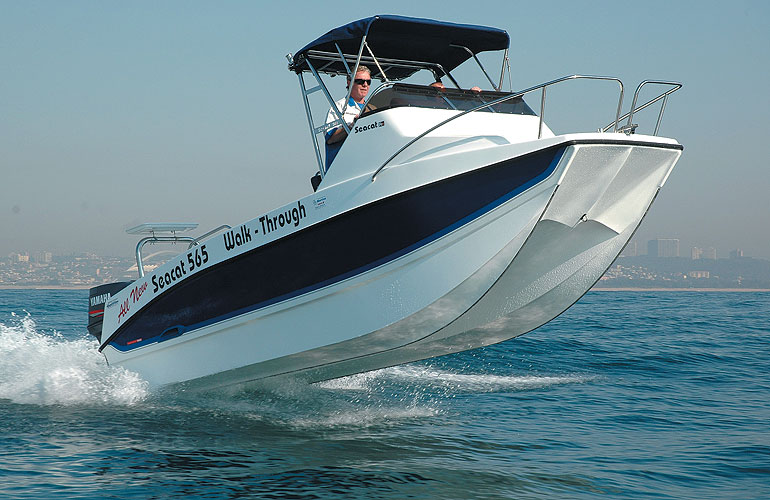
    IT seems that Yamaha is determined to try to please all the people all of the time … About two years ago they launched the Seacat 565 centre console, then the forward console version, and since then they’ve been looking for ways to improve on their product. Recently they asked me to try out their new baby — the Seacat 565 Walkthrough.

    GENERAL IMPRESSIONS
    I’ve seen the whole range of Seacats before, so was interested to see what they could have done differently on this one. When I saw the new Walkthrough at the Durban International Boat Show in July, I was very impressed. It was clear that a lot of time and effort had gone the changes. I liked what I saw and was looking forward to giving her a good workout.

    The boat has a very bold design which makes her look much larger than she really is. I had a whole crew escorting me on the test — Sean, Allison, Anthony and Stewart from Yamaha, as well as Grant Read, the man who is responsible for building all these awesome boats.

    CONDITIONS
    We took her out on a chilly winter’s morning with almost no wind and a sea that was all over the place — not big, but a little bit like a washing machine — with a moderate swell that was all over the place. This test were looking very challenging, not so much with regard to driving the boat, but rather with trying to take decent photos.

    TRAILERING
    As I turned into Point Road, aka Mahatma Ghandi Drive, on my way to Durban Ski-Boat Club, Anthony turned in front of me with the new Seacat. I thought it would be a good idea to follow behind to see what she looks like on the trailer. The size and weight is in line with the law, so Anthony towed her with a 4×4 and I could not see any problems, even during morning traffic.

    Dropping her off on the beach was made to look very easy. We pushed the boat and trailer across the sand, then dumped her into the surf. She easily slid off the trailer with some of us aboard. We didn’t even get our feet wet.

    When we returned we couldn’t beach her as the engines were still brand new and had not been fitted with beach kits, so we had to come in very slowly with the engines trimmed up. We pulled her up the beach out of the surf and used the winch to get her back on the trailer without too much effort.

    If you have been doing this for years it looks very simple, and with the Seacat she just glides on to the trailer.

    MOTORS AND CONTROLS
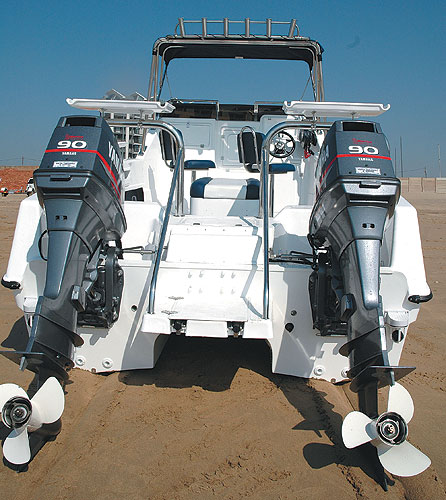
    The new Seacat 565 Walkthrough was fitted with two brand-new 90hp two-stroke Yamahas. The controls were sidemount cable controls. At first I thought they would be stiff, but to my surprise they were smooth and soft when putting the craft both into and out of gear. I have to say that the 90hp motors made a huge difference between the performance of this Seacat and the previous ones we’ve tested. I like that she had a little more power behind her.

    PERFORMANCE
    Once we were out the shorebreak, getting onto the plane was effortless and quick. The low-down torque on the 90hp Yamahas is extremely powerful and I didn’t even have to change the trim settings much to get her to run smoothly.

    Moving offshore the sea was not rough, just all over the place, and we had to ride the controls a bit to avoid the holes popping up everywhere. 
    As mentioned in previous tests, setting your trims sometimes plays a vital role in getting the ride of your boat to suit the prevailing conditions, and raising the windward sponson can eliminate the spray. I did not experience any spray coming over the front, even in this choppy sea.

    From stationary and full locking into tight turns from port to starboard and back again to port, she sat tight. No cavitation or rolling to the sides was felt. Even in a tight circle she sat tight with no cavitation, which is a good characteristic for boats that are required to surf launch.

    I then took her into a slow troll, and even though the sea was not nice, she performed very well both into the swells and with the following sea. Even with a side-on swell her stability wasn’t affected. I didn’t once feel that she had any shortfalls when it comes to stability.

    LAYOUT
    This is where you notice major changes when comparing the 565 FC with the all new 565 FC Walkthrough. The forward console has been changed totally, and a walkthrough has been built in to make it easy for boaters to get to the front and put out the anchor. It’s easy — you just lift out the front part of the front window and step on to the raised tread that has been built in. You can easily reach your anchor hatch.

    To complement the console area you have half-round windscreens on both sides with a removable part in the middle with stainless trimmings. A stainless T-top provides shade or protects against rain. There’s also some rod stowage in this area.

    The cabin doors have been made larger so that you can access them with ease. In the middle where the walkthrough has been created, there’s a small cabin with built-in drawers for all your loose tackle. In the side of the gunnels, space has also been made for stowage of small, loose tackle items that tend to roll around. Underneath that there space to store rods.

    In the stern the false transom has been made wider to cater for the anglers who want to fit Luna tubes. They have also fitted a nice big livebait well that has a pickup in the tunnel of the boat. The livebait pump is a through-hull version which does away with all the piping at the back of the boat that can look untidy. This also prolongs the life of your livebait pump.

    On both sides the trolling boards have been changed to a bait-board system that looks great and will no doubt work well, reducing mess all around the boat while cutting bait

    FISHABILITY
    The Seacat 565 Walkthrough has the same look as all the other Seacats and could be rated as one of the best offshore craft in the market. The boat is very spacious for her size due to her wide beam and high gunnels, and as she’s a forward console craft you have a spacious fishing deck. This area is sheltered by the high console and windscreen.

    At high or low troll speed she is easy to handle when maintaining a track and still provides good stability and comfort whether running into, side on or with the swell and chop. The wider beam makes her very stable and comfortable when drifting or at troll speed. The higher gunnels are definitely a plus when fighting a fish, and you won’t easily get swamped out at sea.

    The new walkthrough also makes it easier and safer to drop and retrieve the anchor. All these extras and her great handling make her one of the nicest and most versatile vessels of her size on the market. This craft could be used for all facets of fishing.

    FINISH AND CONCLUSION
    The new Seacat 565 Walkthrough’s finish is in the same class as all the other Seacats built by Grant Read for Yamaha. His workmanship is in a class of its own. A lot of time and effort went into this all-new version of the Seacat, and although it’s impossible to please everybody, Yamaha is trying hard and it looks like they are doing pretty well.

    This is certainly the right boat to look at if you are in the market for an entry- to mid-level ski-boat with an entry-level price tag.

  • Seacat 636 — by Yamaha

    Seacat 636 — by Yamaha

    Tested by Heinrich Kleyn (May/June 2011)

    Contact 0800 926 242 for your nearest Yamaha Marine dealer. 

    AT A GLANCE
    Length: 6m
    Beam: 2.4m
    Approx weight: 8 x 25 litre Jerry cans
    Fuel capacity: 8 x 25 litre Jerry cans
    Rated max hp: 2 x 200hp four-strokes
    Rated min hp: 2 x 80hp four-strokes
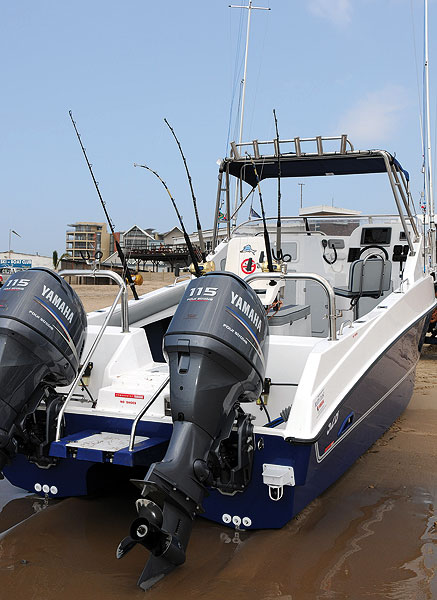
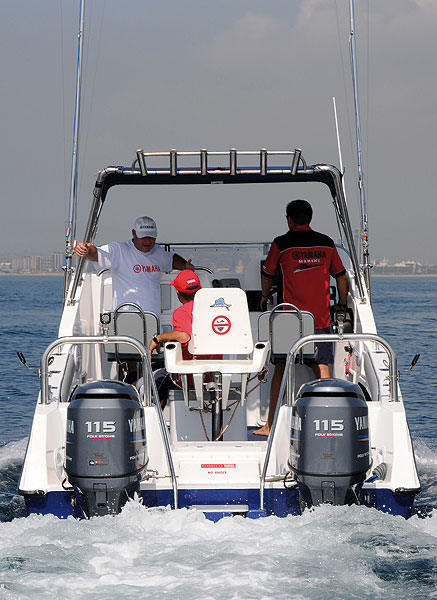
    Power as tested: 2 x 115hp Yamaha four-strokes


    I HAD been waiting since last year for news of the latest addition to Yamaha’s Seacat range, and finally I was told that she was ready to go into full production. I recently met up with Grant Read and Shaun Lavery from Yamaha, as well as Ryan Hansen from Durban Yamaha, to test this baby. I don’t know who was more excited, Ryan Hansen or me, because as a dealer he was eager to put this boat on the market. Indeed, after early trials her reputation had preceded her. 
    His excuse for being aboard for the test was that we needed his demo safety equipment, but if truth be told, I reckon he just wanted to get a sneak preview of this new boat.

    FIRST IMPRESSIONS
    When Shaun opened his garage at the Durban Ski-Boat Club I was still under the impression that this was just another Seacat. I couldn’t get a proper look at her in the garage because she took up almost all the space, but when she was pulled out into the sun it was a totally different story. 
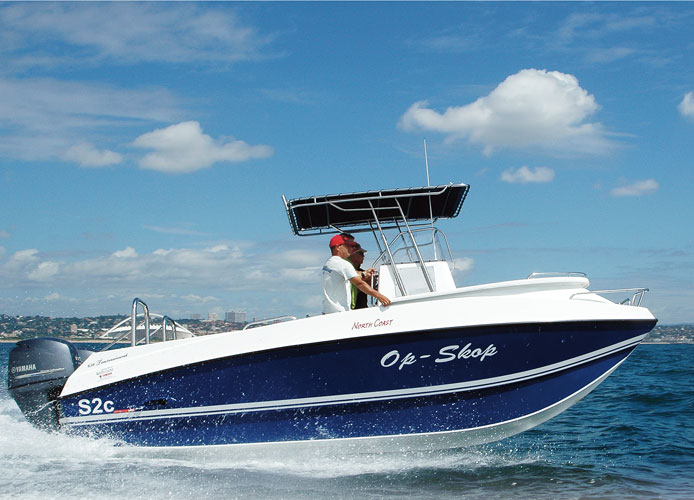
    I left the crew to put up the outriggers and prepare everything for the test, but when I saw her coming down to the beach, wow — what a boat! She’s navy-blue with a white deck, stainless-steel T-top and aluminium outriggers, and my mouth was literally watering to get at her. I could but dream — imagine owning one! — and I’m sure many others will feel the same way when they see her. 
    As for the Durban Yamaha man, well, Ryan was tap-dancing around the boat as if he owned her. This is a Seacat, but if you were seeing her for the first time without knowing her origin, you wouldn’t know she came from the Seacat stable because she’s quite different from the other models.

    CONDITIONS
    The conditions were very difficult for a boat test, but perfect if you were going fishing — the sea was very flat with no wind or swell. In fact, the glare of the sun off a glassy sea makes it hard to see where you’re going. 
    Indeed, you would rather be fishing in conditions like this than trying to get a boat to perform out of the ordinary.

    LAUNCHING AND TRAILERING
    The Seacat 636 was towed onto the beach by a tractor, but Shaun told me that he uses his Nissan Navara to tow this boat, and everything is within the legal limits. Even up at St Lucia the week before, he had no hassles putting her in the water and taking her out with his normal 4×4. 
    Now at Vetch’s beach in front of the Durban Ski-Boat Club, pushing her into the water with the tractor did not require much of an effort.
    Coming back I ran her up the beach — she slid up as easy as she had glided over the water. Pulling her onto the trailer was a cinch with the 9 000 lb winch. With the neck of the breakneck trailer loose and pulling with the winch, she was on the trailer in a flash.

    MOTORS AND CONTROLS
    This new Seacat 636 was fitted with twin 115hp Yamaha four-stroke motors with sidemount cable controls. The controls were very smooth, but you have to get used to them especially when taking the boat out of gear, as it’s easy to pull them past the neutral mark. When putting the craft into gear, you also have to be careful that you don’t open up too fast. 
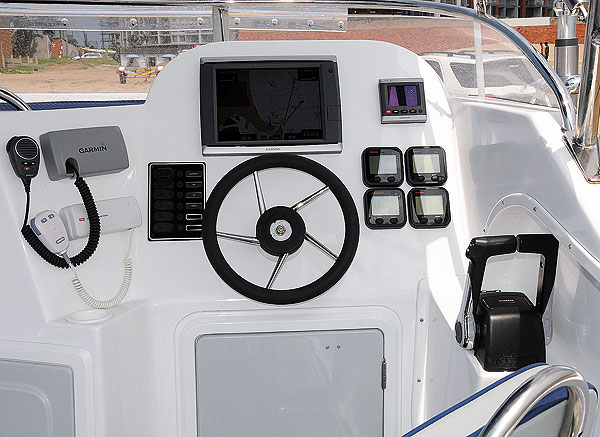
    This craft had been fitted with hydraulic steering as well as with a Garmin autopilot.

    PERFORMANCE
    To begin with you have to listen closely then look to see if the engines really are running — that’s how quiet they are. After a while on the boat at sea, when you stop with the motors at idle, you don’t hear them at all. 
    From standing still to full throttle there was more than enough power to get this boat through any surf. These two 115hp four-stroke Yamaha engines seem to be the right combination for this craft. Although I am a firm believer in overpowering rather than underpowering, I would be very happy with this combination. 
    Out the hole she jumped onto the plane as quick as a flash without a hint of cavitation on any of the turns from starboard to port. Her turning circle is also fairly tight considering the size of the boat. She turns on a ticky.
    Running her in this sea at full throttle without using any trims, she shot up to 60kmph on the GPS speedometer. At this speed most of the big boats I have tested before have tended to pound because of their size and weight. It almost feels like a shudder when the front of the boat enters the water and the water is forced through the tunnel. There was none of this with the new Seacat 636. She just glided over the water, and even at this speed I didn’t experience that braking feeling from water resistance through the tunnel. 
    Another thing I have noticed on some boats this size is the sensation of the sides in the front rolling and digging into the waves from side to side, depending on the sea conditions. The Seacat 636 showed none of these tendencies, no matter what speed I was travelling at. 
    What also impressed me that I didn’t have to adjust any of my motor trims to make her ride level. Normally when testing a boat, I need to lift the bow to get her level for the photos, but this craft ran so proud and the motor installation was so perfect that I didn’t have to carry out any trim adjustments. It was so straight forward and easy — just drive the boat and take the pictures. 
    The Seacat 636 also sits very high in the water, resulting in her very proud aspect when drifting, and even more so when travelling. 
    Into the swell I could barely get her to get airborne in this flat sea. With a following sea, even at high speed, I did not once get the broaching feeling or feel that I was travelling too fast. For me she felt like she was one with the sea. 
    At normal trolling speed we switched on the autopilot and everyone aboard stood back from the controls to see what would happen. Even with all three of us on one side of the boat there was no sign of her leaning to one side, nor was there was any effect on the steering. While we were traveling Grant went down into the cabin to explain the reason for a window in the bow on the nose of the Seacat 636. 
    He opened it, and next minute he popped half of his body through the window, opened the anchor hatch and started working on the anchor.

    LAYOUT
    The general layout of the new Seacat 636 is simple and practical for the ski-boat fisherman. The deck is fairly spacious, but the very serious marlin angler might want even more space. 
    From the stern section the motors, steering system and cables have been fitted neatly and with precision. In between the motors there’s a small step platform with a fold-down ladder for easy entry and exit, both when she is on the trailer and in the water. 
    The transom section flows into a hatch system consisting of a decent-sized livebait well with a clear viewing window for monitoring your baits. 
    The deck features two fair-sized fish hatches that can handle long fish like ’cuda and wahoo, as well as big tuna, without them having to fold them in half. There are also two fuel hatches that take 4 x 25 litre cans per side in front of the fish hatches. These hatch lids have been recessed into the deck with a water channel around them to prevent water that might come onto the deck from going into the hatches. 
    All the deck hatches have flush-mount lids and handles, so you shouldn’t lose any toenails on them. 
    A fighting chair has been mounted in the centre of the deck, but this could be removed when you’re not marlin fishing. Just in front of that is a raised hatch which also serves as a seating area. This hatch can hold another six canisters of fuel, so travelling long distances or spending many hours trolling wouldn’t be a problem with this boat.

    Matching rod- and gaff racks are positioned on the gunnels. The higher gunnels also make it comfortable to lean against when both fishing and travelling. 
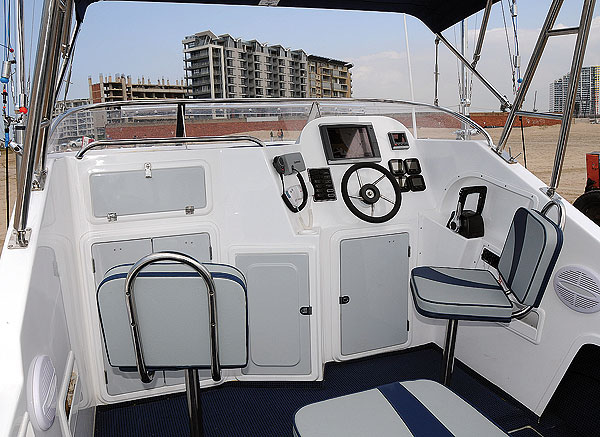
    Moving towards the console, there are two stools for the skipper and a crewman. The console area is neat and spacious with all the necessities — a decent area for fishfinders and GPS units of all sizes, two fishing tackle hatches with drawer systems for organised tackle storage, dry storage compartments and a decent stowage section that opens from the deck side. This can be used for general storage, and it’s through this area that you gain easy access to the anchor hatch.
    The top section of the console has a windscreen that gives good protection from the wind so that it’s not blowing into your face all the time. It also has a small reverse bend on the top to throw down the odd chop splash that comes over, stopping it from slapping you in the eyes. 
    When it’s a bit rough out there you have an assortment of stainless-steel handles and a decent bow-rail to hold onto. The deck is covered with Flotex carpets and the front section has sponge underneath the carpet, especially welcome if you have to stand all day long. Above the console there’s an impressive foldable stainless-steel T-top with extra rod holders. 
    Lastly, she has been fitted with aluminium outriggers that can be easily folded up or down.

    CONCLUSION
    In conclusion, I believe the new Seacat 636 will take the market by storm. She is different from the other Seacats currently on the market: she looks different, rides differently and she’ll surprise many fishermen when they see her for the first time or take her for a ride. 
    For the marlin angler who is looking for a boat that’s towable but is still big enough to take on rough seas, do yourself a favour and take this craft for a ride. I know I was impressed — and I’m sure you will be too.

  • Seacat 636 CC — by Yamaha

    Seacat 636 CC — by Yamaha

    (March/April 2013)

    Seacat 636 CC — by Yamaha 

    SPECIFICATIONS
    Length – 6.36m
    Beam – 2.4m
    Min hp — 2 x 90hp 2-stroke
    Max hp — 2 x 150hp 2/4-stroke
    Buoyancy — foam
    Power as tested — 2 x 115hp 4-stroke Yamahas

    BIGGER is not always better, but in this case it truly is — the first glance I got of the new Seacat 636 confirmed that. My thoughts were short and sweet — if I was into big boats this is the boat I would like to own.

    Grant Reed has made a few changes to the hull (and obviously the top deck) of the forward console Seacat 636 in order to produce this centre console craft, and it all adds up to a very impressive product indeed.

    I met up with Shaun Lavery from Yamaha as well as the “big boss”, Greg Bennett, and the master builder himself, Grant Reed, at Durban Ski-Boat Club to do the test. Thanks must also go to Ryan Hansen from Durban Yamaha who kindly helped us with setting up and provided demo safety equipment for the test.

    FIRST IMPRESSIONS
    This is a great looking, impressive, solid boat which draws attention to herself even when she’s standing on the trailer.

    We decided to launch from the beach to assess her launchability into the surf from the trailer. Answer? Easy! With her breakneck, double-axle galvanised trailer the Yamaha guys pushed her into the shore dump and she slipped off easily. The motors were trimmed down, started, put into reverse and there she was, floating like a duck on a pond. This is easily one of the smoothest offloads I have witnessed.

    The same was true when we returned after the test. The 115hp Yamaha 4-strokes had been fitted with beach kits, so Grant opened the engines just a little bit and we slid smoothly up the sand. Shaun used his Navara to push the trailer under the Seacat and then his winch finished off the job.

    She got back on the trailer just as easily as she’d slid off. Indeed, it was much easier to launch and load this nearly 21ft Seacat than I would have imagined.

    WEATHER CONDITIONS
    With the amount of rain we’d had just before the test, the most important thing we wanted was a bit of sun so that we could take photos, but on my way to the ski-boat club it was pouring again. By the time everything was prepared and we were ready to launch, the rain had stopped, leaving overcast skies with the sun popping out every now and then. The sea was fairly smooth with no wind to talk about.

    Out at sea we met up with Erwin Bursik so that he could help with some photography, and after the photo session Erwin couldn’t resist jumping aboard and taking the Seacat for a ride too.

    PERFORMANCE, MOTORS AND CONTROLS
    The test model was fitted with twin 115hp Yamaha 4-stroke engines with sidemount cable controls. There’s always a lot of discussion about what size engines to put on a boat, but I think Yamaha got it right with this Seacat. The twin 115s gave us more than enough power to get out of the hole fast, even with such a big boat.

    The controls were very smooth both into and out of gear, and I really liked the combination Yamaha had put together on this boat. Everything from the engine size and the controls to the fishfinder was ideal.

    Out of the hole onto the plane I could not fault her and I could not pick up any cavitation on pull-away or in the turns. Her stability is also remarkable. This really is one of the smoothest boats I have tested. Indeed, I could not get her to pound at all. Into the swell the ride was still very comfortable and dry. Even with two of us in the front of the boat Erwin could not get us wet – he twisted and turned in all directions, but we stayed dry.

    Running with the swell and along a swell she did not once give any indication that she would broach. The ride was comfortable and very stable, even at speeds up to 30 knots. As I mentioned, Grant has made quite a few changes to the hull which he reckons will produce a much smoother ride. I guess he was right, because her ride was very smooth indeed throughout the test.

    LAYOUT
    Starting at the back with the false transom, Grant has made a walk-through with the livebait well in the middle. The bait well also has a window so that you can see your bait and check that your pumps are working. Battery hatches are found on both sides in front of the engines, and there’s enough space on top for someone to sit on if extra seats are required.

    The gunnels have been fitted with padding to make it as comfortable as possible to lean against them when you’re fighting a fish. Some drink holders have also been put in the sides.

    Behind the centre console Grant has positioned a comfortable bum box with a seat and a hatch behind that. The console has been made to look very modern: when you’re behind the steering it feels like you are in a wheelhouse with everything in its right place.

    The sturdy stainless-steel T-top is great for when you’re out at sea and can be lowered when you’re towing to reduce the wind resistance. I think this is the only boat I’ve been on where the T-top does not rattle or make a noise, no matter what speed you’re doing.

    Next to the centre console in the deck you’ll find the fish hatches with the fuel hatches just in front of them. They have been spaced to ensure that weight displacement is correct which helps to give the boat a stable ride. The hatches have also been designed so that if water come onto the deck, most will flow off, out the side of the boat.

    The front of the Seacat has been designed to take an add-on lip that goes around the nose of the boat. This will enable you to walk round the boat with places to hold on to, and will ensure that any water that does come over the front will not reach the deck but will instead be deflected back down.

    The Seacat 636 has standard bowrails with two hatches in the front and an anchor hatch as

    well. As with all of Grant’s boats, the finishings are also of a very high standard.

    CONCLUSION
    For me this is by far one of the best and nicest boats in this range and I would recommend her to any fisherman looking for a craft this size. The Seacat 636 is not a small boat, but you could still easily tow her to Moçambique and fish often if you live in KwaZulu-Natal. She could be rigged for marlin fishing, but is ideal for any type of offshore fishing.

    The whole package that Yamaha has put together makes for a very good combination. As an all round offshore boat she will be ideal for any kind of fishing.

    Well done to Grant and his team for another craft that will no doubt make a lot of fishermen very happy.

Verified by MonsterInsights