
TAKING DOWN THE KING
Top tips for catching big ’cuda
(Originally published in the July 2025 issue of SKI-BOAT magazine)
By Gareth Brockett
THE sight of a big croc ’cuda (a.k.a. couta/king mackerel) is exciting for all South African deep sea gamefish anglers, especially those fishing KwaZulu-Natal waters and right up into Moçambique, who regard it as the “ultimate” prize, and often the trophy of a lifetime.
For those who don’t know, ’cuda is short for barracuda, as those who first put to sea off Vetch’s in 1945 mistakenly called the silver speedster which we now nickname speed bream.
Ever since recreational deep sea fishing took off in South Africa, ski-boaters have used 60 lb (27.3kg) as the ultimate benchmark for the king mackerel or ’cuda. As a grander is to marlin anglers, so is a 30kg ’cuda to gamefish anglers.
Over the last 80 years, these magnificent fish have set the benchmark for offshore gamefish angling. It is a tribute to these fish that the annual Durban Ski-boat Club Festival focuses on this species.
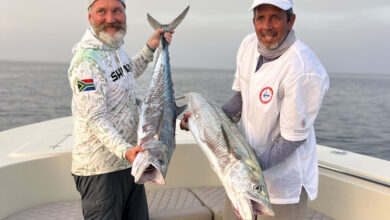
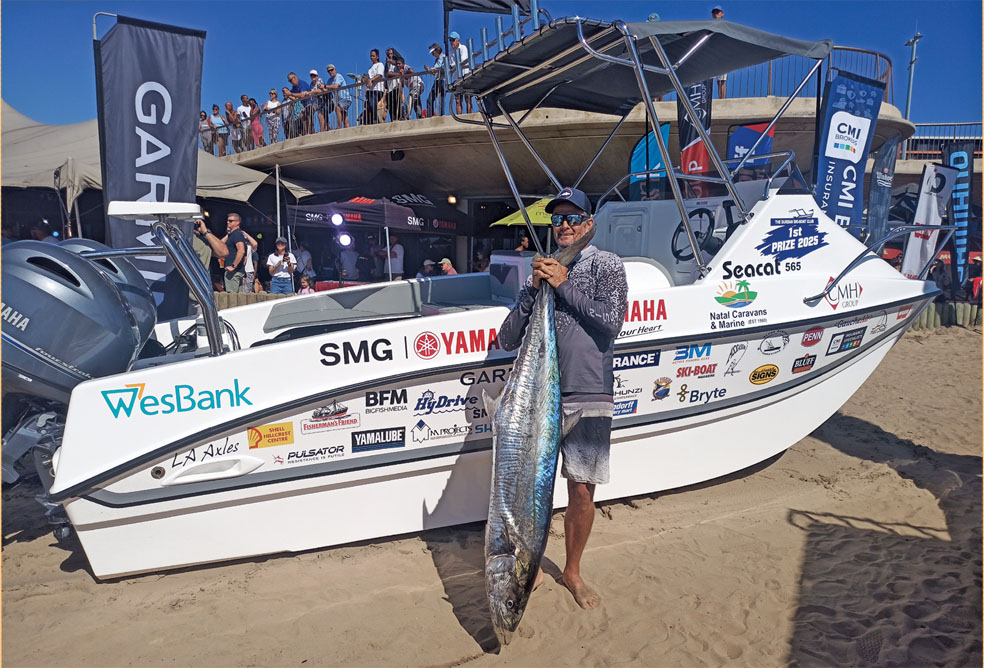
This year 250 boats and 700 anglers participated in the festival with a number of very decent ’cuda coming out. The 2025 event also fulfilled the dream of a lifetime for me when I won the Festival with a 29.86kg ’cuda, a solid “croc”!
If my intel is correct, the nickname “croc” was first given to big ’cuda caught off Mapelane in the early 1970s during May/June when, for some reason, very big ’cuda were caught off the Mapelane lighthouse reef. The size and formidable array of big razor sharp teeth apparently reminded the locals of the big St Lucia crocodiles.
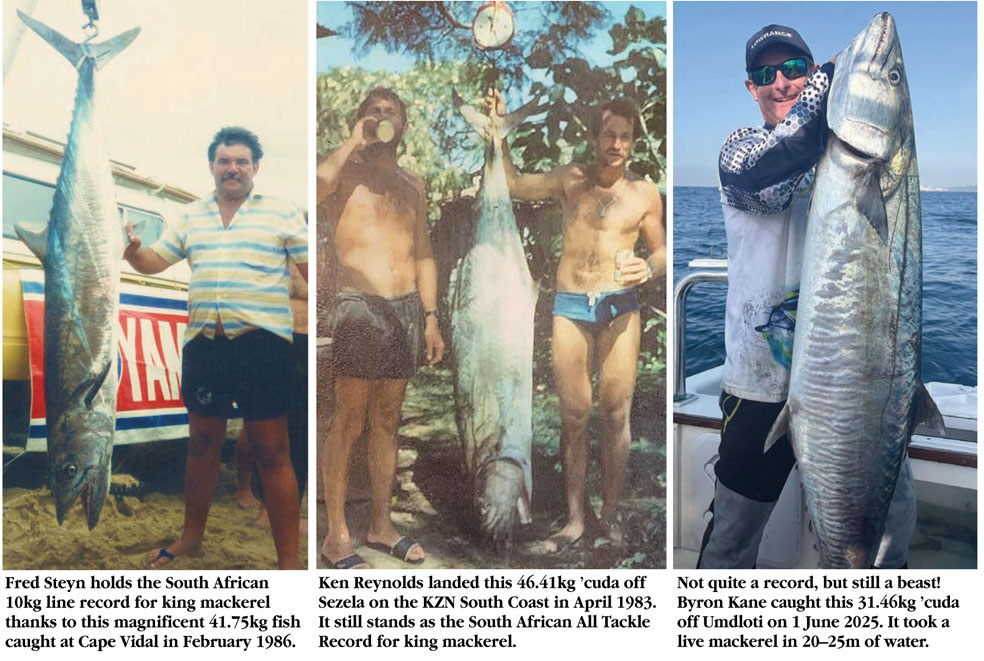
Over the years croc ’cuda have become trophies that most KwaZulu-Natal (KZN) gamefish anglers strive to catch, but it’s a goal not many achieve. Nowadays a ’cuda over 20kg is considered a “croc” due to the scarcity of really big ’cuda.
The South African All Tackle Record for ’cuda stands at 46.41kg (102 lb); it was caught off Sezela on the KZN South Coast in April 1983 by Ken Reynolds, while whipping a spoon.The All Africa All Tackle Record of 44.9kg was caught by I Forbes at Cape Vidal in April 1990. Fred Steyn holds the SA record for king mackerel on 10kg line. His 41.75kg ’cuda was caught at Cape Vidal in February 1986.
These records are specific and not only pertain to line class, but were also caught with tackle complying with the IGFA standards. Many other big record -worth ’cuda don’t feature in these lists as they were caught on standard ’cuda-style traces with treble hooks, which IGFA doesn’t recognise.
 A study of SADSAA records over all line classes, together with information gathered from general “bragging reports”, indicates that the main hunting grounds for really big ’cuda are from Richards Bay to Sodwana Bay, with a few caught off Moçambique. Erwin Bursik tells me that the biggest ’cuda he ever saw himself was a 95- or 100 lb monster that was being kept in a cold room in Inhambane, Moçambique, in 1973.
The area off Red Sands on the Eastern Cape coast also produces some really big ’cuda in the 40kg class every year just prior to the sardine season, and they’re mostly caught by boats running south from Shelly Beach and Port Edward. However, in my opinion, any ’cuda in the 20kg to 30kg class is a trophy and well worth pursuing and gaining as a personal best or trophy specimen.
As the croc I caught on Sunday, the final day of the 2025 DSBC Festival, slid over the gunnel and onto the deck of Pelagic, I was completely overwhelmed. It was huge! With this came the feeling that it might just be the winning fish in the Festival, as the fish topping the leaderboard at the end of day one was just over 21kg.
After pulling the scales to 29.86kg, my fish raised the benchmark significantly, but had me stressing until the scales closed. At last I could take a good few deep breaths when I realised I had won the incredible boat on display in front of the DSBC club house!
GETTING LUCKY
Whatever anglers say, Lady Luck plays a huge part being successful at any angling event. Anglers are lucky to be taking part. Lucky to be in the right area at the right time. Lucky to have the right bait. Lucky to get the bite. Lucky to get the fish to the boat without it self-releasing. Lucky if the fish is not taxed by a shark. I was extra lucky that my fish was the biggest in the event.
Of course, luck isn’t everything, there is also a fair bit of skill and knowledge involved. During most of my fishing outings I target big ’cuda, so I have honed my skills, knowledge and methods of targeting these elusive “croc” ’cuda over many years.
Here are a few general tips I’ve picked up to give myself the best chance of catching them…
• Always take into account the sea conditions, including water colour, current direction and speed, water temperature and swell.
• Do your homework prior to the event on areas where ’cuda shoals are being caught. Then, work areas knowing that there is a likelihood of big fish being present.
Having said that, I believe that really big ’cuda don’t hang out with the shoalies. These big fish hunt in known areas and are largely found in the shallower water over structures or sandy travelling areas between points.
• ’Cuda don’t get big by being stupid – they have seen countless spoons, lures, bait rigs, etc. during their migration each year from Moçambique to our area, and survived. As a result, you’ll need to be clever too.
• The saying “big bait = big fish” does apply, but, equally, small baits catch all fish.
• Finally, plan your strategy and don’t run backwards and forwards over the ocean. Make a decision and be patient.
 DOWN TO THE DETAIL
Let’s look at a few more specifics of how I go hunting for croc ’cuda …
Traces for big fish
My preferred baits for targeting big ’cuda are live or dead bonnies, walla walla and silkies (wolf herring).
My wire strength of choice is #6, and I use 4–6 x-strong trebles.
I like to run a wire down each side of my baits as big ’cuda can bite through wire, leaving the second wire as a back up.
Tackle for big fish
I use a multiplier reel with 300- to 500m of 12–16kg breaking strain line and a 7–8ft rod with a nice soft flex in it to handle the blistering fast runs that these ’cuda are known for.
Home of the big fish
My favourite areas for targeting larger ’cuda are St Lucia, Zinkwazi, Tinley and uMdloti.
Depths of the big fish
My preferred depths for targeting them are 15- to 30m.
Fighting big fish
When these fish bite, it’s best to have your drag pre-set and let the fish do as long a run as it needs. You want to keep just the right amount of pressure on it in the hope that it burns itself out, and that you can get it within gaffing distance as quickly as possible.
Sometimes there might be three or four of these long runs. Teenage fish have a much faster burst of speed than the larger fish which do longer, slightly slower runs.
Often, when the fish is tired and gets to the side of the boat, it’ll just roll over on its side and present you with a good gaff shot. Occasionally, you might need to use the boat to chase the fish to gain some of the line back that they have peeled off on their long, fast run. It is, however, beneficial to keep your engines and sounder noise to a minimum so you don’t attract the ever-opportunistic tax man (sharks).
Boat tips for big fish
• It’s important to know how to read your fish finder and look carefully at the structure it shows to figure out where ’cuda would hunt bait around a structure.
• Trawl as slowly as possible and then occasionally speed up to give your bait some extra action.
• When a ’cuda runs, it’s advisable to wind in all the other lines to prevent them crossing over and burning each other off.
• Have a sharp gaff ready for when you get a fish to the side of the boat.
• When pulling the fish onto the deck, watch out for the razor sharp teeth and hooks that are flying around.
Many anglers have their own ideas for targeting big fish with different baits and trace set ups. This all comes down to the individual and them fishing confidently with their own methods. All I know is that my tactics just won me a brand new boat!