ARABIAN KINGS
Catching ’cuda in the Arabian Gulf
[Originally published in the September 2025 issue of Ski-Boat magazine]
By Martin du Plessis
IT’S incredible how fishing pulls people together and transcends gender, age, language and culture anywhere in the world.
A few months ago, I was invited to fish in a tournament in Abu Dhabi. It was not just any tournament, but one that explicitly targeted big king mackerel (AKA crocs, ’cuda, kings, kingfish, couta, Spanish, sierra or speedbream).
The United Arab Emirates (UAE) fishing circle is small, and social media makes it smaller still. I was invited to fish in the April tournament by a friend of a friend of a friend I fished with in Jeddah a year ago.
Despite having no prior experience of the waters, no intel on the tournament, and never having met the people I would be fishing with, I threw caution to the wind and embarked on an adventure.
I’ve been based in the Middle East for a few years now, and the preferred styles of fishing here are popping, spinning, and jigging. This allows you to target a range of species and certainly gets good results in these waters. Charters particularly like this style because it’s action-packed, energetic, fast, and gets the result for paying customers.
It’s not uncommon to catch ’cuda, a range of trevally, cobia (prodigal son), queenfish, barracuda, hamour (similar to a catface rockcod), and a few other species all in one day, while spinning and jigging.
The king mackerel was the first deep-sea fish I caught – I was only six at the time – and since then I’ve become obsessed with them. Before moving to the Middle East, I only ever targeted them with dead- or live bait. I was a little out of my comfort zone when first I arrived here and saw the guys using grinders and an assortment of casting lures and jigs to catch ’cuda, but I quickly adapted and have had some serious fun on light tackle.
Still, you can’t fight what’s in your DNA. I was dying to put a bait out. Dying to put out a spread, click one motor into gear, and wait. Dying to slow the pace from the frenetic chasing of birds and bait balls and casting for fish.
It’s not easy when you are on a boat with five or six other anglers, and that’s the only style of fishing they know and the only style they want to try.
One day I bought a few sardines from the local fish market and quietly put a sard out on the surface while the others were jigging. I got a few frowns, a few sideways looks, and some polite, but concerned chatter that I was slowing the pace on the boat.
“What’s that? Bait? Seriously?” One guy asked.
I was hoping for a result to silence them, but when you cast and jig, you aren’t stationary for long enough to let your bait settle, cover ground, or give it time to work. I couldn’t persevere – for obvious reasons. I will silence them one of these days!
Until I fished the ’cuda comp in April 2025, I hadn’t used any form of bait for three years! That’s a pretty serious adaptation for a hardcore bait and ’cuda angler like me.
ABU DHABI GRAND KINGFISH CHAMPIONSHIP
Coincidentally, the Abu Dhabi Grand Kingfish Championship took place on the same weekend as the 2025 Durban Ski-Boat Club Festival. They also used a similar format, where the biggest ’cuda would walk off with the top prize.
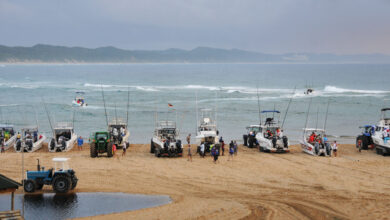
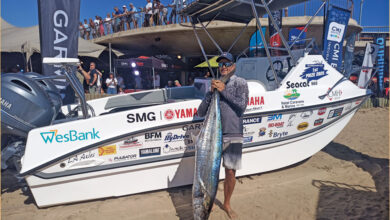
It was a significant event on the UAE calendar, and 375 boats and 1 500 anglers participated in the 2025 tournment.
A big difference to our Durban Festival was that, after the fly past on the first day, fishing was from dawn to dusk, and we slept on the boat for three nights. We fished over three days, and catches were documented via a continuous video showing the team’s relevant day codes, and were weighed on a gantry scale on each boat. The fish were then put on ice, and the final weights were verified at a weigh-in at the end.
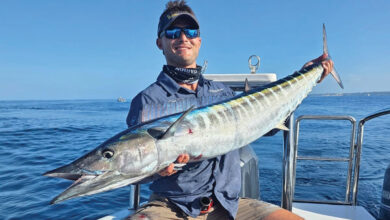
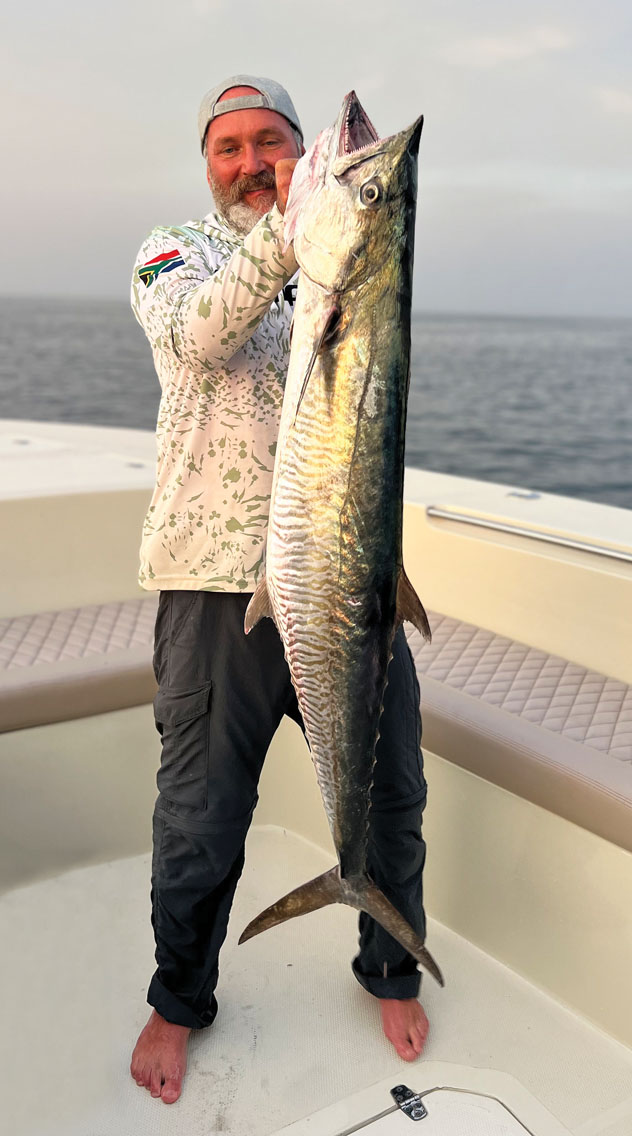
At this year’s event the winning fish weighed 31.34kg. The top ten fish were all over 27kg, the top 20 fish were all over 25kg, and the top 65 fish were all over 20kg. Proper crocs!
BACK TO MY PREFERRED STYLE
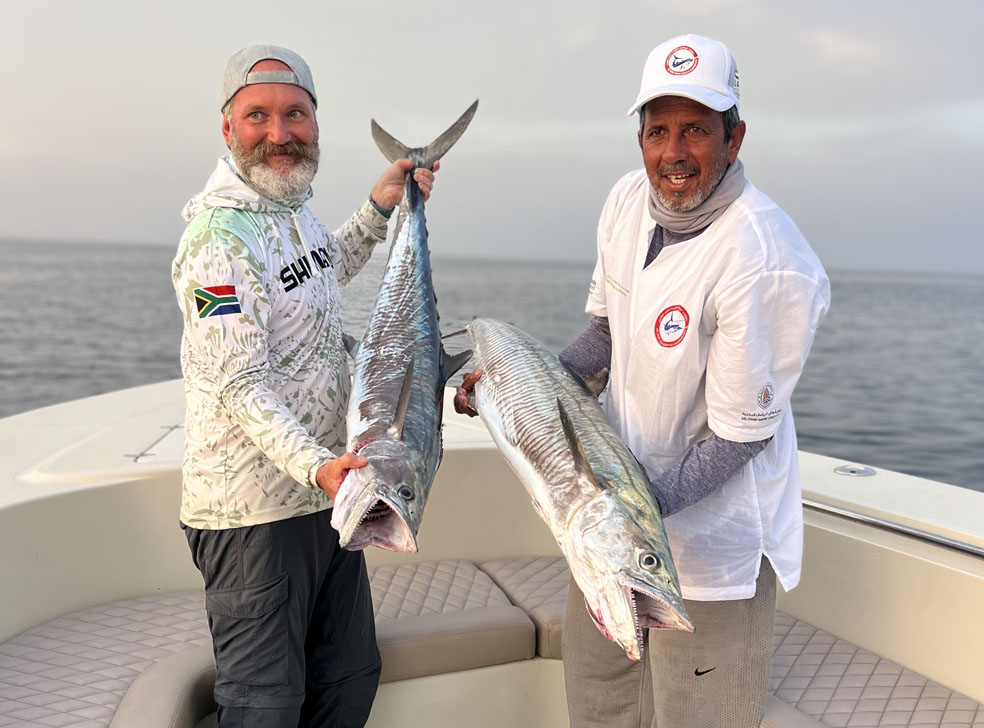
It was absolutely amazing to jump on a boat and fish with the same style, tackle, traces, technique, and hunting attitude that is in my DNA, and to see it being applied in the Arabian Gulf by local anglers who fish exactly the same way as we South Africans do on our east coast – slow trolling with dead- and live bait.
We started each fishing day heading to the oil rigs and a few pinnacles to catch live bait. Small jesh (orange spot trevally) and small barracuda (in Durban we call them sea pike) were the live baits of choice, and we filled our live wells each morning.
The anglers were cautious when extracting the Sabiki or Yo-Zuri hooks, and used tools rather than handling the live bait by hand. Little details like this were a tell-tale sign that these anglers knew “the game”.
As the day progressed, I saw so many similarities between our fishing back home and the way these anglers were fishing, that it stunned me to silence. I could have been fishing at Vidal with my dad or in Durban with John “Goobat” Boswarva!
It was wonderful to be using these methods rather than just jigging for a change.
 TACKLE, TRACES & TECHNIQUE
I knew we would be getting live bait, but I also took along two bonnies, two goggle eyes, and one walla walla, which I’d bought at the local fish market. Once our live wells were full, we headed off to our first spot.
Although there were many similarities with the fishing back home, there was one big difference to what I am accustomed to: we ran 57 miles from the bait spot to our first ’cuda spot! Maybe it had something to do with the low price of fuel in the Middle East, the flat seas, and the three 300hp Mercury motors behind us!
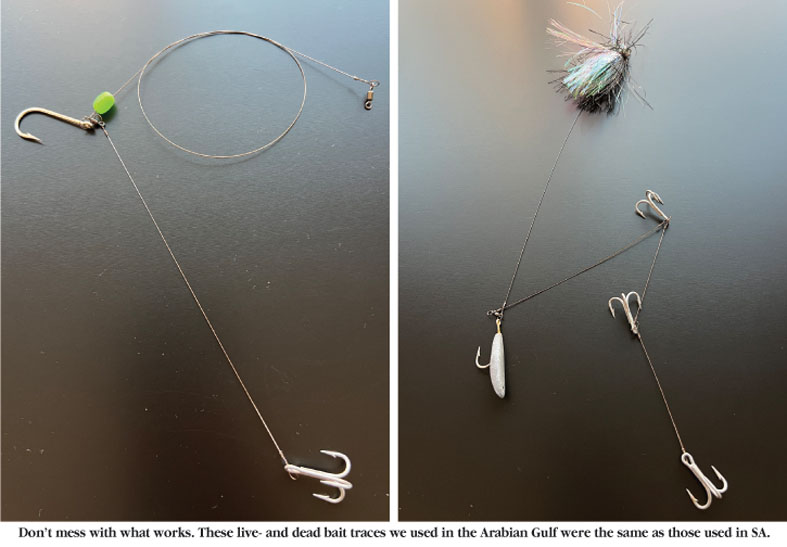
The traces used were no different to what I started with almost 50 years ago when I was introduced to that style of fishing. We spent plenty of time targeting ’cuda at Sodwana and Mapelane on my dad’s Z-Craft Bermuda 14ft fitted with twin 25hp Yamaha motors.
Of course, nowadays we use chemically sharpened hooks (as opposed to using a sharpening stone in those days), a GPS (as opposed to navigating by land marks) and the odd modern bead or skirt, but it’s essentially the same style of fishing I know so well.
Back on the boat, we all made traces to suit to the size of the live bait we’d caught, just as I am accustomed to doing back home where we make a few standard ones beforehand, but then adapt them to the live baits we catch.
Live bait traces were generally “naked”, but some had the odd bead, and some had a skirt to vary the spread. Dead baits were given a little more flash, with a duster or small skirt, and a chin weight of choice.
Next year, my eight-inch Scarborough and whipping stick plus ’cuda spoons will definitely be in the mix!
We generally fished the magic depth of 25–30m, sometimes a little shallower and sometimes a little deeper.
Sinkers ranging from 3oz to 12oz were used to down-rig baits, and were secured with elastic bands. We used a heavy sinker on the short lines on both sides and lighter sinkers on the long on either side, plus a “Hong Kong” in the middle, on the surface. We also put one dead bait in the mix together with the various live baits.
We caught fish on both dead- and live bait.
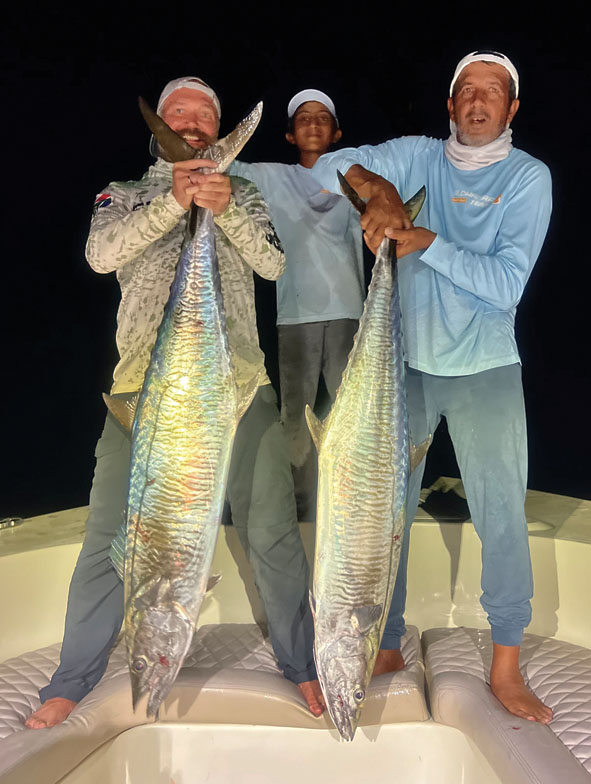
The results were not only some big ’cuda, a range of bycatch and an excellent fishing experience overall, but also great camaraderie, good food, good times, and a wonderful memory banked.
Those who know what this fish means to me will also know what the weekend meant to me: a proper taste of home.
The event has been chiseled into my diary for next year – fishing for ’cuda, SA ’cuda style, with like-minded people in the Arabian Gulf, almost 7 000km north of where I learned to catch ’cuda after a three-year ’cuda drought.
What can I say? I’m in heaven!