Tag: billfish

  • WHERE TO FISH Part 23

    WHERE TO FISH Part 23

    Ponta do Ouro to Millibangalala

    By Marcus Joubert

    (Originally published in the January 2026 issue of SKI-BOAT magazine)

    TUCKED away in southern Moçambique, Ponta do Ouro is a place that effortlessly blends adventure, relaxation and world-class fishing. This small coastal town hums with life and is a favourite for families, travellers and serious anglers alike. Beyond the rods and reels, Ponta offers everything from dolphin swims and vibrant reefs for snorkelling, to dive sites that rank among the best in Africa. Add in crystal-clear waters, golden beaches, and a lively mix of restaurants and beach bars, and it’s easy to see why this is one of Moçambique’s most popular destinations.


    GETTING THERE & PERMITS

    Ponta do Ouro lies just 20 minutes north of the Kosi Bay border and about two hours south-southeast from the Ressano Garcia border crossing. The town sits within the Maputo Special Reserve, a pristine marine-protected area and World Heritage Site – a fitting backdrop for the kind of fishing that keeps you coming back.

    Fishing and launch permits can be arranged through the local Port Captain’s office in Ponta. Fees depend on the vessel’s size and how many days you intend to fish. Remember, because Ponta falls within a marine reserve, bottom fishing and vertical jigging are not permitted – a crucial rule in protecting this incredible ecosystem.


    LAUNCHING

    Launching here is relatively straight forward thanks to Ponta’s large bay, but it’s always worth chatting to one of the local skippers before heading out. They’ll gladly share advice on current sandbanks, surf conditions and how to ensure safe launches. Tractors are available for hire, if necessary, to help get your boat in the water.

    While Ponta is the main launch site, other spots like Malongane and Techobanine can also be used. They’re more remote, though, and best suited to smaller boats.
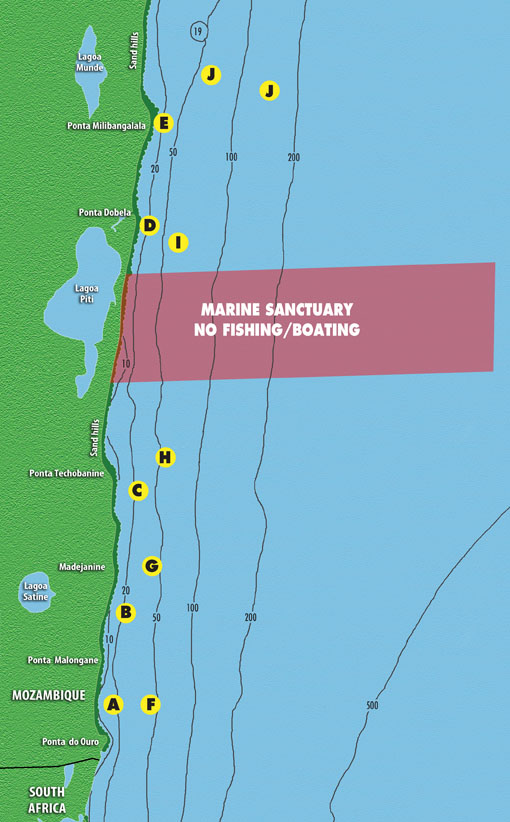
     

    MAP KEY:

    A: Doodles Reef

    B: Texas

    C: Techobanine

    D: Dobela Point

    E: Millibangalala

    F: Atlantis Reef

    G: Pinnacles Reef

    H: Techobanine Deep

    I: Dobela Deep

    J: Millibangalala Deep


    The coordinates for the sanctuary are:-26.66585 to -26.55394 and it extends three nautical miles out to sea. No fishing or boating is permitted within these boundaries.


    THE FISHING GROUNDS

    Fishing around Ponta do Ouro can be challenging at times, but the sheer variety of species makes every trip exciting. After 17 years on these waters, I still find new surprises on the sounder and still have days out there that blow me away.

    The reef systems in this area generally run parallel to the coastline, with shallow reefs in 15–22 metres of water offering reliable action. Expect ’cuda (king mackerel), green jobfish and queen mackerel to dominate these waters. The deeper reefs, between 30- and 50 metres, open up the playground for yellowfin tuna, dorado, wahoo and even marlin when trolling or throwing top-water lures.

    Be mindful of the marine sanctuary between Techobanine and Dobela which is clearly marked on all charts. The coordinates are: -26.66585 to -26.55394 and it extends three nautical miles out to sea. No boating or fishing is allowed within its boundaries, and those heading further north to Dobela or Millibangalala must go around it.


    REEF HIGHLIGHTS

    Just 800 metres off the beach, Doodles Reef [A] – our house reef – sits in about 16 metres of water. It’s alive with baitfish like maasbanker, mackerel and the occasional red-eye sardine.

    In the cooler winter months, it becomes prime territory for king- and queen mackerel, which patrol the area hunting baitfish. I often get one of my crew to throw a stick bait here in the early mornings while we look for baitfish with sabiki jigs.

    Running north along the same depth contour brings you to some of the most productive and picturesque reefs in the region – Texas [B], Techobanine [C], Dobela Point [D], and Millibangalala [E]. These coral systems light up with colour and life and fish beautifully with livebait, bucktails and drop shot.

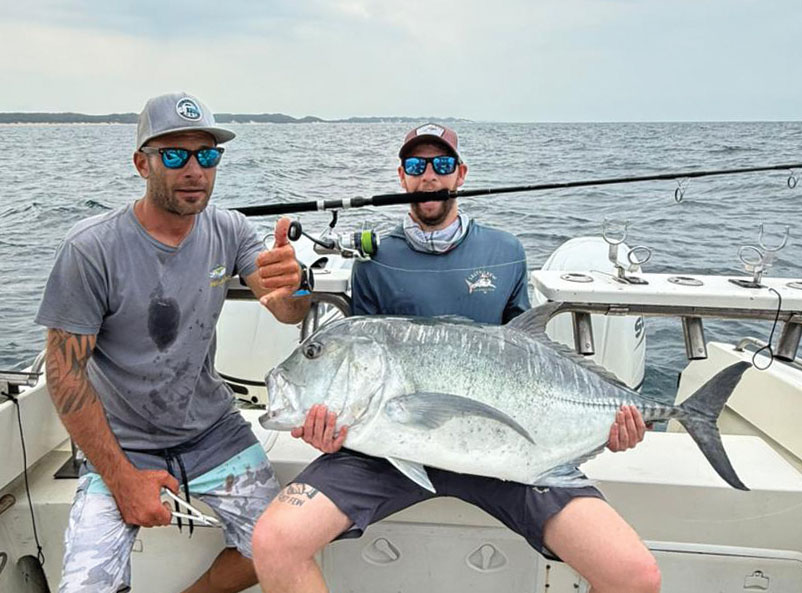
    They’re prime spots for GTs, various kingfish species, jobfish and ’cuda. When conditions line up, working poppers over these reefs can result in explosive surface strikes from giant trevally, or even spectacular aerial strikes from ’cuda – the kind of heart-stopping action every angler dreams about.
     

    DEEPER WATER ADVENTURES

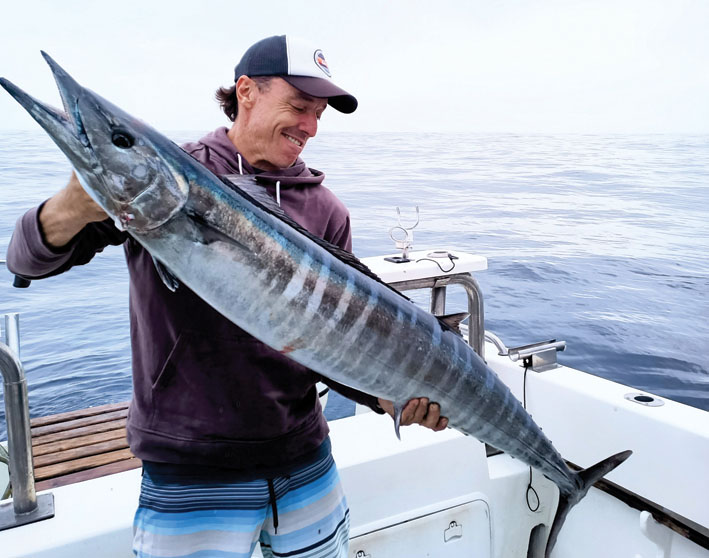
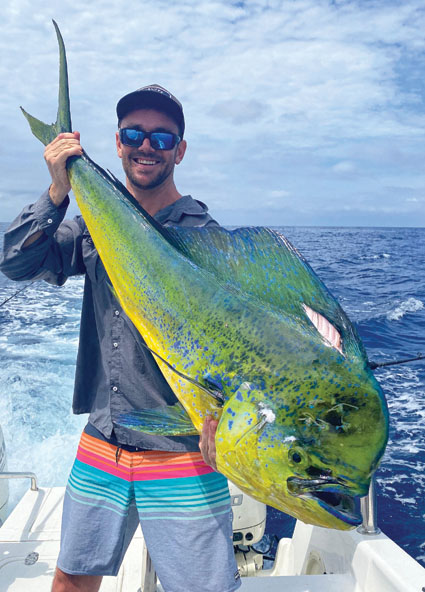
    Push further offshore to the 35–50 metre line, and the fishing gets wild. These deeper reefs are where tuna, wahoo, dorado, sailfish and even black marlin come into play.

    The first of these, Atlantis Reef [F], lies just over a kilometre from the launch site in about 40 metres of water. It’s an incredibly productive system, holding a mix of pelagic species whether you’re trolling, spinning, or working bucktails. Typical catches include tuna, wahoo, sailfish, amberjack, bluefin trevally and bludger kingfish.

    A little further north sits the legendary Pinnacles Reef [G], off Federico Bay – depths here range from 35- to 50 metres. Known worldwide as one of the top ten shark-diving sites, it’s also an angler’s dream, though not without challenges. The “tax man” (sharks) are always ready to claim their share, but the rewards are worth it. For some of the bigger fish, allow them to run while pulling in lines; this gives them a chance to get away from the taxman and gives you a better shot at following and landing your catch.

    Pinnacles is home to the famed Golden Shoal –a breathtaking school of more than one thousand giant trevally that migrate through in the summer months. The reef system sprawls across roughly a one-kilometre radius, each pinnacle holding its own mix of species. It’s the kind of place where you can spend an entire day exploring and never drop a line in the same spot twice.

    Further north towards Techobanine Deep [H] and the sanctuary boundary, you’ll find a string of smaller, lesser-known reefs. They don’t get as much pressure and often produce incredible fish when conditions align. Although a bit of a run if one is launching from Ponta, the deeper reefs off Dobela Deep [I] and Millibangalala Deep [J] hold some amazing fish.

    These reefs are best fished with live bonnies or frigate tuna, and you can expect to catch a wide variety of pelagics including the reef master himself, the amberjack. Downrig a live bonnie over these reefs and it’s almost a guarantee.
     

    TACKLE SUGGESTIONS

    Keeping in mind that the water is crystal clear, it is crucial that you keep things “neat”. By this I mean keeping your ’cuda trace wire down to a number 4 or 5 wire, and not having oversized hooks or large dusters. For best results I sometimes only use a small glowbead on these traces.

    When it comes to bucktails or drop shots, I very seldom use wire on these lures, but that means I do get bitten off at times by ’cuda, so it’s very much “tata ma chance”. Like they say, go light for the bite.

    Also try to downscale some of your terminal tackle, like using a power swivel on your trolling lures instead of large snap swivels. At the same time, it’s important to remember that we have a lot of toothy species in these waters, so sometimes it is important to use wire on some of your trolling lures. You don’t want to hook a 30kg wahoo only to have your monofilament bitten through.


    SEASONAL HIGHLIGHTS

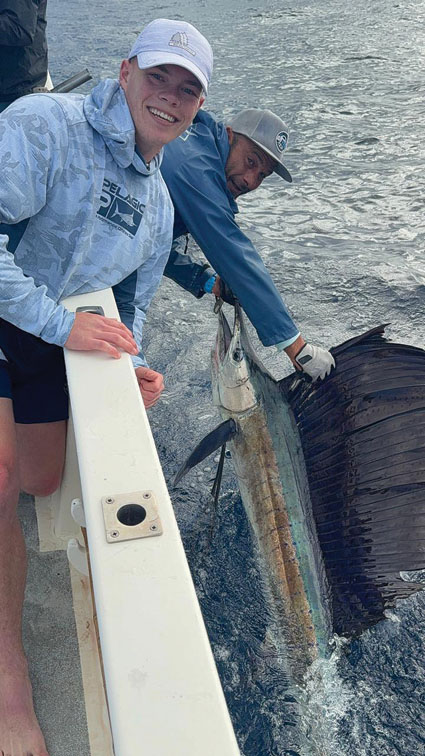
    Each season in Ponta brings its own excitement. Summer (November to March) is all about warm currents and fast-moving pelagics – wahoo, dorado, tuna and sailfish dominate the action, with marlin making regular appearances off the deeper reefs. As winter rolls in, the cooler waters bring an influx of ’cuda and queen mackerel, making the shallower reefs come alive. The winter months are also perfect for light tackle fishing, chasing green jobfish and smaller trevallies in calm, shallow waters.

    No matter the season, dawn launches are magical – the horizon glowing orange over the Indian Ocean, the air still, and that electric anticipation of the first strike of the day.
     

    TACTICS AND TECHNIQUES

    Fishing in Ponta is all about reading the water and adapting. Early mornings are often best spent along the 15–18m line, mostly at Doodles, scanning for baitfish and bird activity. Live bait is gold here – a fresh mackerel or maasbanker slow-trolled over a reef edge can be deadly for a wide variety of pelagics.

    When the current slows, I often switch to spinning or casting poppers over the reefs. There’s nothing quite like seeing a GT explode through the surface after your lure. Drop shot and bucktail jigging can also produce fantastic results on calmer days, especially for kingfish species and jobfish.

    Those who prefer trolling the deeper reefs need to keep an eye on current lines, bird activity and small shifts in water temperature – and must always be on the look out for bonito action. A live bonito is the ultimate weapon in this area, and can make all the difference between a quiet day and a screaming reel.


    CONSERVATION MATTERS

    Fishing in a marine reserve is a privilege, and with that comes responsibility. Catch-and-release is widely practised here, particularly for billfish and large GTs. Local charter operators work closely with authorities to uphold sustainable practices, and respecting bag limits and sanctuary zones ensures these waters stay alive for generations to come. Please respect the rules when you come to visit.


    FINAL THOUGHTS

    Whether you’re after fast-paced pelagic action, the thrill of topwater GT strikes, or simply soaking up the beauty of a coastline that feels wild and untouched, Ponta do Ouro delivers it all. For me, after nearly two decades fishing these waters, there’s still no better feeling than watching the sun rise over the Indian Ocean, throttling up through the surf, and knowing that anything could happen once the lines go in.

    At the end of the day, it’s the laughter, the shared stories, and the time on the water with friends and family that capture the real spirit of Ponta do Ouro. Later, you can share stories of the catch of the day or the “giant” that got away, either back at your accommodation or over a meal at Melting Pot while your catch is being cooked.

    If you find yourself in Ponta do Ouro and want some extra info, feel free to contact me at Gozo Azul and Salt & Search Fishing Charters. We are always happy to share a bit of local knowledge and point visitors in the right direction.

  • A FAMILY AFFAIR

    A FAMILY AFFAIR

    Chasing blue marlin across the globe

    By Johan “Bees” Terblanche (originally published in the November 2025 issue of SKI-BOAT magazine)

    SINCE my very first day on the ocean when I was five and we surf launched a 14’ 6’’ ski-boat off Sodwana, the sport of big game fishing has been a family affair and a shared passion for us all.

    I cut my teeth fishing mostly with my family and close friends both competitively (Mpumalanga interclub tournaments, the OET, Mpumalanga junior tourneys, junior nationals, the Billfish 15 000, etc.) and during family vacations, with a month-long annual pilgrimage to Sodwana for marlin season and a few other trips mostly along the South African coastline during my formative years.

    From a very early age, I was fortunate, to have not only the guidance of my parents, but also that of many of the serious Mpumalanga marlin fishermen and a number of the Dorado Ski-Boat Club stalwarts, chief among them Oom Piet Joubert (Bonito). I was privileged to spend countless hours fishing with and learning from a number of the top billfish teams in the country.

    Those early experiences were the sparks that lit a fire that still rages (some might say mostly out of control) almost half a century later!

    PICKING A BASE

    As I built my professional career and my wife and I raised our two daughters in a land-locked country, I fished a lot less than I’d have liked to until I acquired Impi, a 48-foot Ocean Yachts sportfisher, in 2020.

    Having fished in many of the top marlin locations in both the Indian and Atlantic oceans, I then had to decide where I would base the operation. I considered what I knew and had personally experienced, spoke to a lot of fellow fishermen, professional captains and friends, and ultimately decided to base Impi at La Gomera in the Canary Islands.

    There are a number of reasons I made this choice: great fishing throughout the year, relative ease to get to and from continental Europe and the UK, the variety and size of the fish we have there, the natural beauty and incredible diversity of landscapes on the island, the availability of other activities such as golf and hiking, the quality of the food, and last but not least the African weather combined with European infrastructure and security.

    While it is difficult for me to believe, I recently calculated that the last time my folks, my brother Wian and I fished for marlin together was over 25 years ago! In the interim, I have fished separately with my dad and my brother a couple of times, and even did some gamefishing with my mother and another brother in the Caribbean, but Covid kiboshed a trip to Cabo Verde for those based in South Africa, and circumstances outside our control meant that my mom could not join my dad on his previous trip to the Canaries, and my brother’s visits did not coincide with that one either.

    I was determined to get us all together for another roll of the dice.


    TWO MORE CONVERTED

    Things finally fell into place this past July/August and I had not only mom and dad with me, but also my brother (Wian), my wife (who I met on a fishing trip to the Seychelles many years ago), my two daughters and their boyfriends who all descended on La Gomera to finally chase blue marlin together again. Not only did we manage to do it together for the first time in a long time, but we also added the next generation, and I’m pretty certain that we have converted both of the boyfriends to lifelong marlin fishermen too. My apologies for the certain and significant negative impact this will have on the collective finances of both couples!

    While the fishing was excellent, the older two generations also revelled simply in the nostalgia of being able to do this together again after such a long break. I smiled when my mother frequently referred to the house we had rented as “the camp” and used the phrase “boat packs”, a term I had not heard in many, many years!

    For those who are not familiar with the Canary Islands, the islands (which oficially belong to Spain) are located in the Eastern Atlantic, west of the southern part of Morocco. This is north of Cabo Verde and south of Madeira, and is therefore slap bang in the middle of the annual migration path of the Atlantic blue marlin. La Gomera is the second smallest of the seven main islands that make up the Canary Islands and is recognised as the prime location for marlin fishing in particular because of the topography, the currents and the abundance of baitfish and tuna.


    JURASSIC PARK

    When it comes to fishing, I think of La Gomera as the Jurassic Park of bluewater fishing. For just about any species that we catch, the average sizes are enormous. In just about every season we catch as many blue marlin of 500 lb or larger as we do smaller ones, and granders are caught each year. Giant bluefin tuna pass by in March and April each year and range between about 600 lb and 900 lb for the most part. Bigeye tuna range from about 140 lb to well over 300 lb, and skipjack tuna get up to 45 lb. The all-tackle world record was caught there. Massive amberjacks abound on the reefs, bluefish/shad of sizes that not even the Durban old-timers will believe are frequent in winter, and we can literally fill the boat with decent (35- to 50 lb) wahoo year round. White marlin, spearfish and dorado also show up from time to time, as do longfin tuna (albacore) during our winter months. There is also excellent jigging for snapper, bream, grouper and other bottomfish – if the amberjacks don’t get to the jig first. I still get excited just writing this all down!

    PAYDAY

    The marlin season lasts from mid-May to early October, with the largest fish typically caught at the beginning and back end of the season, although August usually produces plenty of fish in the 500- to 750 lb range.

    This year, in ten days of fishing, we released eight blue marlin from 17 bites (and saw a bunch more), and went one-from-one on white marlin – despite “wasting” a couple of hours to get some wahoo for ceviche.

    For some reason the fish were generally a bit less aggressive on the bite, leading to a few more pulled hooks and missed hook-ups than we usually have. On one afternoon everything fell squarely into place and it seemed that there were marlin everywhere! We had two from five (including two double strikes) in a matter of about three hours or so on the tide change. Adrenaline aplenty!

    However, more important even than the amazing fishing we experienced was the opportunity to do it with three generations of the family.

    We have shared these special times since the early 1980s when my dad acquired Shani (a name shared by my eldest daughter) and it was a true privilege to be able to do it all together again.

    When all is said and done, it is the experiences (and the passionate people we meet along the way) that make life special. Who better to share it with than family and friends? I feel truly blessed to be able to still do this together with those I love, and this recent trip will live on in our individual memories for as long as we all live.

    We’re not all able to take luxury trips to international destinations, but I  encourage SKI-BOAT’s readers to continue to relentlessly pursue their passion with good friends and family, wherever they may be.

    • If anyone is interested in finding out more about our fishing adventures and charters in La Gomera, they can follow my Instagram account impi_fishing.

  • HISTORIC BILLFISH SLAM

    HISTORIC BILLFISH SLAM

    A record-breaking victory at Sodwana!

    By Jean Schoonhoven

    (Originally published in the July 2025 issue of SKI-BOAT magazine)

    EACH year the SADSAA Heavy Tackle Billfish Nationals takes place at Sodwana Bay in the week immediately after the Billfish 15 000 competition. Last year the event was hosted by Mpumalanga Deep Sea Angling Association and I was honoured to be part of the 2024 SADSAA Heavy Tackle Billfish team.
    The rest of the elite team comprised Gavin Heale (team captain) from Griquas, Jannas Henriksz from Gauteng, and Michael Fourie from Southern Gauteng. We had earned our places based on merit, and our selection symbolised the pinnacle of achievement in competitive billfishing, setting the stage for an intense and highly anticipated tournament.

    PRACTICE MAKES PERFECT
    Although the four of us had never fished together before, we were excited for what lay ahead. Michael and Jannas had both participated in the 2024 Billfish 15 000 tournament, with Jannas fishing aboard Kit-Kat which took first place. Team Kit-Kat also equalled the tournament record with an impressive seven billfish releases.We hoped Jannas’s “luck” would continue!
    Our team joined up on Saturday 16 November 2024, a day that was dedicated to tackle preparation as we’d planned a practice day for the Sunday. This was a crucial opportunity for us to refine our teamwork.
    On the Sunday we launched at 5am aboard Dee-Jay, Gavin’s Citation 900 powered by twin Yamaha 300hp engines. The first couple of hours were quiet, but at 8.17am, I hooked a blue marlin on an Ilander Black Hole lure with a strip bait that we’d run in the shotgun position.
    With Michael handling the leader, Jannas capturing video footage, and Gavin at the helm, our team worked together very efficiently, releasing the marlin at 8.33am. This promising start reinforced our confidence and readiness for the upcoming tournament.
    We returned to shore around 11amto finalise tackle adjustments before attending the opening function that evening at the Sodwana Ski-Boat Club Clubhouse.

    A STRONG START
    The 2024 SADSAA Heavy Tackle Billfish Nationals officially commenced on Monday, 18 November 2024, at 5am, featuring 14 fiercely competitive teams.
    The morning began slowly, with the first marlin release only recorded at 10.49am by the Griquas team aboard Certainty.
    Our team remained patient, working the Diepgat area, and our perseverance paid off when, at 12.19pm, I hooked a sailfish of approximately 50kg. The fish was successfully released at 12.27pm. Once again the Ilander Black Hole with a strip bait in the shotgun position was the charm.
    Encouraged by our success, we continued working the Diepgat area. At 12.55pm, we had another strike – this time Gavin took the chair. Battling against increasing northeasterly winds and growing swells, he fought a 180kg black marlin which was successfully released at 1.27pm. For the third time in two days, the Ilander Black Hole with a strip bait proved its worth!
    By the end of the first day, our SADSAA team topped the leaderboard with 352 points, setting the pace for the rest of the competition.

    WEATHER CHALLENGES
    Unfortunately, the second day of the tournament was declared a blowout due to adverse weather conditions.
    This setback meant that standings remained unchanged going into day three.

    HOLDING POSITION
    Wednesday, 20 November 2024, proved to be a testing day. Despite two aggressive billfish strikes on our teasers, neither fish switched to commit to the pitch baits. Our team ended the day in third place still on 352 points, trailing behind North West province in first place on 487 points and the SADSAA Masters Gold team in second place on 482 points.

    A STRATEGIC SHIFT PAYS OFF
    Day four marked a pivotal moment for our SADSAA team as we decided to tweak our strategy. We replaced the two hookless teasers on the left and right short positions with fully rigged lures. The decision paid off immediately.
    At 5.25am, a fish was spotted in the spread, striking and missing the right short lure – a Bahama Phoebe 50 in Captain Morgan colours. Jannas quickly grabbed the pitch rod and presented a mackerel rigged with a circle hook, while I cleared the right short lure to make space. The fish took the bait, and Jannas carefully set the drag to secure the hook. The fight was on!
    Battling the fish in a stand-up position using a Black Magic harness, Jannas held strong while Michael took the leader, I recorded the action, and Gavin expertly manouevred the boat. After an intense 25-minute fight, the fish was brought boatside. Initially mistaken for a blue marlin, closer inspection revealed it to be a massive sailfish – approximately 80kg – with a torn dorsal fin giving it the appearance of a marlin. At 5.52am, the first fish of the tournament day was successfully released.
    We quickly reset the spread, and at 6.41am another strike came on the same Bahama Phoebe 50. This time, Michael took the chair while I handled the leader, Jannas recorded footage, and Gavin captained the boat. The fight on 80 lb tackle was brief, with another sailfish successfully released at 6:56am – the second fish of the day.
    At 7.17am we had yet another strike – this time on the short left lure, a Black Bart Marlin Candy in blue. I jumped into the chair while Jannas filmed, Michael worked the leader, and Gavin helmed. The fish fought hard, but the estimated 80kg striped marlin was successfully released at 7.43am – the third fish of the day.
    The hot streak continued when, at 8.20am, we hooked into a larger blue marlin on the long right, which struck a green-and-black Pulsator Tube. Gavin took the chair as the fish peeled line well into the backing. Unfortunately, the line popped, and the fish was lost. Such is the nature of the sport!
    The action slowed until 12.14pm, when the short left rod got hit again, with the Black Bart Marlin Candy proving irresistible. Jannas was back in the chair, Michael took the leader, and Gavin guided the boat. This was undoubtedly the biggest fish of the tournament for our team. After a grueling 50-minute fight, a stunning blue marlin estimated at 250kg was successfully released at 13.04pm.
    This incredible achievement marked our team’s fourth release of the day, and gave us our third billfish species, completing the elusive Billfish Slam. With 1 144 points, our SADSAA team finished the day in first place overall.

    MAKING HISTORY
    The final day began quietly for our team, but patience paid off.
    At 10.10am, the right long lure – a Pulsator Tube in blue, white, and purple – got a strike.
    Jannas took the chair once more, with Michael handling the leader, me capturing footage, and Gavin at the helm. At 10.32am we successfully released a blue marlin estimated at 200kg – our seventh billfish of the tournament, tying the all-time record for billfish releases in any Sodwana tournament!
    Momentum was on our side, and at 11.18am, the shotgun position got hit by a marlin attacking a chartreuse, yellow Ilander Express. The marlin missed the lure twice but committed on the third strike.
    I took the chair, Michael grabbed the leader, and Gavin skippered the boat. After a 22-minute battle, another magnificent blue marlin – approximately 180kg – was released. This marked our eighth release of the tournament, setting a new record for the most billfish released at any tournament in Sodwana’s history.

    A DOMINANT VICTORY
    Our SADSAA team emerged victorious, securing an emphatic win with 1 644 points – nearly double the second-placed team, Western Province, who finished with 885 points. The SADSAA Masters Gold team claimed third place with 767 points. Over five launches, which included the practice day, our team released a remarkable nine billfish, including a billfish slam!
    This victory was particularly noteworthy as it marked the first time in more than 15 years that a SADSAA team had won the prestigious SADSAA Heavy Tackle Billfish Nationals Tournament. It took an impressive combination of skill, teamwork, and strategic adjustments, but we did it!

  • CHASING BILLS OFF SANTA MARIA

    CHASING BILLS OFF SANTA MARIA

    A marlin fishing dream come true

    By Hailey Harris

    (Originally published in the May 2025 issue of SKI-BOAT magazine)

    THERE are fishing trips that are good, some that are great, and then there are those that change the way you see the ocean forever. My recent adventure in Santa Maria, Moçambique, was one of the latter – an electrifying journey filled with adrenaline, learning and sheer fishing magic.
    After boarding Malakas with skipper Branden Brodell, I set out with one goal: to catch a marlin. Not only did that dream come true, but we landed four!
    The trip started at The View at Santa Maria, a fitting base for an experience that would be nothing short of spectacular. As we made our way in and out of Hell’s Gate – a treacherous passage known for its shifting tides and strong currents – Branden navigated it with a confidence that only comes from years of experience. His knowledge of the waters, the fish, and the conditions was beyond impressive.
    The first day started with a bang! At 8.30 a.m., we saw a fin chasing the first lure; no bite. We held our breaths as the marlin fell back, chased the outside long kona, and ultimately hooked on that – my first striped marlin!
    The fight was intense, the adrenaline coursing through me as I worked to bring in my dream fish. This was a tough fight – one that tested my endurance right from the start. The marlin, put up an incredible battle, peeling line off the reel. Every time I made ground, it would dive again, forcing me to dig deep and keep my composure.
    After an exciting fight, I finally brought it in – a truly unforgettable first marlin. It was everything I had dreamed of and more. That single moment alone would have made the trip a success, but the ocean had more in store for us.
    Over the next few days, we hooked three black marlin, each one a lesson in power and endurance.
    The second marlin was a completely different fight to my first with the stripey. This time the marlin was hooked on a light setup with 50 lb leader. I had to fight it differently, knowing that with 20 lb mainline onto light leader, the line could snap at any moment. This time it was not only a physical challenge, but one that would test my technical skills too.
    Whilst reeling it in, I could feel this marlin had a different energy to the previous one – it was agile, making sharp runs that kept me on my toes. Compared to the first, it was a fight of speed as well as brute force, forcing me to adjust my technique to keep up with its unpredictable movements and immense power.
    Finally, after about a 40-minute fight, I landed an estimated 120kg black marlin. The excitement aboard Malakas was unimaginable – not just marlin number two for me, but a black marlin, the fastest and strongest fish in the world!
    We made sure to celebrate with a well-deserved local Mozambican beer.
    The third marlin was the smallest of the blacks we caught, but it was just as fierce. Hooked in shallower water at 6.30 a.m. on the fourth day of my fishing trip, it surprised us with its acrobatics, leaping multiple times and giving me a chance to test my reaction times. Just because it was smaller didn’t mean an easy fight, though; it still had that relentless marlin spirit. However, after a shorter battle, we successfully brought it in, and it was wonderful to have another boat nearby, with those anglers screaming in excitement for us.
    The last marlin of the trip, however, was the one that truly tested me. At 5 p.m. on that fourth day, Branden had just put out a live rainbow runner in the hope that something would bite, as we’d had a long, quiet patch. Just as we were thinking of calling it, the line screamed, and we knew we had something big.
    Both Branden and I had seen a splash as we hooked it, but we couldn’t quite tell what it was. For the next 15 minutes I battled the fish, still unaware it was a marlin, making me wonder if I was just lacking strength from the last few days of hard fishing, or if this was something really big. My back was sore, and eventually we both started to wonder if it might be another marlin.
    Just as the thought crossed our minds, the marlin breached the surface! It erupted from the water in a display of power, its body twisting and thrashing against the setting sun. The moment was mesmerising, but I had no time to admire it – I continued to reel furiously, knowing that every second counted.
    Branden spoke me through the fight, his voice like a lifeline, reminding me to stay calm, to breathe, to keep fighting. For an hour I battled that fish, every muscle in my body burning and my mind locked in focus. Every time I thought I was making progress, the marlin would make another deep dive, stripping away all the line I had just gained, emphasising that this was a give and take relationship. The sweat dripped from my forehead as I pushed through the burning fatigue, refusing to lose this battle.
    This marlin was the biggest of the trip. Estimated to be around 150kg, it was an absolute beast that pushed me to my limits. By the time we brought it alongside the boat, I was trembling from exhaustion, but the satisfaction of that final, massive catch made every aching muscle worth it. It was a moment of pure triumph and exhaustion.
    Unlike traditional marlin fishing from a fighting chair, I fought all four of these giants on stand-up tackle, my legs bracing against the gunnel, my core locked to maintain balance, and my arms burning with every turn of the reel. Each fight felt like a marathon, pushing me to the edge of my physical limits; it was a test of willpower as much as it was a battle with the fish.
    By the end of the trip, my hands told the full story – raw, blistered and sore from gripping the rod and working the reel, a testament to the sheer effort that went into landing every marlin. But every blister was worth it for the experience of fighting those fish, feeling their power through the rod, and ultimately witnessing them swim off strong after the release. It was brutal, it was exhilarating and it was unforgettable.
    Beyond the marlin, the trip also delivered a bounty of gamefish – ’cuda, wahoo, dorado, GT and yellowfin tuna, each one adding to the thrill of the experience. The ocean seemed to be on our side, rewarding our efforts with incredible catches time and time again.
    Fighting marlin is unlike anything else, and with Branden’s expert guidance, I learned the nuances of handling these magnificent fish – reading their movements, adjusting my technique, and enduring the physical challenge. It was a masterclass in big game fishing, and I relished every moment, including releasing the marlin and watching them swim away as the adrenaline rush in my body slowly turned to an overwhelming feeling of euphoria.
    Many anglers go years chasing one marlin, and yet I managed to catch four in a single trip of four days. That kind of luck is something I will never take for granted. Fishing around Santa Maria with Branden gave me memories that will last a lifetime, and reinforced why I love fishing – the unpredictability, the challenge and the ultimate reward of landing a dream catch.
    Beyond the thrill of the catch, staying at The View @ Santa Maria was an experience in itself. Every time I visit, I’m left in awe of its breathtaking beauty – the endless ocean views, the peaceful surroundings, and the way nature seamlessly blends into the adventure. It’s a place that never fails to amaze me.
    As a woman who discovered a love for fishing only two years ago, I’ve been fortunate to land some remarkable gamefish off Santa Maria, including a 40kg GT, a 13kg green jobfish and a 24kg ’cuda.
    I am still at the start of my fishing journey, and there is so much I have yet to learn, but Branden has been an invaluable teacher, guiding me through each trip and slowly helping me understand different techniques, read the ocean, and improve my ability to handle big game fish.
    Branden’s expertise, instincts, and deep understanding of the ocean made this trip unforgettable. Every time he had a gut feeling about what we were going to catch, he was right!
    As I look back on this experience, I know one thing for sure: the ocean has so much more to teach me, and I can’t wait for the next adventure.

  • WHERE TO FISH PART 12

    WHERE TO FISH PART 12

    Scoping out Richards Bay, KwaZulu-Natal

    By Jono Booysen

    [Originally published in the November 2023 issue of Ski-Boat magazine]

    RICHARDS Bay is a very popular fishing destination, and for good reason. This area has a bit of a reputation for being a difficult place to find fish, but when you do find them, they are often of trophy size.
    I agree with this sentiment, even after calling the area home for nearly my whole life. One of the difficulties is that the area is vast, and fishing spots are not in close proximity to one another. This is where a well thought out gameplan is essential for the day to be successful.
    Focusing not only on the target species, but also on the area I intend to hone in on, significantly improves my success rate. By having a good idea of what “Plan A” is, you can have a few contingency plans for backup.
    Other things to consider when looking at where to fish off Richards Bay might seem obvious, but are really important…
    • Check weather forecasts, as there is nothing worse than running 40km north only to get caught in a 30 knot south-westerly buster.
    • Try to find out what the current is doing. You can ask around, check a few apps or simply look at which directions the ships are lying at anchor (if there is not too much wind affecting this).
    • Water colour can affect my decision of where to fish, so if there has been a lot of rain or the north-easterly wind has blown for a while, ask the regulars what they have seen.
    Once you have done your homework on conditions, you need to make a call on where to go.
    Regardless of what area I decide to fish, I always first look for a good supply of live bait. To me a reliable bait spot is way more important than any fishing spot. Often these bait spots are themselves some of the best fishing spots but are overlooked by those solely focused on bait fishing.

    FISHING SPOTS
    1 Mapelane Pinnacle
    2 Mapelane Ledge
    3 Dingos, Scavenger, Potatoe, Buddies
    4 Kitchen
    5 50m Ledge [north] 6 Nhlabane Pinnacle
    7 Drukgang
    8 Kasteel
    9 Groenkop
    10 Pipeline
    11 South Pier
    12 Arm Mans
    13 Len
    14 Small High Point
    15 Jackpot
    16 Patingo
    17 32m
    18 Danies, Edwards, Pats, Gerries
    19 Marlin Ledge
    20 High Point

    COORDINATES
    South East
    Lighthouse Ledge 2828600 03247000
    Scavenger 2828900 03227300
    Mapelane Pinnacle South 2830600 03224700
    Buddies 2836300 03223700
    Hlobane Pinnacle 2840700 03216000
    Scavenger 2841200 03233200
    Kasteel North 2842500 03220300
    Groenkop Snoek 2844900 03210900
    Groenkop Snoek 2845000 03210900
    DRUKGANG 2845600 03224600
    Kasteel South 2846000 03218100
    Pipeline 2848600 03207900
    Pipeline 2848700 03208100
    Pipeline 2848700 03208200
    Pipeline 2848800 03208700
    Arm mans 2852600 03203500
    Len 2854000 03207400
    Patingo 2857700 03202300
    Sml High Point 2858000 03209500
    32m 2859700 03202000
    32m 2859900 03203700
    Danies 2902500 03201300
    High Point 2909300 03202900
    Pats 2904300 03147500
    Edwards 2904800 03146100
    Gerries 2905400 03144600


    BAIT SPOTS
    My go-to bait spots are mostly close to the harbour. This allows me to get bait and then decide if I am going north, south or east. On the northern side of the harbour entrance, just off the short pier, there is a yellow marker buoy indicating the presence of an old wreck. This buoy often holds bait. Failing that, a few hundred metres outside the harbour, just to the south, there is a wave rider buoy that yields great results on its day.
    The most popular bait area has to be the “pipe”. This is the effluent/sewer line running out off the coast. As with most underwater structures, it is a magnet for bait. I find the best area is at the end of the pipe. Just sound around until you find the showings or head to the small clusters of boats that have already found the bait. Not only is the pipe a great bait spot, it is also THE place to be when the daga salmon make an appearance in winter months. The size of these fish gives the Breede River a run for its money, with many 45kg-plus daga landed there.
    Other good bait spots include “Len” which is in the middle of the ship waiting area, about 8km east of the harbour in roughly 40m of water. Most shallow reefs will have some kind of small fish species that can be used as bait, so don’t be shy to send a sabiki down whenever you see a good showing.
    Now that the livebait is sorted, we can focus on something a bit more substantial.
    As mentioned before, the fishing spots are a fair distance apart, so it’s better to make a call whether to go north or south and stick to that decision. I will be mentioning a few good areas between Mapelane lighthouse in the north and Mtunzini in the south.

    NORTH
    Mapelane Lighthouse is roughly 40km north of the Richards Bay harbour. In the shallows, from Lighthouse Bay to the Jolly Rubino wreck, the Natal snoek (queen mackerel) can often be found in plague proportions. Mixed in with them are the usual backline species such as GTs, blacktip kingfish and the odd queenfish or prodigal son. I’ve also managed to catch quite a few silkies (wolf herring) in this area which are dynamite big baits for fishing the deeper water in the same area.
    The “Mapelane pinnacle” has been regarded as one of THE gamefish destinations in this area for anglers and spearos alike. This pinnacle comes up from 30m to 11m and is home to good numbers of ’cuda, which are the main focus on this reef.
    You never know what you might encounter in this area as good hauls of tuna species (yellowfin and kawa kawa), wahoo and sailfish occur regularly. Unfortunately, the sharks have also become privy to this spot, and it can be near impossible to get your fish out whole when the sharks are hungry.
    If the pinnacle is not producing, there is an option to head out deeper to one of my favourite deep water gamefish spots: the ledge.
    The name refers to the ridge in roughly 50m of water that runs along the entire Natal coastline. To find it, travel east until you see the depth come up from ±55m to 47m and then back to deeper water. This ledge runs roughly north to south, so it’s relatively easy to find.
    Fish use this ledge as a highway to travel along. Littered along the ledge are a few high spots that are popular areas to fish and I will mention a few of them in the Richards Bay reaches.
    The ledge near Mapelane includes places such as “Scavenger”, “Dingo’s”, “Potato” and “Buddy’s”. Many large ’cuda have been taken on these marks and the area remains a very special place to fish.
    Other species such as dorado, sailfish, wahoo, tuna and marlin also patrol this ledge, not to mention the good number of bottomfish. Please note that there is a green zone from Mapelane Lighthouse heading north where bottomfishing is prohibited, so make sure you don’t fish illegally.
    For the marlin fishermen, in the 1 000m deep area, there’s a spot known as “The Kitchen”. It is known for having produced good numbers of blue- and striped marlin as well as some of the large yellowfin tuna that sporadically make an appearance.
    Hlobane and Dawsons are about 30km north of the harbour. Here you will find the water colour changes to become a lot cleaner due to the prevailing currents. Again, the 50m ledge is a go-to spot for dorado, wahoo and black marlin, with the odd sailfish in the mix.
    Hlobane pinnacle, in 23m of water, used to be a great spot but lost popularity for some unknown reason. I have had some success there with ’cuda and queenfish. The spearos also get good mixed bags here when the clean water moves over the pinnacle.
    During the winter months into early spring, the backline can be a great place to fish. GTs, Natal snoek and garrick move into the shallows chasing baitfish. Look for rips and current/plankton lines that will hold the baitfish. If you see large, surface-feeding fish in the scum lines, they are most probably milkfish (Chanos chanos) so don’t get too despondent when they don’t eat the lures you throw at them.
    Also off this area is the well knows marlin area called the “Drukgang”. It is the area found between Dawsons and south of Hlobane in about 500- to 600m. The 180m to 250m depth drop off Hlobane is quite steep, so it’s worth spending some time there pulling lures for marlin.
    As a result of the good structure, the deep water bottomfishing is also really good if the current is not too strong.
    Roughly 15km north of the harbour, we start getting into the big Natal snoek territory. This landmark is known as “Groenkop”, named after the highest vegetated dune in the area. Every year the small baitfish gather here and attract Natal snoek, ’cuda and tuna. Look for the birds and clusters of boats between 10m and 25m and you should find the fish.
    If the shallows are not producing, again, the ledge is a great alternative. The high spot off this section of the coast is called “Kasteel”. It is, in my opinion, an underrated spot and has produced many ’cuda, yellowfin tuna, dorado, wahoo and sailfish. For some or other reason, the average size of the ’cuda on this section of the ledge tends to be less than 15kg.
    Groenkop is often used as a final “Plan Z” on the way home from a fruitless day’s marlin fishing but has, on several occasions, delivered the goods with a black marlin or sailfish. I have also had some great bottomfishing off the deeper edge of the reef.
    The last area that is worth a mentioning here lies just north of the harbour. It’s a great marlin fishing area with a steep dropoff from 200m to 450m. Commonly known by locals as “Jackpot”, it produces blues and stripeys that are attracted to the upwelling caused by the dog-leg shape of the contours.

    SOUTH
    The closest, and probably the most popular fishing spot is the harbour itself. More specifically, the south side of the channel, up to and including the South Pier, produces some of the best garrick fishing on the KZN north coast. Several world records have been caught within a stone’s throw of the harbour wall.
    One of my favourite little spots is “Small Highpoint”. It’s a single pinnacle on the 50m ledge just deeper than the ships’ waiting area. Being so isolated, it acts like an oasis for baitfish, which in turn attracts predatory fish. The pinnacle often teems with small jube-jubes, and rigging them live produces wahoo, ’cuda, amberjack and GTs. As with most pinnacles that hold jube-jubes, the marlin are never far behind.
    During the winter months this is a great place to stock up on bait to target big Richards Bay ’cuda.
    The bottomfishing in this area can also be great, especially when the geelbek stack up there.
    The map alongside this article shows three deep-water pinnacles in over 1 000m of water. This area is known as “The Berge” and has produced many big tuna and blue marlin.
    When I’m in the area and am fishing for marlin, I personally prefer fishing for marlin a bit shallower than that and tend to concentrate on the steep dropoff from 200 to 400m that runs for several kilometres to the south. For the old school marlin anglers who still fish live bait, it’s a great option to get liveys off Small Highpoint and then work that ledge.
    Heading south, we enter the zone of the infamous “crocodile” (aka 30kg-plus ’cuda). The area from New Mouth/Mhlatuze Lagoon all the way past Mtunzini has produced countless trophy fish.
    The first spot, “Arm mans” or “Callies Reef” was made popular by Callie Peens who caught a 39kg and 43kg ’cuda there over the years. It is still a great area to fish for bottomfish and put out a trapstick on the surface.
    Patingo wreck is probably the most well-known spot in this area for big ’cuda. Lying 18km south of the harbour, it has been responsible for the vast majority of 30kg-plus crocodiles caught around here. As with most of this region, it fishes best in the week or late afternoon when most boats head home. It is a small area, so it gets crowded quickly, especially when one boat puts the anchor down.
    If the water conditions are not great or if there is too much boat traffic, 4km to the south-east is an area called “32m”. It refers to a large zone with scattered reef in 30- to 34m depths. The 32m area stretches south towards Mtunzini and includes well known reefs such as “Danies”, “Gerries”, “Pats” and “Edwards”. These are great places to anchor up and fish for bottomfish. At the same time, put your ’cuda baits out as you stand a great chance of getting a pull from a proper ’cuda.
    The last spot that has to be mentioned is the Mtunzini High Point, 44km from the harbour. This is one of those magical spots on the 50m ledge that is a gamefisherman’s dream when the conditions are right. It is also the one deep water location where the big ’cuda like to hang out.
    Similar to “Small Highpoint”, the jube-jubes are abundant and rigging one live is a sure-fire way of getting connected to any number of big gamefish that abound there.
    In summary, Richards Bay has good reason for being a popular fishing destination. It has all the onshore amenities as well as excellent fishing all year round, offering anglers access to everything from 1 000 lb billfish to trophy size gamefish and bottomfish. There is also that great feeling of satisfaction when you return to port with a good haul knowing that you have managed to figure out some of the secrets of this great location.

  • DREDGES — OUTWIT, OUTPLAY, OUTFISH

    DREDGES — OUTWIT, OUTPLAY, OUTFISH

    (Published in the January 2018 issue of Ski-Boat magazine)

    by Stuart Simpson

    I RECENTLY arrived back in my home town of Durban after a great season’s fishing in Kenya, Cape Verde and Morocco during 2017. On my arrival I met up with Erwin Bursik and we got talking about fishing. The subject of teasers came up and we began discussing which was the most successful lure or teaser and what method had worked best for us last year.
    You cannot hook a fish unless you have its attention first, and understanding how to tease fish in the offshore world is a necessary precursor to success. But mastering teasing tactics is only a small part of the science.
    It’s very important to understand the actual teasers themselves. Over the years lure manufacturers and fishermen have developed several different types of lures and teasers and each teaser/lure plays an important role in an angler’s arsenal.
    While single, hookless, natural baits and lures are often used effectively as offshore teasers, the most common type of teaser used in the boating world is the daisy chain. This is created by having a line of soft plastic squids grouped together with an equal spacing between each squid, rigged onto 300- or 400 lb monofilament which often stretches to nine- or 12 feet long.
    This teaser runs between wake number one and wake number two, typically with a softie trailing behind, skipping and splashing seductively in the boat’s wake. Sometimes they draw fish close to the boat, giving the angler a better chance at hooking the fish.
    When it comes to running these kind of teasers on a ski-boat, the white water from the boat and engines often disguises what you are trying to achieve especially when the sea is slightly choppy or unfavourable on the day.
    There is a big secret behind all of this and it was not invented yesterday, but actually way before most of us even started fishing.

    THE DREDGE
    Everyone knows about the dredge but hardly anyone uses it in southern- and east African waters.
    Dredges are basically clusters of plastic squids or natural baits designed to mimic a bait ball. They are generally slow trolled below the water’s surface, and are typically held down by a downrigger.
    Dredges have become very popular again in recent times, especially in some of the mid-Atlantic billfisheries for blue marlin. The dredge was first designed to attract sailfish off the bait balls in Miami, Florida, and there are many ways of rigging them, from using natural baits to bulb squids and mud-flaps.
    The good news for South African fishermen is that we don’t need to stock up on natural baits and go through the tedious efforts that Florida fishermen have to to rig their dredges with natural baits. Although I respect the crews that do that, all we are trying to do is get the marlin to come to the closest lure/teaser in our spread.
    Since I started running a dredge in my spread (bulb-squids and mud-flaps) I have noticed a turn around in the way the fish behave behind my boat. This has changed our strategy in fishing for billfish.

    POSITION
    You may well be surprised at how close we run the dredge behind the boat. It needs to be trolled completely submerged with no skipping or tumbling, and I also like to fish it where I can see it. Unfortunately this is a little more difficult on a ski-boat if there’s only a low platform and no fly-bridge. In that case run it as it disappears, with an added one metre of line once it’s out of sight.
    If I had to pick a general spot where I like the dredge to run, it would be somewhere between the first and second waves. The skipper needs to have sight of the downrigged line at all times, so it depends on where your helm is; if you’re steering from the port side run your dredge on the port, and the same goes for the starboard side. You can run it flat out the back of your boat, but the preferred method is to run your roller off your riggers to give you more clearance and better sight of where your dredge is.
    Statically I would say 70% of the blue marlin that we have raised came behind the dredge. I don’t believe that it raises you more fish, but I do believe it entices an inquisitive billfish to come in and have a look at the “bait ball” you have created.
    You have now achieved the first goal — bringing that fish right behind your boat where your short teaser/lure is instead of having it swimming through your spread while it chooses whichever lure is performing the most. In that scenario quite often they will go for your long lures because they’re at a better surface angle or else the fish fades away without you knowing that it was there in the first place.
    The fish is generally enticed to attack the lure closest to the dredge, giving the angler a much higher strike rate. Instead of the fish having a shot at the longs, you have convinced it to come in short to have a look at your artificial bait ball.
    A dredge swims very simply under the water, almost in a hypnotic way, creating no aggression at all, but it’s a very visual indicator to a billfish. Marlin often lose interest quite quickly after they’ve had a look at the “bait ball”, but as it fades off the dredge it will notice your lure behind the dredge. That lure will be behaving in a completely different manner to the dredge which first lured the fish in, and with your lure positioned in the right place — smoking and acting like a smaller baitfish feeding on the surface — you will get a much more aggressive bite. You will soon notice that you raise more fish to your shorts when you use a dredge as opposed to running without one.
    I understand that we fish on smaller boats in South Africa, but this does not mean that you cannot run a dredge. My advice is to rather leave two rods at home and run a spread of three — maximum four — lures and have that dredge in the water. With a bit of team work and practise I promise you will see better results regarding where the fish will appear in your spread and you’ll have a better chance of successfully hooking up.

    METHOD
    There are a few ways of running your dredge off your boat:
    • Electric reel
    • Traditional downrigger
    • Off a 130 lb bent butt spooled with 400 lb monofilament
    Electric reels are the ideal way to pull your dredge in if you’re teaser fishing — using the bait and switch method.
    If you’re lure fishing there is no hurry to get your dredge in until you have come to a complete stop as you’re running hooked rigged lures. I would advise you to also have a pitch bait or a pitch lure ready as there is a high chance of another fish following as you start to pull your dredge in, so always be ready. This method can be done with a traditional downrigger or else use a heavy marlin rod and reel spooled with 400 lb monofilament.
    This method of teasing is only for fishermen who are willing to try new techniques and gain more experience in offshore fishing.
    One must remember that when you have driven over a hungry fish or a group of hungry fish they are going to come up regardless of whether you have seven lures in the water or two.
    Simply put, it’s not the number of lures in the water nor rods on your boat that is important.
    You have to concentrate on attracting that fish to the back of your boat. Once you have achieved that it will make your billfish fishing ten times more exciting. Your shorter turn around time of clearing lines and having more space on the deck will be an added bonus.

    • For further information on targeting marlin contact Stuart Simpson <capeverde.bluemarlin@gmail.com>.

  • HOT LINE PROVES HER PEDIGREE

    HOT LINE PROVES HER PEDIGREE

    (Published in the January 2018 issue of Ski-Boat magazine)

    By Erwin Bursik

    FORTY years! Yes, indeed, the OET has been holding its November competition for the gamefish anglers of the Mpumalanga Deep Sea Angling Association (formerly the Oos/Eastern Transvaal Ski-Boat Association) since way back in 1977. Under the then chairmanship of Jimmy de Pradines and Secretary Cliff Reid, this competition was founded for two reasons. The first was to galvanise the member clubs of this provincial region, and the second was to prove to all that Sodwana Bay had — in addition to the prolific gamefish of the area — a hitherto untapped billfish fishery.
    For this reason the competition has historically focussed on both the gamefish as well as billfish — a determination that stands to this day. Where light tackle and heavy tackle used to differentiate between the two structures of the competition, the two are now melded by having an open line class up to 80 lb class tackle, but the rules stipulate the weight of the gamefish is added to the basic points allocated to the released billfish.
    The 2017 point scoring rules proved essential in determining the final outcome of this year’s OET because it was the gamefish points scored that made it such a thrilling chase to the final finish line. Have a look at the scores of the top ten teams and you’ll appreciate the tension as Hot Line skipped by Sean Van Veijeren and Zean-Mari with Captain Japie Kleinhans at the helm fought their way to the finish line. With final scores of 424.2 and 421.9 points respectively, it couldn’t get much closer!
    During the opening function of the 2017 OET Jimmy De Pradines, Cliff Reid and Pieter Hendrick were guests of honour. Their presence and the lovely 40th anniversary booklet emphasised the distinction of the event that was to begin a week of serious angling in the pristine waters off Sodwana Bay.
    The OET Committee under the Chairmanship of Nico Zaaiyman and Competition Convenor Stephen Kleynhans did a sterling job. The massive marquee in the grounds of Sodwana Bay Lodge buzzed with the extra special atmosphere all week long, and the sophisticated layout and decoration was, in my opinion, the best it has ever been. The two massive 150hp Mercury 4-stroke motors which were the top prize, took pride of place next to the podium and invited all the teams present to strive to be “The Team” which would uplift them at the final prize giving.
    Garth McGee of McGee Ford Motors, Lydenburg, sponsored a cash prize of R50 000 which would be awarded to the team in second position overall. This generous prize, together with a Garmin Marine EchoMap 725 and other worthwhile prizes made coming second very desirable.
    The OET committee’s support of its large band of loyal sponsors and the way they were honoured throughout the event underscored both the sponsors’ and organisers’ intention to make sure the 40th Anniversary tournament was the most prestigious event in its history at Sodwana Bay.
    And what a competition it turned out to be! Shortly after launching on day one Mrs Seevarkie reported a hook-up on a marlin by Henry Martin. It was released at 6.20am and set the pace for the action, with 23 billfish released on day one.
    That first day proved to be one of the most exciting — and frustrating — days I have ever experienced off Sodwana Bay. Most of the fleet — including my team on B’s Nest — were attacked by striped marlin that appeared to have lock jaw. They slashed at the lures with their bills, but very few were hooked. We got one stripey out of six strikes which is a terrible ratio. However, during weigh-in that afternoon many of the skippers reluctantly admitted raising up to seven stripies with either one or zero catches to their credit.
    To a large extent the stripey attack continued throughout the four fishable days, but thankfully the hook-up ratio improved and striped marlin accounted for 27 of the 71 total billfish releases.
    They say “It’s better to have loved and lost than never to have loved at all”; perhaps the same is true of fishing. Even though the striped marlin gave us all a severe ego bashing and made us question our knowledge and skill at hunting marlin, it was wonderful to see these “jousters” of the marlin species back in our waters and in apparently big numbers.
    Blue marlin, the stock in trade of Sodwana’s lure pullers were also present and accounted for 25 successful releases during the 2017 OET. Fast, hard strikes and vigorous fights provided some entertaining experiences for those able to stay attached to these magnificent billfish.
    There were a few teams that were eventually beaten by some very big marlin with Sky Bird possibly going the longest distance — four hours — on the last day only to have the hook pull fairly close to the boat. This long fight effectively cost them a higher place on the leader board and they ended in ninth position overall whereas they were second going into the last day. All the same, the memory of that mighty encounter will remain clearly etched in the minds of Captain Dave Knudsen, his son, son-in-law and two grandsons.
    These days the gamefish aspect of the OET has largely become a bycatch issue compared to the years gone by when it was a separately fished section of the competition. However, what has come to the fore is the improved quality rather than quantity of the gamefish presented to the weighmasters. This year a number of good size dorado — the biggest one of 17kg — and some good wahoo came to the table, but it was Rhuan Barnard, fishing on Mad Marly, who brought the most meritorious gamefish of the week to the scales. His 35.4kg yellowfin tuna won him the very substantial Calcutta cash prize.
    Hot Line’s skipper, Sean Van Veijeren, together with an extremely accomplished team of Gerhard von Bonde, Stuart Simpson and Richard Scott, worked the waters off Jesser Point hard, patiently and with determination. They released five billfish in total — at least one each day and a second on the Tuesday. This perseverance and success in marlin fishing shows their depth of experience.
    That’s also what enabled Team Hot Line to win the 2017 40th Anniversary Mercury OET Bill- and Gamefish Competition and the twin Mercury 150hp outboard 4-stroke motors together with their insurance for one year (by Cross Country Insurance) and two Penn rod and reel combo sets, all of which was handed over to Team Hot Line by Rutherford Marine/Mercury South Africa’s Francois Human and Aaron Ledsham.
    The entire 2017 Mercury OET 40th Anniversary Tournament was executed with the precision we have all come to expect from this prestigious competition.
    Thanks to Master of Ceremonies Brad Van Zyl, the organisers, marquee management, weighmasters as well as both beach- and radio control and the all-important bar staff, the final gala prize giving of the 2017 40th Anniversary Mercury OET Bill- and Gamefish Tournament was a worthy culmination of four decades of promoting bill/gamefishing off Sodwana Bay.
    However, what really crowned this event was when all the anglers who had released a billfish during this event, lined up in front of the dias after being awarded gold OET medals by the chairman Nico Zaaiman.
    So much work, so much play, so much dedication, so much skill, so much luck went into hooking and bringing alongside each of these released billfish. Finally these efforts were lauded by everyone in the marquee that evening not just because they’d collectively caught this incredibly high number of billfish, but also because each and every fish was returned alive to the ocean.
    On behalf of SADSAA, OET and every deep sea angler in South Africa, we congratulate and applaud your achievement.
    The OET is always a spectacular event, so take note that the 2018 Mercury OET Bill- and Gamefish Tournament will take place during the first week of November 2018, and book early for another enjoyable competition you don’t want to miss. I sincerely hope to see you all there.

  • ALL SHIP SHAPE

    ALL SHIP SHAPE

    (Published in the March 2018 issue of Ski-Boat magazine)

    By Lyn Adams, Photos by Actual Image

    The Sea of Life presents us
    With some Currents that confuse
    And many “ships” are needed
    On this memorable Cruise

    Apprentice-ship and Workman-ship
    Can form a worthy crew
    Leader-ship and Statesman-ship
    Can help steer us through

    Wor-ship is a Flag-ship
    That is carefully designed
    And proper navigation
    Can leave Hard-ship far behind

    Though the sea of life’s uncharted
    At times, it must be said
    The finest craft is Friend-ship
    When it steams full speed ahead!
    — John M Robertson
    AS John Robertson’s poem rings in my head, this is how I sum up the Billfish 15 000: It is a competition of friendship, apprenticeship, workmanship, hardship and most of all it’s about your ship tagging and releasing fish …
    The 2017 Billfish 15 000 tournament was once again hosted by Dorado Ski-Boat Club, at Sodwana Bay in KwaZulu-Natal. With a new base and new image it was once again a big success thanks to the hard work behind the scenes and the buy-in from sponsors and anglers alike. The camaraderie there is really something special.
    Last year the event’s base was moved to the Sodwana Bay Lodge, and with a new stage and bar trailers, it looked spectacular. The sponsors all seemed very impressed with the Billfish 15 000’s new look. On the Sunday, all the boats were registered for the event and the tent was packed with all the teams excited to get on the water and start fishing.
    On Monday 13 November 2017 the Billfish tournament started off very slowly and only four billfish were tagged and released. Every night was tent night and there were prize give-aways galore, with happy hours and much game-plan chatter. Numerous daily cash prizes as well as prizes like limited edition cooler boxes, compressors and battery vouchers from Probe Corporation, lure packs, reels, and lots more were handed out.
    It was a very emotional time for everyone present when Oupa Attie Janse van Rensburg, aged 94, (pictured below) had an opportunity to speak to the crowd. He’s a real angling legend and had most people in tears.
    On the second day all the boats went to sea but the billfish just did not want to be hooked; in the end only two billfish were released. On Wednesday things changed dramatically and the lucky crew aboard Mrs Seevarkie released three billfish before 10am and took the lead in the tournament. Mrs Seevarkie and her team had certainly upped their game to ensure they were among the legends at the 2017 event. Sadly Thursday was a blow-out.
    On the Friday the game was still on and all the teams had their eye on the first prize — a Carry Cat 670 on trailer, with two Yamaha F70hp motors, equipped with an Onwa fishfinder and lots of extras. The winners would also walk away with a R25 000 clothing voucher from Columbia and an invitation to the Offshore World Championship in Costa Rica, as well as insurance on the boat from Club Marine — in total a prize worth almost R650 000.
    The team aboard Mrs Seevarkie, stayed focused and made sure that they won the 31st Billfish 15 000 tournament after 22 years of trying!
    On the last day they quickly released their fourth billfish for the tournament, and knew that they could start celebrating. With one blue, one black and two striped marlin for the week, they had 1 123 points on the board. Mrs Seevarkie had 500 more points than the second placed team — Captain Fine (last year’s winners) — which had 510 points; they won a Lowrance HDS12 Gen.3 fishfinder, worth R53 250. Team Sea Breeze came third with 508 points and won a Zeon Platinium 12 000 Warn winch worth R44 400.
    The week ended with a total of 35 billfish released and culminated in a spectacular prize-giving event! Mrs Seevarkie’s crew proudly stood on their new Carry Cat 670 while their theme song — Jo Black’s Skepe — played in the background!
    The Dorado Ski-Boat Club committee would once again like to thank all the loyal sponsors, anglers and everyone else involved for another great Billfish 15 000 Tournament. We can’t wait to see all of you at Sodwana for the 2018 Billfish 15 000 Tournament — it’s going to be fantastic!

Verified by MonsterInsights