
WHERE TO FISH Part 23
Ponta do Ouro to Millibangalala
By Marcus Joubert
(Originally published in the January 2026 issue of SKI-BOAT magazine)
TUCKED away in southern Moçambique, Ponta do Ouro is a place that effortlessly blends adventure, relaxation and world-class fishing. This small coastal town hums with life and is a favourite for families, travellers and serious anglers alike. Beyond the rods and reels, Ponta offers everything from dolphin swims and vibrant reefs for snorkelling, to dive sites that rank among the best in Africa. Add in crystal-clear waters, golden beaches, and a lively mix of restaurants and beach bars, and it’s easy to see why this is one of Moçambique’s most popular destinations.
GETTING THERE & PERMITS
Ponta do Ouro lies just 20 minutes north of the Kosi Bay border and about two hours south-southeast from the Ressano Garcia border crossing. The town sits within the Maputo Special Reserve, a pristine marine-protected area and World Heritage Site – a fitting backdrop for the kind of fishing that keeps you coming back.
Fishing and launch permits can be arranged through the local Port Captain’s office in Ponta. Fees depend on the vessel’s size and how many days you intend to fish. Remember, because Ponta falls within a marine reserve, bottom fishing and vertical jigging are not permitted – a crucial rule in protecting this incredible ecosystem.
LAUNCHING
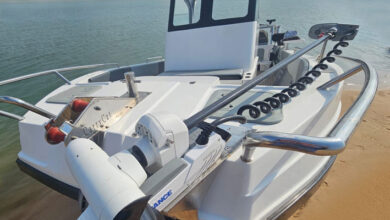
Launching here is relatively straight forward thanks to Ponta’s large bay, but it’s always worth chatting to one of the local skippers before heading out. They’ll gladly share advice on current sandbanks, surf conditions and how to ensure safe launches. Tractors are available for hire, if necessary, to help get your boat in the water.
While Ponta is the main launch site, other spots like Malongane and Techobanine can also be used. They’re more remote, though, and best suited to smaller boats.
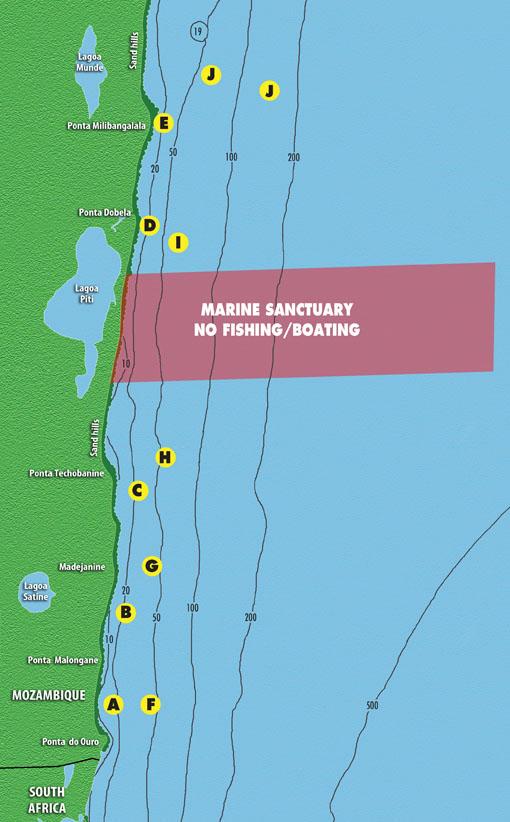 MAP KEY:
A: Doodles Reef
B: Texas
C: Techobanine
D: Dobela Point
E: Millibangalala
F: Atlantis Reef
G: Pinnacles Reef
H: Techobanine Deep
I: Dobela Deep
J: Millibangalala Deep
The coordinates for the sanctuary are:-26.66585 to -26.55394 and it extends three nautical miles out to sea. No fishing or boating is permitted within these boundaries.
THE FISHING GROUNDS
Fishing around Ponta do Ouro can be challenging at times, but the sheer variety of species makes every trip exciting. After 17 years on these waters, I still find new surprises on the sounder and still have days out there that blow me away.
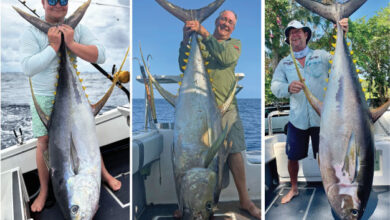
The reef systems in this area generally run parallel to the coastline, with shallow reefs in 15–22 metres of water offering reliable action. Expect ’cuda (king mackerel), green jobfish and queen mackerel to dominate these waters. The deeper reefs, between 30- and 50 metres, open up the playground for yellowfin tuna, dorado, wahoo and even marlin when trolling or throwing top-water lures.
Be mindful of the marine sanctuary between Techobanine and Dobela which is clearly marked on all charts. The coordinates are: -26.66585 to -26.55394 and it extends three nautical miles out to sea. No boating or fishing is allowed within its boundaries, and those heading further north to Dobela or Millibangalala must go around it.
REEF HIGHLIGHTS
Just 800 metres off the beach, Doodles Reef [A] – our house reef – sits in about 16 metres of water. It’s alive with baitfish like maasbanker, mackerel and the occasional red-eye sardine.
In the cooler winter months, it becomes prime territory for king- and queen mackerel, which patrol the area hunting baitfish. I often get one of my crew to throw a stick bait here in the early mornings while we look for baitfish with sabiki jigs.
Running north along the same depth contour brings you to some of the most productive and picturesque reefs in the region – Texas [B], Techobanine [C], Dobela Point [D], and Millibangalala [E]. These coral systems light up with colour and life and fish beautifully with livebait, bucktails and drop shot.
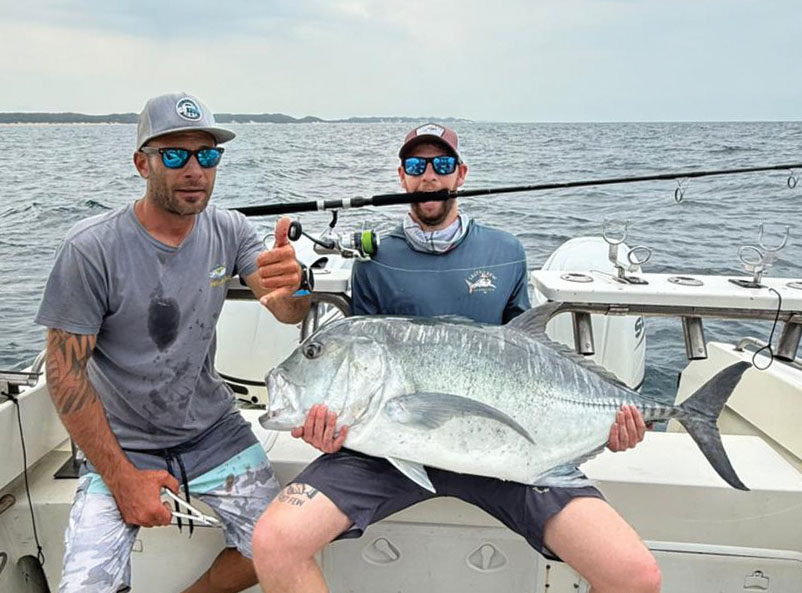
They’re prime spots for GTs, various kingfish species, jobfish and ’cuda. When conditions line up, working poppers over these reefs can result in explosive surface strikes from giant trevally, or even spectacular aerial strikes from ’cuda – the kind of heart-stopping action every angler dreams about.
DEEPER WATER ADVENTURES
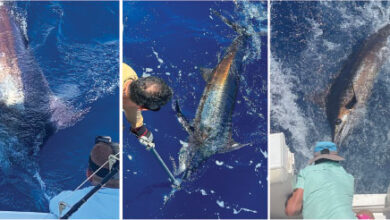
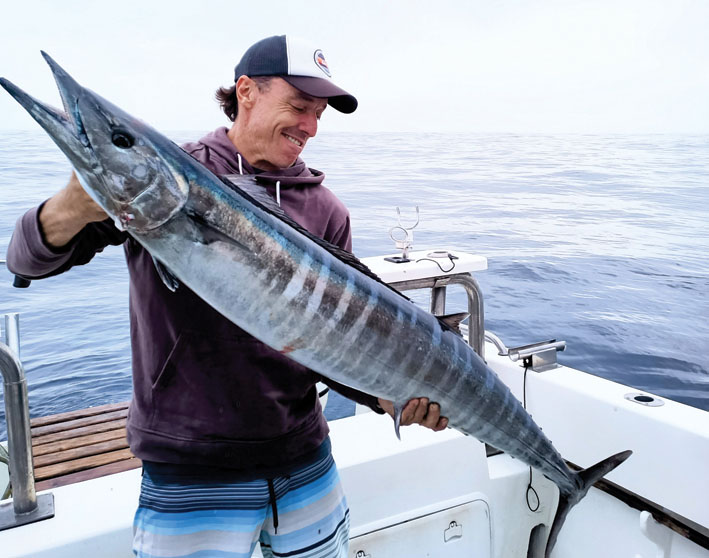
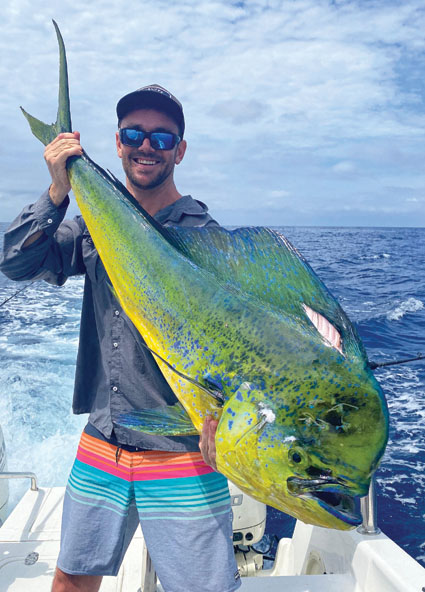
Push further offshore to the 35–50 metre line, and the fishing gets wild. These deeper reefs are where tuna, wahoo, dorado, sailfish and even black marlin come into play.
The first of these, Atlantis Reef [F], lies just over a kilometre from the launch site in about 40 metres of water. It’s an incredibly productive system, holding a mix of pelagic species whether you’re trolling, spinning, or working bucktails. Typical catches include tuna, wahoo, sailfish, amberjack, bluefin trevally and bludger kingfish.
A little further north sits the legendary Pinnacles Reef [G], off Federico Bay – depths here range from 35- to 50 metres. Known worldwide as one of the top ten shark-diving sites, it’s also an angler’s dream, though not without challenges. The “tax man” (sharks) are always ready to claim their share, but the rewards are worth it. For some of the bigger fish, allow them to run while pulling in lines; this gives them a chance to get away from the taxman and gives you a better shot at following and landing your catch.
Pinnacles is home to the famed Golden Shoal –a breathtaking school of more than one thousand giant trevally that migrate through in the summer months. The reef system sprawls across roughly a one-kilometre radius, each pinnacle holding its own mix of species. It’s the kind of place where you can spend an entire day exploring and never drop a line in the same spot twice.
Further north towards Techobanine Deep [H] and the sanctuary boundary, you’ll find a string of smaller, lesser-known reefs. They don’t get as much pressure and often produce incredible fish when conditions align. Although a bit of a run if one is launching from Ponta, the deeper reefs off Dobela Deep [I] and Millibangalala Deep [J] hold some amazing fish.
These reefs are best fished with live bonnies or frigate tuna, and you can expect to catch a wide variety of pelagics including the reef master himself, the amberjack. Downrig a live bonnie over these reefs and it’s almost a guarantee.
 TACKLE SUGGESTIONS
Keeping in mind that the water is crystal clear, it is crucial that you keep things “neat”. By this I mean keeping your ’cuda trace wire down to a number 4 or 5 wire, and not having oversized hooks or large dusters. For best results I sometimes only use a small glowbead on these traces.
When it comes to bucktails or drop shots, I very seldom use wire on these lures, but that means I do get bitten off at times by ’cuda, so it’s very much “tata ma chance”. Like they say, go light for the bite.
Also try to downscale some of your terminal tackle, like using a power swivel on your trolling lures instead of large snap swivels. At the same time, it’s important to remember that we have a lot of toothy species in these waters, so sometimes it is important to use wire on some of your trolling lures. You don’t want to hook a 30kg wahoo only to have your monofilament bitten through.
SEASONAL HIGHLIGHTS
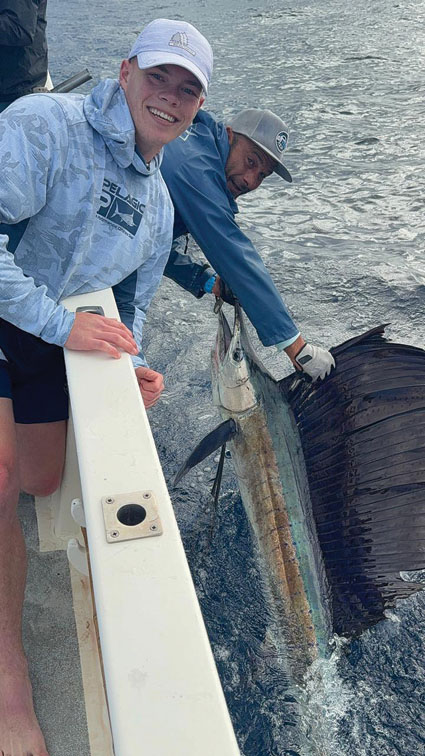
Each season in Ponta brings its own excitement. Summer (November to March) is all about warm currents and fast-moving pelagics – wahoo, dorado, tuna and sailfish dominate the action, with marlin making regular appearances off the deeper reefs. As winter rolls in, the cooler waters bring an influx of ’cuda and queen mackerel, making the shallower reefs come alive. The winter months are also perfect for light tackle fishing, chasing green jobfish and smaller trevallies in calm, shallow waters.
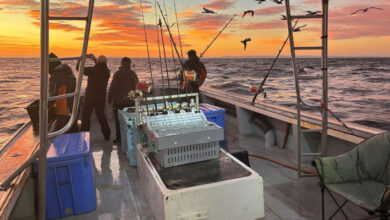
No matter the season, dawn launches are magical – the horizon glowing orange over the Indian Ocean, the air still, and that electric anticipation of the first strike of the day.
 TACTICS AND TECHNIQUES
Fishing in Ponta is all about reading the water and adapting. Early mornings are often best spent along the 15–18m line, mostly at Doodles, scanning for baitfish and bird activity. Live bait is gold here – a fresh mackerel or maasbanker slow-trolled over a reef edge can be deadly for a wide variety of pelagics.
When the current slows, I often switch to spinning or casting poppers over the reefs. There’s nothing quite like seeing a GT explode through the surface after your lure. Drop shot and bucktail jigging can also produce fantastic results on calmer days, especially for kingfish species and jobfish.
Those who prefer trolling the deeper reefs need to keep an eye on current lines, bird activity and small shifts in water temperature – and must always be on the look out for bonito action. A live bonito is the ultimate weapon in this area, and can make all the difference between a quiet day and a screaming reel.
CONSERVATION MATTERS
Fishing in a marine reserve is a privilege, and with that comes responsibility. Catch-and-release is widely practised here, particularly for billfish and large GTs. Local charter operators work closely with authorities to uphold sustainable practices, and respecting bag limits and sanctuary zones ensures these waters stay alive for generations to come. Please respect the rules when you come to visit.
FINAL THOUGHTS
Whether you’re after fast-paced pelagic action, the thrill of topwater GT strikes, or simply soaking up the beauty of a coastline that feels wild and untouched, Ponta do Ouro delivers it all. For me, after nearly two decades fishing these waters, there’s still no better feeling than watching the sun rise over the Indian Ocean, throttling up through the surf, and knowing that anything could happen once the lines go in.
At the end of the day, it’s the laughter, the shared stories, and the time on the water with friends and family that capture the real spirit of Ponta do Ouro. Later, you can share stories of the catch of the day or the “giant” that got away, either back at your accommodation or over a meal at Melting Pot while your catch is being cooked.
If you find yourself in Ponta do Ouro and want some extra info, feel free to contact me at Gozo Azul and Salt & Search Fishing Charters. We are always happy to share a bit of local knowledge and point visitors in the right direction.