Tag: Seacat

  • SEACAT 636 HARDTOP — by Yamaha

    SEACAT 636 HARDTOP — by Yamaha

    Tested by Heinrich Kleyn (May/June 2013)

    SEACAT 636 HARDTOP — by Yamaha 
    SPECIFICATIONS
    Length – 6.36m
    Beam – 2.4m
    Min hp — 2 x 90hp 2-stroke
    Max hp — 2 x 150hp 2/4-stroke
    Buoyancy — foam
    Power as tested — 2 x 150hp 4-stroke Yamahas

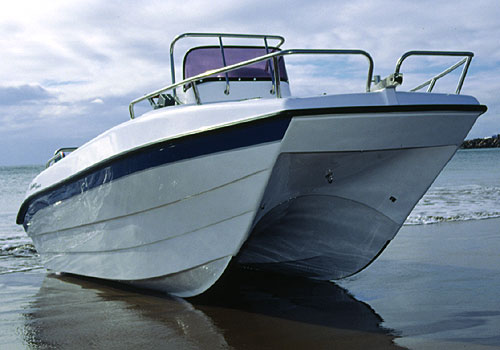
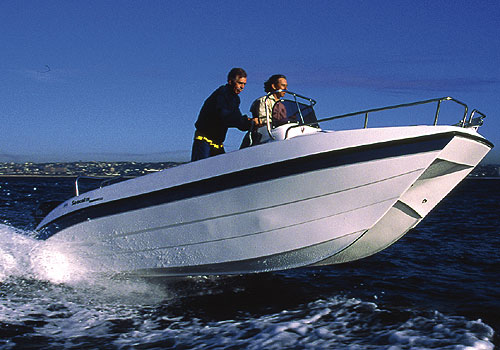
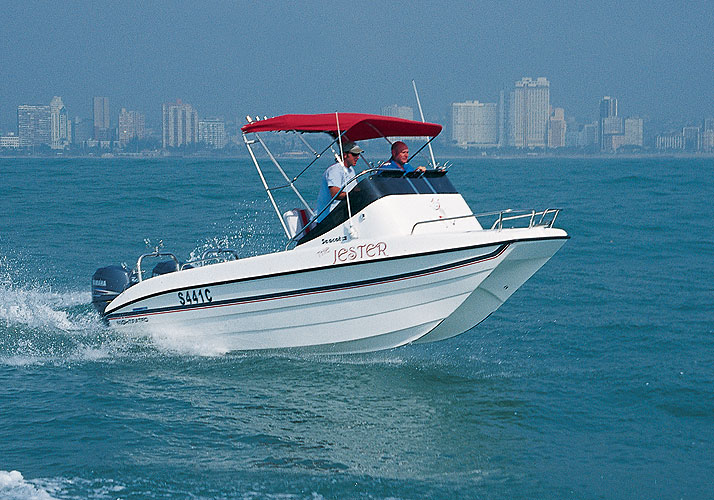
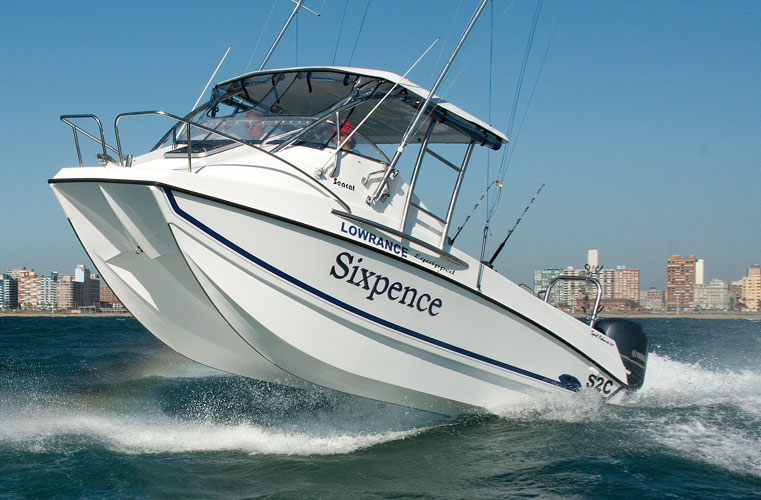
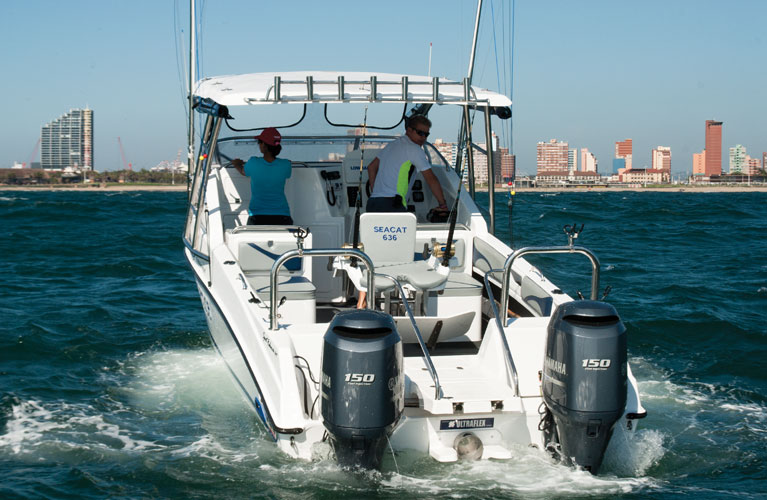
    A TEST of the Seacat 636 Hardtop was long overdue. During the Marlin Club’s annual competition held at Durban Ski-Boat Club I got my first peak at the new 636 Hardtop. Although it is the same hull as the 636 that I have tested previously, she has a totally different look about her due to the hard top.

    Shaun Lavery of Yamaha approached me and requested a test on this new 636 Seacat, and when I met up with Shaun and Grant Read at Durban Ski-Boat Club for the test, I noticed that they had finished her off with all the bells and whistles.

    They have also added a couple of extras that I will discuss later.
    FIRST IMPRESSIONS
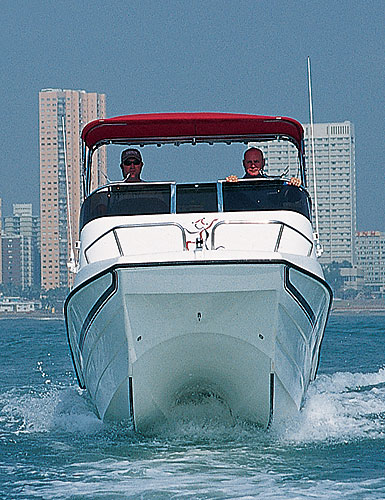
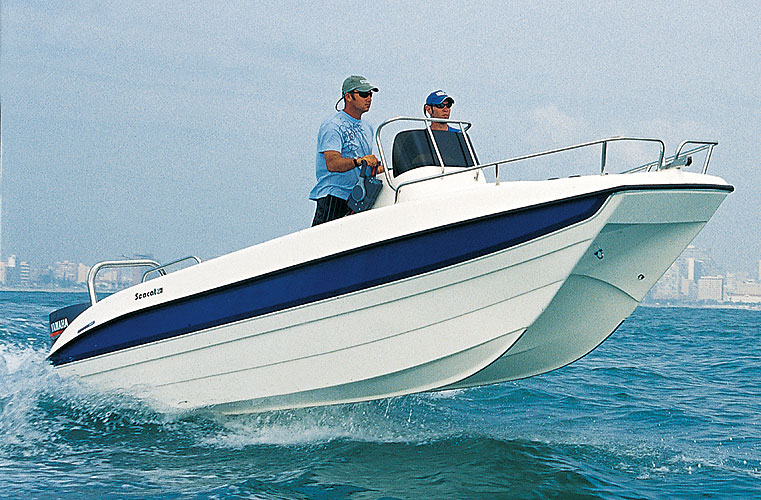
    This Seacat 636 Hardtop is impressive indeed, like her centre console predecessor which I tested two years ago (see SKI-BOAT May/June 2011), but even more so with her hard top which gives her a more sporty look and finish. Her hard top and forward console makes her look like a different boat.

    Although I prefer a centre console craft, this boat seems quite different to the usual forward console boats I have tested. I was keen to assess the difference between the two boats. 
    I was most impressed with the centre console version — so what lay in store for me with the new 636 Hardtop? Time would tell.

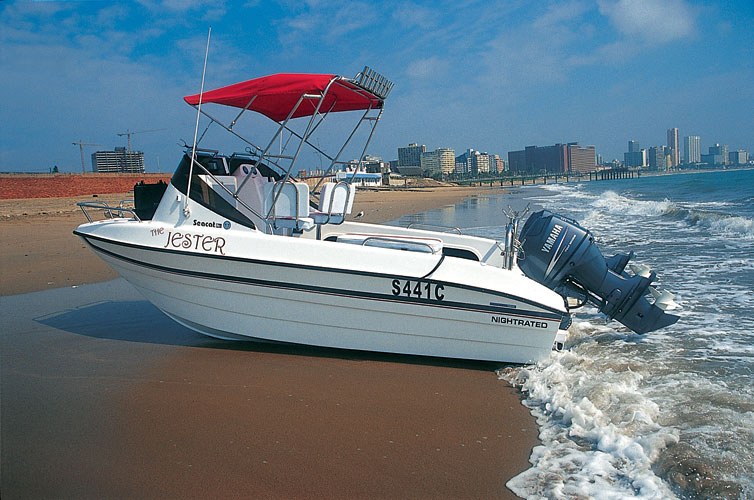
    Although we used the club’s tractor to put her in the water, I was looking forward to returning to the beach to see if she loaded as easily as the centre console, not that I envisaged any problems. The more you do it the easier it gets.

    We have all had our fair share of battling to get some or other boat loaded or offloaded at some time or another, but that’s all part of the learning process. As I said, the more you do it the easier it gets — or so I hoped. When I ran her up the beach after the test, Shaun used his Navara to pull her onto the trailer with the winch. Every time I watch him, he makes it look so easy, something gained from experience and doing it over and over again.

    Because of her size she comes on a double-axle galvanised trailer.

    WEATHER CONDITIONS
    I have to say that this was one of those times that hope played a large part in the photographic exercise. All one has to do is hold on, shoot, and hope the photos come out!

    The sea was horrible with swells coming from all directions. However, I could not rush the Seacat 636 Hardtop because with all the horsepower in her large engines pushing us, if I caught a swell just wrong or too fast we would have been airborne in an instant. Not that she is too light — no, nothing of the sort — it was simply a case of intense concentration under the circumstances in the prevailing atrocious conditions, and tapping off when necessary.

    The northeaster made the sea look like the Zambezi at the foot of Victoria Falls. However, I have to add that these conditions were just what the doctor ordered for the test. If she was ever going to break or take on any water, it would be in conditions like these.

    So, with a fairly high shore dump rushing onto us, we struggled to turn her around and push her far out enough to be able to start the engines and get going. Remember, this is a big boat, so if you going to try and push her by hand on the beach you will suffer. That is why most operators of big boats like this mount a push bracket at the stern for a pole to push her in, but unfortunately we didn’t have that luxury and it turned out to be hard labour for us. 

    However, the three of us eventually managed, and after getting a wee bit wet, off we went into the maelstrom.
    MOTORS, CONTROLS AND PERFORMANCE
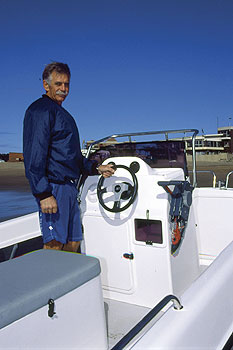
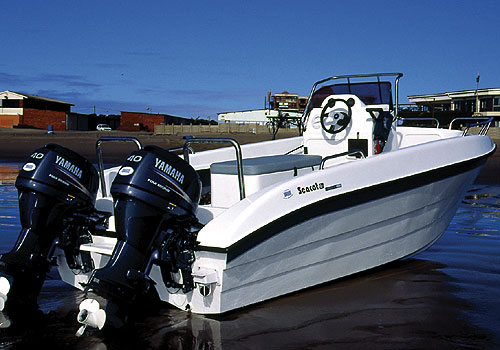
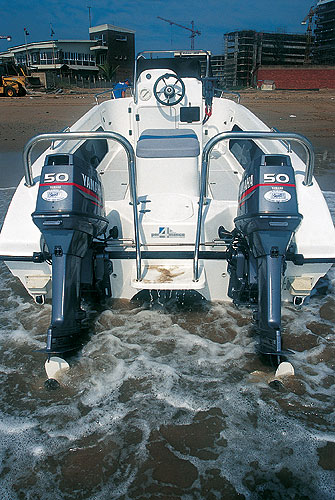
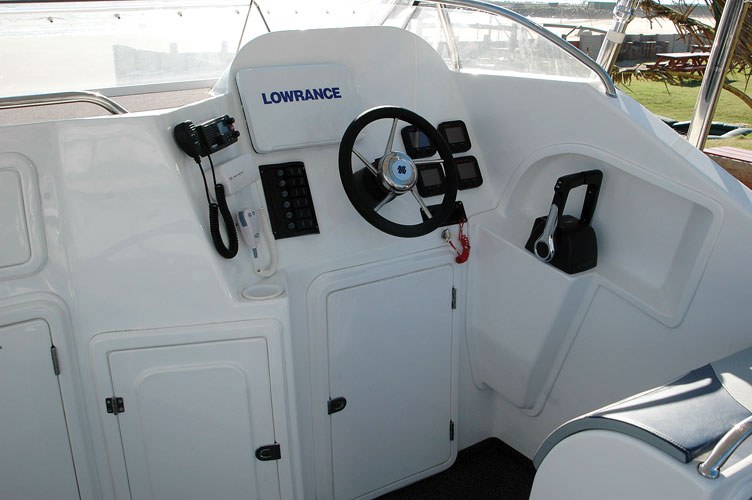
    This Seacat 636 forward console with a hard top was fitted with two 150hp 4-stroke Yamaha engines with binnacle-mount controls. They’re beautiful engines with a lot of power, so were right up my alley.

    Especially with a big boat like this I believe she needs ample power behind her just in case she needs it. The controls were very smooth, but the only thing to watch out for with these controls is they do not have a neutral lock. That is why they are so smooth — you just push forward and they slip into gear. You pull them back to the middle and they are in neutral, but if you pull too hard they go into reverse and you will hear gears grinding.
    Similarly, you have to be careful that when you hit the beach you do not pull the gear lever too far back.

    With power from twin 115hp 4-strokes during the centre console version test in 2011, I could immediately feel the difference between this boat and the centre console. Quite a difference in power, in fact.

    It is actually quite funny because a few years ago everybody was asking whether they should choose 4-stroke or 2-stroke as back then there was little difference between the two when it came to pull-away.

    Nowadays nobody asks anymore. It seems the norm that most boats are fitted with 4-strokes. Even with the bit of extra weight, she is still very fast out of the hole on the plane. For this size boat her turning circle is surprisingly tight, and she’s fast enough to turn between swells when launching through the surf.

    As we proved, it is quite feasible to launch her from the beach, but it is recommended that a push bracket is fitted for use with a push pole. It will make life much easier.

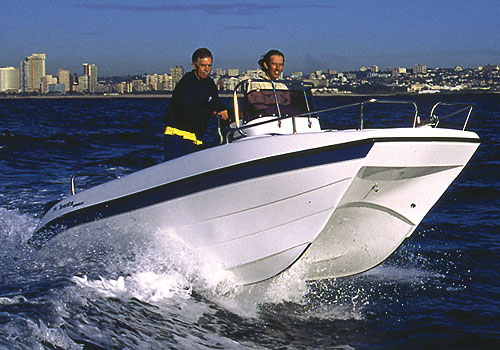
    Her performance out at sea I found to be flawless and she handled the rough sea with grace. With the swell all over the place, she was still stable enough for us to travel at speeds between 15 and 20 knots. She never showed any signs of broaching in a following sea, whilst into the heavy swell it would be the skipper’s responsibility to proceed with care. 
    It’s like driving a car on a road with a thousand speed bumps. The minute you pick up speed you have to hit the brakes to go over the next speed bump. This is how it was in the conditions we experienced that day.

    The message was clear — be aware and be a responsible skipper. Slow down where necessary and accelerate when possible.
    LAYOUT
    Grant has done it again. His layout for a big boat like this is perfect, having utilised the space superbly.

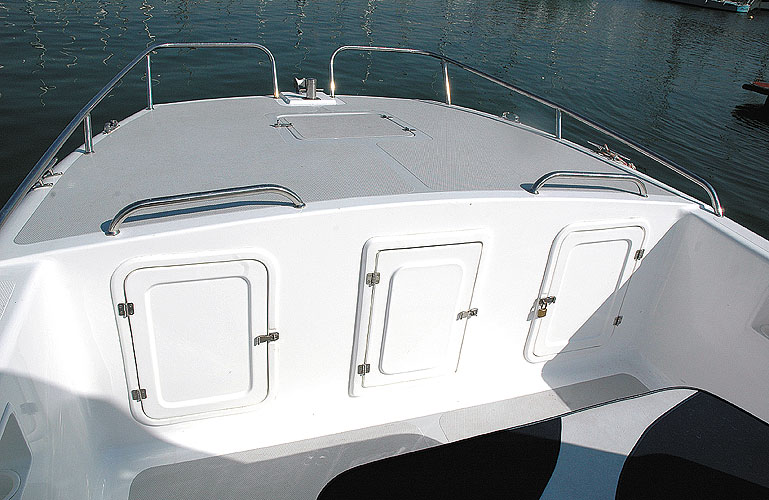
    The normal anchor hatch is in the bow with the hard top attached to the front to strengthen the top. The whole frame has been designed in such a way that there are no rattles when travelling. Easily accessible outriggers were mounted on both sides.

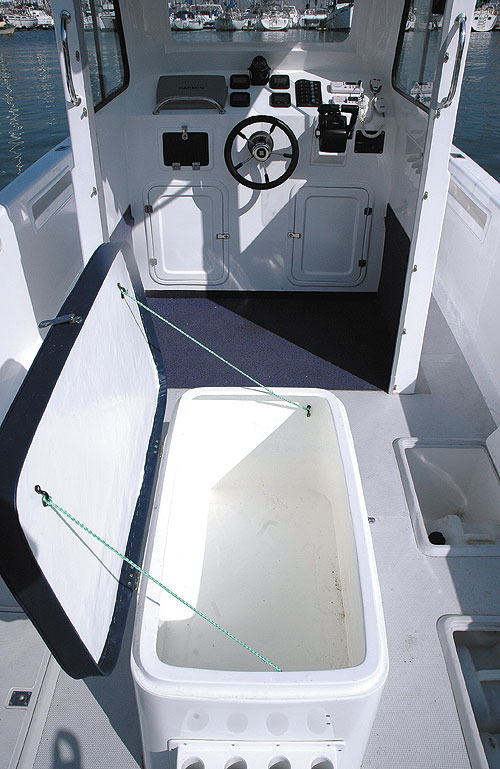
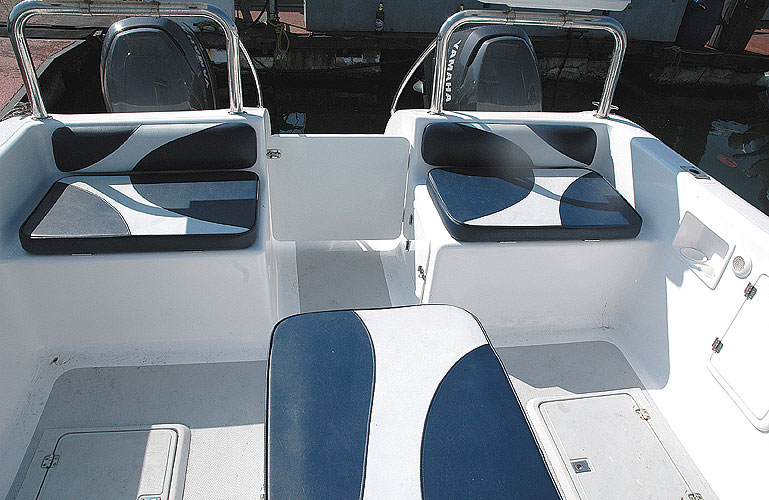
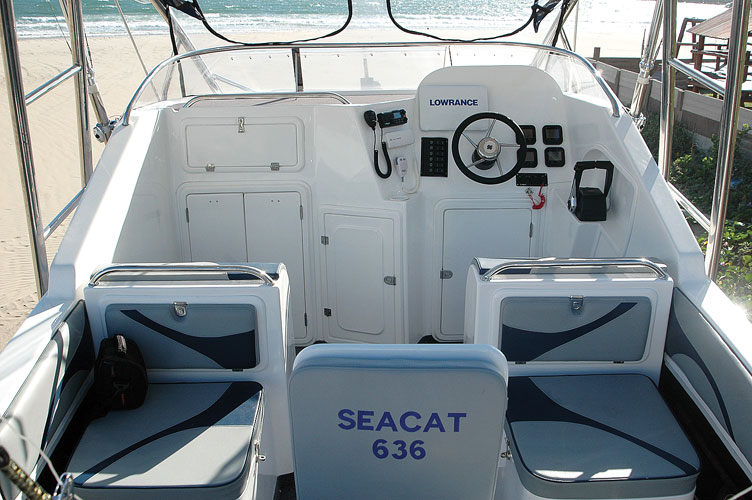
    The front console houses the normal hatches upfront as well as the dry hatches for cell phones and all paperwork needed these days. Then there are two bum boxes in the front with seats behind them for the crew, and with fuel hatches underneath them.

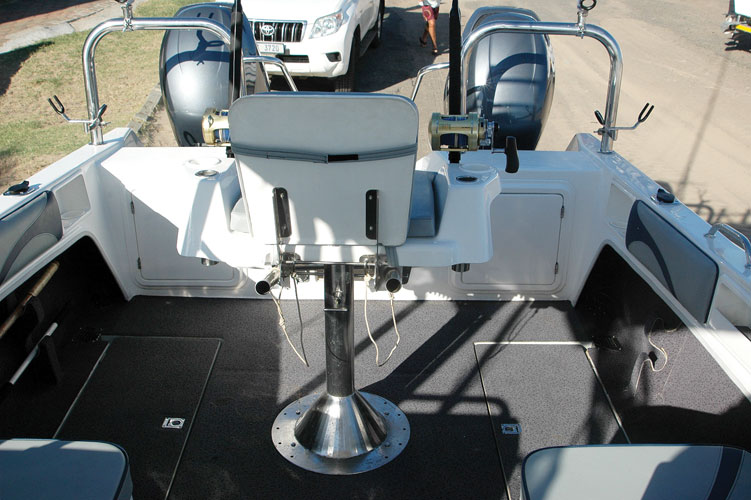
    Self-draining flush fish hatches have been provided in the carpeted deck, flanked by padded gunnels to protect your knees when fighting a fish standing up. In the middle of the deck they have fitted a fighting chair for the marlin aficionado, and at the back in the false transom you will find the livebait well in the middle with a battery hatch on each side.

    A rod holder is mounted on each roll bar at the stern, adding to those on top of the hard top where there are another seven. Added to that is the space for rod stowage recessed below the gunnels.
    CONCLUSION
    Without doubt, this is one of the best boats I have been on. Her layout has been excellently planned, in such a way that there is ample deck space available. And when it comes to her finish, well — what more can one say — it is superb, something we’ve come to expect from all of Grant’s boats.

    I could not fault her ride and her stability was remarkable, especially in the horrid conditions prevailing on the day of the test.

    This is by far one of the most comfortable boats I have been on. Her size is still within the legal limits to be able to tow her around and launch through the surf, and for her size you can tow her with a 4×4, nothing bigger.

    I believe that, price-wise, she is worth every cent if you are in the market for a boat in this class. This is not just another boat in the Seacat range — this is Yamaha’s top-of-the-range Seacat. She’s a very special boat indeed.
  • Seacat 800 — by Yamaha

    Seacat 800 — by Yamaha

    Tested by Henrich Kleyn (November/December 2009)

    Contact 0800 926 242 for your nearest Yamaha Marine dealer

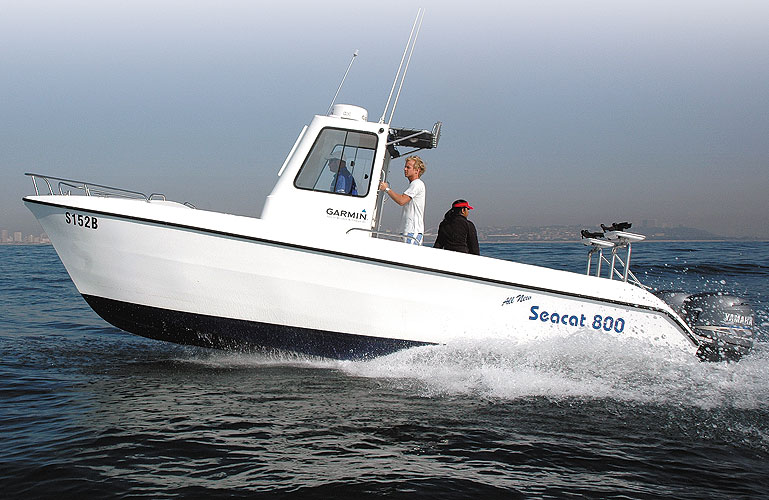
    I RECENTLY had the privilege of taking the new big sister in the Seacat range out for a run. When you test a lot of boats, like I do, inevitably there are some you like a lot and others you like a lot less. This was one of those that I really did like, and really enjoyed taking her out to sea.
    For quite a while Yamaha has wanted to launch a bigger model ski-boat on to the market. They have done a really great job developing the Seacat 800, and I predict she will become very popular amongst big boat enthusiasts.

    FIRST IMPRESSIONS
    I first saw the Seacat 800 from a distance at the Durban Gamefish Classic. I immediately liked the way she sat in the water and how she glided smoothly through the ocean. This was one boat I just had to take for a run.
    The next time I saw her was at the test when I got on board, and again I was impressed by what I saw. On these bigger boats I prefer a centre console, and this is what I was presented with. 
    I must say that Grant Reed has outdone himself with this boat. She was stunning in every visual aspect. I believe Grant has established himself as one of the top boat manufacturers in the country.

    TRAILERING
    This is quite a big boat to tow, but it’s not impossible with the right vehicle. The test model is kept at moorings in Durban harbour, so unfortunately I cannot comment on the towing aspect.

    WEATHER CONDITIONS
    For a couple of weeks leading up to the test, the weather in Durban was awful. Fortunately, on the day of the test there was no wind, but the sea was not kind to us, with swells of 1.5 to 2 metres all over the place. However, this gave me the opportunity to test her to her limits to see how she would handle these unfavourable conditions.

    MOTORS AND CONTROLS
    The demo boat was fitted with twin 115hp Yamaha four-stroke motors with binnacle controls. This Seacat 800 can be fitted with anything from 2 x 115hp to 2 x 250hp motors. As it is, the two 115hp motors fitted for the test pushed this magnificent boat with ease. 
    Although she had been fitted with cable controls, I had no problem getting her into and out of gear smoothly and easily.

    PERFORMANCE
    The Seacat 800 jumped onto the plane in a flash — impressive for a boat of this size. People are quick to say that four-strokes are slower than two-strokes, and to a certain extent they’re correct, but on the top-end I prefer four-strokes. After this spectacular take-off and with this much torque behind me, I gained enough confidence in this new Seacat to push her seaward with confidence. 
    I took her into the swell, and after playing with the throttles a bit to ensure that she did not slam through them, I easily steered her deeper offshore. There was no hassle at all, even when I turned her.
    Then, with a following sea she ran true with no slamming or broaching. 
    Next, I turned her bow northwards towards Umhlanga and ran her parallel to the swell. She behaved much better than I anticipated, with no rolling to the sides or any other indications that it was not safe to travel too fast. 
    When I turned to starboard and port I could not get her to cavitate. Then I turned and accelerated fast to see how she reacted, and still she was cavitation-free. She reacted very quickly indeed during this aspect of the trial, which shows that she would easily cope with surf launches. During sharp simulated surf turns she proved most willing and able! 
    The Seacat 800 cruises very comfortably at 25 knots. Although she performed very well with the twin 115hp Yamaha four-strokes, I would like to try her again one day with slightly bigger engines — maybe 140hp twins or bigger. If she performs this well with twin 115hp motors, then I can only imagine she would fly with more power.

    LAYOUT
    As the Seacat 800 is a centre console craft, she offers a lot of space all round. She has a state-of-the-art cabin with big widows on three sides, and her navigation equipment and electronics are flush-mounted and look superb. There are two storage hatches in the centre console, and in the bow she has the usual anchor hatch, as well as storage space next to the anchor hatch and under the bow seat. 
    Flush-mount storage drawers have been incorporated into the gunnels, while fuel hatches are situated on both sides of the transom. The coffin-style fish hatch behind the console provides some seating, with more seats against the false transom. 
    The only thing that I would add to the test boat’s layout would be a livebait well. This can be fitted on request.

    FISHABILITY
    This is a big boat with lovely high gunnels, so you would be able to use her comfortably for any kind of fishing. Because she is stable while running fast and slow, as well as on the drift, I’m happy recommending her for all fishing applications.

    CONCLUSION
    As I said in the beginning, Grant Reed has outdone himself and should be very proud of this particular craft. I could not fault her finish nor her performance. Indeed, everything is of a very high standard. 
    My time at sea aboard the Seacat 800 was thoroughly enjoyable, and she did everything asked of her. She has the looks, she has the ride, she’s comfortable, she’s well-appointed. Yes, she could easily be my fishing partner — any day!

  • Seacat CC — A 4,9m craft by Yamaha

    Seacat CC — A 4,9m craft by Yamaha

    Tested by Erwin Bursik (July/August 2005)

    THE Seacat CC made its first public appearance at the Johannesburg Boat Show in 2004, and the two models on display created an enormous amount of interest. Here was a 16ft ski-boat able to be powered by twin 40hp Yamaha motors, whose proportions made her seem like a big boat for her overall length.

    Greg Bennett — “Mr Yamaha” in South Africa — told me that, in line with worldwide trends, Yamaha were pursuing the route of “selling transoms”. In essence, this means designing a range of craft, having them made in South Africa to Yamaha’s stringent requirements, and then, after mounting Yamaha motors onto their transoms, marketing them through their comprehensive South African Yamaha dealer network.

    A first-time buyer or an offshore angler searching for a craft that’s stable, practical and seaworthy — and can get him to the fish and back again —can be assured that the Seacat, backed by Yamaha, is well worth considering.

    GENERAL IMPRESSION

    I studied the Seacat carefully at the boat show and found myself returning a number of times to consider the logic behind the selling of the “transom”, as well as trying to establish in my mind how she would rate as a 16ft offshore ski-boat.

    Both models looked good. I liked the high sides and wide beam, as well as the option of centre- or forward console. Her overall styling also appealed to me. Indeed, I was looking forward to testing one of the models at sea.

    CONDITIONS FOR TEST

    When Greg and I eventually managed to set a date for the test of the Seacat, the weather played ball too.

    The sun was shining for most of the time and a strong south-westerly out at sea — aggravated by a strong, cold land breeze (north-westerly) — made for an interesting sea out deep and relatively calm water along Durban’s beachfront. There was also a mean swell that looked at times as if it was about to break over the Kinmount Bank that lies 300-odd metres off the shark nets protecting Durban’s main beaches.

    It was an ideal setting in which to test Yamaha’s Seacat.

    LAUNCHING AND TRAILERING

    Greg arrived at Vetch’s with two boats — the Seacat centre-console version which we would test, and the Explorer SLC, a 5,1m offshore-rated, single-engined monohull which I would use as a photo boat.

    The Seacat was loaded onto a reasonably sturdy trailer which, although a breakneck model, was primarily designed for slip launches. On the beach, Greg launched the Seacat CC with ease into the fairly soft shorebreak. The boat came off the trailer smoothly, and even though the water was shallow for a long way out, SKI-BOAT’s Mark Wilson and Yamaha’s Warren Gregg turned her effortlessly and pushed her into deep water.

    Hand-winching any craft this size on a soft beach is never that easy, but with the aid of my 9000 Warn winch she loaded so easily. Indeed, drawing a comparison between the Warn winch and a hand winch would be ludicrous.

    I must admit that the new style of using submersible tail lights and a fixed chevron makes launching and retrieving that much quicker, taking away the fiddly job of running cables and bolting and unbolting the chevron board.

    MOTORS AND CONTROLS

    As it turned out, the twin Yamaha four-stroke 40hp motors installed on the Seacat CC were the same motors I had reviewed a few weeks prior to the boat test. This review is carried as a separate article on page 30 in this magazine, so I will not repeat my views in this forum.

    The only point I need to make is that the props had been changed from 13-pitch to 12-pitch, a switch that enhanced the craft’s performance — especially out the hole and during single-motor operations.

    I was also able to use the shallow-water trim lock to good effect in the rough water. This lock, which enables one to set the trim manually, works well but lacks the ease of trim application one would obtain from a conventional hydraulic trim facility.

    HANDLING

    The Seacat CC has a lot of built-in performance features, but she has to be driven hard to show what she is capable of.

    When I first saw her through the camera lens, she appeared lackadaisical in her approach to the sea in which we were operating. On a run out of camera range, though, I saw Greg applying his hand to the throttle, and she suddenly started to look alive.

    “Do that for the camera,” I chirped. He did, and the pictures show the difference.

    After watching him I had an idea of how I would have to drive her, so when I took the helm I also worked the throttles and experienced how well this craft rode the ocean. I also realised why I had judged the craft’s performance to be rather leaden when I reviewed the Yamaha four-strokes on this craft on Durban Bay a few weeks prior to this test.

    With this now established, throughout the trials in the big water out deep, in simulated surf work in the big swells, and while judging her take-off speed using the Vetch’s Pier’s end block as a marker, I used her motors to the fullest and she performed beautifully.

    So, what’s wrong with taking it easier on the throttles and letting her run the sea at her own pace? Nothing. She will still provide a very stable, comfortable ride, even in the big seas. But, personally, I enjoy the liveliness of a craft’s hull over the water.

    The four-stroke Yamaha 40s that were fitted had hydrostatic tilt which eases the effort of tilting the motor into the “up” position. They also have what Greg calls the shallow-water drive lock. This provides a degree of manual trim without having to go to the trouble of altering the trim pin.

    It’s better than having no trims, but I would still like to see hydraulic trim motors on this boat, especially if one wants to run bigger motors than the 40s I tested her with. There were many occasions when I would have liked to have tweaked her ride either laterally or bow-up or down to accommodate the continually altering sea conditions, but I was unable to do this.

    Small boats are not meant for big seas, but occasions arise when their ability to handle such seas becomes critical. To test her resolve in these conditions I took her out into the big stuff, both head-on and running with the sea, and her ability to handle it surprised me.

    Back off Glenashley north of Durban, where the south-westerly chop was quite severe, I began my run home to reach the more protected water off the beachfront. All the skippers who operate off Durban know this run is uncomfortable and, if you angle it, quite wet. However, the Seacat loved it and I ran in at 4 200 revs on each motor which gave me a comfortable 15 knots SOG.

    In the smooth water I pushed her up to 4 800rpm and 20 knots, and later got nearly 30 knots with the motors running full bore.

    I mentioned her stability earlier, and out in the deep I put her through a routine of slow troll on one motor and lure trolling speed, as well as on the drift, to assess this aspect. It was during these trials that her stability really came to the fore. Moving about on the craft, I felt no tendency for her to lean with the weight nor to take water over the transom nor through the aft scuppers. Above all, she was pretty dry, although wind-driven spray is always more pronounced on a centre console craft than on a forward console, and I presume an outing on the forward console model would confirm this.

    In a following sea I found that if I didn’t race down the front of waves she rode better, as the natural ride-angle of the Seacat at speed is very prone. Again, I have no doubt hydraulic trims would have enabled me to get a better bow-up ride.

    With her wide beam she does not come about as easily as I would have expected. In surf-like conditions she goes into the turn very quickly, but I had to use a lot of outside motor throttle to pull her around, then use bursts of the inside motor to pull her out the hole and onto the plane. During these trials I experienced no cavitation, but if I was to operate her in big surf areas with three or more big crew, I would go to at least 50hp motors.

    Greg tells me that a number of rigs are running with 60hp Yamahas and some even with 70s. Those that use the bigger motors do so mainly for pulling waterskiers and water toys on inland waters where power and speed are a fashion statement.

    For her offshore work I give her a good thumbs-up. I liked her very much.

    DECK LAYOUT

    As I mentioned, this craft is available in forward console and centre console models. Both will have their specific applications and will appeal to different users.

    The deck layout of the centre console model I tested has been designed to cater for both the gamefishing and flyfishing fraternities, yet will still have an appeal for social activities where fishing is not on the agenda.

    With a full transom backing up the motor wells, the deck is clear of obstruction, apart from the coffin-style fuel hatch and the centre console, and is extremely spacious for a craft this size. The area ahead of the centre console is also big enough to work a fish or throw a fly, and getting to and from this area past the console is easy.

    The inside flush panelling does reduce deck space a bit, but the ability to conveniently store rods in the rod racks provided makes up for this. Not only does it keep them out of the way, but it also goes a long way towards preventing rod damage. So, in fact, the space is not lost, it’s merely used for a different purpose.

    The console itself is well positioned quite far forward and is both comfortable and practical for the skipper.

    The aft coffin hatch is designed to take 4×25 litre plastic fuel cans, which should be more than adequate for the craft, especially when using four-stroke Yamahas.

    Underdeck hatches, both for livebait and caught fish, are not excessively large but will take most if not all of one’s allowable fish catch these days. Besides, when the fish hatch is full, the livebait hold should be empty and excess fish can be loaded into that.

    Upfront two forward anchor and rope hatches have been provided in a slightly forward-sloping decked area. This area is still big enough and flat enough for a flyfisher to stand on and cast a line.

    Adequate storage for a craft this size will enable all the necessary equipment and tackle most anglers carry with them to be packed away off the deck.

    With regard to the deck covering, a non-slip surface has been laminated into the deck moulding and it works — I did not find it slippery at all.

    FINISH

    A lot of thought has gone into the design of this craft to ensure that the two major components, the hull and the top deck, sandwich together properly in the construction process and are well reinforced. The result is a craft that feels rigid even when it takes a pounding in rough seas.

    All the essential hardware is supplied on this “off-the-showroom-floor” craft, and the buyer can fit the nice-to-have extras at will.

    For a production craft it is well presented and is a boat one could tow out of the showroom and straight to the launching ramp.

    CONCLUSION

    Describing this craft as “entry level” in the offshore market is not entirely appropriate, because although her price is affordable for first-time buyers, I feel she is more than a step up from that.

    The Seacat herself comes from a long line of proven boat designs. This ensures that she is a very practical, seaworthy fishing craft and should be recognised as such. I can personally testify to that.

    There are many offshore boaters who don’t want a big boat, don’t want to fish in bad weather and require a reasonably small craft that they can tow easily both on the road and on the beach. Above all, they want to be able to handle her without much effort with a crew of only two or three. The Seacat is ideal for this market.

    It doesn’t surprise me to hear Greg say that this craft is selling very well, with sales split almost equally between the centre console and forward console models.

  • Seacat FC and CC — by Yamaha

    Seacat FC and CC — by Yamaha

    Tested by Kevin Smith (May/June 2007)

    SPECIFICATIONS
    Length – 4.9m/16ft
    Beam – 2.13m/7ft
    Flotation — Foam-filled (1 300l)
    Hull weight – 400kg 
    Min hp – 2 x 40hp
    Max hp – 2 x 70hp
    Power as tested:
    2 x 50hp 2-strokes (centre console)
    2 x 50hp 4-strokes (forward console)

    THE beginning of a new year is always exciting in the boating and fishing industry, with most of the manufacturers and dealers pushing out new or upgraded products. This year was no different, with Yamaha getting us to again review the Seacat FC (forward console) and Seacat CC (centre console) now that they’ve undergone a few changes — all for the better.
    Well, it took the better of two months to synchronise dates and times and to get the natural elements to work in our favour for the tests. Eventually we got it right and arrived at the Durban Ski-Boat Club for the tests on the day in question. 
    The Seacat Centre Console was originally reviewed by Erwin Bursik in 2005, but it was going to be interesting testing both models together. I was especially keen because I had not yet driven either of the craft.

    GENERAL IMPRESSIONS
    The Yamaha team of Shaun Lavery and Anthony Daniels arrived at DSBC with the Seacat sisters in tow. My first viewings of these craft was a few years back at the factory, and what immediately struck me was the modernised, foreign look about them — notably their curvy lines, wider beam and higher gunnels — which I automatically liked. These Seacats looked well-proportioned for their size and, judging by their looks, I was pretty sure that they would ride well too.

    CONDITIONS
    The launch was calm and the ocean was average, with the leftover chop and swell from a north-easter making it ideal for a true boat test.

    LAUNCHING AND TRAILERING
    The first of the Seacats up for test was the forward console version, complete with all the bells and whistles. The trailer was a decent galvanised, breakneck model and handled offloading on the beach with ease. Having dropped her into the wash, swinging the bow around was fairly easy for Shaun and I, as was the short push through the shorebreak. The Seacat FC’s good, shallow draft contributed a lot towards this ease of operation. 
    Trailering her at the end of the day was also a simple task, as the check chains were set correctly. They enable you to drive the trailer at least halfway in, reducing the distance you need to hand-winch.

    MOTORS AND CONTROLS
    The Seacat FC was tested with the new model Yamaha 50hp 4-strokes (trim-and-tilt) with 13 pitch props. This particular boat has the new, luxury 704 control boxes which do not come standard with the motors. 
    The 704 controls are exceptionally smooth, and what’s nice about them is that trimming of the motors can be done simultaneously off one switch, or individually. 
    Weight-wise, these motors are heavier than standard 2-strokes, but in this case they were well suited to the forward console version because they compensated for the extra bow weight. Another advantage of the 4-strokes is that they run very quietly and have reduced smoke emissions. They are also very economical when it comes to fuel costs. 
    The Seacat FC I tested was fitted with a standard cable steering system. For an entry-level craft and to save costs, it is workable, but personally I would rather fit the hydraulic steering system and do away with something else that’s nice to have but not necessary. The hydraulic steering systems definitely help to control the boat better in the surf zone and offshore.

    PERFORMANCE
    Acceleration on the Seacat FC was quick off the mark. The low-down torque on the new Yamaha 50hp 4-strokes, along with 13 pitch props, provided ample power to push her onto the plane quickly and smoothly, and without me having to push full throttle. 
    In full lock to port and starboard, she accelerated out of the hole fast on a tight turn, with no cavitation being detected. 
    When I pushed the Seacat FC up to higher speeds in the offshore chop, she ran comfortably around 4 500rpm. As with all boats, fine-tuning on the trims is necessary to create a better ride. At higher speeds I found it better to ride with the bow slightly higher in the rough conditions. This softened the ride and kept it drier.
    Cruising into the leftover north-easterly swell and chop, a good ride at speeds of approximately 12-15 knots could be maintained. Side-on and running with the swell and chop, the Seacat’s ride was still good, and at times a higher speed could be maintained by working the throttles. Again, with the ample power of the 50hp 4-strokes, she powered out of the trough with ease, with no signs of ploughing or major broaching. 
    One thing I did find was that she climbed to high revs fast, which is not a problem as the power came with the revs. I am positive that the Seacat would still have ample power if she were running 15 pitch props, and this change might improve the ride and economy further.
    Testing her at all the different angles and speeds, I definitely found that the wider beam gives better stability all round for a craft of this size, and that’s a good characteristic.

    FISHABILITY
    The Seacat FC, being the “super model” of the two craft, has ample space for two to four anglers. The boat is set up to suit the serious angler, having all the bells and whistles to make fishing extra comfortable. The gunnels are a decent height so that you can balance against them while fishing, and there’s enough space to move around the craft if necessary. 
    The two fish hatches are now longer than before and their lids are mounted flush with the deck. Another new addition is the livebait well, something I find essential on any ski-boat. From an angling aspect, this model works well as far as comfort and protection are concerned, keeping you out of the wind and spray. The T-Top gives good shade coverage and provides stowage space for rods.
    Pushing into the swell and chop at both fast and slow troll speeds, the Seacat FC remained comfortable and stable for her size. Running side-on and with the swell and chop, the stability and comfort were also good. When stationary and drifting with the wind, she wasn’t quite as stable, but considering the rough conditions there was no real need to complain. 
    Set up like this, the Seacat FC would definitely keep you out on the ocean for longer.

    LAYOUT
    The Seacat FC has a well-designed, compact false transom area which keeps all the motor fittings neatly out of the way. As previously mentioned, these craft now boast the addition of a livebait well, and also have the standard dual stainless-steel roll bars mounted. 
    Even though it has a raised fuel hatch that carries six jerry cans for fuel, and serves as a seating area, the deck area is still spacious enough for angling purposes. On the craft I tested the deck area was carpeted with Flotex for extra comfort. 
    As I mentioned earlier, the deck also houses two flush-mount fish hatches. Standard rod holders are mounted into the gunnels, with a flush panel covering, which gives better protection to the rods and prevents crew stubbing their toes. 
    The forward console section is fitted with a fair sized T-Top, along with plenty of extra dry stowage space for any other equipment. Other console fittings and trimmings include a full windscreen and stainless steel grab rails. 
    The bow section has dual anchor hatches with non-slip lids, and a full stainless-steel bowrail to complement it.

    FINISH
    The Seacat FC comes across as a far larger craft than her actual size. The new, modern look of curvy lines and higher gunnels, along with all the extras, gives her a nice finish that anyone would be proud to tow out of a showroom.


    SEACAT CENTRE CONSOLE
    TESTING two different models of the same hull can be fairly tricky at times, but it can also be quite beneficial, as you get to test and view the boats in action when someone else is at the helm. 
    When Erwin Bursik tested this model in 2005, she was carrying Yamaha 40hp 4-strokes. For this test, Yamaha 50hp 2-strokes were used. It was going to be interesting to compare the two.

    LAUNCHING AND TRAILERING
    As was the case with the FC model, the Seacat CC comes on a decent galvanised breakneck trailer that is easy to operate, and can handle some of our poorly-kept roads. Launching the Seacat CC was equally as simple as launching her sister — she slid off the trailer with ease and her shallow draft made it easy enough for Mark and Anthony to turn her into the shorebreak and push out. Like the forward console model, it was also fairly simple to get her back on the trailer on the beach once we’d completed the test.

    MOTORS AND CONTROLS
    As tested, the Seacat CC was running two Yamaha trim-and-tilt 50hp 2-strokes. My expectation was that the 2-strokes would out-perform the 4-strokes, but I have to admit that the performance levels were very similar. Both sets of motors had ample power on the bottom- and top ends. As far as motors are concerned I prefer having extra power. Both the Yamaha 2- and 4-strokes are well suited to these craft. 
    The 2-strokes on this model come standard with 703 control boxes which have individual trims. This model is also fitted with cable steering and, as previously mentioned, I believe hydraulic steering is the way to go to achieve added control and comfort.

    PERFORMANCE
    Having just tested the forward console model, I was not expecting the centre console to be as comfortable, especially considering that a south-westerly had breezed upon us, turning the ocean to white caps with speed. However, when I crossed over to the Seacat CC I was pleasantly surprised at her stability in the rough conditions. 
    Acceleration with the 2-strokes was fast, and within a short time of setting the trims I had her riding extremely comfortably. Out of the hole she climbed onto the plane fast, and from a stationary position, in full lock to port and starboard, she spun on less than a ticky with no cavitation when I worked the throttles.
    Heading into the now messed-up ocean, I could maintain a good, soft, comfortable ride at speed without working the throttles. Running her side-on and with the swell and chop, the Seacat CC handled really well, again showing good stability. By tweaking the bow up, I kept the ride reasonably dry considering the conditions. Even when pushing into the troughs at speed she showed no tendencies to plough or broach, which automatically gives you confidence in the boat’s handling capabilities.
    This model actually seemed to perform better when I worked the throttles at speed, which is not usually the case on smaller craft. As with the forward console, the wider beam seemed to give the craft really good stability at all angles. Sure, the spray was a bit more evident, but in those conditions most small boats are wet, so, it was definitely nothing to cry about. Personally, I enjoy open boats like this model and found the performance perfectly suited to my preferences.

    FISHABILITY
    Being a centre console model, the boat automatically has plenty of space for walking around while fishing, but the wider beam adds to this. Like the forward console, she too has high gunnels.
    This model is suitable for the general offshore fisherman and is a definite win for the avid deep sea flyfisher. The bow section is slightly raised and is perfect for balancing against when casting flies or plugs. The anchor hatch area could also be used as a casting platform since it has a non-slip coating.
    The centre console model has the same fish hatch layout as the forward console model, as well as a livebait well and decent rod rack stowage. 
    At high and low troll speeds, maintaining a constant speed was simple, as it was when running side on and with the swell. In each direction the stability and comfort was really good for a boat of this size in the rough conditions we were experiencing. When sitting stationary on the drift, I still felt comfortable while balancing against the gunnels and moving around and I didn’t feel any major roll on the hull.

    LAYOUT
    As with the forward console model, the Seacat centre console’s transom area was compact and neat, and is also fitted with dual roll bars and the new livebait well. The deck area is spacious and uncluttered with a large petrol hatch (holds six jerry cans) which also serves as comfortable seating behind the main console. The centre console version also has decent sized fish hatches that are flush-mounted into the deck. 
    The centre console is large and has plenty of dry stowage space fitted with stainless-steel grab rails and a wraparound windscreen. Although the console is large, there is still plenty of space to get past to the bow area. 
    The bow section has two forward entrance hatches, dual anchor hatches that are easily accessible and full bow rails to complement it.

    FINISH
    Although the Seacat CC does not have all the bells and whistles that the forward console model boasts, she still has the same modern look with a nice finish to her. Being the standard entry-level craft in this range, you can still add on the trinkets when the budget allows.

    CONCLUSION
    Although she’s classed as an entry-level craft, the Seacat centre console still boasts many more features than other entry-level craft. The Seacat CC is really practical, is simple to handle in all areas, is ideal for two to three anglers and is a nice size to tow, which facilitates quick fishing getaways. 
    If you’re in the market for a boat of this size, you definitely ought to take another look at these craft.

Verified by MonsterInsights