Tag: Supercat

  • LANDING A GIANT

    LANDING A GIANT

    Port Alfred gives up two big yellowfin

    By Colin Fletcher

    [Originally published in the May 2024 issue of SKI-BOAT magazine]

    “JASCOMAT, come in for Running Wide.”

    “Go for Jascomat.”

    “We just landed a giant!”
    Let’s rewind the clock 18 hours. The beasterly easterly had been cranking for two weeks, and the coastline around Kleinemonde where I grew up fishing was cold and miserable.
    Cabin fever had set in properly, and as soon as the weather gave us a gap I seized the opportunity and made my way to the rocks. This particular spot was nothing more than just that – a spot. Nothing special, just somewhere to wet a line and enjoy the sound of the breaking waves while soaking in the evening sun.
    After admiring the sunset, I decided to pack it in and slowly head home.
    I passed a few familiar faces and shared greetings. Around Smelly Corner, I met Dave Duncan and Megan McCallum – great family friends who are keen on their fishing.
    “We want to head out deep tomorrow to make the most of the weather but are struggling for crew. Are you in?” asked Uncle Dave. Without a second’s hesitation, I gratefully accepted the offer.
    Not much sleep was had that night, and when morning came I was up with intent. I love heading out deep in search of warm water, because it is something different from the traditional fishing in our area. A fresh double shot of Masterton’s Morning Patrol coffee and some oats porridge, and I was off.
    After a short walk, I met Uncle Dave and Megan on the side of the R72, and we were soon joined by their friend Andrew Thomas. Everyone was in high spirits as the weather was holding well. We made a short trip to Port Alfred to top up supplies, and then headed for the Port Alfred Marina.
    The mouth was dead calm, making for a straightforward exit followed by a smooth hour and a bit’s trip filled with conversation, anticipation and preparation peppered with stories and jokes.
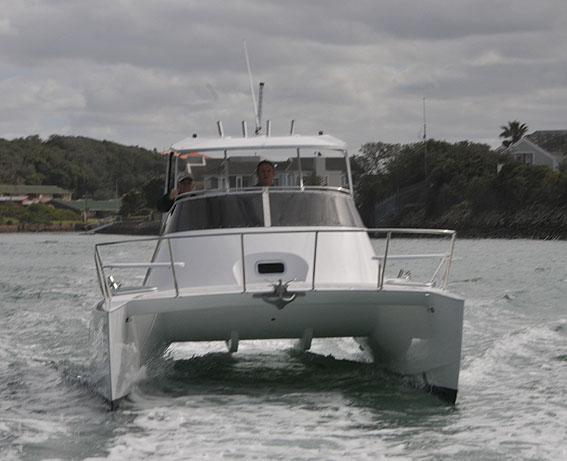
    Running Wide, Uncle Dave’s Supercat 38 Custom Sport, is the most comfortable gamefishing platform I have ever fished on. Built by Supercat in South Africa, it is powered by two 100hp Suzuki DF100B motors. The twin hull design is incredible, and the hulls cut through swells like a hot knife through butter.
    But back to the fishing…

    Dave Duncan, Andrew Thomas and Colin Fletcher celebrate Andrew landing this 42kg yellowfin tuna off Port Alfred.

    We hit warmer temperatures around 28 nautical miles offshore, and the first task was to look for life. We spent around 20 minutes searching the horizon for birds that looked to be flying against the wind or making an effort to follow what we hoped to be tuna under the surface.
    From the flybridge, a promising group of birds was spotted around half a mile away. As we neared, we saw more and more birds, and proper excitement kicked in. Time for action! As we passed through the back end of the flock of birds, the familiar and dreamy sound of a Tiagra 30W shattered the droning of the motors. Uncle Andrew was first up and got settled in on the rod. After a 29-minute fight, a 42kg tuna hit the deck. A beautiful yellowfin indeed.
    “You’re next, Col,” said Uncle Dave.
    After taking photos and dropping Uncle Andrew’s fish in the hatch, we got the lines straight back out. A hard hour of trolling, picking up and looking for birds went by painstakingly slowly, especially as I knew I was next on the rod.
    All of a sudden I heard a shout from the flybridge: “Fish are busting ahead, I just saw a big splash!” I felt that warm feeling in my chest that comes when the adrenaline is just about to kick in, and the second I heard that reel screaming my heart went ballistic.
    On, Dad! It’s game time!
    When I tightened the drag on the Shimano Talica 50 and the fish didn’t slow down, I knew I was in for a proper boxing match with a proper fish.
    As the line peeled off the spool, the tuna began to dive. Megan got the fighting harness setup, and I tied myself to this fish for good; if it wanted to go down, I would be going down with it.
    The harness made a massive difference, taking some of the weight off my arms and allowing me to fight the fish with my knees, leaning back and forth as I cranked in the slack.
    After ten minutes I got its head pointing towards the surface and made back a good amount of line, only for it to be lost again in a fraction of the time as the fish dived again and again and again!
    Eventually, the tuna started to circle as it neared the surface. When I saw colour for the first time I realised how special this fish was, and after some clinical gaff work from Uncle Dave and Uncle Andrew the fish was finally on deck.
    Elation swept over us all when we realised this was the biggest fish to be landed on Running Wide to date – a yellowfin tuna tipping the scales at 50.2kg and the experience of a lifetime!
    After a few photos we popped the fish onto the ice and continued the search for life. Two hours later, after trolling with no luck, we packed it in, satisfied and counting our blessings. Back at the ski-boat club we were greeted by wide eyes and congratulations for a successful day out.
    I would like to take this opportunity to thank Uncle Dave and Megan for the amazing experience. That day could not easily be repeated, especially in our part of the world.

    To watch the video from this trip, visit Colin’s YouTube channel: East Cape Hunting.

  • SuperCat 38 Sport — An 11,6m Craft by SuperCat Marine

    SuperCat 38 Sport — An 11,6m Craft by SuperCat Marine

    (March/April 2001)

    Tel/Fax: (046) 624-1867 • Cell: 076 833 6000
    E-mail: supercat@cluesnet.co.za • www.supercat.co.za
    SPECIFICATIONS

    An eleven metre craft that does 20 knots with a pair of 50hp four-stroke outboards? Pour me another Captain, Dennis, and I’ll listen to your story again…

    That was my unkind view when Dennis Schultz of SuperCat Marine phoned me some months ago. No doubt he detected the scepticism, so he asked me to make the trip to Port Alfred and review his new craft, christened Stiletto.

    I have known Dennis for nigh on 20 years and should have listened a little more carefully when he was telling his story about “eleven metres and 20 knots with a pair of 50hp motors”. Dennis, the most innovative of all South African boat-builders, had the guts to try various designs and techniques until he came up with something very different in the boating game.

    So it was, after much thought, that I arranged to see Dennis’s new craft. Yes, curiosity had finally got the better of me.

    Prior to going to the Halyards Marina within the Port Alfred Marina, I was shown a video of the Bitech Motor-Sailor Dennis had designed and made (see SKI-BOAT Sept/Oct 1995). In fact, he had taken her on two extended cruises from Port Alfred to the Bazaruto Archipelago off Moçambique.

    Then Dennis told me that he was using the design features of the Bitech, and its displacement characteristics, to maximise speed with low hp thrust and consequent very low fuel consumption.
    To qualify this, I’ll try give a very broad, short explanation of displacement-versus-planing hulls: With displacement, the hull floats with its power source pushing it through the water, while the hull retains its same or very similar wetted area. A planing hull, however, uses a lot of power to get a craft out of the water in which it is floating, thereby reducing its wetted area.

    In essence, a planing hull is continually being pushed “uphill” by its motors to retain its planing ability and hence speed. A displacement hull, however, uses the motor’s thrust to push it through the water. This means that the sleeker the hull and the lower the wetted area, the faster the craft should glide though the water. Elementary, my dear Watson!

    Dennis has taken the hulls of the Bitech — which he tried extensively during the two long sea voyages in some terrible seas — and modified them, the deck structure and motor configuration to produce a sportfishing boat with some very unique characteristics.
    Right, I was finally ready to see Stiletto and take her to sea. With the big swell that was running at Port Alfred and the tide almost at spring low, the mouth of the Kowie was going to be interesting.

    And, yes, it was very interesting indeed as the eleven metre craft approached the mouth. There was no way to turn in a hurry — in fact there was no way we could turn at all with the sandbank that was hugging the east pier. It was either take it on the bow or reverse out of trouble — and pray that a big set wouldn’t turn us side-on.

    Interesting, very, very interesting … “Keep her straight,” Dennis instructed. “Don’t use speed, the hull will do the work.” Ja, well, no, fine … it’s not so easy when a two metre-plus wave is bearing down on you, followed by a few bigger ones.

    I watched dry-mouthed as the long forward sponsons were enveloped by churning, white water. I kept the throttles at half power as the wave boiled past us, the water running off the rounded sponsons as they surfaced. Strange — the craft didn’t seem to reach for the sky which is what would happen in a ski-boat, and we were moving forward to meet the already curling backline.
    I wanted to jam the throttles forward, but Dennis talked me out of it. The backline loomed and the sponson cut into it and — without a jolt — we were through the worst! Only then was I allowed to increase speed.

    What an experience — and we did it twice more that day just to relive it and get the adrenaline flowing!

    As Dennis explained, the hull is designed to cut through the water not bounce along the top. Like a yacht, the Stiletto’s hull is rounded and has no straking to cause pounding and drag. Being as long as they are, the hulls ensure that buoyancy is maximised and keep the deck structure high enough above the water to ensure a high tunnel. In most cases, therefore, as the sponsons cut through the water, they are not affected by the chop. Indeed, it really has to be a very big sea before it has any effect on the ceiling of the tunnel and causes both drag and pounding.

    Out at sea the craft was put through her paces in a light-to-moderate south-easter which, in that part of the world, blows almost directly onshore. I had to get my mind around the perceived and actual differences of the craft. I then had to judge her on her capabilities in relation to the task she was required to perform as a deep sea fishing platform.

    In this regard the major advantages are her deckspace (4,5m x 4,8m), stability, economy and cost. The only downside for big game fishing is that the two aft sponsons protrude by about two metres (including the motors). Manoeuvring a big fish from a fighting chair could be interesting.
    However, for light tackle fishing up to 50 lb standup, the small inconvenience of the aft sponsons is greatly outweighed by all her other benefits.

    Dennis took umbrage to me calling the craft a “prototype” for, as he correctly said, the Motor-Sailor version has been on the water for about five years, during which she did a lot of sea miles, including the two extensive, three-month Bazaruto trips I mentioned earlier. In his opinion, these proved the worth of the hull and concept. Consequently, the top deck revamp to suit the sportfishing market is the only area of the craft that has been redesigned.

    At sea I admit it took me time to become attuned to this new concept. When aboard a craft in the 30/40ft class, I am used to thundering along at 20 knots on a conventional sportfisherman, its bow high, smoke billowing from behind in a churned, white-water wake. The feel of power, the thrust of twin 200hp+++ diesel engines, the scream of turbos and the overall sense of speed has been an integral part of my boating life for many years.

    The 38 Sport, on the other hand, is quiet. The twin 50hp Yamahas were barely audible above the light slap of water against the sponsons. There was no bow lift, very little wake and almost disbelief at the feel of the craft’s movement in relation to the sea and the speed shown on the two GPSs that were installed.

    It was only when I was aboard the SuperCat 530, photographing the 38 Sport, that I saw how fast she was actually slicing though the water. In the sea that was running, the smaller craft — renowned for her performance over the water — battled to keep up with the bigger boat!

    These differences are real and take some getting used to. What I mean is that they take some getting used to in terms of believing what is actually taking place. Indeed, I kept looking at the two Yamaha 50s that seemed so small, perched on the end of the 38ft sponsons, and marvelled at the performance they were achieving. “I just don’t believe it!” I thought to myself and uttered out loud many times during my time at sea aboard Stiletto.

    In my mind, the 19ft cutdown version of the 530 SuperCat, powered by a single 50hp Honda, should have raced rings around the 38ft craft, powered with twin 50hp motors. I still find it hard to believe that it couldn’t even keep up!

    During the sea trials at Port Alfred I noted the speeds achieved, and they were as follows:
    RPM Into wind With wind
    2 000 8 knots 9 knots
    3 000 11 13
    3 500 15 16
    4 000 17,5 18,5
    4 500 20 21,5
    Using one motor with the other tilted up, she did 12 knots at 3 500 revs, 13 knots at 3 800, and peaked at 15 knots at slightly over 4 000 revs, which was the maximum the motors could do under that load. These single-motor trials were undertaken while running in a side sea.

    This craft tracks well both at high speeds and on the troll. The latter may not be true in big winds and sea if one is trolling in different directions, although straight into or with the wind must be good, otherwise Dennis would never have reached Moçambique with his Bitech. 
    On the video I saw some of the seas they encountered on that trip. As that particular craft was powered by twin 27hp Yamaha diesels, if she didn’t track at 8 knots, skipper and crew would never have lived to show the video.

    As with all SuperCats, Dennis has put an incredible amount of thought into the detail and finishes of the craft. Indeed, the simplistic overall look is deceiving.

    In short, there is a single bunk up forward in each sponson, with limited stowage in this area. Up on the deck — which can be totally enclosed in zipdown screens — and behind the forward glassed console is a huge, 21sqm living-cum-party-cum-fishing area. Rigged out for tropical cruising as a live-aboard craft with a 700 nautical mile range, this craft could take a fishing nut to paradise and allow him and his friends to have a wonderful holiday.

    There are many variations to the theme on Dennis’s drawing board. A number of commercial operators in the south-eastern Cape are looking at the boat as it has a three-ton carrying capacity with minimal effect on performance. Another interested party wants a booze-cruise party-boat. The options are numerous and Dennis is known for going to enormous lengths to satisfy customers’ demands.

    I know I have missed out a lot of the features of the craft — like the twin anchors operated from the skipper’s console, the large trampoline upfront, favoured by the ladies for suntanning, the special iceboxes, intricate fuel system, stowage hatches, etc. etc. — but I decided it was more important to review the craft’s concept than its hardware. I’m sure the photographs will whet your appetite.

    It would, however, be remiss of me not to mention her fuel consumption. I measured this both physically and on a GPS/flowmeter. The craft used only 16,5 litres after about 4H hours of pushing the motors hard — yes, 16,5 litres for both motors! I thought that since the twin Yamahas were four-strokes, we could not possibly have used less than 50 litres, an estimation I voiced aloud but deemed to be on the low side. I double-checked the consumption as I first thought it was 16,5 litres per motor. But, no, that was indeed the total consumption.
    Yes, there is a lot I don’t know or understand about the displacement hull configuration, but the proof is in the 38 Sport’s performance. For me it was a very unique experience aboard a very unique craft.

  • Supercat 590 Multisport

    Supercat 590 Multisport

    [Original article appears in November 2021 issue of Ski-Boat magazine]

    Reviewed by Erwin Bursik

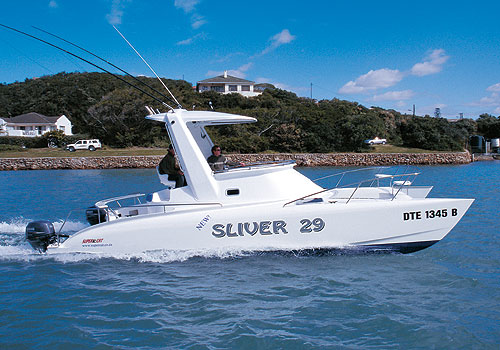
    ON the banks of the Kowie River, adjacent to the Eastern Cape’s hamlet of Port Alfred, Supercat’s walk-on mooring at the yacht club and marina displays a few of the craft this boatbuilding company manufactures. When I visited recently, in front of me floated their flagship — a 67ft super yacht — two 29ft Slivers and their latest redesigned Supercat 590 (the original of which I reviewed in SKI-BOAT magazine back in 1998). They are all magnificent.
    This awesome view encapsulated the variety of incredible craft that are produced from start to finish at the Supercat factory which is situated on a small holding just inland of this town’s industrial area. Dennis Schultz, together with sons Neil and Clinton, have been building offshore ski-boats and yachts for many, many years. Initially they built the legendary Supercat 620, 520 and Witblitz, then they began specialising in their version of displacement craft. To date they have manufactured over 60 of the 29- and 38ft models. These are mostly based in the Indian Ocean islands, but also as far afield as the Bahamas.

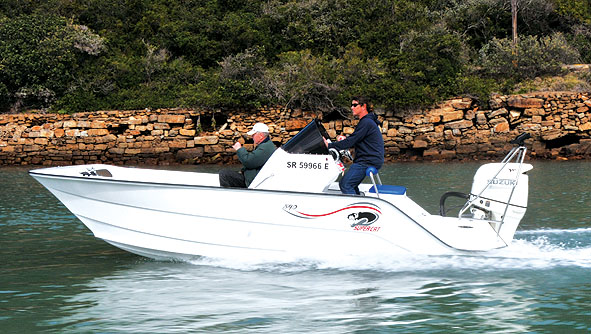
    The Supercat 590 Multisport has been largely redesigned to accommodate the needs of the resorts operating the 38ft Stiletto and 29ft Sliver outboard powered craft based on the islands off East Africa. In essence, the Supercat 590 I review in this issue is to be used as a “sports” craft for fishing, waterskiing and pleasure rides. It will also indirectly provide a backup for those owners who can utilise the outboard motor powering the Supercat 590 as a quick replacement for the motor of the bigger displacement craft should it be necessary.
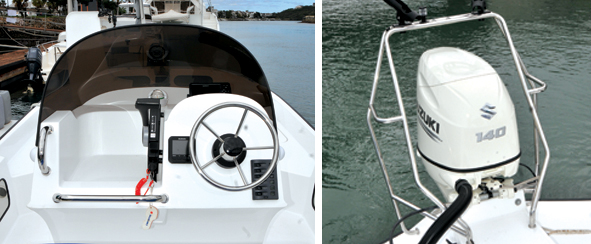
    For this reason, and due to the fact that the 38ft Stilleto and 29ft Sliver are traditionally powered by outboards ranging from 50hp to 140hp, a Suzuki 140hp ATL swinging a 21 pitch stainless steel three-blade propeller was used on the craft I reviewed on the Kowie River.
    At the outset I must admit I was not able to take the Supercat 590 or the latest Sliver to sea. This was because the notorious bar between the two concrete piers at Port Alfred’s Kowie River entrance to the sea was totally impassable. Huge winter swells had been generated by gale force winds the preceding day, and an unusual sand bar had formed between the east and west piers; at low tide it was so shallow that surfers were walking over it on this spring tide. This sand build-up has never been experienced before at this launch site although, under normal offshore sea conditions, boats have only been able to go to sea on the high water.
    On the day of the review the spring tide had just turned from spring low and the incoming tide was still meeting the outflowing Kowie River water, producing a horrible “graau” at the entrance over the sand bank. I admit I am Mr Chicken, and I had no wish to go swimming in that freezing, horrible water in mid-winter.
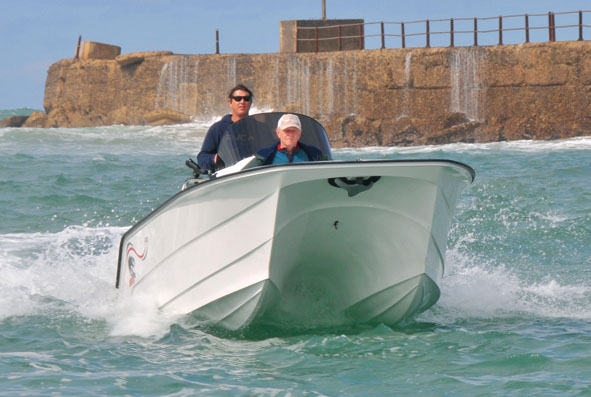
    Neil and Clinton who are now running Supercat Marine grew up on the Kowie and arguably know the conditions of this launch site better than most; they strongly supported the decision not to tempt fate. We thus spent a lot of time “playing” on the upriver side of the sand bar, spinning the 590 into and around in front of the ugly churned up rollers that were coming over the bar into the river.
    The excessive power and torque of the 140hp Suzuki initially frightened me a tad until I got its feel and was able to control the rate of throttle increase during tight turns. Her performance with a roller about to ride up her stern was electric; the Supercat 590 is very stable in the turn and out of the hole.
    While assessing all the above, one must take into account the fact that this craft has a single engine installation that essentially allows one to turn extremely quickly, but does not provide the same stability within a tight turn that one would get from a dual engine rig.
    Watching Clinton handle this craft as he ventured far closer to the washing machine than I would have dared, I witnessed the dexterity he displayed in the bumpy waves. Seeing him spin the craft to escape the blinders building up over the sand bank showed me not only what this craft was capable of handling, but also just how proficient Clinton is with the throttle of the 140 Suzuki, and how in tune he was with the speed and condition of the horrible sea in which he was playing.
    All regular SKI-BOAT readers will be aware of my reserve regarding speed over water, but with Clinton at the helm—and me trying to ensure I didn’t have my glasses whisked off my head—we ran upriver at a top speed of 70 knots, yes 70 knots, with the Suzuki 140 revving at 6 500 rpm. Exhilarating yet frightening.

    Needless to say, when I was behind the helm the throttle never went that wide open and I enjoyed her at speeds up to 40 knots, but mostly worked on the boat’s feel and performance in the 0- to 25 knot range. Nursery school stuff, maybe, but it’s the extent most if not all craft are run out at sea under offshore conditions.
    Being a single engine craft designed for the applications already mentioned, the Supercat 590 is very stylishly presented to appeal to the “sunseekers” as well as inland boaters and offshore ski-boaters. She’s the proverbial boat for all seasons.
    A review of the accompanying photographs will show the open aft transom area where the original Supercat 530 has been extended. This not only acts as an “outmount”, but also facilitates extremely easy access on and off the craft. For those operating on the beaches of the Moçambique islands, for example, when the craft is backed up onto the beach it’s a simple step off the transom for a “bathing beauty”. It’s equally as easy for a spearfisher or snorkeller to board the Supercat 590 in deeper water.
    Clinton uses this model of craft extensively for fishing off his home venue of Port Alfred, and says he simply slides most of the fish he catches up onto the deck. If a longer fish is caught, once it’s gaffed alongside he manoeuvres it aft and again slides it over the transom and into the large fish holds which are designed to accommodate fish as well as waterskiing and diving equipment.
    The Supercat 590 I reviewed was extremely well presented and has incredibly high quality finishes both on the hull and top deck.
    At this juncture it’s necessary to mention the Supercat factory with its immense array of high tech equipment including CNC steel laser cutting and bending machines, computerised design facilities that ensure the factory’s capability to produce incredible craft completely inhouse, including the 67ft yacht shown on the opening page of this article.
    In Neil’s words, “With major suppliers far away from Port Alfred, our capability to make everything — including the extremely efficient 25m high mast — is a big advantage.” All this is evident when one sees and appreciates the finished craft as I did during my recent visit to Supercat Marine.
    While at the factory, I witnessed the bonding of the hull and topdeck of a Supercat 590 in production and saw for myself the under-deck configuration as well as the degree of composites used in the manufacturing process. Neil also showed me the total absence of wood with the build underway, and how their buoyancy is achieved.
    It was a great experience for me to see this side of the boat rather than just be presented with a completed craft to launch and try out on the ocean.
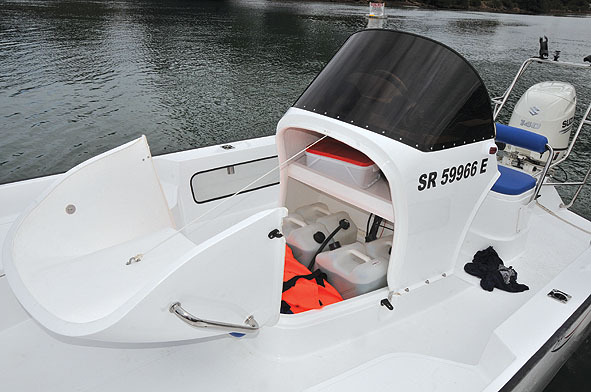
    The boat has a stylish centre console with a front opening, cone-shaped cover housing not only the fuel, but also the life jackets and safety equipment. There’s also easy access to the aft side of the electronics and instrumentation panel.


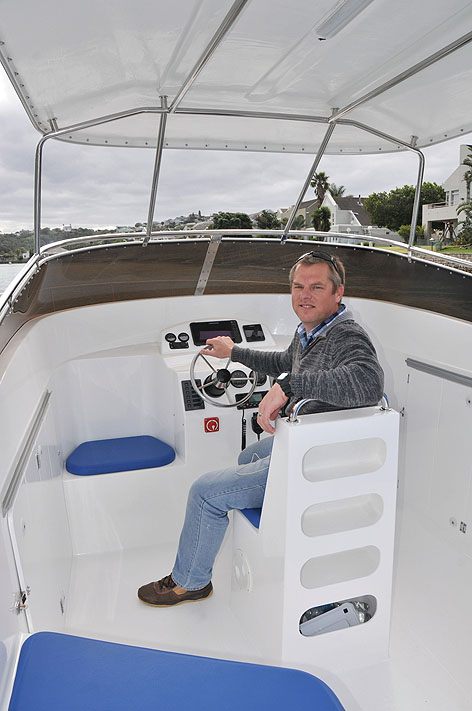
    The helm station itself is unique. It’s very skipper friendly and has all the instrumentation required, offering the skipper good space to stand up and skipper during rough sea conditions, and sit down on a “bum” seat with pivoting backrest while casually boating and fishing in calmer conditions.
    As I intimated, the two large longitudinal below-deck holds were installed mainly to house water skis and spearguns, but also hold fish when the craft is used for fishing.
    The Supercat 590 is a beautifully presented craft that will appeal to the inshore sportfisherman and the entire family.

    CONTACT SUPERCAT ON:

    Tel/Fax: (046) 624-1867 • Cell: 076 833 6000
    E-mail: supercat@cluesnet.co.za • www.supercat.co.za

  • Supercat 38 Sport Custom — An 11.6m craft by Supercat Marine

    Supercat 38 Sport Custom — An 11.6m craft by Supercat Marine

    Tested by Erwin Bursik (May/June 2008)

    Tel/Fax: (046) 624-1867 • Cell: 076 833 6000
    E-mail: supercat@cluesnet.co.za • www.supercat.co.za

    YOUR PERFECT SUN SEEKER

    EARLY in 2001 (see SKI-BOAT March/April 2001) was when I was first exposed to Supercat’s original Supercat 38 Sport. I first took this rather large craft through the notorious Kowie River mouth, head-on into the breakers that emerge around the end of the western breakwater. There’s no possibility of turning a big craft like the Supercat 38 to bolt back into the protected waters of the Kowie. One just has to take a decision and ride into whatever Mother Nature hurls at you.


    They were adrenaline pumping moments, but then that’s how it is with each launch of this incredible craft. The sight of a cresting wave approaching, a moment of involuntary freezing as the craft’s bows cut into the approaching water, and then the almost anticlimax as the wave disappears between the sponsons as she carries on at a constant velocity towards the open sea.

    Normally one would expect the bow to rear up over the wave, with white water everywhere, and a big thump as the craft lands over the wave’s shoulder. Not so with the Supercat 38. Her displacement hulls and overall above-the-waterline design make launches like these all too easy.

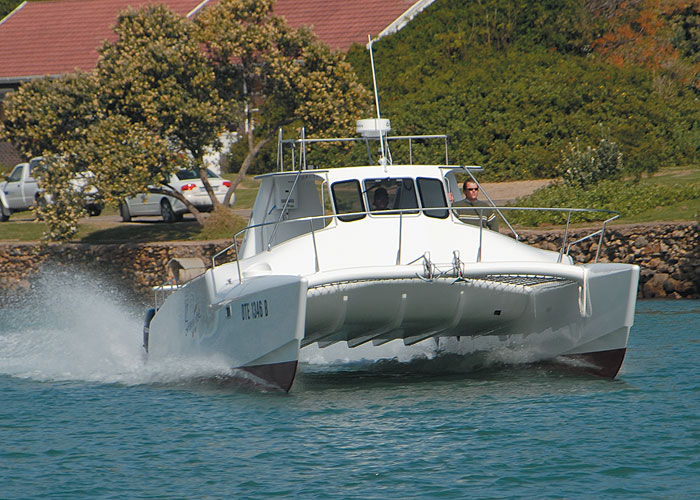
    While I was reviewing the Supercat Sliver 29 during the autumn of 2007, I had the opportunity to play with a Supercat 38 Sport Custom that was due to be handed over to her new owner the following day. Serenade, as she had been named, had been redesigned significantly to suit her new owner’s intended use of the craft. I was more than curious to scrutinise the above-deck changes and to see how this craft handled the additional power provided by the twin 115hp 4-stroke Suzuki motors that were mounted on her transom, compared to the twin 50hp 4-stroke Yamahas that powered the original Supercat 38 Sport I reviewed.

    It is the latter that I will dwell on first. A major aspect of this craft’s performance is to understand — and get used to — the difference between the performance of a displacement hull (as used in the Supercat 38) and the planing hull of the conventional ski-boat we are familiar with. Indeed, we are all used to skimming over the water’s surface, but a displacement hull slices through the water, retaining its waterline depth throughout its performance.

    For this reason, all a displacement hull requires from its power source is constant forward thrust. Motor trim during performances will detract from the craft’s ride and speed.

    On the other hand, with a planing hull — be it a 16ft ski-boat or a 40ft sportfisher — the skipper’s ability to lower or lift the craft’s attack on the sea will assist greatly in the optimisation of the craft’s planing stance, thereby increasing or decreasing the hull’s wetted area and consequently its speed over the water. With outboard powered craft, much of the motor’s thrust is diverted in trimming, thus subtracting that effort from forward thrust of the motors and, therefore, reducing speed.

    Dennis Schultz explained that he always demarcates the Supercat 38’s hull’s waterline by having the anti-fouling painted a contrasting colour to the upper gunnel area. He then tells the new owner to trim his craft to that exact waterline, both with motor trim and onboard weight and crew placement. This will ensure optimum use of power.

    It’s a long story to explain why an increase of power from 50hp to 115hp only produces an additional four to six knots in overall top speed, but a story that should go a fair way to helping readers to understand the theory. However, only a ride on a craft such as the Supercat Sliver 29 or the 38 Sport will put one in a position to fully appreciate the ride and performances of these displacement hulled crafts.

    Getting behind the helm of Serenade, gradually opening her throttles as I made my way down the Kowie River, quickly brought back the memories of the full test I did in early 2001 on the first Supercat 38 Sport. With a ride that’s so different from the norm, it’s no wonder the experience is never forgotten.

    What I really wanted to experience, though, was the effect of substantially increasing the power. I had watched her performing for the cameras and noticed that when she was accelerating very quickly, she seemed to be pushing a lot more white water than I remembered when watching the first Supercat 38, powered by its twin 50hp Yamahas.

    This perception was in fact accurate, as the initial acceleration with the bigger motors is much, much quicker, thus creating more white water than with the smaller motors whose gradual increase of speed seemed to maximise the benefits of this hull.

    Whilst saying this — and proving it during my own onboard trials — I must admit that I enjoyed having the extra power at my disposal as it added that extra excitement of pushing the throttles forward and feeling the craft’s quick acceleration. This acceleration is so completely different to what I’m used to on ski-boats and sportfishers. There’s no wanting to climb out of the water as with a planing hull. There’s just a slicing forward motion that never quite seems to be going as fast as the onboard GPS indicates.

    It is this aspect — actual speed relative to perceived speed — that had me totally confused during the original test. I have always prided myself on being able to judge a craft’s speed, but not with these Supercats. An actual speed of 20 knots SOG feels to me much more like 15 knots. So much so, that when I did the test on the original Biotech, I dug out my own handheld GPS as I thought that the one on the craft was faulty.

    The design of these hulls really is different to what we’re used to, and I still battle to understand how, when you increase power by 120%, your top speed only increases by a maximum of five knots.

    At the end of this review there’s a report written by Dennis’s son, Clinton, detailing his delivery of Serenade, from Port Alfred to Simon’s Town, which will give readers a better idea of this craft’s long range capabilities.

    The superstructure of this custom-built craft was changed to suit the new owner’s specific requirements, and I was surprised to see how much could be achieved without detracting from the craft’s overall striking appearance. Also, adding some extra weight did not adversely affect her performance.

    This particular craft will spend a lot of her time cruising around the ocean as well as fishing, so more emphasis has been placed on onboard comforts and practical requirements for catering and for guests, opposed to just a bunch of fishermen.

    The structure which contains the galley on the port side and heads (toilet) on the other, while taking up a fair amount of space, provides spacious and practical facilities for those onboard. The cockpit helm station area has also been separated from the craft’s fish deck, making it a lot cosier with its lateral seating, and providing more protection for guests in inclement weather than on the express model I originally reviewed.

    The helm station itself is well positioned, making it very comfortable to skipper this craft, and has all the instrumentation necessary for running Serenade, as well as for ensuring the safety of those aboard

    In the forward half of each sponson there’s a cabin which is accessed via a hatchway and steps in the side of the forward helm station area. Both cabins are comfortable and adequate for the purpose for which they were designed. Between the forward sponsons is a tightly-strung trampoline, surrounded by a substantial stainless-steel bow rail, making this an ideal suntanning area for the ladies or even a platform from which an angler can cast a fly or plug.

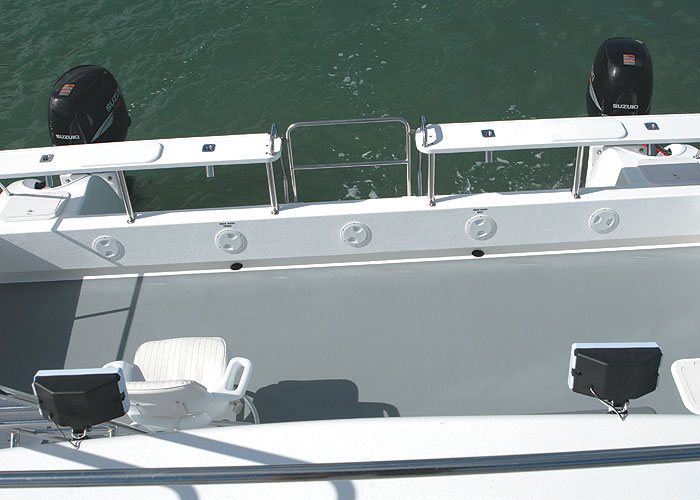
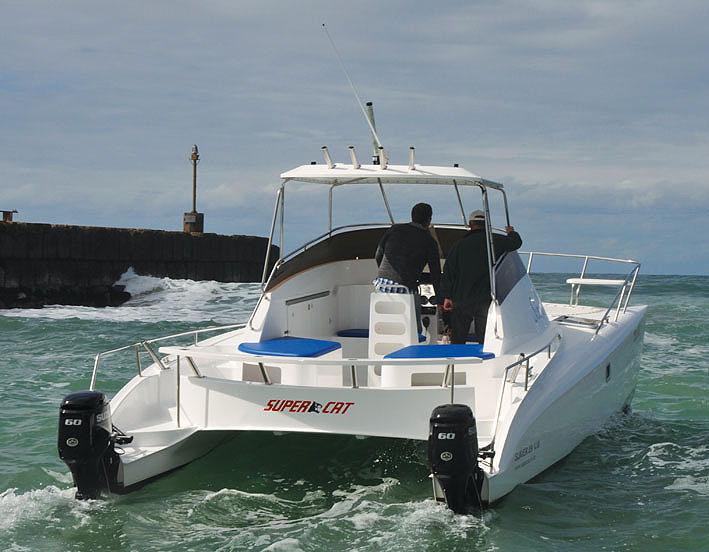
    Supercat have moved the craft’s transom a lot further back to increase the size of the aft deck area. This not only provides for a larger entertainment facility, but will also be more practical for the fishermen aboard. The full transom and trolling boards are sufficiently far aft that one can walk a big fish around the back of the craft without venturing out onto the “sugar scoops”of the aft sponsons supporting the twin 115hp Suzukis powering this craft.

    Dennis and his sons, Neil and Clinton, have combined all their design and production skills, together with a huge amount of enthusiasm, to built Serenade to the most stringent requirements of her new owner. Indeed, they have achieved outstanding results, both in overall design and in her finishes.

    Despite her redesigned format, this craft has all the sea handling capabilities of her predecessors which have found favour in a number of ports and islands off the tropical east African coast. It is in places like this that the Supercat 38 really comes into her own. Her shallow draught, low horsepower requirements and economical fuel usage, as well as her comfortable layout, make her the ideal craft for playing in the sun.

  • SUPERCAT SLIVER 29

    SUPERCAT SLIVER 29

    [Originally published in January 2022 issue of Ski-Boat magazine]

    By Erwin Bursik

    SUPERCAT Marine’s Dennis Schultz, who I have known since the earliest days of SKI-BOAT magazine, first introduced me to his range of ski-boats when I tested his Supercat 620 off Port Alfred on the banks of the Kowie River.
    His innovative ideas captured my attention then, but it really boggled my mind when he asked me to do a review on the Supercat 38 Sport, an 11.6m displacement bitech hull that I was told could do 20 knots powered by twin 50hp motors. He also asked me to test the Sliver 29 that followed.
    My introduction to the craft in the marina was great, but as I took the helm and pointed her hull into the big waves rounding the western breakwater of the Kowie River, my faith in Dennis and the two 50hp outboards powering Stiletto took a huge nose dive. All I remember to this day is Dennis standing next to me at the helm and reiterating that I must keep her straight bow-on to the sea, and saying, “Don’t touch the throttles!” We exited perfectly with oncoming waves seeming to rush through the craft’s tunnel without any major upward lifting of the bow.
    Now it’s 20 years later, and during the intervening years I saw a sportfishing model of the 38 Sport, Castle Lager, very effectively fishing the waters off the north Kenya coast from Watamu.
    The first 29ft Supercat, Sliver 29, was bought into production in early 2007, and I reviewed her in the November/December 2007 issue of SKI-BOAT. That craft was powered by twin 40hp 4-stroke outboards that maxed out at 21 knots at sea.
    With Dennis’s two sons, Neil and Clinton, having taken over the helm of Supercat Marine under the advisory eye of the old seadog, Dennis, a number of changes and innovations have been implemented. One of these was the redesign of the Supercat Sliver 29’s deck layout.

    The original Sliver 29 had a raised deck in the large helm station area, thus providing more headroom in the below-deck accommodation and storage areas. Whilst this boat was popular in areas such as the Moçambique islands, the Seychelles and even the Bahamas, the South African sportfishing market tended to look for more fishing-orientated craft with less emphasis on the accommodation requirements. With this in mind, the Sliver 29 was re-designed.
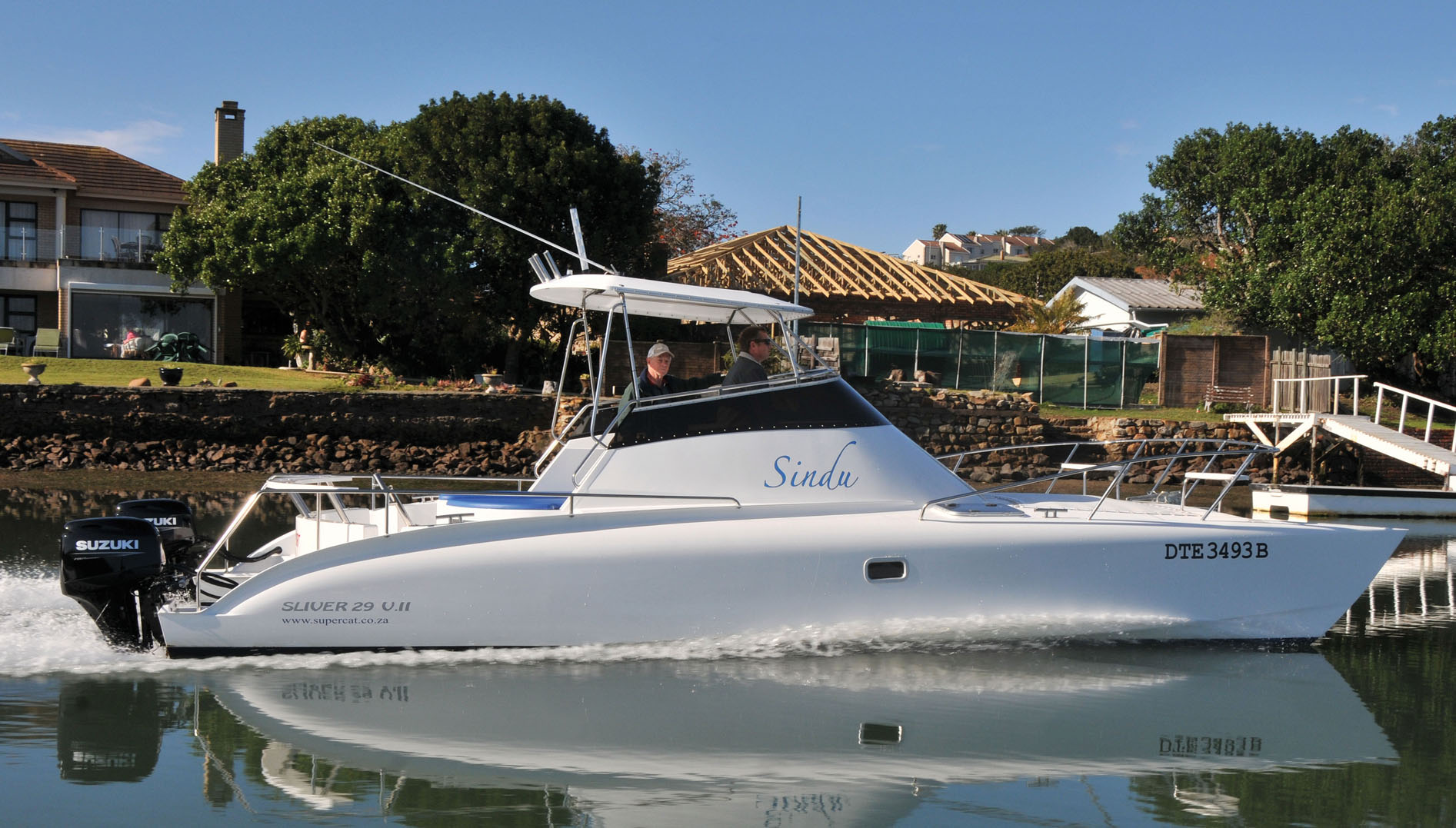
    Having the fishdeck and wheelhouse on one level the way it is now makes it, in my opinion, much more user friendly and gives her a much more streamlined appearance. This craft will be based at Port Alfred and her owner is looking forward to fishing in the waters off this Eastern Cape harbour.
    Once I was behind the wheel of the Sliver 29 and enjoying her performance on the waters of the Kowie River, I very quickly began to appreciate the new design of the helm station itself and also the easier access to the aft fishing deck. This is a great benefit when, for example, and as so often happens when fishing a craft of this size, the skipper has to leave his helm station and quickly move aft to either sort out a tackle problem, gaff a fish or even take a bending rod. It’s all so much easier on this new Sliver 29.
    As I stated in my review of the Supercat 590 Multisport (November/December 2021 issue of SKI-BOAT), I was very disappointed that the mouth of the Kowie River was virtually barricaded with a sand bar that, during the then low spring tide, made it impossible to attempt an exit to sea in a craft of this size. One also has to accept that as the Sliver 29 has a displacement hull, it doesn’t jump up into the plane like many of the planing hull ski-boats we are used to. Any ability to plane across the sandbank and through a break in the waves that may have become possible with other boats would have been impossible with the Sliver 29 as the below water design of her twin hulls is designed to cleave water and not bounce over a sand bar.
    I was thus precluded from taking the redesigned Sliver 29 through the surf and experiencing once again the incredible feeling I had last time of seeing a rolling surf building up in front of this craft’s bow and hearing Dennis’s voice in my ear. On that occasion, with great apprehension to put it mildly, I saw how the bows sliced into the cresting wave and watched the wave build up in the tunnel and slip aft, with almost no upward thrust of the craft’s bow. With very little of this “bow up” or jumping of the craft, its forward trajectory is not slowed down. After the first wave I took, and thereafter a second, we were out to sea with our speed over ground hardly retarded.
    Whilst I missed the “kyk weer” of my previous Sliver 29 launch, this time I was able to place the bow of the craft I was skippering into the big broken water that was smashing over the sand banks and colliding with the strong outgoing tide of the Kowie River. During the exercise it was incredible to note just how little this turbulent water affected the lateral and fore-aft stability of the Sliver 29.
    At one point I had both Suzuki 60hp 4-stroke motors in strong reverse, holding the craft against the outgoing river water whilst facing the very “angry” oncoming waves. It was impressive. Then, using forward reverse on the two Suzukis I was able to turn the 29ft craft 180 degrees on her axis to escape the washing machine of turbulent water, and power upstream in the protection of the wide Kowie River.
    Again I must reiterate the incredible performance of these two low horsepower motors and that of the twin 40hp motors on the previous Sliver 29 I tested. It’s really unbelievable when one thinks that on a conventional 30ft ski-boat — monohull or cat — a minimum of 2 x 200hp outboards would be required for surf operations.
    Whilst doing speed trials on the river it immediately became apparent that there is no “jumping out of the hole and onto the plane” as one expects on any craft with a planing hull. A displaced hull cuts through the water, maintaining its stationary profile and flotation waterline, just incrementally increasing SOG with increased throttle application.

    Exact speed/RPM comparison undertaken naturally varied as the Kowie River was running fairly strongly on the outgoing spring tide. With little or no wind on the river, the approximate data I was able to ascertain was 8 knots at 3 000 rpm, and 13 knots at 3 800. She topped out at 21 knots at 4 500 rpm. Any increase in rpm over that didn’t result in any greater SOG.
    Much of the internal layout of the Sliver 29 is as a result of Dennis’s experience taking the original 38ft Sport on a month-long excursion from Port Alfred up to Moçambique’s Bazaruto archipelago. The original Sliver 29 incorporated many of the niceties and/or necessities he determined were required at that stage. Some of those features have now been sacrificed to make the latest version of the Sliver 29 more practical as a sportfishing craft that will be used for day trips off our South African coast.
    As I mentioned earlier, the craft I reviewed will be used primarly for angling, thus changing the overall emphasis from cruising to fishing. This, to be honest, aligns with my thinking as — for a fisherman at least — the fishability of the craft is more important than the cruising live aboard aspect.
    Having put the Sliver 29 into the rough stuff that was boiling in the mouth of the Kowie River where it passes between the east and west piers, I was totally confident and very impressed with the way this craft could be manoeuvred while having the turbulent undercut waves bashing into her at all angles. It’s not easy to describe, but whether those waves were taken head on, on her forward bow, or side on, she seemed untroubled, and with her lateral stability inherent I had no qualms when playing with her in this rough and confined waterway.
    When I positioned her to take the broken wave on her transom, I noticed that the aft lift was negligible and didn’t force the bow region to dig into the water. Instead, the craft seemed to use its inherent flotation to lift the bows to enable her to glide forward rather than digging in as one would expect with a conventional planing hull of the same size.
    Throughout my review of the new Sliver 29 I really appreciated the changes to the saloon area and having the wide, flat deck area right to the transom. This open deck configuration not only improves the craft’s fishability, but also encourages the crew to be more centrally situated and closer to the skipper. With the older model they tended to say right aft next to the rods so they had quick access while fishing. Now a crew member can stand next to the skipper and be at the rods in seconds without having to climb around and down from the raised helm station of the previous model.
    I personally enjoyed the helm station’s accessibility, visibility and comfort, with all the necessary instrumentation, throttles and steering positioned for maximum skipper comfort.
    Whilst the entire helm station is designed to accept the installation of clears, at the time of the review they had not yet been fitted. From a personal preference point of view, I enjoy clears because they offer protection from adverse weather and also improve the ride and stability of most craft.
    For those unfamiliar with this craft, the below deck configuration of the new Sliver 29 still has the single sleeper accommodation in the forward section of each sponson. With its three ton load capacity, there are a number of variations that can be incorporated in line with an owner’s requirements. The craft I reviewed certainly had everything I would want for a day’s fishing off any port on the South African coast, all stylishly finished.
    I took a long and close look at this craft’s finishes because for many years I have only observed Supercat Marine’s presentations from a distance. I was extremely pleased to see that Neil and Clinton are continuing in Dennis’s footsteps, not only regarding the superb finishes, but also the extra ideas and hardware incorporated to make this craft an extremely well finished and well presented craft.

  • Supercat Sliver 29 — A 29ft craft by Supercat Marine

    Supercat Sliver 29 — A 29ft craft by Supercat Marine

    Tested by Erwin Bursik (November/December 2007)

    Tel/Fax: (046) 624-1867 • Cell: 076 833 6000
    E-mail: supercat@cluesnet.co.za • www.supercat.co.za 

    THE revolutionary 38ft Supercat — Stilleto — which I reviewed in SKI-BOAT March/April 2001, has proved very popular in the marketplace both in South Africa as well as the Seychelles, Madagascar, Kenya and Moçambique. One has even been shipped to the United Kingdom. Number 15 off the production line, destined for Cape Town, was moored next to the 29ft Sliver which I had travelled to Port Alfred to review. She was all ready for delivery the following week, but I still got a little bit of time to play with her …

    However, it was Sliver, a new generation craft which has appeared in recent Supercat adverts in SKI-BOAT, that I had raced down to Port Alfred to review ahead of a series of cold fronts that were rumbling up from the Cape. Bouyweather.com was predicting winds over 40 knots from the south-west, and I knew that a few hours of wind of that magnitude would effectively cancel any plans we might have of exiting the notorious Kowie River mouth.

    Having arrived later than expected due to mechanical problems on the car I had hired at East London Airport, I had only a few hours of daylight in which to take the 29ft Sliver to sea before the darkness and ahead of the south-westerly due at midnight.

    Mooring lines were cast off, and with Dennis Schultz’s son, Clinton, at the helm, we went down the river, through the piers and out into an ugly sea. Manoeuvring through this “interesting” bar with a big easterly swell and a pushing spring tide brought back memories of when I first took this boat’s big sister to sea. The words I penned after that trip were as true on the day I went to sea in the Sliver as they were after my trip on the 38ft Stiletto …

    “And, yes, it was very interesting indeed as the 11m craft approached the mouth. There was no way to turn in a hurry — in fact, there was no way we could turn at all with the sandbank that was hugging the east pier. It was either take it on the bow or reverse out of trouble — and pray that a big set wouldn’t turn us side-on.

    “Interesting, very interesting … ‘Keep her straight,’ Dennis instructed. ‘Don’t use speed, the hull will do the work.’ Well … it’s not so easy when a two-metre-plus wave is bearing down on you, followed by a few bigger ones.

    “I watched dry-mouthed as the long forward sponsons were enveloped by churning white water. I kept the throttles at half power as the wave boiled past us, the water running off the rounded sponsons as they surfaced. Strange — the craft didn’t seem to reach for the sky which is what would happen with a ski-boat, and we were moving forward to meet the already curling backline.

    “I wanted to jam the throttles forward, but Dennis talked me out of it. The backline loomed and the sponson cut into it, and — without a jolt — we were through the worst! Only then was I allowed to increase speed.

    “What an experience — and we did it twice more that day just to relive it and get the adrenaline flowing!”

    Again I marvelled at the way the displacement hulls with their incredibly fine, almost knife-like entry enable a craft to pierce through these big waves and proceed forward at relatively slow speeds. And this is done without the slamming, jumping and ploughing one would experience on any conventional ski-boat of this size, let alone the drenching one would receive.
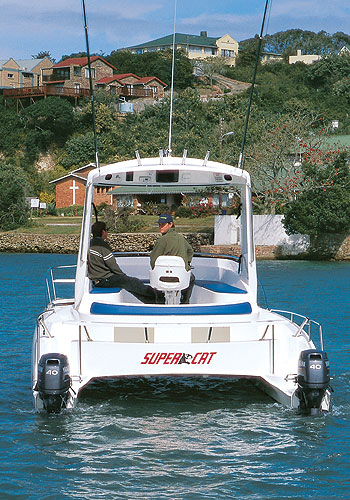
    For those who haven’t read about Dennis’s displacement hulls as opposed to the conventional planing hulls that we are so conversant with in offshore boating, here’s a brief overview: A displacement hull is designed to float in the water — like an ocean liner — at a certain waterline level and then use its power source to push it through the water, retaining that waterline level. A planing hull, however, is designed to float at a certain depth in the water when stationary or at very low speeds; then, using a good deal of power, be thrust forward until the craft’s hull is virtually out of the water and skimming over its surface. High-powered motors are required to maintain sufficient power to keep a planing hull moving forward and also keep most of her out of the water.

    To illustrate the difference, Sliver was powered by twin 40hp Yamaha four-stroke motors which, at top speed, provided 21 knots SOG. I believe it’s fair to say any planing catamaran of this size and weight would require twin motors of at least 150hp to obtain the same performance.

    With the theory behind us, it was time to see how the 29ft Supercat Sliver performed in practice in the big north-easterly sea whose top was being blown off by the ever-increasing north-westerly wind of about 15 knots that preceeded the big blow that was expected out of the west.

    As soon as we exited the Kowie River mouth I took over the helm of Sliver to enable me to maximise the time I was to have on the ocean. The sun was already closing in on the western horizon and I had no intention of trying to ride back through the piers in the dark.

    Easing the throttles forward, I set a course into the prevailing wind and watched as the Navman GPS/sonar reflected her speed climbing effortlessly. Remember that the speed on a displacement hull is an even increase between power and forward momentum. Initially I fell into the trap of thinking that the apparent speed did not correlate with the speed my instrumentation was showing.

    She travels so smoothly that the speed is deceptive. As a result, I kept looking back at where the water exited the tunnel to appreciate the speed at which we were actually slicing our way through the water.

    At 2 000rpm into the wind we were registering 8 knots, at 3 000rpm we were doing 13 knots, at 3 800rpm — 17 knots, and at 4 500rpm — 21 knots.

    I opened the throttles completely, but we seemed to have reached the upper limit of her power because the rpm didn’t increase much more and the speed settled at 21 knots. Dennis explained the reason for this, but it was far too complex for me to fully comprehend. I settled for a speed of around 17 knots with the motors cruising at 3 800rpm for my long run into the wind, but with a big following easterly swell which gave an extremely soft and dry ride.

    Initially I once again had to get used to the craft’s bows being low in the water as opposed to a planing craft’s bow-up stance, and I tried to lift her bows with the motor trim. Dennis just smiled. He had already told me that trim has a negative effect on these hulls. “That’s why I paint the waterline on my boats,” he said, “so that skippers can see how she should ride once she’s loaded, to get maximum performance.” What he meant to say was that it’s for idiots like me who don’t believe in the theory behind displacement hulls.

    I quickly learnt that as I tried to raise her bows the speed dropped astoundingly quickly, even though I had retained the same throttle settings. There was also a dramatic increase of hydraulic action at the stern of the craft as the water through the tunnel — normally very clear — was being impeded, thus causing not only drag, but also some jarring.

    Thus I quickly returned her to an even keel and retained it that way for the rest of the review.
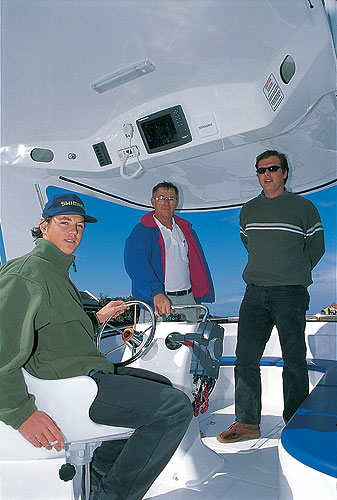
    After a long run to the west I slowed down considerably to see how she would perform at various trolling speeds. Having previously watched one of the 38-footers, Castle Lager, which has been fishing off Watamu, Kenya, for five or six years, especially the way that craft trolls and the fish it catches, I was in a position to compare the 29ft Sliver with a known base. Another benefit of the displacement hulls is that she trolls at a very even speed through the water with little or no reaction to wave action, be it head-on or with a following sea.

    To attain the 5-6 knots required for skipping baits for sailfish or trolling deep-diving lures, the two little 40hp motors were idling along at just over 1 000rpm and producing almost no wake. Even with the relatively big wind-over-swell chop I was experiencing, she trolled effortlessly side-on to the sea, and minimal spray was thrown over the helm station area.

    Clears are available but had not been fitted for the review. If fitted, they would protect the entire saloon area in inclement weather.

    At idle,very slow and at livebait or ’cuda bait troll speed she again held course relatively well, but both motors had to be running, otherwise the wind interfered with the troll patterns I had selected. In a fairly calm sea I am sure that trolling with one motor would be practical as well as productive.

    Two other aspects I must mention are, firstly, the stable way she drifted in that lousy sea; and secondly, on one 40hp motor she comfortably achieved a 10 knot SOG, which she retained for a considerable distance while not putting the motor under undue stress.

    The run back towards Port Alfred was uneventful as I had wind from the stern and a head swell, so apart from ensuring a comfortable ride I had nothing to prove. Unfortunately in the prevailing conditions I wasn’t able to test her reaction to a big following sea other than by following some biggish swells back into the river. Sliver held her speed running back between the swells, and we were able to hold her bow over the cresting wave to give us maximum water depth as we crossed the shallow sandbar.

    Before I attempt to describe this unique craft, I must mention that Dennis made it clear that she was designed for a cruising/fishing application and not as a dedicated fishing machine. As her big sister has proved, she will thus be ideal for use in tropical waters where her ability to “play and fish” around the islands can be put to great use. Another benefit of these hulls is that they can even steam up to a sandbank so that those aboard would barely get their knees wet while disembarking.

    When it comes to her construction, the 29ft cat is manufactured in a unique manner in so far as boat construction in South Africa goes. Each hull is moulded in two halves, and then these are bonded together like a clamshell, as opposed to laminating the entire hull in one form. To put it simply, the two inner-half hulls and the deck bridge are moulded and rigged out with all the extras, and then the outer hull sides are bonded on. We don’t have space — or the technical knowledge — to properly convey the intricacies of this process as well as the pros and few cons of it, but suffice it to say that it works — and works well.
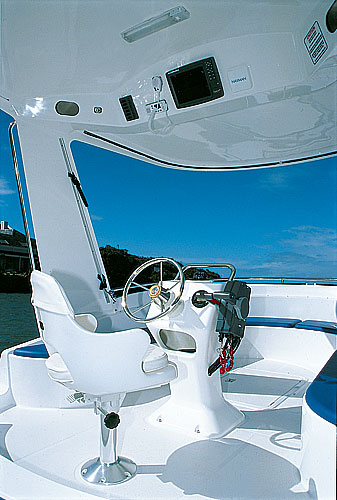
    The designs for the helm station area and the aft fish deck were based on the now proven design of the 38ft Supercat, as well as the experiences of the Shultz family during the month-long liveaboard cruise they undertook on that model up the Moçambique coast. This has resulted in a user-friendly deck layout which also encourages crew to be ensconsed in the right areas when travelling to ensure that the weight distribution — whether there are three crew members or six — will result in the Supercat 29 riding to her designed waterline level.

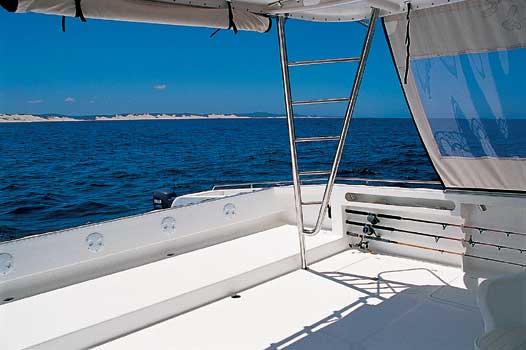
    This is achieved by means of a large horseshoe-configuration seating arrangement in the helm station/saloon area that centres around a freestanding helm station. The skipper’s domain is simple, yet stylish. From a seated position in an extremely comfortable chair, he has all the controls at his fingertips and can easily view the instrumentation both on the control panel as well as the Navman sonar/GPS and radio, mounted on a plinth built into the Targa-style T-top. This T-top becomes the saloon roof when the clears are fitted.

    Aft of this area and a step down is the wide fishing deck that extends a good way aft on the sponsons to a position that will allow an angler to swim a hooked fish past the motors with relative ease. The area has reasonably high gunnels and an additional protective stainless-steel rail for extra safety while cruising.

    Apart from access steps to the motor wells, a full transom stretches across the rear of the craft, and a full array of rod holders can be fitted here.

    A good-sized fish hatch, as well as a pair of Luna tubes, are positioned on the deck, while the livebait hatches are situated right aft in the motor wells.

    The bunking area and toilet are situated in the two sponsons and below the saloon deck. Access to this area is via two Lumar-style waterproof hatches on the top of each hull.

    Access in or out of here is relatively easy, even for a big guy, but I might add it is only for use when one is really tired.

    Upfront a trampoline-styled foredeck that is stretched remarkably tight provides not only a sunbed for the ladies, but also the ideal position for casting and working a fly.
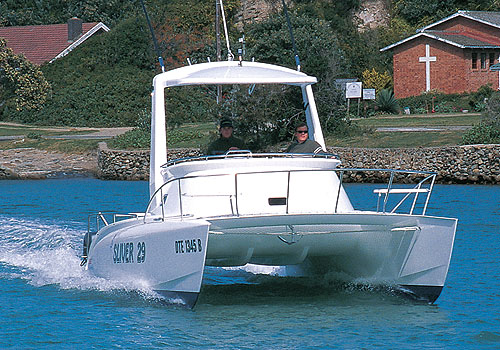
    Having worked with Dennis for the last 25 years, I’ve come to know that his attention to detail and the quality of finish is exemplary. Dennis’s two sons, Neil and Clinton, have now taken over the day-to-day running of the factory, leaving “the old man” to his passion of innovation and building his dream boat, a 67ft Supercat of the same design. Thankfully, Neil and Clinton have followed closely in their father’s footsteps and would rather strive for perfection than take short cuts for the sake of a few rands.

    The craft’s finishes, from the stainless-steel eyelets that hold the trampoline to the lockable hatch covers, need to be seen to be appreciated.

    In conclusion, this 29ft cruising-cum–fishing craft motors on the smell of an oil rag — we used less than ten litres of fuel in over four hours of boating — and comes in at a price that you’d pay for many of the 24-26ft ski-boats on the market today.

    Indeed, this is a boat well worth considering. For fishing, pleasure boating and extremely comfortable riding at sea, this craft could be just what you are looking for.

Verified by MonsterInsights