Tag: Yanmar

  • Afri-Cat 420

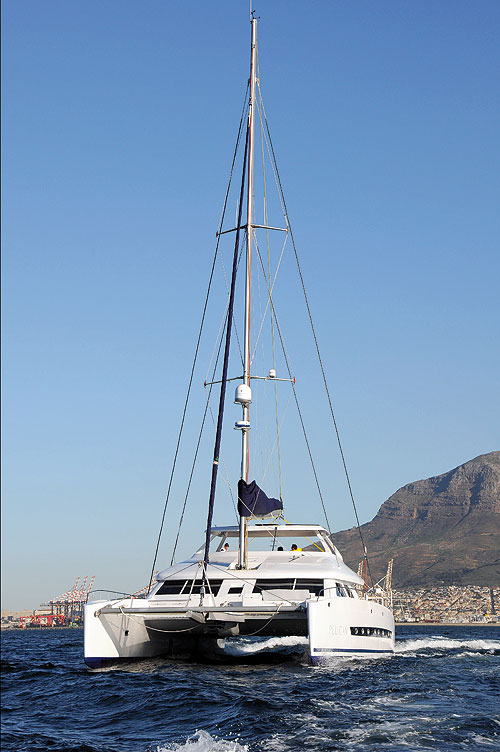
    Afri-Cat 420

    Tested by Erwin Bursik (SKI-BOAT July/August 2008)

    LUXURY ON THE GO
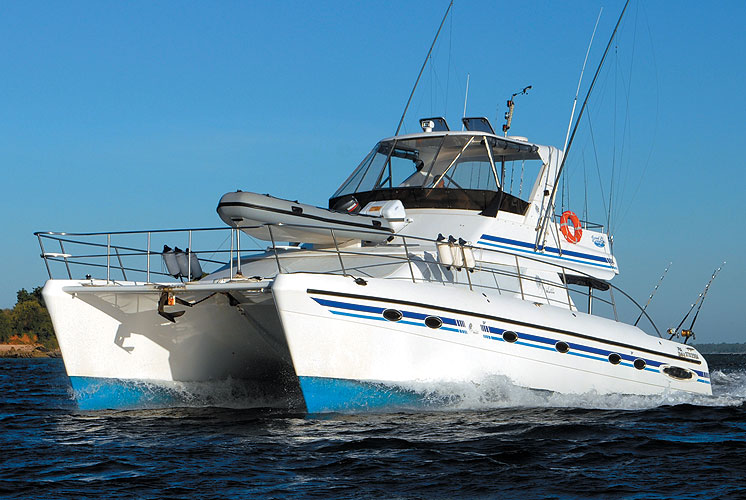


    ANDRÉ Hannekom — an acquaintance of old — phoned me a while back to say he was having a new craft built in Durban for long-range fishing charters, and did I want to come to the factory to see it in its final stages of production. He didn’t have to ask twice.

    As I walked into the Afri-Cat factory in New Germany, all my preconceived ideas about the craft I was about to see were shattered as the production line of new craft came into view, their mighty white prows towering above me. It was very, very impressive. Now I was anxious to see the fleet of large powercats from the stern and to climb aboard Broadbill, André’s new charter boat.

    Over the next month or so I followed her progress and spent many hours on her as the finishing touches were being attended to once she was at moorings in Wilson’s Marina, Durban Harbour. Then, finally, together with Jeff Nieman, MD of Afri-Cat, his brother, Paul, and other technical staff, I was permitted to be aboard her during her maiden voyage out to sea off Durban. In modern parlance, I had “bonded” with this magnificent craft.
     
    Broadbill then departed for her new home port of Pemba in northern Moçambique — I only wished I’d had the time to ride with her. My consolation was that I had already loaded tackle and equipment aboard her for a month or so later when I was due to spend a week on board during her first charter to Lazarus Bank (see May/June 2007 issue of SKI-BOAT).

    This year, together with a few other anglers, I once again joined André on Broadbill for another exploratory trip (see page 42) and an opportunity to reassess Afri-Cats’ powercatamaran.

    Angelo Lavranos — a foremost marine designer in South Africa — designed the Afri-Cat 420 ostensibly for the overseas cruising market, and the craft has proved extremely popular in that sector. Broadbill was the first of Afri-Cat’s 420s to be modified to suit serious offshore fishing for large pelagic gamefish, and its this aspect that I will cover in fair detail.
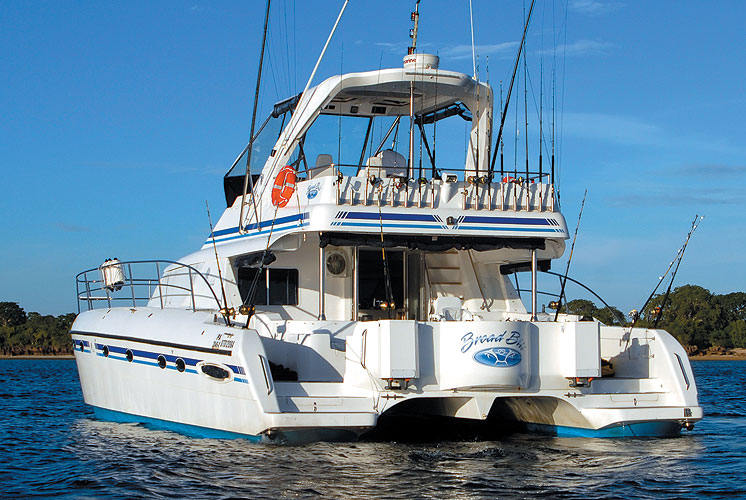
     
    With most cruising craft and yachts, the aft ends are generally not user-friendly when it comes to sportfishing. No doubt anyone who has fished from this type of craft, like the yachts that go to Bassas da India or the local powercats that fish our offshore waters, will agree with me here.

    However, on Broadbill, Afri-Cat have redesigned the transom area to create a fishing cockpit that not only works from a big game fishing perspective, but is also functional for light tackle game fishing. She has all the necessary facilities — such as livebait hatches and Luna tubes — and looks good as well, while providing a safe aft platform from which to fish.

    As the bottom-line of craft of this nature is their fishability, I have purposely addressed this aspect before attempting to convey the overall luxuries onboard the Afri-Cat 420 and her sea handling capabilities.

    With Broadbill’s outriggers deployed, the heavy tackle marlin outfits set in her rodholders, and lures positioned in a 5/6 lure spread, she trolls the ocean very effectively. Not only does her 22ft width allow a wide coverage, but her tight wake at speeds up to 8.5 knots also ensures that the majority of the lures in the spread are in clear water. I also found that working the deck during both the setting of the lures and during multiple hookups was practical and secure.

    André recently laid some areas of Flotex carpeting on the craft’s deck. This has made a huge difference both from a heat point of view as well as to counter the slipperiness we encountered last year with the number of fish we had on the deck prior to releasing.

    The Afri-Cat 420 is powered by twin Yanmar 315hp turbocharged inboard motors with shaft drives. They give her a loaded top speed of 23 knots, an easy planing speed of 16 knots, and long distance cruising speed of 8 knots. At cruising speed, with her fuel capacity of 2 400 litres, she has a great range, a fact borne out during her 2 000-odd nautical mile voyage from Durban to Pemba.

    My assessment of Broadbill’s performance capabilities since my initial ride during her sea trials, then the trip to Lazarus Bank and the last cruise down the northern Moçambique coast almost to Nacala, has remained steadfast. She is a very fine seagoing craft that is remarkably comfortable in normal sea conditions. Even in the post-cyclonic seas we experienced off Lazarus, she was comfortable enough, both while fishing and at anchor overnight on the top of the bank, to enable those of us aboard to enjoy the experience without worrying about being 85 nautical miles out at sea in a relatively small craft in rough seas.

    It was on this first trip that I really got to appreciate the Afri-Cat’s design and the way her twin hulls worked the rough Indian Ocean. With the cyclonic winds pushing in from the northeast — at times well over 20 knots — the run to Lazarus was with the sea on the craft’s port bow. At 16 knots she rode incredibly well with virtually no hydraulic action of hull-over-water, and the wind-driven spray that is to be expected was blown aft of both the craft’s deck as well as the flybridge. Any suck-back of spray onto the craft’s deck was limited to the aft fish deck.

    On the occasions that we had to steer directly into the wind and current, I found that when we went over 16 knots, hydraulic turbulence was sometimes noticeable in the tunnel. As such we did not push her harder than was necessary. Slowing down a few knots vastly improved the hydraulic action to a point where it was hardly noticeable.

    On the way back to the islands north of Pemba, with the wind on her beam, she rode fairly comfortably with no radical action of hull-over-water being experienced.

    Running with a following sea was to be the big test, as this craft has no hydraulically-operated trimming devices and relies solely on her hull design to ensure that she does not dig her nose in a big following sea. André experienced some horrendous conditions on his way up to Pemba and told me countless stories of how Broadbill survived big following seas for hundreds of miles.

    However, I needed to feel the craft — steering and throttles in hand — to make my own evaluation. With the strong winds and current running in the same direction, I had the swell and white caps I needed for just such a trial.

    With this size craft cruising at 10-12 knots, a swell will obviously overtake her, causing her to surge forward as her stern is lifted, resulting in an apparent downhill run until the swell overtakes completely and the bow feels as if it wants to dig into the trough. This is where the hull design on the Afri-Cat comes into its own. Using the substantial buoyancy of the forward section of her sponsons, the hull lifts the front of the craft, thus preventing her bows from digging into the water. After this trial I understood exactly what André had been trying to tell me about her following-sea capabilities.

    It was when this craft was cruising at low speed and was at anchor — even out on Lazarus — that her stability, especially laterally, really came to the fore. Even though she is a biggish craft in recreational boating terms, out on the ocean she is small. And yet her ride is not only very comfortable, but also gives one a strong sense of safety in a mighty big ocean.

    Finally, on the performance aspect of Broadbill, what really surprised me was her low-speed manoeuvrability. Putting a craft of this size in and out of moorings, especially when the wind is blowing, can be a mission, but with her electronic fly-by-wire controls and bow-thruster, André has become very adept at accomplishing the task with ease.

    However, it’s when anglers are fighting fish that manoeuvrability becomes really important. André has had an electronic gear shift/throttle binnacle mounted at the aft of the flybridge. From this position he has a bird’s eye view of the fishing deck and can manoeuvre the craft with surprising ease and speed to assist anglers who have a lively fish on the end of the line.


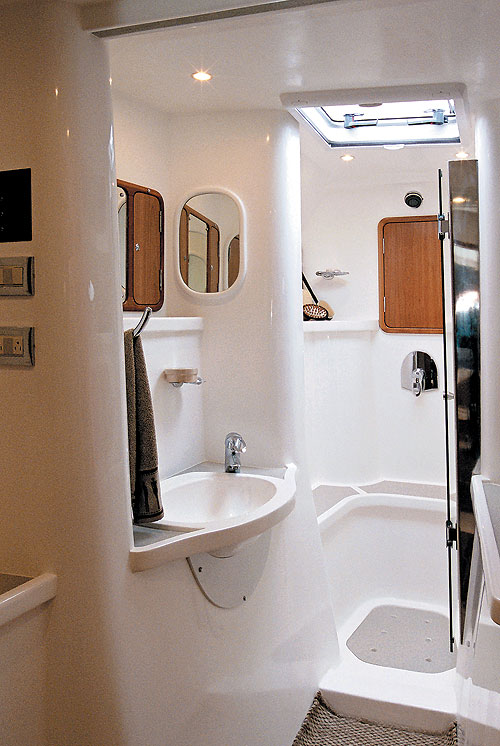
    Afri-Cat’s Broadbill is one of those craft that when you step aboard to enter the main saloon, your mind automatically responds to the sight with a big “Wow!” What’s more, it’s not only the first impression, because every time I board her my reaction is the same. The opulence is prevalent in the large interior layout of Afri-Cat’s 42ft catamarans, and carries through from the main saloon to the three double-berth cabins and the bathrooms aboard.

    Having now spent 14 days in total living aboard this craft with at least five other anglers, plus a crew of three, it has proved to me that the layout works as I never felt congested, experienced cabin fever or sensed the desire to change any aspect of the interior design.

    Catering for the bunch was accomplished very easily by the hostess and was served on the aft deck at a table that accommodates up to six persons. Being a fishing boat, the main saloon table that could have been used for mealtimes was always being taken up by someone’s fishing tackle or people watching videos on the large flat screen TV monitor situated in the area. Another plus was that the ventilation through the aircon system removed all cooking smells from the living area — a personal bugbear of mine.

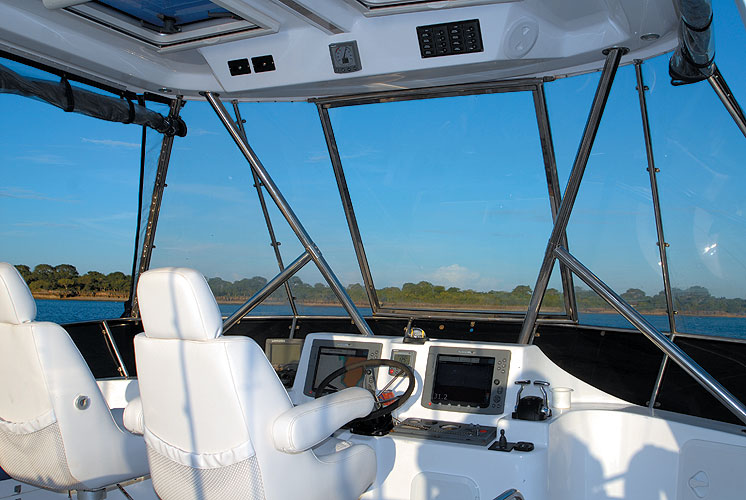
    The flybridge area, where the main helm station is situated, is extremely large, effectively covering the major aft portion of the Afri-Cat 420. Apart from offering a great deal of lounging area, it also boasts a vast amount of storage space for fishing tackle and other necessary onboard requirements for long-range chartering.

    André’s helm station is extremely well equipped with the latest array of Raymarine onboard electronics, including a GPS, mapping and plotter system, sonar that was reading down to 400 metres, and radar, which can also be monitored in the main saloon.

    Protecting the front of the flybridge are two panels of high-impact shatterproof glass with panels on each side of these. Also, clears follow right through to the aft of the flybridge, offering extremely good protection for this area. In the heat of the tropics, the clears can be rolled up.

    Access from the aft deck up to the flybridge is via a curved, wood-faced stairway that is longer than a normal sportfisher’s, yet is practical to scuttle up or down, even in the roughest of weather.

    The Afri-Cat 420 is fully equipped with a a large capacity generator, airconditioning for the entire saloon and cabin area, and a 600 gallon-per-day desalination water plant. These are all essential for long-range chartering in the tropics. During the recent trip aboard Broadbill they all worked perfectly. André has got to know his boat very well, and he controls power and water usage in such a way that we were never restricted in the use of either.
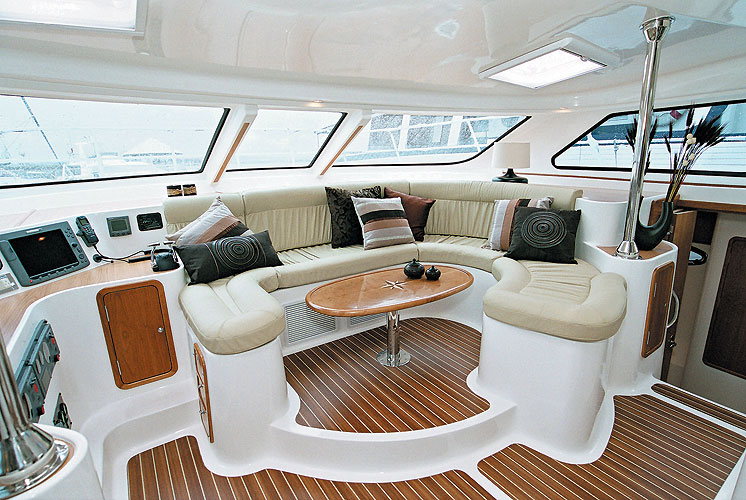


    Her finishes — both interior and exterior — are of the highest order, as is demanded by the overseas luxury cruising community. The attention to detail, use of upmarket hardware and solid construction methods of both interior and exterior facilities also puts this craft in the top bracket of similar boats. At the time of the handover and sea trials, Afri-Cat Marine MD Jeff Nieman was present with his service staff to make sure Broadbill was perfect, and since then they have been extremely helpful in ensuring that this craft is continually operational in the remote area of Moçambique at Pemba.
     
    Broadbill was customised for big game offshore fishing. In my opinion, they have exceeded the practical expectations in turning a luxury offshore cruising powercatamaran into an efficient sportfishing craft.
  • BobCat 43 – A 13m craft by Two Oceans Marine

    BobCat 43 – A 13m craft by Two Oceans Marine

    Reviewed by Erwin Bursik (SKI-BOAT May/June 2001)

    Tel: +27 21 448-7902 • Fax: +27 21 447-6668 
    E-mail: 2oceans@mweb.co.za • www.2oceans.co.za

    A big sportfisher thundering across the ocean is to me an awesome sight that brings to the fore a desire, almost a fixation, to be aboard the craft. Regal beauty, combined with elegance, carries an air of superiority and evokes dreams of hunting big gamefish. It encompasses, to my way of thinking, the ultimate of life’s experiences.

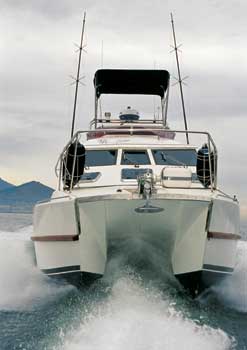
    The Bobcat 43 evoked all these feelings in me. I watched her idle her way out of Cape Town’s Table Bay harbour. I saw her bow lift and simultaneously heard the increasing drone as her twin 440hp diesel motors exerted the thrust to get her onto the plane and racing across Table Bay into the north-west. She was truly a magnificent ray of sunshine in an otherwise bleak, dreary, rainy day.

    “Just let me board her,” was my fervent wish.
    I hadn’t heard that Two Oceans Marine were building such a large boat, so I admit to being a little surprised when Rod Delaney invited me to Cape Town to review her. “She’s a 13 metre craft that will be based at St Francis Bay,” he added, “and she’s powered by twin inboard diesels.” I wanted to know more, but he insisted I come and see for myself. And see for myself I certainly did.
    There she was, lying at her mooring in Table Bay Marina where she dwarfed the craft berthed alongside her. “What’s her pedigree?” I asked myself. I could instantly see much of the Two Oceans Marine influence, and I’d also been told that Bob van Niekerk had had an influence in her design.

    Well, in reality, Bob’s basic mould had been used to provide the client’s overall specification. Under Bob’s watchful eye, Rod and Mark Delaney set about moulding the hull, plus designing and fabricating the top deck and superstructure. The result of their mammoth task now lay before me.

    My wonder and admiration at their achievement was only overshadowed by Table Mountain and the proud “fathers”, Rod and Mark, who were more than pleased with their new “baby” — all 13 metres of her!
    As we moved out into Table Bay, the north-westerly that had been blowing fairly lightly gradually began to increase in strength. Mark, aboard the Bobcat 43, set course directly into this, while Rod and I on the Magnum 25 Demonstrator attempted to position ourselves to capture on film the magnificence of this craft on that dim, dreary, overcast and rainy Cape day.


    It has become a bit of an obsession of mine of late to view the water and wave action of a new craft through the magnification of my camera lens as the she thunders up behind the craft I am on. It’s both intriguing and frightening, yet there is no better way of seeing how a craft’s hull works the water at 20 knots-plus, and then revisiting the experience once the film has been developed.

    Further more, watching a craft perform at speed from close quarters, and having 60-odd photographs of her performance from every conceivable angle, almost negates the necessity of actually testing the craft. Well … almost, except for that most important aspect — the thrill I personally get skipperin

    g a craft such as the Bobcat 43.
    Up on the BobCat 43’s flybridge, I eventually took the helm and felt her reaction as I slipped the electronic Morse binnacle controls from neutral into gear and the throttle began to open.

    To feel the throb of the twin 440hp Yanmar 6LY2 diesels (both turbo-charged and intercooled) as they begin to pick up revs, hear the turbos come in, experience the sensation as the eight-ton craft gets onto the plane — freeing herself of the drag of the water — is a mind-blowing experience. Anyone who loves boats or has experienced the sensation will know what I mean. To others, dream on, for you may one day get this unique privilege.

    As the rev counter began to climb, I simultaneously watched the SOG on the GPS. At 2 000 revs she was on the plane, and at 2 700 we were cruising at 21 knots directly into the north-westerly wind. As I increased the throttle, first to 3 000 revs — 25 knots — and then to full throttle at 3 700 revs, we hit 30 knots SOG. She was flying, barely noticing the chop the 15 knot north-wester was putting on the sea, and I began to feel the craft’s sensitivity through the steering as most of her hulls were out of the water. Just the props, rudder and aft transom area were planing on the surface to maintain stability. (Note: On one motor at 3 000 revs she attained 17/18 knots into the sea and was on the plane.)

    Robben Island was approaching very quickly on our port bow as I pulled back on the throttles to settle at 3 000 revs and about 25 knots. I say “pulled back on the throttles”, but in fact this is a vast exaggeration as the electronic Morse binnacle controls, unlike cabled controls, do not give one a sense of push/pull. The feel is light and very smooth, obviously the only drag being in the actual lever mechanism. As one goes from neutral into gear or the converse, an inbuilt electronic delay of a few seconds prevents one pulling back directly from forward into reverse.
    Mark told me there was a two second delay between moving from forward into neutral, and a further two seconds before selecting reverse, no matter how quickly one pulled the lever from forward into reverse. Throughout the trials — including backing up and the difficult procedure of reversing a boat this size into a tight marina berth in windy conditions — the response seemed immediate, in spite of the inbuilt two-second delays. Amongst other things, listening to and feeling the effect and the smoothness on the gearbox proved to me the benefit of the system.
    Whilst on this aspect of the craft, her response to backing up was very good, considering her length and the twin sponsons that have to be pulled around during this manoeuvre. While backing up at reasonable speed, she didn’t tend to dig in her transom and only took limited water over the back. It must be remembered that in the docking/mooring proceedings, many boats this size have the advantage of bow thrusters to aid pulling the bow around or holding the craft beam-on in windy conditions.

    Back to the craft’s performance, the chop on the water was nothing to the BobCat 43. She made the chop and low swell seem almost lake-like, a big change compared to the 25ft Magnum I had been riding a little while earlier.

    No, I did not have big head seas to run her in, but from the way she rode I would expect no problem with this. I would, however, have been interested to see how she rode a big following sea, seeing as her angle of attack at speed did not give a lot of bow lift.

    Mark has since informed me that a big westerly hit them just past Mossel Bay, on the way to St Francis Bay. “Sitting on the flybridge with the autopilot engaged and a huge wave coming up behind us was an unnerving experience,” he said. “I just wanted to grasp the wheel, but after a few waves had pushed us and the craft had handled them beautifully, I was both relieved and confident enough to relax and enjoy the ride, leaving the autopilot to do the work.” 
    As can be expected, from the control station inside the main cabin — into which he retreated as the conditions worsened — the seas, especially following seas, never look quite as bad as they do from atop the flybridge.

    I had put the BobCat 43 through a range of trolling speeds with the wind blowing from every angle to see how it affected her momentum. Speed-wise, at 1 500 rpm she did 9 knots; 1 300 — 7 knots; 1 000 — 5 knots; and at idle 700 — 3 knots. Her directional stability was very good, only picking up wind effect at very low speed with the wind on a port or starboard quarter.

    This craft produces a very flat wake with minimal white water at troll speeds, less than a quarter of the white water produced by the outboard-powered Magnum 25 trolling next to us at the same speed. Therein lies, I believe, another theory of the benefits of trolling big lures behind inboard-powered craft as opposed to outboard-powered craft.

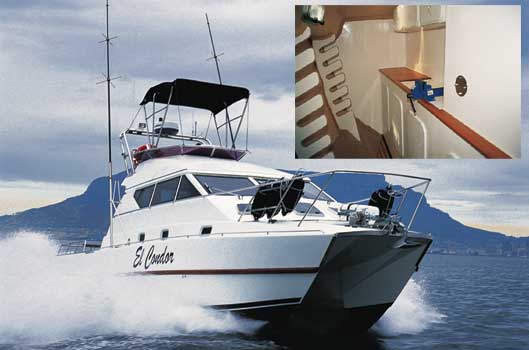
    Before trying to understand the niceties incorporated in this magnificent craft, the owner’s requirements must be explained. Peter Sprung is a German national based in Hong Kong where he has a 43 Bertram. He intends fishing the BobCat 43 off St Francis while staying at his holiday home in that area. Peter has fished extensively around the world and was adamant that he wanted a sportfishing boat and not a “party boat”, and his criteria flowed from that directive.

    As a result, fancy cabin space and decor is minimal, but in its place, forward in the one sponson is a large tackle “room” with rod racks, a work bench with a sturdy vice, plus many cupboards and drawers for tackle. This is the most sensible use of forward space I have come across.

    Peter does have a small master bedroom and small skipper’s cabin, but they are plain and functional for a fishing craft. A good feature is a very well-designed and spacious shower/toilet/bathroom, big enough for even a large guy like myself to move around in, without feeling claustrophobic every time I try to get into the toilet, let alone shower, of a sportfisher.

    To carry on the theme, the large main saloon interior is beautifully yet practically appointed. It’s a saloon one will be impressed by, and yet a fisherman can still enter and not be intimidated, as if he was entering the Lord Mayor’s parlour.

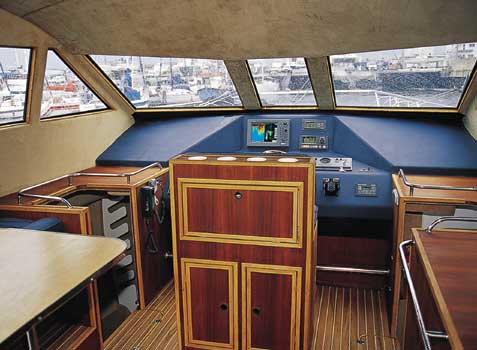
    The main control/helm area is midships in the BobCat 43 and is one of the most spacious, well designed and instrumented I have seen on a craft of this size and price range. Having incorporated the entire Navnet electronic integrated network of sonar GPS mapping system, auto pilot and radar — including flybridge electronics — it must make the craft one of the best equipped in the country, as well as a very interesting boat to skipper. Yes, there are indeed lots of toys to play with.

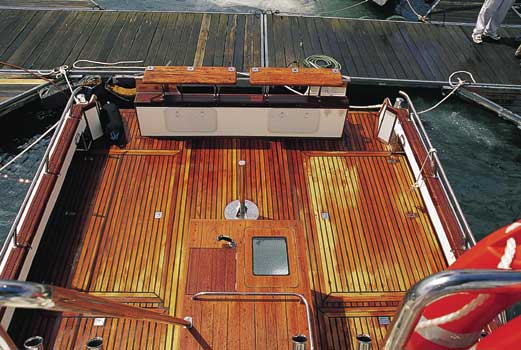
    When it comes to the fishing deck, this boat is huge with a practical and extremely attractive strip teak decking. This is the ideal platform for stand-up fishing for tuna and billfish, but is also practical for the odd stint of bottomfishing. A decision on whether to mount a fighting chair is to be left until Peter has explored the fishing potential, marlin-wise, off St Francis. Again, being both fishing wise and practical, a fighting chair may look great on the deck of this fine boat, but if it’s never used, why have it? It will only get in the way — especially during tuna fishing.

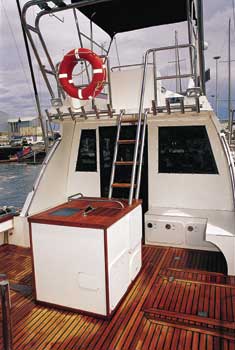
    A central bait-cum-tackle station has been cleverly designed as it incorporates the access to the flybridge. This access is easy to climb, but — more importantly — one can get from the flybridge to the deck very quickly, even if one has to take a shortcut across the top of the bait station.

    Peter is not concerned about large fish hatches as he believes in quality above quantity. Therefore, he has opted for two smallish fish hatches, forward of the large motor access hatches in the aft of the deck. They are big enough to contain the fish required for family and friends.

    Cape-style trolling boards adorn the top of the transom, as do stainless-steel rails along the deck port gunnels, again additions based on practicality over aesthetics. In both port and starboard corners of the transom, a marlin door has been fitted which, in addition to making loading of big gamefish simple, allows one to embark or disembark the cockpit deck with ease when in the marina.
    The BobCat 43 was 98% completed at the time of the review, with only minimal finishing touches to be done prior to delivery. 

    In line with the overall concept of the craft, the finishes were not only of the best material and extremely well made and completed, but were also rugged and practical. However, rugged is perhaps an inappropriate description as many of the aspects of overall finishes have a lot of finesse, yet are still solid and substantial. It’s these sort of finishes that I favour in a sportfishing craft.
    While Mark was giving me a bow-to-stern tour of the craft, I thought about the incredible conceptualisation that goes into creating the thousands of extras that fit into the basic hull and superstructure when the first of a new model like the BobCat 43 is built.
    I have great admiration for what Rod, Mark and all the staff at Two Oceans Marine have put into the BobCat 43. She’s a boat that not only looks stunning but performs — dare I say it — beyond the expectations of all who designed and built her.

  • Luhrs 28 Express Sportfisher

    Luhrs 28 Express Sportfisher

    Tested by Erwin Bursik (July/August 2006)

    FAULTLESS FISHABILITY

    DUNCAN McKenzie of Bluewater Marine was very excited. The 28ft Luhrs Sportfisher he had been telling me about for a considerable while had finally arrived from the United States and was moored at Wilson’s Wharf Marina here in Durban. “You must come and see it now,” were his words — as much an instruction as a plea .

    Viewing new boats is like an addiction for me, and as a result, not an hour after receiving the phone call I was at the marina.

    On board to meet me were Duncan and the immensely proud new owner, Leroy White, who has named his new craft Charlie Brown.

    Initial impressions often prove accurate, and in this instance it was definitely the case. My first thought on seeing Charlie Brown was that I really liked her and was very interested to see more. As an express model, she is low, sleek and extremely stylish, the sort of craft I believe is ideal for both light tackle- as well as marlin fishing on the eastern seaboard of South Africa.

    The next time I saw her was from my boat, Sea Lord, as I waited off Vetch’s Pier for Leroy to exit the harbour so that we could photograph her. Once that was done, I would get behind her controls for a few hours to experience first-hand how she likes African waters.

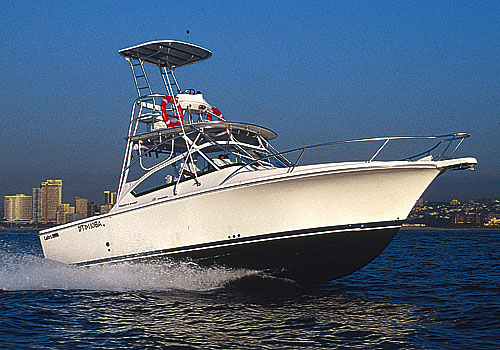
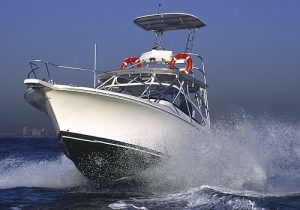
    The first thing I saw was a flybridge flying down the channel from the harbour — the North Pier hid the rest of the Luhrs 28 from view. As she rounded the pier and came into full view, she was very impressive indeed. Beautiful in the early morning sunshine, her sleek, prone ride gave the impression that she was virtually skimming over the water’s surface.
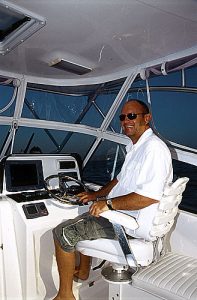
    The drone of her big diesels subsided and her stern settled deeper in the waters as she slowed down to a slow troll to come alongside us. I could really appreciate the lines of this craft now that she was free of the clutter that surrounded her at her moorings.

    The Luhrs 28 Express (or “Open” as the Americans call her) is, in my opinion, an extremely practical offshore sportfisher for a person who wants a fishing machine with a modicum of comfort, yet does not foresee himself using the craft for cruising or as a party boat.

    It was with this firmly in mind that I got myself seated in the comfortable skipper’s seat to take over the controls of Charlie Brown.

    After a number of abortive attempts to get the weather, Leroy’s diary and my work schedule to coincide, we finally got it right — especially weather-wise. A moderately strong south-westerly had blown the previous day, and a strong land breeze was blowing when we launched on the day of the review. The sea off Durban’s beachfront was therefore glassy, but the further offshore we went, the stronger this wind blew. As it was directly across the line of the prevailing swell, it gave me sufficient rough water in which to ride this craft so that I could appreciate her capabilities and gauge what she would be like in the really rough stuff.

    It only took a few minutes of instruction from Leroy on how to drive the Luhrs 28, and then he let me loose at the helm of Charlie Brown. As with most new sportfishers these days, the primary controls (the binnacle-mounted gear shift/throttle control) was electronic — fly by wire. I needed Leroy to instruct me on the various options available through this electronic box, and how they affect the twin 240hp Yanmar 4LHA-STP diesel motors that were powering this craft.

    With the two short control levers’ smooth little red-balled tops firmly in my right hand, the time had arrived … I had become the skipper and all I needed to do was push them forward a fraction to engage the gears from neutral, and push a bit further to get the twin Yanmars to really start working.
    Fortunately, I was fully aware that there would be no mechanical resistance when I moved the levers forward, because unlike the levers of old that need a fair degree of pressure, electronic levers require practically no effort at all. However, even knowing this, my first very gentle push still resulted in a rather sharp production of power from the engines.

    After getting used to this power application, I found out how much torque she has to get out of the hole and onto the plane. This performance aspect was bordering on what one would expect from a craft this length powered by big outboard motors.

    Once on the plane, and with the turbochargers giving their full effect, this craft really gets going very quickly. She settled onto the plane at about 1 700rpm and was doing 20 knots at 2 400rpm. Depending a lot on the trim of this big deep-vee, I found that she rides superbly between 17 and 20 knots at an rpm range of between 2 000 and 2 500. Other than to show off, I cannot see any need to push her harder then this. Yes, I did go faster — to just over 30 knots — but Leroy said that during speed trials she maxed out at 3 400rpm and a speed of 39/40 knots.

    This brings me to the use of hydraulic trims and their value on a craft of this size and design. Luhrs have installed recessed hydraulic trim-tabs. Simply put, these hinged, hydraulically-operated, stainless-steel plates that are situated in a recess just in front of the transom line (one on each side) are forced downwards, thereby using the craft’s forward momentum over the down-trimmed tabs to lift the craft’s transom and settle its bow deeper in the water.

    The hull design, and therefore the craft’s natural or designed ride, is marginally bow high. The trim-tabs are therefore brought into play to bring her bow down when so required, getting her out of the hole when getting onto the plane, and for lateral stability.

    The next issue of SKI-BOAT will feature a full article on the need for trim-tabs, how they work and how to use them to maximize a craft’s ride in various sea conditions. This has arisen from numerous requests from readers wanting to know a lot more about trimming a craft.

    With a dead rise of 19°, she is a seriously deep vee, and as such rides incredibly well into a big head sea and chop, yet one is able to stabilise her lateral stability with the above-mentioned trim-tabs. At low speeds and while trolling she sits very stable in the water, and at these speeds runs a very tight whitewater wake, making her ideal for sailfish and marlin fishing.

    Unfortunately, the sea was not running with the swell, so I was unable to run her in a big following sea to judge her capabilities in that situation. My own craft, also a big, very deep-vee’d boat, handles a big following sea remarkably well. As the ride of the Luhrs 28 is so similar to Sea Lord’s, I believe that she would run a big following sea well, as long as the trim-tabs are positioned to give maximum bow-up positioning and are only used for lateral stability.

    From a handling point of view, the only other aspect that I need to discuss is her ability to backup during a fight with a big fish. In this regard she is remarkable, with the electronic controls enabling me to spin her transom extraordinarily quickly using forward and reverse simultaneously, without excessive throttle. Backing up at a good speed was easy, without a lot of water pushing up over her transom. This ability obviously also helps a lot when manoeuvring the craft onto mooring.

    During trolling, especially trolling very slowly with livebaits, the skipper can make use of the Luhrs 28’s trolling valves that are also electronically operated by means of a touch pad. During trials I found that with one motor in gear and the other running in neutral, she had an SOG of about 2,5-3 knots. With the trolling valves activated, this was reduced to just under 1,5 knots.
    The Luhrs 28 Express is an ideal sportfishing craft for tropical waters, especially for standup fishing for reasonably big fish, such as sails and big tuna, as well as the full range of smaller gamefish. Her open fishdeck and the nice height of the gunnel and transom offers the anglers maximum fishability.

    When Leroy fits the fishing chair and outriggers he has on order, I am convinced she will provide a good platform both for fighting big marlin and for the crew to “work the deck”.

    Both the helm station and the flybridge controls are well positioned for the skipper, whether running to the fishing grounds or trolling. One can immediately tell that a sportfishing captain has had a lot of input in the design of this craft, especially when it comes to what a skipper needs on a sportfisher like this.

    A case in point is that the flybridge helm is well positioned and has an easy view of the entire fishdeck. However, in addition to that, access to and from the flybridge is practical by way of steps built into the hard-top support structure on both port and starboard sides. Even in rough water, while drifting side-on to the sea, I had no problem climbing up and down.

    On to the cabin. The Luhrs 28 Express does not have the sort of cabin setup one usually associates with a sportfisher, but rather a cabin that a serious angler will use. It is not the focal point of the craft, though.

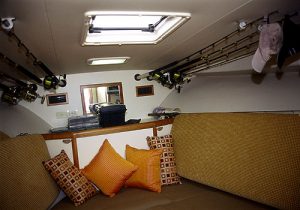
    For a 28ft craft, the cabin is well designed to make full use of the area below the foredeck and provides an adequate seating area that can be converted into a double forward bank, a kitchenette and a toilet/shower bathroom. Leroy has opted for the roof-top rod-rack system instead of a lift-up additional bunk setup that is also available within the cabin.
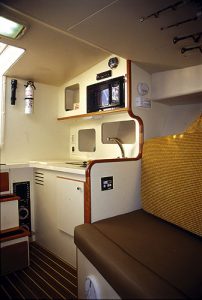
    A further advantage of the cabin area is that it can be locked up securely from within the confines of the helm station. Definitely a plus while the craft is at mooring.

    For a craft this size — and let’s face it, there are ski-boats longer in overall length than Charlie Brown — she has a lot of storage space, a nice work station, a large circulating livebait well and an insulated freezer box, all well positioned for easy access by anglers working the deck.
    A major feature that really impressed me was the easy access to the engine room. The entire aft floor area of the saloon area of the craft lifts up and is supported by two hydraulic-style arms, thereby allowing a big guy like me to get down between the twin Yanmar engines to do the essential checks that are so necessary on an inboard powered craft.

    Most craft emanating from the ’States are well finished, yet when I saw the complete array of Luhrs at the Miami boat show a year ago, I remember being awestruck by the overall presentation of their craft at the show. Now I had the opportunity to not only see one of these craft up close, but also to feel it when it was at sea.

    I found no reason to change my mind. Charlie Brown, a Luhrs 28 Express, is extremely well finished and a craft any prospective owner will always be very proud of. •

    • This craft will be on display at the Durban Boat Show at Wilson’s Wharf from 14th to 16th July, so stop by and have a look at her.

  • Luhrs 41 Open

    Luhrs 41 Open

    Tested by Erwin Bursik (November/December 2009)

    THERE in front of me were seven Luhrs sportfishers rigged in full splendour inside the convention centre where the Miami Boat Show was held a few years back. It was breathtaking, to put it mildly. They formed an arch with their transoms facing one’s approach, ready for the show-goers to step aboard and view the these magnificent craft.

    The memory of that day is indelibly etched in my mind, a lasting impression indeed which again recently vividly came to mind. A Luhrs 41 Open came thundering up behind the craft I was on, on our way out to sea off Durban where I was to photograph her before I boarded her for her sea trials. No picture nor words can adequately capture the sight and sound of this experience.

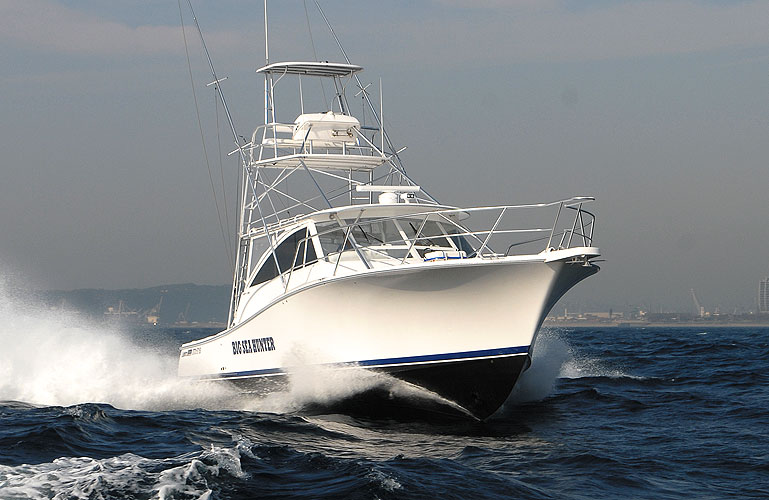
    I certainly did my best, but while one gets a nice photograph, when viewing the pictures one still misses the sound, the thrill and even smell of this sleek craft with her strongly-flared bow thundering up behind one, clearing the choppy sea and throwing her bow wake far and wide. Her sleek, almost thrown-back, racy look, and prominent tuna tower makes her a most beautiful craft whether she is at moorings or racing across the ocean at 30 knots.

    I have to admit that it has taken a complete shift in mindset for me to appreciate the express style of sportfishing craft. Even though I have always appreciated their stylish looks, initially I questioned their practicality as sportfishers for serious offshore fishing.

    The root of this mindset, I believe, comes from my experiences aboard express sportfishers in Kenya on which I often fish for sailfish. The captain always commandeered the tuna tower from which to skipper his craft, leaving us to while away the day on the deck without his company. It is this latter aspect that was the Achilles heel, in my opinion. There was no captain to talk to during a day at sea, and no quick access up the steps to the flybridge to quiz the captain on the dozens of queries any ardent angler has when chartering a boat to go fishing at sea.

    Now that I have personally skippered and fished on many express sportfishers, I have come to realise that I have allowed my own personal wants to decry a very effective system of skippering a sportfisher and maximising one’s fishability. Perched up in the tuna tower while hunting fish, and billfish in particular, one gets a phenomenal feeling of being in tune with the ocean. This is the primary purpose for which craft like the Luhrs 41 Open have been designed.

    In tropical conditions, such as those we experience along most of the east coast of Africa, craft such as these really come into their own. A constant movement of air through the saloon and fishing deck area ensures that cool comfort can be achieved without airconditioning.
    Sitting up at the top helm station of the Luhrs — the pinnacle of this craft — you are sited higher than on most conventional flybridges, but not as high as the true tuna towers of the Bahamas fleet that target big bluefin tuna. However, it’s still high enough to provide the skipper with a superb view of the sea around him, as well as the wake, lures and fish behind the craft that require his dedicated attention, not to mention the fishing cockpit, angler and deck crew below.

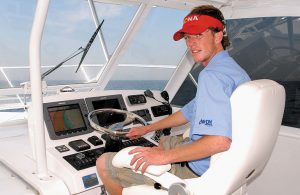
    This helm station is fully equipped with controls, gauges and instrumentation that enable the skipper to have complete control of the craft while up top. What I particularly enjoyed on this craft is that there is more than adequate space for another person to keep the captain company during the many long hours of trolling. This has certainly helped greatly to shift my thinking regarding express-style sportfishers.
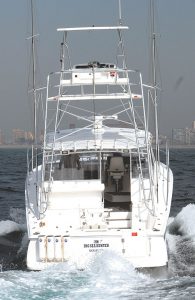
    With the theory now effectively behind me, I need to put down on paper the wonderful experience I had aboard the Luhrs 41 Open. After swopping boats in the flat water of Durban harbour, I took over the helm from Richard White who was skippering this craft on the day of the review. Richard, whose father owns and operates an identical craft out of Durban — Charlie Brown — was understandably totally at home on Big Sea Hunter, which the new Luhrs 41 Open has been named. He is also very vocal in his admiration of this craft.

    As we idled out between the new breakwaters of the recently widened harbour entrance, my right hand was itching to thrust the electronic throttle controls forward — a desire that had to be contained until we reached open water. This restriction was due to the ongoing underwater work being carried out on the side of the channel.

    My time finally arrived as I called on the twin 655hp Yanmar turbo-charged motors powering Big Sea Hunter to show me how this craft would perform in the easterly chopped ocean prevailing off Durban’s beachfront.

    I was not disappointed. As I moved the throttles forward, I could immediately feel her props biting into the water. I felt the thrust while the gentle purr of her motors at idle began to take on an ever increasing growl as the turbos kicked in. The lift onto the plane was exciting as I watched the SOG on the Ray Marine Navigation monitor climb quickly to 22 knots.

    Why 22 knots? No reason other than that was the speed she was happy at while cruising across the ocean in a northeasterly course up the coast. The twin Yanmar motors were maintaining a steady beat, almost effortlessly maintaining a speed that was very impressive on a craft this size in a sea that was not all that nice. It was as we were running north that I began to play with the hydraulic afterplaners, initially to settle her lateral trim, thereafter to try and improve or detract from her forward momentum by raising or lowering her bow.

    During these trials, and later in a high-speed run up Maydon Channel where we achieved 31 knots at virtually full throttle, this craft showed that her basic hull design tends to dominate her ride to such an extent that the hydraulic planers have only a marginal effect on her ride. 
    I noticed this most when cruising north at just over 20 knots. Her forward momentum as registered on the GPS varied only marginally when I tried to trim her right up or down. My opinion is that the raw power of her big engines and the way her hull has been designed to plane with a reasonably bow-up stance, combined with the overall weight of the craft — approximately 18 tons — override the marginal effect the hydraulic planers had on her performance. At speeds of 14/15 knots she responded more to bow-up/down trim adjustments.
    With the chop over swell that we were experiencing, I had her taking the sea on her starboard beam and she was cruising beautifully. Now it was a case of moving my right hand down a little on the helm to face her into the northeast and head into the sea without reducing throttle. In this sea her strong Carolina-style bow flare comes into its own. Apart from the bow wake being dispersed at greater intensity far and wide and our SOG dropping by a tad — say1H to 2 knots — the comfort was remarkably retained as this Luhrs 41 Open sped across the ocean. 
    Very impressive.

    Within the arena of high speed cruising, and here I am talking speeds of 18-23 knots and not the full throttle speeds the craft is capable of, my final trial was the long run back to Durban harbour with the sea and wind directly on her transom.

    Those of us who operate out of Durban know only too well the upside-down sea the beastly easterly produces off Durban beachfront. Add to this the sharp entry of the Luhrs 41 Open and one would expect a less than comfortable ride. Look at the accompanying photographs of the craft bow-on and you will see quite clearly how this craft’s bow and shoulders work to control her path through troubled water.

    Once I got her lateral trim spot-on, she merrily powered her way forward, almost never reacting to the surging sea and hardly ever throwing us laterally as she ran down the face of a swell and pulled out of the trough ahead of it. Yes, I did use a fair amount of bow-up trim, but then, as I have so often stated, the skipper’s ability to trim the craft to the prevailing sea is vital in order to get his craft to proceed at a speed that will get the craft and crew to their destination as comfortably, timeously and safely as possible.

    When we were deep off Glenashley it was really playtime for me. Slipping the main helm station controls into neutral, I climbed the aluminium ladder up to the top helm station to take command of Big Sea Hunter. I have to admit to feeling a degree of trepidation as the craft swayed on the drift in a side-sea, but having watched Richard shimmy up and down on numerous occasions gave me some confidence when it came to descending the ladder after the trials.

    Early on in the report I stated my views of what it’s like “upstairs”; now I will comment on the craft’s low speed performance, but always remember this will be tinged by the excitement of skippering from the tuna tower.

    With the motors just in gear, the Luhrs 41 Open trolled at a reasonably fast 5 knots, yet produced very little white water in her wake. Working up the troll speed to 6H knots, i.e. sailfish speed, then 7 to 9 knots for pulling lures for marlin, I watched with great interest and from an ideal viewpoint to see the way the wake developed and spread out in what I believe is the general speed range for practical sportfishing. It was great — really great — as I imagined where I would run my lures if I was fishing this craft.
    The days of pulling levers or plungers to open the trolling valves and allow the props to slow right down when the motors are idling are over. On the Luhrs 41 Open it’s a case of putting the throttle levers into neutral and pressing two electronic buttons — the trolling valves are open.

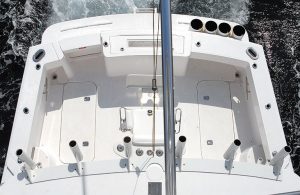
    Back in gear the minimum speed was reduced from 5 knots to 1H knots. With Big Sea Hunter sporting four Luna-style tubes on her transom, there is little doubt as to why trolling valves have been fitted on this craft.

    Finally, from up top the marlin skipper’s ultimate test of ability — backing up on a big marlin. Even this was oh so easy on the Luhrs 41 Open. With the advent of electronic controls, slipping from forward into reverse, as well as using the motors — one reverse and one forward — to slip the craft sideways has become a lot easier. On this craft the way she manoeuvred her transom from side to side, forwards or back wards, was as pretty as it was effective. It made me look and feel good too!
    On this craft the open helm station/ saloon that can be enclosed with clears is big, spacious and uncluttered, thereby allowing the free flow of anglers and crew between this and the large, open fishing cockpit. Apart from boasting a very impressive skipper’s domain of chair, controls and instrumentation, there is an abundance of seating as well as a summer galley incorporating an electric grill and a fridge. This means that one does not have to go downstairs into the main saloon and galley when the need for food and drink arises while you’re still busy fishing.
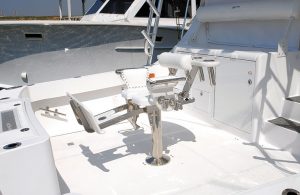
    The fishing cockpit is designed to suit both the serious marlin angler as well as those opting for light tackle sportfishing. In addition to the four Luna tubes, Big Sea Hunter has a large livebait circulation tank built into the transom. A very substantial fighting chair takes centre stage in the cockpit — a further indication that her new owner, Willie de Bruyn, is not going to play around in vlak water and has his mind firmly set on targeting big billfish.

    A few steps down takes you into the air-conditioned comfort of the main saloon, galley, heads and stateroom. Trimmed in cherry wood with lush upholstery, the transition from the relatively austere working area of the bridge, deck and fishing cockpit is breathtaking. Opulent in design and finishes, it’s practical to use for sophisticated entertaining or relaxing after a long day at sea.

    The layout and style really appealed to me, and its high headroom, well designed interior and appointment add substantially to the general appeal of this craft.

    Whilst there is only one dedicated cabin, the owner’s stateroom, which is awesome, a further four beds can be created by transforming the designer sofa into a double bed — electronically — and the saloon settee into two over-and-under single bunk beds. It’s certainly an outstanding onboard luxury living facility that needs to be seen to be fully appreciated.

    For a craft that is 45ft in overall length, she encompasses a lot of boat. Wading through the schedule of what is incorporated on the Luhrs 41 Open, I was amazed at how much goes into a craft of this size and intrigued at how much has to be wired up and powered by the onboard 9 KVA generator.
    Above all, the Luhrs 41 Open/Hardtop is an extremely beautiful craft and her ability on the water makes her a sportfisher to be noticed and appreciated.

    “Sea Hunter, Sea Hunter,” is a call I’ve often heard come over the radio when billfishing off Richards Bay, with Willie De Bruyn’s deep voice breaking the ether. From now on it will be “Big Sea Hunter, Big Sea Hunter,” as Willie commands the airways.

    As the new owner of this magnificent craft, we jealousy wish him many, many, many years of pleasure and lots of fish to add to his already significant tally.

  • Open Ocean 630 — by Two Oceans Marine

    Open Ocean 630 — by Two Oceans Marine

    Tested by Erwin Bursik (July/August 2011)

    Tel: +27 21 448-7902 • Fax: +27 21 447-6668 
    E-mail: 2oceans@mweb.co.za • www.2oceans.co.za

    A 5 STAR APARTMENT ON THE OCEAN

    LYING at her moorings at the Royal Cape Yacht Club, Pelican presented a stunning picture in the late afternoon sun. My first sight of her had my heart racing for two reasons: firstly, the large and stylish craft lying proud in front of me was unbelievably impressive; and, secondly, this beautiful 63 foot craft had been custom-made in Cape Town by Mark Delany and his team from Two Oceans Marine, and I was very proud of their achievement.

    Designed by Du Toit Yacht Design, Pelican is the largest of the nine custom-built yachts that Two Oceans have constructed alongside their Magnum range of offshore fishing craft which have been very successfully marketed in South Africa and many other countries in Africa.

    Before anybody shouts, “What is Bursik doing reviewing a craft powered by wind?” allow me to categorically state that throughout the review the sails stayed firmly furled on their respective boom and stays. I relied totally on the two 165 Yanmar diesel motors that have been installed as auxilliary power on Pelican to power her within the precincts of Cape Town’s Table Bay.

    During the last decade the “power cat” concept has blossomed and has captured a strong foothold in the offshore boating market, both for cruising and to provide offshore fishermen with a different platform from which to practise their sport. These craft are being practically used for the full ambit of sportfishing, from fly- and light tackle fishing right up to serious marlin fishing. During both the 2010 and 2011 SADSAA Columbia Billfish Classic tournaments, the power cat Trinity achieved an impressive second position overall, in addition to the productive social marlin fishing she has enjoyed off Richards Bay.

    Mark Delany therefore reasoned that it was logical for me to review Pelican, whose owner is a very keen offshore angler and is planning to cruise Southern African waters from Moçambique to Angola in this craft. These rich and varied fishing waters will open up a multitude of angling opportunities for those aboard Pelican.

    Furthermore, as it is estimated that up to 80% of this type of craft’s operation is by motor power, I feel totally justified in undertaking the task of reviewing the Open Ocean 630. To be brutally honest, an opportunity to ride on and skipper this magnificent craft was not one I was going to pass up.

    This craft encompasses a vast amount of the owner’s personal requirements and ideas, in addition to the designer’s concepts. As with all custom-built craft, it’s that strong personal stamp by the owners that flows throughout the craft and which adds so much to the final product. In this case, it’s a home-from-home, with all the comforts and sporting equipment. This ensures that those holidaying aboard her can arrive at an exotic destination and have at their disposal all the equipment, facilities and toys they require to experience the holiday of their dreams.

    Climbing aboard Pelican’s large aft deck immediately made me aware of the size of this craft. As big as she looked from the jetty, the overall magnitude of this craft is only truly appreciated once you’re aboard. So much to see, so many corners to explore, so much to assimilate. At the same time, I was trying to imagine what it would be like to cruise and fish around an archipelago such as Bazaruto aboard this craft — all this before we’d even left the moorings.

    For once Cape Town weather was good to me and provided a clear sky, a light westerly wind and a perfect Table Bay in which to spend a late afternoon aboard this incredible craft. After photographing her under ideal conditions, I boarded her a second time to experience the Open Ocean 630 at home on the ocean.

    The other Open Ocean custom-built yachts from Two Oceans Marine are sailing extensively in the Indian Ocean as far north as the Seychelles and have had to face the unpredictable seas that we all know occur south of the equator. In high seas as well as the flat waters of the tropics, these craft have proved their seagoing capabilities, as well as providing the comfort they are designed for.

    I experienced her ride in calm conditions in Table Bay, so I cannot comment on her rough sea capabilities. I have, however, chatted to her captain and have, over the years, overheard numerous favourable comments from those who have skippered other Open Ocean cats manufactured by Two Oceans. Pelican’s captain says he was ecstatic about how this craft handled both under power as well as while sailing during a number of sea trials they undertook in some in seriously rough Cape conditions, prior to her official handover to the owners.
    Having discussed her performance, I was now able to explore all the onboard facilities and designed niceties, and compare this craft’s features with those of other power cats and yachts on which I have enjoyed extended outings in some exotic locations.

    First and foremost, the size of this craft, all 63ft of her, gives her a head and shoulders advantage over the other craft on which I have explored the Southern African east coast. Her spacious internal design and the room at one’s disposal, both in the living areas of the main saloon — and even more so in the living quarters situated in the huge sponsons — is simply wonderful.
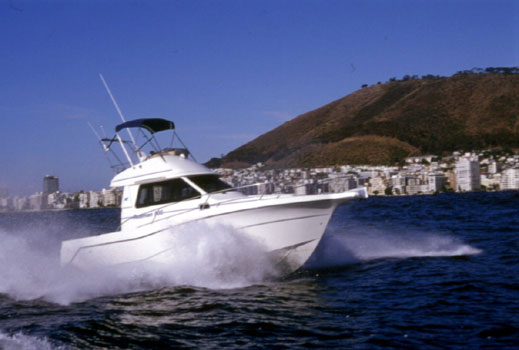
    On this craft one has to refer to bedrooms and bathrooms, for that’s what they are. No, not “cabins” and “heads”, the generally accepted terminology on yachts, for the simple reason that the latter are generally small in size and cramped. Boat builders try to get away with saying, “They are only for sleeping in.” However, during my extended stays at sea aboard similar craft I have always felt that the less confined the living quarters are, the more I enjoy the whole experience. 
    Speak to any woman who has spent time aboard this type of craft. Without exception, the main topic of criticism and/or praise is the onboard bed/bathroom/toilet facilities. On board Pelican there will never be dissatisfaction in this regard.
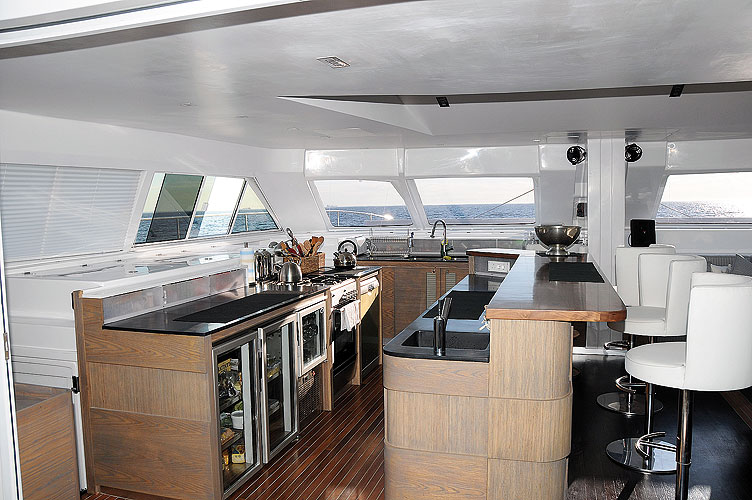
    The internal saloon area — galley, dining/bar area and lounge — is spaciously designed with tremendous almost 360 degree visibility. From my experiences on this style of craft, it is the aft deck relaxation and play area that is most used. Whether the craft is underway or lying at anchor, it is the area that is the most stable and most protected from the weather. It provides the open, outdoors feel that makes such an experience so special.
    On Pelican this area is substantial with a 12-seater table ideal for both dining as well as relaxing. In my case it would be a great tackle prepping station where you could “work” while talking and sipping a few cold ones.

    At the back of the aft deck there’s a semi-rigid inflatable, powered by twin 70hp motors and fully rigged for light tackle gamefishing. She rests on a substantial cradle, ready to be lowered onto the ocean by means of an electric winch and a pulley system at the end of the craft’s huge boom.

    Also in this area there’s what I call the “toy locker”. It holds fishing tackle, boating equipment and scuba diving kit — everything you need to keep family and friends occupied and entertained for an extended holiday on the ocean.

    The flybridge/upper deck level is almost as large as the saloon area. In addition to housing the upstairs helm station, plus all the winches and ropes required to sail this craft, it hosts an additional lounging area.
    The instrumentation and electronics in the helm station, the main saloon and interlinked to the helm station on the flybridge lacks nothing. Everything is very impressive, providing the captain with every piece of equipment he might require for long distance sea voyages.
    The twin 165hp Yanmar diesel motors that power this craft are not only used for long distance cruising, but often also add to the forward momentum while the craft is under sail. In saying that, Pelican is designed to travel at about 9 knots with no sail and one motor operating at 2 700rpm. This provides for maximum fuel efficiency from the 1 500 litres of fuel the craft carries. Surprisingly, with two motors both running at maximum revs of 3 600rpm, she will average a SOW of marginally in excess of 12 knots.

    Pelican is indeed a very special yacht — a craft that dreams are built around and a craft that is the proverbial seaside villa for the owner’s family. The best thing about this villa is that she can be moved to almost any destination in the world, thus enabling her owners to maximise adventure, travel, fishing and holiday relaxation to the nth degree.

  • Rodman 800

    Rodman 800

    Tested by Erwin Bursik (July/August 2004)

    THE Rodman 800 is very different to most if not all the craft in her size I have reviewed over the years — all 28ft of her. One difference is that she is powered by diesel inboard shaft drive motors, and not outboards as we have come to expect of a craft of this size in South African waters.
    However, it’s not for this reason that I found her to be such an amazing craft. Rather it was because of her entire design and the many features that her designers have been able to fit into 28ft of boat, while still producing a very good-looking, practical walkaround, user-friendly craft.

    For anyone who may think that this craft is too small for a sportfisher, let me remind you of the popularity of the small Bertram in this size range, and the fact that these small sportfishers have accounted for some mighty big marlin over the 20-odd years they have been fishing the gamefish waters of the world.

    The Rodman 800 will, I believe, fall into this category. These craft not only have big sea capabilities, but the walkaround feature also offers wider fishing possibilities. At the same time, the interior saloon cabin and heads configuration offer creature comforts in excess of those usually found on craft this size.

    When I first boarded a Rodman 800 at the company’s walk-on moorings in Vigo, Spain, I was captivated by her and all she had to offer, but was initially a little concerned about her size. Unfortunately for this craft, she was the last of the three boats to be made ready for testing when I visited the factory. What this meant was that following tests on the much bigger Rodman 1250 and 1120 models, I not only had to get used to a smaller craft, but also needed to adjust my mind so as not to compare her with her big sisters.

    In Cape Town it was the same story, with the Rodman 800 again being the last of the three I took control of in the wind-ripped ocean off Table Bay. For those who have not read the review of the Rodman 1120 (see SKI-BOAT May/June 2004), the south-easter was blowing at 25 knots-plus and a reasonably big swell was pushing in from the south-west, making it an “interesting” sea in which to test a boat. Under normal circumstances, a craft this size — in fact, any craft — would not have gone out to fish in these weather conditions, even for a reasonably short run.
    Following the photo shoot, I boarded the Rodman 800 in the marginally protected waters off Granger Bay and set about reacquainting myself with her. It had been a good four months since I had run her in the North Atlantic and in the estuary off Vigo.

    Initially I opted for the comfort and protection of the helm station in the saloon as I put her through her paces. Gradually, as I got the feel of her and established her correct trim position with the hydraulic after-planers which Laurence Steytler, who imports these craft, had had fitted, I ventured further and further out into the rough water.
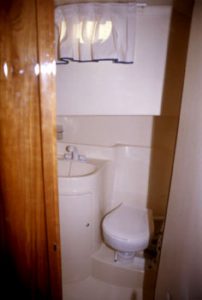
    The 800 I tested in Spain did not have hydraulic trims, and I was soon noticing the difference, especially in the rough water. In very rough water, the confidence that trims provide is very important as one can stabilise the craft laterally as well as bow-up and down. To be able to achieve additional bow-up trim in a big, following sea on any craft is a tremendous benefit — it eases the nerves and makes the ride more comfortable and safer.

    There are two aspects that I believe are crucial to establish when reviewing a craft of this size in rough water. Firstly, how does she ride in a big following sea? And — secondly — how long will it take one to get back to port in a big head sea?

    In the prevailing sea that day, I was able to test both of these aspects in what I considered to be very severe conditions.

    Running with the wind and chop on the starboard aft beam, the Rodman 800 rode exceptionally well at about 16-18 knots as I moved out into open water and the full effect of the swell could be felt. Then, with the wind directly on her transom, I ran with the sea for many kilometres. With the swell’s influence on her forward beam, it was a difficult run because, in addition to bow lift, I also needed to stabilise her laterally by marginally dropping the port trim. Once I got it all correct, the ride was fast and comfortable. She only needed to be pulled out and over a crest if I found a wave or hole out of synch with the general run of the sea.
    A number of times I lifted the trim completely, thereby effectively nullifying their effect, just to see how her basic hull design coped with the conditions. Both Captain Johan van den Berg and I were pleasantly surprised at how well she ran the gauntlet, with the only aspect requiring trim being laterally to port. We both believe her big bow and aft stub keel give her notable bow lift and tracking stability when running down-sea. There is no doubt in my mind about this, but I was just that much happier when I reset the trims.

    Then it was the long ride back, straight into the sea. This part of the trial proved her pedigree to me. Even though I dropped speed a fair bit to 12-14 knots, we made good progress, and both the boat and crew were comfortable. The overall bow design of these craft — and I refer to all three that I tested — provides a good ride into a big sea at a reasonable speed.

    A horrible course in conditions like this is travelling slowly along the crest of a swell with the wind on one’s port bow. It’s wet, miserable and throws the boat all over the place. However, it’s also a course that is often necessary. I followed just such a course with the Rodman 800. 
    From the comfort of the saloon I was very dry, but spray was being thrown all around. What did surprise me, however, was how well she took the sea. With the twin diesel motors giving weight amidships and her props effectively tucking in her stern, there was a lot less lateral push by the wind and sea than one gets on outboard-powered craft of this size.

    In the more protected water that I considered fishable, I ventured up to the flybridge and went through my standard routine of various speeds, from simulating ’cuda trolling with livebaits to kona speed when fishing for marlin. Apart from the effect of the strong wind, the Rodman 800 came through with flying colours.

    Even at very low speeds around 1½ knots — only made possible by adjusting the trolling valves fitted to these motors — she was able to cope well, provided I kept the wind on her forward quadrant. At faster speeds of 5- to 7 knots (with trolling valves disengaged), she handled a big figure-of-eight course well, even with the strong wind. Her wake is also pleasingly even with tight, white water. What’s more, I was comfortable and dry on the flybridge.

    The final aspect of her ride to be assessed was on the drift in reasonably big chop. Even up on the flybridge, the pendulum effect from her lateral roll was not enough to make it uncomfortable as she held position beam-on to the wind.

    The Rodman 800 I tested was powered by twin turbo-charged Yanmar 200hp diesel motors that provided very good performance for this craft throughout the range. The revs/speed I noted were as follows: 1 000rpm — 5 knots; 1 500rpm — 7,5 knots; 2 500rpm — 16,6 knots; 2 700rpm — 18,5 knots; 3 000rpm — 20 knots, topping out at 3 500rpm giving 28 knots. Regardless of speeds achieved, she felt good with efficient out-of-the-hole acceleration and an even climb to top speed while on the plane.

    In this review I also need to expound on what has actually been provided on Rodman’s little-big boat.
    First and foremost, she is decidedly fishable for light- and medium tackle game- and bottomfishing. If fitted with a fighting chair and outriggers, she would be capable of taking on the heavy tackle brigade too, for she has the backing-up capabilities and manoeuvrability to handle the task.

    Her walkaround area is very practical, and the sturdy gunnel bow-rail provides more than adequate support and protection when fishing from this area.

    The flybridge is comfortable for two people and enables the skipper to have a good view of the cockpit area, at the same time having at his disposal all the accoutrements to enable him to do his job properly.
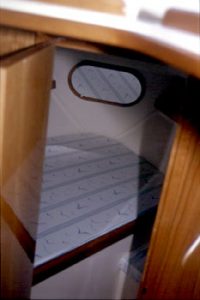
    It is, however, the features and functionality of the interior design that intrigued me. Not only is it beautifully laid out, but the helm station is comfortable to use, and the rest of the saloon is great for relaxing in.
    When one first sees the lounge, galley, cabin and bathroom (heads), one immediately gets the impression that this craft is much bigger than her 28ft length. What’s more, it’s not designed for midgets. I am far from small, and I tried all the “comforts” provided on this craft whilst we were out at sea in fairly rough water. They were great and I was able to go through the motions of fixing food in the galley, going into the bathroom, using its facilities, and then reclining on the double bed.

    A boat’s facilities often appear practical when you’re on the mooring, but try and use them out in a rough sea — that’s when impracticalities start to show. I still find it hard to believe that so much is provided in this relatively small craft. Take my word for it, I certainly tried to prove otherwise, only to come out even more impressed than before.

    As with all Rodman craft, the finish throughout is superb. Not only is it good to look at, it is also robustly made and fitted with high-class continental workmanship. I’m sure it will withstand both time and hard use.

    Another aspect that is commendable is the attention to detail. There is no doubt that, due to the number of craft they have produced over many years, this factory’s staff have accumulated knowledge and ideas which are manifest in all their craft, and the Rodman 800 is no exception.
    The Rodman 800 is, I believe, the ideal family boat with the ability to provide cruising comforts that the whole family will enjoy, whilst still enabling one to fish in the big league, if so desired.

Verified by MonsterInsights