
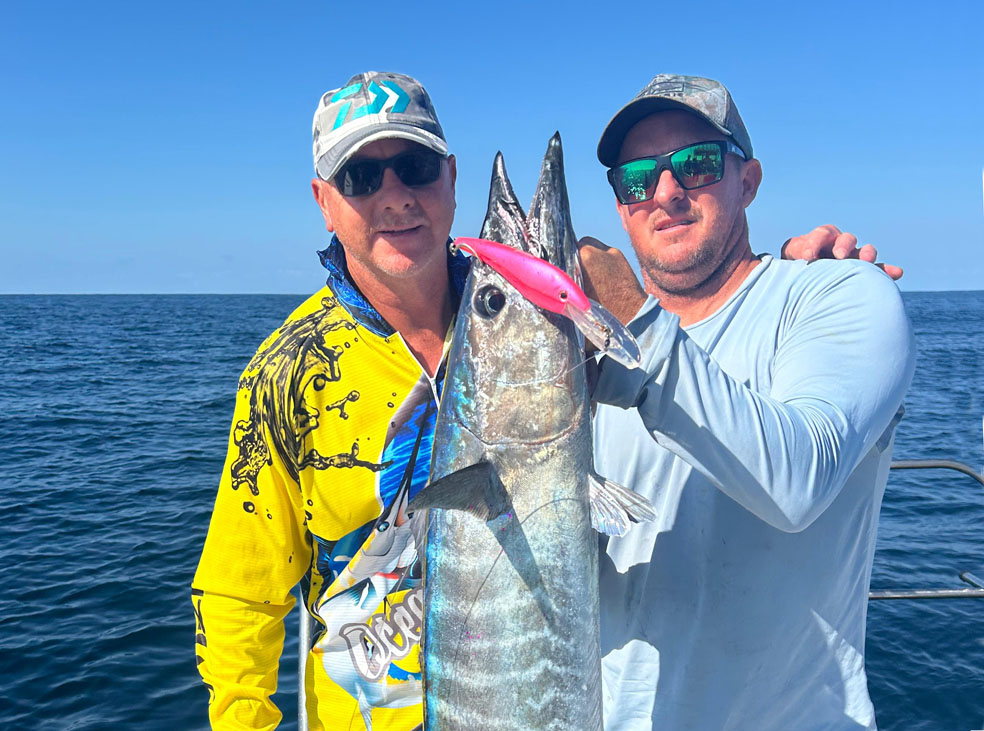
WAHOO!
Nailing the ocean’s speedsters
By Mark de la Hey
(Originally published in the July 2025 issue of Ski-Boat magazine)
ARGUABLY the fastest fish on the planet, and definitely one of the most sought-after and difficult customers to catch, wahoo are found abundantly all over the world, both inshore and offshore. With their blistering speed and seamless changes in direction, they’re also one of the most exciting and challenging fish to keep under control right to the end of the battle.
In South Africa and Moçambique we find wahoo all year round, with the bigger fish generally making an appearance in the winter months.
There are a few different ways to target them, but my two personal favourites are on the Nomad DTX minnows and live bonnies. Both methods have their pros and cons, so depending on the area, you can come up with a game plan to suit your conditions.
 TROLLING
The most obvious advantage with trolling is that you can cover a larger area and there is no time taken up trying to catch livebait. It’s also a lot less complicated and easy for everyone to do. You can basically take a Nomad out the packet, tie it on, let it out and you’re fishing!
A few adjustments that you can make are to the colours and sizes of the lures, their position in the spread, and the speed at which you troll them.
These are my personal favourite sizes and colours that work for me:
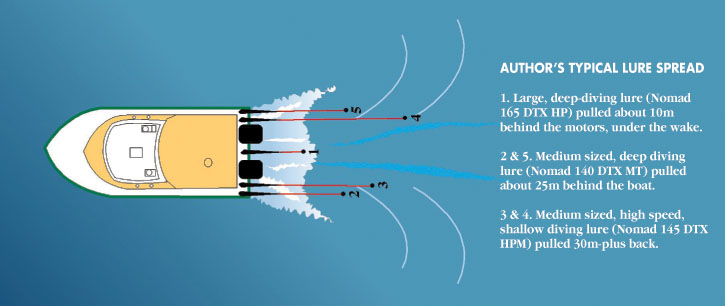
The Nomad 145 DTX HPM
(Hot pink Mackerel)
This is a medium sized, high speed, shallow-diving lure that we have had endless success with over the past few years. It works for a huge variety of pelagic species, not only wahoo.
With it being a shallow diver, we like to pull it further back in the spread – usually 30m-plus. It works well at low and high speeds.
The Nomad 140 DTX MT (Mac Tuna)
This is another medium sized lure, but a deeper diving version of the 145. With a bigger lip, it pulls a lot harder than the 145 and dives much deeper. This is a very natural colour and has been successful for a variety of species.
We have had a lot of success pulling it close and further from the boat, with the most common place being about 25m away.
The Nomad 165 DTX HP (Hot Pink)
This is a larger lure that pulls really hard, dives deep and swims true. We have found it to be most successful when pulled close to the back of the boat just under the wake, about 10m back from the motors.
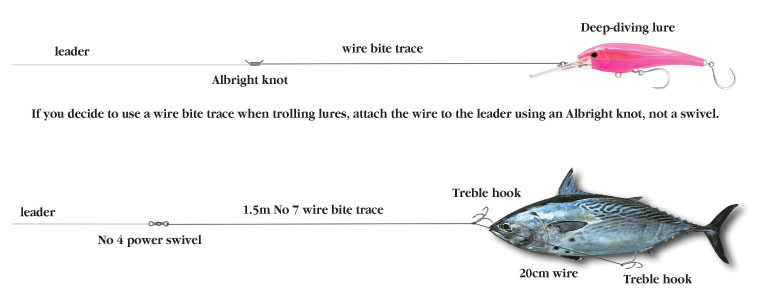
There’s an age-old argument of whether to fish these lures with straight nylon or with a bite trace, and we have been using both methods with equal success. The only thing we would recommend when using wire is to join the wire to the leader using an Albright knot and not a swivel. This minimises the bubbles the swivel can cause and makes it look more natural.
LIVE BAIT
Although the lures work well, for me the most effective and exciting way to target large wahoo is by using a live bonnie as a bait. There are, however, many complications when doing it this way, none bigger than finding and catching the bonnies to start with!
So, where do you find them?
Bonito and other tuna species are commonly found around large offshore pinnacles that occur in depths between 40m and 60m of water. These shoals and reefs can cover vast areas, which can make them quite tricky to find. Luckily there are a few patterns that can make the job slightly easier.
Step 1 – Where?
You will almost always find them on the up-current side of the northern most side of the reef. You can also often find them on the up-current (or northern) side of the largest pinnacle on the reef system. This will at least give you a good starting point.
Step 2 – How ?
This is the million dollar question. On a good day, they will feed on anything – lures, spoons, daisy chains and surface lures. On a bad day it feels like a shot gun would be the only way to catch one!
These are the two most successful methods we have found:
A. The daisy chain
A daisy chain is a string of soft squids (normally between three and five) with a hook in each one. These can be trolled at a variety of speeds and in different place in the spread for different results. The location and conditions will dictate what colour to use. Some colours that generally work well in many different locations are white, pink, glow and clear.
B. Spinning
Throwing small spoons on light braid is often an effective way to target bonnies when you can see them on the surface. Three of the most effective spoons that we have used are:
• The Halco twisty in the 20g
• The Iron candy couta-C #1 28g glow
• The Nomad ridgeback 20g LC Pink Sardine & Chrome
THE LIVE BAIT TRACE
There are many different traces that work for rigging live bonnies, but this is the one that has served us the best to date:
1.5m #7 lead wire
No 4 power swivel
2 x No 2 SSH Predator trebles 20cm apart on #7 wire
The reason we use a treble as a lead hook instead of a single hook, is that most of the time if a wahoo gets snagged on the back hook of the trace and then speeds off, the front hook gets pulled against the fish. Nine times out of ten, that hook goes into the soft flesh around the gills or head of the fish. Once it goes in there the fish becomes hard to lose!
RIGGING THE BAIT
This is a crucial part of the process. It’s really important that the front treble goes through the bonnie’s top jaw from the top down, avoiding any chance of the mouth being closed by the other two hooks. It’s also very important that the second hook goes underneath the bait and just through the skin. When the wahoo chases the bait, when the second hook is underneath the bait, it avoids the hook getting caught up on your lead wire and “boxing” the bait.
THE TACKLE
When trolling lures or livebait, I use a Penn Fathom II 40 NLD with 500m 50 lb Berkley X9 backing and 100 Maxima 50 lb IGFA top shot. When I’m trolling lures, I pair this with a Seeker Hercules 7ft H, and when I’m using livebait, I pair it with a Seeker 7ft Hercules M/H.
My spinning set up is a Penn Authority 4500 with Berkley X9 20 lb braid, paired with a 7ft Penn Battalion M spinning rod.
When targeting wahoo, one of the most important things to remember is that wherever you find the bait, is usually where you’ll find the fish. Stick, stay and make it pay!