
TROPICAL TORPEDOES
Catching Sodwana Bay’s giant yellowfin tuna
By Jaco Lingenfelder
(Originally published in the January 2026 issue of SKI-BOAT magazine)
AT dawn, Sodwana Bay comes alive. The surf glows gold in the first light, the smell of salt fills the air, and boats idle just before the breakers, waiting for the perfect moment to head out deep. Engines roar, bows rise, and within minutes, anglers are skimming across a cobalt sea that drops into hundreds of metres of deep blue water. It’s a world ruled by speed and strength, and is home to one of the ocean’s most formidable predators: the yellowfin tuna.
Sodwana Bay, nestled within the iSimangaliso Wetland Park on South Africa’s northeast coast, is a place where wilderness and water meet in perfect harmony. It’s one of those rare destinations where the ocean still feels raw – untouched and unpredictable.
The Agulhas Current, sweeping south from Moçambique along southern Africa’s east coast, brings warm, nutrient-rich water teeming with life. This current fuels an ecosystem that attracts marlin, sailfish, dorado, wahoo – and of course, the mighty yellowfin.
Just a few kilometres offshore, the continental shelf plunges into deep blue canyons, creating the ideal hunting grounds for big pelagics. For local skippers and seasoned anglers, these waters are as familiar as old friends – and capable of producing incredible rewards.
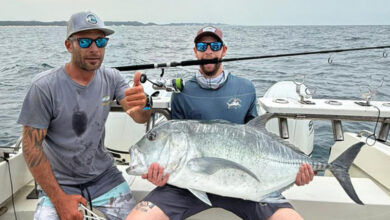
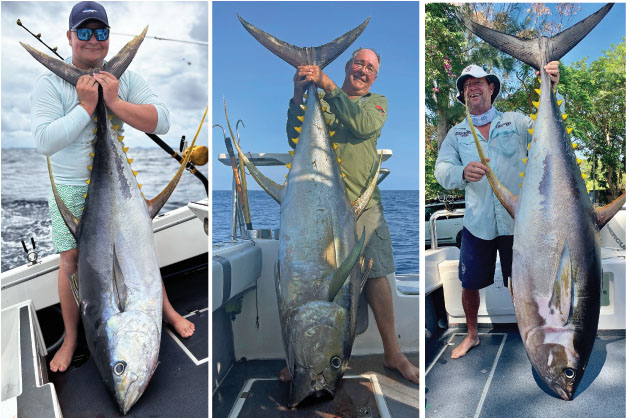
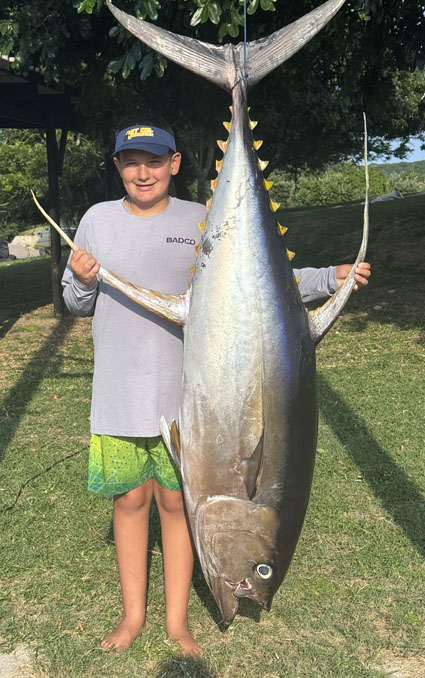
Yellowfin tuna (Thunnus albacares) are the muscle cars of the sea – sleek, fast and relentless. Off Sodwana, they average between 25- and 60kg, but every season a few brutes pushing 80kg make headlines. Their power is legendary. The first strike is like being hit by lightning, then there’s an unstoppable run that tests every knot, swivel, and sinew of strength you have.
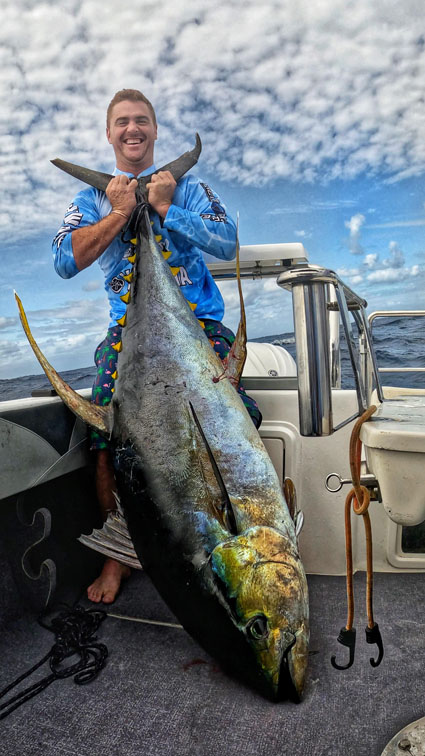
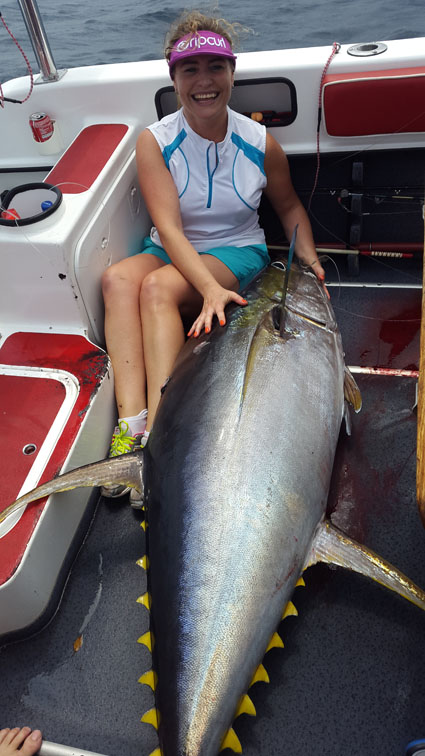
Over the years a few in the 90- to 100kg range have also been caught along this stretch of the coast. Mariette Hendriksz’s 100kg yellowfin caught during the 2015 Billfish 15 000 was a new ladies’ All Africa and South Africa record on 50 lb line. Peter Harvey also caught a 93.8kg whopper in March 2020 in just 40m of water. It was a pending All Africa record on 15kg line. In November 2024 Tielman Roos was absolutely thrilled to land a 98,6kg specimen on a chugger and strip bait while fishing in 800m of water off Klein Witsand.
TACTICS, TIMING AND TENACITY
The best time to target yellowfin in Sodwana is from October to April, when warm-water eddies drift close to shore.
If you’re trolling lures, keep your speed between 7- and 12 knots, and watch the spread for a telltale boil or a sudden explosion of white water. Yellowfin tend to take lures that are trolled fast and shallow. Smaller skirted lures like the tubes from Pulsator and the Nomads DTX high speed artificial lures worked the best over the past season. Darker colours with purple and pink in them seemed to be the tuna’s favourites for the past season.
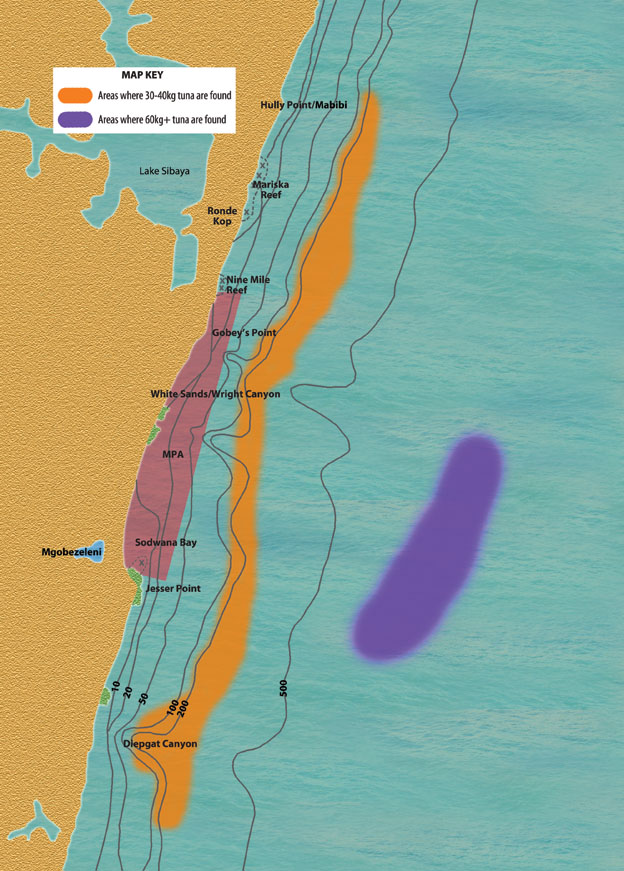
Yellowfin in the 30- to 50kg range come in closer to shore and are frequently caught on the 250- to 350m contours from Mabibi in the north all the way down to Diepgat.
The larger specimens above 60kg are predominantly caught out on the 700m contour and beyond – sometimes as far out as the 1 200m contour while targeting marlin – straight out from the point and to the north.
Heavy 50–80 lb tackle is standard, though even the strongest gear can feel inadequate when a big fish digs in deep.
It’s a battle of endurance – you versus a creature built for speed and stamina. The fight can last 30 minutes or three hours. Either way, it ends in sweat, sore arms, and a sense of victory that lingers long after the boat returns to shore.
Sodwana’s waters are alive with baitfish schools – sardines, flying fish, bonito and mackerel – thanks to the nutrient flow from tropical currents, and the reef structures. Large schools of big tuna are often seen feeding on baitfish before they are caught, so keep your eyes peeled for these giants. If you see them, head over to them and hope you entice the bite.
Yellowfin here often feed in competition with dorado, wahoo and marlin, and the constant need to outcompete other predators makes them:
- More aggressive feeders.
- Quicker to strike lures or live bait.
- Stronger and more explosive when hooked.
WATER TEMPERATURE AND METABOLISM
Yellowfin tuna are warm-water pelagic fish, and Sodwana’s yellowfin are tropical athletes – fast, fiery and built for speed. At Sodwana, surface sea temperatures typically range from 24°C to 29°C, thanks to the Agulhas Current bringing tropical water from Mozambique down the east coast.
Warmer water increases a tuna’s metabolism, meaning:
- They need to feed more frequently.
- Their muscle activity and oxygen use are higher.
- They’re simply “fired up” – faster, more explosive, and far more aggressive in the fight.
In Sodwana, tuna are typically hooked in warm, high-oxygen surface water, where they can sustain fast, powerful runs and dramatic dives.
By contrast, Cape Town’s waters, influenced by the cold Benguela Current, range from 13°C to 20°C. Tuna there still fight hard – especially large specimens over 80kg – but their metabolism is slower, resulting in more sustained, heavy, deep fighting rather than the fast, acrobatic runs typical of Sodwana fish. This is the main reason that the tuna off Sodwana are perceived to be stronger than the ones in Cape waters.
In my opinion, Sodwana Bay is South Africa’s most underrated yellowfin tuna paradise. If you’re heading up that way over the holidays, you might want to work on your fitness before you go, and make a point of trying to land some of these tropical torpedoes.