
WHERE TO FISH Part 22
Santa Maria Peninsula, Moçambique
By Charles Hayter (originally published in the November 2025 issue of SKI-BOAT magazine)
THE Santa Maria Peninsula in southern Moçambique is steadily growing in popularity. In the previous issue of SKI-BOAT we carried an article focusing on fishing the northern section of this coast from Santa Maria home reef up to the Inhaca reefs, and in this issue we cover the section of coast from Santa Maria down to Milibangalala.
This area is part of the Ponta do Ouro Partial Marine Reserve, so anglers must be aware of the regulations pertaining to this. To start with, bottomfishing and vertical jigging are banned. Make sure you go to the Maritimo police office (either in Maputo or Santa Maria) to obtain a fishing licence and a map showing where you can and can’t fish. You will be fishing inside a marine reserve, so if you’re caught doing something illegal, you will be in trouble.
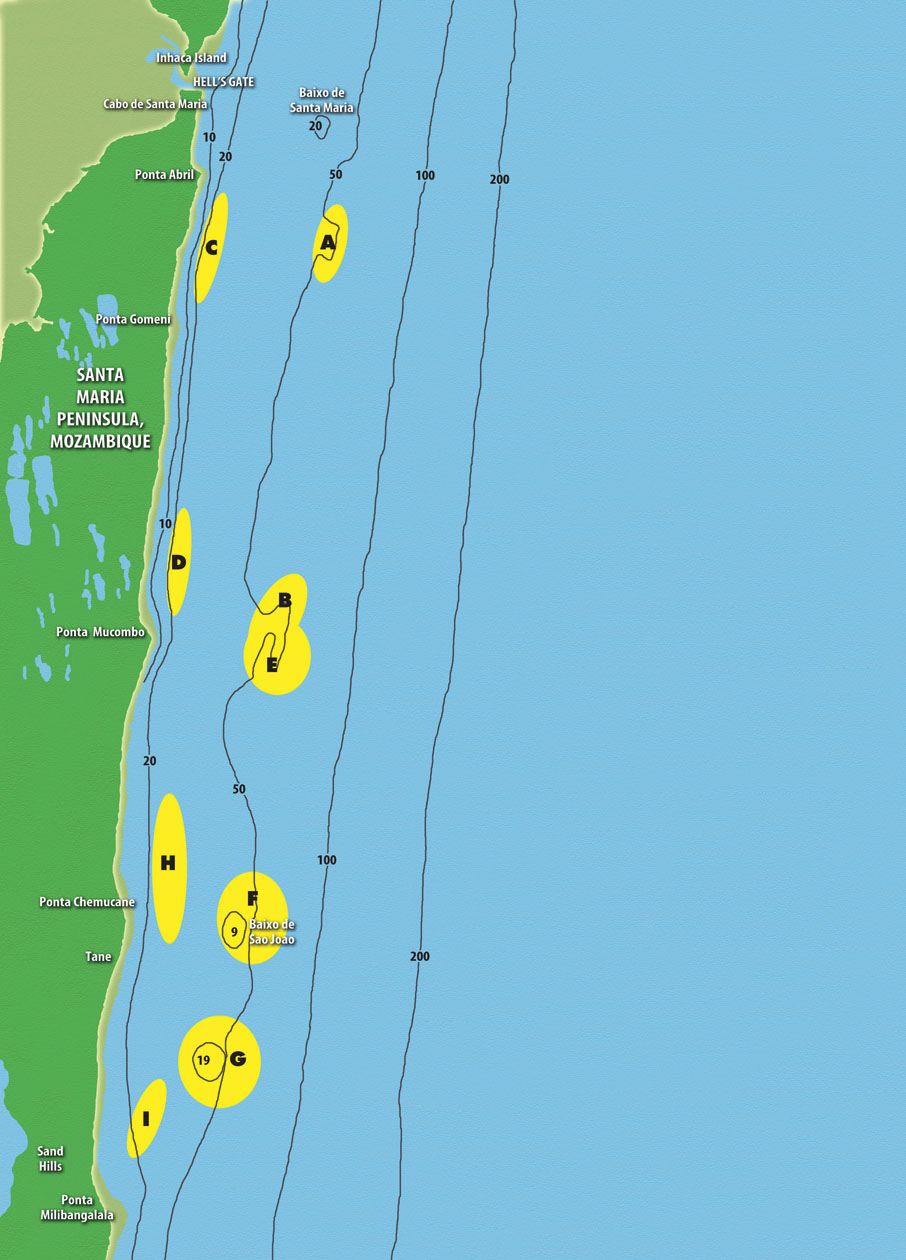 COORDINATES OF FISHING SPOTS
A: Santa South S26 07.308 E033 00.249
B: Mucombo Pinnacles S26 16.209 E032 58.472
C: Reef 23 S26 07.916 E032 58.840
D: Mucombo Shallow S26 14.252 E032 56.972
E: Mucombo Pinnacles S26 16.543 E032 58.486
F: Jao Reef North S26 21.494 E032 58.352
G: Jao Reef South S26 24.057 E032 57.773
H: Chemucan Shallow S26 20.065 E032 56.833
I: Milibangalala Shallow S26 26.459 E032 56.412
REEF SYSTEMS
This stretch of coast is characterised by a section of reef ledge which basically runs parallel to the coast at a depth of 15–25m. Then there is a more prominent coral reef which runs along the 50m contour. In places, pinnacles rise up from the deep to as little as 13m. If you take a look on your charts, you’ll notice this mostly tends to happen off the prominent points on the shore.
On the deeper 35–50m line, you have some pinnacles just south of Santa Maria main reef, then again off Mucombo you get some pinnacles. Further south towards Milibangalala, you reach the northern pinnacle of the Jao/Joao Reef system just off Chemucane, and then you’ll find the main southern pinnacles of Jao.
Jao Reef is a pristine coral reef, and you will find shoals of fusiliers, scads, garfish and other species on top of these pinnacles which come right up to about 10m deep. The main pinnacles which rise out of the depths, and their associated steep walls and drop-offs, tend to be where the bait fish come to feed on the small plankton and fry that sustain them. Wherever you find the bait is generally a good place to start fishing and looking for the pelagic fish which hunt here.
The shallower ledges of reef tend to be found around the 15–25m contour, and basically run all along this section of coastline. At certain times they tend to sand up, and then they’re not as productive as usual.
The most prominent shallow areas to fish are in front of Hell’s Gate, then just south of Ponta Abril at an area we call “Reef 23”, then on the scattered reef approaching Mucombo Point. Off Chemucane you again get shallow reef, and there’s also a very prominent reef structure off Milibangalala, about 18m deep.
LAUNCH
Be very respectful of launching through Hell’s Gate, especially when you have an outgoing spring tide against a northeasterly wind. It can get very, very ugly, and many skippers have had bad experiences in this treacherous piece of water, with some paying the ultimate price. Speak to some locals and do extra research about the expected conditions at the time you’ll be visiting, and take the local skippers’ advice on the launch. If there is any doubt, wait for the tide to change, as the water usually flattens out reasonably well with an incoming tide.
FISHING STRATEGY
The pinnacles and deeper reef structures tend to hold bait in the form of eastern little tuna and frigate tuna (bonnies). These bonnies are key in the food chain for the pelagic fish which we focus on catching. In shallow sections off Hell’s Gate entrance, Mucombo Point, and other patches of reef, you will also find baitfish like mozzies, red-eye and mackerel from time to time.
The tide and current definitely affect when the pelagic fish will start to feed, so you’ll need to put in some effort and watch your sounder and the surface to see what is happening when and where.
If you mark some bait deeper down on a pinnacle, make a mental note of it and return at the change of the tide when this bait may have been forced up by the pelagic fish beginning to feed. These reef areas with pinnacles generally fish well on a pushing tide with the prevailing north to south current.
When the tide turns and begins draining, it’s generally a good idea to start focusing your attention on the areas on the land side of the reef systems. Ideally, you need to find some ledges and structure which can create a upwelling. These areas where a upwelling forms will start to hold bait, and then the pelagic fish will move in to hunt around there.
When the current starts to run from south to north, this can be a finicky area to fish. You then need to search for upwellings and bait on the southern sides of the reef structures.
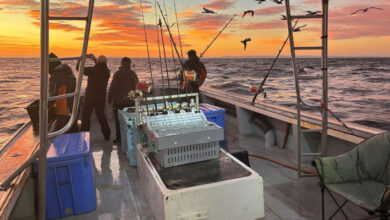
Our plan is generally to try and catch some bonnies to use as livebait. If they don’t survive, we swim them dead around these pinnacles and reef structures. We also do a lot of old school ’cuda-style fishing by drifting or slow trolling with normal ’cuda-style rigs with live/dead baits. We make sure to cover the whole water column by downrigging some of our baits.
When we are drifting or slow trolling, we also always have two rods working the top of the water column with a combination of poppers and stickbaits.
When things go quiet or we are moving from place to place, it’s a good time to carry on fishing, and we then put out a spread that gives us a good chance at catching something.
Generally that will be a spread consisting of two or three Speedpro lures or Nomad deep divers, with two Ilander-type lures with either a stripbait or a halfbeak inside, and then we always have a daisy chain out to try and snag a bonnie.
You often get a surprise in the middle of the “bush” between spots when you least expect it, with one of these lures screaming off.
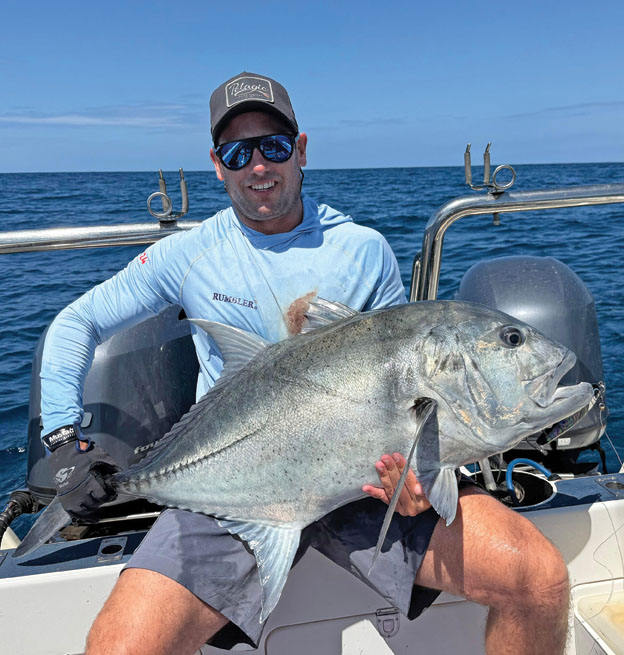
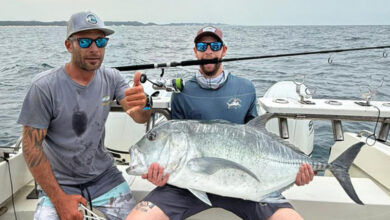
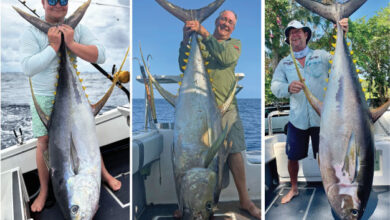
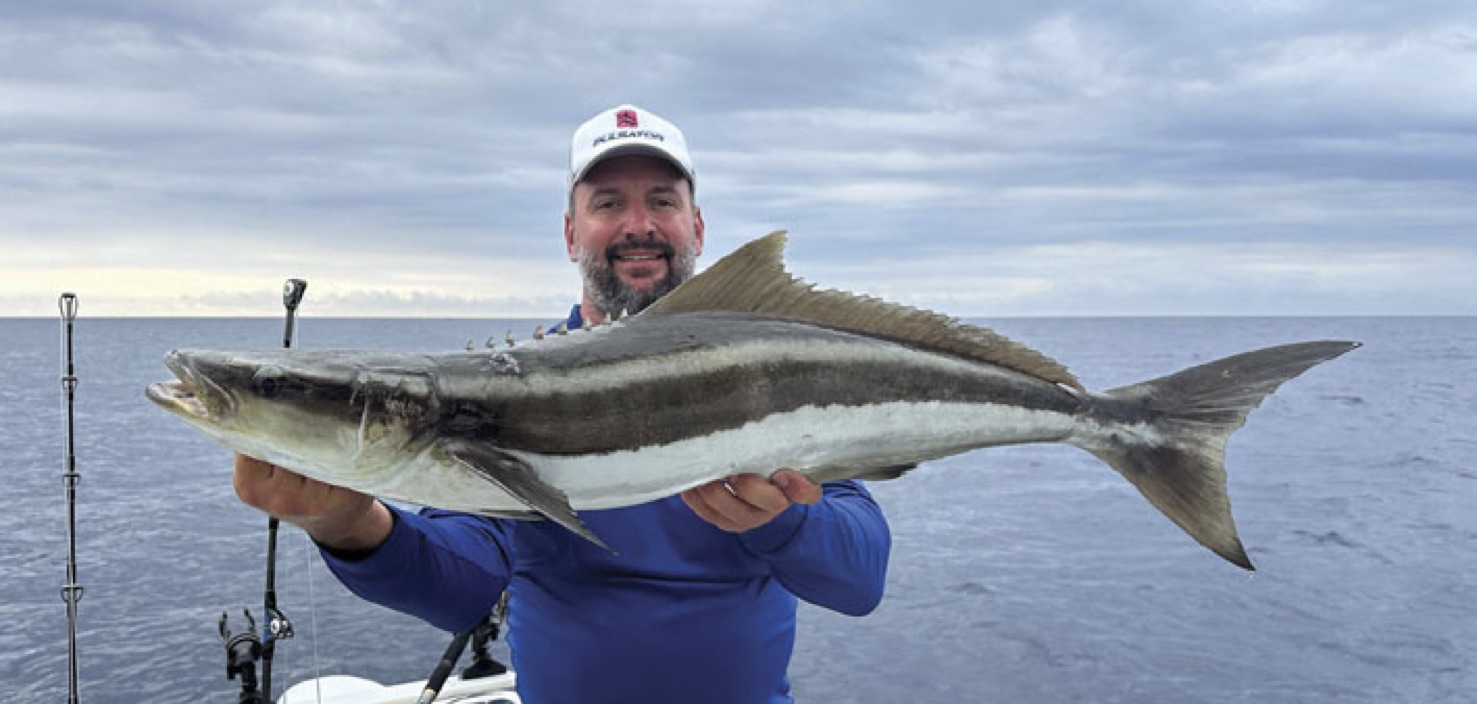
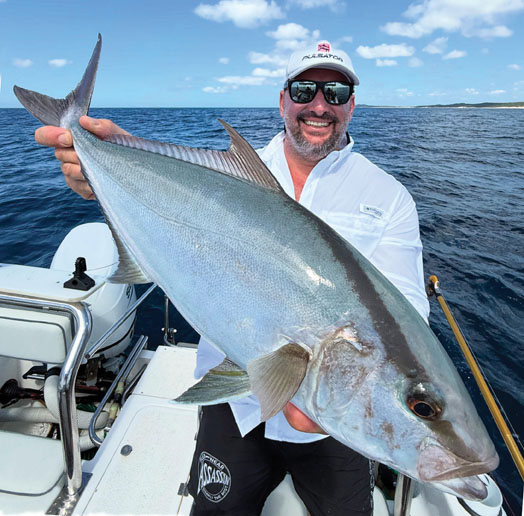
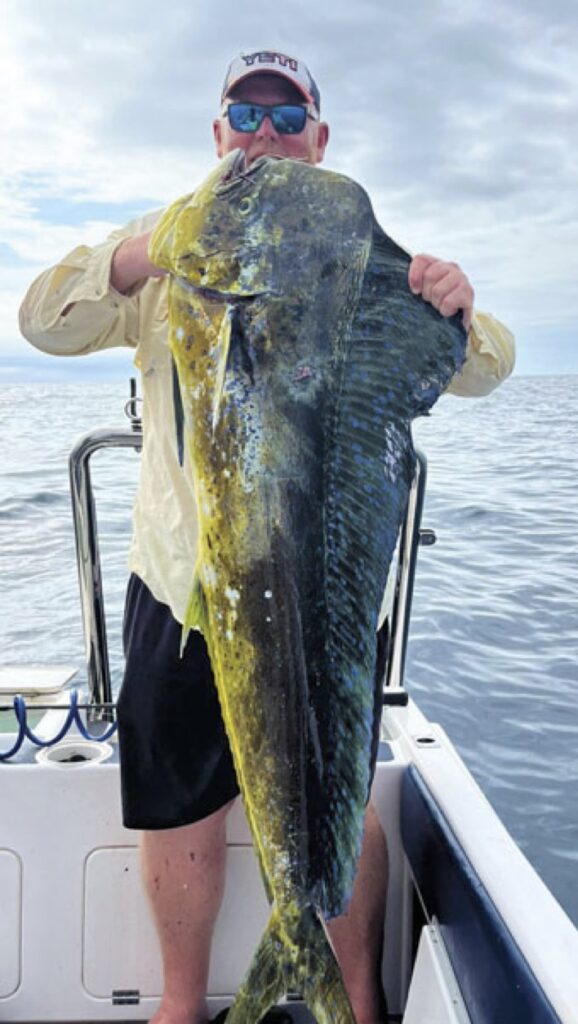
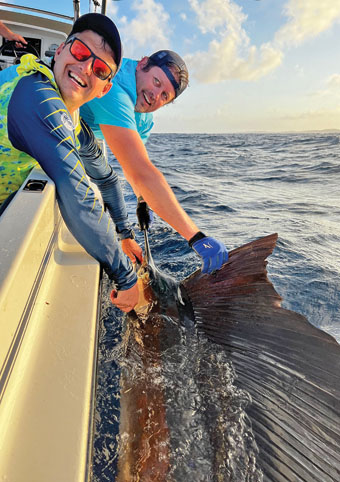
On the deeper reefs, you are mainly going to be looking to target wahoo, yellowfin tuna, sailfish, marlin, ’cuda, greater barracuda and GT’s. On the shallower reefs ’cuda, prodigal son and various kingfish species make up the majority of what’s targeted.
If you are not having luck with swimming a bonnie or other live bait, then it’s a good time to maybe pull some “plastic” around the pinnacles. Often a slight change in tactics results in a bite. It is not a hard and fast rule that a bonnie will always get a bite; very often you find the fish get triggered by a reaction bite created by a lure.
When we fish shallower, we tend to mostly target ’cuda, so our techniques focus mostly on slow trolling dead and livebaits while still casting poppers, stickbaits and dropshot/bucktail which are also very effective. Here we have found that the last bit of the pushing tide seems to be most productive as that’s when the fish move into the shallower waters to feed.
TACKLE
As the water is mostly very clean and visibility is good, we tend to fish fairly light. When we’re fishing with bonnies, it’s generally on 30–50 lb outfits with 60/80 lb leaders and No. 5/6 lead wires with heavier between the hooks. We usually use good quality size 2 treble hooks.
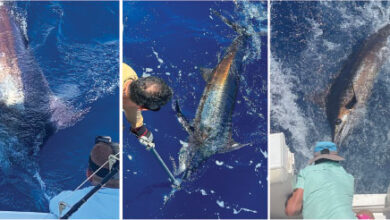
In this area black marlin often pick up our live bonnies, and it’s nice to then have a 50 lb setup for this with the assurance that you have quality tackle.
When we’re targeting ’cuda with dead- and livebaits, we mostly use 20/30 lb setups with 40/50 lb leaders and we go down to No. 3/4 wire.
When it comes to popping setups to target the brute GTs on these reef systems, we fish heavy and use 80/100 lb braid with heavy 100/120 lb leaders.
Before you target the gamefish, though, you need to stock up on bait. To catch bonnies, you need to outsmart them, and they can be very finicky. This calls for 10–20 lb fluorocarbon leaders and small bait presentations.
Catch up on previous articles in SKI-BOAT magazine written by the likes of Mark de la Hey and Justin Paynter on various bonnie rigs and ’cuda rigs as well as general techniques for targeting wahoo and ’cuda to get a refresher course on techniques and traces.
CONSERVATION AND ETHICS
As you fish this amazing stretch of ocean, you’ll notice that the further south you go on this section of coastline you will begin to catch a lot of fish which are usually an indication of an exceptionally healthy reef system that is not over fished.
In this line, you will get a lot of different jobfish, Bohar snapper, swallowtail rockcods, and the big old bucketmouth himself, Mr Potato Bass. Please treat these fish with the respect they deserve. These fish are super aggressive and it’s very evident that wherever there’s a lot of fishing pressure, they are the first to be missing in action.
It’s very much a gentleman’s agreement that we release all billfish, amberjacks, queenfish, GTs and other kingfish species caught in this area, so please adhere to that even if you’re just visiting.
As I said before, this area forms part of a marine reserve, so it is very important that we manage these resources carefully and do our small part to ensure they remain healthy. The local residents are very reliant on tourism for their livelihoods, and the more sustainable it is for them, the better it is for everyone.
If you don’t have your own boat and find yourself visiting Santa Maria, there are a few good charter boats to make use of, and some very knowledgeable guides who operate in the area.